Reading together
When people read Scripture together through an app, what do the others see, and who looks after the conversation?
Reading Scripture with others is one of the oldest ways of reading it. Two disciples on the road to Emmaus asked each other afterwards, “Were not our hearts burning within us as He spoke with us on the road and opened the Scriptures to us?” (Luke 24:32). Apps now offer the same passage on the same day, guides for a group, plans with friends, comments on every verse and feeds of what friends have read. Each decides what the others see of your reading, and who looks after the conversation. Most days, reading together is a gift. Some days someone falls behind, or a verse is turned against the person who has just shared. Design for both.
- 6 working options
- 6 app examples
- 7 takeaways
- Editorial review, not user-tested
The spectrum
From the same passage to everything shown
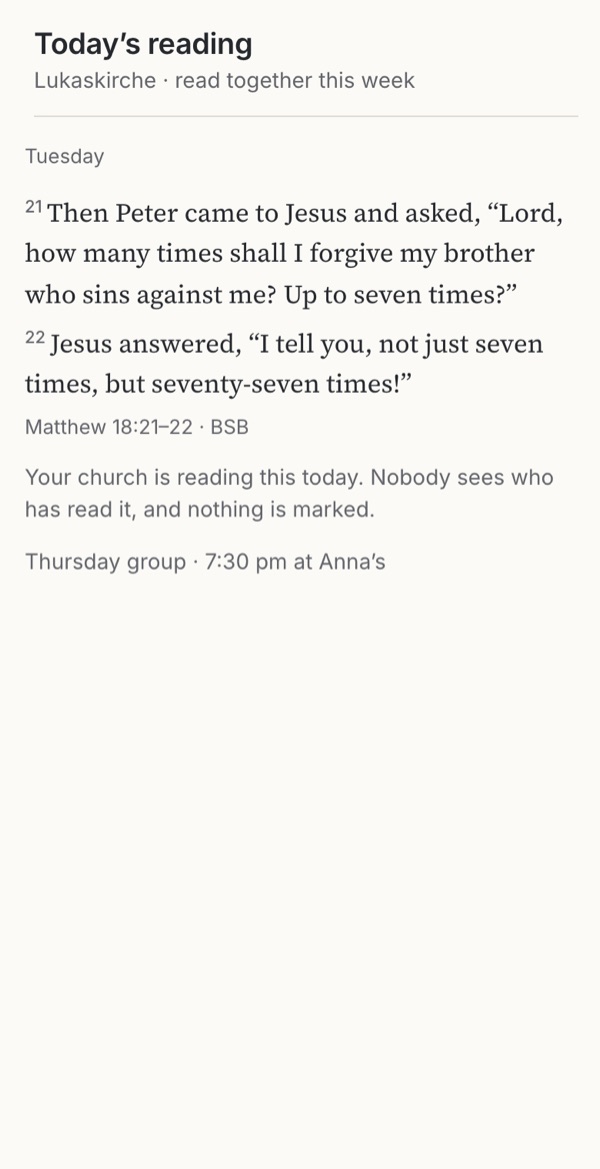 Familiar convention Nothing to compare or answer No one to talk it over withTry it →
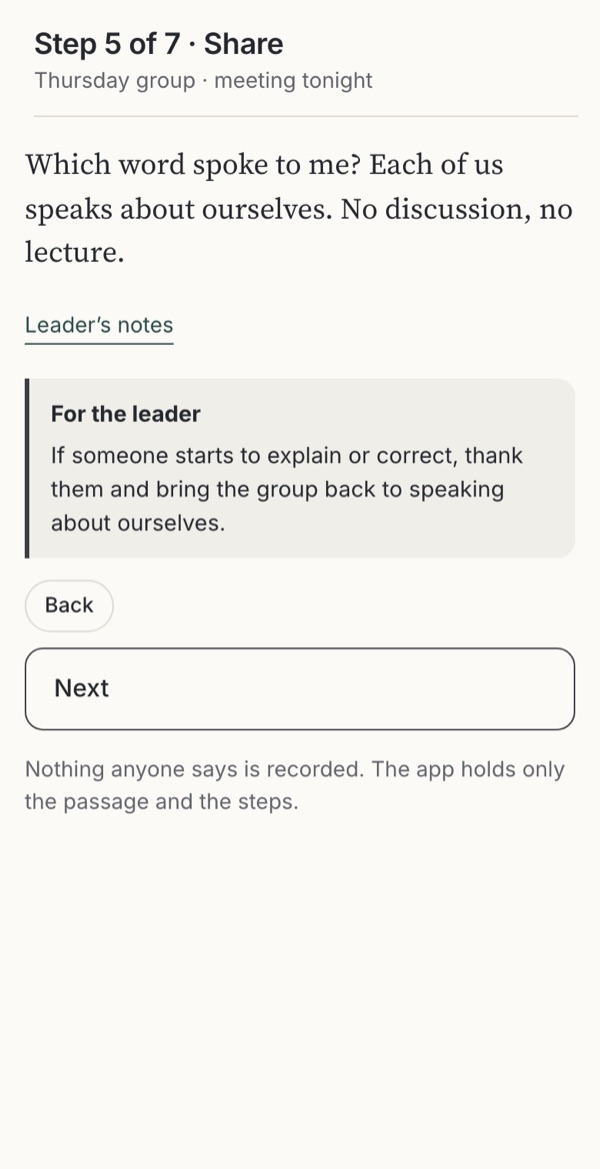 Borrowed Words stay in the room Needs people in one placeTry it →
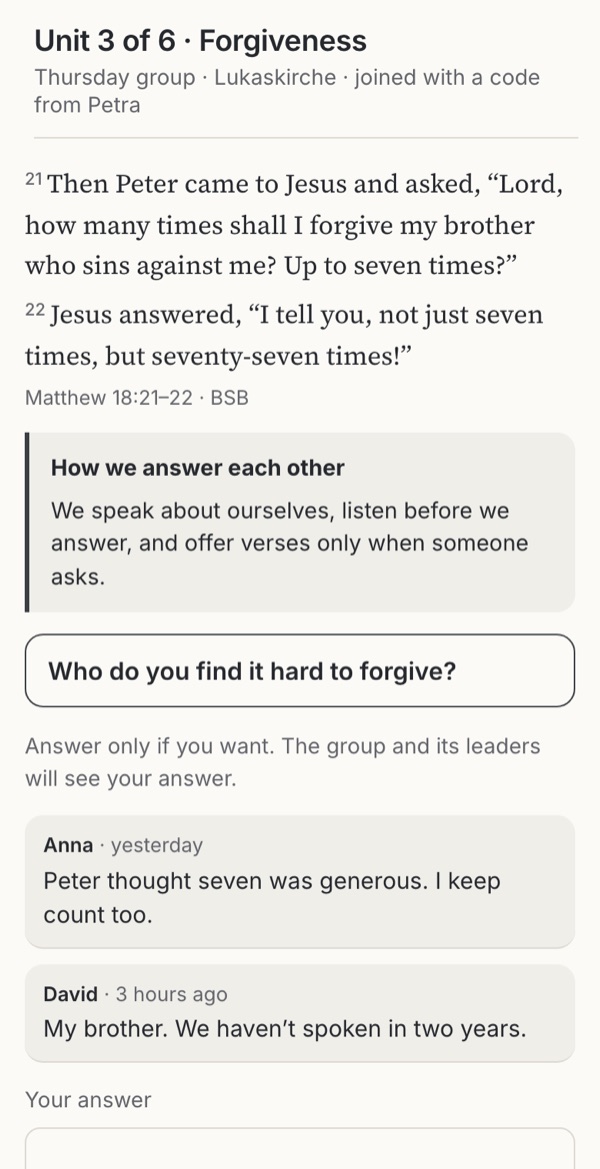 Observed Someone looks after the talk The leader sees who answersTry it →
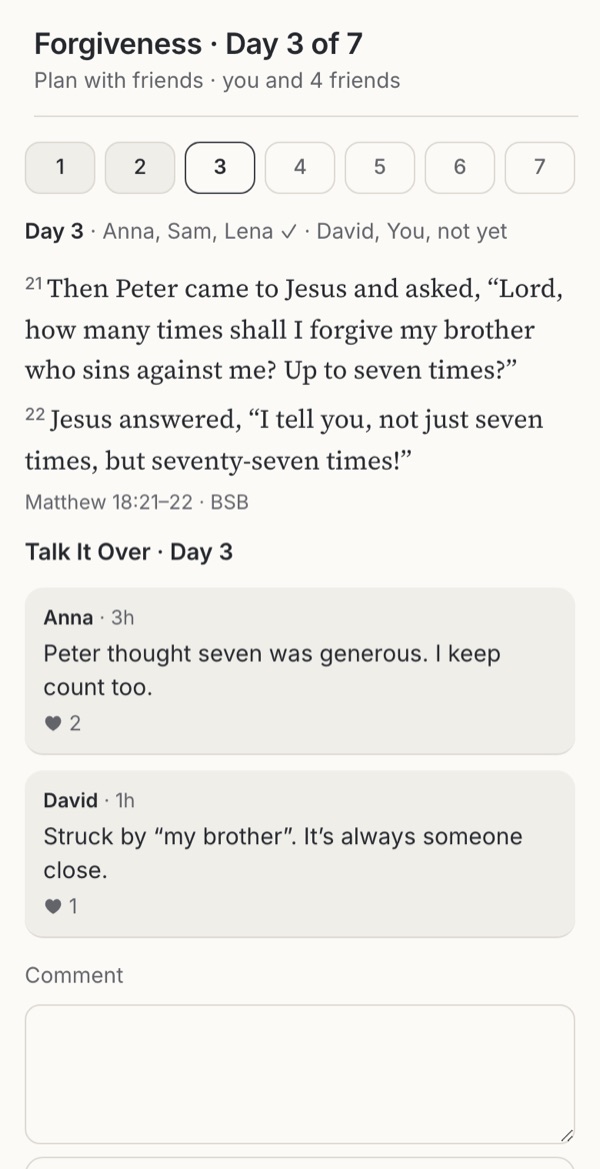 Observed Friends reading the same day Everyone sees who is behindTry it →
 Observed Friends’ reading in view Every completion is a signalTry it →
 Observed Many voices on a verse Strangers interpret for youTry it →
Stills from the working example below. Choose one to try it.
Try it
Try six ways to read a passage together
A small group is reading Matthew 18:21–22, where Peter asks how many times he must forgive. First try an ordinary day. Then fall four days behind and see what you, and the others, can see. Then read on as Lena shares that she is finding it hard to forgive someone who hurt her badly, and another member answers her with a verse. Notice what each person sees of the others, and who looks after the conversation.
Option
Why these settings?
On an ordinary day the group reads Matthew 18:21–22. When you fall behind, you are four days behind the others. In the hard situation Lena shares that she is finding it hard to forgive someone who hurt her badly, and another member answers with “seventy-seven times” and Matthew 6:15, as these passages have been used to press people to forgive quickly. A youth group adds two leaders to every conversation, no one-to-one messages, and a named safeguarding contact.
Familiar convention
1. The same passage, nothing shown
Familiar from shared daily texts: the Moravian Daily Texts, printed since 1731, lectionaries and a church’s own reading plan. Everyone reads the same words on the same day; nothing in the app shows who read. The church and its Thursday group are written for this example.
Try this
Read today’s passage. Then fall behind, and then try the hard situation.
Makes easier
Nobody is compared, and nobody can answer badly.
Costs
No one to talk it over with, unless the group meets.
Ask your teamWhere will people talk about what they read, if not here?
Borrowed
2. A guide for meeting in person
Borrowed from group practice outside apps: the seven steps of Bible sharing (the Lumko method), whose rule for sharing is “Keine Diskussion, kein Vortrag” (no discussion, no lecture), and the Västerås method’s marks for questions, insights and experiences. Not observed in an app. The steps are shortened, and the leader’s notes are written for this example.
Try this
Step through the evening. Switch to the hard situation at the Share step, then to a youth group.
Makes easier
What is said stays in the room, and the steps start with listening.
Costs
Needs people in one place, and a leader who follows the guide.
Ask your teamWhat does the guide tell a leader to do when a share goes wrong?
Observed
3. A group with a leader
Observed in Startblock, where people join a group with a code from their leader and work through units with a question banner; see the screenshots below. The leader’s replies, the group’s agreement and the safeguarding contact are proposals.
Try this
Answer the question, then fall behind and see where the group starts you. Try the hard situation, then a youth group.
Makes easier
Someone looks after the conversation, and the group is closed.
Costs
The leader sees who answers, and may be close to a concern.
Ask your teamWho looks after the group when the leader is part of the problem?
Observed
4. A plan with friends
Observed in YouVersion’s Plans with Friends: participants “see each other’s progress as you finish days” and talk in a “private discussion area”; only the host can invite people, and anyone who leaves cannot rejoin. See the screenshots below and YouVersion’s help centre. Names and comments are written for this example.
Try this
Open Talk It Over. Then fall behind and look at the ticks. Then try the hard situation.
Makes easier
Friends far apart reading the same day, with somewhere to talk.
Costs
Everyone sees who is behind, and no one is asked to look after the talk.
Ask your teamWhat does the friend who fell behind see when they open the plan?
Observed
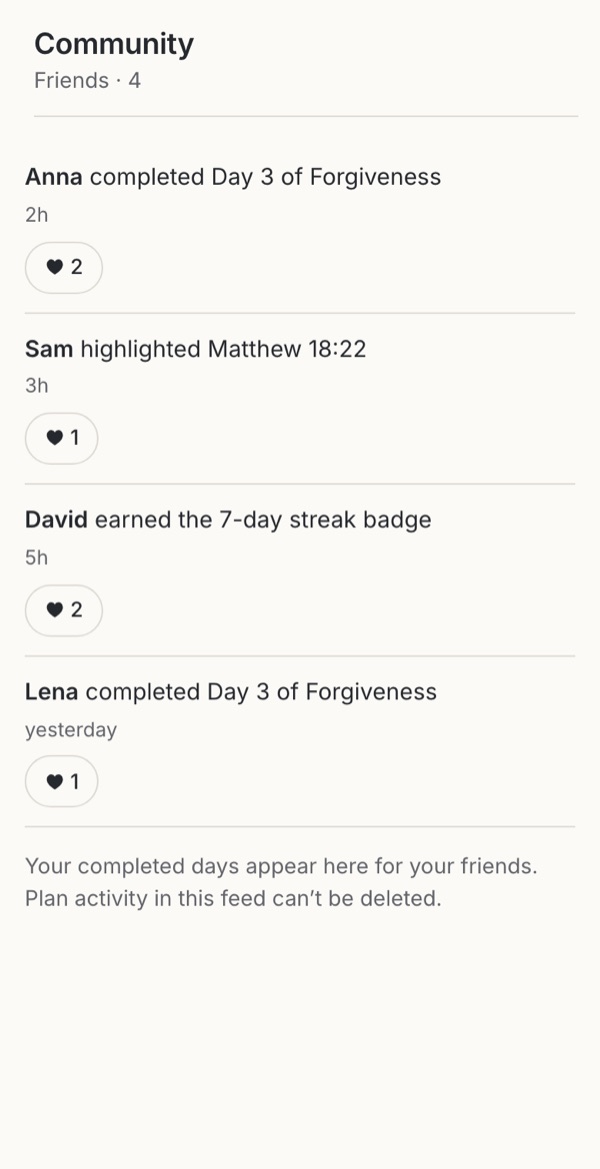
5. A feed of friends’ activity
Observed in YouVersion, where a plan set to Friends Only puts each completed day in friends’ Community Feed and “Plan activities on the Community Feed or your timeline cannot be deleted”, and in YouVersion’s profile, where badges and verse images are listed as activity; see the screenshots below. Names and entries are written for this example.
Try this
Scroll the feed. Then fall behind, and then try the hard situation.
Makes easier
Friends’ reading in view, as encouragement.
Costs
Every completed day becomes a signal, and absence shows too.
Ask your teamWould each friend choose to have this entry shown, today?
Observed
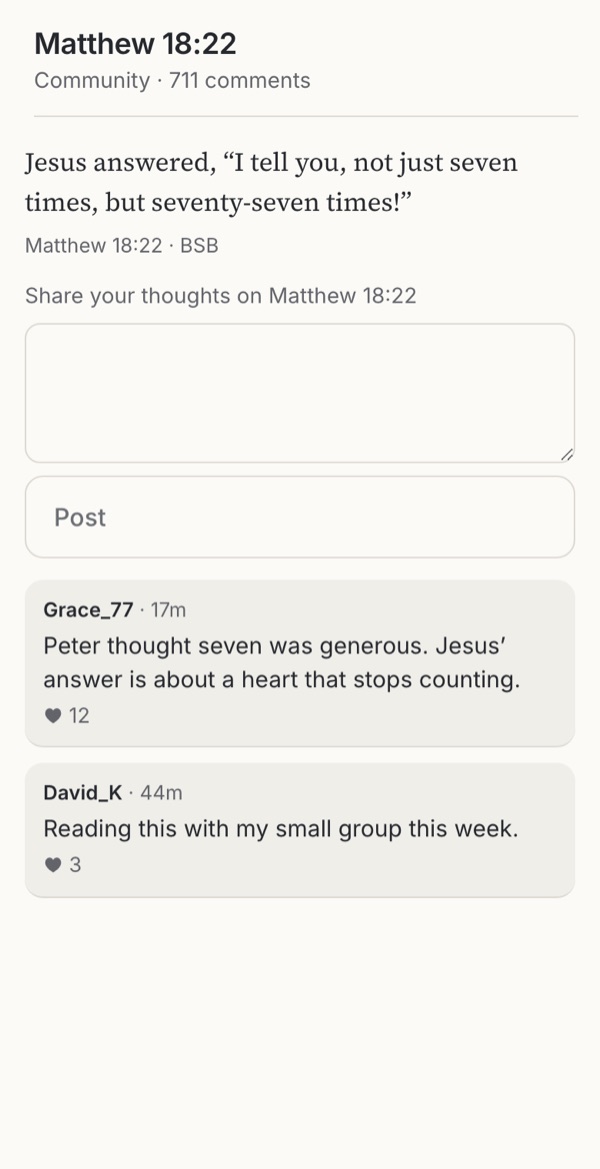
6. A public thread on the verse
Observed in Glorify, where a thread on a verse fills with comments from people across the app, and in YouVersion’s public notes from other readers on the same passage; see the screenshots below. Names and comments here are written for this example.
Try this
Read the comments, post your own, and try the hard situation.
Makes easier
Many voices on a verse, at any hour.
Costs
Strangers interpret the text, and answer people they don’t know.
Ask your teamWho reads these comments, and what happens when one is turned on someone?
What we noticed
Takeaways
Share the passage, not the record
A church can read the same words on the same day without anyone seeing who read; the Moravian Daily Texts have done it since 1731. Share the passage and the day, and keep each person’s completed days to themselves unless they choose to show them.
Say what others will see before the plan starts
In YouVersion, people in a plan with friends see each other’s completed days, and with Friends Only each day appears in friends’ feeds, where it “cannot be deleted”. Before anyone joins, show what participants and friends will see, and where. Let people delete it.
Falling behind should be a way back, not a signal
Ticks show the group who is behind, and YouVersion’s Catch Me Up isn’t available for plans with friends. Let someone rejoin where the group is today, mark nothing as missed, and remember that comparison motivates some people and discourages others.
Give the conversation a shape
Bible sharing asks each person to speak about themselves: “Keine Diskussion, kein Vortrag”. A prompt such as “Which word spoke to you?” invites a share; “What should we all learn from this?” invites a lecture. Carry the shapes groups already trust into the app, and let people answer only if they want.
A verse can be turned on the person who shared
When someone says they are struggling to forgive, a reply of “seventy-seven times” and Matthew 6:15 can press them to forgive quickly, keep quiet or go back. Groups can agree how they answer, and someone responsible needs to see the reply, step in and reach the person who shared.
When Scripture is used to harm →Young people: two leaders, no one-to-one, a named contact
Church safeguarding guidance keeps conversations with young people in the group, with two adults present. A youth group in an app can make that the rule, and name a safeguarding contact outside the group’s leadership, as the prayer request deep dive does.
Sharing with a group →Strangers’ notes are interpretation
Glorify’s thread on Jeremiah 17:6 and YouVersion’s related notes put other readers’ interpretations beside the verse. Label them as other people’s words, say who moderates them, and keep them a deliberate step away from the text.
Highlights and notes →
Use cases
Which situation, which option?
People come with different needs, sometimes in the same week. Each need fits some options better than others.
| Situation | Needs | 1 The same passage, nothing shown | 2 A guide for meeting in person | 3 A group with a leader | 4 A plan with friends | 5 A feed of friends’ activity | 6 A public thread on the verse |
|---|---|---|---|---|---|---|---|
| A house group that meets each week | Something to read before, and a shape for the evening | Possible | Good fit | Possible | Possible | Poor fit | Poor fit |
| Friends who live far apart | The same day, and somewhere to talk | Possible | Poor fit | Possible | Good fit | Possible | Poor fit |
| A youth or confirmation group | Two leaders, no one-to-one messages, a named contact | Possible | Good fit | Good fit | Poor fit | Poor fit | Poor fit |
| Someone who has fallen behind | A way back without being watched | Good fit | Good fit | Possible | Poor fit | Poor fit | Possible |
| A hard passage, or a hard week | People who listen before they answer | Poor fit | Good fit | Possible | Poor fit | Poor fit | Poor fit |
| Reading alone, with questions | Other voices, clearly not the text | Poor fit | Poor fit | Possible | Poor fit | Poor fit | Possible |
Editorial judgments drawing on the research below, not test results.
The research behind it
Theology, practice and science
Scripture and tradition
Reading in company
Hearts burning on the road
As two disciples “talked and deliberated, Jesus Himself came up and walked along with them” (Luke 24:15); afterwards they asked, “Were not our hearts burning within us as He spoke with us on the road and opened the Scriptures to us?” (Luke 24:32). The conversation was part of the reading.
Teaching and fellowship together
The first church “devoted themselves to the apostles’ teaching and to the fellowship, to the breaking of bread and to prayer” (Acts 2:42).
The same words on the same day
The Moravian Daily Texts were first printed in Herrnhut in 1731; since 1788 each day’s watchword has been drawn by lot from around 2,000 Old Testament texts. Christians across the world read the same words each day, and nobody counts who read them.
Church practice
Giving the conversation a shape
Share, don’t discuss
In the seven steps of Bible sharing, each person speaks about themselves in the first person: “Keine Diskussion, kein Vortrag”, no discussion and no lecture.
Questions, insights and experiences
The Västerås method invites everyone to mark verses with a question, an insight or an experience, and to share experiences without pressure. Its guide names the risks: some verses stay unclear, and some people talk too much.
Young people: in the group, not one to one
Church of England guidance recommends group calls rather than one-to-one calls with young people; one parish’s policy allows conversations with young people only in groups where at least two DBS-checked adults are present.
Church of England National Safeguarding TeamAll Saints Boyne Hill, Church of England parish
Products and research
What reading together shows
Plans with friends show progress
In YouVersion’s Plans with Friends, participants see each other’s completed days and talk in a private discussion area; up to 300 friends can be invited, only the host can invite, and anyone who leaves cannot rejoin.
Feeds keep what they show
With a plan set to Friends Only, each completed day appears in friends’ Community Feed, and YouVersion says these activities “cannot be deleted”.
Comparison helps some, not all
A review of physical activity apps found that comparison features give inconsistent results: they “may motivate PA for some people under some circumstances”. No figure we found shows that reading with friends helps people finish plans.
Danielle Arigo, Megan M. Brown, Kristen Pasko and Jerry SulsYouVersion blog
Groups matter to many people
In Lifeway Research’s survey of US Protestant churchgoers, those in a small group five or more times a month scored higher on a discipleship assessment than those in none. A correlation, not proof that groups cause growth.
Every source, with what it can and cannot show, is listed under Go further → Sources and their limits.
Where to start
Which fits your product?
IfA church or house group
Start withThe same passage, and a guide for meeting in person
IfFriends far apart
Start withA plan with friends: progress private by default, and a way to rejoin
IfA youth group
Start withTwo leaders, no one-to-one messages and a named safeguarding contact
IfComments on verses
Start withOthers’ words labelled, a step away from the text, with someone moderating
IfYou are tempted to show everyone’s progress
Start withDon’t: show the passage and the conversation, not the record
These are editorial judgments from design review, not results of user testing.
In real apps
Examples in use
Attributed screenshots with dates and review limits. A screenshot shows an implementation; it does not show that it works for every audience.
 Startblock · iOS app · German interface · device model not recorded
Joining a group with a code from the leader
User-contributed screenshot · resized, content unchanged
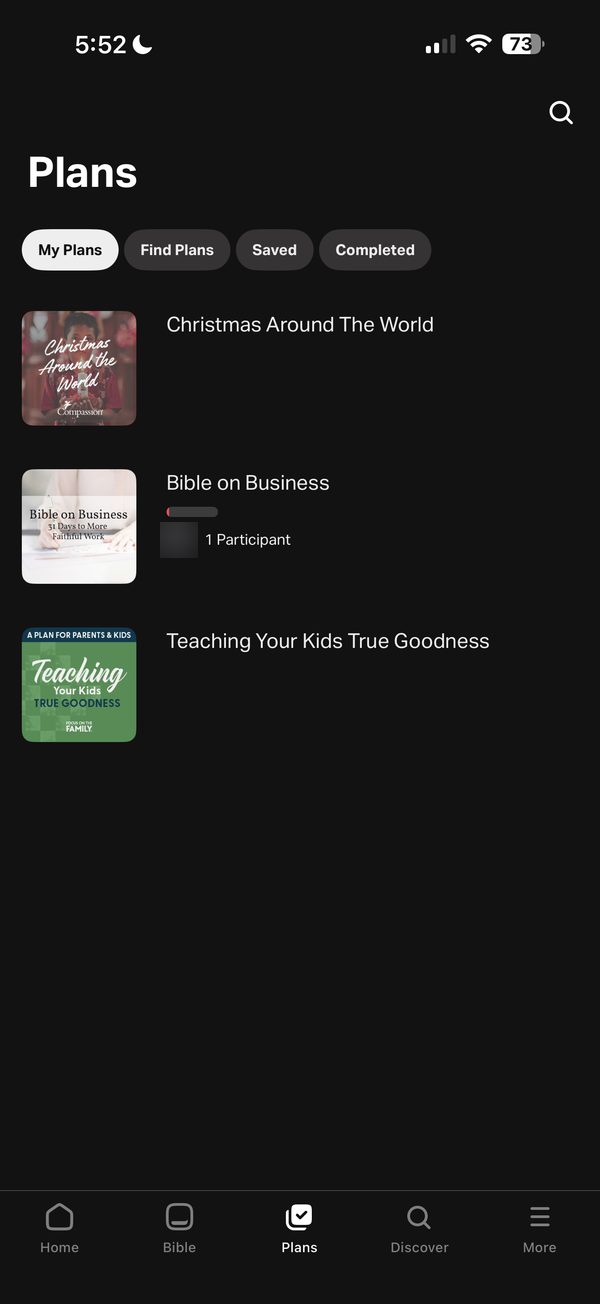 YouVersion · iOS app · device model not recorded
Progress and participants on each plan
User-contributed screenshot · resized, content unchanged
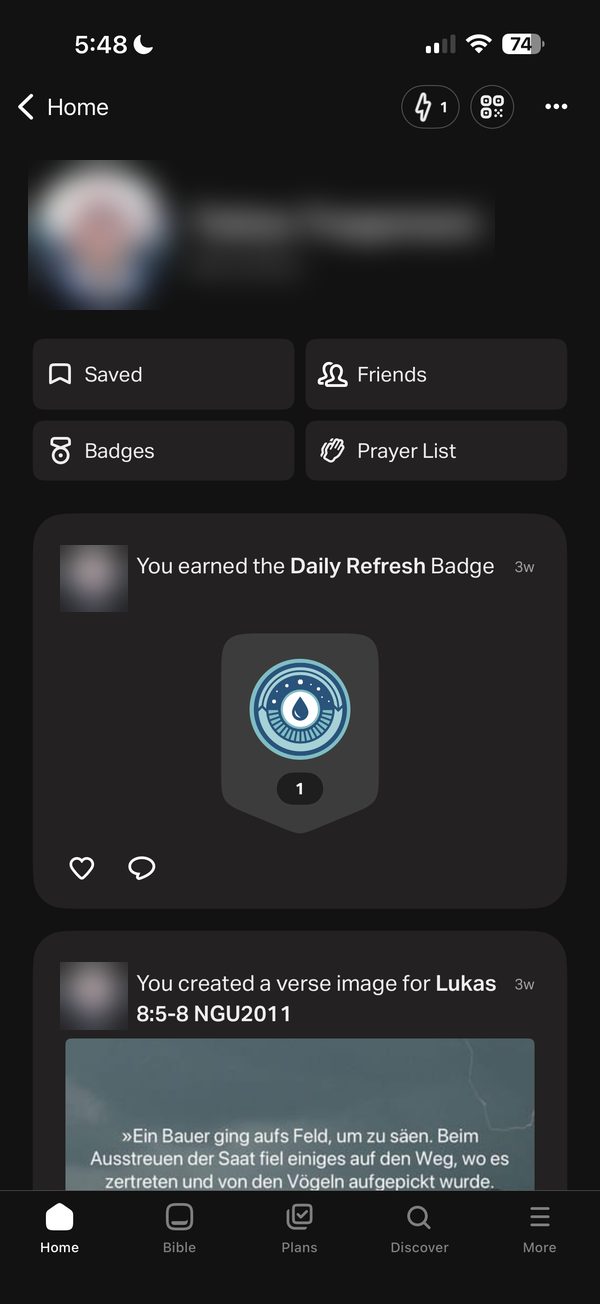 YouVersion · iOS app · device model not recorded
A profile that lists badges and verse images as activity
User-contributed screenshot · resized, content unchanged
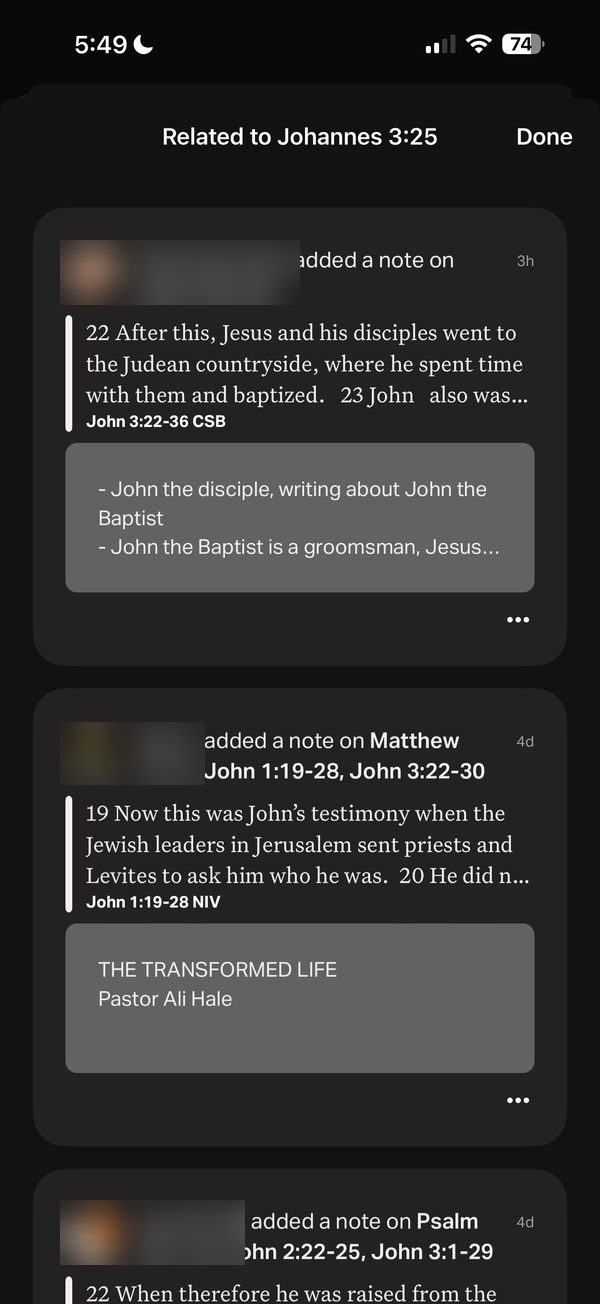 YouVersion · iOS app · device model not recorded
Other readers’ notes related to a verse
User-contributed screenshot · resized, content unchanged
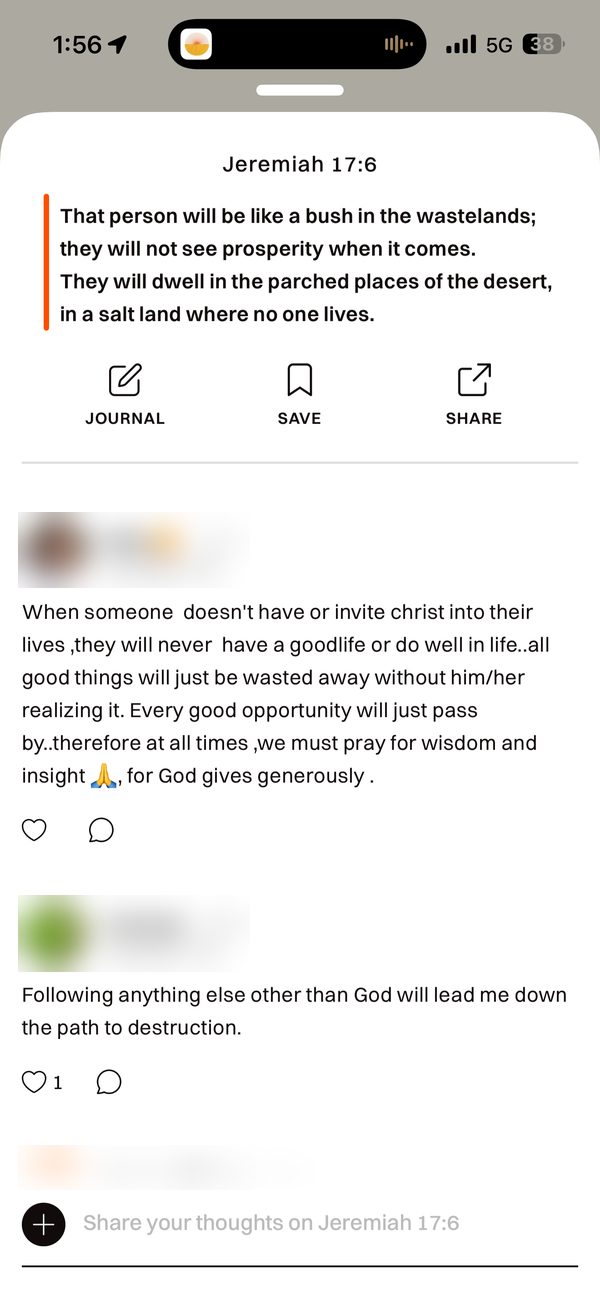 Glorify · iOS app · device model not recorded
A public thread under a verse
User-contributed screenshot · resized, content unchanged
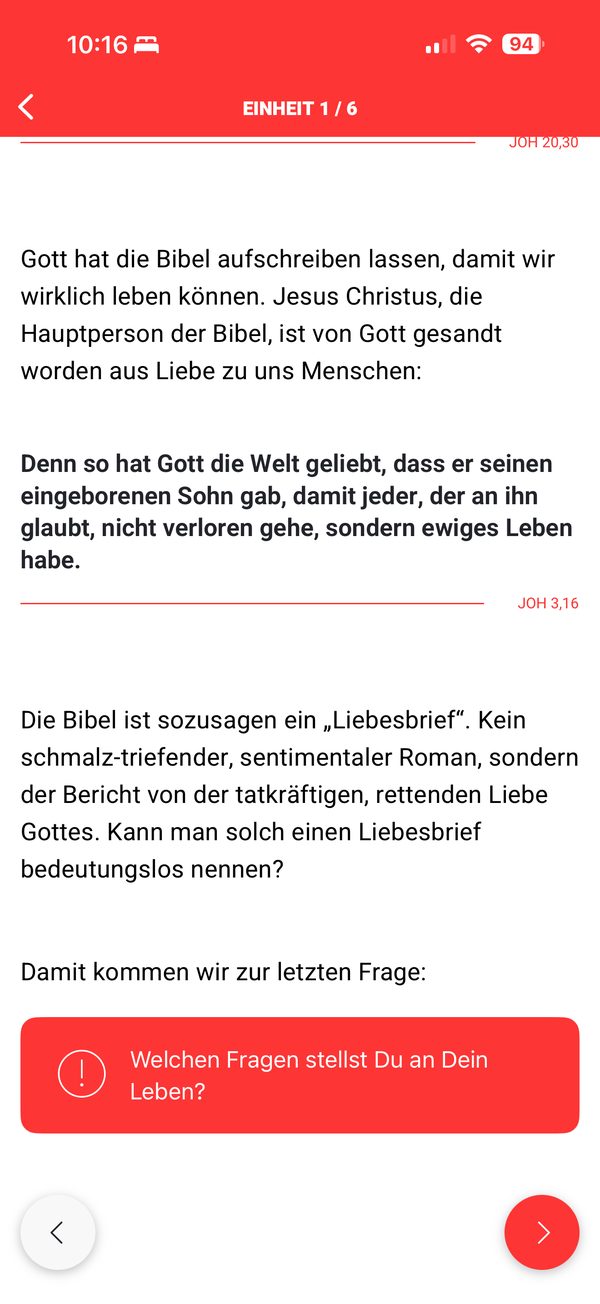 Startblock · iOS app · German interface · device model not recorded
A question for the group at the end of a unit
User-contributed screenshot · resized; other users’ names blurred
Theological reflection
What is this practice for?
What reading together is for
The disciples on the road to Emmaus “talked and deliberated” until Jesus walked with them and “opened the Scriptures” (Luke 24:15, 32). The first church devoted itself “to the apostles’ teaching and to the fellowship” (Acts 2:42). Others help us hear what we would miss, and a passage read together becomes something a community shares.
Where Christians differ
Liturgical churches read appointed texts on the same day, and Moravians have shared daily texts since 1731. Bible sharing, which began at the Lumko Pastoral Institute in South Africa and is used in German dioceses today, asks members not to discuss or correct each other; many evangelical small groups study a passage with a leader and questions. Traditions differ on who may interpret for others, and on how much a group should hear of each person’s life.
What follows for design
Share the passage and the conversation, not the record. Give the conversation a shape that starts with listening, name who looks after it, and prepare for a verse turned against someone. A completed day is between the reader and God unless they choose to show it.
In conversation with
- Dietrich Bonhoeffer, Life Together (1939) balanced “The Day with Others” and “The Day Alone”: “Only in the fellowship do we learn to be rightly alone and only in aloneness do we learn to live rightly in the fellowship.”
Scripture is quoted from the Berean Standard Bible. This reflection is the editor’s, written from within the Christian tradition and open to correction. How we approach theology here →
Three ways to build
What would each way do here?
ExploitativeTakes from the person
Show every friend’s ticks and streaks, fill feeds with each completed day, and nudge whoever falls behind.
EthicalDoes no harm
Say what others will see before a plan starts, let people delete their activity, and give a way back to anyone who fell behind.
RedemptiveGives something up for them
Keep each person’s record private and give up the engagement that visible progress brings; pay for someone to look after the conversation, and give groups shapes for listening instead of feeds.
The three ways are Praxis’s frame for redemptive entrepreneurship; their application here is ours. Why we use it, and its limits →
Take into your next review
What will each person see of the others’ reading, and who looks after the conversation when it goes wrong?
Exercise
Take one week of a group plan. For each person, list what the others will see: that they started, which days they finished, what they wrote, and what appears in anyone’s feed. Then write a reply that turns a verse against someone who shared something hard, and walk through your design: who sees it, who can step in, and how the person who shared is looked after.
Share the passage and the conversation, not the record, and make sure someone looks after what is said.
Record the decision with the worksheet →
Something missing or wrong here? Send a correction or suggest a topic.
Details
Go further
Edge cases to design for
Share the passage and the day, and keep each person’s record private unless they choose to show it. Say before a plan starts what participants and friends will see, and let people delete it. Let someone rejoin where the group is today. Give groups prompts that ask what touched each person, not what others should do. When a church or leader runs the group, name who looks after it, keep conversations with young people in the group, and name a safeguarding contact. Label others’ notes as theirs, say who moderates them, and keep them a step away from the text.
What tends to go wrong
Completion ticks for everyone in a group by default; friends’ feeds filled with each completed day that cannot be deleted; no way back for someone who fell behind except by catching up in view of everyone; strangers’ readings shown inside the verse; a verse quoted at someone who shared a hurt, with no one able to step in; leaders messaging young people one to one; badges and streaks in the same stream as the group’s conversation.
How to test it
Run a week of a group plan with five people. Ask each to list what the others can see of them, and where. Have one fall behind and watch what they see when they return. Post a reply that turns a verse against someone who shared, and time how long it takes for someone responsible to notice and reach the person. Check what a young person in the group can receive, and from whom.
Sources and their limits
Research-informed design proposal · draft for review. Editorial review, not user validation.
- iOS: Plan with FriendsArticle and FAQ reviewed 10 October 2026 · Publisher documentation for iOS; the interface was not tested end to end.
- iOS: Plan PrivacyArticle reviewed 10 October 2026; the Android article says the same · Publisher documentation; the default setting is not stated.
- iOS: Plan with Friends – CommentsArticle reviewed 10 October 2026 · The article does not describe reporting or moderation; it may exist elsewhere in the app.
- Announcing Plans with FriendsPost reviewed 10 October 2026 · A launch announcement; it gives reasons, not completion figures.
- Android: Catch Me UpScheduling and availability guidance reviewed 5 October 2026 · Documented behaviour; exact interface and discovery were not tested.
- A brief history of the Moravian Daily TextsArticle reviewed 10 October 2026 · A church’s own history of its publication.
- Anleitung BibelteilenLeaflet reviewed 10 October 2026 · One diocese’s leaflet; other versions have six steps or name them differently.
- Methoden praktischer BibelarbeitSection on the Västerås method reviewed 10 October 2026 · A practical guide, not a study of outcomes.
- Video calling: safeguarding questionsGuidance reviewed 10 October 2026 · Written for video calls during the pandemic; the principle comes from wider guidance.
- Guidance on use of social media and private messaging with young and vulnerable peopleGuidance reviewed 10 October 2026 · One parish’s policy applying diocesan guidance; German churches set their own rules.
- Social comparison features in physical activity promotion apps: scoping meta-reviewAbstract reviewed 10 October 2026 · A review of reviews about physical activity apps, not Bible reading.
- Small group participation linked to higher discipleship scoresArticle reviewed 10 October 2026 · A correlation from self-report; it does not show that groups cause growth. US Protestants only.
- Section 4.2: Spiritual AbuseOfficial indexed excerpts reviewed on 5 October 2026; direct page access returned 403 · Institutional safeguarding guidance, not universal law or an automated abuse classifier; full-page review remains outstanding.
- Process personal data lawfullyOfficial guidance reviewed · Specific lawful basis, retention and DPIA decisions require the actual data flows.
Faith and interpretation
Two disciples on the road to Emmaus “talked and deliberated” until Jesus “came up and walked along with them” (Luke 24:15), and afterwards asked each other, “Were not our hearts burning within us as He spoke with us on the road and opened the Scriptures to us?” (Luke 24:32). The first church “devoted themselves to the apostles’ teaching and to the fellowship” (Acts 2:42). Reading together is a gift, and the conversation needs tending: a verse can open the Scriptures to someone, or be turned against them.