Reading plans
What happens when someone misses days?
A reading plan decides what time means: a date to keep, a next step whenever the reader is ready, a number for the week, or the readings that belong to today. Life always interrupts, and the plan then decides whether coming back feels like a welcome or a bill. Decide what the plan asks of time, and what it says after days away. A plan is a gift to someone who wants to keep a rhythm; it should never become a debt.
- 5 working options
- 9 app examples
- 5 takeaways
- Editorial review, not user-tested
The spectrum
From shared dates to a day of its own
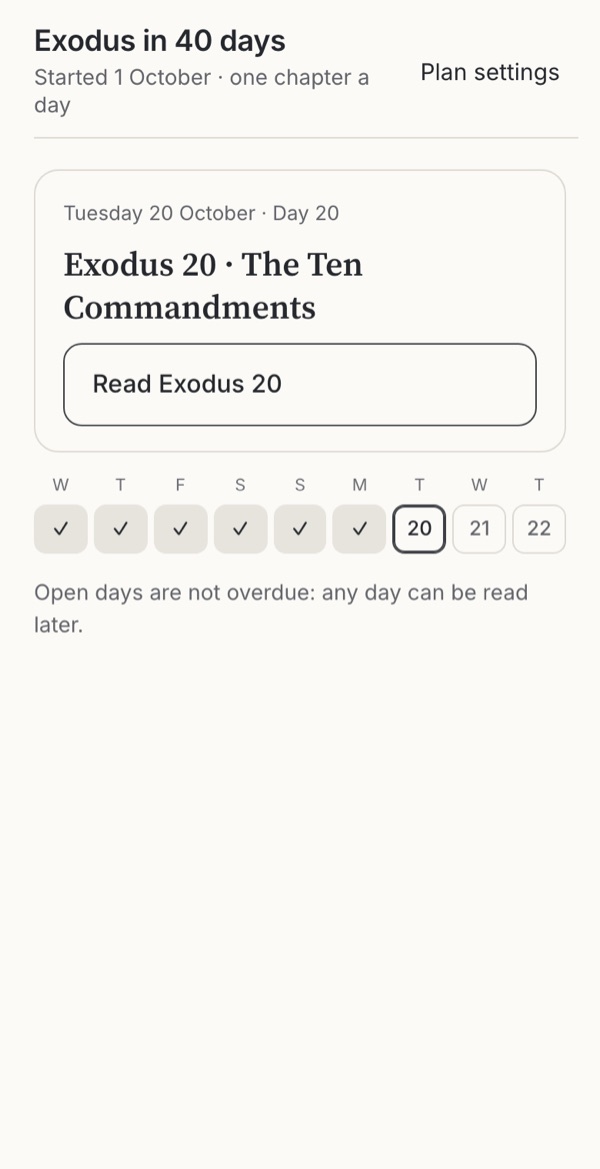 Observed Reading together on one day Days away become visibleTry it →
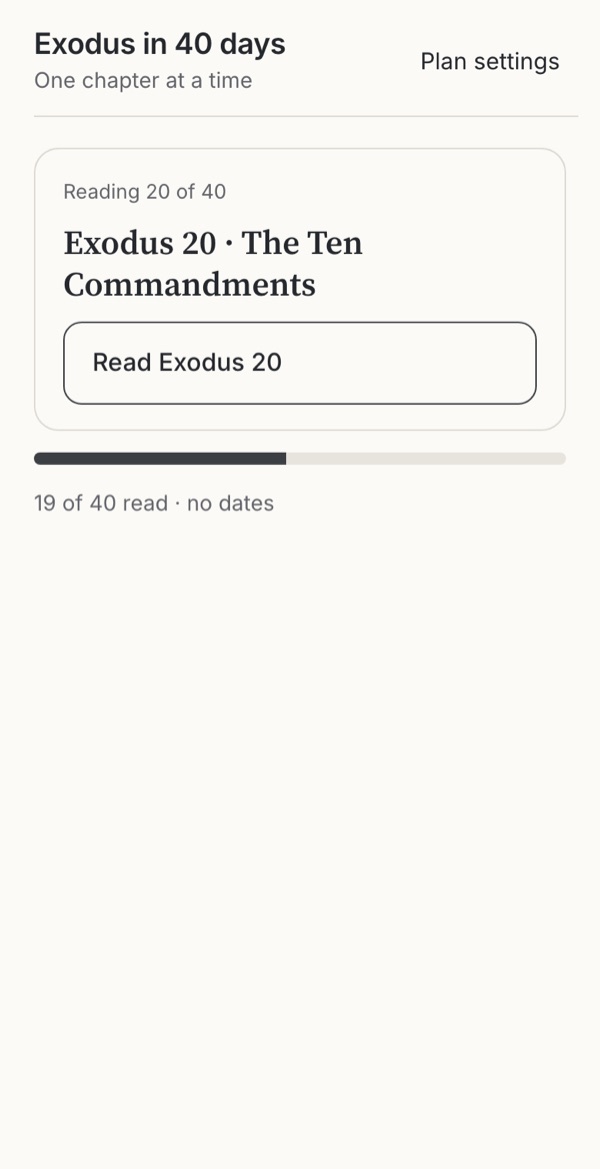 Observed Nothing is ever late No shared dayTry it →
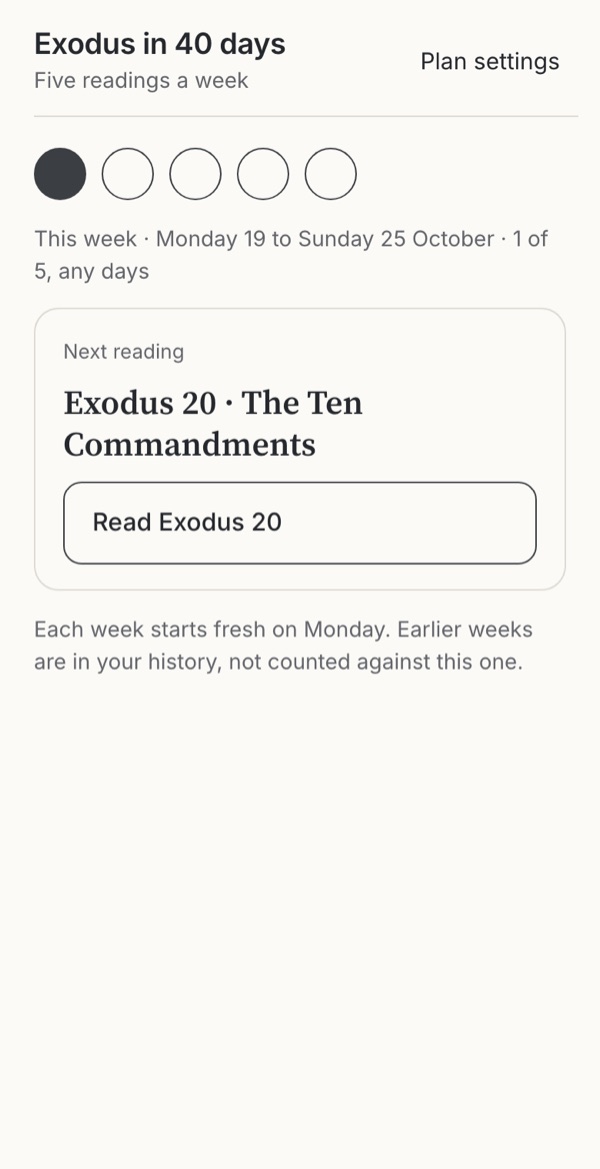 Familiar convention A fresh start every week Needs a sense of the weekTry it →
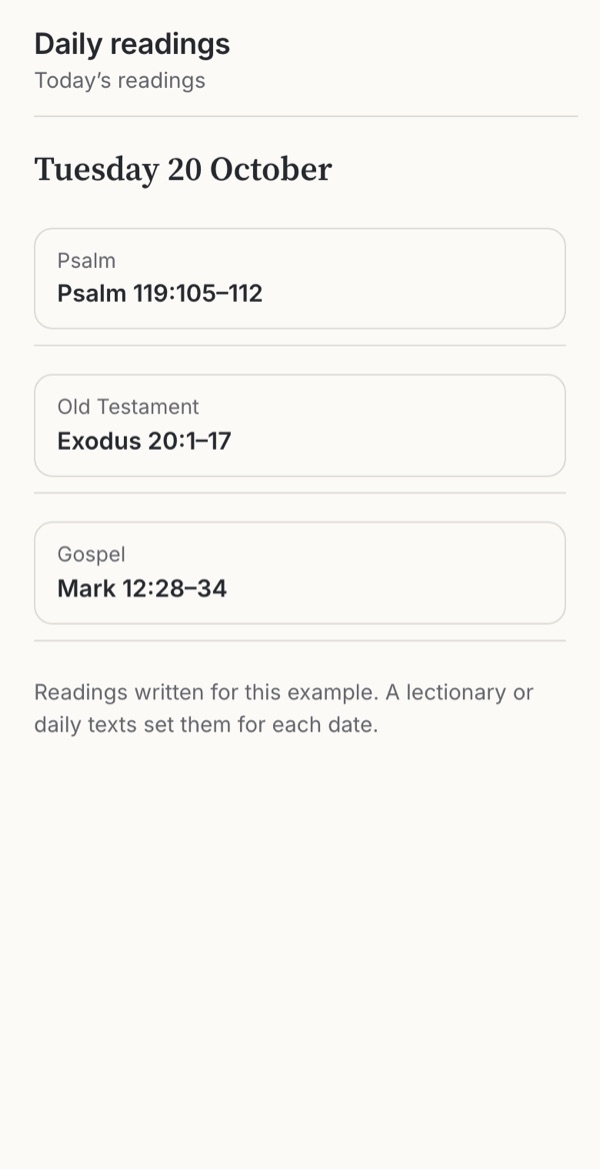 Familiar convention Nothing piles up No book to finishTry it →
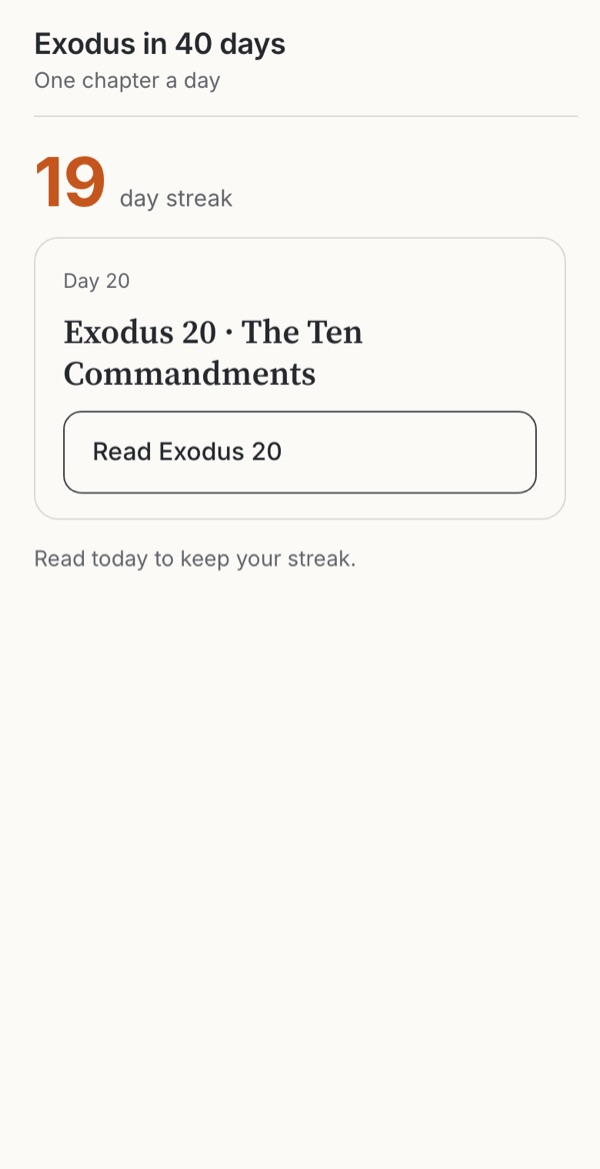 Observed Motivates while it lasts A missed day becomes a lossTry it →
Stills from the working example below. Choose one to try it.
Try it
Try five ways a plan can hold time
A plan through Exodus in 40 days, a chapter at a time. It is Tuesday 20 October, day 20. Each option holds time differently, from a dated plan to readings that belong to each day. Read today’s chapter, then switch the situation to “Back after nine days” and see what each plan says.
Option
Why these settings?
The reader last read Exodus 11 on Sunday 11 October. A dated plan offers three places to start and never says “behind”; open days stay unmarked. A sequence and a weekly rhythm simply continue. Daily readings have nothing to catch up. The streak shows what many apps do. With a group, each option shows how the reader relates to the group’s day, without showing anyone’s progress to others.
Observed
1. Dated plan
Observed in most Bible apps, where each plan day has a date. Bible.is offers “Change Start Date” and ESV “Read at My Own Pace”, and YouVersion documents “Catch Me Up”; see the screenshots below.
Try this
Come back after nine days and try each way to start. Then open Plan settings.
Makes easier
A shared day, so a church or group can read together.
Costs
Days away become visible, and a plan can turn into a debt.
Ask your teamWhen someone returns, does the plan offer a place to start, or a list of what they missed?
Observed
2. Sequence
Observed in Olive Tree’s “1 of 3 Complete | Next” bar, which moves to the next reading whenever the reader is ready; see the screenshot below.
Try this
Come back after nine days. Then turn the group on.
Makes easier
The plan waits; nothing is ever late.
Costs
No shared day: a group may be several chapters ahead.
Ask your teamIf people read together, how will they stay close without dates?
Familiar convention
3. Weekly rhythm
A familiar convention in five-day plans, which leave weekends for catching up. Here the week starts fresh each Monday.
Try this
Read today, then come back after nine days and look at the week.
Makes easier
Fits irregular lives; every Monday is a fresh start.
Costs
Readers need a sense of the week; a group still needs a meeting point.
Ask your teamDoes a new week truly start fresh, or does last week follow it?
Familiar convention
4. Daily readings
A familiar practice in daily offices, lectionaries and the Moravian daily texts, where each date has its own readings. The readings here were chosen for this example.
Try this
Come back after nine days. Look for anything you owe.
Makes easier
Nothing piles up; everyone reading today reads the same passages.
Costs
No book to finish; passages arrive out of their context.
Ask your teamIs today’s reading enough on its own, and can someone find their way into the whole book?
Observed
5. Streak
Observed in Abide, which shows a streak but lets people switch it off, and in many learning apps that sell streak repairs; see the screenshot below.
Try this
Come back after nine days and read the message.
Makes easier
A visible record that motivates some people while it lasts.
Costs
A missed day becomes a loss; people who feel they have failed often stop.
Ask your teamWhat does this count teach people about reading Scripture?
What we noticed
Takeaways
The plan’s author wanted readers free
Robert Murray M’Cheyne warned that his own calendar could become “a yoke too heavy to bear”, and told readers to “throw aside the fetter”. Benedict told anyone who found his weekly psalter unsatisfactory to arrange it better. Build that freedom in: pause, own pace and moving dates.
A missed day does not undo a habit
In a study of people forming new daily habits, missing one opportunity did not materially affect how automatic the habit became. A plan that treats a missed day as failure misreads how habits work.
Broken streaks drive people away
Across seven studies, showing people a broken streak reduced their later engagement, most when they blamed themselves. Shame tends to make people hide and withdraw, guilt to repair. Avoid counts and copy that make a reader feel they have failed.
Dates are for reading together
Shared dates let a church or group read the same passage on the same day. That is worth keeping for group plans, with open days left unmarked and a choice on return. For personal reading, a sequence or a weekly number that starts fresh each Monday removes the debt altogether, as ESV’s “Read at My Own Pace” begins to do.
Begin again on a landmark
People start goals after temporal landmarks: a new week, a new month. A plan can offer a fresh start on Monday, or simply today’s reading, without first listing what was missed.
Use cases
Which situation, which option?
People come with different needs, sometimes in the same week. Each need fits some options better than others.
| Situation | Needs | 1 Dated plan | 2 Sequence | 3 Weekly rhythm | 4 Daily readings | 5 Streak |
|---|---|---|---|---|---|---|
| A group reading together | Same passage, same day | Good fit | Poor fit | Possible | Good fit | Poor fit |
| Personal reading at any pace | Never late | Poor fit | Good fit | Possible | Possible | Poor fit |
| Shift work, small children, illness | Irregular days | Poor fit | Good fit | Good fit | Possible | Poor fit |
| Coming back after weeks away | A good place to start | Possible | Good fit | Good fit | Good fit | Poor fit |
| Finishing a book or the Bible | A whole to complete | Good fit | Good fit | Good fit | Poor fit | Possible |
| Daily prayer with the church | Today’s readings | Possible | Poor fit | Poor fit | Good fit | Poor fit |
Editorial judgments drawing on the research below, not test results.
The research behind it
Theology, practice and science
Tradition
Rules that served the reader
“Throw aside the fetter”
M’Cheyne’s four dangers of his own reading calendar.
Arrange whatever is better
Benedict’s weekly psalter, with freedom to rearrange it.
Readings that belong to the day
Daily texts and the daily office.
Discipline and grace
A chosen rhythm is not spiritual merit.
Psychology
Habits, streaks and shame
A missed day is not fatal
Habit automaticity grew despite a missed opportunity, on very different timelines for different people.
Broken streaks reduce engagement
Most when people blame themselves; less when the streak can be repaired.
Shame withdraws, guilt repairs
Moral emotions and what they lead people to do.
Fresh starts
Temporal landmarks prompt new beginnings.
Practice
How Bible apps handle it
Catch up without pretending
YouVersion’s “Catch Me Up” reschedules without marking readings complete, and is not available for plans with friends.
Every source, with what it can and cannot show, is listed under Go further → Sources and their limits.
Where to start
Which fits your product?
IfA church or group reads together
Start withA dated plan with open days unmarked and a choice on return
IfPeople read on their own, at their own pace
Start withA sequence that waits
IfLives are irregular
Start withA weekly number that starts fresh each Monday
IfThe practice is daily prayer
Start withReadings that belong to each day, with nothing to catch up
IfYou are tempted to add a streak
Start withAsk what it teaches; if you keep it, let people switch it off and never sell repairs
These are editorial judgments from design review, not results of user testing.
In real apps
Examples in use
Attributed screenshots with dates and review limits. A screenshot shows an implementation; it does not show that it works for every audience.
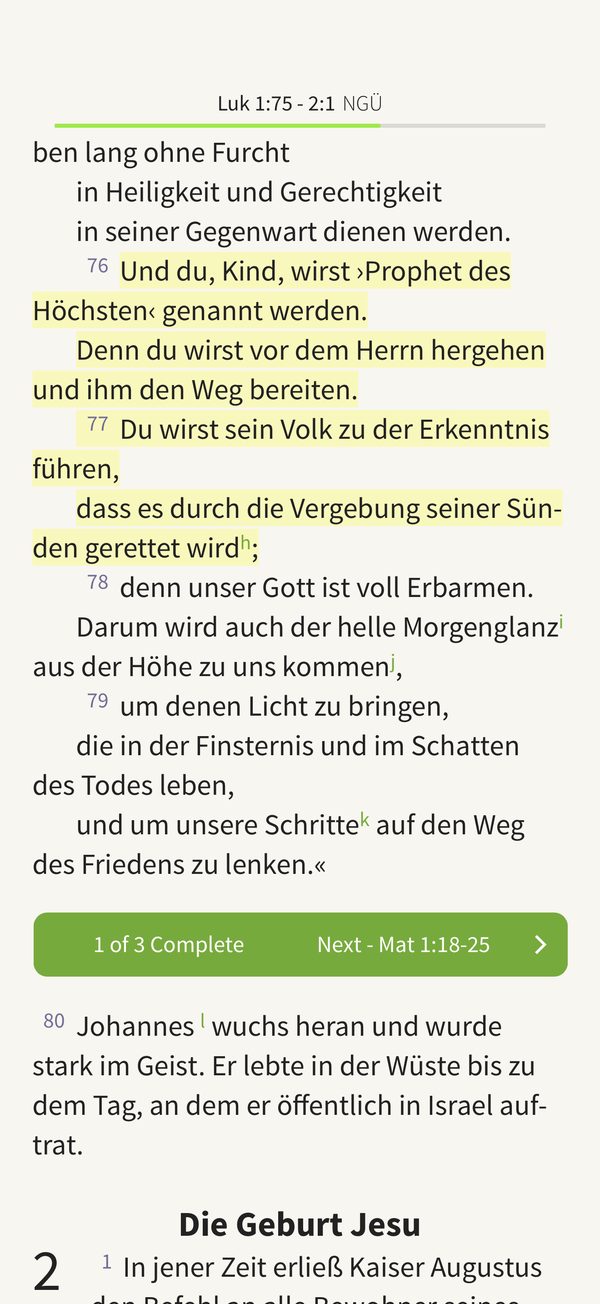 Olive Tree Bible · iOS app · device model not recorded
“1 of 3 Complete” and the next reading, inside the text
User-contributed screenshot · resized, content unchanged
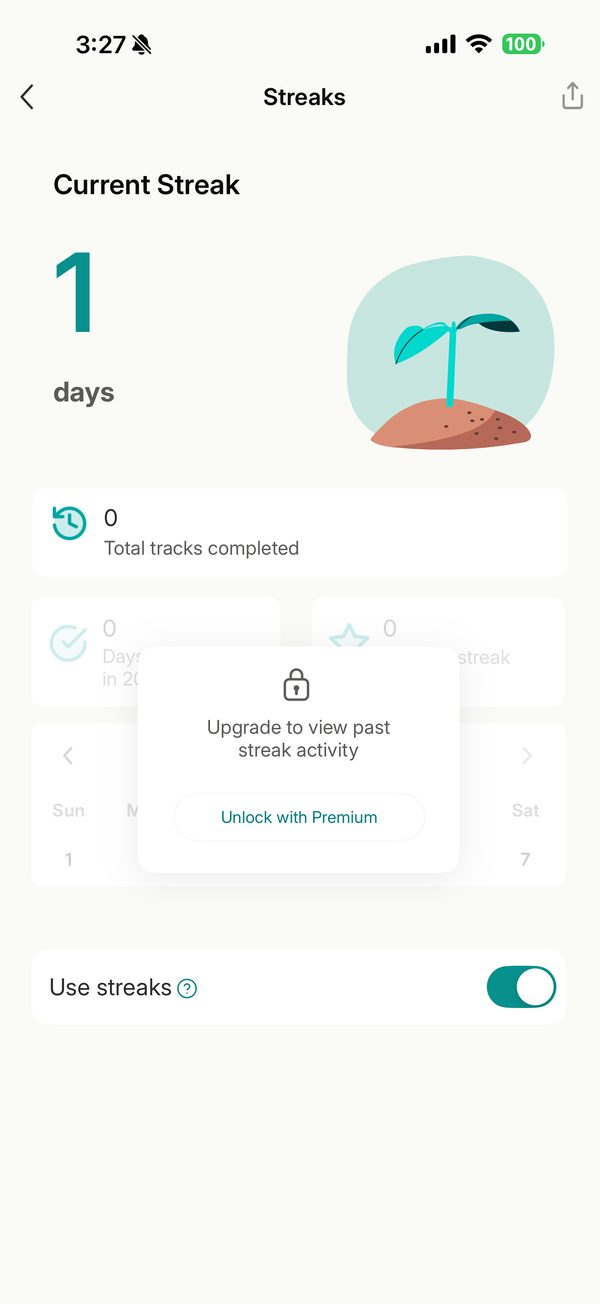 Abide · iOS app · device model not recorded
A streak you can switch off, with history behind Premium
User-contributed screenshot · resized, content unchanged
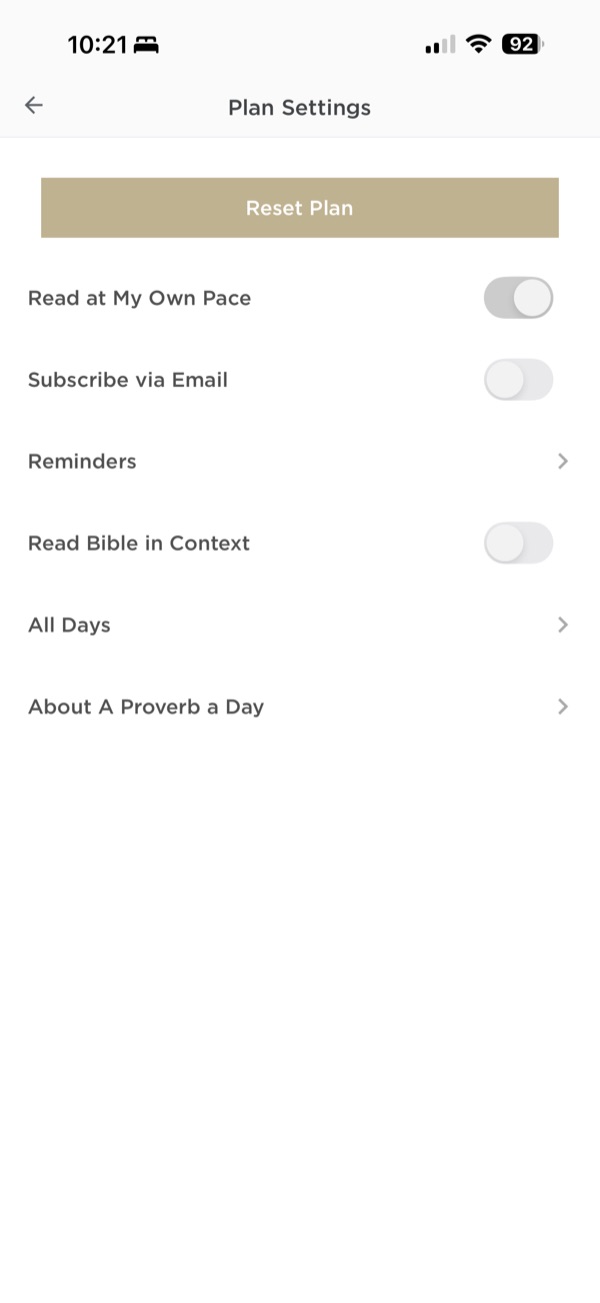 ESV Bible · iOS app · device model not recorded
Plan settings with “Read at My Own Pace”
User-contributed screenshot · resized, content unchanged
 Bible.is · iOS app · device model not recorded
Change the start date of a plan
User-contributed screenshot · resized, content unchanged
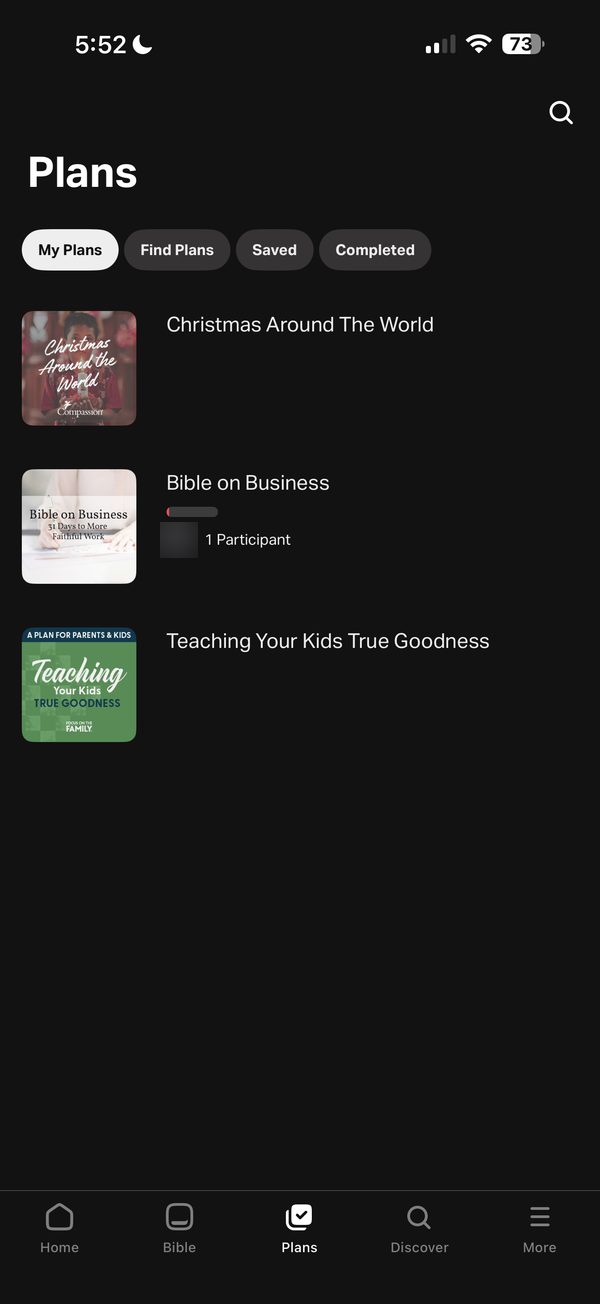 YouVersion · iOS app · device model not recorded
Progress and participants on each plan
User-contributed screenshot · resized, content unchanged
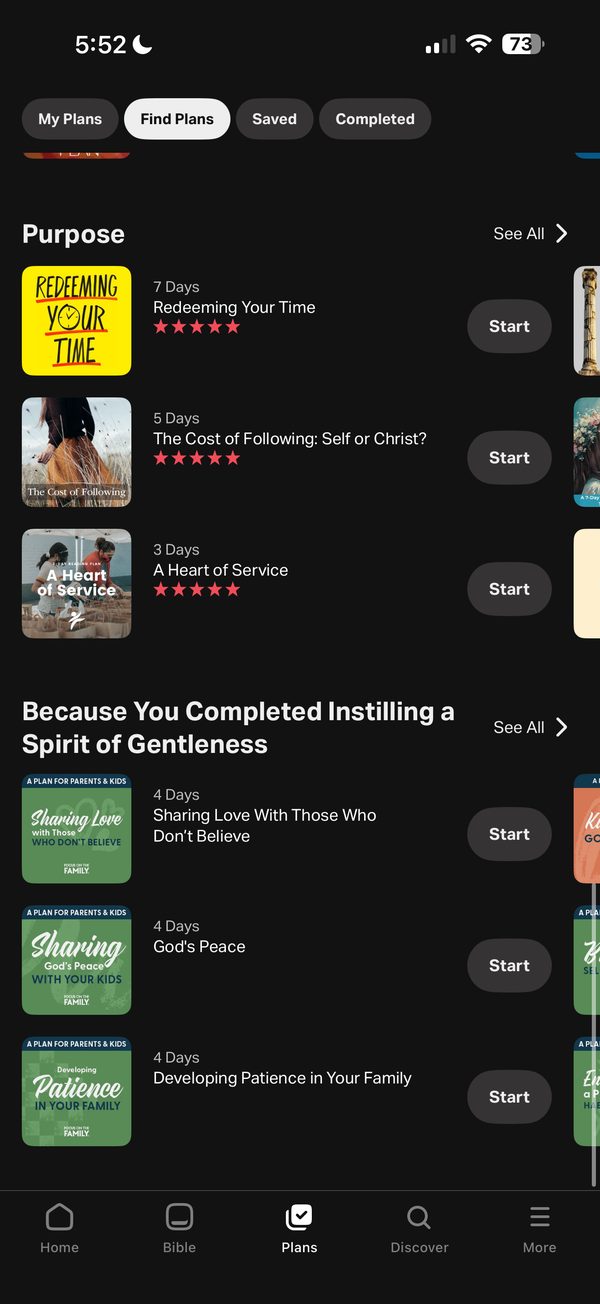 YouVersion · iOS app · device model not recorded
“A plan for parents & kids”
User-contributed screenshot · resized, content unchanged
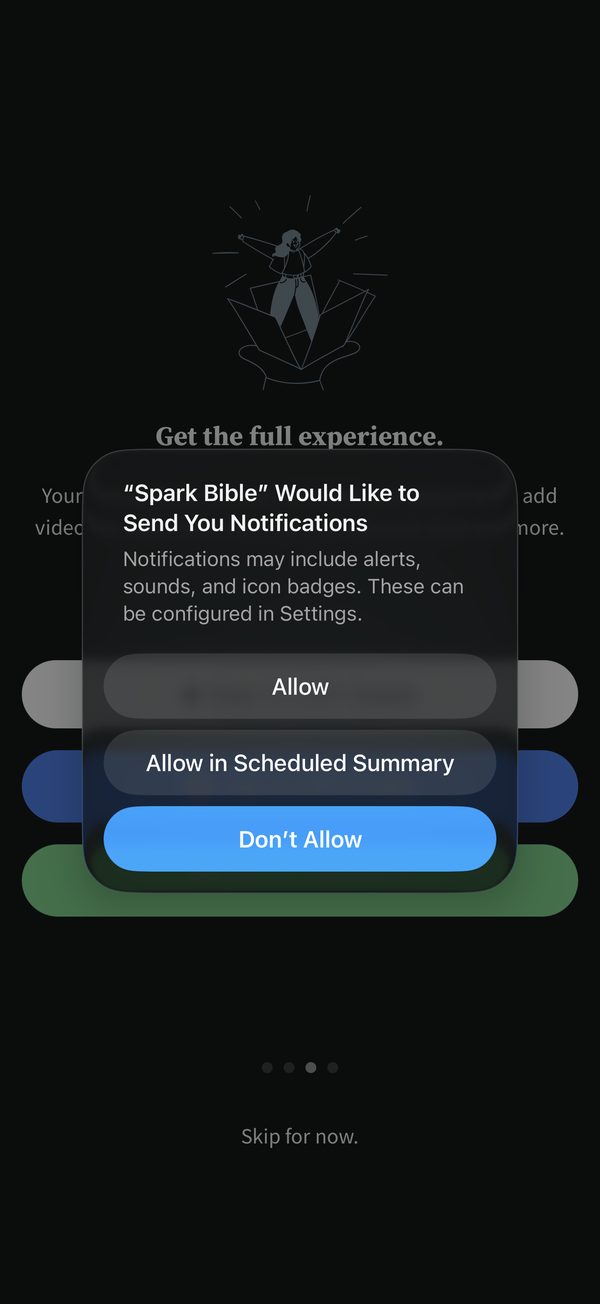 Spark Bible · iOS app · device model not recorded
A notification prompt before the first verse
User-contributed screenshot · resized, content unchanged
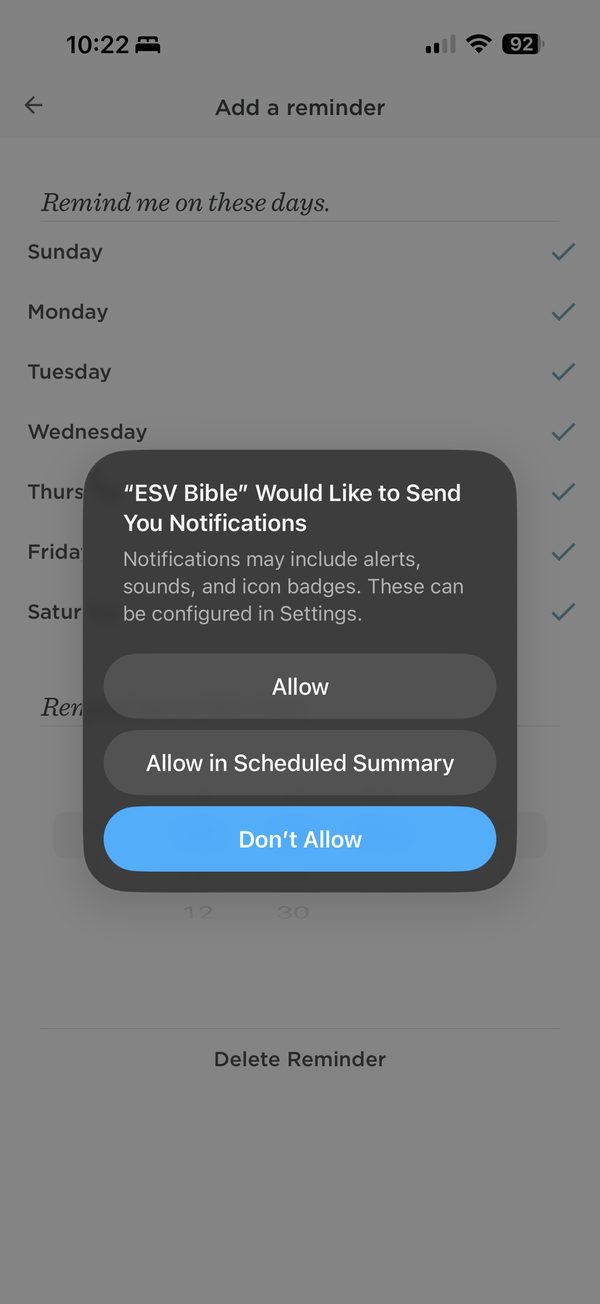 ESV Bible · iOS app · device model not recorded
Permission asked when a reminder is set
User-contributed screenshot · resized, content unchanged
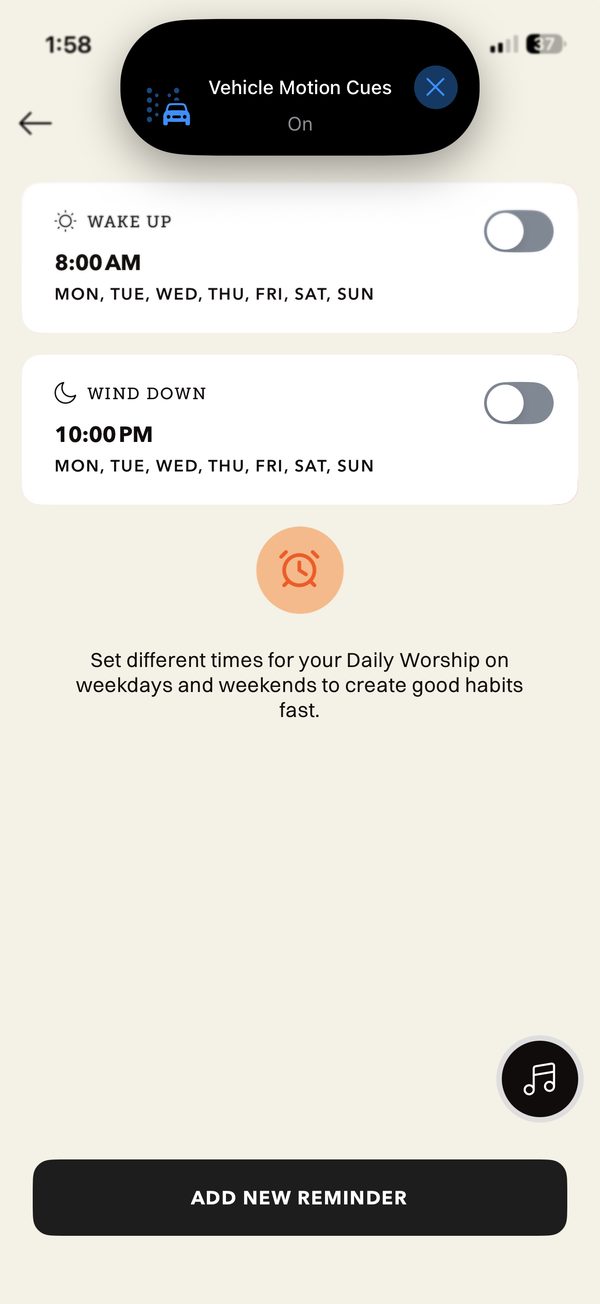 Glorify · iOS app · device model not recorded
“Wake up” and “Wind down” reminders
User-contributed screenshot · resized, content unchanged
Theological reflection
What is this practice for?
What a rhythm is for
“The Sabbath was made for man, not man for the Sabbath” (Mark 2:27). Daily offices, lectionaries and the Moravian daily texts give each day its words so that no one has to choose alone. God’s mercies are “new every morning” (Lamentations 3:22–23): a rule of reading exists to bring people back to that newness, not to measure them.
Where Christians differ
Liturgical churches read by a shared calendar, so a congregation hears the same texts on the same day. Many evangelicals favour personal plans, often reading through the whole Bible in a year. Some value discipline as a means of grace; others warn that a plan can become a law. Dallas Willard distinguished effort from earning: a chosen discipline is not merit.
What follows for design
M’Cheyne warned that his own calendar could become “a yoke too heavy to bear”. Design the plan so that coming back is grace, not debt: no streaks to lose, no reminders that escalate, and a welcome that offers today’s reading without a bill for the days missed.
In conversation with
- James K. A. Smith, You Are What You Love (2016) argues that habits are “liturgies” that train what we love; a streak is a small liturgy, and it teaches something about God and ourselves.
- Dallas Willard, “Spiritual Disciplines and Means of Grace” (2002) insisted that “grace is not opposed to effort, but to earning”: a plan is effort, never merit.
Scripture is quoted from the Berean Standard Bible. This reflection is the editor’s, written from within the Christian tradition and open to correction. How we approach theology here →
Three ways to build
What would each way do here?
ExploitativeTakes from the person
Streaks, paid streak repair and reminders that escalate after silence.
EthicalDoes no harm
No shame in the copy; let people pause, move dates and change pace.
RedemptiveGives something up for them
Let the plan wait and welcome people back owing nothing, giving up the retention a streak buys.
The three ways are Praxis’s frame for redemptive entrepreneurship; their application here is ours. Why we use it, and its limits →
Take into your next review
After nine days away, does the plan offer a good place to start, or a bill?
Exercise
Ask three people who abandoned a reading plan what the app said when they last opened it. Then show them each option after nine days away, and ask which one they would open tomorrow.
A plan should welcome someone back after a hard week, never send them a bill.
Record the decision with the worksheet →
Something missing or wrong here? Send a correction or suggest a topic.
Details
Go further
This deep dive brings together 2 earlier patterns. Their guidance, wireframes and sources are kept below; their old addresses lead here.
Edge cases to design for
Decide what the plan is for. For reading together, keep shared dates but treat open days as available, not overdue, and on return offer today’s reading, where they stopped, or moving their own dates. For personal reading, use a sequence that waits, or a weekly number that starts fresh. For daily texts, let each day stand on its own. Explain what each change will do before it happens, keep completed readings and notes, let people pause without reminders, and say nothing about absence beyond what helps them choose.
What tends to go wrong
“You are 9 days behind”; a catch-up list of every missed reading; streak counters on the home screen; streak repair for money or gems; reminders that escalate after silence; resetting the plan and erasing history; group dashboards that show who is behind; asking why someone was away.
How to test it
Ask people returning after a week, a month and a year what they would do next and how the screen makes them feel. Try each change (pause, move dates, own pace) and ask what will happen before confirming. Test with a group plan: can someone fall back without the group seeing it?
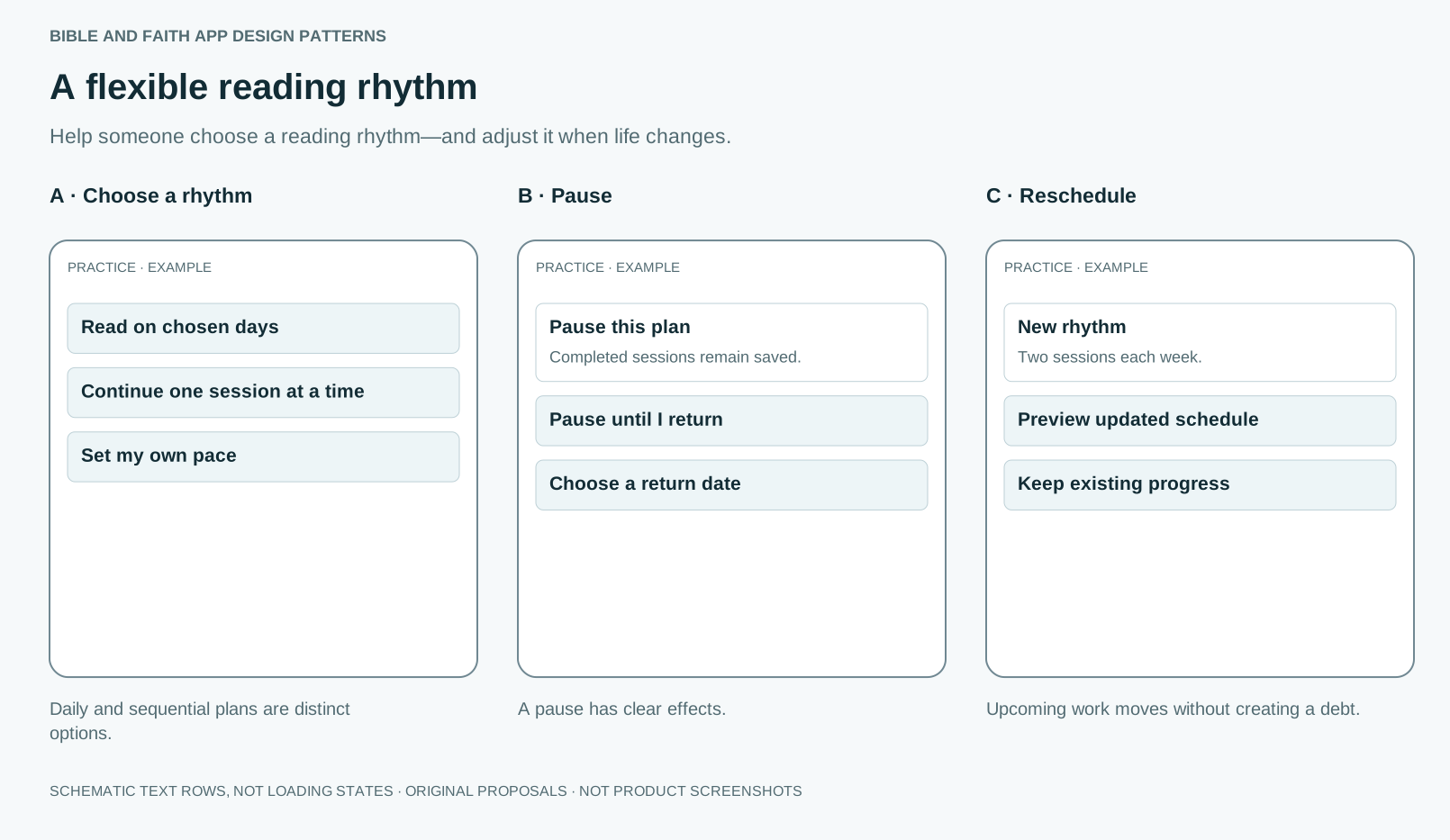
Earlier pattern: A flexible reading rhythm
Help someone choose a reading rhythm—and adjust it when life changes.
Guidance
Let the person choose between a dated plan and a sequence that waits for them. Offer reminders separately. Before pausing or moving dates, explain what will change and preserve completed sessions, notes and the saved place. For a group plan, distinguish a personal adjustment from a change to the shared calendar.
What tends to go wrong
Forced daily goals; erasing progress after rescheduling; presenting missed days as moral failures.
How to test it
Study real reading rhythms, including irregular and shared practice. Can users change pace without losing their place or feeling penalised?
Sources
- Digital Spiritual Formation research agendaSelected Kairos manuscript synthesis and continuing research agenda · Further studies require complete citations, methodological review and explicit limitations before their findings inform a pattern.
- Spiritual Disciplines and Means of Grace: Contrast or Continuum?Selected interview discussion of discipline, grace and context reviewed 5 October 2026 · A theological conversation containing disagreement, not empirical evidence of reading-plan effects.
- Android: Catch Me UpScheduling and availability guidance reviewed 5 October 2026 · Documented behaviour; exact interface and discovery were not tested.
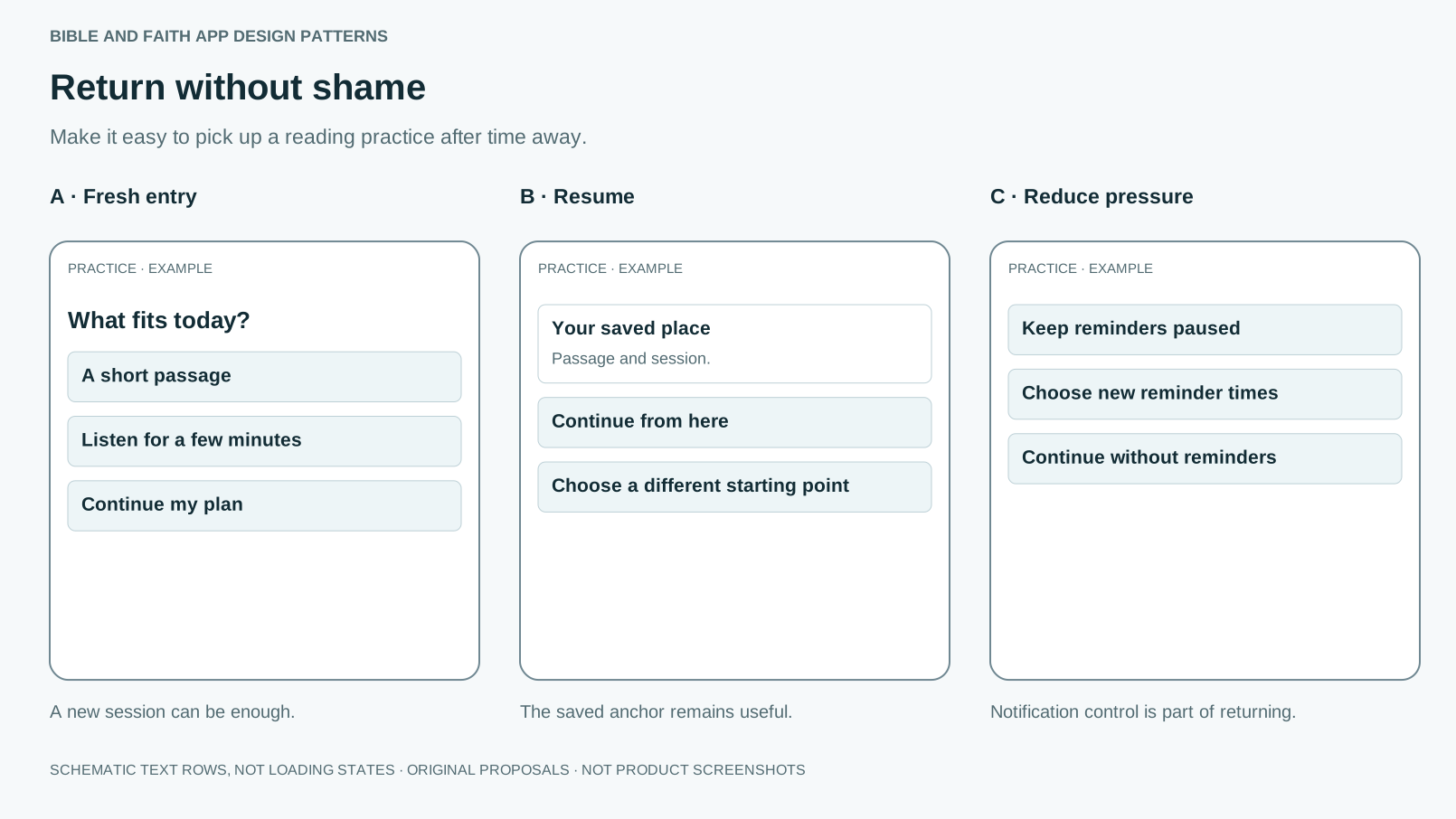
Earlier pattern: Return without shame
Make it easy to pick up a reading practice after time away.
Guidance
Show the saved place and a clear way to continue. In a dated plan, distinguish resuming from opening today’s reading. Make a different starting point available without erasing earlier work. Keep paused reminders paused unless the person chooses to restart them. A return should not require an explanation or a new commitment.
What tends to go wrong
A guilt message; demanding reasons for absence; “save your streak” payments; escalating reminder frequency after silence.
How to test it
Compare returning-user experiences through interviews and longitudinal observation. Does the welcome respect choice rather than merely increase opens?
Sources
- Digital Spiritual Formation research agendaSelected Kairos manuscript synthesis and continuing research agenda · Further studies require complete citations, methodological review and explicit limitations before their findings inform a pattern.
- The Cape Town Commitment: integrity and successPart II E.4 reviewed 5 October 2026 · Evangelical missional commitment, not a comparison of interface or funding-model effectiveness.
- Android: Catch Me UpScheduling and availability guidance reviewed 5 October 2026 · Documented behaviour; exact interface and discovery were not tested.
Sources and their limits
Research-informed design proposal. Editorial review, not user validation.
- Daily Bread: M’Cheyne’s calendar for daily readings, with his prefacePreface text reviewed · A pastor’s preface, not a study.
- The Rule of Benedict, chapter 18: the order for reciting the psalmsChapter reviewed · A monastic rule for a community, not individual readers.
- How are habits formed: Modelling habit formation in the real worldAbstract reviewed 5 October 2026 · Not a gamification study or a test of intrinsic motivation replacing incentives.
- On or off track: how (broken) streaks affect consumer decisionsAbstract reviewed · Consumer and lab studies; not Scripture reading.
- The fresh start effect: temporal landmarks motivate aspirational behaviorPaper reviewed · Archival field data on health and goals.
- Moral emotions and moral behaviorReview and abstract reviewed · General moral-emotion research, not app design.
- Improving the streakCompany experiment account reviewed 5 October 2026 · Company-reported results; not independent learning or formation evidence.
- Android: Catch Me UpScheduling and availability guidance reviewed 5 October 2026 · Documented behaviour; exact interface and discovery were not tested.
- Losungen: the Moravian Daily TextsFormat description reviewed 5 October 2026 · Format documentation, not comparative popularity or outcome evidence.
- Daily Prayer app and podcastOfficial search-index excerpts reviewed 5 October 2026; full-page fetch blocked · Documented overview only; no live app capture or exhaustive liturgical rules review.
- Spiritual Disciplines and Means of Grace: Contrast or Continuum?Selected interview discussion of discipline, grace and context reviewed 5 October 2026 · A theological conversation containing disagreement, not empirical evidence of reading-plan effects.
Faith and interpretation
Christians have long read Scripture by rule and by calendar: the daily office, lectionaries and the Moravian watchwords give each day its texts. Rules served the reader. Benedict asked that the whole psalter be prayed each week, yet told anyone who found his arrangement unsatisfactory to arrange whatever he judged better. Robert Murray M’Cheyne, whose 1842 calendar is still widely used, warned that it might become “a yoke too heavy to bear”: “throw aside the fetter, and feed at liberty in the sweet garden of God.” His mercies are “new every morning” (Lamentations 3:22–23); a plan should be too.