Giving and offerings
How should a faith app ask for gifts, and what should it never promise?
“Each one should give what he has decided in his heart to give, not out of regret or compulsion. For God loves a cheerful giver” (2 Corinthians 9:7). Giving is worship, and it pays for churches, missions and the apps people pray with. More of it now happens on a phone: in a church’s app, through a QR code during the service, or with a Give button in a Bible app. The design decides what is chosen for the giver, where the ask appears and what a gift is said to do. Most people who give through an app want it to be simple and safe. Design also for the person who is short of money this month, and for the one who has just told the app about their grief.
- 7 working options
- 12 app examples
- 7 takeaways
- Editorial review, not user-tested
The spectrum
From the giver’s choice to the app’s
 Familiar convention Nothing asked in the app Nothing pays for the appTry it →
 Observed There when wanted Easy to missTry it →
 Observed To their own church, by fund Fees and recordsTry it →
 Observed Steady, chosen support Easy to forgetTry it →
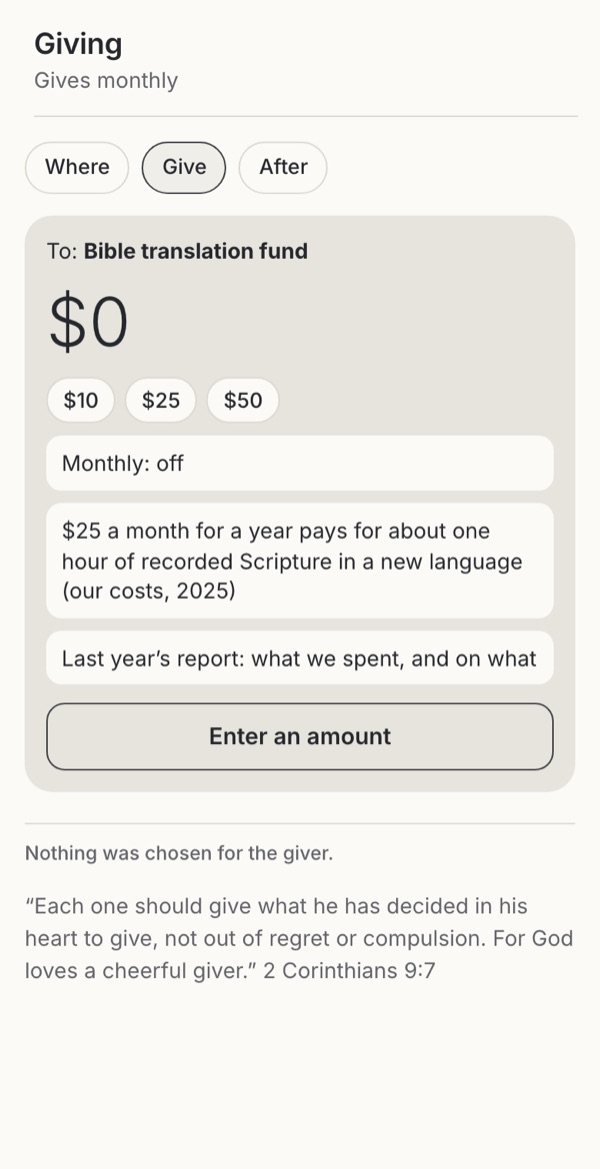 Observed Shows where it goes Figures age and overpromiseTry it →
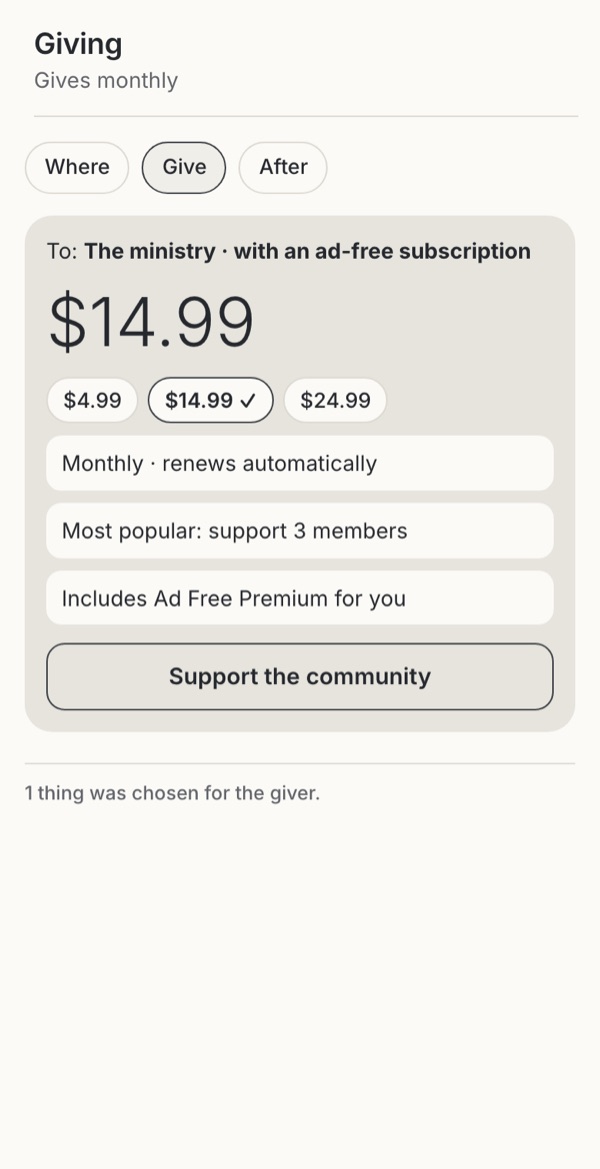 Observed Supports others too A price dressed as a giftTry it →
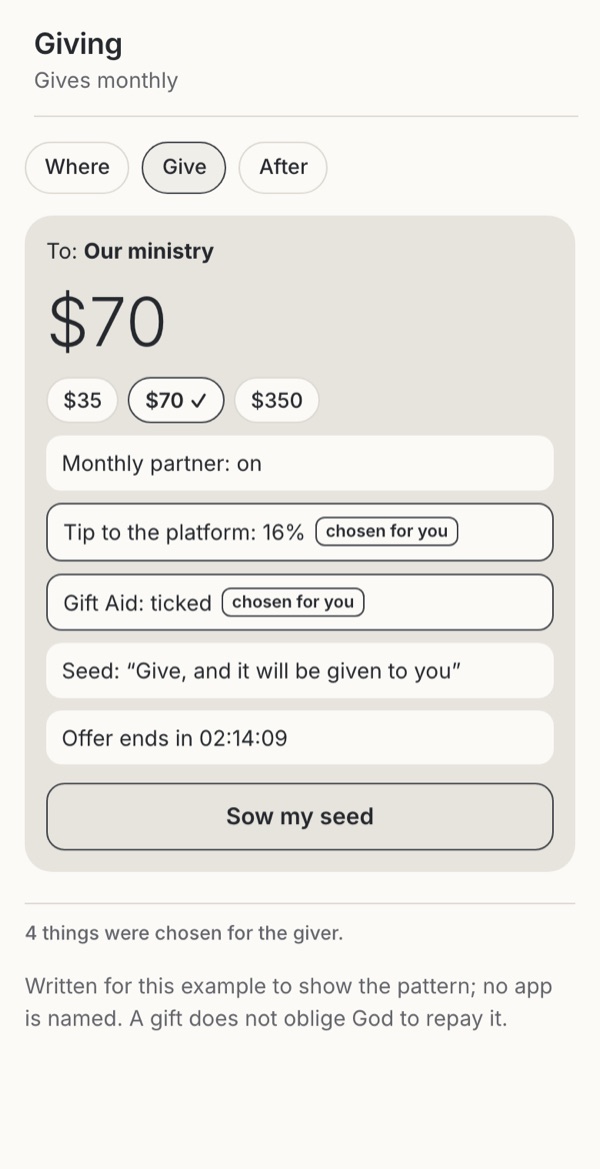 Leave it out Raises money fast Trades on faith and fearTry it →
Stills from the working example below. Choose one to try it.
Try it
Try seven ways a faith app can ask for gifts
The same faith app, made by a small ministry and used by members of St Luke’s church, handles giving in seven ways. Choose who is giving: someone who gives every month, someone who installed the app this week, someone short of money this month, or someone who has just shared a prayer request. Then look at where the ask appears, the screen where they give, and what happens afterwards. Nothing is paid.
Option
Why these settings?
Someone who has just shared a prayer request is shown no ask in the better options; the warning case shows what happens when an app asks then. Help for someone in a hard moment is TelefonSeelsorge, whose numbers are from its own website, checked 11 October 2026.
Familiar convention
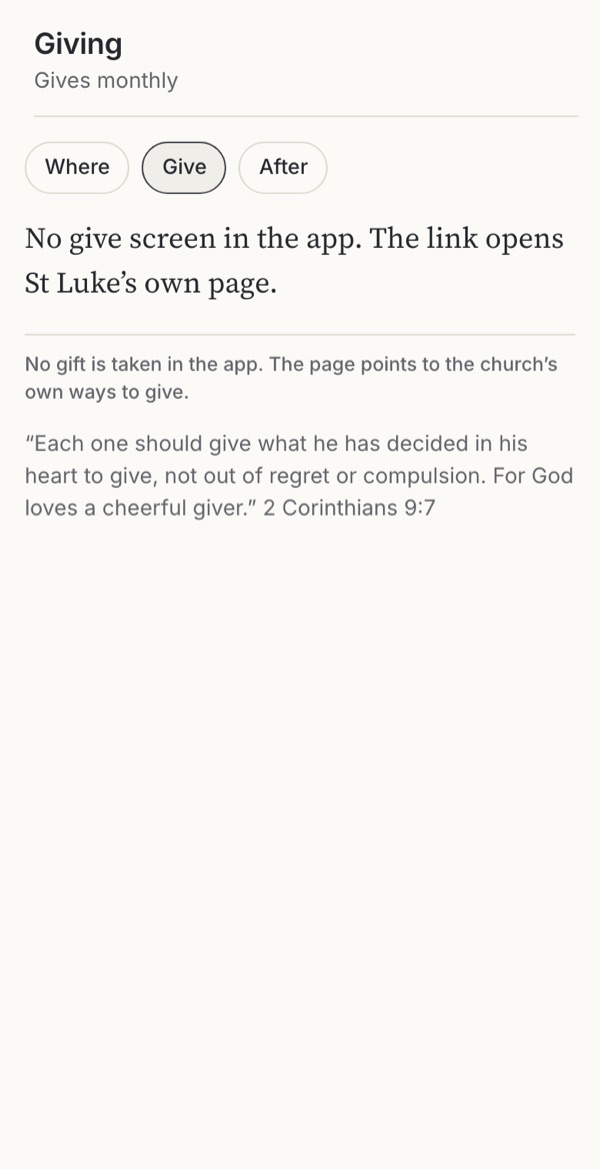
1. Giving stays with the church
Familiar from churches where the offering, a bank transfer or church tax carries giving, and from Startblock’s support page, which asks first for prayer and help, then gives a bank account and a receipt on request; see the screenshot below. The church and wording here are written for this example.
Try this
Look for the ask as each person, then follow the link to the church.
Makes easier
Nothing in the app asks for money.
Costs
Nothing pays for the app, and some people want to give there.
Ask your teamWho pays for this app, and do its users know?
Observed
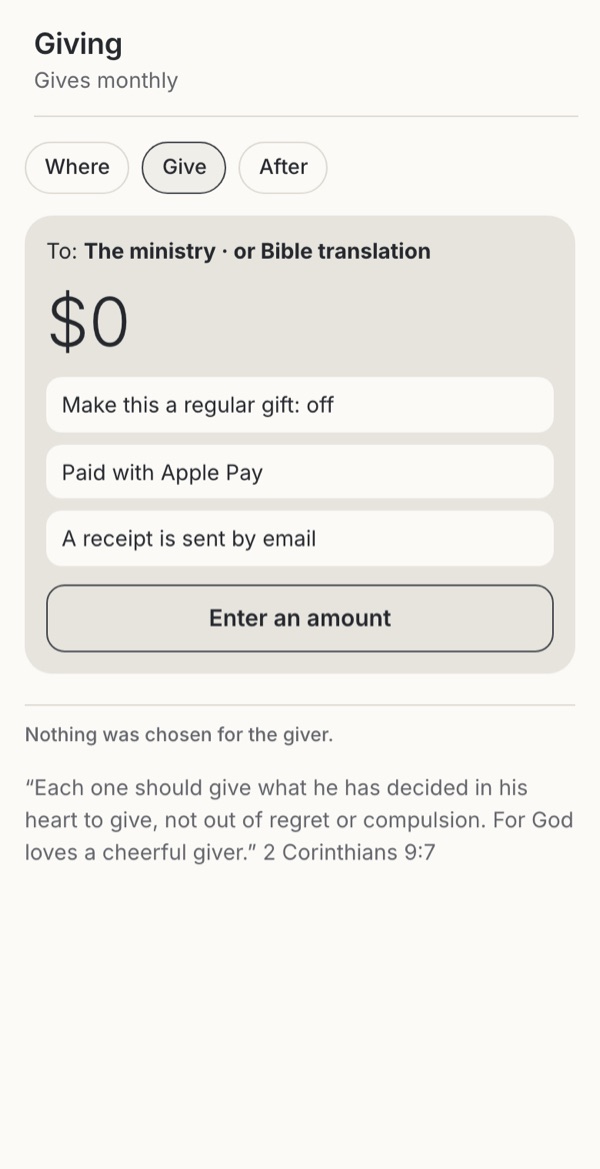
2. A quiet way to give
Observed in YouVersion, captured 11 October 2026: Give from the profile, an amount that starts at zero, a regular gift switched off, and a choice between YouVersion and Bible translation; see the screenshots below. The ministry, funds and wording here are written for this example.
Try this
Find Give in the menu as someone new, then as someone short of money.
Makes easier
Easy to find when someone wants it, and silent otherwise.
Costs
Easy to miss, and it raises less than an ask.
Ask your teamWhere would someone look for this, and is it there?
Observed
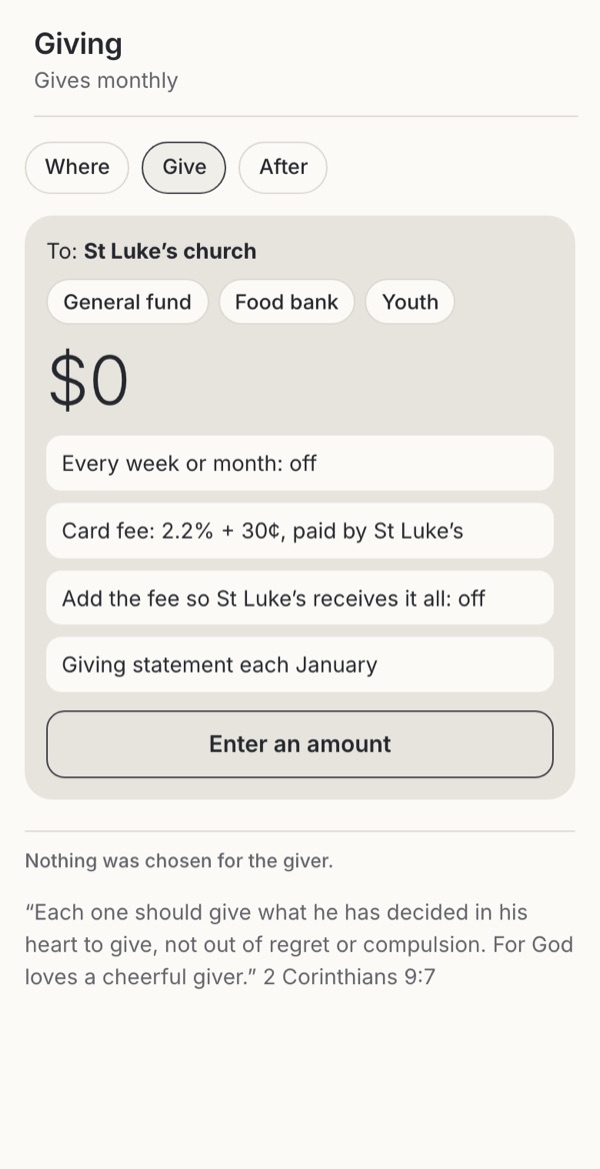
3. The church’s offering
Observed in Churchome, captured 11 October 2026: Give in the menu, named funds, Pushpay, Apple Pay or PayPal, and a recurring gift changed in the person’s Pushpay account; see the screenshots below. Church giving apps such as Givelify (101K ratings), Church Center and Tithe.ly work the same way. In Germany congregations show a QR code during the service that leads to their own donation form. The church, funds and fee here are written for this example.
Try this
Try someone who gives every month, then someone new at the service.
Makes easier
The gift goes to the person’s own church, by fund, with a receipt.
Costs
Card fees, and the church’s giving records held by a platform.
Ask your teamDoes the giver see the fee, and who keeps their giving history?
Observed
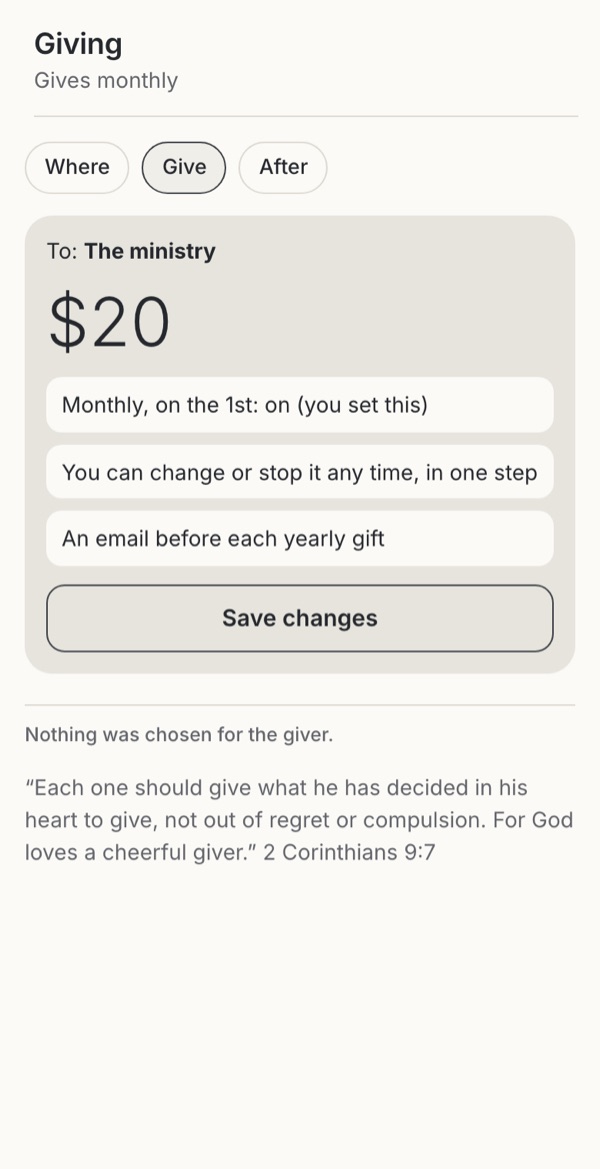
4. A regular gift
Observed in YouVersion’s “Become a Sower”, a monthly gift switched off until the person turns it on, and in Abide’s donate sheet with “Make it a monthly donation” unticked; see the screenshots below. Recurring giving is 35% of digital church giving in one vendor’s data. The reminder before a change is a proposal.
Try this
Set a monthly gift as someone who gives, then stop it.
Makes easier
Steady support the person chose, on a day they chose.
Costs
Easy to forget that it is running.
Ask your teamIs stopping as easy as starting, and when does the giver hear about it?
Observed
5. What a gift does
Observed in YouVersion’s Sowers page, a slider from $10 to $100 a month with Bibles per year beside it, and Pray as you go’s “80%” of a donation going to content; see the screenshots below. The figures here are written for this example.
Try this
Move the amount as someone who gives, then read the source line.
Makes easier
People see where the money goes and what it makes possible.
Costs
Figures age, and a number per dollar can promise too much.
Ask your teamCould you show the source and the date of every figure?
Observed
6. A gift tied to a benefit
Observed in Pray.com’s “Support & Go Ad Free”, where a ministry donation brings “an Ad Free Subscription”, and Glorify’s “Pay it Forward” tiers with “Most popular” ticked; see the screenshots below. Apple treats a gift tied to content as a purchase. The tiers here are written for this example.
Try this
Open the ad-free offer as someone new, then as someone who just shared a prayer request.
Makes easier
People who would pay anyway support others too.
Costs
A purchase dressed as a gift, with a tier chosen for the giver.
Ask your teamIs this a gift or a price, and would the receipt say which?
Leave it out
7. Pressure and promises
A warning case. Evangelical theologians at Lausanne described prosperity teaching that promises health and wealth through the “sowing of seeds” in tithes and offerings; regulators objected to a default “tip” added to gifts. The seed, the countdown, the tip and the ask after a prayer request here are written for this example to show the pattern; no app is named.
Try this
Try someone short of money, then someone who has just shared a prayer request.
Makes easier
It raises money quickly.
Costs
Trades on faith, fear and need, and promises what God has not.
Ask your teamWould you say this to the person’s face, in your own name?
What we noticed
Takeaways
Start with no amount, and a one-off gift
YouVersion’s give screen starts at zero with its monthly gift switched off; Churchome’s opens with $100.00 already filled in, and Abide’s donate sheet offers six amounts with $50 already chosen and a monthly box left unticked. An empty amount leaves the decision to the giver; if you suggest amounts, choose none in advance.
Name who receives the gift, and what it pays for
YouVersion asks whether a gift goes to the app or to Bible translation; Bible.is asks people to “Donate online” for recordings in oral cultures. Say which organisation receives the money, what it pays for, and whether a receipt follows.
Keep the ask out of prayer, grief and crisis
Giving belongs in a menu, after a service or on its own page, not between a prayer request and the next screen. Someone who has just written about their grief, or is in danger, should see help and nothing else.
Sharing with a group →Keep gifts and purchases apart
Pray.com’s “Support & Go Ad Free” gives donors “an Ad Free Subscription”, and Glorify’s “Pay it Forward” ticks “Most popular” in advance. If a payment unlocks something, call it a price; if it is a gift, let it unlock nothing.
First use →Stopping is as easy as starting
Keep every regular gift in one place, with its next date, and let it be changed or stopped there in one step. Churchome sends people to “your Pushpay account” to change one: say where, and link to it. Remind the giver before a yearly gift or a change in amount.
Say what a gift does, truly, and when enough is enough
YouVersion’s Sowers page sets Bibles per year beside a monthly amount; Pray as you go says 80% of a donation goes to its content. Give each figure a source and a date, and when a need is met, say so, as Moses did.
Never promise a return
A gift is not a seed that obliges God to send a harvest. Leave out anything that ties a gift to healing, prosperity, answered prayer or a blessing, and anything that ranks givers or shows who gave what.
Use cases
Which situation, which option?
People come with different needs, sometimes in the same week. Each need fits some options better than others.
| Situation | Needs | 1 Giving stays with the church | 2 A quiet way to give | 3 The church’s offering | 4 A regular gift | 5 What a gift does | 6 A gift tied to a benefit | 7 Pressure and promises |
|---|---|---|---|---|---|---|---|---|
| A church that wants its offering in its own app | Funds, a receipt, a QR code at the service | Possible | Possible | Good fit | Good fit | Possible | Poor fit | Poor fit |
| A Bible app run by a ministry | A quiet way to give, and honest figures | Possible | Good fit | Poor fit | Good fit | Good fit | Poor fit | Poor fit |
| A mission or translation project | What a gift does, with source and date | Poor fit | Possible | Possible | Good fit | Good fit | Poor fit | Poor fit |
| An app that also sells a subscription | Keep gifts and purchases apart | Possible | Good fit | Poor fit | Possible | Possible | Possible | Poor fit |
| Someone short of money this month | Nothing chosen for them, no ask they didn’t look for | Good fit | Good fit | Possible | Possible | Poor fit | Poor fit | Poor fit |
| Someone who has just shared a prayer request | No ask at all in that moment | Good fit | Good fit | Possible | Possible | Possible | Poor fit | Poor fit |
Editorial judgments drawing on the research below, not test results.
The research behind it
Theology, practice and science
Scripture and tradition
Given freely, in secret, as one is able
Decided in the heart
“Each one should give what he has decided in his heart to give, not out of regret or compulsion” (2 Corinthians 9:7); “the gift is acceptable according to what one has, not according to what he does not have” (2 Corinthians 8:12). The poor widow’s two coins were “more than all the others” (Mark 12:43).
In secret, and set aside
“When you give to the needy, do not let your left hand know what your right hand is doing, so that your giving may be in secret” (Matthew 6:3–4). Paul asked each to “set aside a portion of his income” “on the first day of every week” (1 Corinthians 16:2): a regular gift, planned, not pressed out at the moment of asking.
Handled openly, and enough is enough
Paul took “great care to do what is right, not only in the eyes of the Lord but also in the eyes of men” in handling a gift (2 Corinthians 8:21). When the people brought more than was needed for the tabernacle, which Bezalel built, Moses “sent a proclamation throughout the camp” and “the people were restrained from bringing more” (Exodus 36:6).
Tithe, offering and church tax
Christians give in different ways: a tenth, as Israel brought “the full tithe into the storehouse” (Malachi 3:10); a proportion “as he is able” (Deuteronomy 16:17); weekly offerings; or, in Germany, church tax collected with income tax. Jesus did not set the tithe aside but named “justice, mercy and faithfulness” as weightier (Matthew 23:23).
Platforms and rules
What the stores, regulators and tax offices ask
A gift, or a purchase
On iPhone, “Approved nonprofits may fundraise directly within their own apps”, with Apple Pay, and “must disclose how the funds will be used”; others “may only collect funds outside of the app”. A gift “connected to or associated at any point in time with receiving digital content or services must use in-app purchase”. Google Play exempts “tax exempt donations” from its billing.
Pressure has a name
The UK Code of Fundraising Practice requires “not putting undue pressure on a person to donate, not using unreasonably persistent approaches and accepting a request to end an interaction”. In 2026 US state regulators objected to “the application of a default “tip” that went directly to GoFundMe”.
Fundraising Regulator (UK)Crowell & Moring client alert, March 2026
Receipts belong to the gift
In the US, organisations give a written acknowledgment for “contributions of $250 or more”, which may say that “the organization only provided intangible religious benefits”. A UK Gift Aid declaration must explain that “the donor is responsible to pay any difference”.
Current, complete and accurate
Christian ministries in the ECFA agreed that what they tell donors “must be current, complete and accurate”, that past events “must be appropriately dated”, and that appeals “must not create unrealistic donor expectations of what a donor’s gift will actually accomplish”.
Research and practice
What defaults, recognition and promises do
A suggested amount moves people
Goswami and Urminsky found “a scale-back effect, in which low defaults reduce average donation amounts”, and “a lower-bar effect, in which defaulting a low amount increases donation rate”. Any default also weakened “other cues such as positive charity information”.
Being seen raises gifts
In a field experiment, “charitable gifts increase in response to the promise of public recognition primarily because of individuals’ desire to improve their social image”: the motive Jesus warned against in Matthew 6.
Much church giving is now digital
Churches that offer digital giving “reported that 41% of their giving came from digital methods”, and “Recurring giving accounted for 35% of the digital giving in 2025”, in one vendor’s US data. Givelify, the giving app with the most ratings (101K), says it “has processed $6 billion in donations”. In Württemberg almost 400 congregations take the collection through a QR code and a web form.
Ministry Brands, 2026GivelifyDavid SeeleyWochenblatt-Reporter
Seeds and harvests
Evangelical theologians at Lausanne described prosperity teaching that promises health and wealth through “the “sowing of seeds” through the faithful payments of tithes and offerings”, and warned against “Replacing the traditional call to repentance and faith with a call to give money”.
Every source, with what it can and cannot show, is listed under Go further → Sources and their limits.
Where to start
Which fits your product?
IfA church app
Start withThe church’s offering: funds, a receipt, a QR code at the service, fees shown
IfA Bible or prayer app run by a ministry
Start withA quiet way to give, a regular gift if chosen, honest figures
IfA mission or translation project
Start withWhat a gift does, with every figure sourced and dated
IfAn app that also sells a subscription
Start withKeep the price and the gift apart; let a gift unlock nothing
IfYou are tempted to add a seed, a countdown or an ask after a prayer request
Start withDon’t: let people give what they decided in their heart
These are editorial judgments from design review, not results of user testing.
In real apps
Examples in use
Attributed screenshots with dates and review limits. A screenshot shows an implementation; it does not show that it works for every audience.
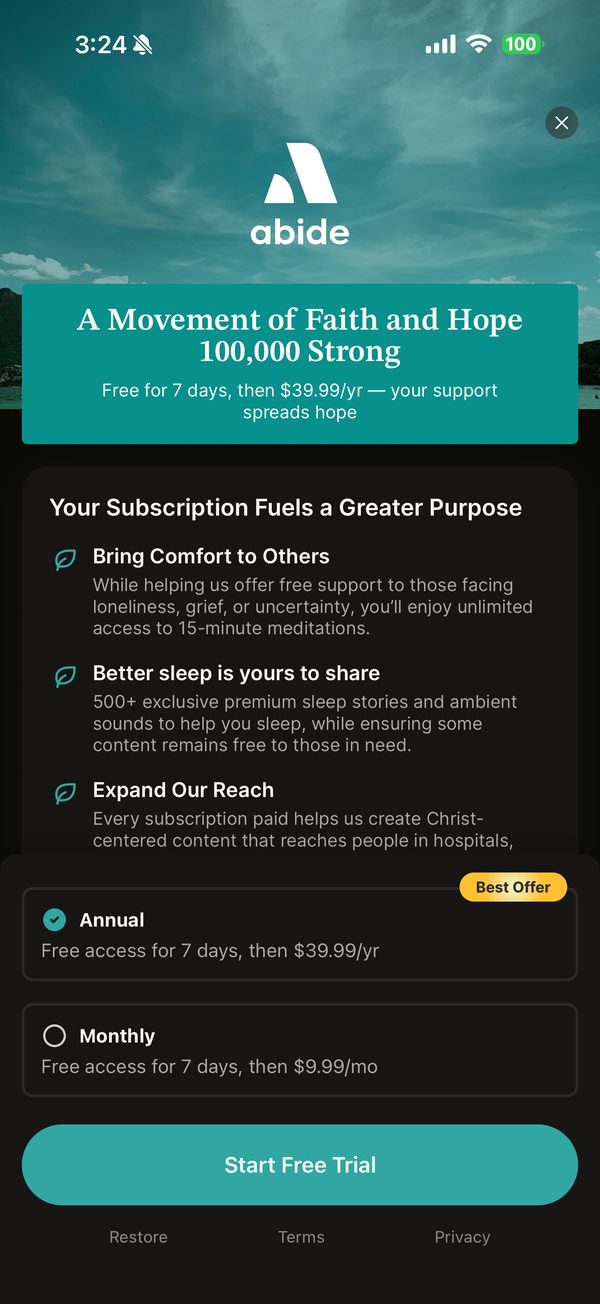 Abide · iOS app · device model not recorded
“Your subscription fuels a greater purpose”
User-contributed screenshot · resized, content unchanged
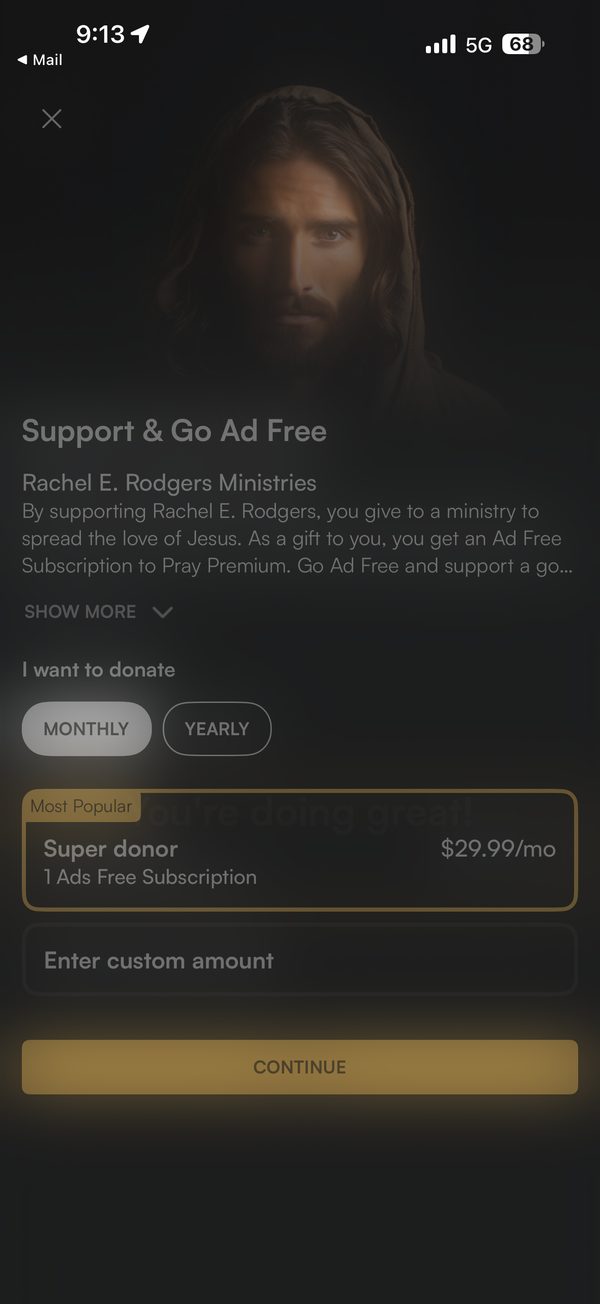 Pray.com · iOS app · device model not recorded
A ministry donation that brings an ad-free subscription
User-contributed screenshot · resized, content unchanged
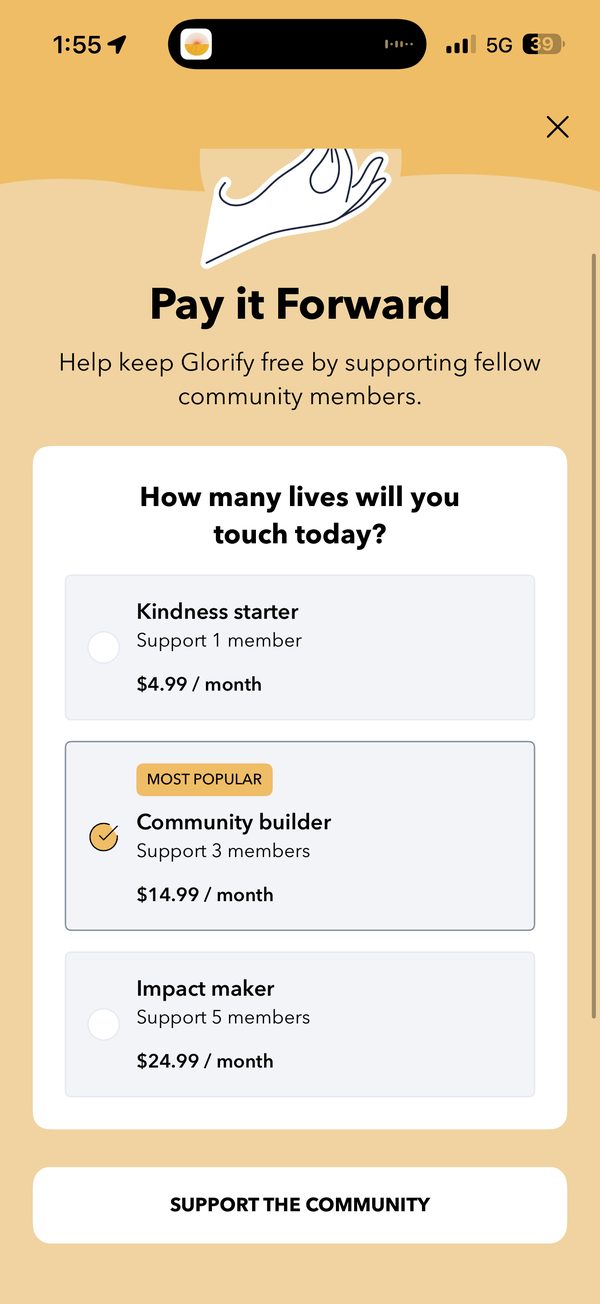 Glorify · iOS app · device model not recorded
“Pay it Forward”: tiers with “Most popular” ticked
User-contributed screenshot · resized, content unchanged
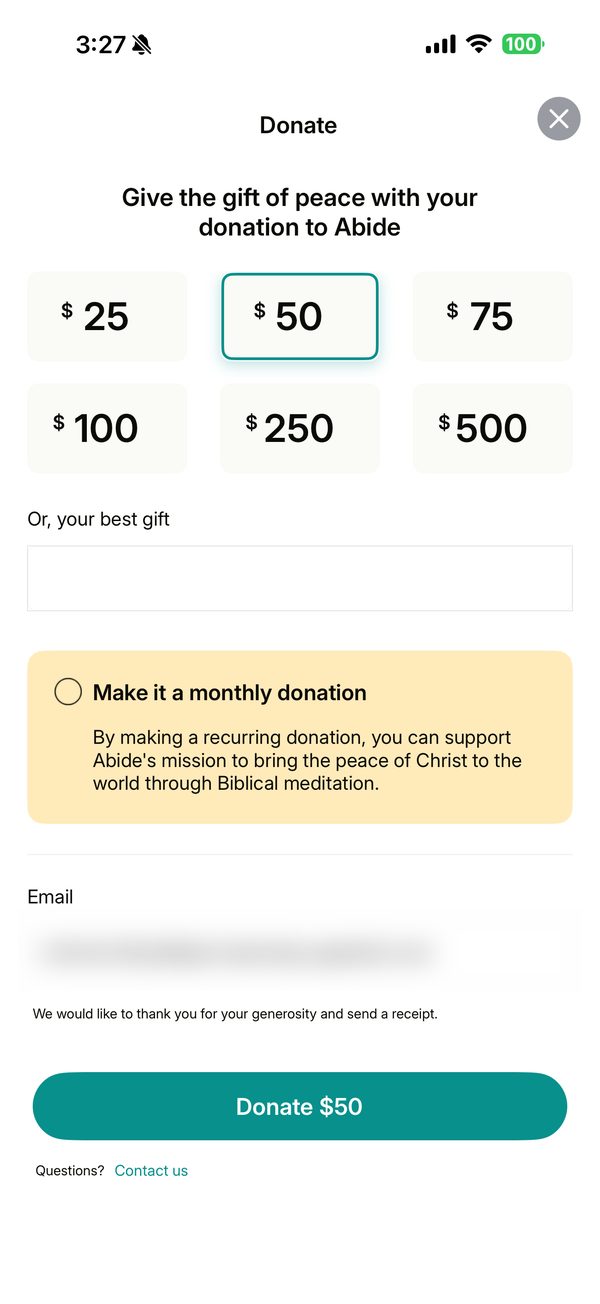 Abide · iOS app · device model not recorded
A donate sheet with $50 chosen and monthly left unticked
User-contributed screenshot · resized; email address blurred
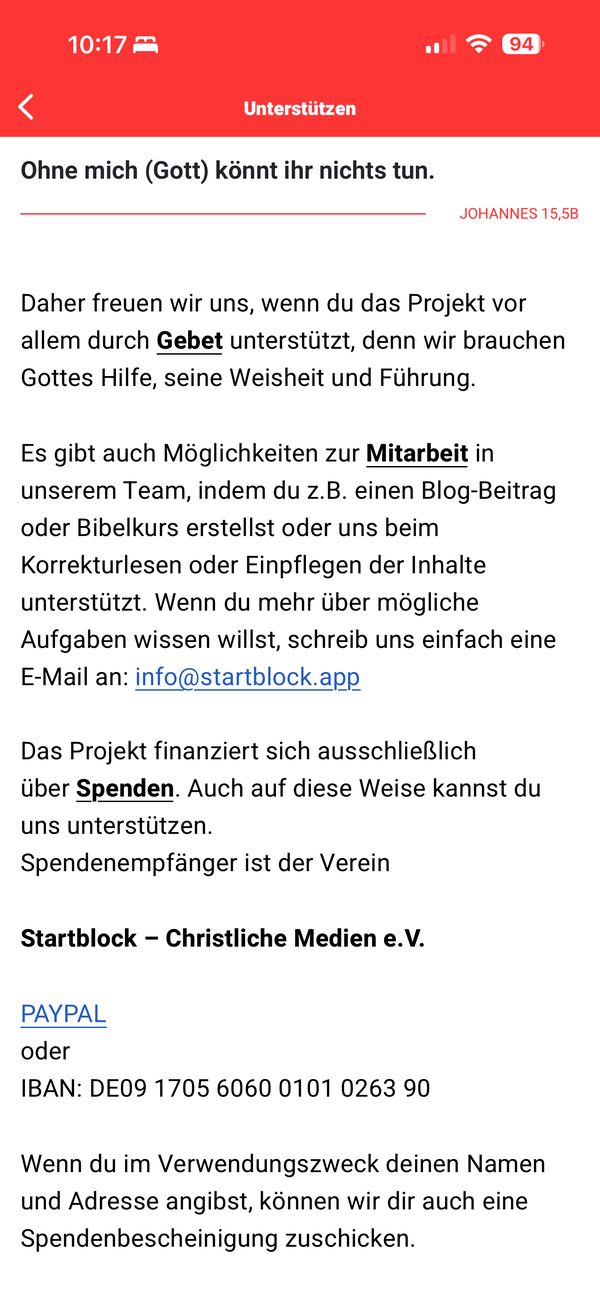 Startblock · iOS app · device model not recorded
Prayer first, then help, then a bank account
User-contributed screenshot · resized, content unchanged
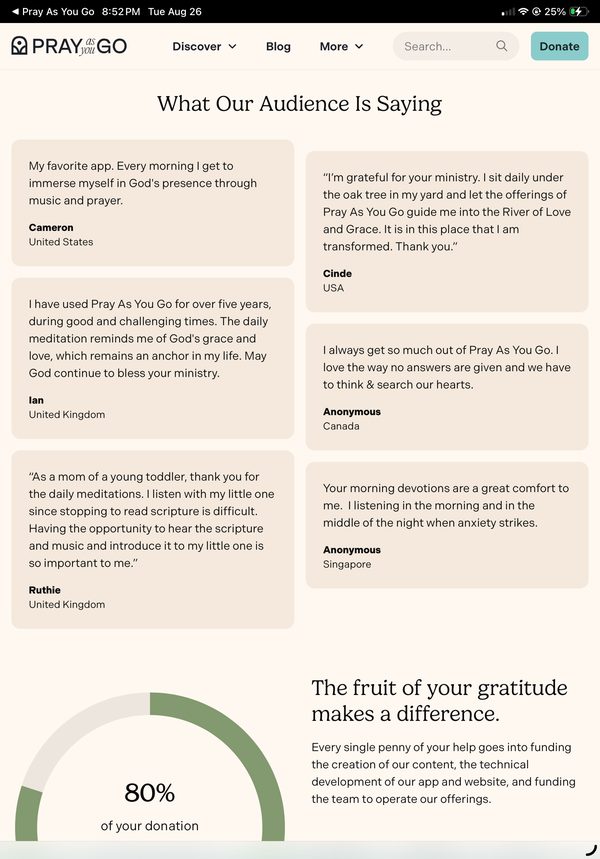 Pray As You Go · Website on iPad · device model not recorded
“The fruit of your gratitude”, with 80% to content
User-contributed screenshot · resized, content unchanged
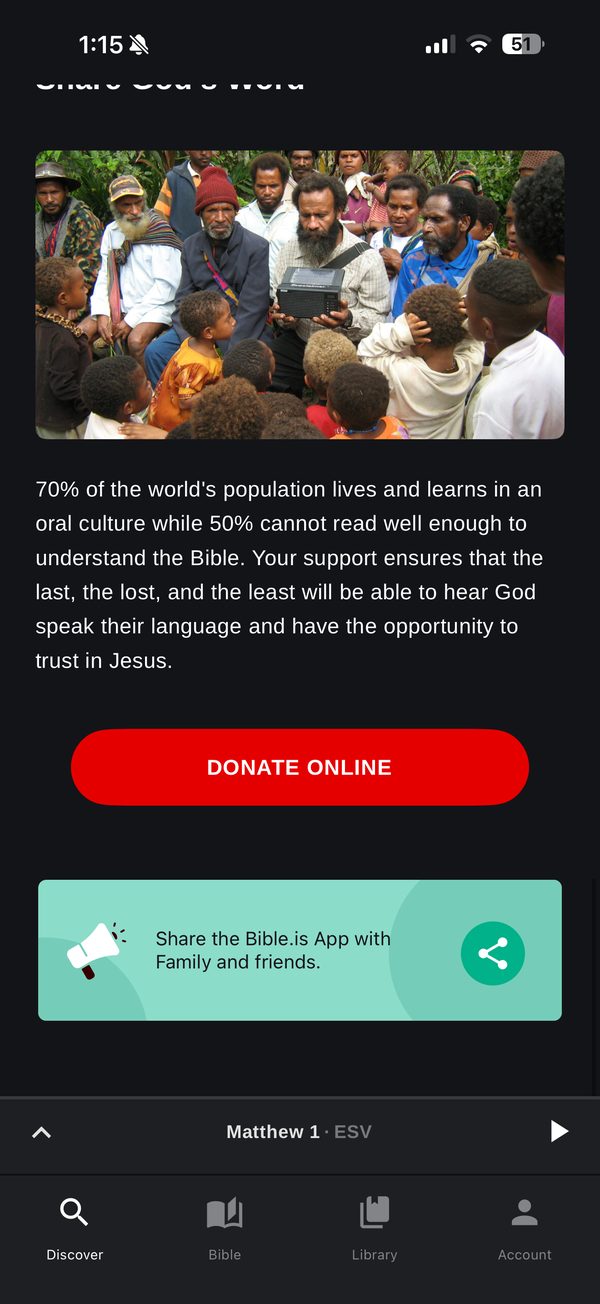 Bible.is · iOS app · device model not recorded
A donation appeal for oral cultures
User-contributed screenshot · resized, content unchanged
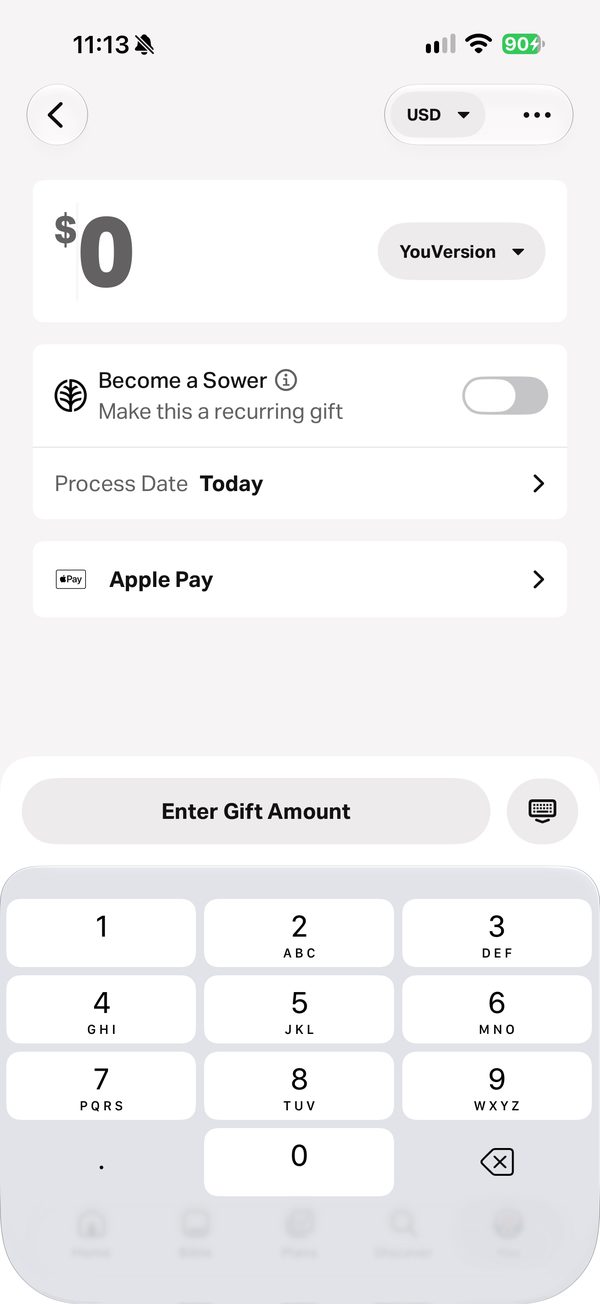 YouVersion · iOS app · device model not recorded
A give screen that starts at zero, with monthly switched off
Editor’s screenshot · resized, content unchanged
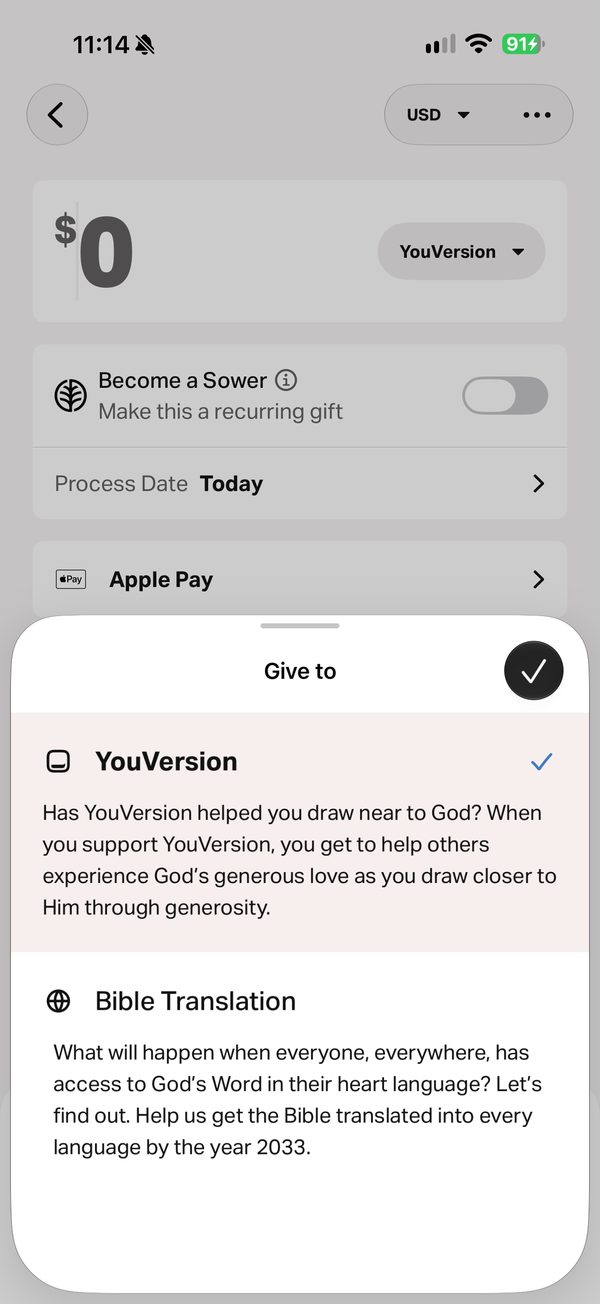 YouVersion · iOS app · device model not recorded
“Give to”: the app, or Bible translation
Editor’s screenshot · resized, content unchanged
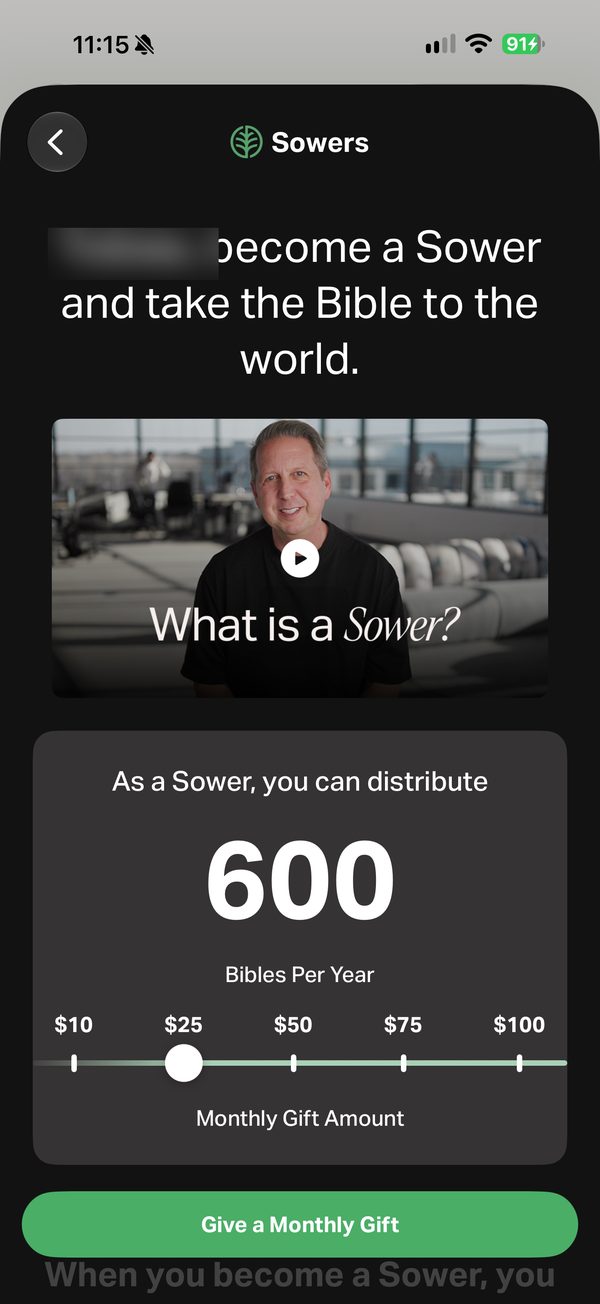 YouVersion · iOS app · device model not recorded
Monthly gifts as Bibles per year
Editor’s screenshot · resized; account holder’s name blurred
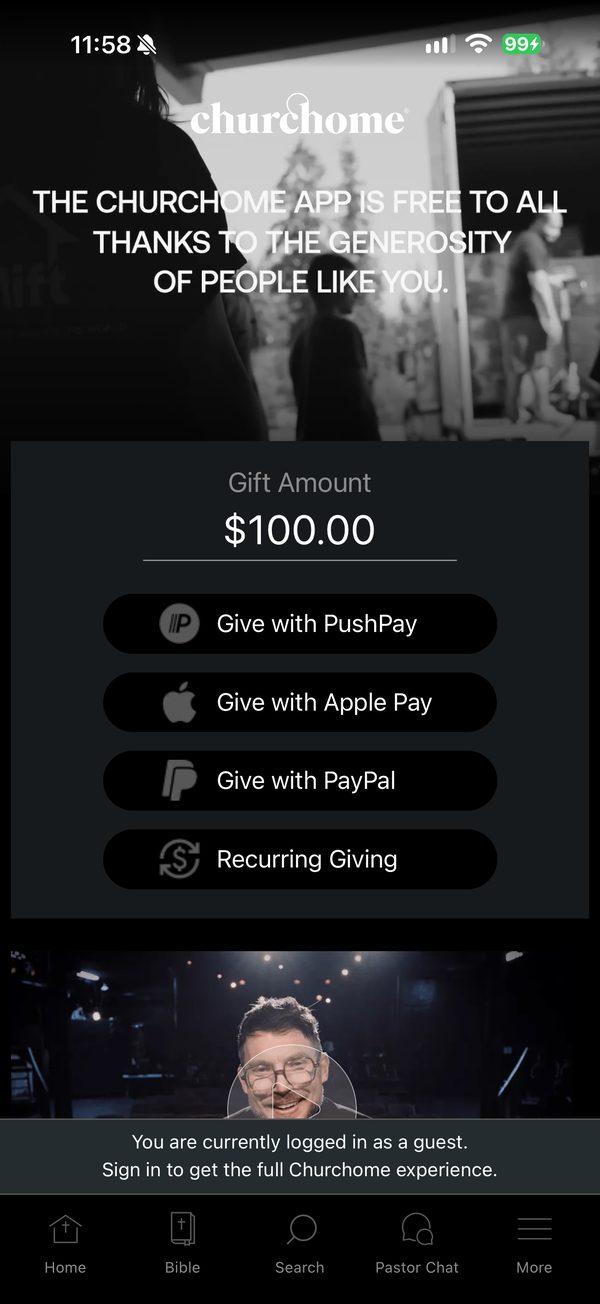 Churchome · iOS app · device model not recorded
A church’s give screen with $100.00 filled in
Editor’s screenshot · resized, content unchanged
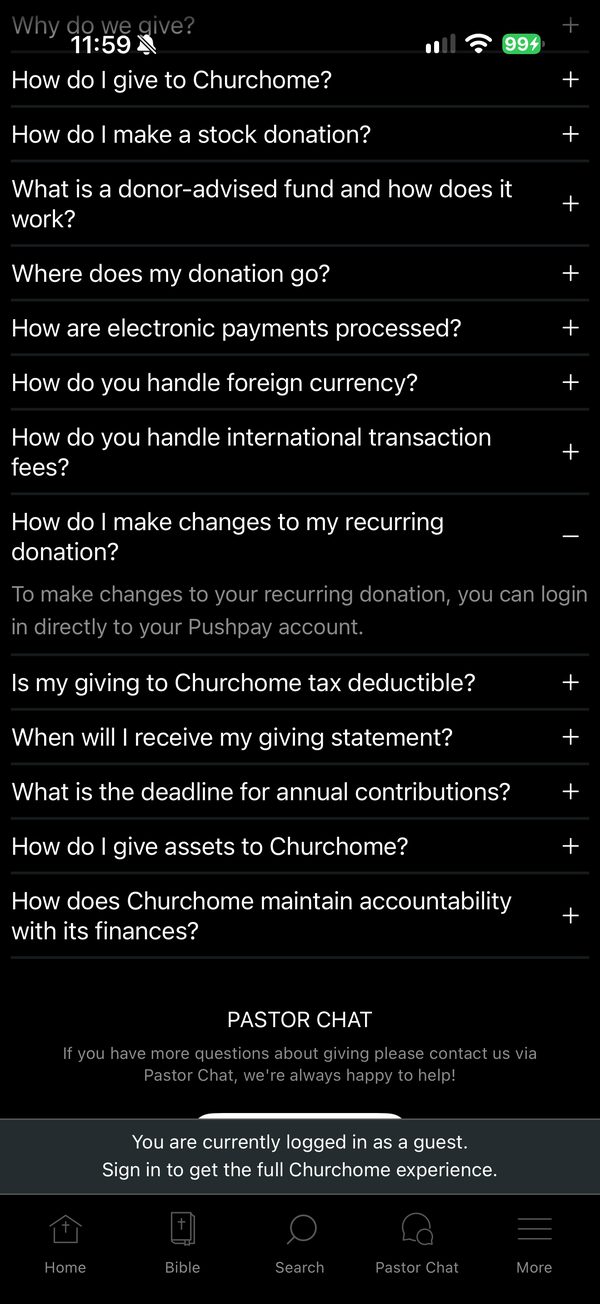 Churchome · iOS app · device model not recorded
A recurring gift changed in another service
Editor’s screenshot · resized, content unchanged
Theological reflection
What is this practice for?
What giving is for
“Who am I, and who are my people, that we should be able to give as generously as this? For everything comes from You, and from Your own hand we have given to You” (1 Chronicles 29:14). Giving returns to God what was already his, supports those who serve the word, and cares for those in need. Jesus said that “It is more blessed to give than to receive” (Acts 20:35), and looked not at the size of a gift but at what it cost the giver.
Where Christians differ
Some churches teach the tithe as the measure of faithful giving; others teach proportional giving “as he is able” (Deuteronomy 16:17) and see the tithe as a starting point or as Israel’s law. Catholics give through the offertory, Mass offerings and parish appeals; in Germany church tax carries most church income and the collection is for a named cause. Pentecostal and charismatic churches range from careful teaching on stewardship to the prosperity teaching that the Lausanne statement rejected. All agree that a gift is free, and that those who receive it must handle it honestly.
What follows for design
Let people give what they decided in their heart: nothing chosen for them, nothing asked in a moment of need. Say who receives the gift and what it truly does, keep it in secret unless the giver chooses otherwise, and make a regular gift easy to stop. Never promise a return, and when the need is met, say so.
In conversation with
- Henri Nouwen, A Spirituality of Fundraising (2010) wrote that “Fundraising is first and foremost a ministry”, “a way of announcing our vision and inviting other people into our mission”, and “precisely the opposite of begging”.
- John Wesley, “The Use of Money” (sermon 50) told Methodists to “gain all you can”, “save all you can” and “give all you can”: giving is the end that earning and saving serve.
Scripture is quoted from the Berean Standard Bible. This reflection is the editor’s, written from within the Christian tradition and open to correction. How we approach theology here →
Three ways to build
What would each way do here?
ExploitativeTakes from the person
Choose the amount and the tier for the giver, switch on monthly by default, add a tip unless it is removed, ask after a prayer request, and promise a harvest for a seed.
EthicalDoes no harm
Start with no amount and a one-off gift, name who receives it and what it pays for, show fees, send receipts, and let a regular gift be stopped in one step.
RedemptiveGives something up for them
Ask only where people look for it, never in prayer, grief or need; give every figure a source and a date, say when enough has been given, and give up the gifts that pressure would bring.
The three ways are Praxis’s frame for redemptive entrepreneurship; their application here is ours. Why we use it, and its limits →
Take into your next review
What is chosen for the giver, where does the ask appear, and what does the app say a gift will do?
Exercise
Give the smallest gift your app allows, three times: as someone new, as someone who has just lost their job, and as someone who has just shared a prayer request. Write down every amount, tick and toggle chosen for you, and every place the ask appeared. Set up a regular gift and time how long it takes to stop it. Then read every sentence about what a gift will do aloud to a member of your church who gives faithfully and has little, and ask whether you would say it to their face.
Make room for cheerful giving: let people give what they decided in their heart, tell them truly what it does, and say when it is enough.
Record the decision with the worksheet →
Something missing or wrong here? Send a correction or suggest a topic.
Details
Go further
Edge cases to design for
Put giving where someone looks for it, in a menu or after a service, not in the middle of reading or prayer. Start with an empty amount and a one-off gift; let the person switch on a regular gift and choose its day. Name who receives the gift and what it pays for, show fees as fees, send a receipt, and keep a history the person can stop or change in one place. Speak of what a gift does with current, complete and accurate figures, and say when enough has been given.
What tends to go wrong
A “Most popular” tier ticked in advance; a tip of a sixth of the gift added unless someone slides it to zero; a monthly gift switched on by default; a gift box on the screen after someone shares a prayer request; “Sow a seed of faith today and expect a harvest” beside a countdown; givers ranked by amount; a figure from five years ago presented as today’s; a recurring gift that can only be stopped by email.
How to test it
Give the smallest possible gift in your app as someone new, then as someone who has just lost their job, then as someone who has just shared a prayer request. Write down every amount, tick and toggle that was chosen for you, every place the ask appeared, and how many steps it takes to stop a regular gift. Then read every sentence about what a gift will do, and ask whether you could show the figure’s source and date.
Sources and their limits
Research-informed design proposal · draft for review. Editorial review, not user validation.
- App Store Review Guidelines: 3.2.1 (vi) and (vii), 3.2.2 (iv)Guidelines reviewed 11 October 2026 · Rules for one platform; they change, and approval as a nonprofit is a separate process.
- Payments policy (Google Play)Policy reviewed 11 October 2026 · A summary page of a longer policy; the exemption depends on the organisation’s status.
- When Should the Ask Be a Nudge? The Effect of Default Amounts on Charitable DonationsAbstract reviewed 11 October 2026 · Charity appeals, not church giving; effects vary with the amounts tested.
- Hey Look at Me: The Effect of Giving Circles on GivingAbstract reviewed 11 October 2026 · One university club in the United States.
- 2026 Protestant Annual Church Giving ReportReport reviewed 11 October 2026 · A survey of church leaders and data from one vendor’s customers in the United States; the vendor sells giving software.
- ECFA Standards for Fund RaisingText reviewed 11 October 2026 · The 1987 published standards; ECFA’s current wording is longer, with the same principle.
- A Statement on the Prosperity GospelStatement reviewed 11 October 2026 · A statement from evangelical theologians; it also affirms a biblical vision of human flourishing.
- Code of Fundraising Practice 2025: table of changesRule 1.1.2 reviewed 11 October 2026 · A UK self-regulatory code; wording is from the 2025 revision.
- Bipartisan group of state attorneys general and state charity regulators send letter to GoFundMeAlert reviewed 11 October 2026 · A law firm’s summary of the letter; GoFundMe disputed some of the regulators’ points.
- Publication 1771: Charitable Contributions, Substantiation and Disclosure RequirementsPublication reviewed 11 October 2026 · US tax rules; other countries differ.
- Gift Aid declarations: claiming tax back on donationsGuidance reviewed 11 October 2026 · UK rules only.
- Mehr Spenden in Baden-Württemberg: Kirchen testen digitale KollekteArticle reviewed 11 October 2026 · A regional news report; church tax still carries most church income in Germany.
- Givelify Mobile Giving App (App Store listing)Listing reviewed 11 October 2026 · Ratings show reach, not quality.
- Led by Dallas entrepreneur, Givelify reports $300 million in North Texas giving, $6 billion globallyArticle reviewed 11 October 2026 · Company figures, not independently audited.
- A Spirituality of FundraisingPublisher page reviewed 11 October 2026 · A short book drawn from a talk; the publisher’s summary is quoted here.
- TelefonSeelsorgeHome page reviewed 11 October 2026 · Germany; other countries have their own services.
Faith and interpretation
“Each one should give what he has decided in his heart to give, not out of regret or compulsion. For God loves a cheerful giver” (2 Corinthians 9:7). Jesus said that the poor widow who put in two small coins “has put more than all the others into the treasury” (Mark 12:43), and told those who give, “do not let your left hand know what your right hand is doing” (Matthew 6:3). When the people brought more than enough for the tabernacle, Moses “sent a proclamation throughout the camp” to stop (Exodus 36:6).