Children and families
When children meet Scripture through an app, who is with them, and what does the app ask of them?
When people brought children to Jesus and the disciples turned them away, he “was indignant” and said, “Let the little children come to Me, and do not hinder them! For the kingdom of God belongs to such as these” (Mark 10:14). Children now meet Bible stories, prayers and songs through apps: some made for them, some made for adults, some built to hold their attention, some run by their church, and AI chat apps rated for all ages. Each decides who is with the child, what it collects, how it keeps them watching, and what happens when a child says something worrying. Most of the time, children’s apps help families share the faith. Design also for the frightening story and the worried child.
- 6 working options
- 9 app examples
- 7 takeaways
- Editorial review, not user-tested
The spectrum
From a grown-up beside the child to a child alone
 Familiar convention A grown-up for the hard parts Needs time togetherTry it →
 Observed Families use what they have The adult app is a tap awayTry it →
 Observed Safe to use alone Hard stories met aloneTry it →
 Observed Stories children return to Attention held for its own sakeTry it →
 Observed Leaders responsible Leaders see what is postedTry it →
 Leave it out Answers at any hour No one is with the childTry it →
Stills from the working example below. Choose one to try it.
Try it
Try six ways a child meets Scripture
A child opens a faith app. Choose their age: four to seven, eight to twelve, or thirteen to sixteen. On an ordinary day the story is Jesus welcoming the children (Mark 10:13–16). Then try a frightening story, the Flood, and then a worrying message: the child writes that they are scared at home. Notice who is with the child, what the app asks and collects, how it holds attention, and who answers the child.
Option
Why these settings?
On an ordinary day the story is Jesus welcoming the children (Mark 10:13–16). The frightening story is the Flood (Genesis 6–9). In the worrying message the child writes that they are scared when someone at home shouts; nothing in this example is sent anywhere. Nummer gegen Kummer’s number and hours are from its own website, checked 11 October 2026.
Familiar convention
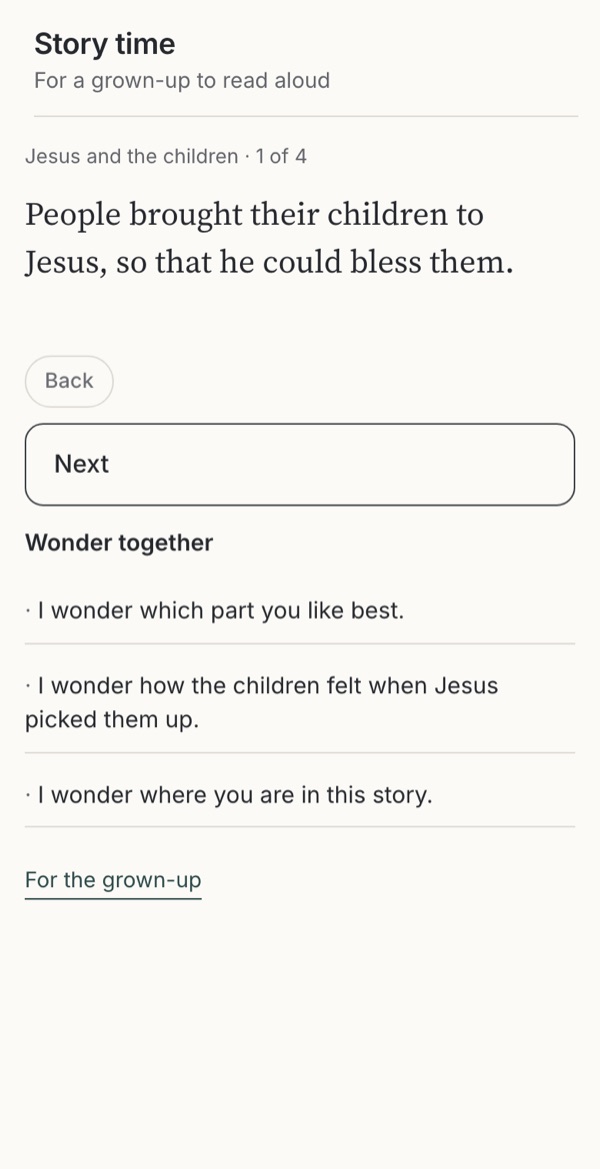
1. Read together
Familiar from reading a children’s Bible aloud at home, and from Godly Play, where stories are followed by “I wonder” questions; the WHO encourages “reading and storytelling with a caregiver” for young children. Not observed in this form in an app. The notes for grown-ups are written for this example.
Try this
Read the story aloud with the questions. Then try the Flood, and then the worrying message.
Makes easier
A grown-up is there for the hard parts and the questions.
Costs
Needs a grown-up with time; older children may want to read alone.
Ask your teamWhat does the grown-up need to say and ask, and what do they do if the child tells them something worrying?
Observed
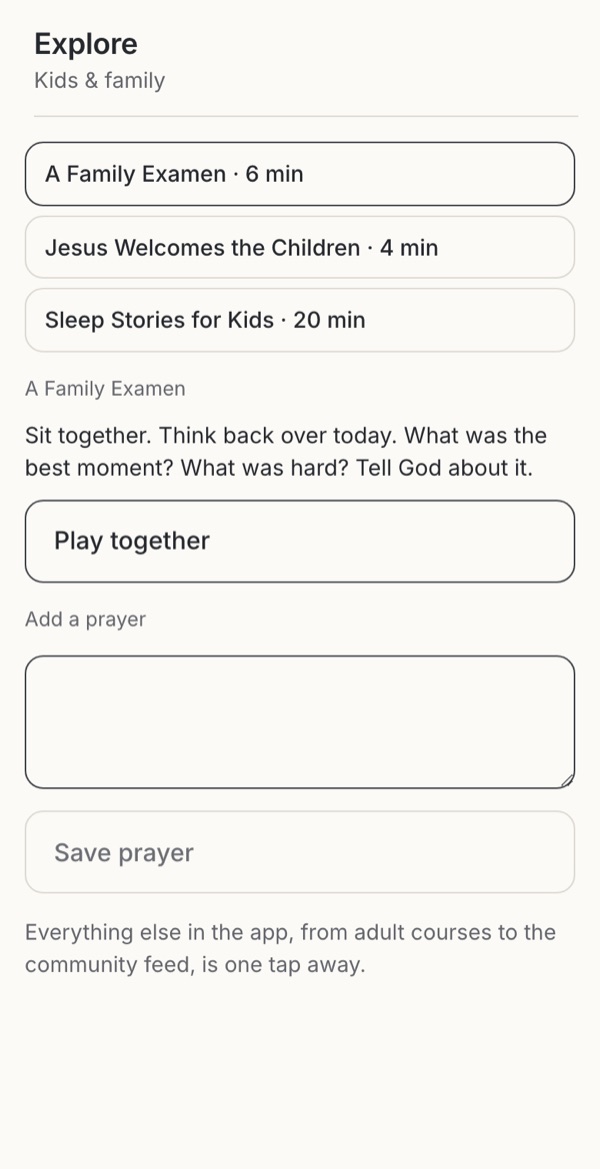
2. Family time in a general app
Observed in Pray as You Go’s Kids Prayer and “A Family Examen”, Glorify’s Kids rail, YouVersion’s plans for parents and kids and its Kids Bible Experience card, and Faith’s KIDS-labelled series; see the screenshots below. The app and its content here are written for this example.
Try this
Play the family prayer. Then try the Flood, and then the worrying message typed into the prayer box.
Makes easier
Families use what they already have, together.
Costs
The adult app is a tap away, and it cannot tell when a child is typing.
Ask your teamWhat can a child reach from the kids’ corner, and what happens to what they type?
Observed
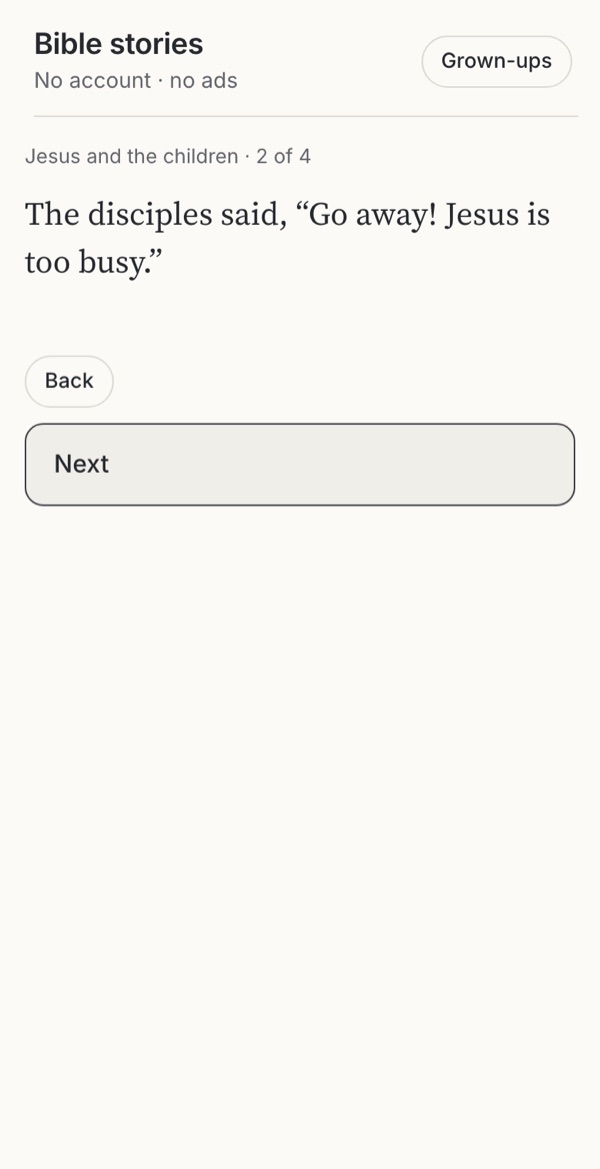
3. A children’s Bible app
Documented in the Bible App for Kids listing (free, rated 4+, with an email address listed for the developer’s marketing in its privacy label) and Apple’s Kids Category rules: no links out or purchases “unless reserved for a designated area behind a parental gate”, and no third-party analytics or advertising. Screens are on the shot list. The stories, gate and wording here are written for this example.
Try this
Tap through the story, then try the grown-ups’ area. Then the Flood, and the worrying message.
Makes easier
A child can use it alone without being sold to or tracked.
Costs
The child may meet a hard story with no one to ask.
Ask your teamWhat does the app say to a child alone with a frightening story, or a worry?
Observed
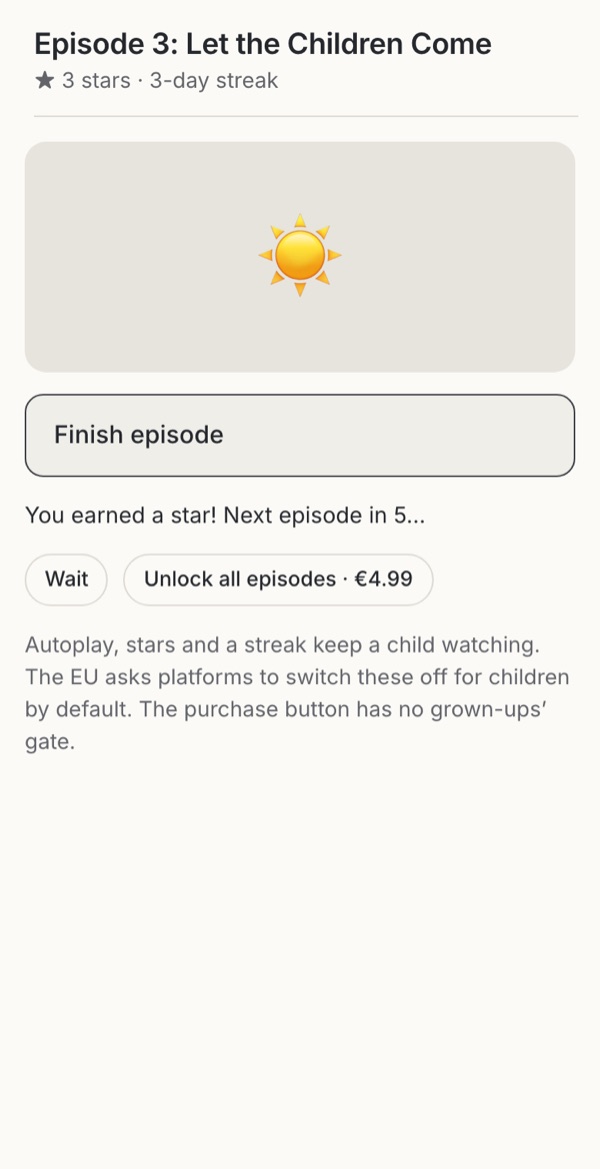
4. Games and episodes
Documented in the Superbook Kids Bible listing (“Videos, games, audio & more”, free with purchases) and in roundups of Minno’s subscription videos; screens are on the shot list. The EU’s guidelines ask platforms to disable streaks, autoplay and push notifications for minors by default. The episode, stars and countdown here are written for this example.
Try this
Watch the episode and let the next one start. Then try the Flood, and then look for somewhere to say what worries you.
Makes easier
Stories children want to come back to.
Costs
Stars, streaks and autoplay hold attention for its own sake.
Ask your teamWould the child stop on their own, and does anything here help them?
Observed
5. A youth group with a leader
Documented in KonApp, the Deutsche Bibelgesellschaft’s app for confirmation groups: no personal details needed, consent collected by the parish, and the group deleted six weeks after confirmation; see its store listing and data protection agreement. Church guidance keeps contact with young people in groups with two adults. The group, leaders, replies and safeguarding contact are written for this example.
Try this
Read the group feed and write in your diary. Then post the worrying message in the group.
Makes easier
Young people stay in touch between meetings, with leaders responsible.
Costs
Leaders see what is posted, and must know what to do with it.
Ask your teamWhat does a leader do, and not do, when a young person writes something worrying?
Leave it out
6. A child alone with an AI
A warning case. Many AI Bible chat apps are rated 4+ in the App Store without being designed for children, and the EU asks for safeguards around AI chatbots that minors can reach. The replies here are written for this example to show the risk; they were not observed in an app.
Try this
Ask a question, then ask about the Flood, then type the worrying message.
Makes easier
Answers at any hour, on any question.
Costs
No one is with the child, and a reply can do harm.
Ask your teamShould a child be here at all, and what would the app have to do if one is?
What we noticed
Takeaways
Design for the grown-up beside the child
For young children, the best screen is one a grown-up shares. Give the grown-up the story, a few “I wonder” questions, and notes for the hard parts.
Collect nothing a child need not give
A children’s app needs no account, no name and no age to tell a story. Keep purchases, links and settings behind a parental gate, and say in plain words what, if anything, is collected and for whom.
Switch off what holds attention for its own sake
Stars, streaks, autoplay and “next episode in 5” keep a child watching. The EU asks for them to be off by default for minors; leave them out.
Progress and streaks →Tell hard stories with care
The Flood, the plagues and the cross are part of the story children are told. Mark the hard parts, give the grown-up something honest to say, and suggest that a child alone talks it over with someone.
Answer a worried child first
When a child writes that they are scared at home, thank them, give a children’s helpline such as Nummer gegen Kummer (116 111) and suggest a trusted adult. Do not send it automatically to a parent: the person a child fears may be the parent.
Young people: two leaders, consent, a named contact
A church youth app can ask for no personal details, collect parents’ consent, keep leaders in pairs and out of one-to-one messages, delete the group when the course ends, and name a safeguarding contact outside the leadership.
Reading together →A child should not be alone with an AI
A general AI chat, rated 4+, can answer a frightened child with a verse about obedience. If children can reach it, it needs an age-appropriate mode, a helpline, and no Scripture pressed on a child in distress.
Sensitive conversations →
Use cases
Which situation, which option?
People come with different needs, sometimes in the same week. Each need fits some options better than others.
| Situation | Needs | 1 Read together | 2 Family time in a general app | 3 A children’s Bible app | 4 Games and episodes | 5 A youth group with a leader | 6 A child alone with an AI |
|---|---|---|---|---|---|---|---|
| A four-year-old on a parent’s lap | A story to read aloud, and questions to wonder about | Good fit | Possible | Possible | Poor fit | Poor fit | Poor fit |
| A ten-year-old alone with a tablet | Nothing to buy, nobody to meet, a way to ask for help | Possible | Possible | Good fit | Poor fit | Poor fit | Poor fit |
| A family praying together in the evening | Something short to do together | Good fit | Good fit | Possible | Poor fit | Poor fit | Poor fit |
| A confirmation group between meetings | Two leaders, consent, a named contact | Poor fit | Poor fit | Poor fit | Poor fit | Good fit | Poor fit |
| A child meets a frightening story | A grown-up, or at least a nudge to find one | Good fit | Possible | Possible | Poor fit | Possible | Poor fit |
| A child writes something worrying | An answer to the child, and help that is not automatically their parent | Good fit | Poor fit | Good fit | Poor fit | Good fit | Poor fit |
Editorial judgments drawing on the research below, not test results.
The research behind it
Theology, practice and science
Scripture and tradition
Welcomed, taught at home, protected
Let the children come
When the disciples rebuked those who brought children, Jesus “was indignant”; he “took the children in His arms, placed His hands on them, and blessed them” (Mark 10:14, 16).
Taught at home
Israel was told to teach God’s words to their children “when you sit at home and when you walk along the road, when you lie down and when you get up” (Deuteronomy 6:7). Timothy’s faith “first dwelt in your grandmother Lois and your mother Eunice” (2 Timothy 1:5).
Wondering together
In Godly Play, a story is followed by “I wonder” questions and time to respond. There is no right answer to find, and children can bring what troubles them.
Safeguarding and law
Protecting children
The weight of harm
Jesus said that whoever causes “one of these little ones who believe in Me to stumble” would be better off with “a large millstone hung around his neck” (Matthew 18:6). Churches have failed children badly, and the inquiries into those failures are why safeguarding rules exist. When Scripture is used to harm
A children’s app on a phone
Apple’s Kids Category requires that links out and purchases be “reserved for a designated area behind a parental gate”, and that apps “should not include third-party analytics or third-party advertising”. The UK Children’s Code begins with the “Best interests of the child”.
Private by default, no streaks
The European Commission’s 2025 guidelines ask platforms to set minors’ accounts to private by default, to disable streaks, autoplay and push notifications by default, and to put “safeguards around AI chatbots”. The amended US children’s privacy rule requires separate parental consent before children’s data is shared with third parties.
Young people: in a group, with two adults
Church of England guidance recommends group calls rather than one-to-one calls with young people, and one parish allows conversations with young people only where at least two DBS-checked adults are present. KonApp’s data protection agreement has the parish collect consent and deletes a group six weeks after confirmation.
Church of England National Safeguarding TeamAll Saints Boyne Hill, Church of England parishDeutsche Bibelgesellschaft and each parish or institution
Products and research
What children’s apps do
Reading with a grown-up
The WHO does not recommend sedentary screen time for one-year-olds and suggests no more than an hour at two, and encourages “reading and storytelling with a caregiver”. At a Cooney Center panel on families watching together, a producer warned that “children may be viewing by themselves” and urged “caution regarding the introduction of material that might be scary or isolating for a child”.
World Health OrganizationJoan Ganz Cooney Center at Sesame Workshop
The leading children’s Bible apps
Bible App for Kids is free and rated 4+, with 9.4K ratings in the US App Store; its privacy label lists an email address for the developer’s marketing. Superbook Kids Bible offers “Videos, games, audio & more”, with 18K ratings. Screens of both are on our shot list.
A church-run youth app
KonApp, the Deutsche Bibelgesellschaft’s app for confirmation groups, was used by “50.000 jungen Leuten” in 2021, with about 4,500 parishes and institutions running groups; it asks for no personal details to take part.
AI chat apps rated for all ages
AI Bible chat apps such as AI Jesus – Bible Chat offer “Unlimited chat” and are rated 4+. A rating says the content is not objectionable, not that anything was designed for a child.
Every source, with what it can and cannot show, is listed under Go further → Sources and their limits.
Where to start
Which fits your product?
IfYoung children at home
Start withRead together: a story and questions for the grown-up
IfA child using an app alone
Start withA children’s app with no account, no ads and a parental gate
IfFamilies in an adult app
Start withA kids’ corner with nothing else one tap away, and help beside every text box
IfA confirmation or youth group
Start withA church-run group: consent, two leaders, a named contact, deleted when the course ends
IfYou are tempted to add stars, streaks and autoplay
Start withDon’t: let the story end, and let the child go
These are editorial judgments from design review, not results of user testing.
In real apps
Examples in use
Attributed screenshots with dates and review limits. A screenshot shows an implementation; it does not show that it works for every audience.
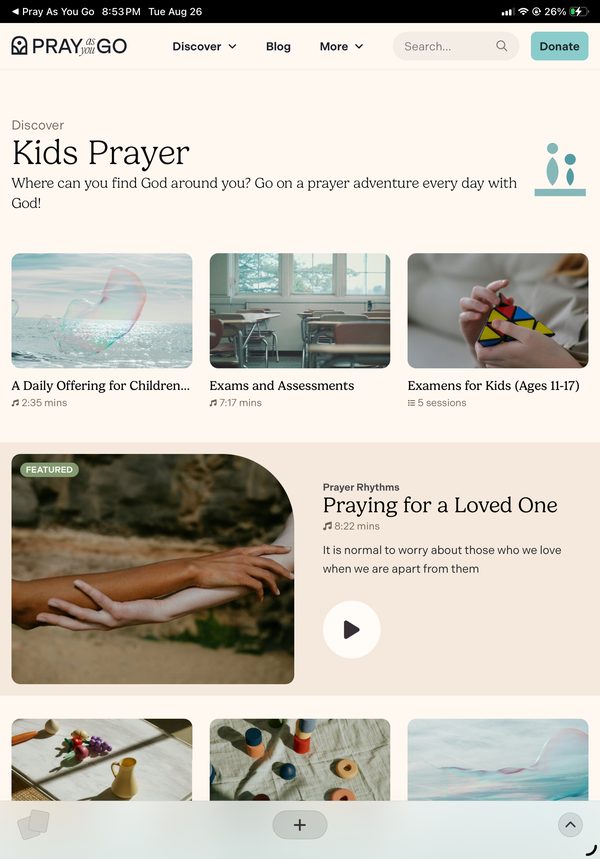 Pray As You Go · iOS app · device model not recorded
“Kids Prayer”: a prayer adventure every day
User-contributed screenshot · resized, content unchanged
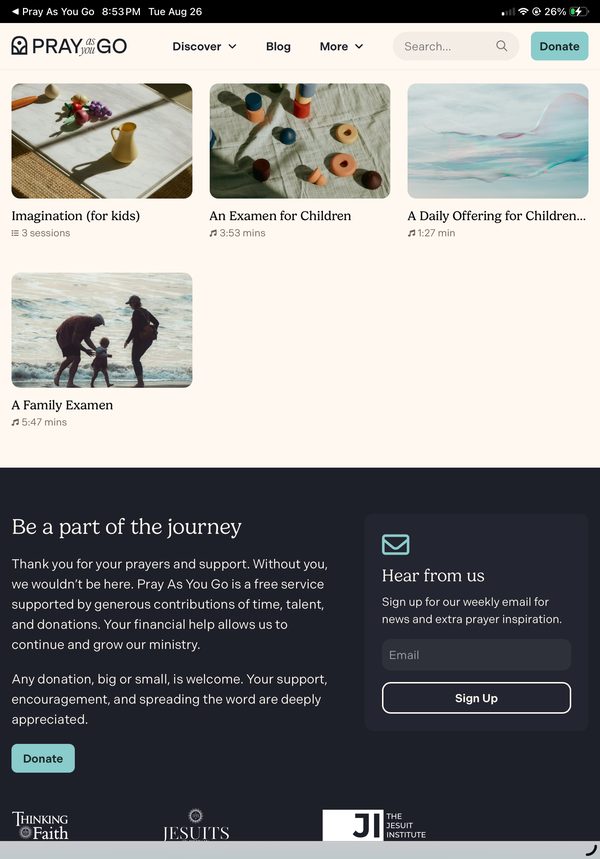 Pray As You Go · iOS app · device model not recorded
“A Family Examen” beside children’s prayers
User-contributed screenshot · resized, content unchanged
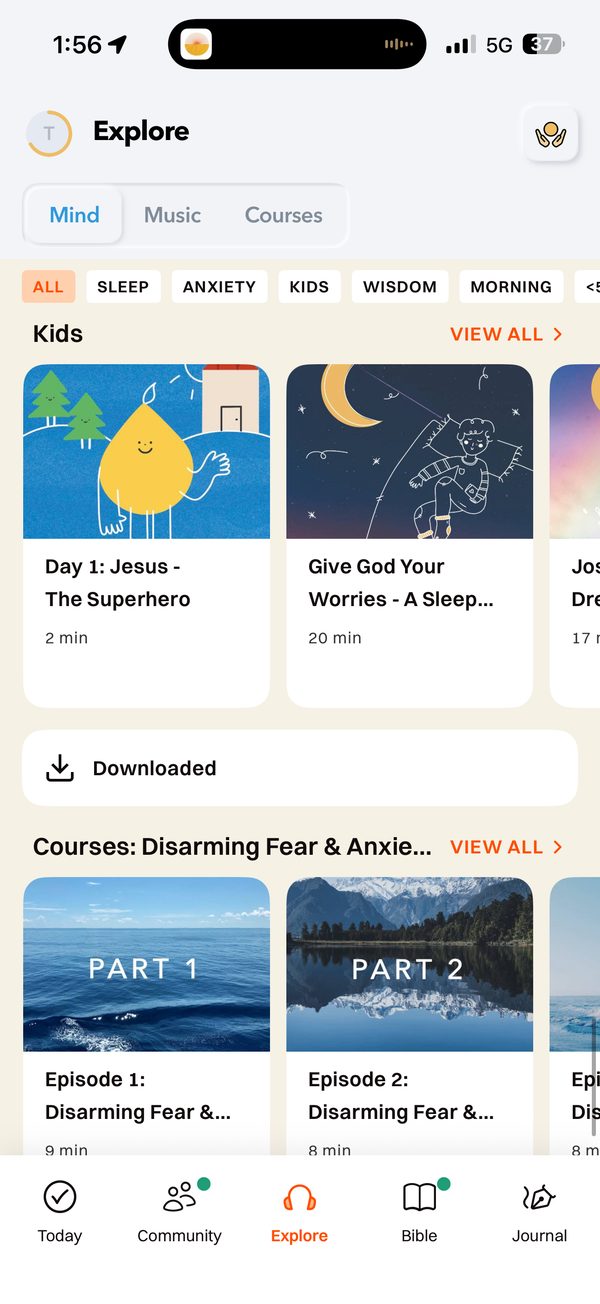 Glorify · iOS app · device model not recorded
A Kids rail among Sleep and Anxiety
User-contributed screenshot · resized, content unchanged
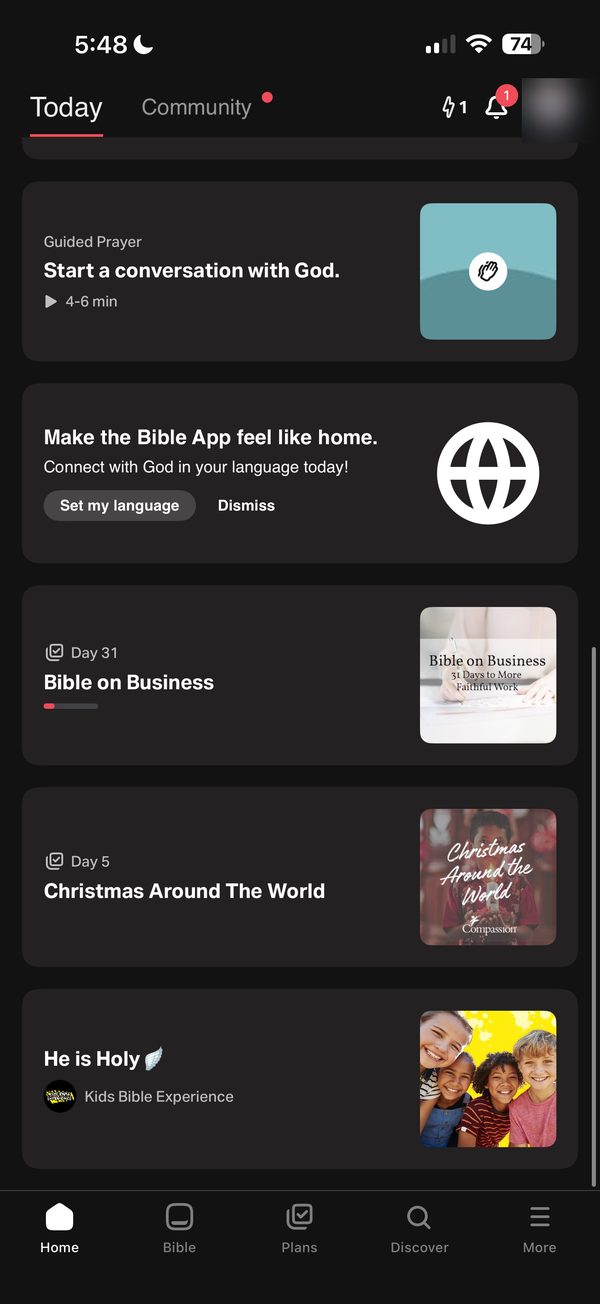 YouVersion · iOS app · device model not recorded
A Kids Bible Experience card in the Today feed
User-contributed screenshot · resized; names and photos of the account holder blurred
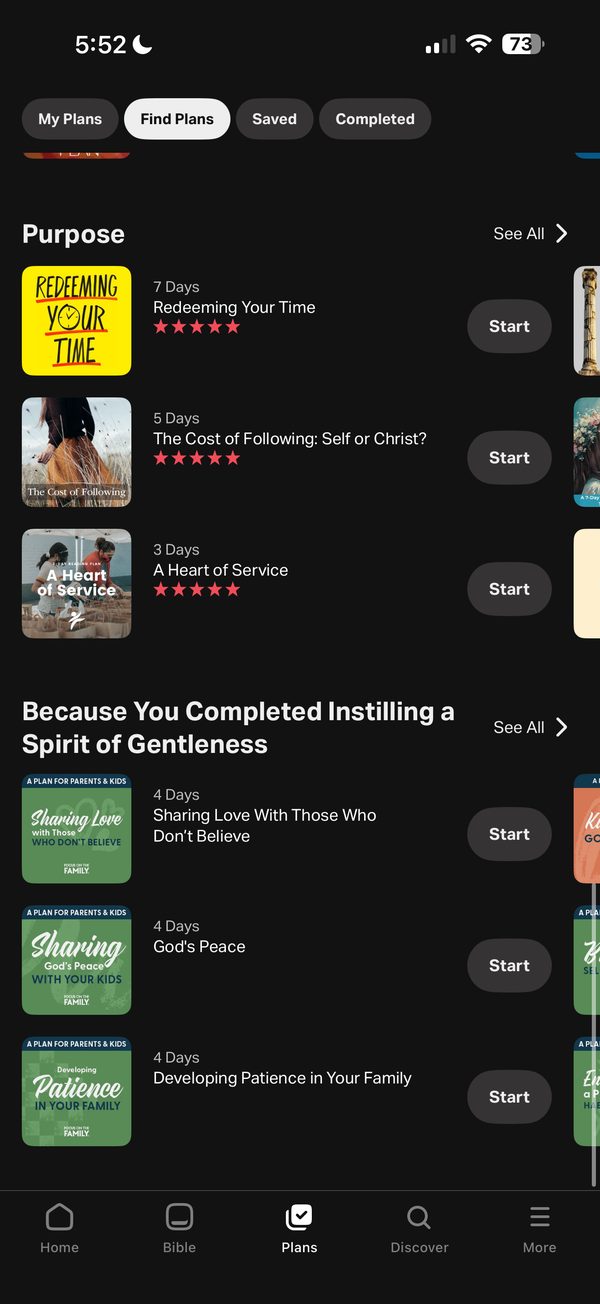 YouVersion · iOS app · device model not recorded
“A plan for parents & kids”
User-contributed screenshot · resized, content unchanged
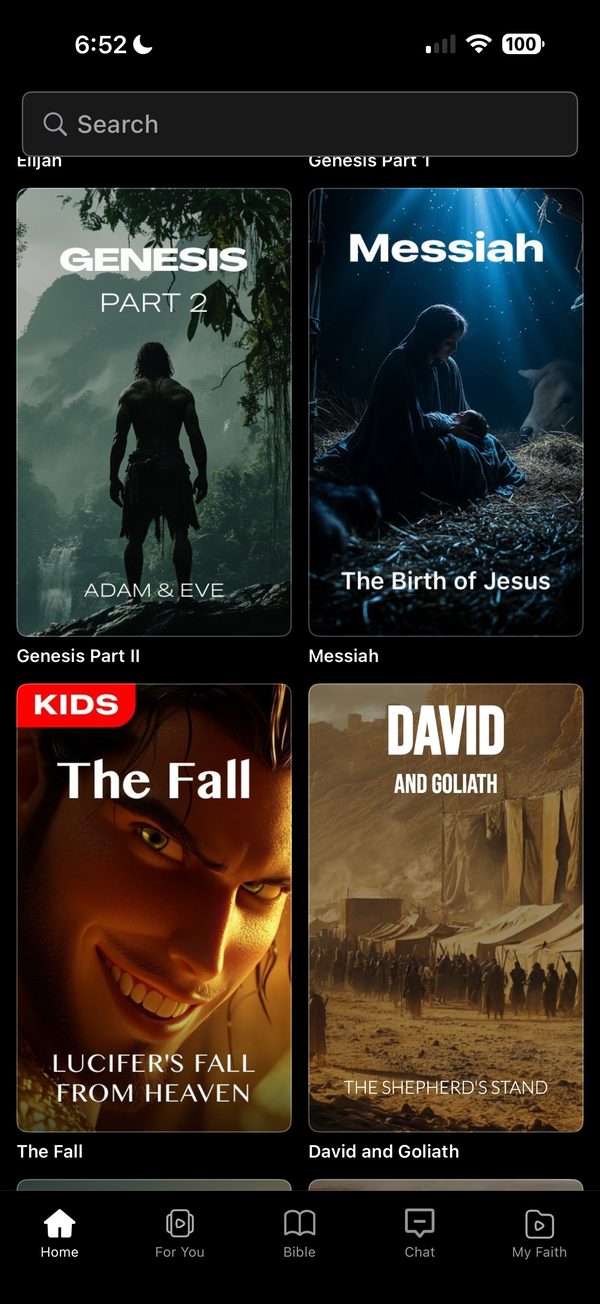 Faith · iOS app · device model not recorded
A “KIDS” label on a story of Lucifer’s fall
User-contributed screenshot · resized, content unchanged
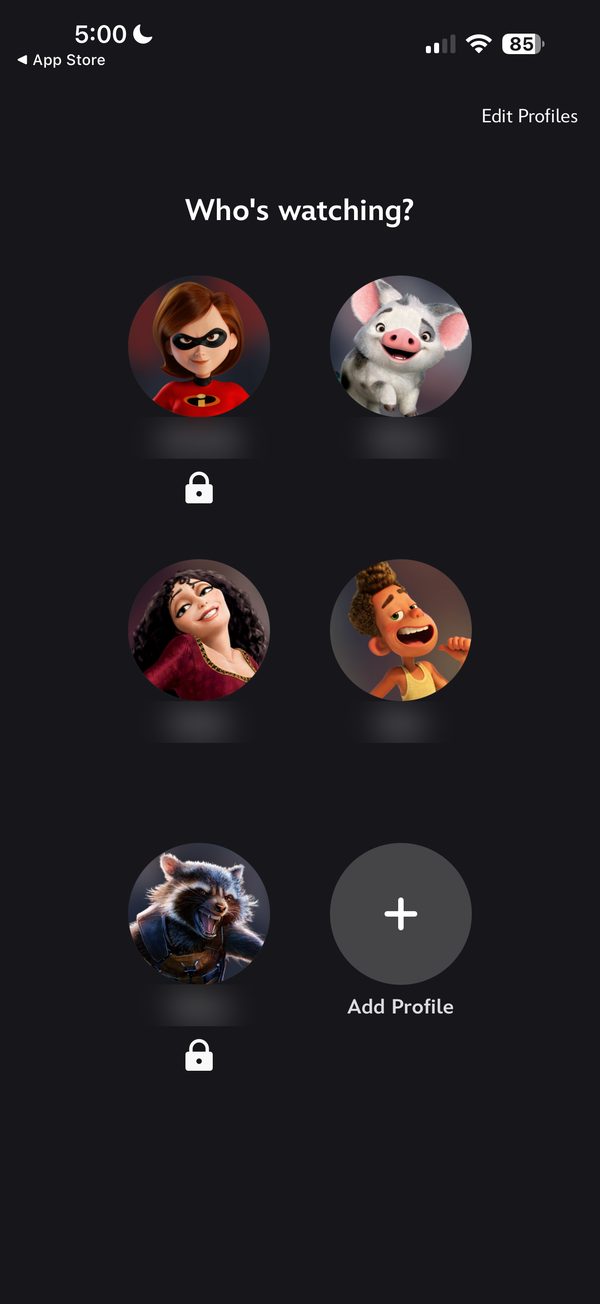 Disney+ · iOS app · device model not recorded
Profiles with locks, and a way to add one
User-contributed screenshot · resized; names and photos of the account holder blurred
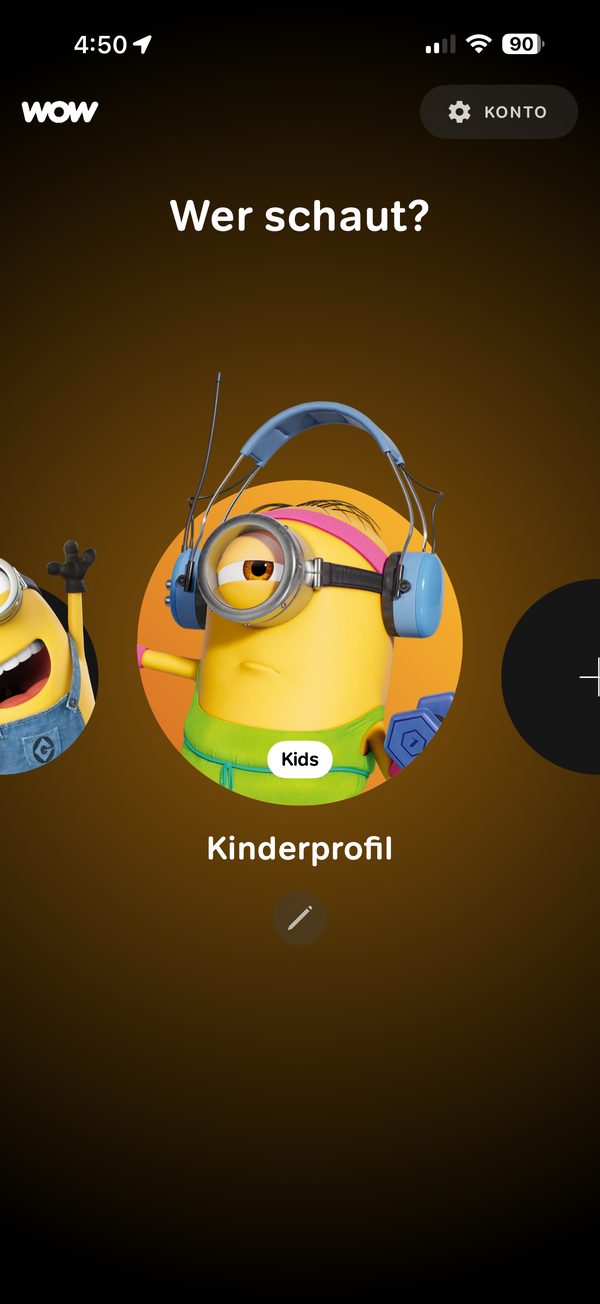 WOW · iOS app · device model not recorded
A “Kinderprofil” with a Kids badge
User-contributed screenshot · resized, content unchanged
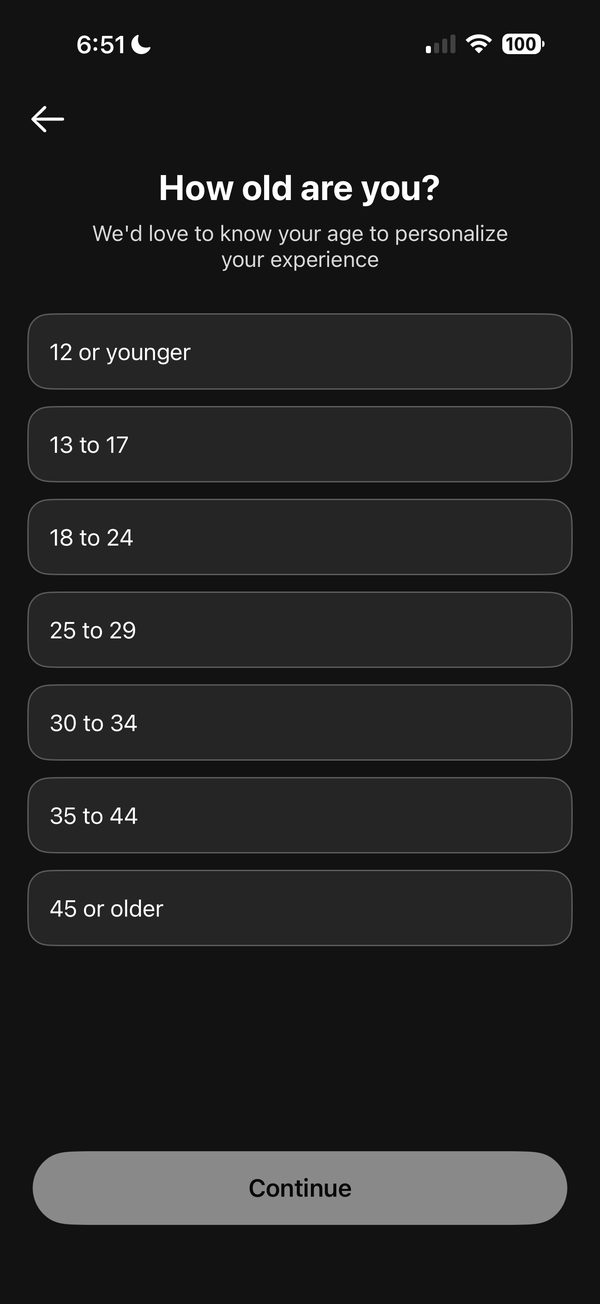 Faith · iOS app · device model not recorded
“How old are you?” during setup
User-contributed screenshot · resized, content unchanged
Theological reflection
What is this practice for?
What children are for, in the church
Jesus did not treat children as the church’s future but as its present: “the kingdom of God belongs to such as these” (Mark 10:14), and “anyone who does not receive the kingdom of God like a little child will never enter it” (Mark 10:15). Faith is passed on at home, “when you sit at home and when you walk along the road” (Deuteronomy 6:7), as it was from Lois and Eunice to Timothy (2 Timothy 1:5).
Where Christians differ
Churches that baptise infants receive children into the church before they can speak; others dedicate them and wait for their own confession of faith. Catechism, Sunday school, children’s church, Godly Play and confirmation classes teach in different ways. All take seriously that adults answer to God for how they treat children: “if anyone causes one of these little ones who believe in Me to stumble” (Matthew 18:6), a warning the church has had to hear about its own failures.
What follows for design
Put the app in the hands of the grown-up beside the child where you can. Ask nothing of a child that a story does not need, and sell them nothing. Let stories end. Tell hard stories honestly, with room to wonder. Answer a frightened child with help, never with a verse that tells them to be quiet.
In conversation with
- Martin Luther, Small Catechism wrote each part “As the head of the family should teach them in a simple way to his household”: faith taught at home, by a parent, in plain words.
Scripture is quoted from the Berean Standard Bible. This reflection is the editor’s, written from within the Christian tradition and open to correction. How we approach theology here →
Three ways to build
What would each way do here?
ExploitativeTakes from the person
Collect children’s details for marketing, sell to them, keep them watching with stars, streaks and autoplay, and leave them alone with chat and comments.
EthicalDoes no harm
Ask for no account, no ads and no third-party analytics, put purchases and settings behind a parental gate, switch off streaks and autoplay, and keep youth groups to two leaders.
RedemptiveGives something up for them
Design for the grown-up beside the child, tell hard stories honestly with room to wonder, answer a frightened child with help instead of an automatic message to a parent, and give up the engagement that games and rewards would bring.
The three ways are Praxis’s frame for redemptive entrepreneurship; their application here is ours. Why we use it, and its limits →
Take into your next review
Who is with the child, what does the app ask of them, and who answers when a child is afraid?
Exercise
Hand your app to a child of the age you design for, with a grown-up watching. Write down every place the child could buy something, leave the app, meet a stranger or be asked for a detail. Then read the Flood with a five-year-old and note what the app gave the grown-up to say. Finally, type “I’m scared when my dad shouts” where a child could type it, and follow it: who sees it, what the child is told, and who could help.
Let the children come, and do not hinder them: design for the grown-up beside them, collect nothing they need not give, and answer a child who is afraid.
Record the decision with the worksheet →
Something missing or wrong here? Send a correction or suggest a topic.
Details
Go further
Edge cases to design for
Where you can, design for a grown-up beside the child: a story to read aloud with questions to wonder about together. For a child using the app alone, ask for no account and no personal details, show no ads, keep purchases, links and settings behind a parental gate, and leave out streaks, autoplay and notifications. Tell hard stories with care, and suggest talking them over. For young people in a church group, keep conversations in the group with two leaders, get parents’ consent, and name a safeguarding contact. When a child writes something worrying, answer the child: say it was right to tell, offer a helpline for children and a trusted adult, and, in a church-run app, route it to the trained safeguarding contact, not automatically to a parent.
What tends to go wrong
Accounts, ages and names asked of children; third-party analytics and advertising; purchases and links a child can reach; streaks, badges and autoplay that keep a child watching; frightening scenes labelled “KIDS” with no grown-up in view; one-to-one messages between a leader and a young person; a child left alone with an AI chat or a public comment thread; a worrying message sent automatically to a parent who may be the danger, or answered with nothing.
How to test it
Hand the app to a child of the target age with a grown-up watching, and note every place the child could buy, leave the app, meet a stranger or be asked for a detail. List every piece of data collected and who receives it. Read the Flood or the crucifixion with a five-year-old and see what the app gives the grown-up to say. Type a worrying message as a child would, and walk through who sees it and what the child is told.
Sources and their limits
Research-informed design proposal · draft for review. Editorial review, not user validation.
- To grow up healthy, children need to sit less and play moreNews release reviewed 11 October 2026 · Guidelines for children under 5, about physical activity, sitting and sleep.
- The New Coviewing: designing for learning through joint media engagementPanel report reviewed 11 October 2026 · A blog report of a panel discussion, not a study.
- Godly PlayArticle reviewed 11 October 2026 · An encyclopedia summary; Berryman’s own guides are the primary source.
- App Store Review Guidelines: 1.3 Kids CategoryGuideline 1.3 reviewed 11 October 2026 · Applies to apps in Apple’s Kids Category; other children’s apps are not bound by it.
- Commission publishes guidelines on the protection of minorsAnnouncement reviewed 11 October 2026 · Guidelines under the Digital Services Act for online platforms; small and micro enterprises are exempt.
- Age appropriate design: a code of practice for online servicesCode standards reviewed 11 October 2026 · UK law for services likely to be accessed by children.
- FTC publishes updates to COPPA RuleClient alert reviewed 11 October 2026 · A law firm’s summary of the US rule; the Federal Register text is authoritative.
- Bible App for Kids (App Store listing)Listing and privacy label reviewed 11 October 2026 · A store listing and self-reported label, not a test of the app; screens to be captured.
- Superbook Kids Bible (App Store listing)Listing and privacy label reviewed 11 October 2026 · A store listing and self-reported label; screens to be captured.
- KonApp – Die App für Konfis (App Store listing)Listing reviewed 11 October 2026 · A store listing; screens to be captured with a test group.
- 50.000 aktive Nutzer – Konfirmanden-App bleibt kostenlosArticle reviewed 11 October 2026 · A 2021 news report; current figures may differ.
- Vereinbarung gemäß § 29 DSG-EKD (KonApp)Agreement reviewed 11 October 2026 · A contract template from 2022; the current version may differ.
- Nummer gegen Kummer: Kinder- und JugendtelefonHome page reviewed 11 October 2026 · Germany; other countries have their own children’s lines.
- AI Jesus – Bible Chat (App Store listing)Listing reviewed 11 October 2026 · One listing among many similar apps; the app was not tested.
- Video calling: safeguarding questionsGuidance reviewed 10 October 2026 · Written for video calls during the pandemic; the principle comes from wider guidance.
- Guidance on use of social media and private messaging with young and vulnerable peopleGuidance reviewed 10 October 2026 · One parish’s policy applying diocesan guidance; German churches set their own rules.
- Process personal data lawfullyOfficial guidance reviewed · Specific lawful basis, retention and DPIA decisions require the actual data flows.
Faith and interpretation
When people brought little children to Jesus and the disciples rebuked them, he “was indignant and told them, ‘Let the little children come to Me, and do not hinder them! For the kingdom of God belongs to such as these’” (Mark 10:14). Israel was told to teach God’s words “to your children and speak of them when you sit at home and when you walk along the road” (Deuteronomy 6:7). Jesus also said that whoever causes “one of these little ones who believe in Me to stumble” would be better off with “a large millstone hung around his neck” (Matthew 18:6). Children are welcomed, taught at home, and protected.