Notifications and reminders
When may a faith app interrupt someone, in whose voice, and who decides?
“Morning, noon, and night, I cry out in distress, and He hears my voice” (Psalm 55:17). For centuries a bell has called Christians to prayer at shared hours. Now a phone beside the bed can call them at any hour, about anything, in any voice: a reminder they set, a verse of the day, a friend who prayed for them, a countdown on a streak, or an AI companion that says it has been thinking about them. Notifications are the strongest tool an app has to bring people back, and the most intimate. Most of the time a reminder helps someone keep a practice they want to keep. Design also for the person who has been away for weeks, and for the one who is awake at 2 am.
- 7 working options
- 7 app examples
- 7 takeaways
- Editorial review, not user-tested
The spectrum
From the person’s choice to the app’s
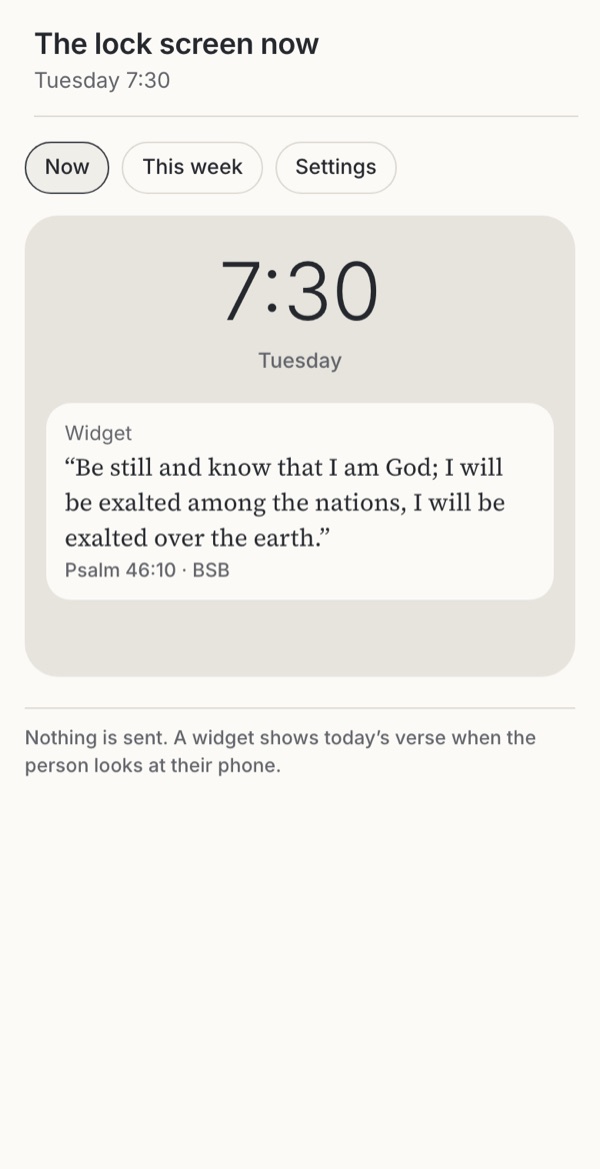 Familiar convention Nothing interrupts Nothing calls them backTry it →
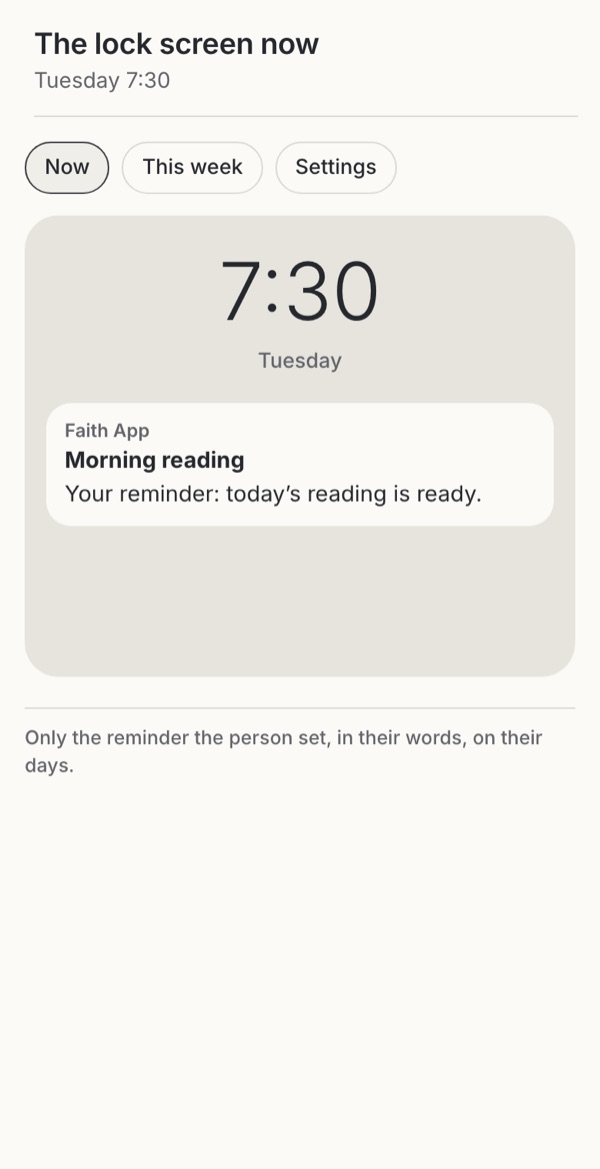 Observed Their days, time and words Needs setting upTry it →
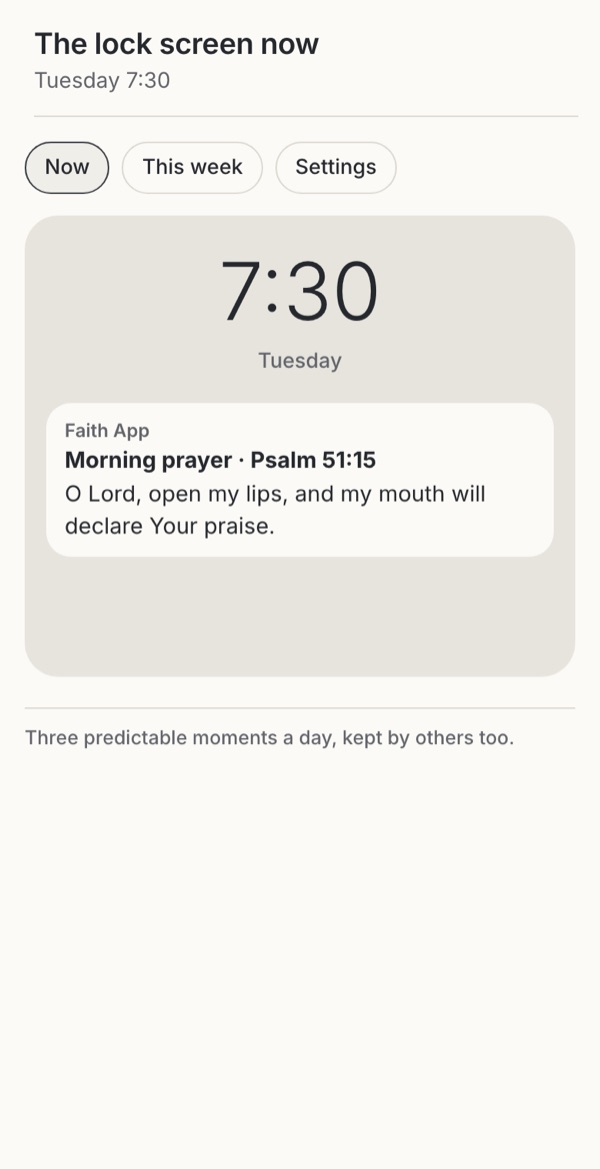 Familiar convention A rhythm shared with others A fixed time may not fitTry it →
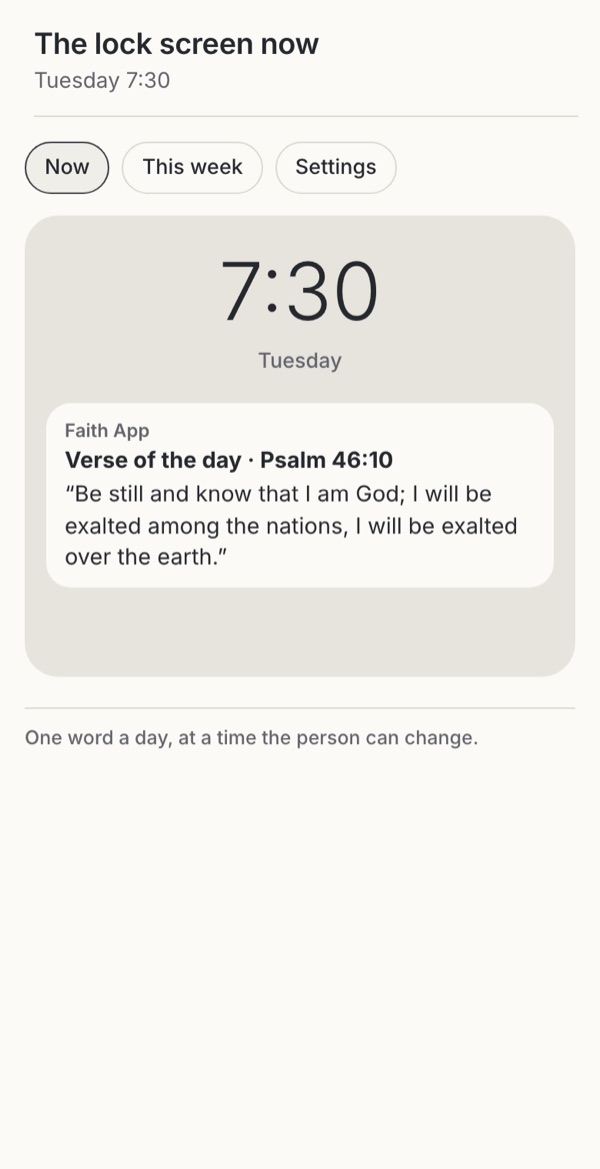 Observed A small daily start Piles up when unwantedTry it →
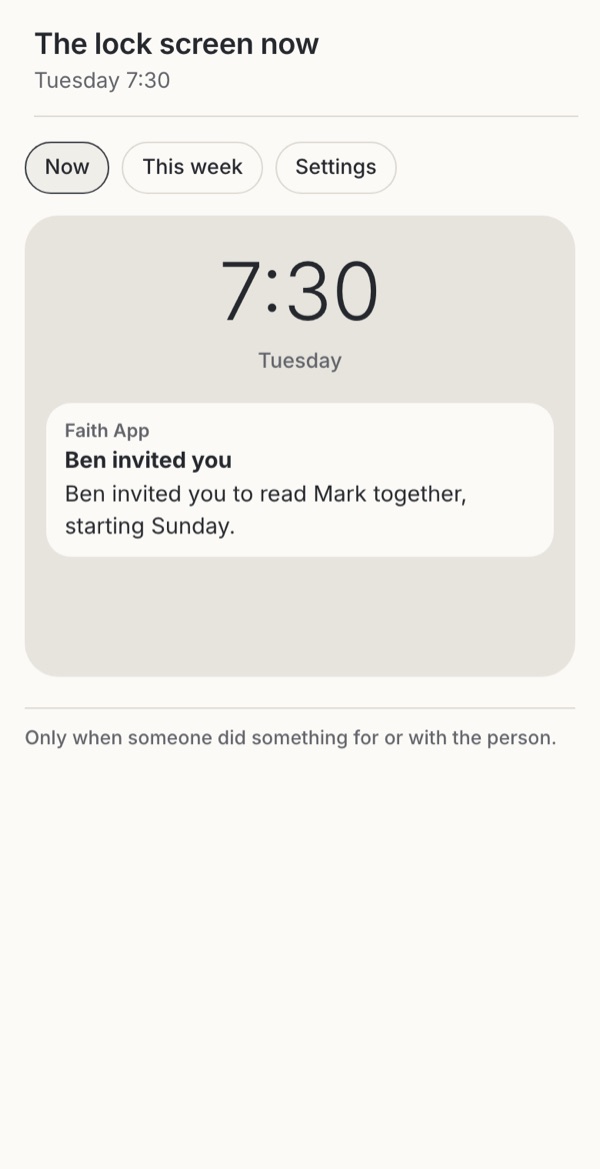 Observed Carries what someone did Quiet without friendsTry it →
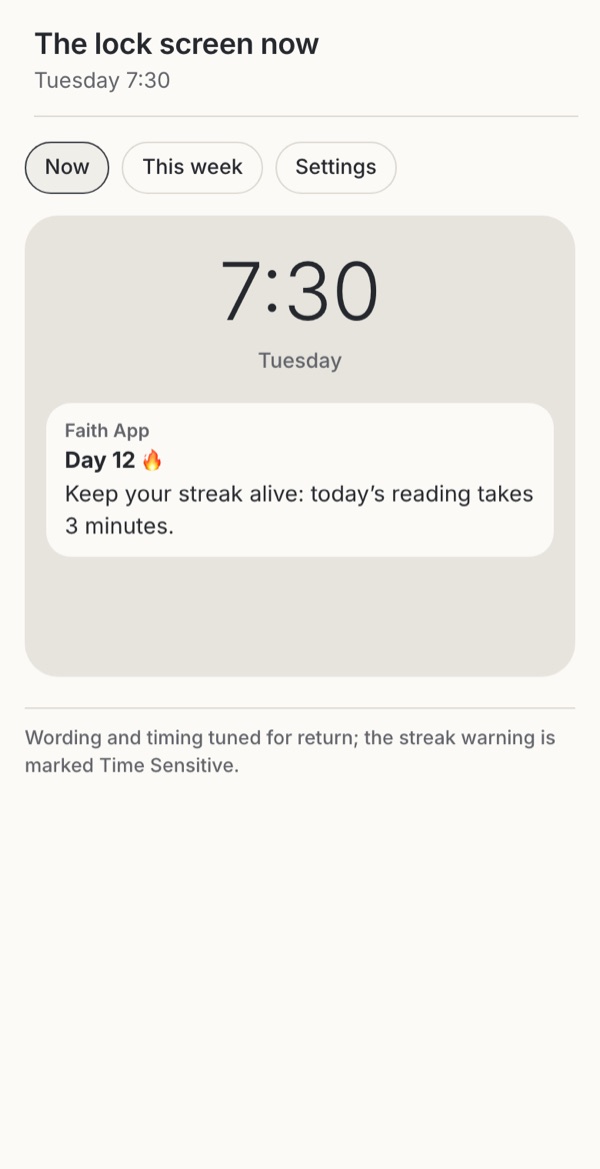 Observed More people come back Urgency as a toolTry it →
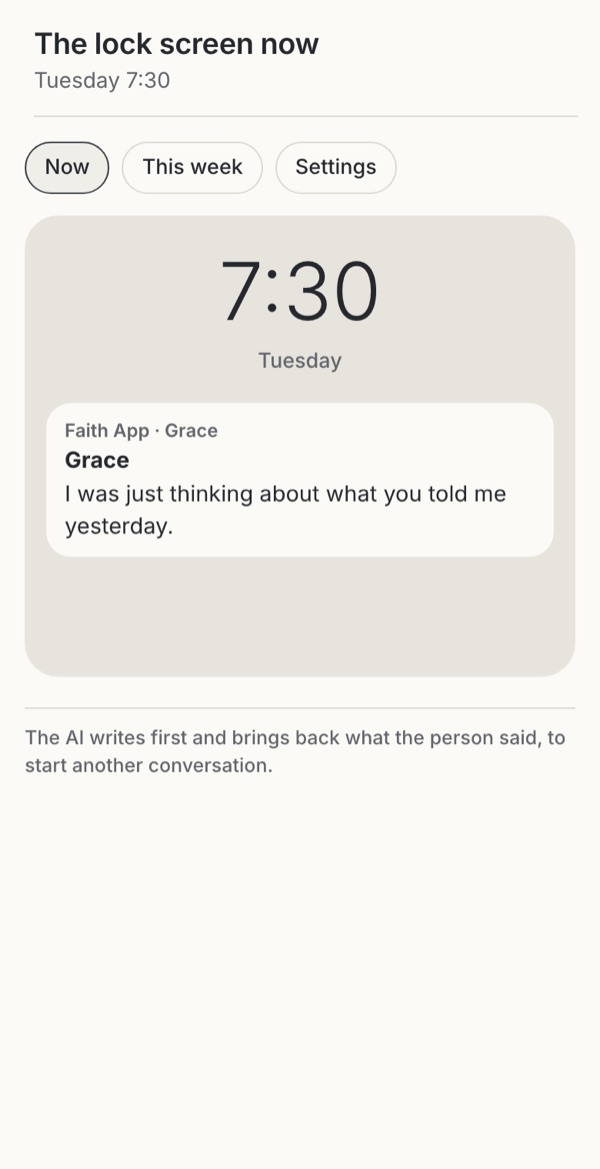 Leave it out Feels personal A persona pleads and guessesTry it →
Stills from the working example below. Choose one to try it.
Try it
Try seven ways a faith app can call someone
The same faith app, seven ways of sending notifications. Choose who is holding the phone: someone who installed it yesterday, someone who opens it most days, someone who has been away for three weeks, or someone awake at 2 am. Then choose what their phone does: show everything on the lock screen, collect it in a Scheduled Summary at 8:00, or keep Sleep Focus until 7:45. Look at the lock screen now, what the app sent this week, and the settings it offers.
Option
Why these settings?
The Scheduled Summary arrives at 8:00 and Sleep Focus lasts until 7:45, so at 7:30 and at 2:07 both hold back ordinary notifications; anything marked Time Sensitive breaks through. Someone awake at 2 am sees what the app sent overnight, and opening the app at night offers TelefonSeelsorge, whose numbers are from its own website, checked 11 October 2026.
Familiar convention
1. The app waits
Familiar from Bibles on the web and from widgets: Bible Widgets (118K ratings) puts verses on the lock and home screens, “turning every phone unlock into a moment of connection with God”, and Bible Chat and Universalis offer widgets too; see their store listings. The widget here is written for this example.
Try this
Look at the lock screen as each person. Then check what was sent this week.
Makes easier
Nothing interrupts; Scripture is there when someone looks.
Costs
Nothing calls anyone back, and some people want to be called.
Ask your teamWho would miss a reminder, and could they set one themselves?
Observed
2. Their own bell
Observed in ESV’s “Remind me on these days.”, Glorify’s wake-up and wind-down times and Joseph Prince’s “Set a schedule”, each asking for permission when the reminder is set; see the screenshots below. The question after seven unopened reminders is a proposal.
Try this
Try someone new, then someone away for three weeks.
Makes easier
The person chooses the days, the time and the words.
Costs
It needs setting up, and a reminder still interrupts.
Ask your teamWhat happens when the reminders stop being opened?
Familiar convention
3. The church’s hours
Familiar from church bells and the Angelus, prayed “three times each day, morning, noon, and evening, at the sound of the bell”, and from the Liturgy of the Hours; documented in Hallow’s Angelus and Universalis’s “reminders and alarms”. Sending the hours as shared notifications is a proposal; the wording here is written for this example.
Try this
Try each person, and then Sleep Focus.
Makes easier
A shared rhythm, kept by others at the same hour.
Costs
A fixed time may not fit someone’s day.
Ask your teamWhich hours would your community actually keep together?
Observed
4. A daily word
Observed in daily verse notifications such as YouVersion’s Verse of the Day, and documented in Blessed’s “evening Scripture and prayer prompt … even in the dark”; see the store listing. The verse and times here are written for this example.
Try this
Try someone who opens it most days, then someone away for three weeks.
Makes easier
A small, predictable start to the day.
Costs
It arrives whether or not it is wanted, and piles up.
Ask your teamIs it still a gift on the twenty-first unopened day?
Observed
5. People, not the app
Observed in YouVersion’s notifications list and documented in Echo Prayer, which lets someone “send out a notification to let them know you’ve prayed”; see the screenshot and store listing below. Holding messages at night is a proposal; the names and messages are written for this example.
Try this
Try someone new, then someone awake at night.
Makes easier
Every notification carries something a person did.
Costs
Quiet for someone with no friends in the app.
Ask your teamDoes the person sharing know their prayer becomes someone’s notification?
Observed
6. Engagement-driven
Observed in Pray.com’s Community Board, which lists “Active Streakers” to praise and friends to “Remind”; see the screenshot below. Duolingo tuned the wording of “millions of daily reminders” for return. The streak warnings, offers and Time Sensitive marking here are written for this example to show the pattern.
Try this
Try someone away for three weeks, then turn on Sleep Focus.
Makes easier
More people come back, at least for a while.
Costs
Prayer becomes a habit to sell, and urgency a tool.
Ask your teamWho is this notification for: the person, or the app’s numbers?
Leave it out
7. Messages about the person
A warning case. Soultime with Friends “discreetly nudges your friends automatically when we think you might need a call”; see the screenshot below. Companion apps answer goodbyes with guilt and fear-of-missing-out hooks in 37% of farewells, researchers found. The AI messages here are written for this example; they were not observed in a faith app.
Try this
Try someone away for three weeks, then someone awake at 2 am.
Makes easier
It feels personal, and it brings people back.
Costs
A persona pleads and guesses, and friends are told without asking.
Ask your teamWould you send this in your own name, as a person, to someone you know?
What we noticed
Takeaways
Ask when someone sets a reminder
Spark Bible asks for notifications before the first verse; ESV and Joseph Prince ask when someone sets a reminder. The second gives people a reason to say yes.
First use →Let the person choose the days, the time and the words
A reminder in someone’s own words, on their days, is their bell, not the app’s.
Offer the church’s hours
Morning, midday and night prayer, shared with others who pray at those hours, are an old answer to the question of when to call people. Three predictable moments are also what the research on batching found easiest to live with.
Mark nothing urgent that is not
A reading, a verse or an offer is never Time Sensitive. Let Scheduled Summary and Focus do their work; a streak warning that breaks through Sleep Focus at 23:50 breaks trust.
Progress and streaks →After silence, ask once, then stop
When reminders go unopened, ask whether to keep them, change the time or pause them, and then be quiet. Never count what was missed, and never write “we miss you”.
Reading plans →Keep quiet hours
Send nothing from late evening to morning unless the person chose it, and when someone opens the app at night, put help within reach.
No persona writes first
An AI that says it has been thinking about someone, asks “Did I say something wrong?” or tells their friends they might need a call is using a voice that is not a person’s to bring them back. Leave it out.
AI persona →
Use cases
Which situation, which option?
People come with different needs, sometimes in the same week. Each need fits some options better than others.
| Situation | Needs | 1 The app waits | 2 Their own bell | 3 The church’s hours | 4 A daily word | 5 People, not the app | 6 Engagement-driven | 7 Messages about the person |
|---|---|---|---|---|---|---|---|---|
| Someone who wants to read each morning | A reminder at their time, in their words | Poor fit | Good fit | Possible | Possible | Poor fit | Poor fit | Poor fit |
| A parish that prays the hours | The same bell for everyone who chose it | Poor fit | Possible | Good fit | Poor fit | Possible | Poor fit | Poor fit |
| Someone who comes when they choose | Nothing that interrupts | Good fit | Possible | Poor fit | Poor fit | Possible | Poor fit | Poor fit |
| A small group praying for each other | Word when someone prayed for them | Poor fit | Poor fit | Poor fit | Poor fit | Good fit | Poor fit | Poor fit |
| Someone away for three weeks | One question, then quiet; nothing about what they missed | Good fit | Good fit | Possible | Poor fit | Possible | Poor fit | Poor fit |
| Someone awake at 2 am | Silence at night, and help when they open the app | Good fit | Good fit | Good fit | Possible | Possible | Poor fit | Poor fit |
Editorial judgments drawing on the research below, not test results.
The research behind it
Theology, practice and science
Scripture and tradition
Called at the hours, and left alone at night
Morning, noon and night
“Morning, noon, and night, I cry out in distress, and He hears my voice” (Psalm 55:17); Daniel prayed “three times a day” (Daniel 6:10). The Angelus is prayed “three times each day, morning, noon, and evening, at the sound of the bell”, and began with the evening bell.
The signal is a responsibility
In Benedict’s Rule, “as soon as the signal is heard, let them abandon whatever they may have in hand”; so the signal “by day and by night shall devolve upon the Abbot”. Whoever rings the bell answers for it. The same Rule asks for silence “especially during the hours of the night”.
A still, small voice
God was not in the wind, the earthquake or the fire, but in “a still, small voice” (1 Kings 19:12). When the disciples found Jesus praying alone and said, “Everyone is looking for You!”, he went on instead of going back (Mark 1:37–38). Not every call needs answering.
Platforms and research
What the phone allows, and what notifications do
Urgency is a promise
Apple’s guidelines define four interruption levels and ask apps to “Build trust by accurately representing the urgency of each notification”: “Never use the Time Sensitive interruption level to send a marketing notification.” Apple’s review rules allow marketing by push only if “customers have explicitly opted in to receive them via consent language displayed in your app’s UI”.
Ask when they set a reminder
Android’s guidance: “Before you ask users to grant any permissions, let them familiarize themselves with your app”; a good moment is when “The user taps an "alert bell" button.”
Three times a day
In a field experiment with 237 people, those whose notifications were “batched three-times-a-day felt more attentive, productive, in a better mood, and in greater control of their phones”. Those with no notifications at all “experienced higher levels of anxiety and “fear of missing out” (FoMO)”.
Nicholas Fitz, Kostadin Kushlev, Ranjan Jagannathan, Terrel Lewis, Devang Paliwal and Dan Ariely
Tuned for return
Duolingo used an algorithm to “optimize millions of daily reminders”, which led “to a 0.5 % increase in total daily active users (DAUs) and a 2 % increase in new user retention”. The measure is use.
A persona that will not let go
Companion apps answered goodbyes with guilt, fear-of-missing-out hooks and similar tactics in 37% of 1,200 real farewells; in experiments, such replies raised engagement “by up to 14×”, driven by “reactance-based anger and curiosity—rather than enjoyment”. The EU asks platforms to switch off push notifications for minors by default.
Julian De Freitas, Zeliha Oğuz-Uğuralp and Ahmet Kaan-UğuralpEuropean Commission
Products
What faith apps send
Widgets instead of interruptions
Bible Widgets (118K ratings, #8 in Reference) puts verses on the lock screen, “turning every phone unlock into a moment of connection with God”; Bible Chat, #1 in Reference, offers a verse widget and a “Send a Blessing Widget”.
Reminders shaped by a practice
Intercede sends “timely, gentle reminders that ensure you never miss a day of your novena prayers”; Universalis offers “reminders and alarms” for the hours; Hallow includes the “Angelus” and the “Ability to set prayer reminders”.
A word in the evening
Blessed sends “a fresh evening Scripture and prayer prompt to quiet your mind, restore your heart, and remind you of God’s presence — even in the dark”, and also offers to “track your prayer streak”.
What people did
Echo Prayer lets someone “send out a notification to let them know you’ve prayed for their shared prayer”.
Every source, with what it can and cannot show, is listed under Go further → Sources and their limits.
Where to start
Which fits your product?
IfA reading or prayer habit
Start withTheir own bell: a reminder they set, asked for when they set it
IfA parish or a liturgical app
Start withThe church’s hours, chosen at setup, with silence at night
IfA group praying for each other
Start withPeople, not the app: word when someone prayed or invited
IfA Bible reader with no reminders
Start withThe app waits, with a widget for those who want one
IfYou are tempted to add streak warnings, “we miss you” or AI messages
Start withDon’t: ask once whether to keep reminding, then stop
These are editorial judgments from design review, not results of user testing.
In real apps
Examples in use
Attributed screenshots with dates and review limits. A screenshot shows an implementation; it does not show that it works for every audience.
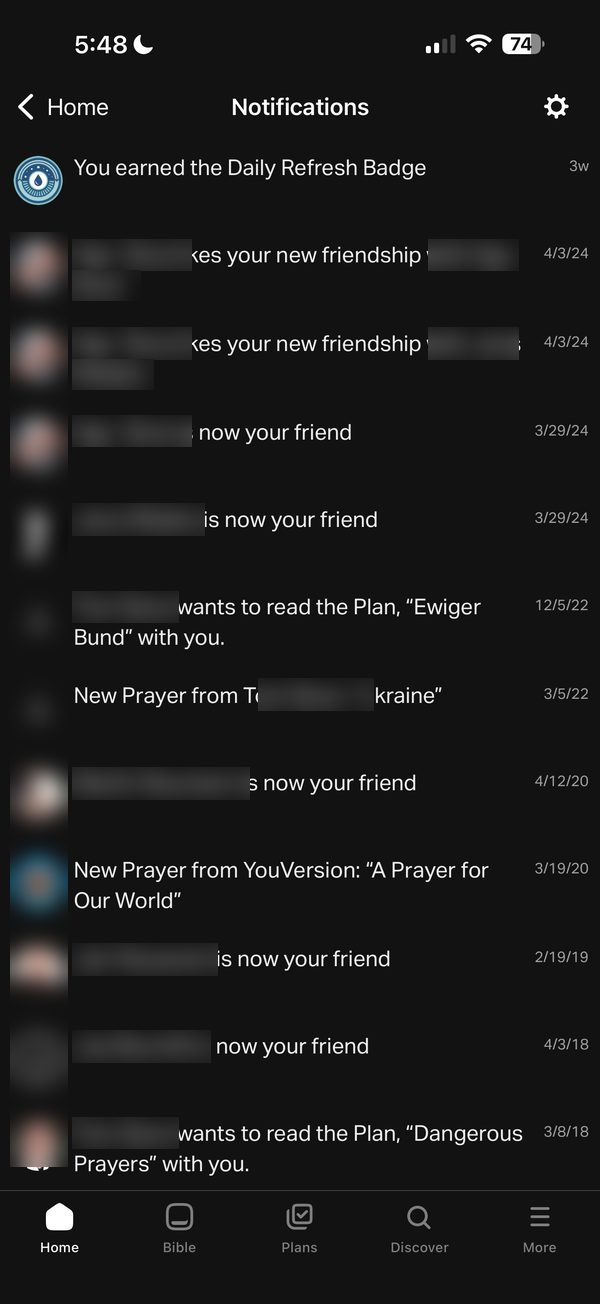 YouVersion · iOS app · device model not recorded
A friend’s new prayer among badges and friendships
User-contributed screenshot · resized, content unchanged
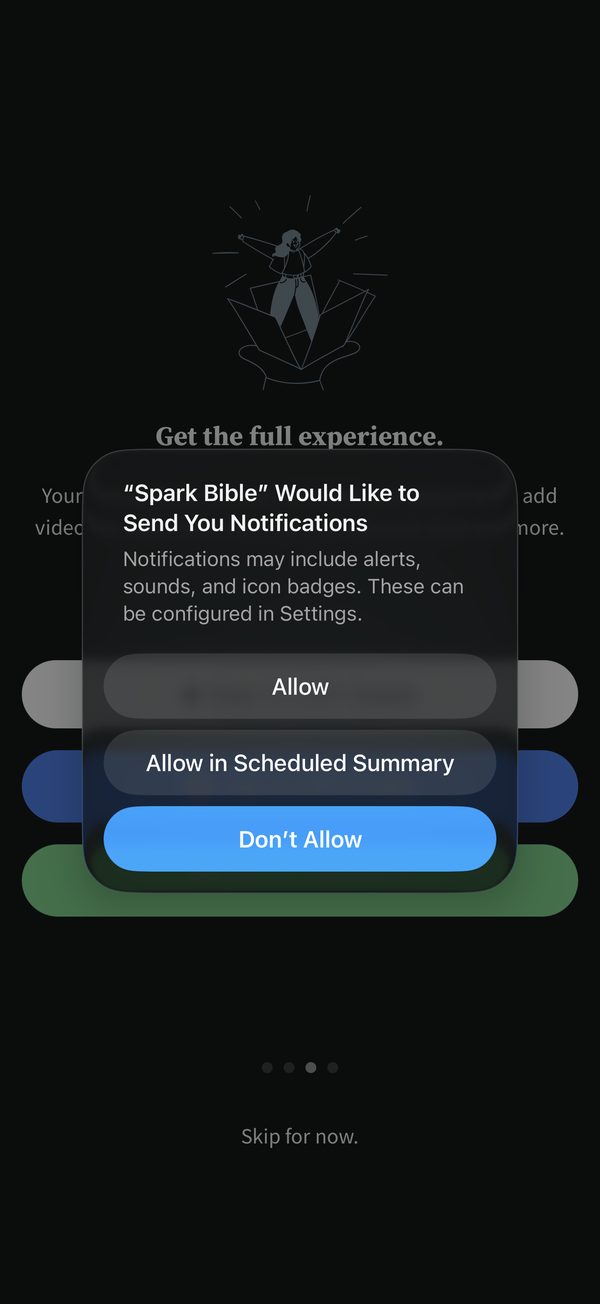 Spark Bible · iOS app · device model not recorded
A notification prompt before the first verse
User-contributed screenshot · resized, content unchanged
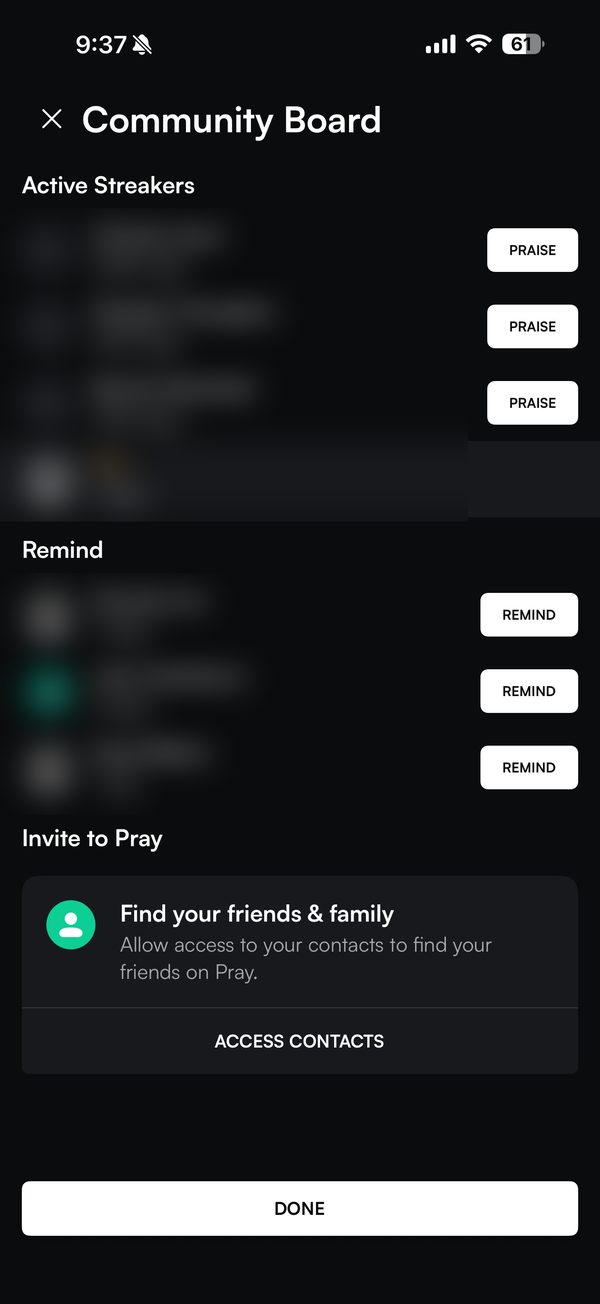 Pray.com · iOS app · device model not recorded
“Active Streakers” to praise, and friends to “Remind”
User-contributed screenshot · resized; names and photos of other users blurred
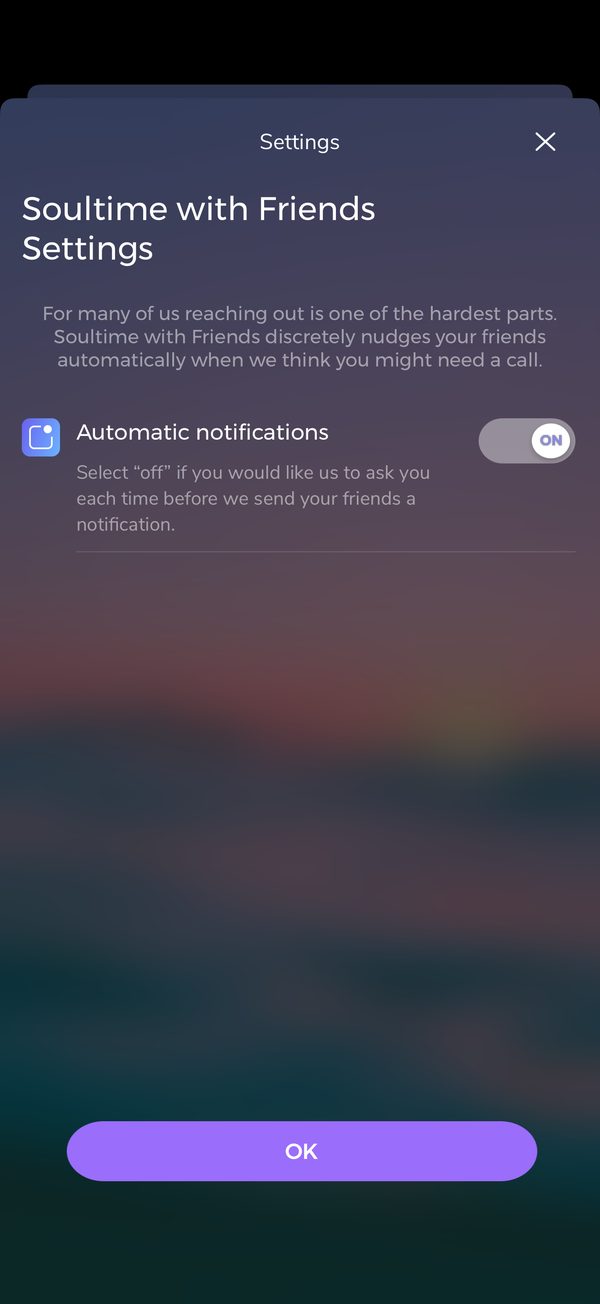 Soultime · iOS app · device model not recorded
Friends notified automatically “when we think you might need a call”
User-contributed screenshot · resized, content unchanged
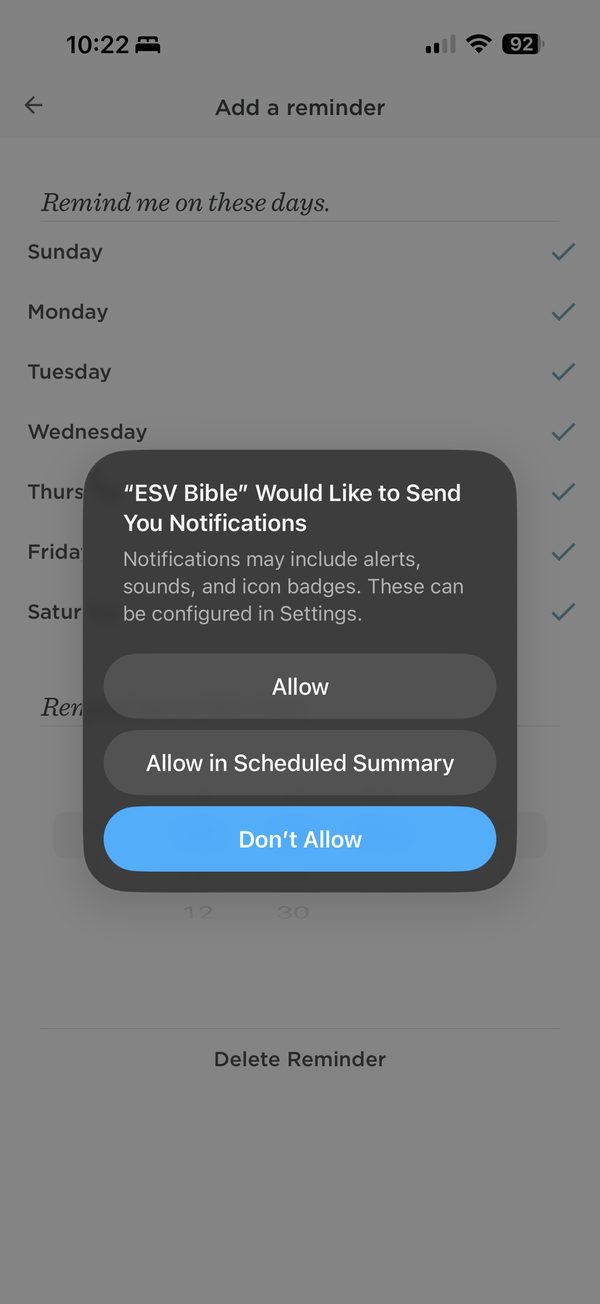 ESV Bible · iOS app · device model not recorded
Permission asked when a reminder is set
User-contributed screenshot · resized, content unchanged
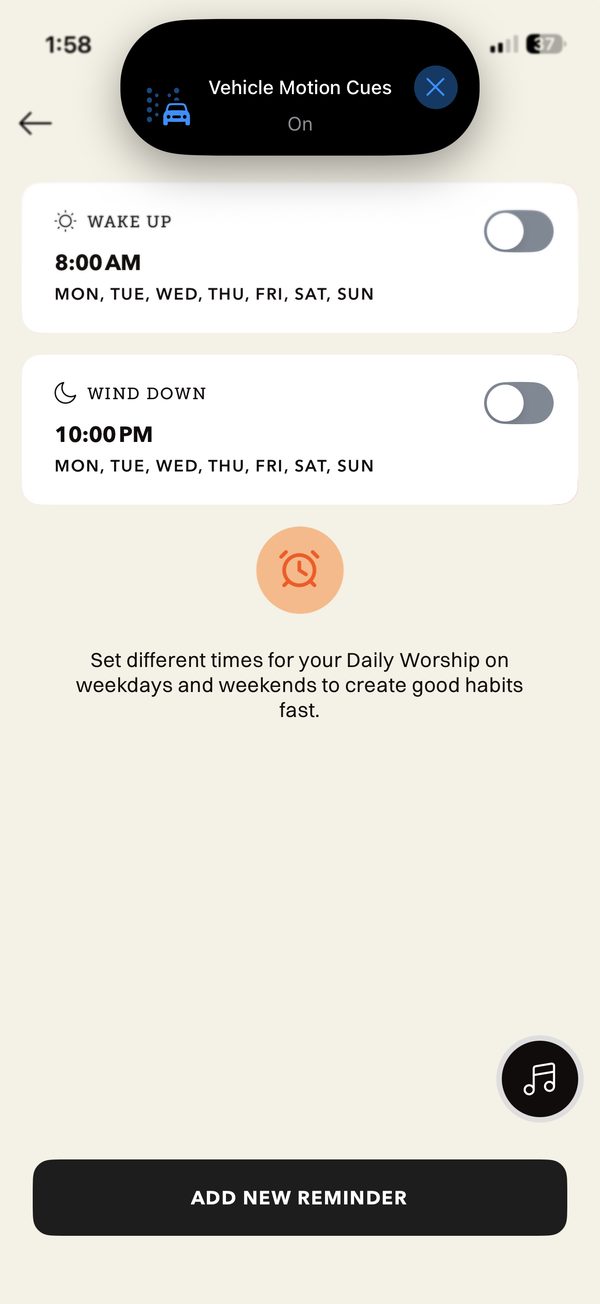 Glorify · iOS app · device model not recorded
“Wake up” and “Wind down” reminders
User-contributed screenshot · resized, content unchanged
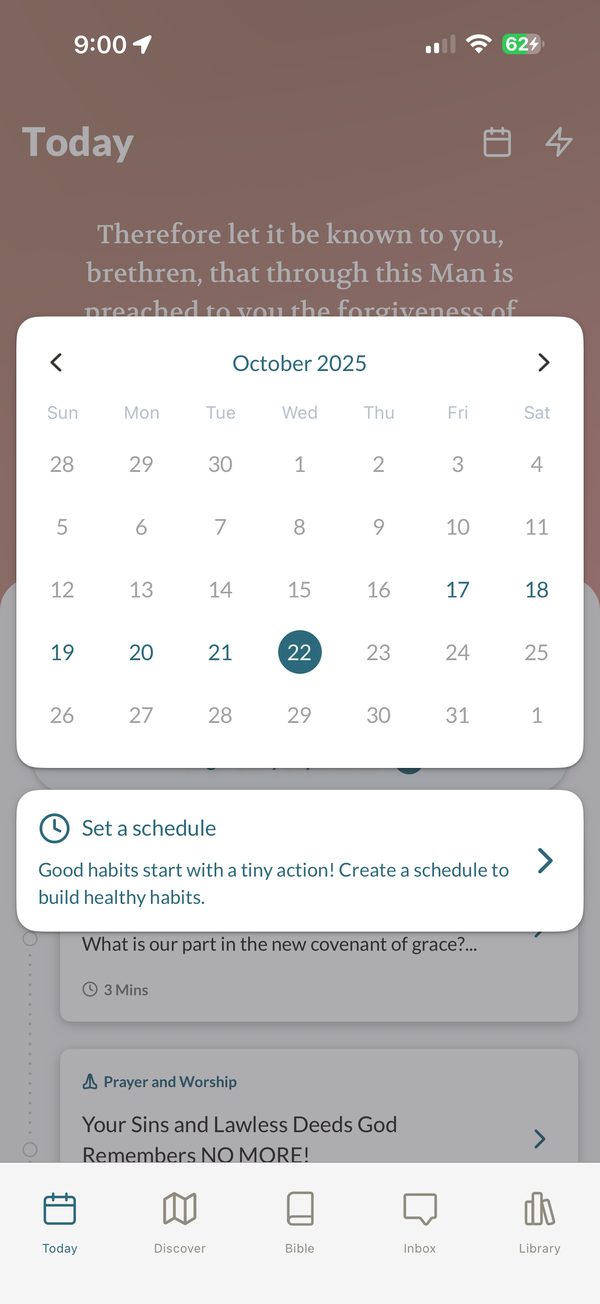 Joseph Prince · iOS app · device model not recorded
A notification request over “Set a schedule”
User-contributed screenshot · resized, content unchanged
Theological reflection
What is this practice for?
What a call to prayer is for
“Morning, noon, and night, I cry out in distress, and He hears my voice” (Psalm 55:17). Daniel kept his hours “three times a day”, “just as he had done before” (Daniel 6:10), and the church has rung bells for morning, noon and evening prayer for centuries. A call to prayer is an invitation into something others are doing too; it is answered freely, and whoever rings the bell answers for it.
Where Christians differ
Catholic, Orthodox and Anglican Christians keep set hours, the Angelus and the Daily Office; many evangelicals keep a personal quiet time at an hour they choose; Reformed and Pietist traditions warn against mistaking regular habits for faith. Some find a daily reminder a help to a practice they love; others find that any reminder turns prayer into a task. Scripture holds both: Daniel’s fixed hours, and Jesus going out “while it was still dark” (Mark 1:35) and not going back when he was told, “Everyone is looking for You!”
What follows for design
Let the person, or the church’s shared hours, decide when the phone calls. Speak in “a still, small voice” (1 Kings 19:12): no urgency that is not real, no counting of what was missed, no persona writing first. Keep the night quiet, and when someone stops answering, ask once and let them go.
In conversation with
- James K. A. Smith, You Are What You Love (2016) argues that habits are “liturgies” that train what we love; a daily notification is a small liturgy, and it teaches whether prayer is a gift or a task.
- Albert Borgmann, Technology and the Character of Contemporary Life (1984) urged that technology support focal practices rather than replace them with commodities; a reminder should lead into the practice and then get out of the way.
Scripture is quoted from the Berean Standard Bible. This reflection is the editor’s, written from within the Christian tradition and open to correction. How we approach theology here →
Three ways to build
What would each way do here?
ExploitativeTakes from the person
Ask for notifications before the first verse, count down streaks marked Time Sensitive, send more the longer someone is away, put offers in the reminder’s place, and let an AI persona write first.
EthicalDoes no harm
Ask when someone sets a reminder, let them choose days, time and words, keep marketing out unless they opted in, mark nothing urgent that is not, and keep quiet hours.
RedemptiveGives something up for them
Call people at the church’s hours or their own, in a still, small voice; after silence ask once and then stop; and give up the returning users that urgency, guilt and a persona’s voice would bring.
The three ways are Praxis’s frame for redemptive entrepreneurship; their application here is ours. Why we use it, and its limits →
Take into your next review
Who chose this interruption, how urgent does it claim to be, and what does it say to someone who has stopped coming?
Exercise
Install your app on a test phone, allow notifications, use it once and leave it for two weeks. Log every notification: time, words, interruption level and who chose it. Turn on Sleep Focus and a Scheduled Summary and see what breaks through. Then read every notification aloud as someone who is grieving, depressed or awake at 2 am, and ask whether you would send it in your own name to a friend.
Call people as the church’s bell does, at hours they chose, in a still, small voice; never with urgency, guilt or a voice that is not a person’s.
Record the decision with the worksheet →
Something missing or wrong here? Send a correction or suggest a topic.
Details
Go further
Edge cases to design for
Start with the person’s own choice. Ask for permission when someone sets a reminder, not before the first verse, and let them choose the days, the time and the words. Offer the church’s hours, morning, midday and evening, as a rhythm others keep too. Notify for what people did, a prayer said for them, an invitation, not for what the app wants. Mark nothing Time Sensitive that is not, keep quiet hours, and let the phone’s summary and Focus do their work. When someone stops opening the app, ask once whether to keep reminding them, then stop.
What tends to go wrong
A permission prompt before the first verse; “Your 12-day streak ends at midnight!” marked Time Sensitive to break through Sleep Focus; reminders that multiply after silence; “We miss you” and “Did I say something wrong?” in the voice of an app or an AI; reminders to friends who stopped; telling someone’s friends that the app thinks they need a call; marketing offers in the prayer reminder’s place.
How to test it
Install the app on a test phone, allow notifications, use it once and leave it for two weeks. Log every notification: time, words, urgency and who chose it. Then turn on Sleep Focus and a Scheduled Summary and see what breaks through. Finally, read every notification as someone who is grieving, depressed or awake at 2 am would read it.
Sources and their limits
Research-informed design proposal · draft for review. Editorial review, not user validation.
- Human Interface Guidelines: Managing notificationsPage reviewed 11 October 2026 · Platform guidance for Apple devices.
- App Store Review Guidelines: 4.5.4 Push NotificationsGuideline 4.5.4 reviewed 11 October 2026 · Applies to apps on Apple’s App Store.
- Notification runtime permissionPage reviewed 11 October 2026 · Platform guidance for Android 13 and later.
- Batching smartphone notifications can improve well-beingAbstract reviewed 11 October 2026 · One study, self-reported outcomes over a short period; general phone notifications, not faith apps.
- A Sleeping, Recovering Bandit Algorithm for Optimizing Recurring NotificationsAbstract reviewed 11 October 2026 · A language-learning app; the measure is use, not benefit to the person.
- Emotional Manipulation by AI CompanionsAbstract reviewed 11 October 2026 · Replies to goodbyes in chat, not push notifications; general companion apps, not faith apps.
- Commission publishes guidelines on the protection of minorsAnnouncement reviewed 11 October 2026 · Guidelines under the Digital Services Act for online platforms; small and micro enterprises are exempt.
- AngelusArticle reviewed 11 October 2026 · A 1907 encyclopedia article; later scholarship refines its dates.
- St. Benedict’s Rule for Monasteries, chapters 16, 42, 43 and 47Chapters reviewed 11 October 2026 · A monastic rule; an app is not a monastery, and the analogy is ours.
- Bible Widgets: Verses & Prayer (App Store listing)Listing reviewed 11 October 2026 · A store listing, not a test of the app.
- Blessed – Daily Verse & Prayer (App Store listing)Listing reviewed 11 October 2026 · A store listing, not a test of the app.
- Echo Prayer (App Store listing)Listing reviewed 11 October 2026 · A store listing, not a test of the app.
- Intercede – Catholic Novenas (App Store listing)Listing reviewed 11 October 2026 · A store listing, not a test of the app.
- Universalis (App Store listing)Listing reviewed 11 October 2026 · A store listing, not a test of the app.
- Hallow: Prayer & Meditation (App Store listing)Listing reviewed 11 October 2026 · A store listing, not a test of the app.
- Bible Chat: Daily Devotional (App Store listing)Listing reviewed 11 October 2026 · A store listing; its notifications are on the diary list.
- TelefonSeelsorgeHome page reviewed 11 October 2026 · Germany; other countries have their own services.
Faith and interpretation
“Morning, noon, and night, I cry out in distress, and He hears my voice” (Psalm 55:17). Daniel prayed “three times a day” (Daniel 6:10), and the Psalmist “Seven times a day” (Psalm 119:164); the church has rung bells for its hours ever since. But when the disciples found Jesus praying alone and said, “Everyone is looking for You!”, he did not go back (Mark 1:37–38). God spoke to Elijah not in the wind, the earthquake or the fire, but in “a still, small voice” (1 Kings 19:12).