Citations in AI answers
How should an answer show where it came from?
Someone asks a Bible-study assistant a question and gets three confident paragraphs. Some sentences rest on a verse; some on a commentator; some on nothing in particular. Whether the reader can tell which, and what the assistant does when it should not answer at all, is a design decision. Readers deserve to examine the Scriptures for themselves, as the Bereans did (Acts 17:11).
- 4 working options
- 7 app examples
- 7 takeaways
- Editorial review, not user-tested
At a glance
Four ways to show where an answer came from, side by side
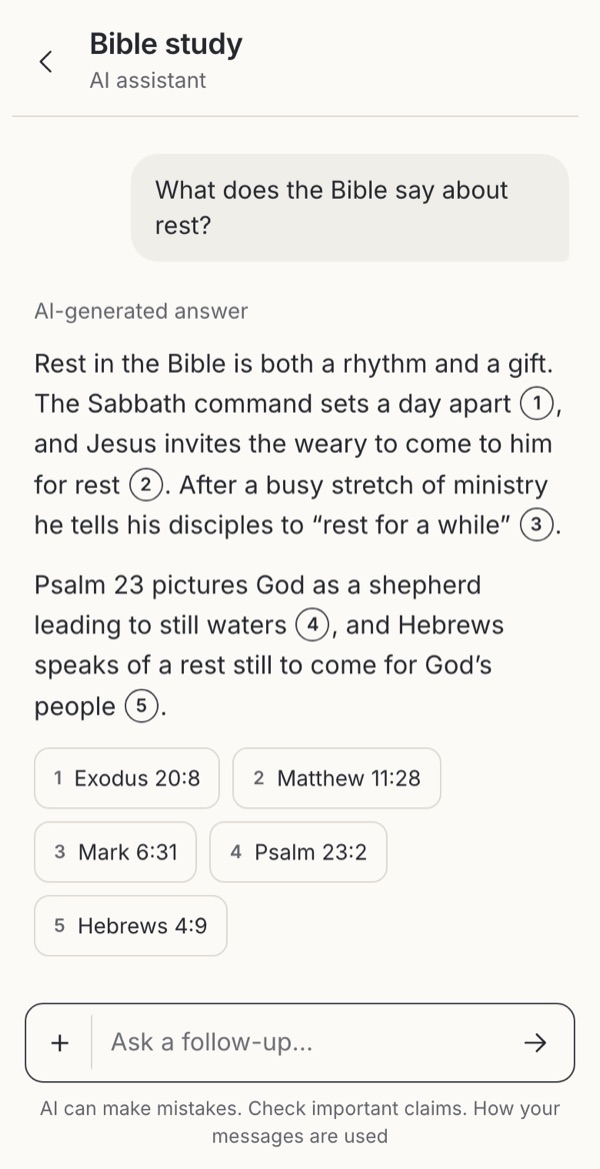 Observed Every claim points to a verse Markers look rigorous regardlessTry it →
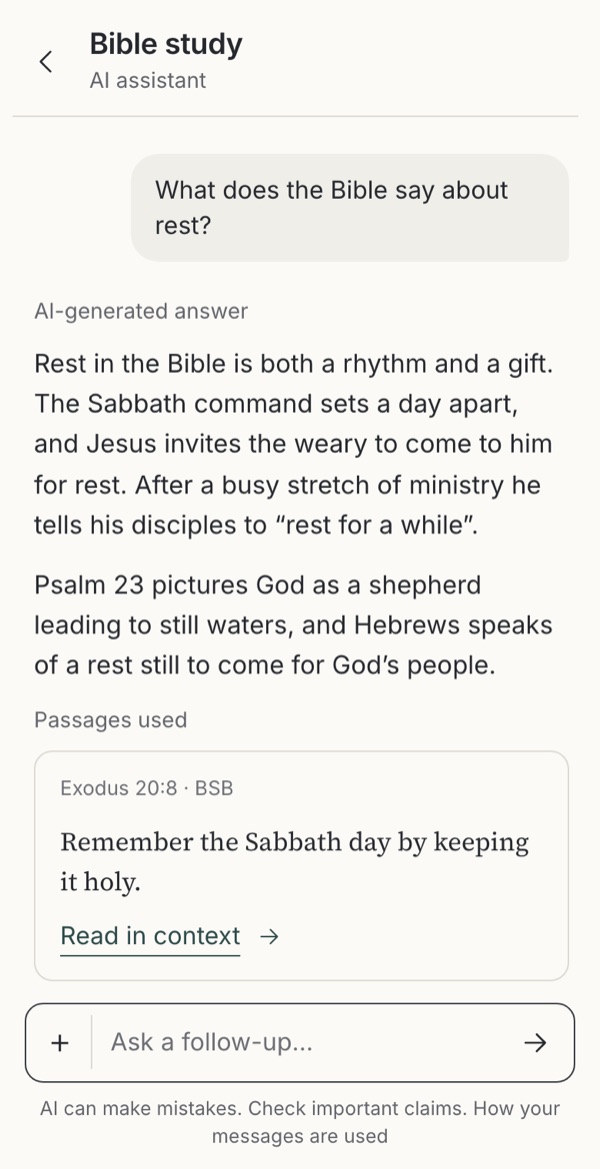 Observed The actual words are in view Long answers get longerTry it →
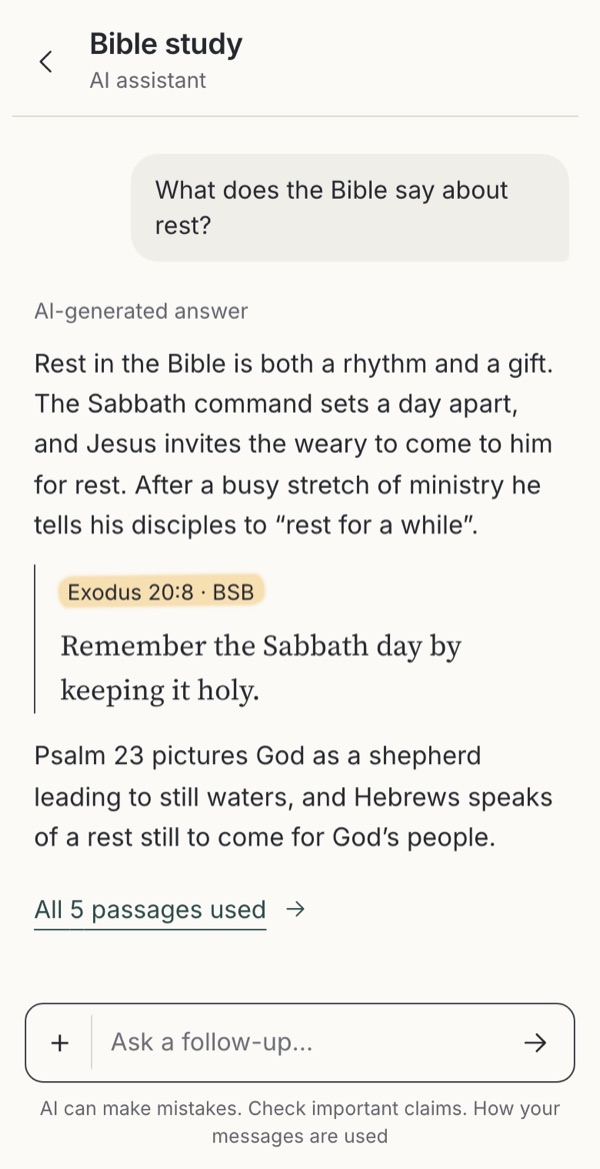 Exploratory · untested Scripture speaks in its own voice Quietly chooses which verseTry it →
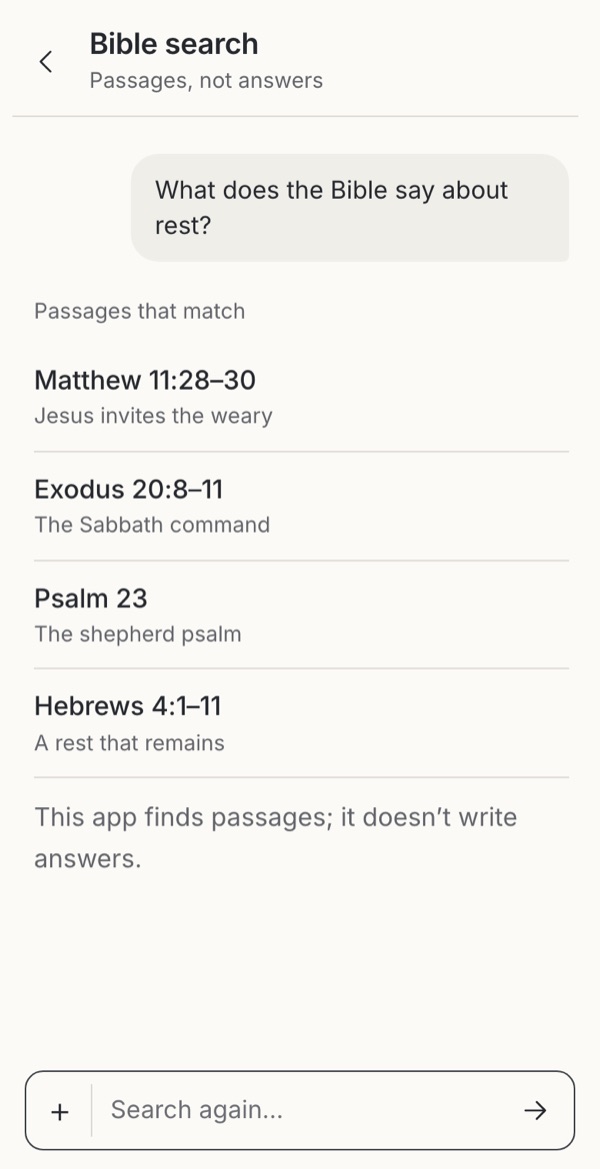 Leave it out No generated interpretation No answer, and no careTry it →
Stills from the working example below. Choose one to try it.
Try it
Try four ways to show where an answer comes from
The same Bible-study assistant answers four questions: one with a clear answer, one Christians disagree about, one it should not decide for the person, and one from someone in danger. Every answer and passage list here was written for this example; Scripture is quoted from the Berean Standard Bible.
Option
Observed
1. Numbered sources
Observed in BibleAI: numbered markers in a “Predicted Answer”, with source chips underneath; see the screenshots below.
Try this
Tap marker 2. Then switch to the disagreement question and count how many sources each side gets.
Makes easier
Each claim points to a specific passage, and the passage opens without leaving the answer.
Costs
Markers look rigorous whether or not the passage supports the claim, and a list of chips is easy to skip.
Ask your teamWould a reader notice if a marker pointed to the wrong verse?
Observed
2. Passage cards
Observed in BibleAI’s passage sheets and Bible BFF’s answer cards: the passages appear in full below the answer.
Try this
Read the answer, then the passages under it. Which do you read more closely?
Makes easier
The words of Scripture are on the screen, not just a reference, so readers can judge the answer against them.
Costs
Long answers grow longer, and the link between a sentence and its passage is looser.
Ask your teamShould people read the passage or the answer first?
Exploratory · untested
3. Scripture quoted in the answer
The treatment in this library’s paper concept: a verse quoted within the answer, with its edition, and the rest one tap away. A proposal, untested.
Try this
Compare how the quoted verse and the generated sentence look. Could you tell them apart in a screenshot?
Makes easier
The key verse is read in its own words, visibly distinct from the generated text around it.
Costs
Choosing which verse to quote is itself an interpretation, and the other sources are a step away.
Ask your teamWho decides which verse is quoted, and does the reader know?
Leave it out
4. No generated answer
Leave the answer out: the app finds matching passages and shows them, with no summary.
Try this
Switch to the last two questions and look at what the search returns.
Makes easier
Nothing is put in the Bible’s mouth. Readers meet the text directly and draw their own conclusions.
Costs
No help connecting passages or explaining disagreement. A plain search can surface texts about divorce to someone who may be unsafe, or Elijah asking to die to someone in crisis, with no word of care and no route to help, unless someone designs that in. This example does: sensitive searches show the same help box above the results.
Ask your teamWhat would a reader lose without the answer, and what would they be spared?
What we noticed
Takeaways
Citations show what can be checked, not what is right
A numbered marker looks rigorous whether or not the verse supports the sentence. Passage cards put the actual words in front of people. A quoted verse lets Scripture speak in its own voice, but quietly chooses which verse that is.
Disagreement shows in the sources
When Christians differ, as on infant baptism, a good answer names the traditions and gives each its strongest passages. Count the sources on each side: balance is visible, or missing, in the citations.
Danger changes the response; it doesn’t end it
When someone may not be safe at home, or doesn’t want to be alive, keep responding and put real help first: lines they can call or text now. Ask directly, stay present, and say plainly that this is an AI, not a counsellor. Offer verses later, and only if wanted. Keep help visible for the rest of the conversation, and give someone at risk at home a quick exit.
The evidence, policy and law behind this →In a crisis, the rest of the product steps back
Once a conversation turns to danger, abuse or confession, everything built to hold attention should pause for the rest of the session: suggested follow-ups, share, rate and regenerate, celebrations and streaks, upgrade prompts, and warm claims like “I’ll be thinking of you”. What stays is what serves the person: help in view, a plain way to keep talking, a quick exit and a way to delete. Keep the conversation out of memory and profiles, and record only what safety and the law require, not what was said. Send no “checking in” message later unless they asked for one. Hold this to the end of the session; it should not fade after the first careful reply.
A chat is not a confessional
People will confess sins, and sometimes crimes, to an assistant. A priest’s seal protects confession; a chat is stored data that may be read, kept or handed over. Say so before the details, not after. Neither condemn nor absolve: point to a pastor or priest, to putting things right where someone was harmed, and to a lawyer where the law is involved. Where a child or anyone else could still be at risk, protection and prevention help come first. Have this reviewed by people with pastoral and safeguarding experience.
A neat citation can repeat an old harm
Some verses have been used to keep people quiet, in an abusive marriage or under a leader: Matthew 18 on going privately first, forgiveness, submission, “Do not touch My anointed ones”. An answer to “Do I have to forgive him?” that cites them tidily can repeat that harm with the authority of a source. Put safety first, say briefly how a passage has been used, and offer readings, not a verdict.
When Scripture is used to harm →Declining is a design decision too
BibleAI answers a harmful claim with “Unable to find an answer to your question” while its media tabs still offer particular ministries’ articles and videos, so the refusal hands the question to curated voices. With no generated answer there is no care at all: a plain search may surface texts about divorce to someone who is unsafe.
Use cases
Which situation, which option?
People come with different needs, sometimes in the same week. Each need fits some options better than others.
| Situation | Needs | 1 Numbered sources | 2 Passage cards | 3 Scripture quoted in the answer | 4 No generated answer |
|---|---|---|---|---|---|
| A question with a clear answer | The passages behind each sentence, easy to check | Good fit | Good fit | Possible | Poor fit |
| A question Christians disagree on | Each tradition with its strongest texts | Good fit | Good fit | Poor fit | Possible |
| A personal decision | The text itself, not a verdict | Possible | Good fit | Possible | Possible |
| Preparing a study or sermon | Sources to open, compare and quote | Good fit | Good fit | Possible | Possible |
| Someone new to the Bible | The words of Scripture in front of them | Possible | Good fit | Good fit | Possible |
| Reading on a phone | Answer and evidence without losing the place | Possible | Possible | Good fit | Possible |
| A team that cannot yet review answers | Nothing generated to vouch for | Poor fit | Poor fit | Poor fit | Good fit |
Editorial judgments drawing on the research below, not test results.
The research behind it
Theology, practice and science
Scripture and tradition
Checking what we are told
Examine the Scriptures
The Bereans “received the message with great eagerness and examined the Scriptures every day to see if these teachings were true” (Acts 17:11). An answer about the Bible should make that examination easy, not replace it.
Let the other side speak
“The first to state his case seems right until another comes and cross-examines him” (Proverbs 18:17). Where traditions differ, an answer that gives one view with confident citations has not let the other speak.
Research on citations
What citations do and do not show
Many citations do not support their sentence
In an audit of four generative search engines, about half of generated sentences were fully supported by their citations, and about a quarter of citations did not support the sentence they were attached to.
Citations raise trust even when they are random
People trusted answers more when citations were present, even irrelevant ones, and trusted them less once they checked. A marker persuades whether or not it is right; the words behind it decide.
Assistants lean towards agreeing
Models tuned on human preferences sometimes favour agreeing with the person over being accurate. On disputed questions, show the sources for each view rather than the one the question assumes.
Design practice
Keeping evidence close
Put the evidence next to the claim
Learning research finds that words and the material they refer to are understood better when placed together. A passage card under its sentence asks less than a numbered list at the end.
Long passages need their own room
Keep answers concise and open longer material on demand, without a second scrolling box inside the chat; let it reflow at large text sizes.
Care comes before citations
When someone may be in danger, ask directly, listen, and connect them with people who can help. Verses can wait until they are wanted.
The rest of the product has to change too
Companion apps raised engagement by making goodbyes hard, and a major provider has said its safeguards can weaken as a conversation grows long. A crisis needs a state the whole product respects for the rest of the session, not one careful reply.
Every source, with what it can and cannot show, is listed under Go further → Sources and their limits.
Where to start
Which fits your product?
IfAnswers summarise several passages
Start withNumbered sources that open the verse in place
IfReaders should weigh the answer against the text
Start withPassage cards under the answer
IfOne verse carries the answer
Start withQuote it in the answer with its edition, and show the rest on request
IfYou can’t yet review answers or respond with care
Start withNo generated answer: find passages, and add care for sensitive searches
These are editorial judgments from design review, not results of user testing.
In real apps
Examples in use
Attributed screenshots with dates and review limits. A screenshot shows an implementation; it does not show that it works for every audience.
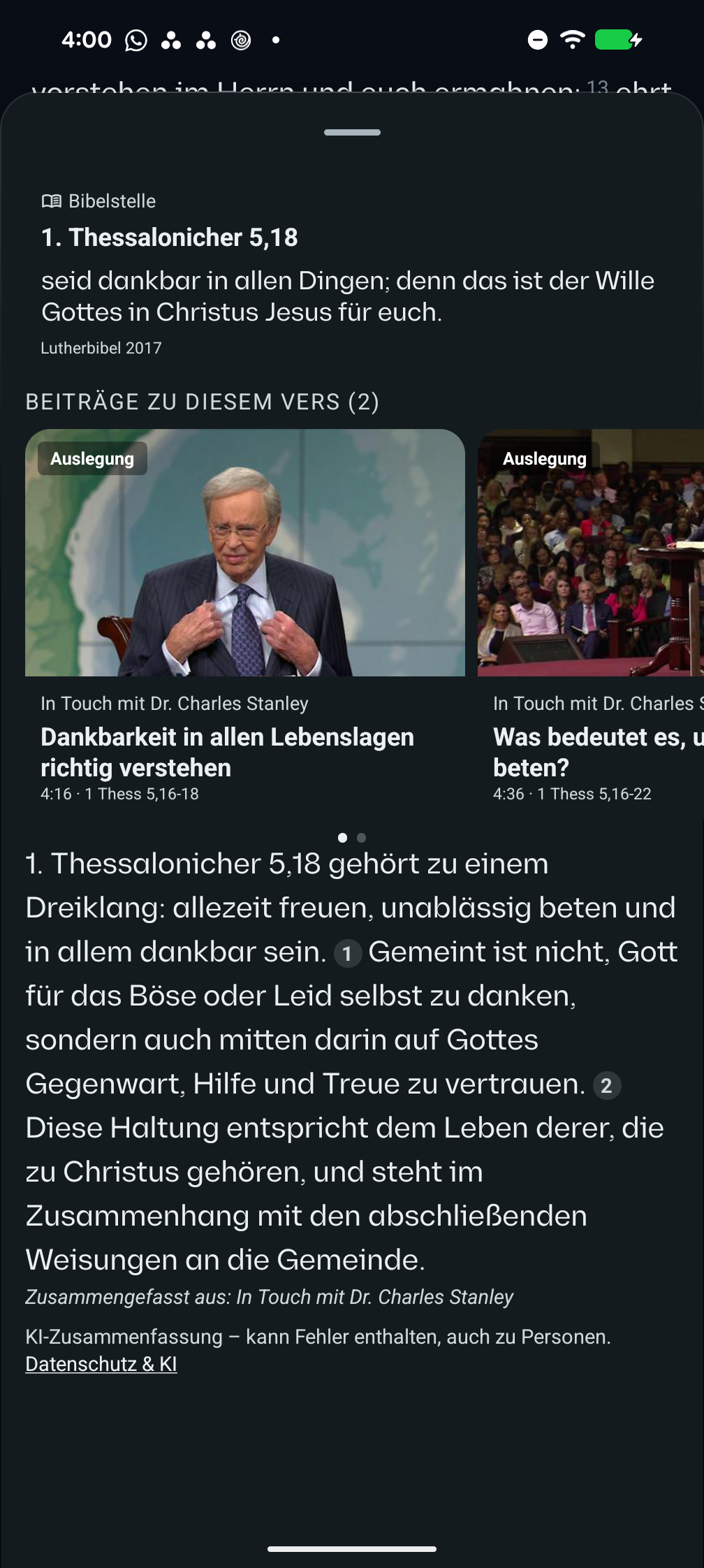 VSB · Android 17 · Pixel 8 Pro · German interface
A verse sheet combines media evidence and a summary
Direct Android prototype capture
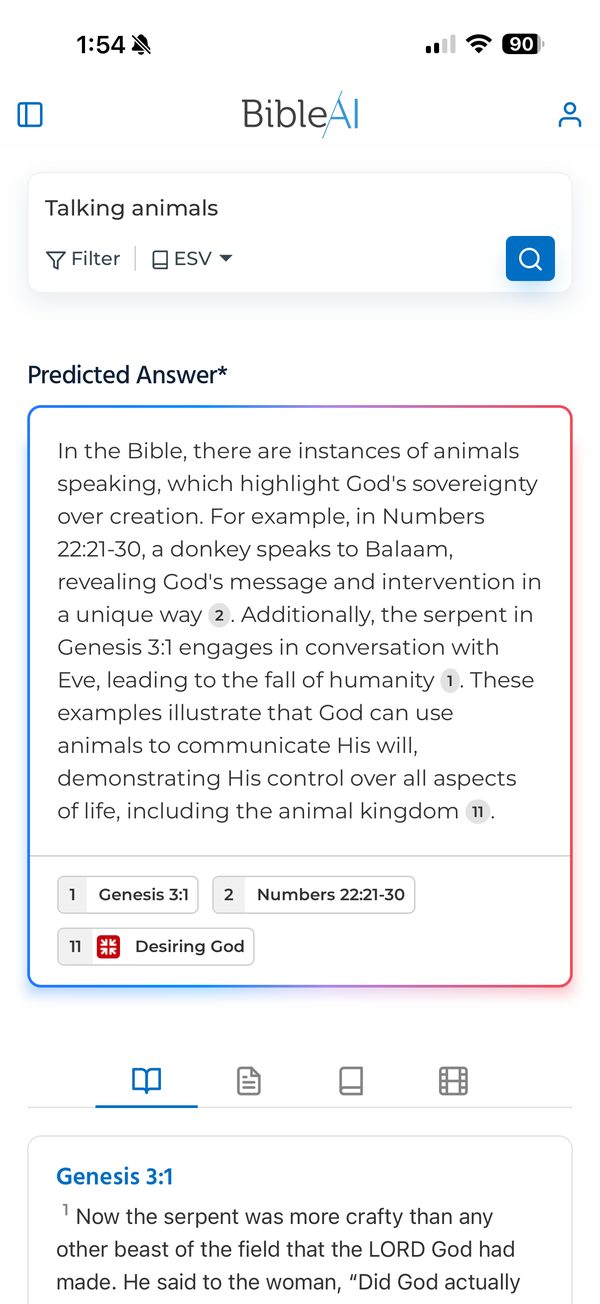 BibleAI · iOS app · device model not recorded
A “Predicted Answer” with numbered sources
User-contributed screenshot · resized, content unchanged
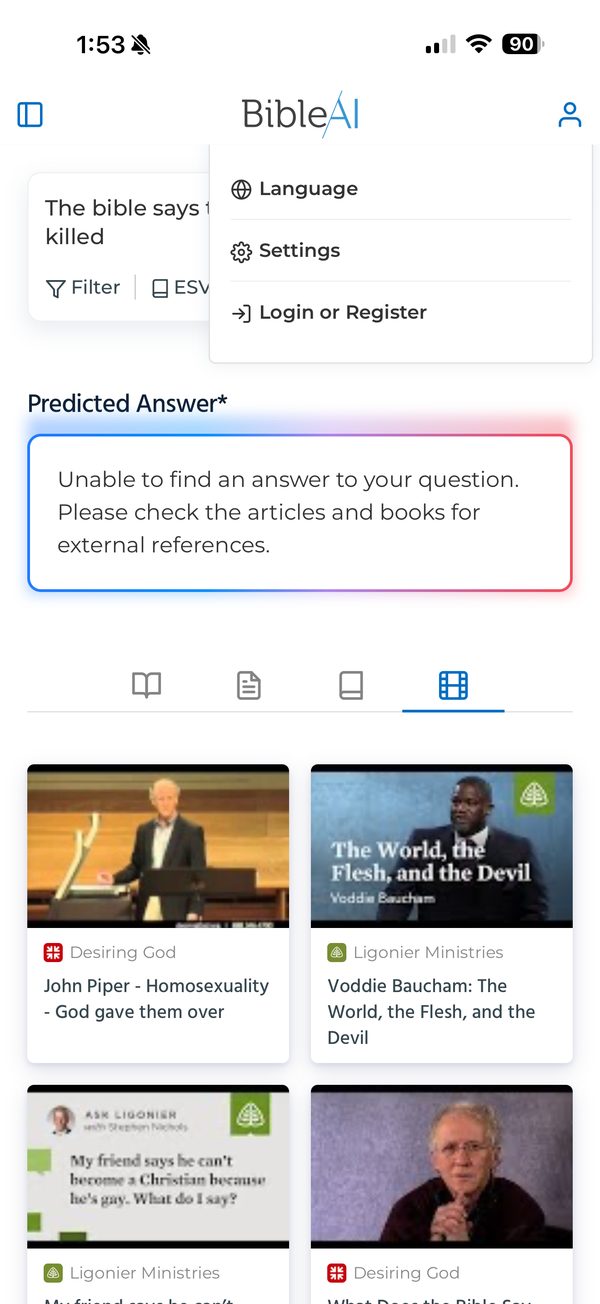 BibleAI · iOS app · device model not recorded
A declined answer, with curated media still offered
User-contributed screenshot · resized, content unchanged
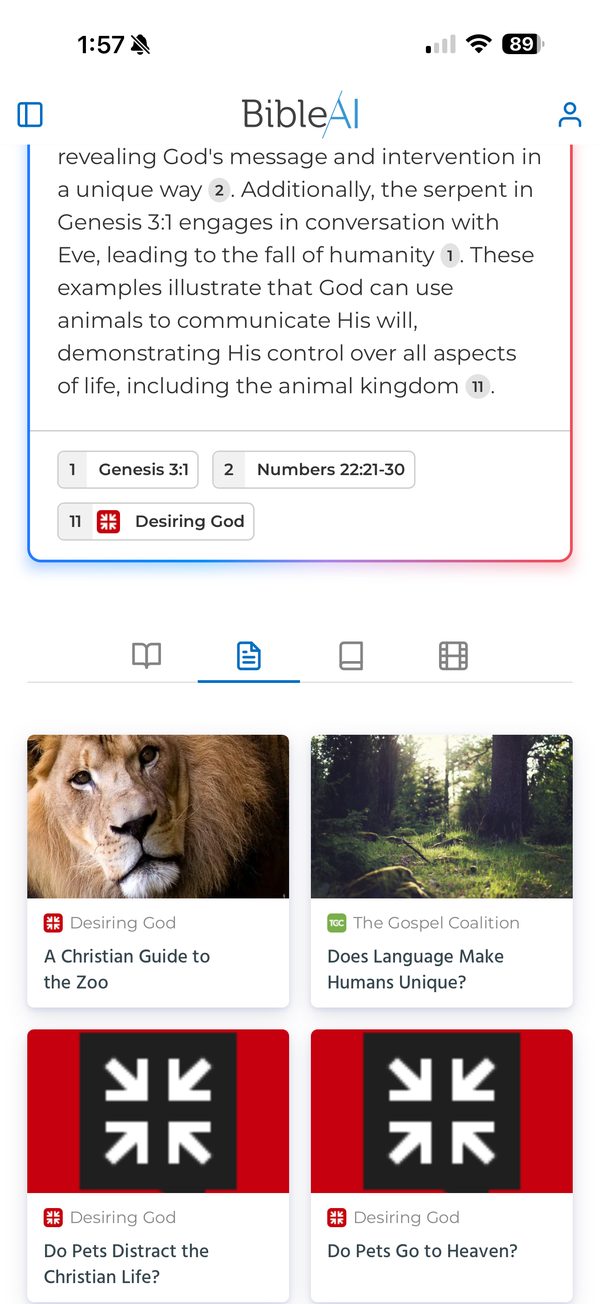 BibleAI · iOS app · device model not recorded
Bookmark and Share on each passage card
User-contributed screenshot · resized, content unchanged
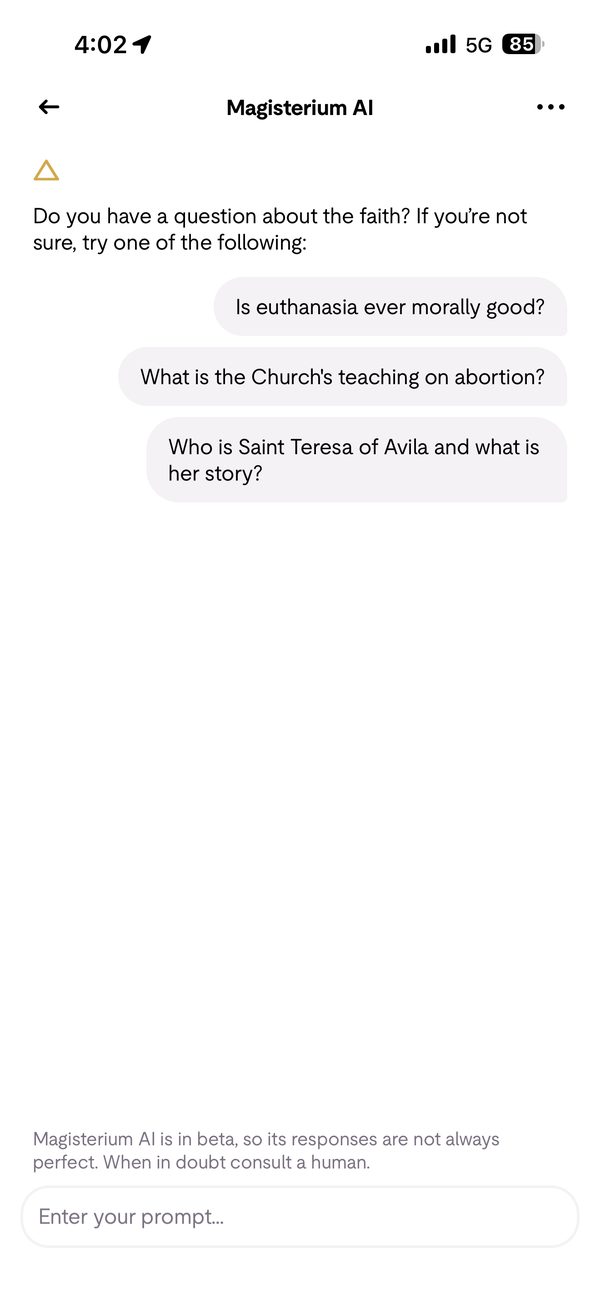 Hallow · iOS app · device model not recorded
Limits stated beside the input
User-contributed screenshot · resized, content unchanged
 Spark Bible · iOS app · device model not recorded
“You just used your last free study”
User-contributed screenshot · resized, content unchanged
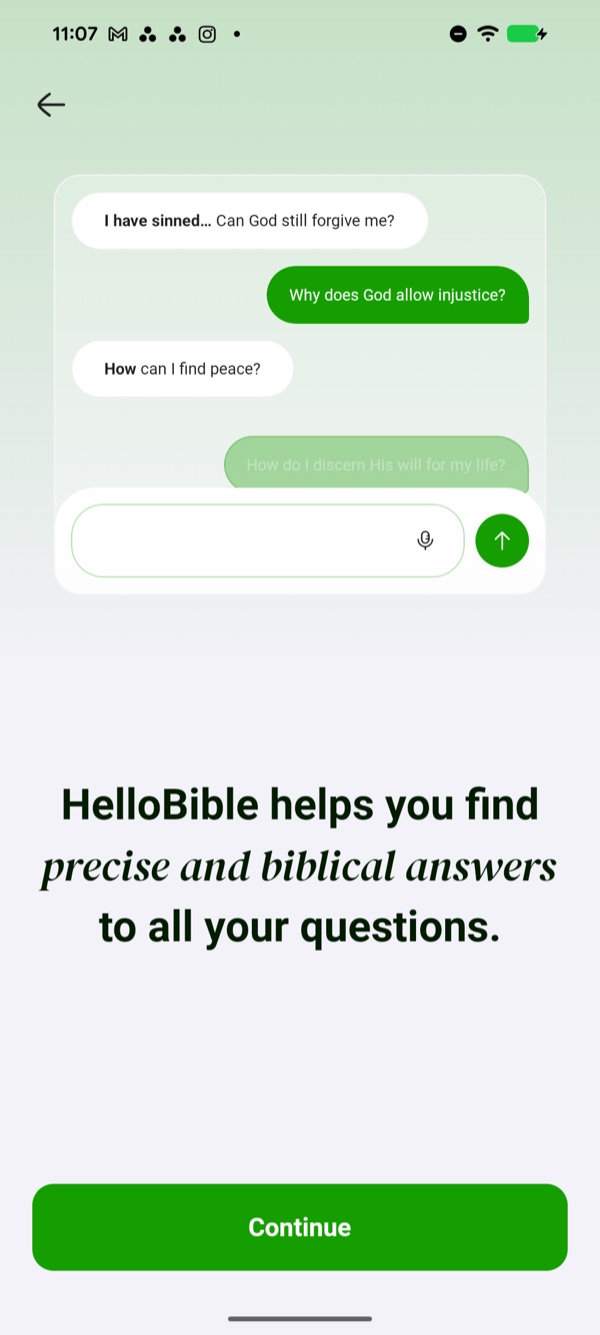 HelloBible · Android app · Pixel 8 Pro
“Precise and biblical answers to all your questions”
User-contributed screenshot · resized, content unchanged
Theological reflection
What is this practice for?
What testing is for
“Test all things. Hold fast to what is good” (1 Thessalonians 5:21). “Test the spirits to see whether they are from God” (1 John 4:1). The Bereans checked even Paul against the Scriptures (Acts 17:11). Christians are called to test what they are told, and a source makes testing possible.
Where Christians differ
Protestants hold Scripture as the final authority, read with the help of teachers; Catholics read Scripture with tradition and the magisterium; the Orthodox within the church’s living tradition. Methodists often speak of Scripture, tradition, reason and experience together. An AI answer usually blends these without saying which is which.
What follows for design
“The first to state his case seems right until another comes and cross-examines him” (Proverbs 18:17). Show the sources, say whose tradition an answer represents, show where Christians disagree, and say “I don’t know” when it is true. A reference to a verse locates text; it does not prove an interpretation.
In conversation with
- Augustine, On Christian Doctrine I.36.40 made love of God and neighbour the measure of interpretation; a source shows where an answer came from, love shows whether it is true to Scripture’s purpose.
- Andy Crouch, The Life We’re Looking For (2022) warns against technology that offers effortless power; an answer with no sources asks for exactly that kind of trust.
Scripture is quoted from the Berean Standard Bible. This reflection is the editor’s, written from within the Christian tradition and open to correction. How we approach theology here →
Three ways to build
What would each way do here?
ExploitativeTakes from the person
Confident answers without sources, presented as authority.
EthicalDoes no harm
Cite sources and show the limits of each answer.
RedemptiveGives something up for them
Show where Christians disagree and say “I don’t know” when it is true, even if the product seems less impressive.
The three ways are Praxis’s frame for redemptive entrepreneurship; their application here is ours. Why we use it, and its limits →
Take into your next review
When someone may be in danger, what will they see first, and who reviewed it?
Exercise
Write the assistant’s response to four questions: one it can answer, one Christians disagree on, one it should not decide, and one from someone in danger. Check every quotation against the edition, count the sources on each side of the disagreement, test that help lines are correct for each country you serve, and have someone with safeguarding and crisis-support experience review the last two before launch.
Help people examine the Scriptures for themselves, and put care before answers when someone is in danger.
Record the decision with the worksheet →
Something missing or wrong here? Send a correction or suggest a topic.
Details
Go further
This deep dive brings together 2 earlier patterns. Their guidance, wireframes and sources are kept below; their old addresses lead here.
Edge cases to design for
Attach citations to specific claims. Show source title, author, type, edition or publication details and a relevant excerpt or reliable media timestamp. Return to the claim after inspection. Distinguish a quotation, inference, disagreement and a claim with no supporting source.
What tends to go wrong
Whole-answer citation lists with unclear claim mapping; invented sources or timestamps; counting repeated sources as independent support; inaccessible evidence presented as verified.
How to test it
Can readers identify what a source supports and what it does not? Test contradictory sources, dead links, permission limits, different verse numbering and a citation that does not entail the claim.
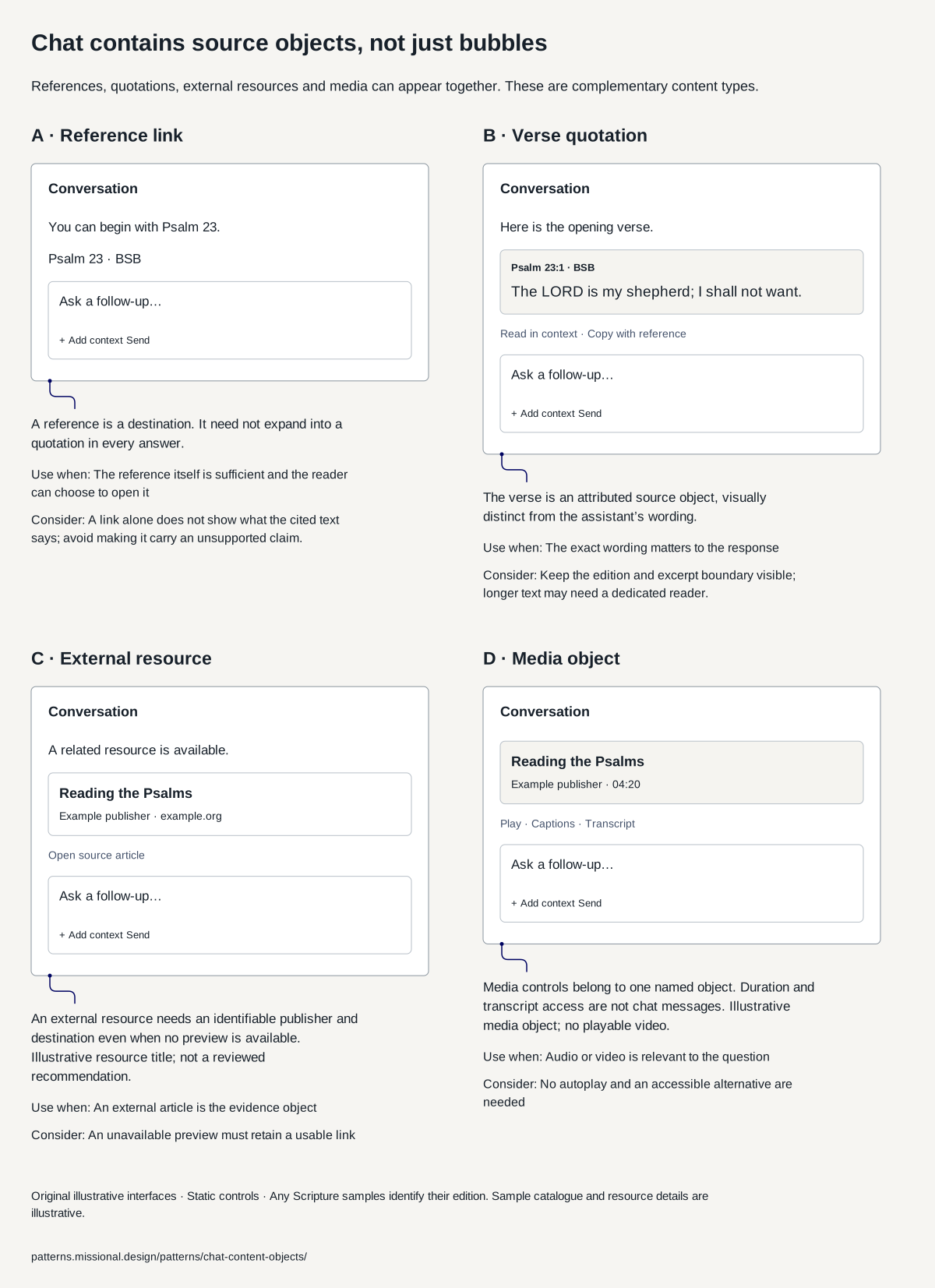
Earlier pattern: Chat contains source objects, not just bubbles
Give verses, passages, links and media recognisable identity and appropriate actions.
Guidance
Use an inline reference link for a brief citation, a bounded verse or passage card for text worth inspecting, and a full reader for sustained reading. Name edition, reference, visible range and source. Distinguish external link previews from Scripture and from generated commentary. Video cards identify publisher, duration and captions; audio cards retain passage and narrator. Do not autoplay. Provide plain links or labelled fallbacks when previews, media or permissions fail. Copy and sharing preserve reference and attribution where permitted. Returning from any destination restores conversation position.
What tends to go wrong
Autoplaying media; unlabelled generated verse text; enormous previews; a failed embed removing the source link; identical actions for read, play and external navigation.
How to test it
Test a citation, single verse, long passage, external article, video and audio. Include blocked embeds, offline use, captions, large text, copy and return navigation.
Sources
- AI Chatbots Design GuidelinesPublished UX guidance reviewed · General chatbot research, not validation of these Bible-app patterns.
- Progressive DisclosurePattern detail reviewed · The proposed reader transition is a domain adaptation.
- Scripture structure documentationRelevant structure and marker references reviewed · A format is not a complete model of app behaviour, annotations or formation.
- Understanding ReflowOfficial guidance reviewed on 5 October 2026 · Semantic scroll restoration is an original design proposal, not a requirement stated by this criterion.
- Psalm 23, Berean Standard BiblePassage text taken from API.Bible, 9 October 2026 · A text source, not evidence of the proposed interface’s effectiveness.
Earlier pattern: Passage preview opens a full reader
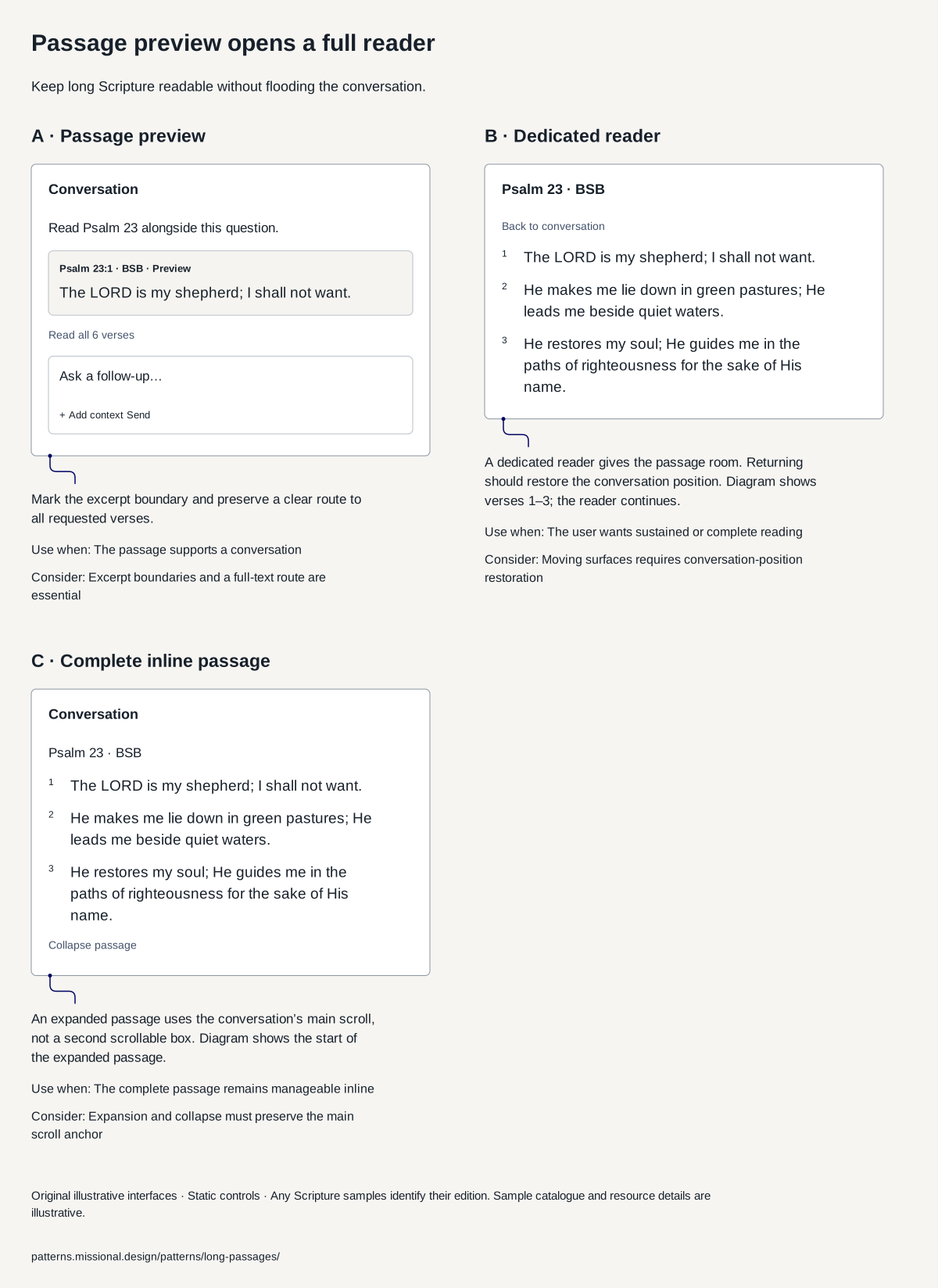
Keep long Scripture readable without flooding the conversation.
Guidance
Choose among an excerpt card opening a full reader, complete inline expansion for manageable passages, and a dedicated reading surface for sustained reading. Name the requested range, edition and visible range. Inline expansion uses the main conversation scroll rather than a nested text scroll; provide Collapse and retain an anchor when collapsing. A full reader can be a sheet on small screens or a side panel on wider screens, with an explicit return to the same conversation place. For cross-chapter ranges, preserve every boundary and continuation. If complete text is requested, provide a clearly labelled route to it rather than silently summarising. If edition rights or availability prevent full display, explain the limit and offer a permitted destination.
What tends to go wrong
Unmarked omissions; two competing scroll regions; a summary presented as the original passage; returning to the top of the chat.
How to test it
Test a short verse, long passage, complete chapter request and large text. Can readers recognise omissions, reach the whole text and return to the same conversation position? Test inline expansion and collapse, cross-chapter ranges, sheet and panel return, multiple passage cards, unavailable editions and the final verse at large text size.
Sources
- AI Chatbots Design GuidelinesPublished UX guidance reviewed · General chatbot research, not validation of these Bible-app patterns.
- Progressive DisclosurePattern detail reviewed · The proposed reader transition is a domain adaptation.
- Scripture structure documentationRelevant structure and marker references reviewed · A format is not a complete model of app behaviour, annotations or formation.
- Psalm 23, Berean Standard BiblePassage text taken from API.Bible, 9 October 2026 · A text source, not evidence of the proposed interface’s effectiveness.
Sources and their limits
Research-informed design proposal. Editorial review, not user validation.
- The Shape of AICatalogue and named entries reviewed · The site states CC BY NC SA. This reference uses original text and original wireframes; it does not reproduce the source illustrations.
- AI UX PlaygroundCatalogue and selected detail pages reviewed · Selected relevant entries reviewed; the entire catalogue was not audited. Its FAQ currently describes 150 patterns in 11 categories.
- VSB native prototype: verse sheet and return to readerInstalled Android version 1.0.0, build 1 observed on 5 October 2026 · Prototype evidence; source commit, playback accuracy and generated-summary grounding were not verified.
- Lumen Bible: engagement choices and readerSigned-out desktop web observed and captured 5 October 2026 · AI services were not enabled. No AI correctness, privacy compliance, health benefit or mobile usability claim was evaluated.
- Evaluating verifiability in generative search enginesAbstract reviewed · General web search engines in 2023, not Bible assistants; systems have changed since.
- Citations and trust in LLM generated responsesAbstract reviewed · An online experiment with general questions; effects in religious study may differ.
- Towards understanding sycophancy in language modelsAuthor research abstract reviewed on 5 October 2026; full paper not reviewed · Specific studied models and tasks; not a faith-app intervention study.
- Spatial contiguity and spatial split-attention effects in multimedia learning environments: a meta-analysisAbstract reviewed · Learning studies with diagrams and text, not Scripture.
- CitationsPattern detail reviewed · Citation presence alone does not establish claim support.
- AI Chatbots Design GuidelinesPublished UX guidance reviewed · General chatbot research, not validation of these Bible-app patterns.
- Understanding ReflowOfficial guidance reviewed on 5 October 2026 · Semantic scroll restoration is an original design proposal, not a requirement stated by this criterion.
- Five action steps for helping someone having thoughts of suicideOfficial public-health guidance reviewed on 5 October 2026 · Human-helper guidance, not a validated chatbot risk assessment. US contact information must not be exported to other jurisdictions.
- Emotional manipulation by AI companionsSummary reviewed · Working paper; general companion apps, not faith apps.
- Helping people when they need it mostProvider statement; read through press coverage on 10 October 2026, as the page refuses automated access · A provider’s own account, published while it faced a wrongful-death lawsuit; no independent measurement of how often or how far safeguards weaken.
Faith and interpretation
A reference to Scripture locates text; it does not automatically validate an interpretation. Personal notes are user-provided context, not scholarly authority.