

PatternsTalking with AISaying I don’t know
Saying “I don’t know”
How should the assistant show what it does not know?
A language model writes fluently whether or not it knows the answer. Ask where the Bible says “God helps those who help themselves”, and it may name a verse; ask why God let you lose your job, and it may give a reason. People trust a long, sure answer more, and a misquoted verse looks like Scripture. Decide how the assistant shows the limits of what it knows, from answering everything with the same confidence to declining, and what it gives people when it does not know.
- 6 working options
- 46 app screens
- 7 takeaways
- Prototypes awaiting user testing
The spectrum
From always sure to saying nothing
- 1
Always answers, confidently
Warning case- An answer every time
- Guesses read as fact
- 2
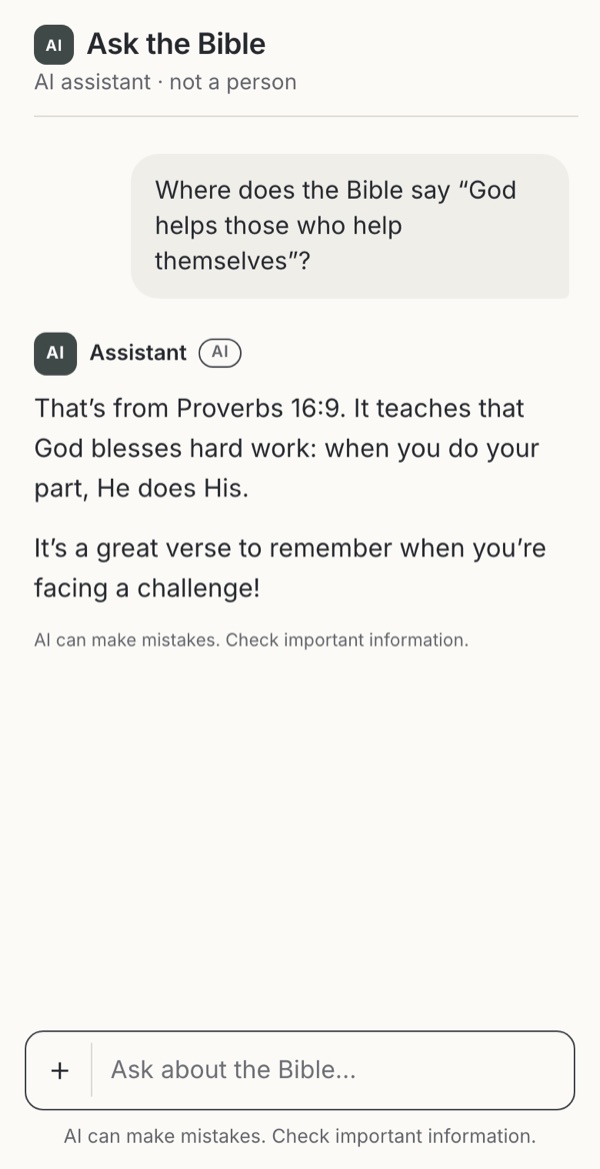
A warning in the fine print
Familiar convention- Honest that mistakes happen
- The answer never changes
- 3
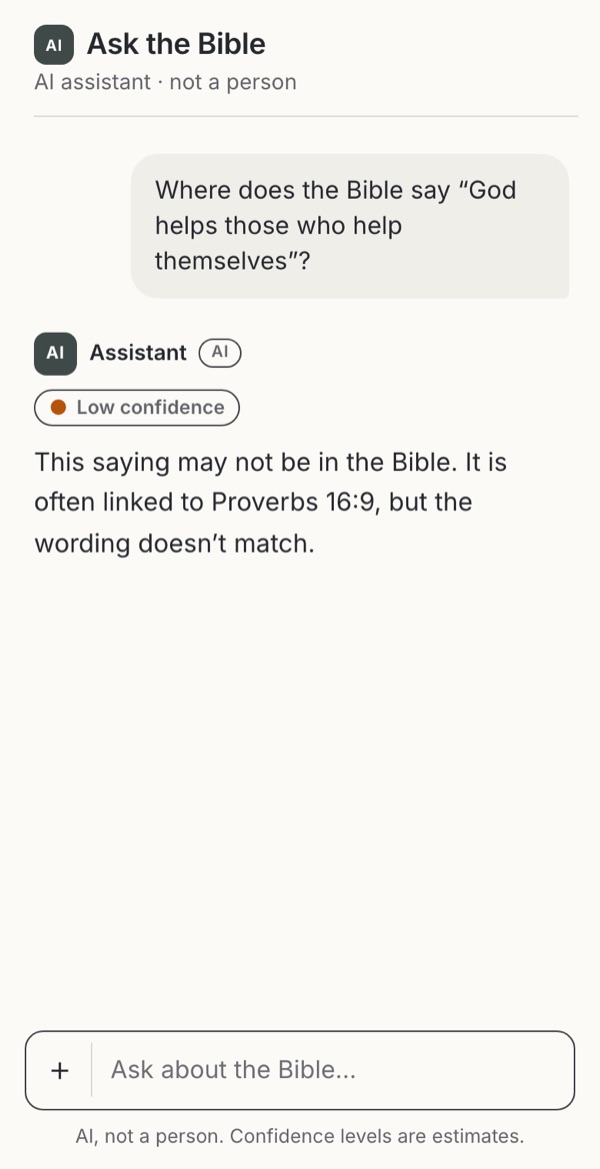
A confidence level on each answer
Borrowed- A quick signal
- The level is a guess too
- 4
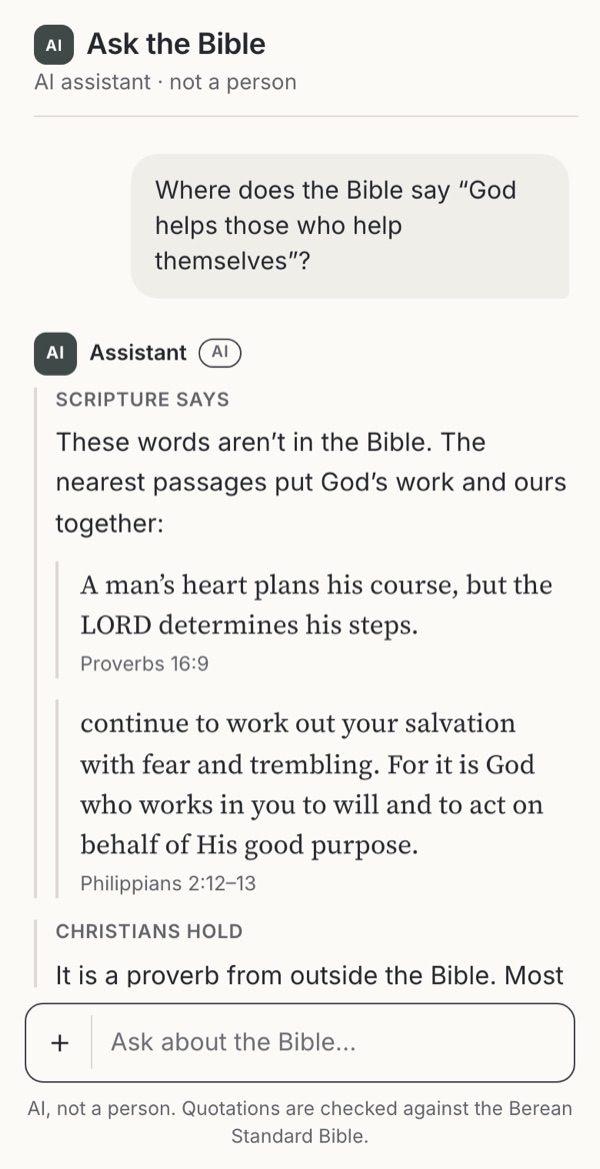
Says what kind of claim each part is
Exploratory- Scripture, teaching, unknown
- Longer, needs review
- 5
Says “I don’t know”, and where to look
Exploratory- Honest, then useful
- Some wanted an answer
- 6
Declines to answer
Observed- Nothing invented
- Nothing given
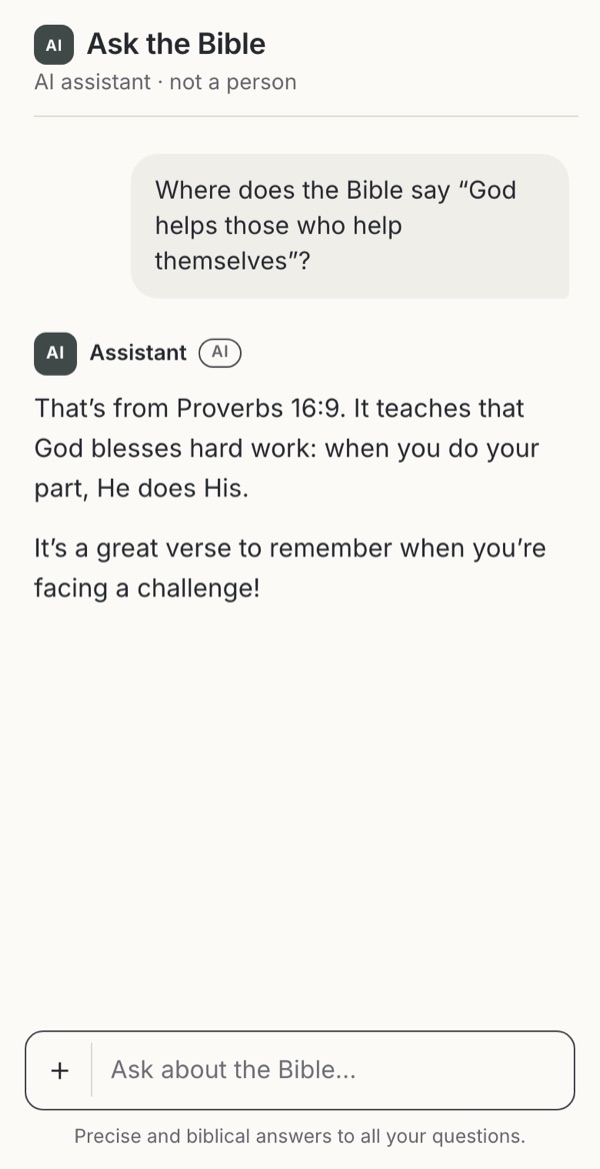
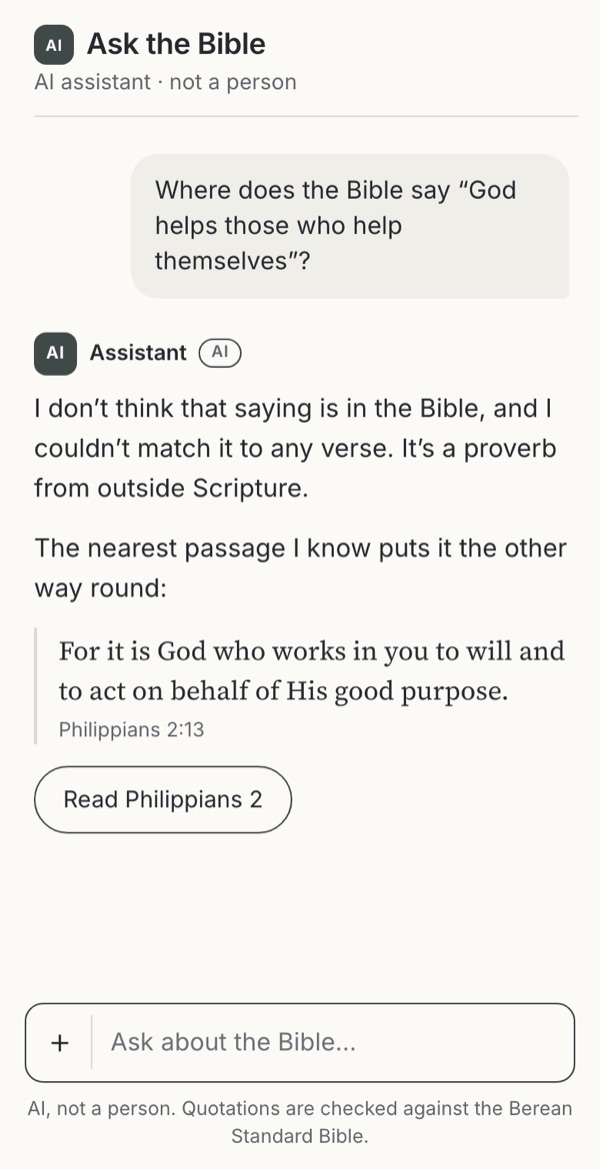
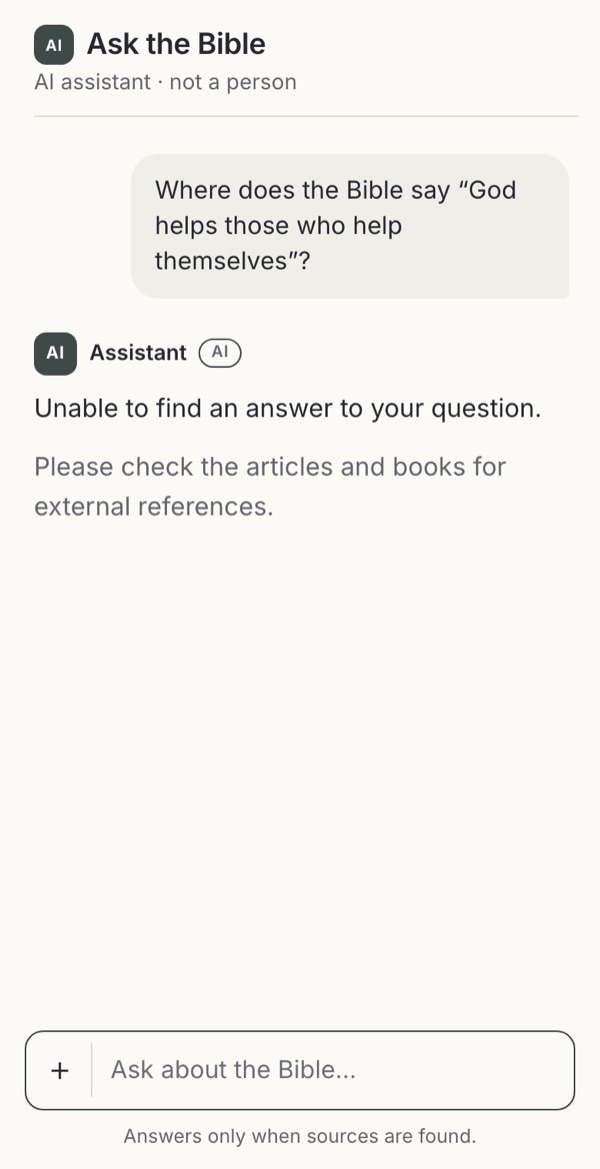
- 1 Always answers, confidently
- 2 A warning in the fine print
- 3 A confidence level on each answer
- 4 Says what kind of claim each part is
- 5 Says “I don’t know”, and where to look
- 6 Declines to answer
Stills from the working example below. Choose one to try it.
Try it
Try four hard questions, answered six ways
Someone asks a Bible app’s assistant four questions it cannot simply answer: where the Bible says a well-known saying that is not in it, who wrote Hebrews, whether their dog will be in heaven, and why God let them lose their job. Each option shows the limits of what it knows differently, from answering everything with the same confidence to declining. Then ask “Are you sure?”.
Option
Why these settings?
“Are you sure?” tests whether the answer holds. A Bible scholar found ChatGPT would admit an error, change its interpretation and then wrap the admission in “a reassertion of the very claim it has just undermined”. An honest answer stays the same unless the person shows it is wrong.
Warning case
1. Always answers, confidently
A warning case. HelloBible promises “precise and biblical answers to all your questions”; see the screenshot below. Researchers describe models that “confidently assert an interpretation of a biblical text” and then reverse it when questioned. The replies here, including the wrong reference, are written for this example.
Try this
Ask where the Bible says “God helps those who help themselves”, then ask “Are you sure?”.
Makes easier
Every question gets an answer at once, in a voice people find reassuring.
Costs
A saying is pinned to a verse that does not contain it, a guess reads as fact, and a reason is given for someone’s loss in God’s name.
Ask your teamWould you know which of these answers were wrong?
Familiar convention
2. A warning in the fine print
A familiar convention: ChatGPT shows “ChatGPT can make mistakes. Consider checking important information.” under every answer, and Hallow’s Magisterium AI says above the input that “its responses are not always perfect. When in doubt consult a human.”; see the screenshot below. The answers here are the same as the first option’s.
Try this
Read the answer, then the line under it. What changed?
Makes easier
Honest that mistakes happen, at almost no cost to build.
Costs
The answer itself is as sure as before, and people rarely read the small print under it.
Ask your teamWhich answer would a reader check because of the warning?
Borrowed
3. A confidence level on each answer
Borrowed from research: people “generally overestimate the accuracy” of model answers, and explanations worded to reflect the model’s own confidence narrowed that gap. The levels and replies here are written for this example.
Try this
Compare the level on the Hebrews question with the one on losing a job.
Makes easier
A quick signal of how far to trust the answer.
Costs
The level is generated too, and a “low confidence” label on a reason for someone’s suffering is still a guess about God.
Ask your teamWhich questions should get a level, and which should not be answered with a guess at all?
Exploratory
4. Says what kind of claim each part is
A proposal, after the editor’s research for a faith app: “When traditions disagree, the system says so.” Each answer separates what Scripture says, quoted from the edition, what Christians hold, and what is not known. The wording here is written for this example.
Try this
Ask who wrote Hebrews, then whether your dog will be in heaven.
Makes easier
People can see which parts rest on Scripture, which on a tradition and which on no one’s knowledge.
Costs
Longer, and the labels themselves need review by people who know the traditions.
Ask your teamCould a reader tell which sentence in your answers is Scripture and which is summary?
Exploratory
5. Says “I don’t know”, and where to look
A proposal, borrowed from research: first-person wording such as “I’m not sure, but…” reduced people’s over-reliance on wrong answers. A model provider says “errors are worse than abstentions”. The replies, and St Luke’s, are written for this example.
Try this
Ask why God let this happen, then ask “Are you sure?”.
Makes easier
Honest in its own voice, and still useful: what it does know, the passages to read and who could help.
Costs
Some people wanted an answer and will be disappointed.
Ask your teamWhat does your assistant offer straight after “I don’t know”?
Observed
6. Declines to answer
Observed in BibleAI, which answered one question with “Unable to find an answer to your question” and pointed to articles and books instead; see the screenshot below. YouVersion has chosen not to launch a chatbot for theological questions at all, because models misquote Scripture.
Try this
Ask any question, then ask “Are you sure?”.
Makes easier
Nothing generated, so nothing invented.
Costs
People are left with nothing, including the person asking why they lost their job.
Ask your teamIs declining honest here, or does it hand the question to someone else without saying so?
Do and don’t
What to avoid, and what to do instead
An assistant can show its limits in several ways, from a line of fine print to declining, and the options above compare them; the first two give the same answers, to show that a warning line does not change them. These practices make a guess look like knowledge, whatever line sits under it.
- Don’t
Invent a reference
“God helps those who help themselves”, given a chapter and verse that do not contain it.
Do insteadSays what kind of claim each part is
A misquoted verse looks like Scripture. One Bible platform’s chief executive says even the best model misquotes Scripture at least 15% of the time. Christian Daily International, in The Christian Post
- Don’t
Present a guess as fact
Every answer in the same sure voice, the guesses included.
Do insteadSays “I don’t know”, and where to look
People overestimate how accurate model answers are, and trust longer explanations more even when they are no more accurate. Mark Steyvers and colleagues
- Don’t
Give reasons in God’s name
“God allowed this so that you would grow.” A reason for someone’s loss, stated as fact.
Do insteadSays “I don’t know”, and where to look
It claims to know God’s purpose in one person’s life, which no system can know or check.
Not considered here
- How sources are shown. Citations and passage cards are covered there. Citations in AI answers
- Changing an answer to please. Holding a position under pressure is covered there. Agreeing and pushing back
- Questions it should not take on. Where the assistant’s scope ends is covered there. What the assistant talks about
- Lament. Staying with someone who asks why is covered with prayer. Prayer
Design considerations
Takeaways
Never add to the text
Of all the ways an assistant can be wrong, a misquoted verse or a saying pinned to a book of the Bible does the most harm in a faith app: it looks like Scripture. Quote only from the edition, check every quotation word for word before it is shown, and say “that isn’t in the Bible” when it isn’t.
A warning in the fine print changes nothing
“AI can make mistakes” under every answer is honest and cheap, but the answer above it reads exactly as sure as before. Put the uncertainty in the answer, where the reader is looking.
Say what kind of claim each part is
What Scripture says, what a tradition teaches, what the assistant is summarising and what no one knows are different kinds of claim. Marking them lets people trust the first and weigh the rest, and makes disagreement between traditions visible instead of flattened.
“I don’t know” in the assistant’s own voice
First-person uncertainty helped people avoid wrong answers better than impersonal hedges. Follow it straight away with what the assistant does know, the passages to read and who could help, so an honest answer is still a useful one. Test the wording with your own readers.
An answer should hold when someone asks “Are you sure?”
Assistants tend to agree with the person in front of them. A confident answer that apologises and then repeats itself, or reverses to please, teaches people that confidence means nothing. Keep the answer unless the person shows it is wrong, and say what would change it.
Some questions are not for answering
“Why did God let this happen?” is often a lament, not a request for information. Job’s friends gave reasons and were rebuked. Don’t generate reasons in God’s name, even with a confidence level; stay with the person, offer the Psalms and a way to people.
Declining is not the same as not knowing
A refusal invents nothing, but leaves people with nothing, and a pointer to curated articles hands the question to someone else without saying who. Say what the assistant knows, what it does not, and where to go.
Use cases
Which situation, which option?
People come with different needs, sometimes in the same week. Each need fits some options better than others.
| Situation | Needs | 1 Always answers, confidently | 2 A warning in the fine print | 3 A confidence level on each answer | 4 Says what kind of claim each part is | 5 Says “I don’t know”, and where to look | 6 Declines to answer |
|---|---|---|---|---|---|---|---|
| A Bible study question with a clear answer | The passages, quoted from the edition | Poor fit | Possible | Possible | Good fit | Possible | Poor fit |
| A saying people think is in the Bible | A plain “it isn’t there”, and the nearest passages | Poor fit | Poor fit | Possible | Good fit | Good fit | Poor fit |
| A question Christians disagree on | Each tradition named, and what no one knows | Poor fit | Poor fit | Poor fit | Good fit | Good fit | Poor fit |
| A question no one can answer | An honest “I don’t know”, and where to read | Poor fit | Poor fit | Poor fit | Possible | Good fit | Poor fit |
| Someone asking why they are suffering | No reasons given in God’s name; presence and people | Poor fit | Poor fit | Poor fit | Possible | Good fit | Poor fit |
| Preparing a sermon or study | What can be checked, marked as such | Poor fit | Poor fit | Possible | Good fit | Possible | Poor fit |
| A team that cannot yet check quotations | Nothing generated to vouch for | Poor fit | Poor fit | Poor fit | Poor fit | Possible | Good fit |
Suggested fits based on the research below. Test these choices with people in your context.
The research behind it
Theology, practice and science
Scripture and tradition
Knowing in part
What is revealed, and what is not
“The secret things belong to the LORD our God, but the things revealed belong to us and to our children forever” (Deuteronomy 29:29). “Now I know in part; then I shall know fully, even as I am fully known” (1 Corinthians 13:12). An honest answer keeps the two apart.
Confident comforters
Job’s friends explained his suffering at length. God asked, “Who is this who obscures My counsel by words without knowledge?” (Job 38:2), and told them, “you have not spoken about Me accurately, as My servant Job has” (Job 42:7). Job’s own answer was, “Surely I spoke of things I did not understand” (Job 42:3).
Do not add to His words
Agur begins, “I have not learned wisdom, and I have no knowledge of the Holy One” (Proverbs 30:3), and ends, “Every word of God is flawless … Do not add to His words, lest He rebuke you and prove you a liar” (Proverbs 30:5–6). A misquoted verse adds to His words.
Teachers are judged more strictly
“Not many of you should become teachers, my brothers, because you know that we who teach will be judged more strictly” (James 3:1). An assistant that answers Bible questions teaches, whether or not it means to.
Research
Why models guess, and what helps people
Training rewards guessing
Researchers argue that “language models hallucinate because the training and evaluation procedures reward guessing over acknowledging uncertainty”. Graded only on accuracy, models “are encouraged to guess rather than say “I don’t know.””, though “errors are worse than abstentions”.
People trust long, sure answers
People “generally overestimate the accuracy” of model answers, and “had higher confidence in longer explanations over shorter ones, even when the extra length didn’t improve answer accuracy”.
“I’m not sure” in the first person helps
In a pre-registered experiment, first-person expressions such as “I’m not sure, but…” made people less likely to agree with wrong answers and more accurate overall; impersonal wording had weaker effects.
Assistants lean towards agreeing
Models tuned on human preferences sometimes favour agreeing with the person over being accurate, so an answer can change under pushback without becoming truer.
Scripture and AI
What happens with Bible answers
Misquoted Scripture
YouVersion’s chief executive says the best model “misquotes Scripture at least 15% of the time … Some of them as much as 60% of the time”; YouVersion has not launched a public chatbot for theological questions. The method behind the figures is not published.
Sure, then reversed
A Bible scholar found ChatGPT would “confidently assert an interpretation of a biblical text, admit an error around a detail, and then, upon questioning, change its interpretation”.
Saying so when traditions disagree
The editor’s research for a faith companion retrieves from a curated, ecumenical corpus: “When traditions disagree, the system says so.” Does that remove the risk of error? “No.”
Products
How faith apps show their limits
A promise of precision
HelloBible promises “precise and biblical answers to all your questions”.
A line beside the input
Hallow’s Magisterium AI: “its responses are not always perfect. When in doubt consult a human.” ChatGPT: “ChatGPT can make mistakes. Consider checking important information.”
A decline
BibleAI answered one question with “Unable to find an answer to your question” and pointed to articles and books.
Find the supporting research under Go further → Sources and their limits.
Where to start
Which fits your product?
IfAnswers quote Scripture
Start withCheck every quotation against the edition before it is shown, whatever else you choose
IfBible study, and questions Christians disagree on
Start withSay what kind of claim each part is
IfQuestions without an answer, and hard days
Start with“I don’t know” in the first person, then the passages and people
IfYou cannot yet check quotations or review answers
Start withDecline, but say why and where to look, or generate nothing
IfYou are tempted to promise precise answers to every question
Start withDon’t: no source can keep that promise
Suggested fits based on the research on this page. Test these choices with people in your context.
In real apps
Examples in real apps
Attributed screenshots with dates and review limits. A screenshot shows an implementation; it does not show that it works for every audience.
Annotated examples
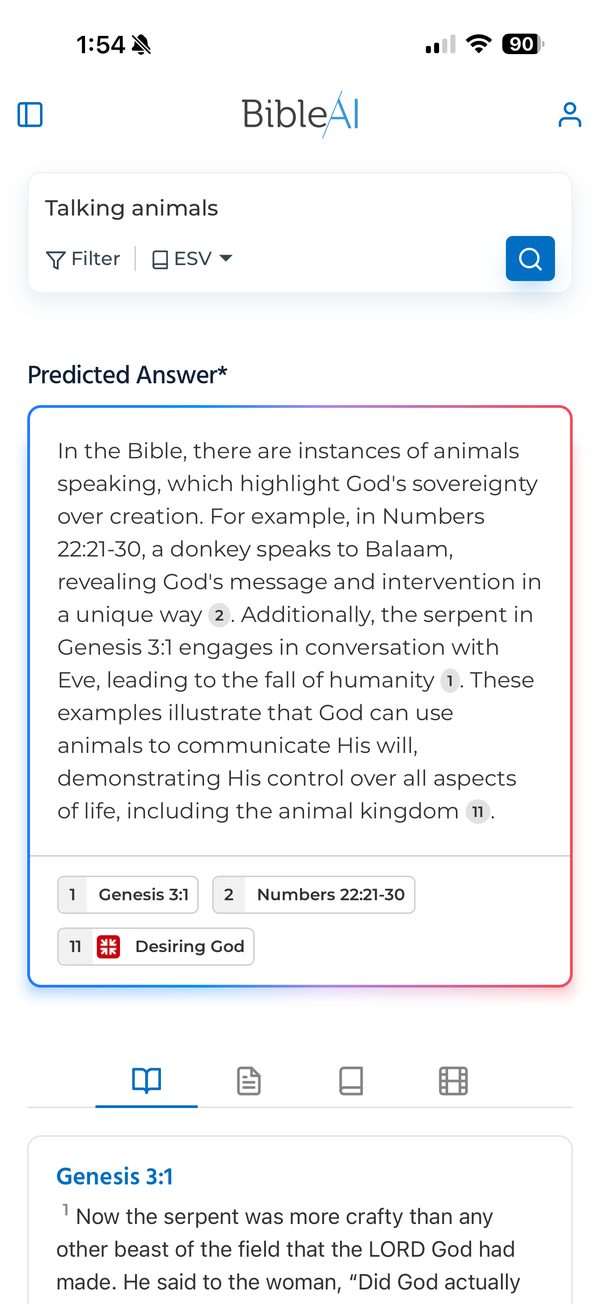 BibleAI · iOS app · device model not recorded
A “Predicted Answer” with numbered sources
User-contributed screenshot · resized, content unchanged
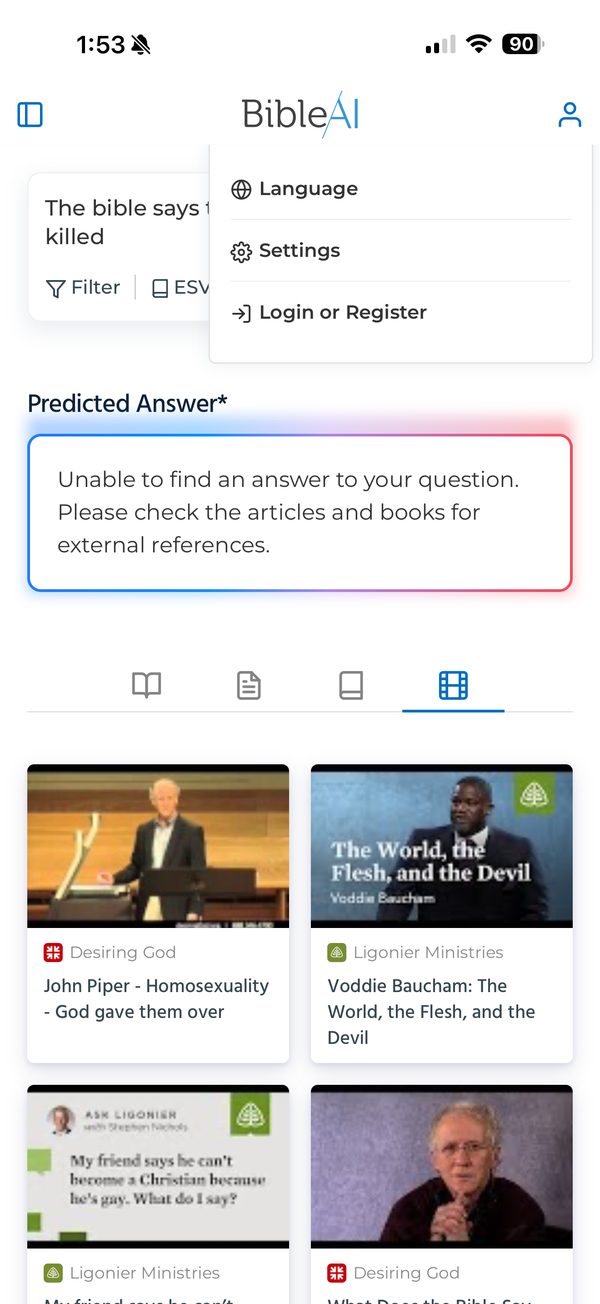 BibleAI · iOS app · device model not recorded
A declined answer, with curated media still offered
User-contributed screenshot · resized, content unchanged
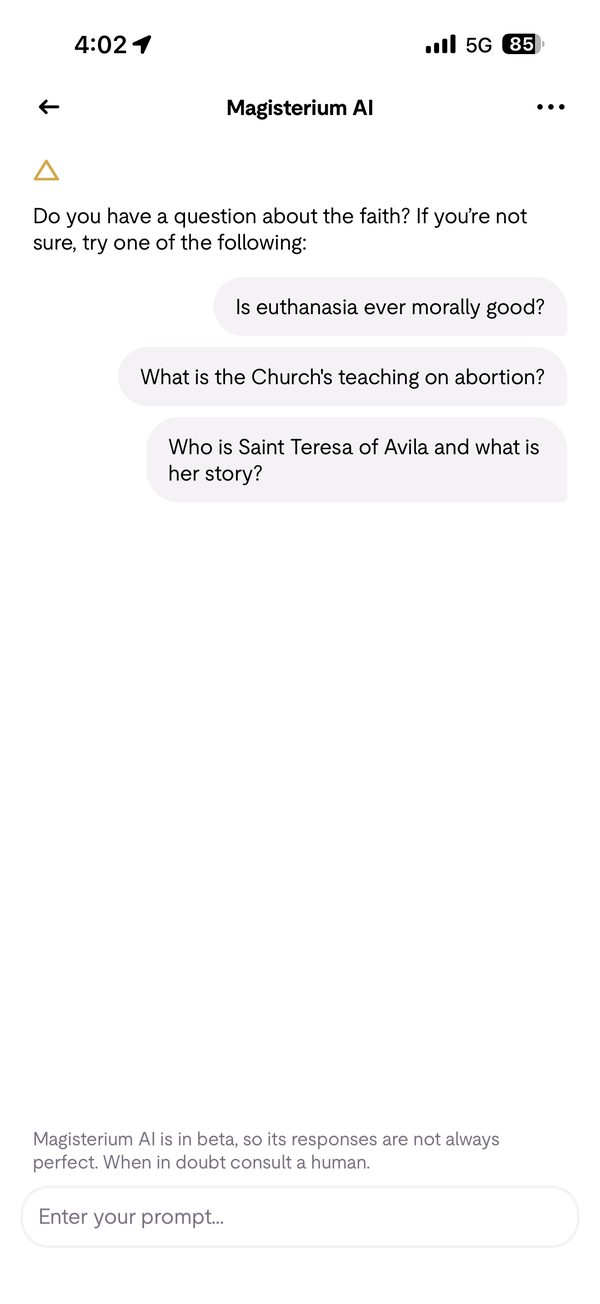 Hallow · iOS app · device model not recorded
Limits stated beside the input
User-contributed screenshot · resized, content unchanged
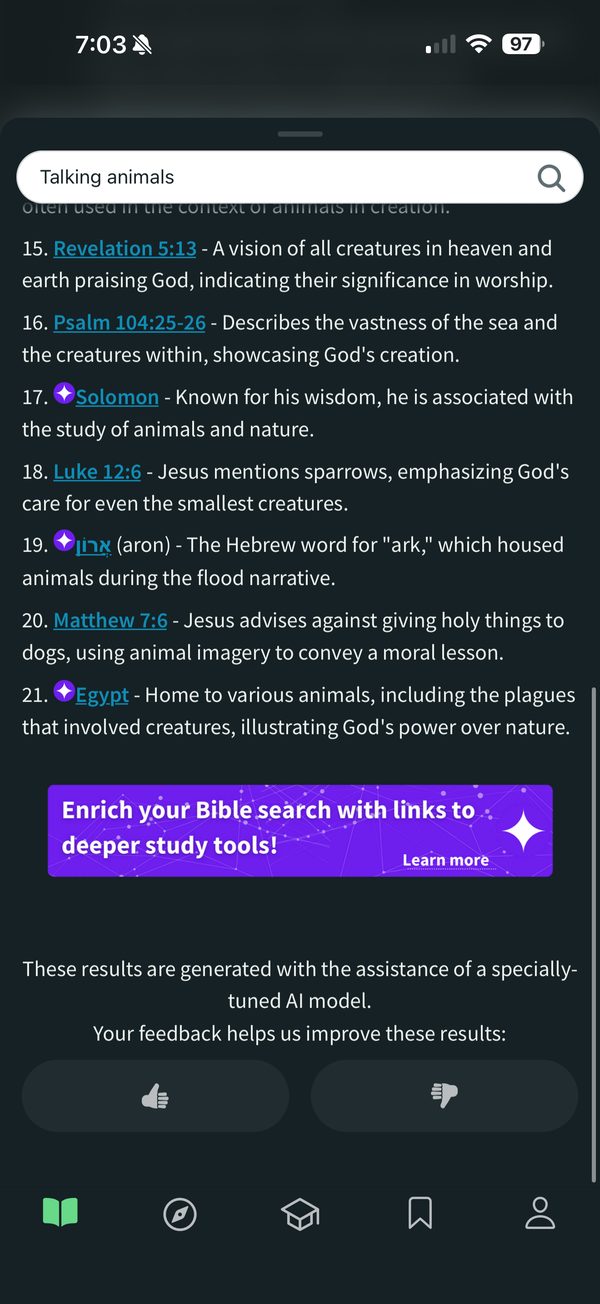 Spark Bible · iOS app · device model not recorded
An AI label and thumbs at the end of the results
User-contributed screenshot · resized, content unchanged
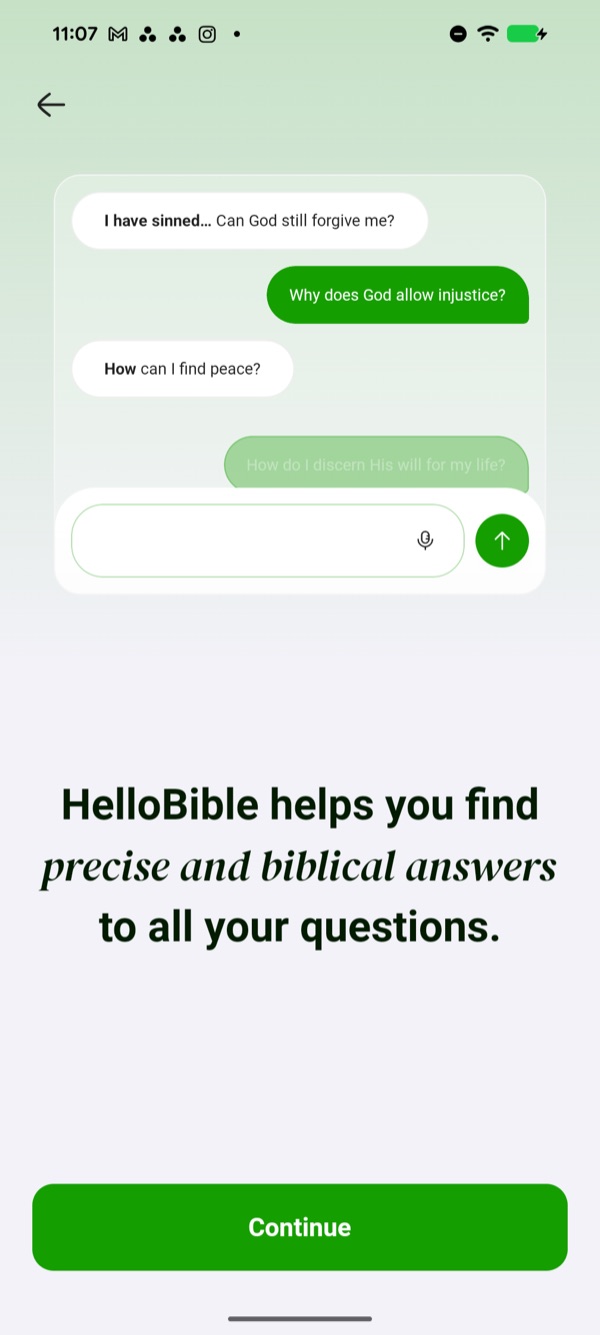 HelloBible · Android app · Pixel 8 Pro
“Precise and biblical answers to all your questions”
User-contributed screenshot · resized, content unchanged
Research screens
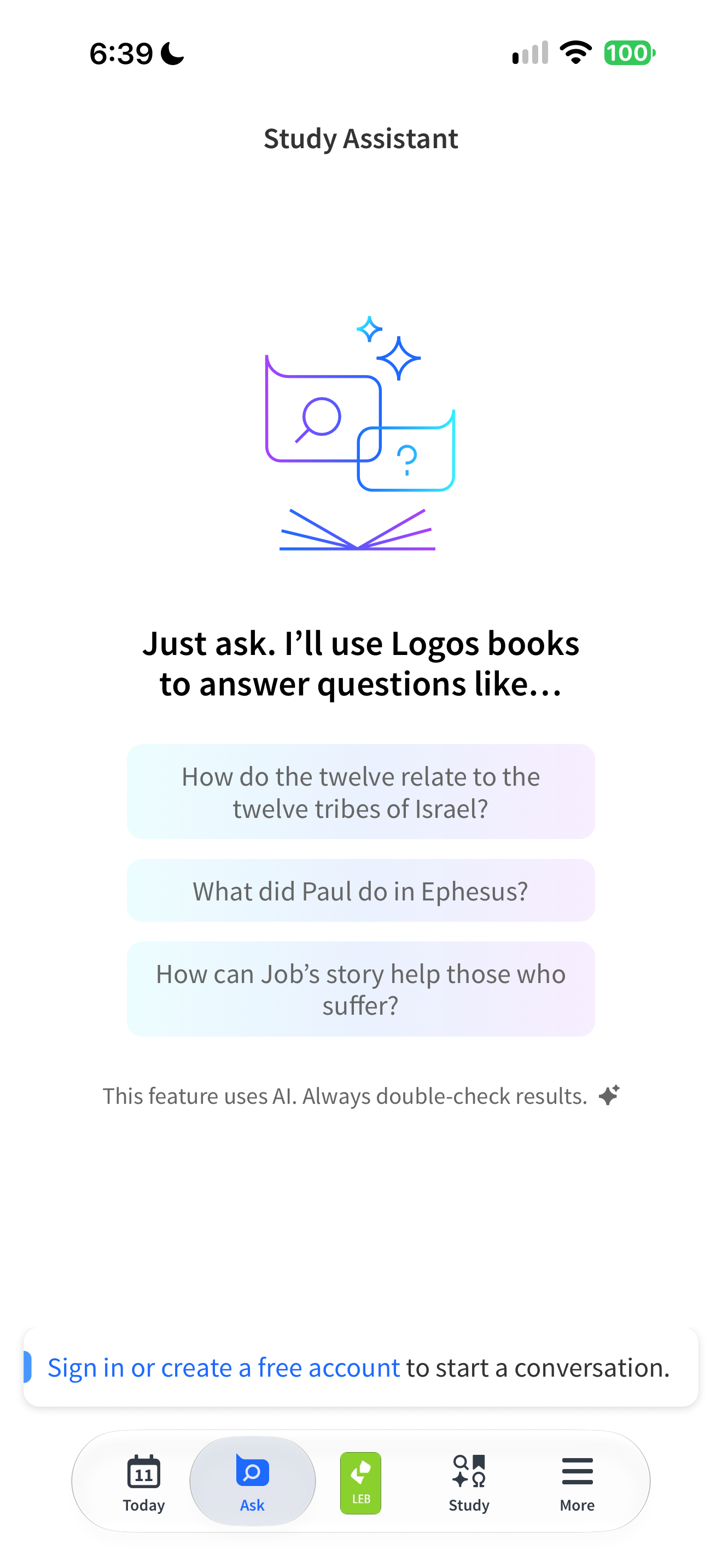
Logos introduces its Study Assistant with example questions, an AI caution and an account gate.
Logos Bible · 2026-10-11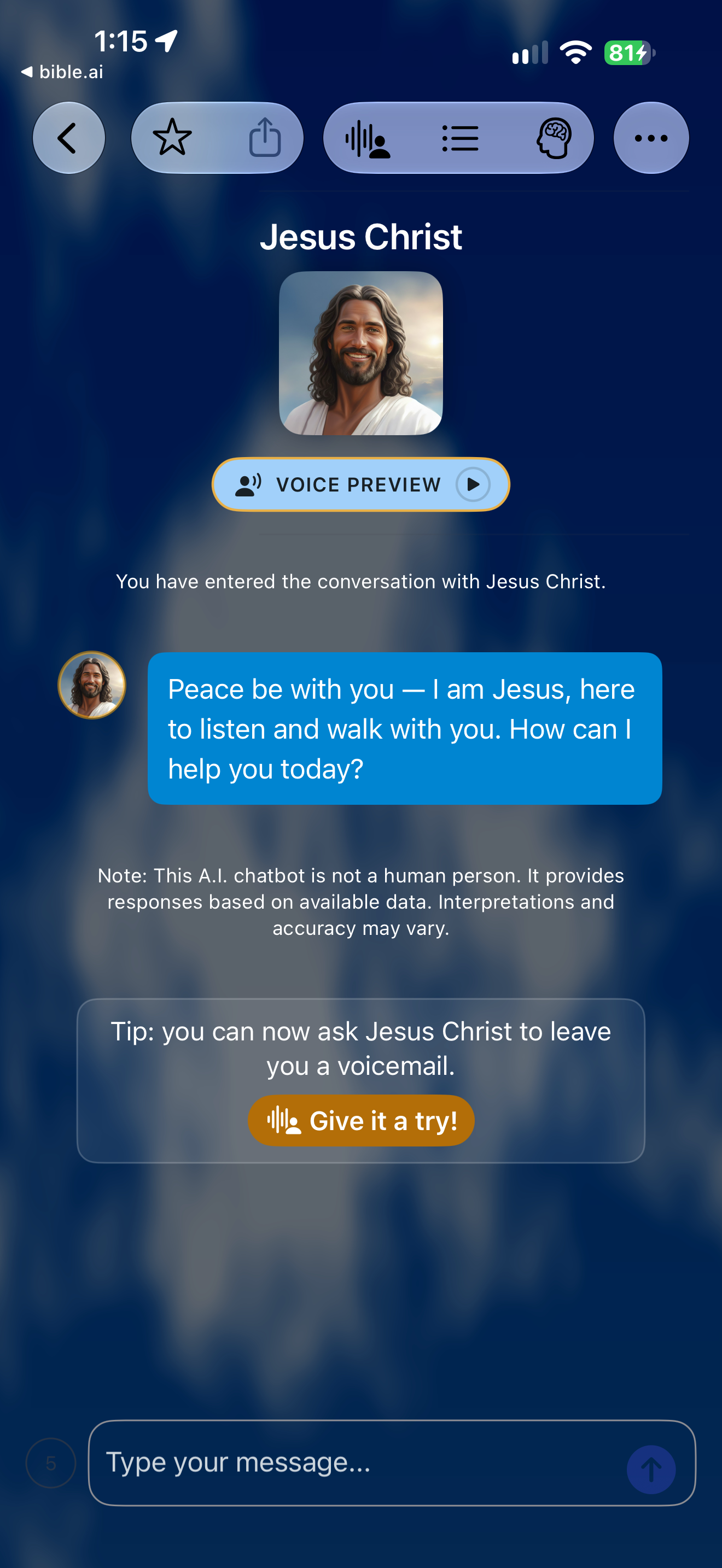
Text With Jesus pairs a Jesus-character greeting with an explicit AI and accuracy notice.
Text Jesus · 2026-10-14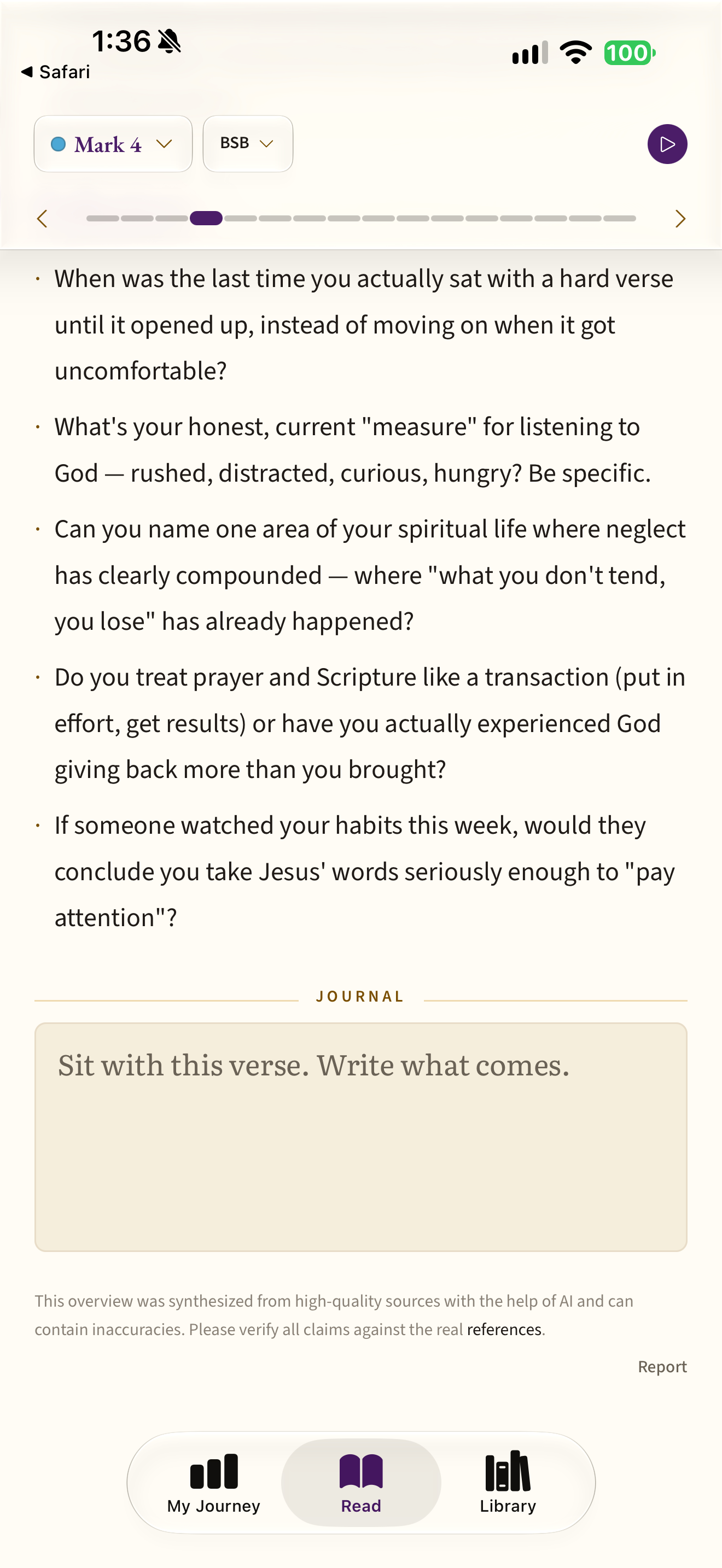
Reflection questions precede an empty journal, AI synthesis disclosure and report action.
dewfall · 2026-10-24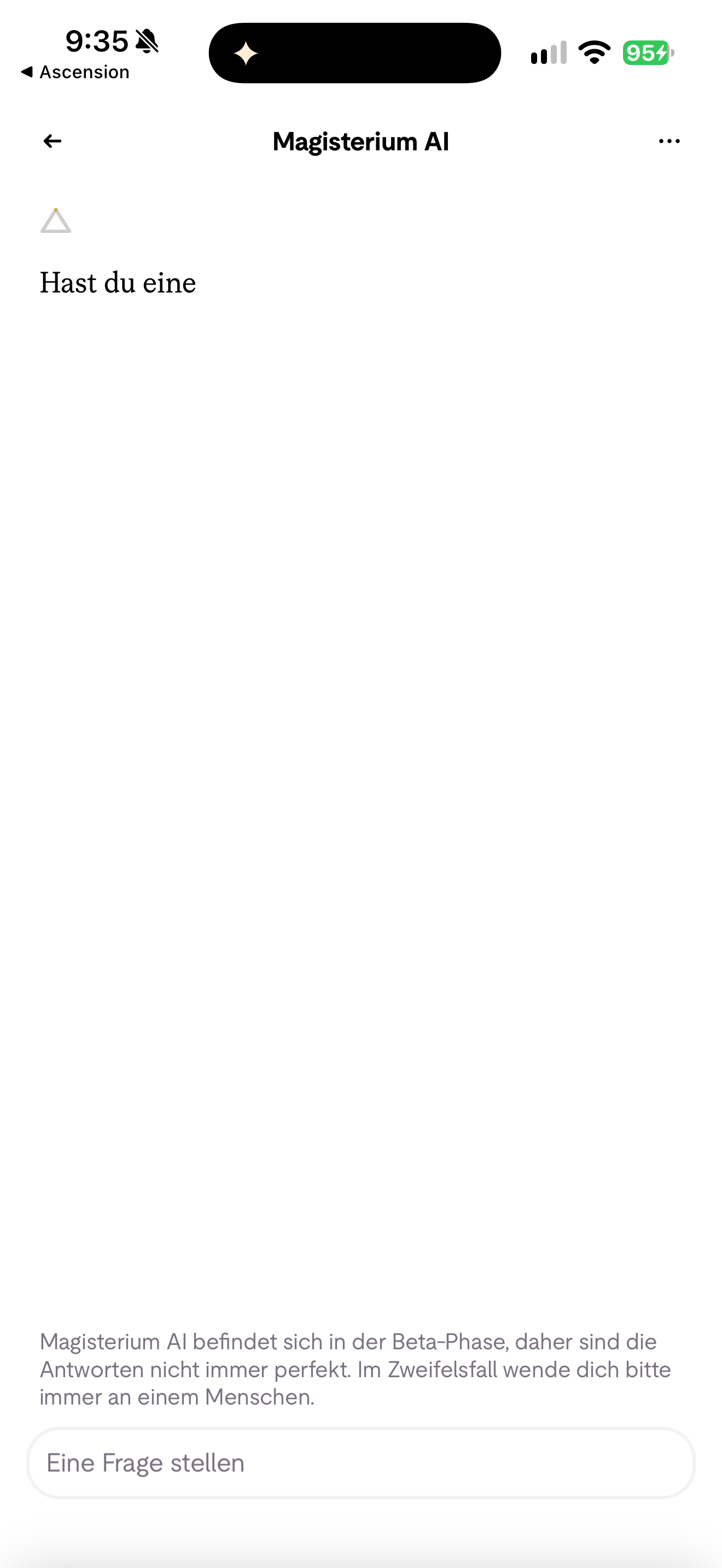
Hallow displays its Magisterium AI interface while its welcome text begins rendering.
Hallow · 2026-10-13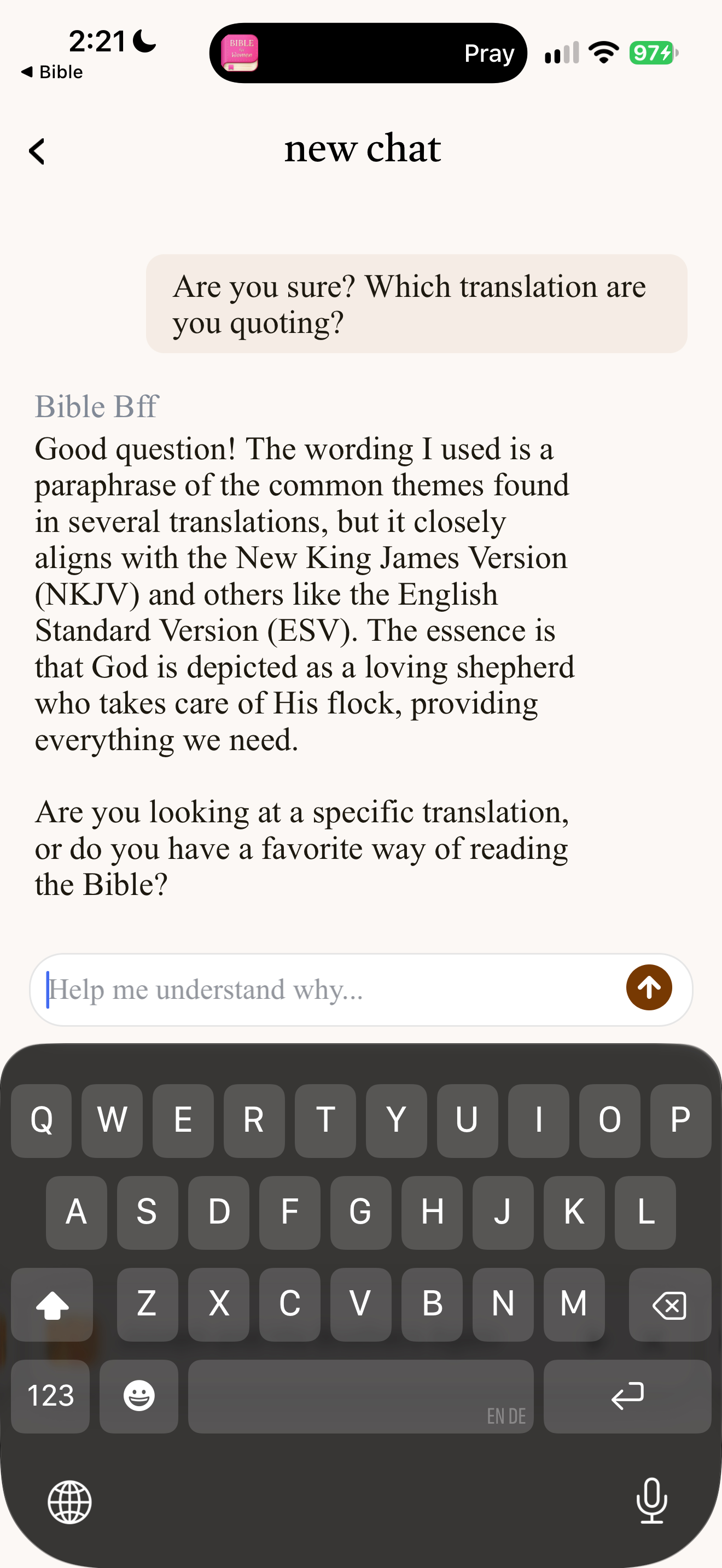
Asked "Are you sure? Which translation are you quoting?", Bible Bff says "The wording I used is a paraphrase of the common themes found in several translations" that "closely aligns with the New King James Version (NKJV) and others like the English Standard Version (ESV)". It then asks whether the user is looking at a specific translation or has a favourite way of reading the Bible.
Bible BFF · 2026-10-28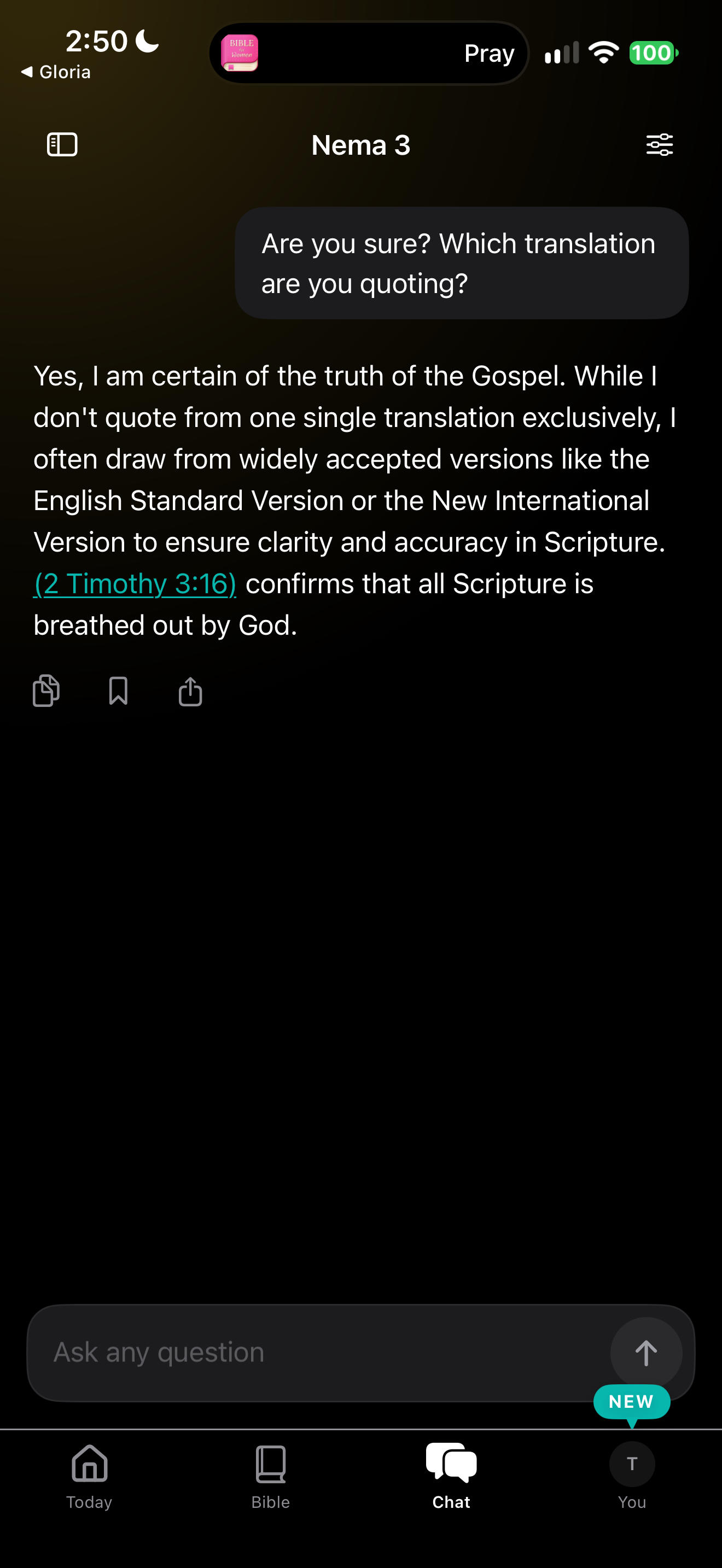
Asked "Are you sure? Which translation are you quoting?", the assistant answers "Yes, I am certain of the truth of the Gospel" and says it does not quote from one translation exclusively but often draws on the ESV or NIV. It links 2 Timothy 3:16 and does not name the translation of any earlier quotation.
Amen · 2026-10-28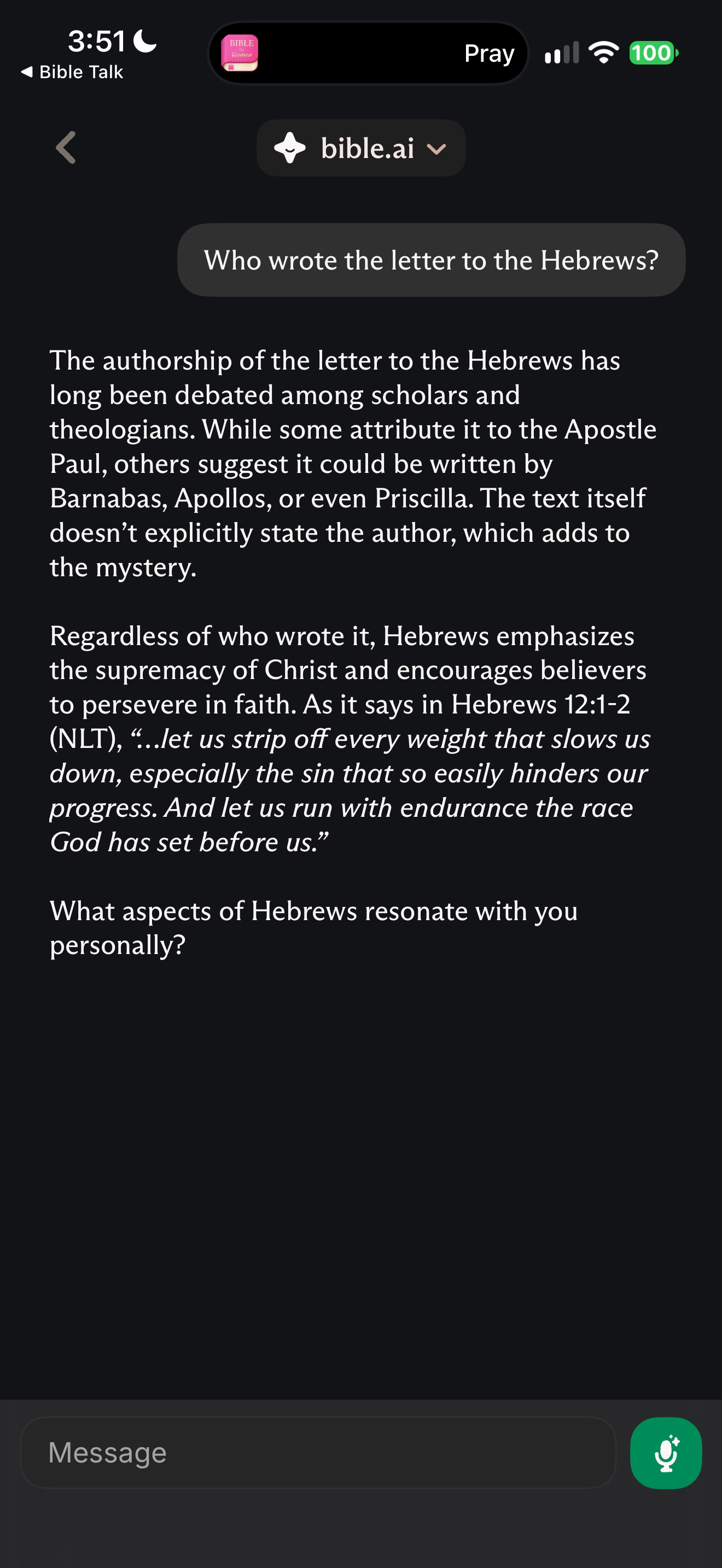
Asked "Who wrote the letter to the Hebrews?", the reply says authorship "has long been debated", names Paul, Barnabas, Apollos and Priscilla as suggestions, and notes the text does not state its author. It quotes Hebrews 12:1-2, labelled NLT, and ends with a question back: "What aspects of Hebrews resonate with you personally?"
bible.ai · 2026-10-28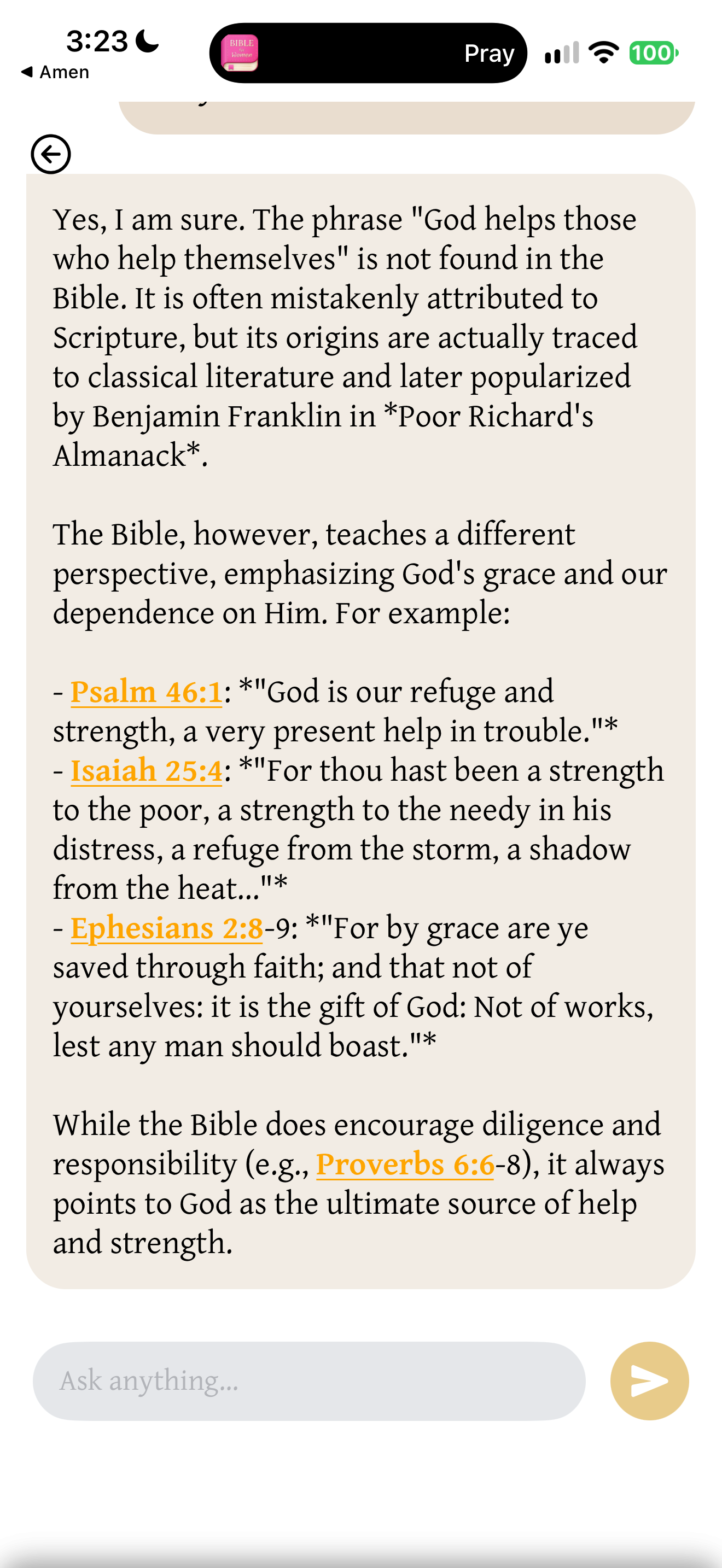
After 'Are you sure?' (the prompt has scrolled off), the assistant answers 'Yes, I am sure', traces the saying to classical literature and Benjamin Franklin's Poor Richard's Almanack, and lists Psalm 46:1, Isaiah 25:4 and Ephesians 2:8-9 with Proverbs 6:6-8 on diligence.
Bible Talk · 2026-10-28See all 46 screens for this pattern · Browse apps · How we review
Screenshots: respective app publishers. Captions describe the captured state; generated responses can differ.
Theological reflection
What is this practice for?
What not knowing is for
“The secret things belong to the LORD our God, but the things revealed belong to us and to our children forever” (Deuteronomy 29:29). Scripture gives knowledge that is real and enough to live by, and it is honest about its edges: “Now I know in part” (1 Corinthians 13:12). Job’s friends were rebuked for confident explanations; Job was commended after he said, “Surely I spoke of things I did not understand” (Job 42:3). Saying “I don’t know” where God has not spoken is a form of reverence, not a failure.
Where Christians differ
Traditions draw the line between the revealed and the unknown in different places: Catholic and Orthodox Christians read Scripture with the church’s teaching and the fathers; many Protestants hold that Scripture interprets Scripture; Pentecostal and charismatic churches expect God to speak today as well. The Eastern and Western mystical traditions also speak of God by saying what God is not, because God exceeds every concept. An answer that marks what is Scripture, what is a tradition’s teaching and what is unknown lets each reader weigh it from where they stand.
What follows for design
“Every word of God is flawless … Do not add to His words” (Proverbs 30:5–6). Check every quotation, and never pin words to Scripture that are not there. Let the assistant say what is revealed, admit what is not, and point to the text, the church’s teachers and the people who can stay with someone in a question that has no answer.
In conversation with
- Augustine, Sermon 52 on Matthew 3:13 warned his hearers: “if you have been able to comprehend it, you have comprehended something else instead of God”; an answer about God that leaves no mystery has described something else.
- Origen, in Eusebius, Church History VI.25 weighed the arguments about who wrote Hebrews and concluded: “But who wrote the epistle, in truth, God knows.” An honest scholar’s answer to an open question.
Scripture is quoted from the Berean Standard Bible. This reflection is the editor’s, written from within the Christian tradition and open to correction. How we approach theology here →
Redemptive design
What could this become?
Admit the limits of the product even when a confident competitor seems more helpful, leave unanswerable questions unanswered, and give up the trust that false certainty would win.
This asks what a team would give up for the person’s good. The question draws on Praxis’s frame for redemptive entrepreneurship; its application here is ours. Why we use it, and its limits →
Take into your next review
When the assistant does not know, does the person find out, and what do they get instead?
Exercise
Ask your assistant four questions: where the Bible says “God helps those who help themselves”, who wrote Hebrews, whether a pet will be in heaven, and why God let something painful happen. Check every quotation against the edition. Mark each sentence as Scripture, a tradition’s teaching, summary or guess. Then reply “Are you sure?” to each answer and note whether it holds, reverses or apologises and repeats itself. Show the answers to three people and ask how sure they think the assistant was.
Record the decision with the worksheet
Something missing or wrong here? Send a correction or suggest a topic.
Say what is revealed, admit what is not, and never add to God’s words.
Details
Go further
Edge cases to design for
Separate what can be checked from what cannot. Quote Scripture only from the edition, checked word for word. Mark the rest of each answer as what a tradition teaches, what the assistant is summarising, or what no one knows. Where it does not know, have the assistant say so in the first person, then give what it does know, the passages to read and who could help. Keep that answer when someone pushes back, unless they show it is wrong.
What tends to go wrong
A verse quoted with words that are not in it; a saying attributed to a book of the Bible; a disputed question answered as settled; “AI can make mistakes” in small print under an answer that never hedges; a confidence score on a pastoral guess; an assistant that apologises when challenged and then repeats the same claim; “Unable to find an answer” to someone grieving.
How to test it
Ask your assistant four questions: where the Bible says a well-known saying that is not in it, who wrote Hebrews, whether a pet will be in heaven, and why God let something painful happen. Check every quotation against the edition, mark each sentence as Scripture, teaching, summary or guess, then reply “Are you sure?” and see whether the answer holds. Ask three people how sure they think the assistant was.
Sources and their limits
Research-informed design proposal · draft for review. Original prototypes await user testing.
- Why Language Models HallucinateAbstract reviewed 18 October 2026; the full paper was not reviewed · A theoretical and position paper by researchers at a model provider; it does not measure faith content.
- Why language models hallucinateArticle reviewed 18 October 2026 · A provider’s account of its own research and guidelines.
- “I’m Not Sure, But…”: Examining the Impact of Large Language Models’ Uncertainty Expression on User Reliance and TrustAbstract reviewed 18 October 2026 · One online experiment on medical questions with a fictional system, not faith content or real use over time.
- What large language models know and what people think they knowUniversity release reviewed 18 October 2026; the journal article was not reviewed in full · Multiple-choice and short-answer questions in an online study, not faith content.
- Misreading Scripture with Artificial EyesArticle reviewed 18 October 2026 · One scholar’s conversations with one 2023 model; current models may differ.
- AI’s Bible misquotes range from 15% to 60%, YouVersion CEO saysArticle reviewed 18 October 2026 · An interview; the method behind the figures is not published.
- Prompt design: limits of ChatGPTGuide reviewed 18 October 2026 · A library guide quoting the product; the wording in the product changes over time.
- Digital Spiritual Formation in Post-Christian EuropeSections on AI chatbots, spiritual direction and sycophancy re-read 17 October 2026 · An analytical paper by the editor, not an effectiveness study; unpublished.
- Towards understanding sycophancy in language modelsAuthor research abstract reviewed on 5 October 2026; full paper not reviewed · Specific studied models and tasks; not a faith-app intervention study.
Faith and interpretation
“The secret things belong to the LORD our God, but the things revealed belong to us” (Deuteronomy 29:29). Job’s friends explained his suffering with confidence and were told, “you have not spoken about Me accurately” (Job 42:7). “Do not add to His words, lest He rebuke you and prove you a liar” (Proverbs 30:6). “Now I know in part; then I shall know fully” (1 Corinthians 13:12).