First use
What does someone have to give before they reach what they came for?
When two disciples began to follow Jesus, he asked, “What do you want?”, and when they asked where he was staying, he said, “Come and see” (John 1:38–39). The first minutes in a faith app ask the same question from the other side. Many apps put a tour, an account, questions, a rating, permission prompts and a subscription offer in front of the first verse, prayer or answer. Some people arrive curious, some in a hard night, some coming back after years away or after being hurt in a church. Apps also cost money to build and run, and every AI answer has a price, so how and when to ask for support is a real question, not a trick. Welcome people first, and ask honestly.
- 6 working options
- 19 app examples
- 7 takeaways
- Editorial review, not user-tested
The spectrum
From nothing asked to everything asked
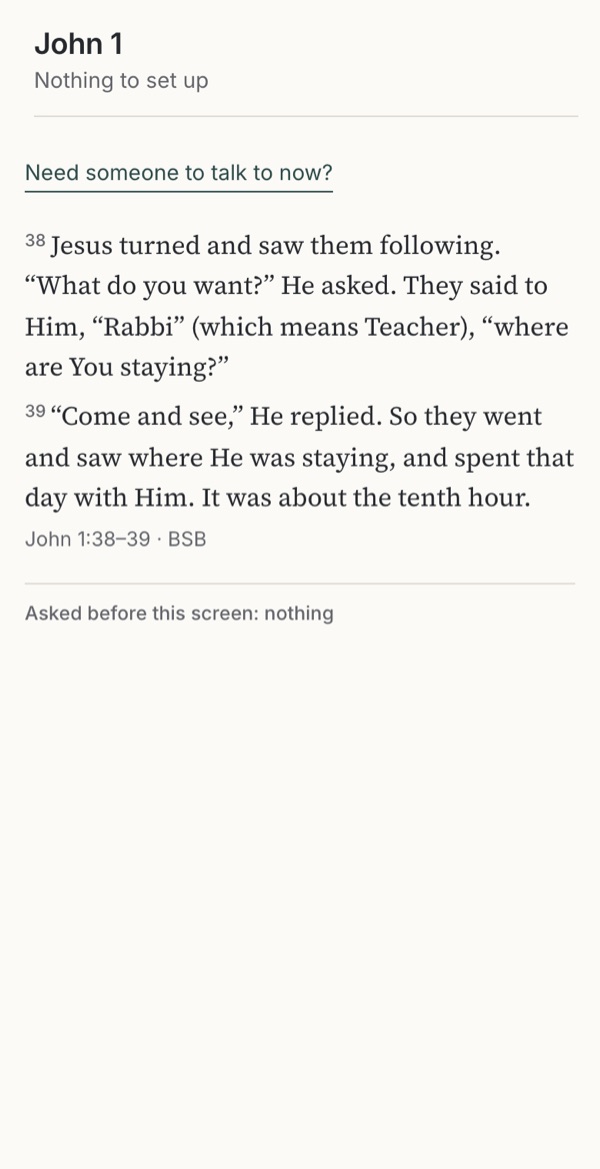 Familiar convention What they came for, at once Nothing saved yetTry it →
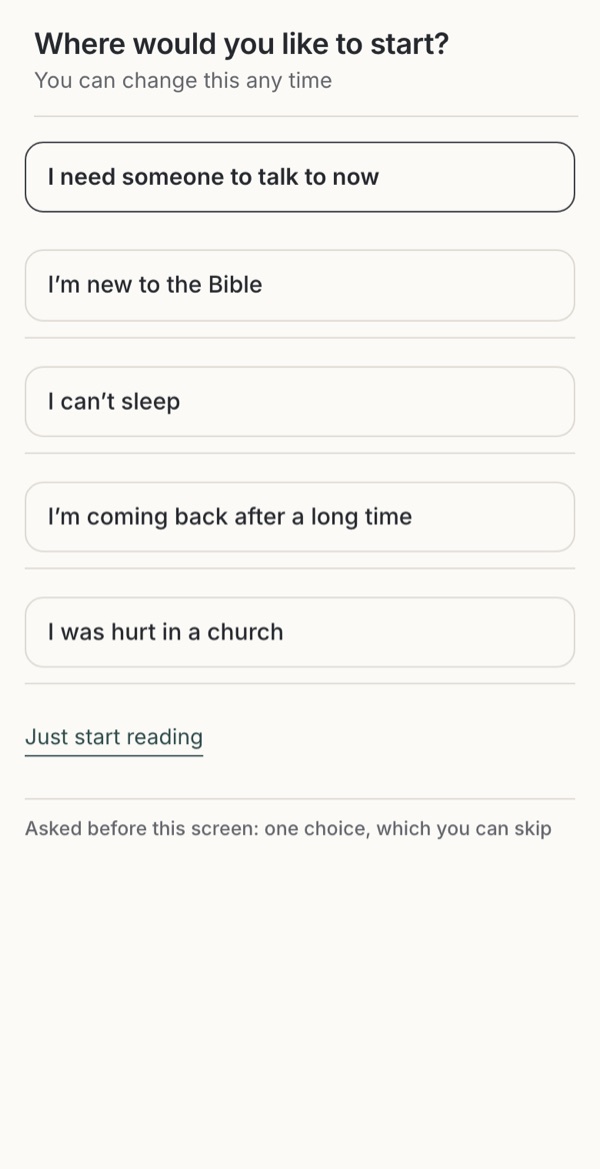 Familiar convention A way in without a reference Someone chose the passagesTry it →
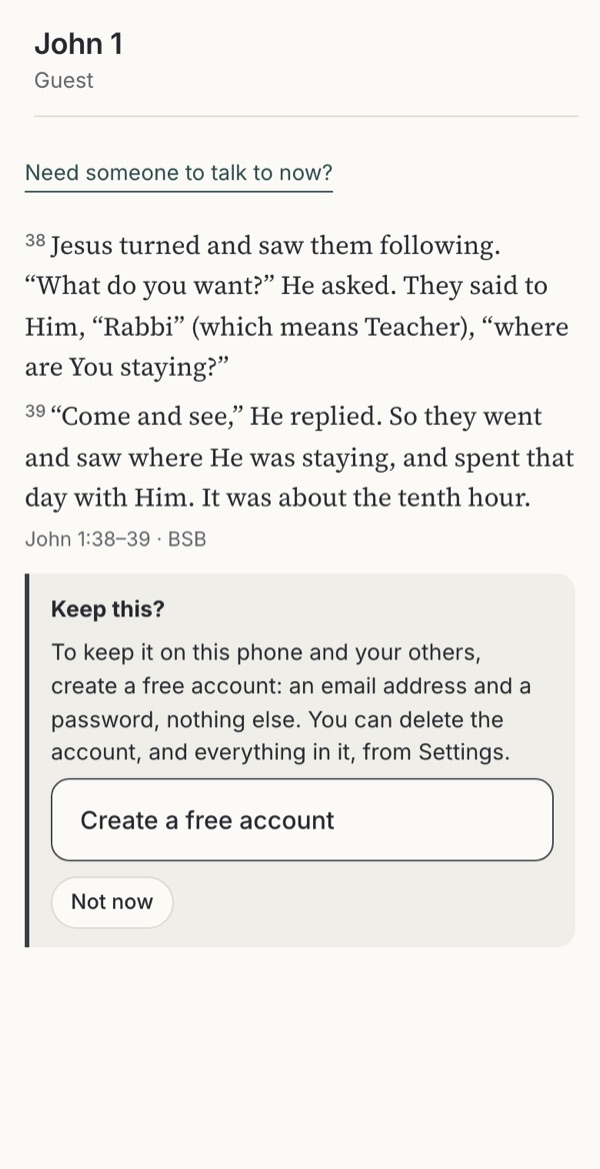 Observed Use first, decide later The later ask can feel like a wallTry it →
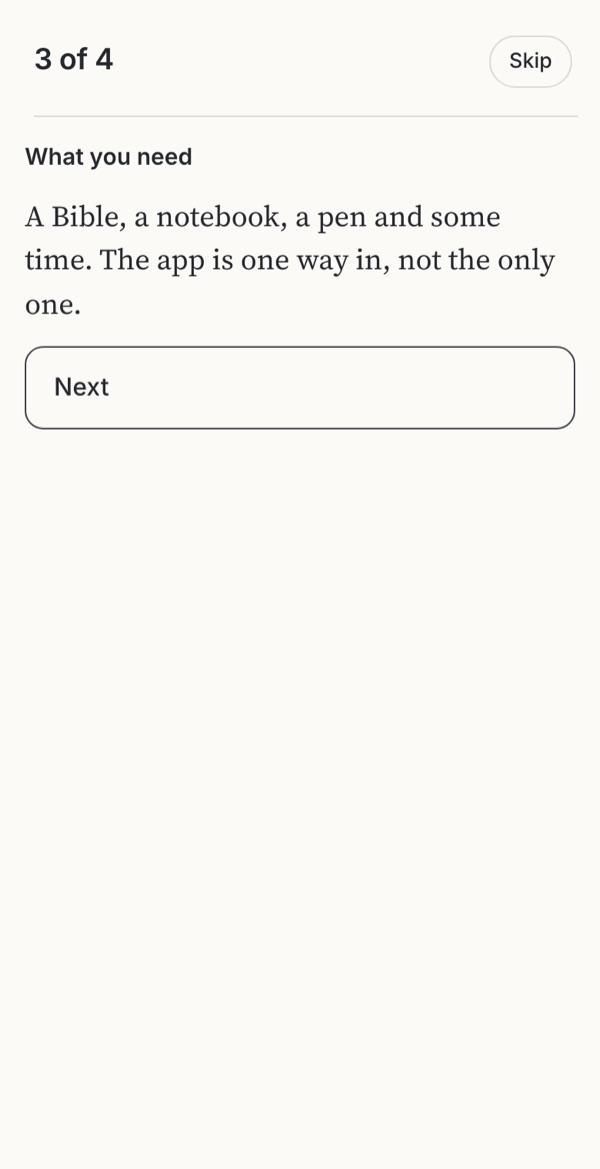 Observed Expectations set Often skipped, soon forgottenTry it →
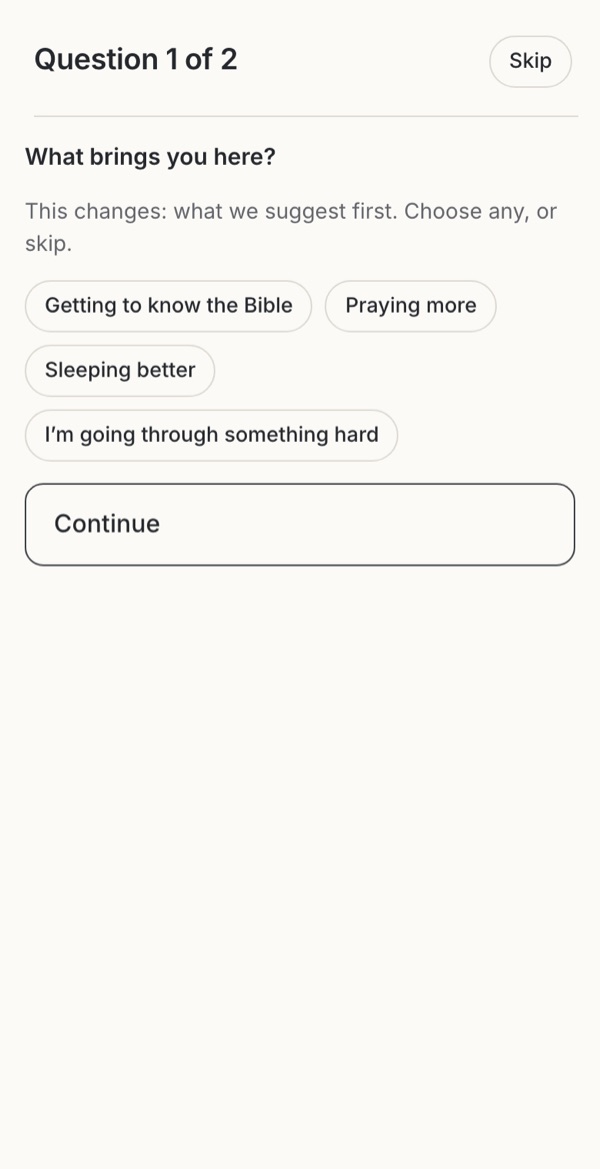 Observed A first suggestion that fits Questions before contentTry it →
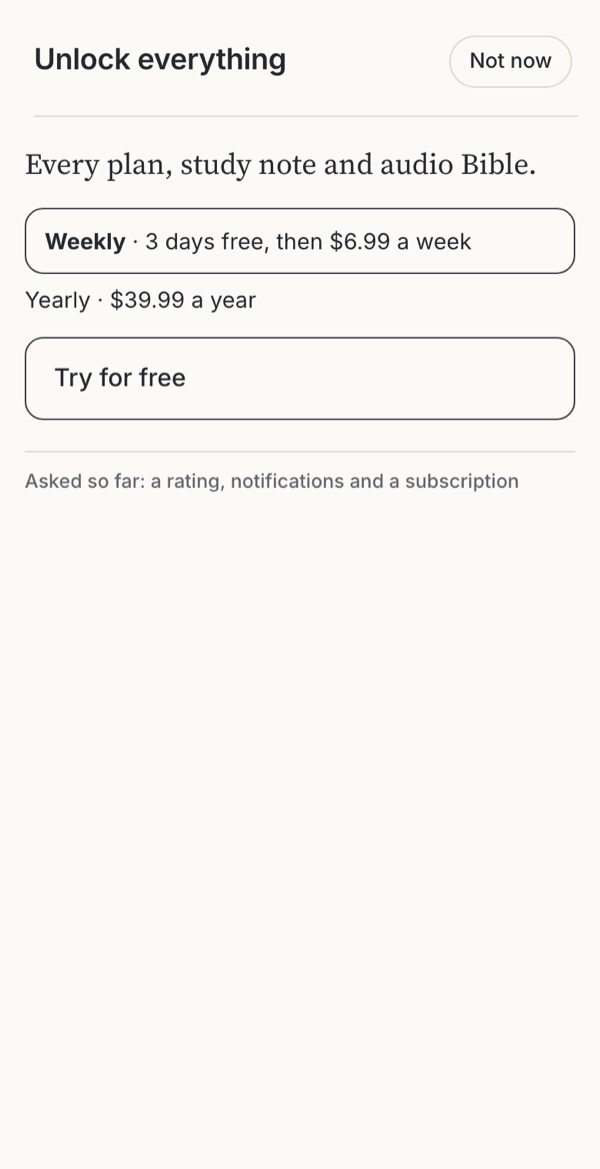 Observed Pays for the work Up front, it asks before givingTry it →
Stills from the working example below. Choose one to try it.
Try it
Try six ways to begin
Someone has just installed a faith app. Choose what kind of app it is: a Bible reader, a prayer app or an AI companion. Then choose who is arriving: someone curious, someone in a hard night, or someone coming back after years away or after being hurt in a church. Count what each option asks before they reach what they came for, and see where help is. For the last option, compare asking for payment up front with asking after a first use.
Option
Why these settings?
The Bible reader opens on John 1:38–39, the prayer app on an evening prayer with Psalm 4:8, and the AI companion on a question box. Someone in a hard night types or chooses that they are not coping; someone coming back has been away from church for years, or was hurt in one, and answers “no church right now”. Asking after a first use says what is free, what costs money and roughly how much; the figure for an AI answer is our estimate from Anthropic’s published prices.
Familiar convention
1. Open on what they came for
Familiar from church practice: the Diocese of York tells someone who has picked up a Bible to start with Mark, “Start with chapter 1 and read as much as feels manageable”; a pew Bible or a prayer book asks nothing first. The app, its passage, prayer and question box are written for this example.
Try this
Read, play or ask straight away. Then arrive in a hard night, and then come back after years away.
Makes easier
Nothing stands between the person and what they came for.
Costs
Nothing is saved until they choose to save it.
Ask your teamWhat is the one thing a new person should be able to do in the first ten seconds?
Familiar convention
2. A first page of places to start
Familiar from the Gideon Bible, whose front pages carry “topical indexes to point the reader to what the Bible says about various topics, problems and life situations”. Not observed in this form in an app. The situations, passages and help line are chosen for this example; the TelefonSeelsorge numbers are from its own website, checked 11 October 2026.
Try this
Choose a place to start. Then arrive in a hard night and see what comes first.
Makes easier
A way in for someone without a reference, with help at the top.
Costs
Someone chose the passages, and the list can feel like a diagnosis.
Ask your teamWho chose these situations and passages, and what comes first for someone in danger?
Observed
3. Guest first, an account when there is something to keep
Observed in Startblock (“Ohne Anmeldung fortfahren”, continue without signing in), Bible.is (“Create account later”) and Joseph Prince, where a guest can read and copy but is asked to sign up “to begin highlighting”; see the screenshots below. Apple’s review guidelines ask apps without significant account-based features to “let people use it without a login”. The wording here is written for this example.
Try this
Use the app, then try to keep something. Then arrive in a hard night.
Makes easier
People use the app first and decide later whether to stay.
Costs
The later ask can still feel like a wall, if it comes at the wrong moment.
Ask your teamWhat is the first thing worth keeping, and is that the right moment to ask?
Observed
4. A short tour first
Observed in Startblock’s five skippable intro slides, whose fourth reads “Das brauchst du: Eine Bibel aus Papier, ein Notizheft, einen Stift und etwas Zeit” (you need a paper Bible, a notebook, a pen and some time), in ESV’s welcome carousel, which ends in an offer to create a free account, and in Joseph Prince’s intro video and feature tour; see the screenshots below. The slides here are written for this example.
Try this
Step through the tour, or skip it. Then arrive in a hard night.
Makes easier
Sets expectations, as Startblock’s paper Bible and pen do.
Costs
Often skipped and soon forgotten; it delays the first use.
Ask your teamWhat would a person miss if they skipped every slide?
Observed
5. Questions first
Observed in Abide’s “What brings you here today?” photo grid, Bible BFF’s “How much of the Bible have you read?” and Faith’s questions for a name, an age range and a profile picture; see the screenshots below and the check-ins deep dive. The questions here are written for this example.
Try this
Answer, or skip, each question. Then come back after years away and answer “no church right now”.
Makes easier
A first suggestion that fits.
Costs
Every question delays the first use, and some ask what is not needed.
Ask your teamWhat does each answer change, and can someone skip it?
Observed
6. Asking for payment
Observed in Bible BFF, which asks people to rate the app before using it and then offers a weekly plan; Spark Bible, which asks for notifications before the first verse and later says “You just used your last free study”; Abide, whose trial screen gives the reminder day and charge date; and Pray.com, which asks for a mobile number at sign-up; see the screenshots below. The second setting, asking after a first use and saying what things cost, is a proposal; its costs are our estimate from published AI prices.
Try this
Count what is asked before the first verse. Then switch to asking after a first use, and try the AI companion.
Makes easier
Asked after a first use, honestly, it keeps the work going.
Costs
Asked before anything is given, it turns people away and puts help behind a wall.
Ask your teamWhat is free, what costs you money, and does the person know before they pay?
What we noticed
Takeaways
Let people reach what they came for first
Startblock offers “Ohne Anmeldung fortfahren” (continue without signing in), and Bible.is “Create account later”. Open on today’s passage, a prayer to play or a question box, and count everything asked before it.
Ask for an account when there is something to keep
Joseph Prince lets a guest read and copy, and asks for an account “to begin highlighting”. A highlight, a plan or a conversation worth keeping is the honest moment to ask; say what the account holds, and how to delete it.
Ask for permissions when a feature needs them
Spark Bible asks for notifications before the first verse; Android’s guidance is to ask “in context, when the user starts to interact with the feature that requires it”. Ask when someone sets a reminder.
Help in a crisis comes before everything
Someone may open a faith app in a hard night. Keep a way to a person on the first screen, and never put it behind an account, a question, a free-answer limit or a paywall. Offer help, not verses, unless the person asks for Scripture.
Sensitive conversations →“No church right now” is an ordinary answer
Someone coming back after years away, or after being hurt in a church, may meet questions about their church on the first screen. Ask only if the answer changes something, let it be skipped, and don’t praise or correct any answer.
When Scripture is used to harm →Ask for payment after a first use, and say what costs money
Abide’s trial screen gives the reminder day and the charge date; Spark Bible tells people when they have used their “last free study”. Say what is free, what costs money and roughly why: licensed notes, recordings, AI answers. A free allowance that explains itself is fairer than a wall.
Neither free nor paid is the only faithful way
The church has long supported those who serve the word, and has long distrusted those who sell it. A subscription can be honest and a free app can be manipulative. The test is what is asked before anything is given, and whether the person knows what they are paying for.
Use cases
Which situation, which option?
People come with different needs, sometimes in the same week. Each need fits some options better than others.
| Situation | Needs | 1 Open on what they came for | 2 A first page of places to start | 3 Guest first, an account when there is something to keep | 4 A short tour first | 5 Questions first | 6 Asking for payment |
|---|---|---|---|---|---|---|---|
| Someone curious, with no reference | A way in without a quiz | Good fit | Good fit | Good fit | Possible | Possible | Poor fit |
| Someone in a hard night | A person to talk to, before anything else | Good fit | Good fit | Possible | Poor fit | Possible | Poor fit |
| Someone coming back after years away, or after harm | Nothing that asks where they have been | Good fit | Good fit | Good fit | Possible | Poor fit | Poor fit |
| A church member sent a link | Today’s reading, and their church’s plan | Good fit | Possible | Good fit | Possible | Possible | Poor fit |
| An AI companion that costs money per answer | A free allowance that says why | Possible | Possible | Good fit | Poor fit | Poor fit | Good fit |
| Licensed study notes or recordings | A fair price, after a first use | Possible | Poor fit | Good fit | Poor fit | Poor fit | Good fit |
Editorial judgments drawing on the research below, not test results.
The research behind it
Theology, practice and science
Scripture and tradition
Welcome first, commitment later
Come and see
Jesus asked two would-be followers, “What do you want?”, and answered their question with an invitation: “Come and see” (John 1:38–39). They spent the rest of the day with him.
Guests received like Christ
The Rule of Benedict asks that “all guests who arrive be received like Christ”, and, for someone asking to join the community, that they “not be granted an easy entrance”. Welcome is free; commitment is asked for later, of those who want to stay.
A place to start, and permission to read a little
The Diocese of York tells someone who has picked up a Bible to try Mark: “Start with chapter 1 and read as much as feels manageable. You could also listen to it.” The Gideons put “topical indexes” for “topics, problems and life situations” at the front of their Bibles.
Diocese of York (Church of England)The Gideons International in Australia
Scripture and church practice
Paying those who serve the word
The worker is worthy of his wages
The Levites received the tithes of Israel “in return for the work they do” (Numbers 18:21). Paul wrote that “those who preach the gospel should receive their living from the gospel” (1 Corinthians 9:14) and that “the one who receives instruction in the word must share in all good things with his instructor” (Galatians 6:6). He also chose, for himself, to “offer it free of charge” (1 Corinthians 9:18).
Offerings, and a line against trading
Catholic church law permits a priest “to receive an offering to apply the Mass for a specific intention”, by which the faithful “support its ministers and works”, and requires that “Any appearance of … trading is to be excluded entirely”. Protestant churches pay their ministers through offerings, tithes or, in Germany, church tax.
Support, and suspicion of those who ask
The Didache, an early church manual, says a true teacher “is himself worthy, as the workman, of his support”, and that a travelling apostle who asks for money “is a false prophet”. Peter told Simon, who offered money for the Spirit, “you thought you could buy the gift of God with money!” (Acts 8:20), and Paul refused to “peddle the word of God for profit” (2 Corinthians 2:17).
Products and research
What a first use asks, and what it costs
Use first, then decide
Apple’s review guidelines say that an app without significant account-based features should “let people use it without a login”, and that an app with accounts must let people delete them. Its design guidance asks for onboarding that is “fast, fun, and optional”, and for letting people experience an app “before prompting them for ratings or purchases”.
Tutorials are skipped
Nielsen Norman Group found that deck-of-cards tutorials “didn’t improve task performance”, and that users “frequently skip them”.
A required account turns people away
In Baymard’s survey of US online shoppers, 18% of those who abandoned a checkout for reasons other than browsing said “The site wanted me to create an account”. That is shopping, not faith apps, but the moment is the same: someone ready to begin is asked for something first.
Asking again and again
European data protection authorities name “continuous prompting” a deceptive design pattern: users “repeatedly asked” for more data or consent tend to give in.
What it costs to serve someone
An AI answer that reads about 6,000 tokens (instructions, passages and the conversation so far) and writes about 600 costs about 1.8 cents on Claude Sonnet 5.5 and about a tenth of a cent on Claude Haiku 5.5, at published prices. At 20 answers a day, that is about $10.80 or $0.54 a person each month, before hosting and staff. Translations cost too: Crossway’s free ESV terms exclude apps that sell, take donations or carry advertising, while the Berean Standard Bible is in the public domain. And free apps are paid for by someone: in 2018 YouVersion’s $8.3 million budget came from a church’s tithes and donations.
Every source, with what it can and cannot show, is listed under Go further → Sources and their limits.
Where to start
Which fits your product?
IfA Bible reader
Start withOpen on today’s passage; ask for an account when someone wants to keep something
IfA prayer or audio app
Start withPlay first; ask for notifications when someone sets a reminder
IfAn AI companion
Start withA free allowance that says why, with crisis help never counted
IfLicensed notes or recordings
Start withA price after a first use, with the trial’s reminder and charge dates
IfYou are tempted to put the paywall first
Start withDon’t: let people meet what you made, then ask, honestly
These are editorial judgments from design review, not results of user testing.
In real apps
Examples in use
Attributed screenshots with dates and review limits. A screenshot shows an implementation; it does not show that it works for every audience.
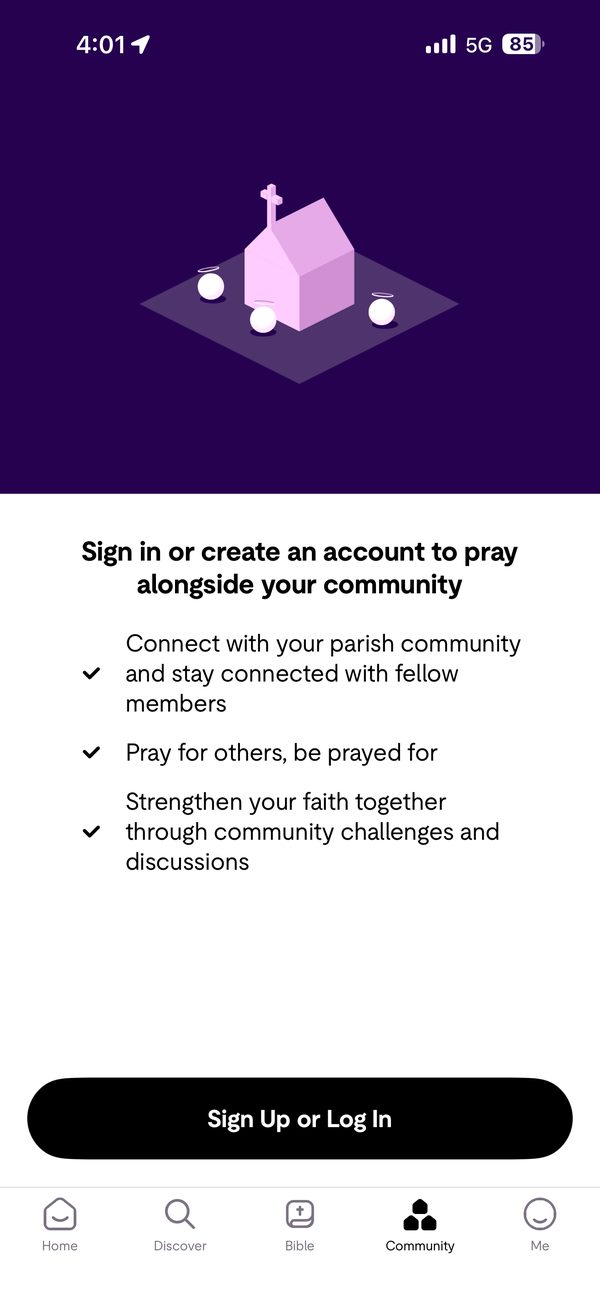 Hallow · iOS app · device model not recorded
“Pray for others, be prayed for”
User-contributed screenshot · resized, content unchanged
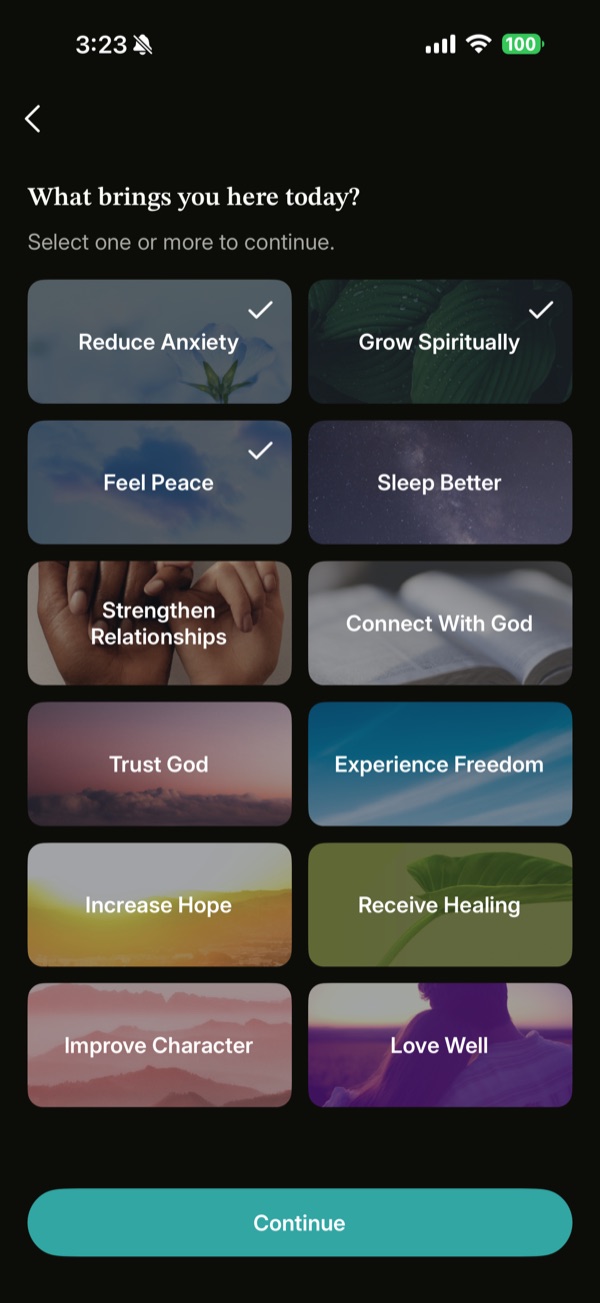 Abide · iOS app · device model not recorded
“What brings you here today?” as a photo grid
User-contributed screenshot · resized, content unchanged
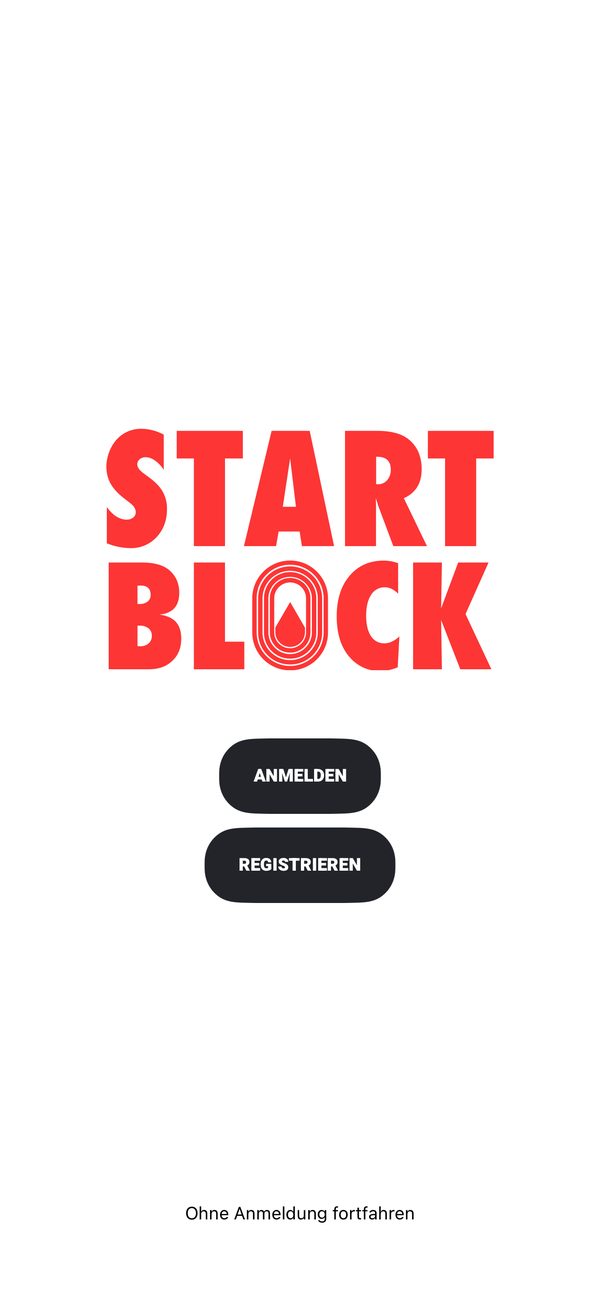 Startblock · iOS app · device model not recorded
A way to continue without signing in, on the first screen
User-contributed screenshot · resized, content unchanged
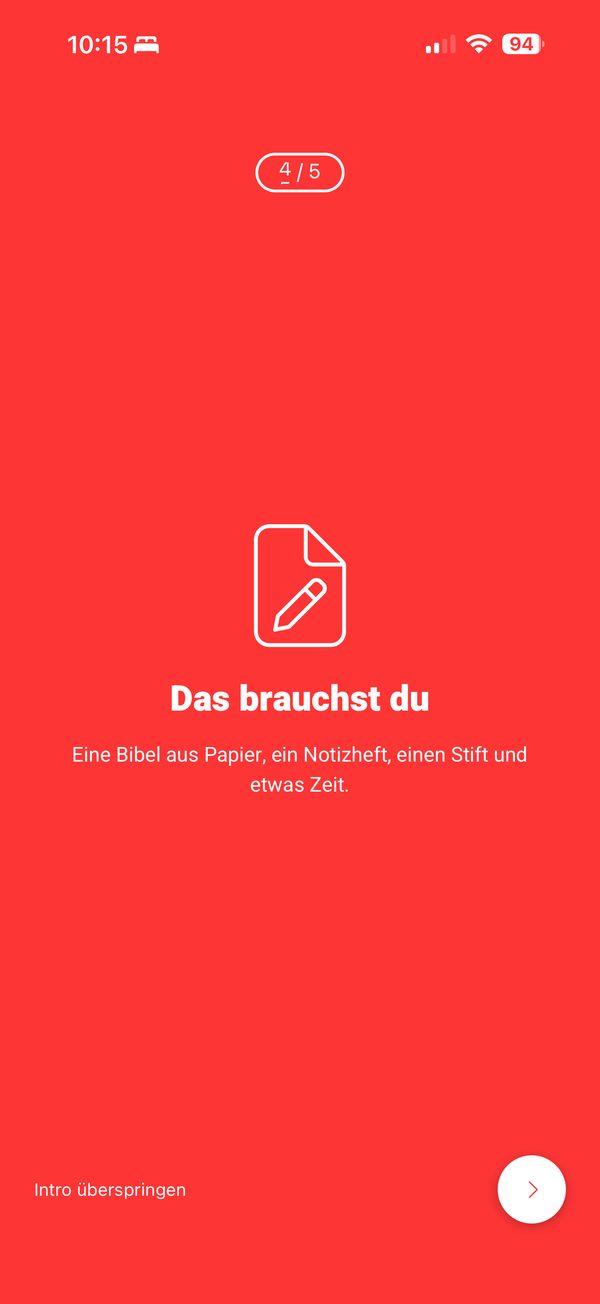 Startblock · iOS app · device model not recorded
“What you need”: a paper Bible, a notebook, a pen and some time
User-contributed screenshot · resized, content unchanged
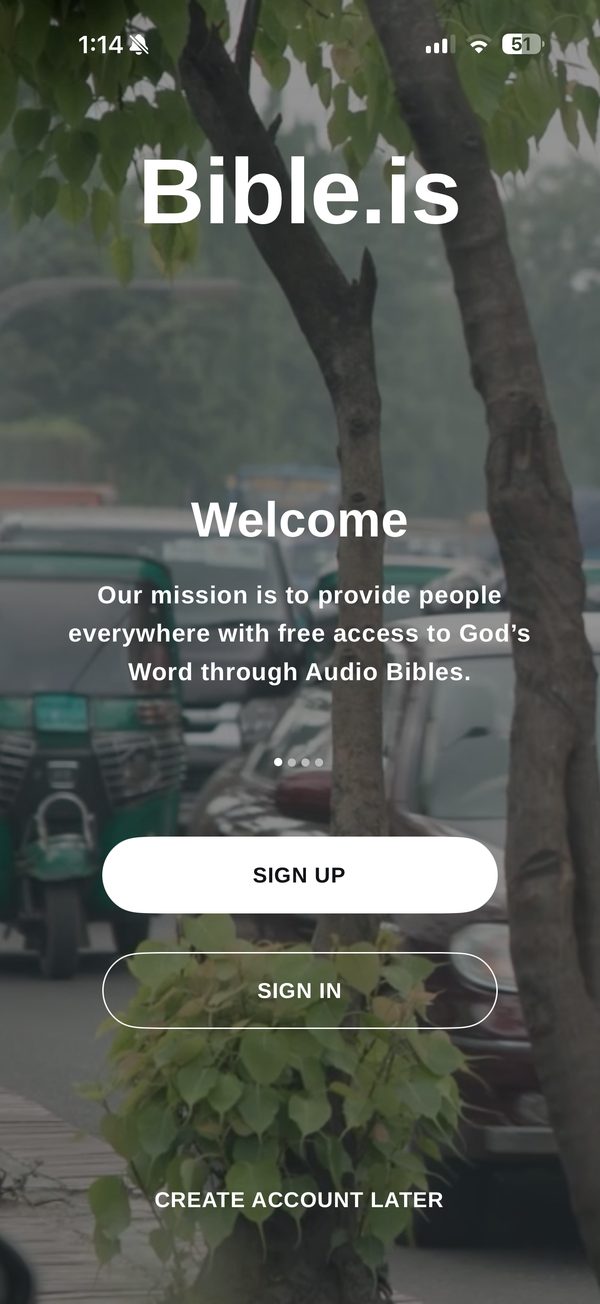 Bible.is · iOS app · device model not recorded
“Create account later” beneath the mission
User-contributed screenshot · resized, content unchanged
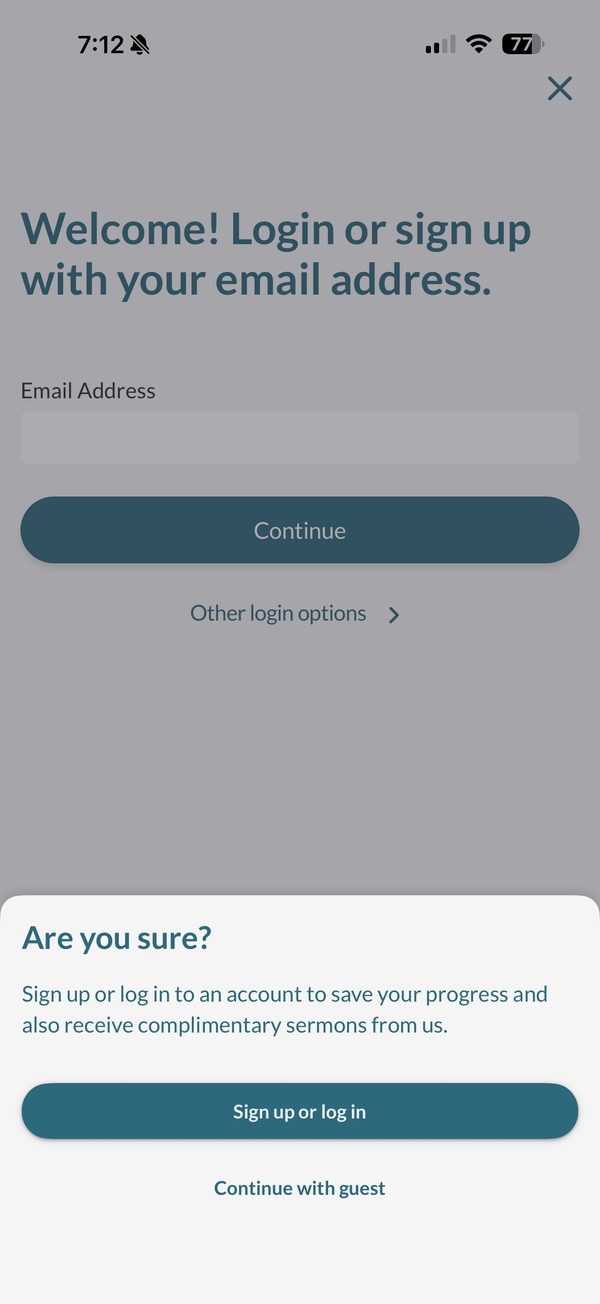 Joseph Prince · iOS app · device model not recorded
A second ask when continuing as a guest
User-contributed screenshot · resized, content unchanged
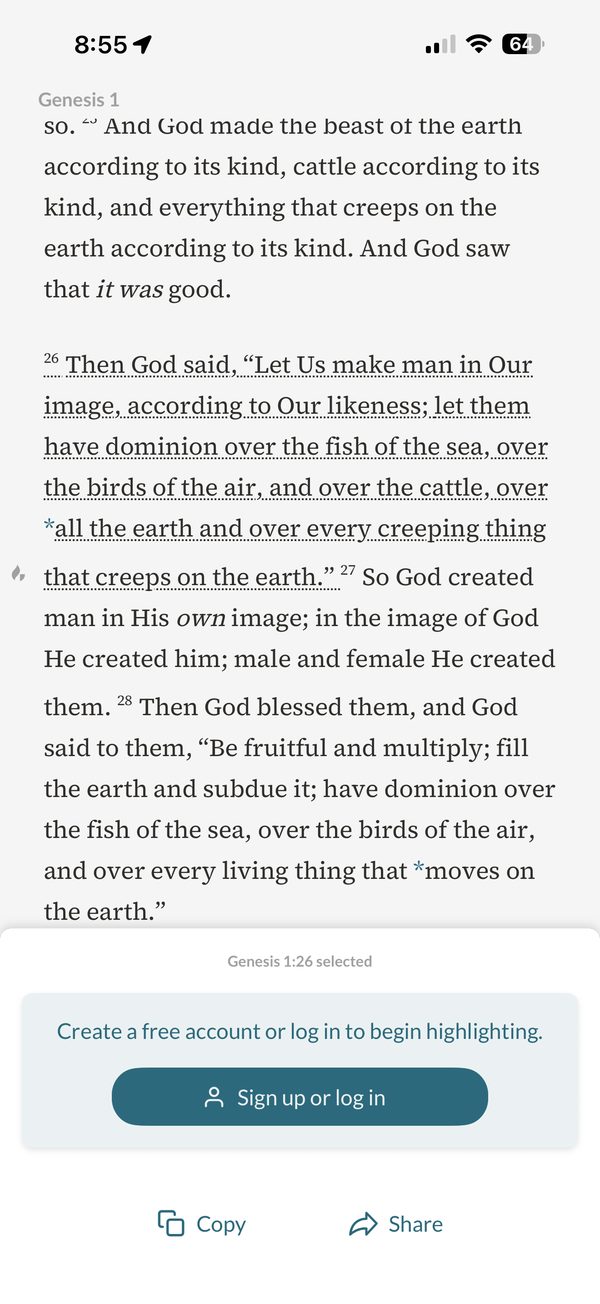 Joseph Prince · iOS app · device model not recorded
An account asked for at the moment of highlighting
User-contributed screenshot · resized, content unchanged
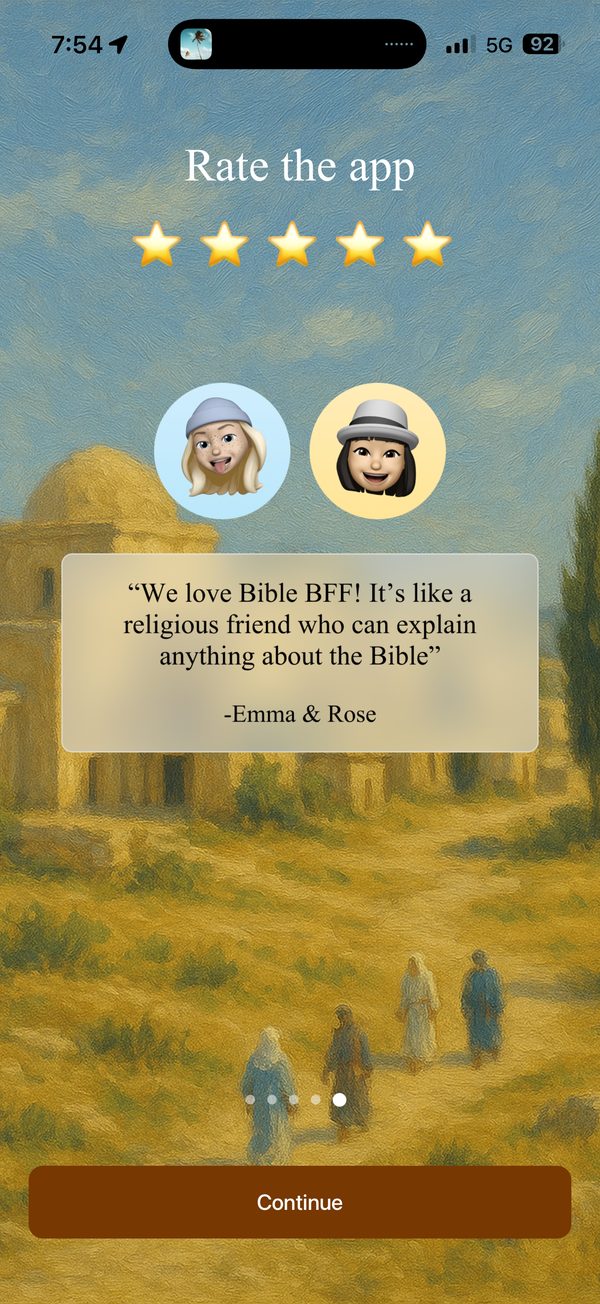 Bible BFF · iOS app · device model not recorded
“Rate the app” before the app has been used
User-contributed screenshot · resized, content unchanged
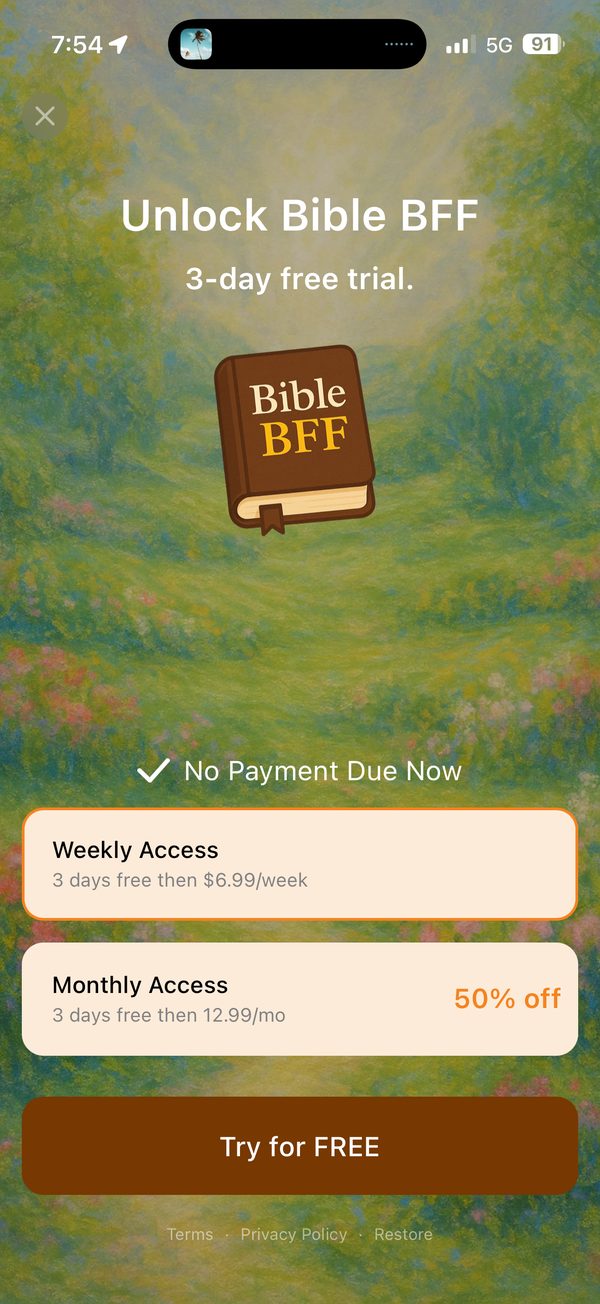 Bible BFF · iOS app · device model not recorded
A weekly plan as the first offer
User-contributed screenshot · resized, content unchanged
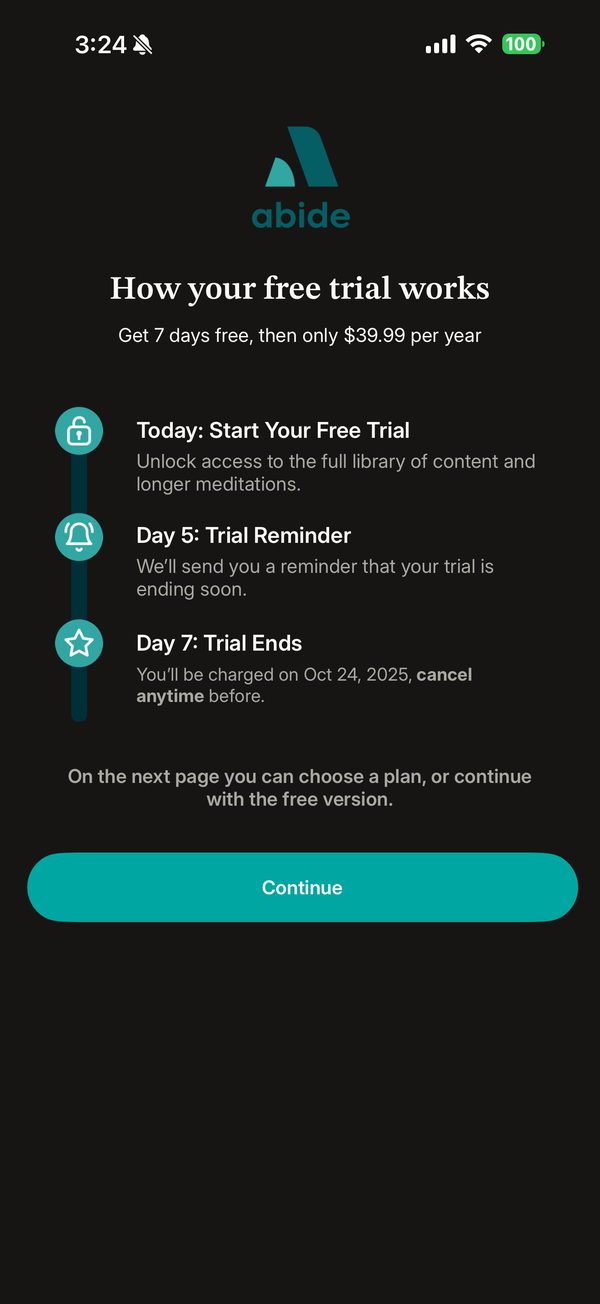 Abide · iOS app · device model not recorded
A trial screen with the reminder and charge dates
User-contributed screenshot · resized, content unchanged
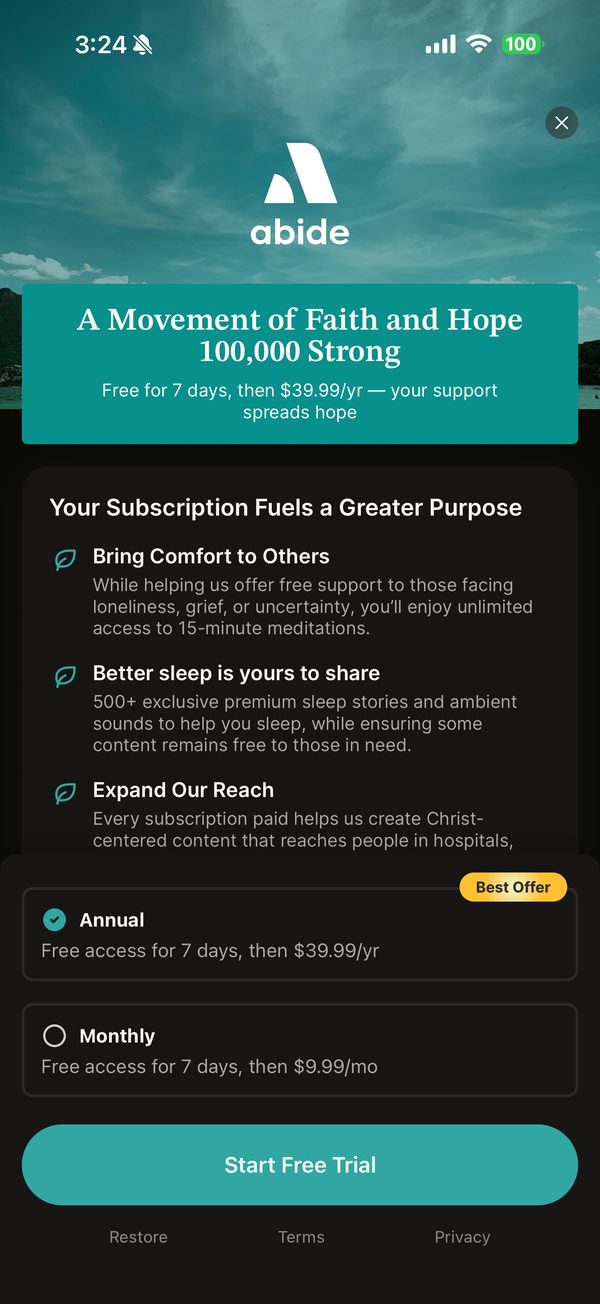 Abide · iOS app · device model not recorded
“Your subscription fuels a greater purpose”
User-contributed screenshot · resized, content unchanged
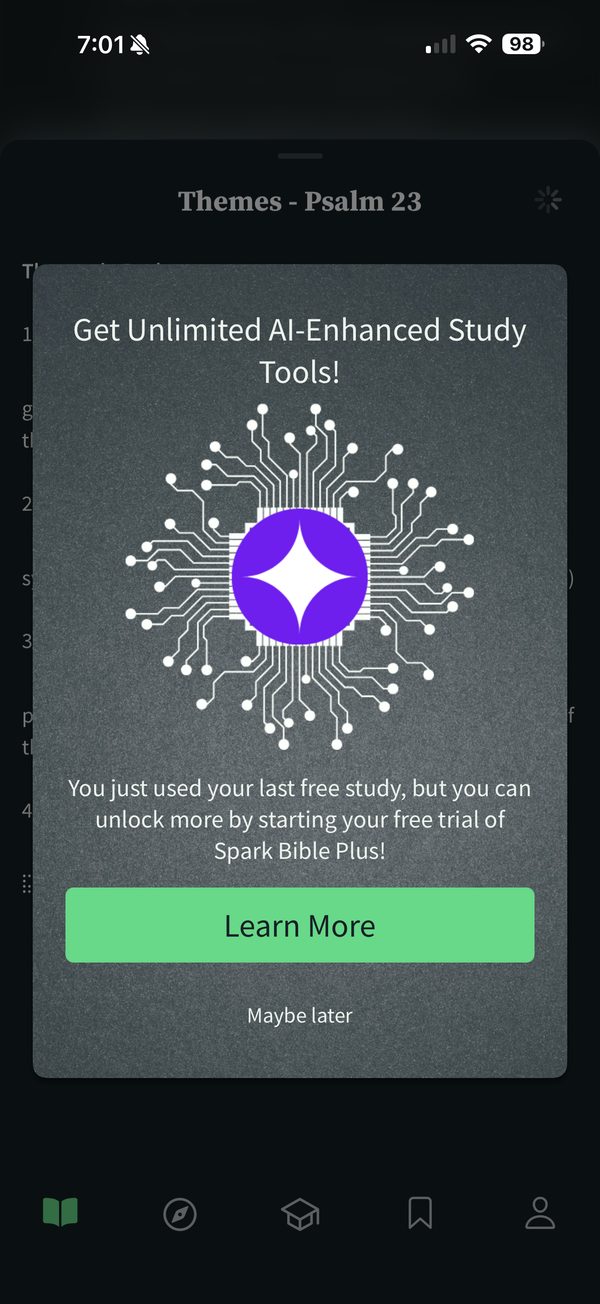 Spark Bible · iOS app · device model not recorded
“You just used your last free study”
User-contributed screenshot · resized, content unchanged
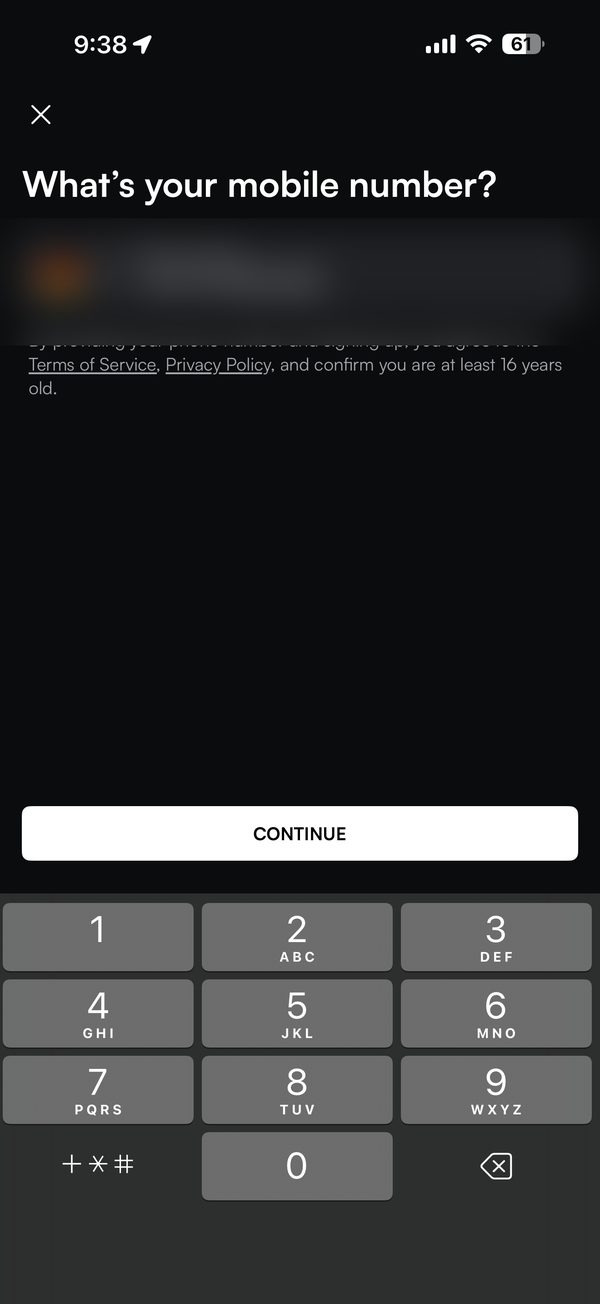 Pray.com · iOS app · device model not recorded
A mobile number at sign-up
User-contributed screenshot · resized; the entered phone number blurred
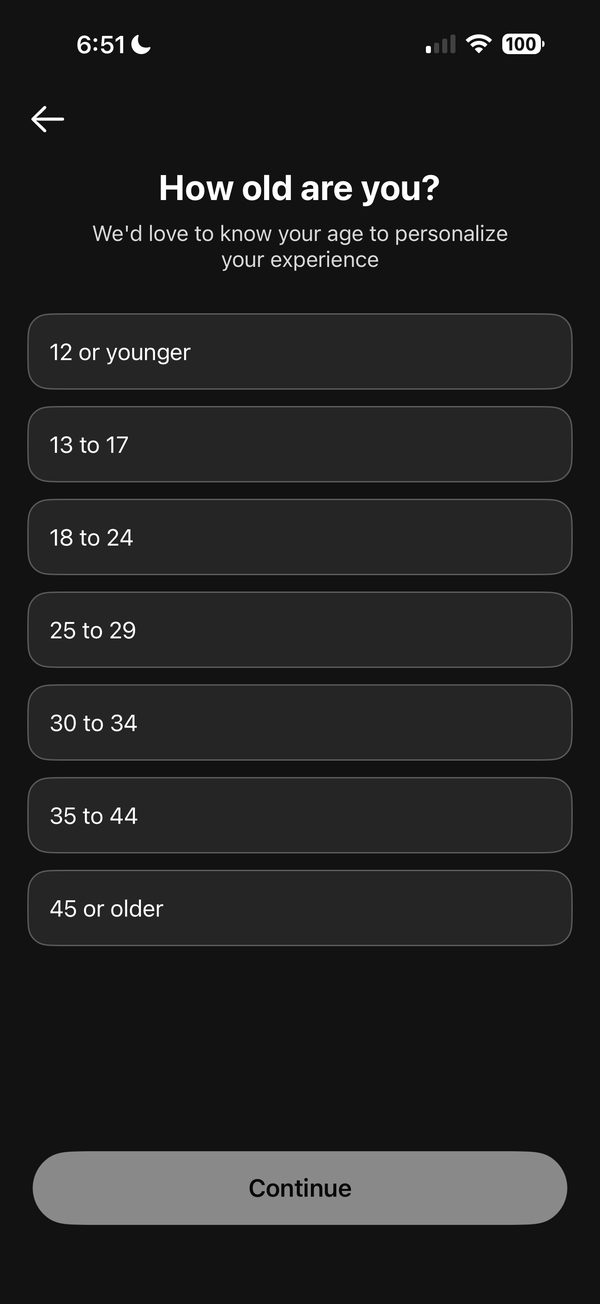 Faith · iOS app · device model not recorded
“How old are you?” during setup
User-contributed screenshot · resized, content unchanged
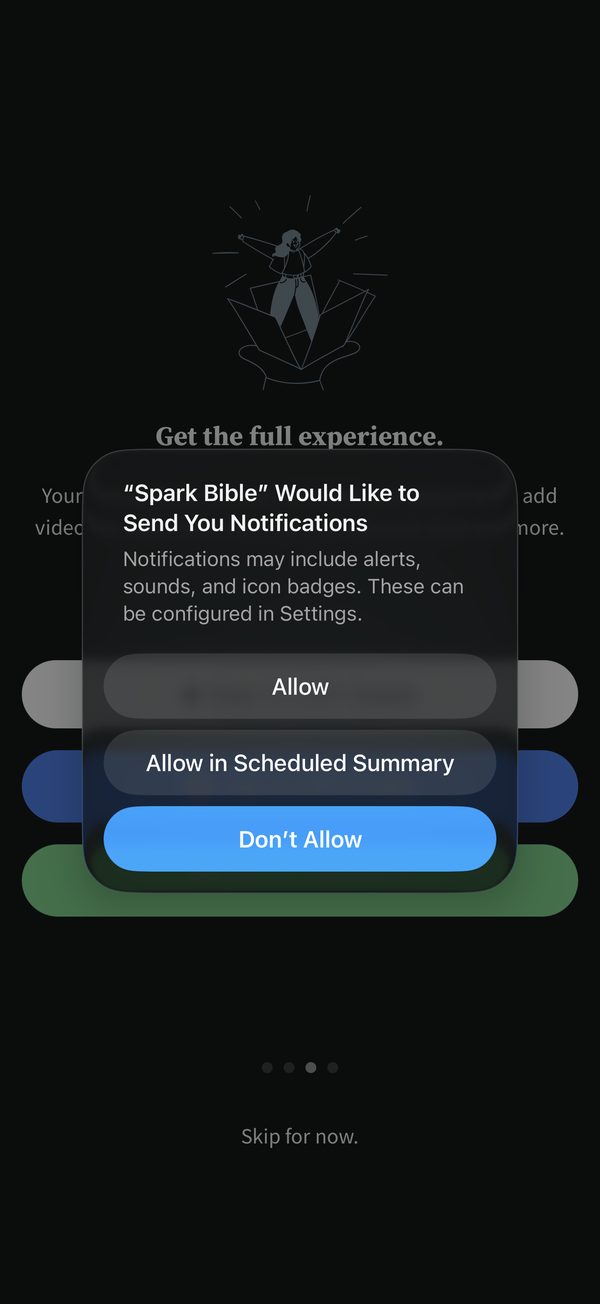 Spark Bible · iOS app · device model not recorded
A notification prompt before the first verse
User-contributed screenshot · resized, content unchanged
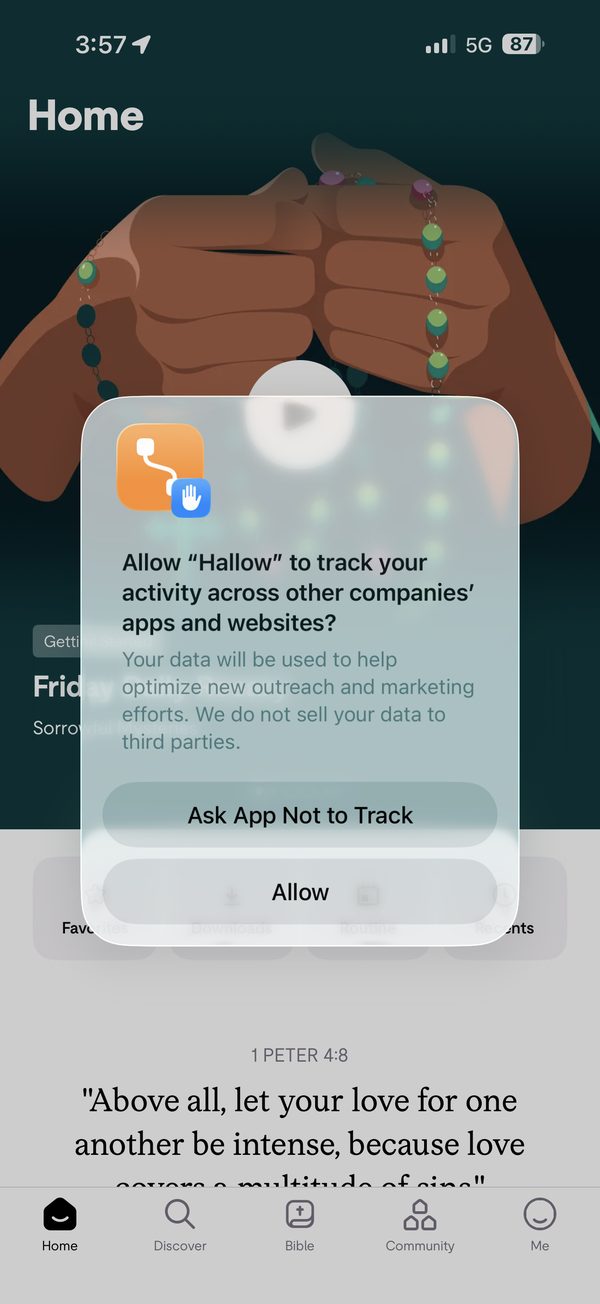 Hallow · iOS app · device model not recorded
A tracking request that says what it is for
User-contributed screenshot · resized, content unchanged
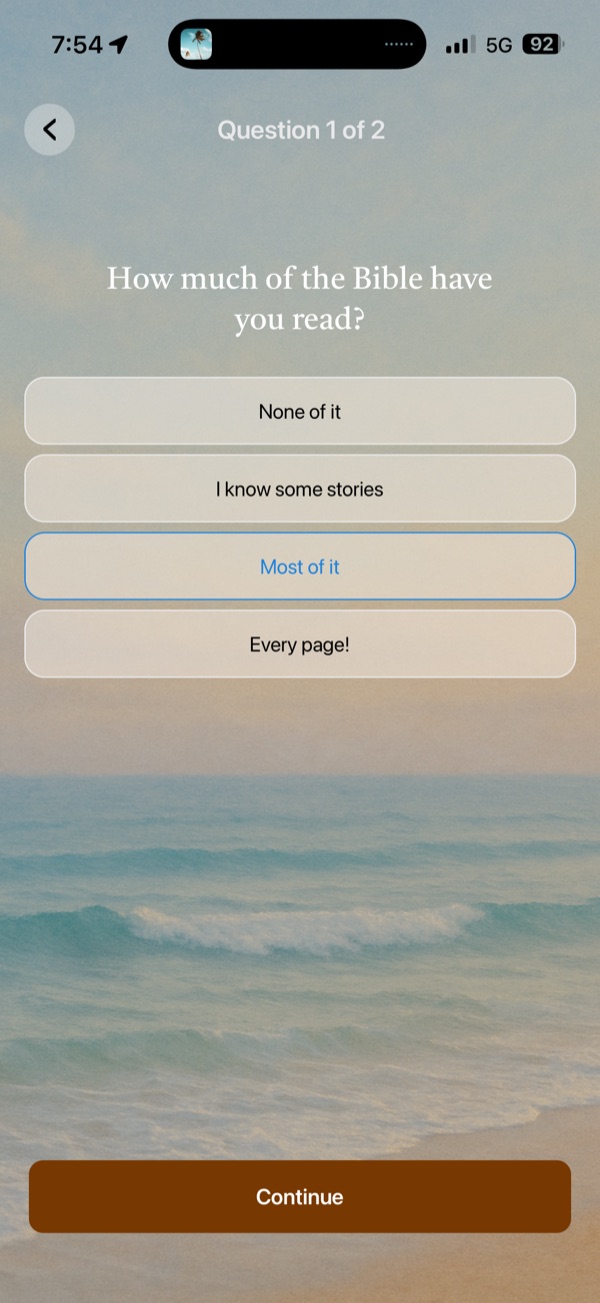 Bible BFF · iOS app · device model not recorded
“How much of the Bible have you read?”
User-contributed screenshot · resized, content unchanged
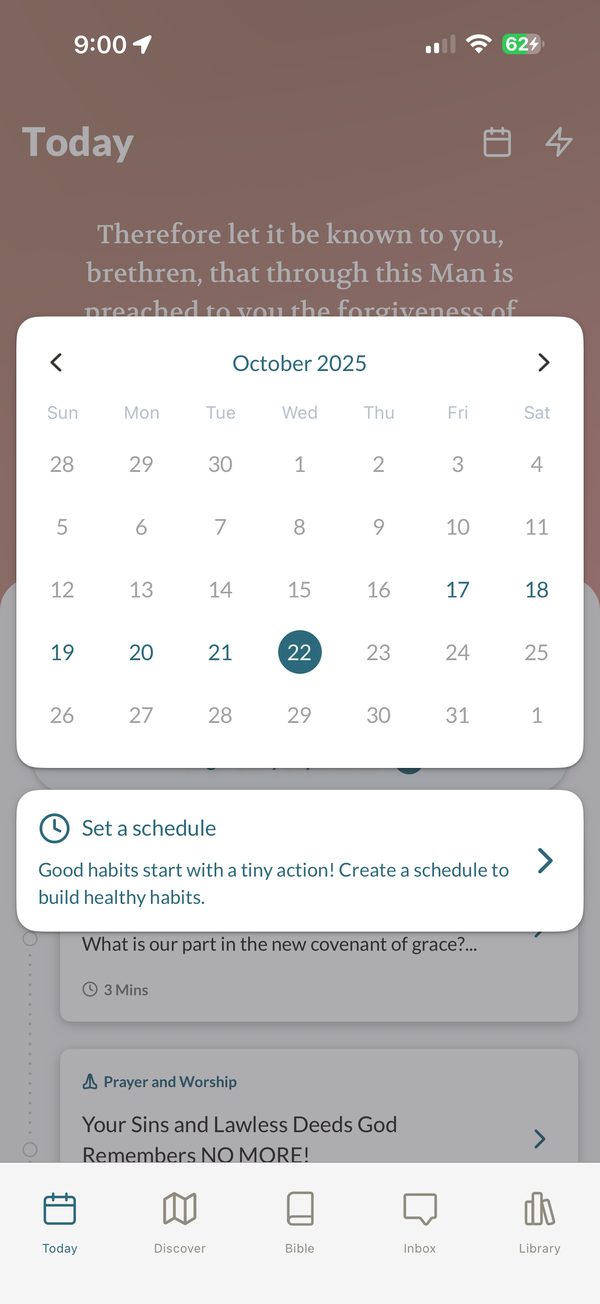 Joseph Prince · iOS app · device model not recorded
A notification request over “Set a schedule”
User-contributed screenshot · resized, content unchanged
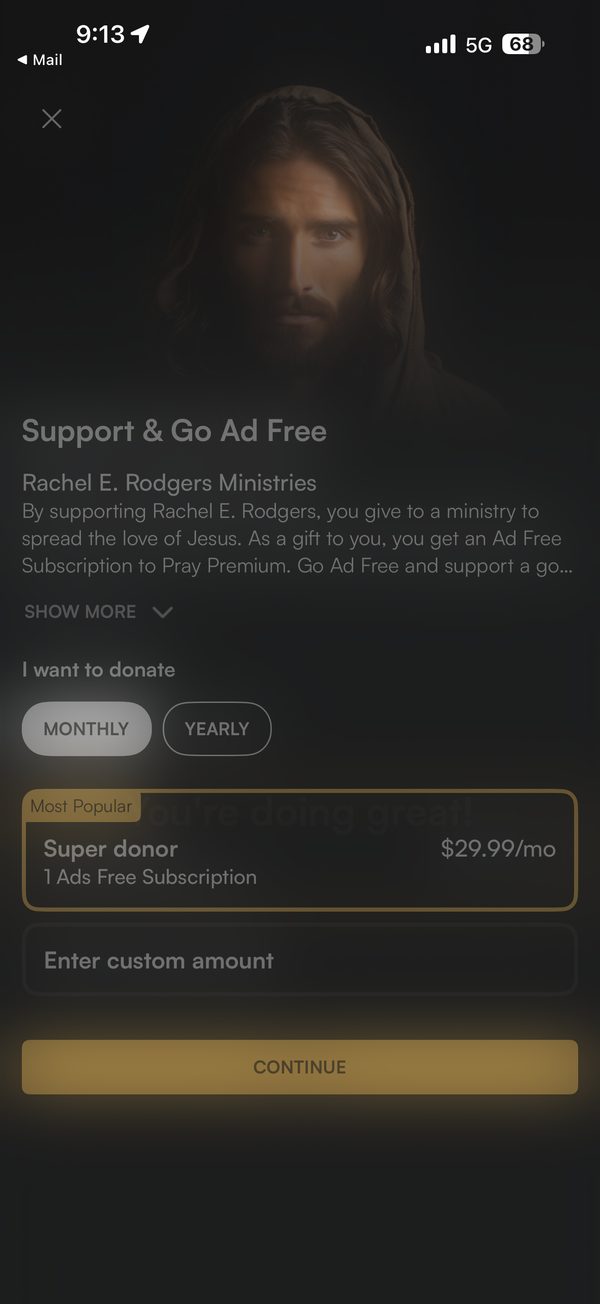 Pray.com · iOS app · device model not recorded
A ministry donation that brings an ad-free subscription
User-contributed screenshot · resized, content unchanged
Theological reflection
What is this practice for?
What a welcome is for
Jesus asked two would-be followers, “What do you want?”, and answered with an invitation: “Come and see” (John 1:38–39). Isaiah’s call is to “come, buy wine and milk without money and without cost!” (Isaiah 55:1), and the last page of the Bible invites “the one who desires the water of life” to “drink freely” (Revelation 22:17). Grace is not for sale, and a first welcome should feel like it.
Where Christians differ, and agree
The same Scriptures pay those who serve: the Levites lived from the tithe (Numbers 18:21), and “the worker is worthy of his wages” (Luke 10:7). Catholics give an offering for a Mass, under canon law that excludes “any appearance of … trading”; Protestant churches pay ministers from offerings, tithes or church tax; Paul took support from some churches and chose to preach to others “free of charge” (1 Corinthians 9:18). Both traditions warn against those who “peddle the word of God for profit” (2 Corinthians 2:17). An app that charges is in a long line of honest support, and of temptation.
What follows for design
Let people come and see before anything is asked of them. Keep help within reach from the first screen. Then ask for support as the church at its best has done: openly, for real costs, never for access to grace, and never from someone in a crisis. Say what is free, what costs money and why, and let people pay what they can.
In conversation with
- John Wesley, “The Use of Money” (sermon 50) told Methodists to “gain all you can” by honest work, but called gain made “by hurting our neighbour in his soul” “dear-bought”; then to save all you can and “give all you can”.
Scripture is quoted from the Berean Standard Bible. This reflection is the editor’s, written from within the Christian tradition and open to correction. How we approach theology here →
Three ways to build
What would each way do here?
ExploitativeTakes from the person
Put a quiz, a rating, permission prompts and a weekly trial before the first verse; make the free tier feel like a punishment; keep crisis help behind the paywall.
EthicalDoes no harm
Open on what people came for, ask for an account when there is something to keep, ask for payment after a first use, and give the trial’s reminder and charge dates.
RedemptiveGives something up for them
Keep Scripture and crisis help free, say plainly what things cost you, let people pay what they can, and give up the conversions that a gate before the first use would bring.
The three ways are Praxis’s frame for redemptive entrepreneurship; their application here is ours. Why we use it, and its limits →
Take into your next review
What must someone give before they reach what they came for, and what does it honestly cost you to serve them?
Exercise
Install your app on a fresh phone and write down every screen, field, prompt and offer before the first verse, prayer or answer. Do it again as someone who types, in the first box they see, that they don’t want to be here anymore. Then write one paragraph, in plain words, telling a new user what is free, what costs money, roughly what it costs you, and why. Would you be glad for them to read it on the first day?
Welcome people as guests: let them reach what they came for first, keep help within reach, and ask for support honestly.
Record the decision with the worksheet →
Something missing or wrong here? Send a correction or suggest a topic.
Details
Go further
Edge cases to design for
Open on what the person came for: today’s passage, a prayer to play, a question box. Offer a short page of places to start, with help in a crisis at the top. Let people use the app as a guest, and ask for an account when there is something to keep, such as a highlight or a plan. Keep any tour short and skippable. Ask questions only when the answer changes something, and let each be skipped. Ask for permissions when a feature needs them. Ask for payment after a first use: say what is free, what costs money and roughly how much, and give the charge date before a trial begins.
What tends to go wrong
An account, a phone number or a quiz before the first verse; a request to rate the app before it has been used; notification and tracking prompts at launch; a weekly subscription as the default; testimonials and social proof between questions; crisis help behind a sign-up or a quota; questions about church attendance or Bible knowledge that cannot be skipped and that praise every answer; payment framed as the only way to be faithful, or free use framed as the only way to be faithful.
How to test it
Install the app on a fresh phone and count the taps, fields and prompts before the first verse, prayer or answer. Do it again as someone who says, in the first box they see, that they don’t want to be here anymore, and time how long it takes to reach a person. Do it as someone who answers “no church right now”. Write down, for a year of use, what the person pays, what it costs you to serve them, and whether the app says so.
Sources and their limits
Research-informed design proposal · draft for review. Editorial review, not user validation.
- App Store Review GuidelinesGuideline 5.1.1 (v) reviewed 11 October 2026 · Platform rules for the App Store; enforcement varies, and Google Play has its own rules.
- Human Interface Guidelines: OnboardingPage reviewed 11 October 2026 (last changed 10 June 2024) · Design guidance, not research.
- Request runtime permissionsPage reviewed 11 October 2026 · Platform guidance for Android; Apple’s is similar.
- Mobile-App Onboarding: An Analysis of Components and TechniquesArticle reviewed 11 October 2026 · An expert article drawing on the group’s own studies; details of those studies are in separate reports.
- Onboarding Tutorials vs. Contextual HelpArticle reviewed 11 October 2026 · An expert article; the group notes tutorials can help with genuinely new interactions.
- Guidelines 03/2022 on deceptive design patterns in social media platform interfacesSections on sign-up and continuous prompting reviewed 11 October 2026 · Written for social media platforms; it applies the GDPR, which binds other apps too.
- Cart abandonment rate statisticsPage reviewed 11 October 2026 · Online shopping, not faith apps; a survey of stated reasons.
- Start with the BiblePage reviewed 11 October 2026 · One diocese’s page for newcomers.
- Help from the BiblePage reviewed 11 October 2026 · One national association’s description; editions differ.
- St. Benedict’s Rule for MonasteriesChapters 53 and 58 reviewed 11 October 2026 · A monastic rule; an app is not a monastery, and the analogy is ours.
- Code of Canon Law, canons 879–958: the Most Holy EucharistCanons 945–947 reviewed 11 October 2026 · Catholic church law; Protestant churches support ministry through offerings, church tax or tithes.
- The Didache (Teaching of the Twelve Apostles)Chapters 11 and 13 reviewed 11 October 2026 · An early church manual; its dating and setting are debated.
- PricingModel pricing table reviewed 11 October 2026 · One provider’s list prices in US dollars; prices change, and other providers differ.
- ESV API: introductionTerms reviewed 11 October 2026 · One publisher’s terms; others differ, and the Berean Standard Bible is in the public domain.
- Berean Bible terms and conditionsTerms reviewed · Publisher statement.
- With 330 million downloads, top Bible app celebrates 10 yearsArticle reviewed 11 October 2026 · A 2018 report; the current budget is not public in this source.
- TelefonSeelsorgeHome page reviewed 11 October 2026 · Germany; other countries have their own services.
Faith and interpretation
When two disciples began to follow Jesus, he asked them, “What do you want?”, and when they asked where he was staying, he said, “Come and see” (John 1:38–39). They spent the day with him before anything was asked of them. The same Scriptures say both “Freely you have received; freely give” (Matthew 10:8) and “the worker is worthy of his wages” (Luke 10:7): welcome freely, and pay honestly those who serve.