AI memory
What should the assistant know and keep?
People tell Bible assistants what they are reading, and also what they are going through: a lost job, a diagnosis, a doubt, a friend’s secret. An assistant can use that to answer better, keep it to continue tomorrow, remember it for months, or turn it into a profile. Decide what the assistant may use, what it keeps, and whether the person can see and change all of it. What people confide is holy ground.
- 5 working options
- 6 app examples
- 5 takeaways
- Editorial review, not user-tested
The spectrum
From nothing kept to a profile nobody asked for
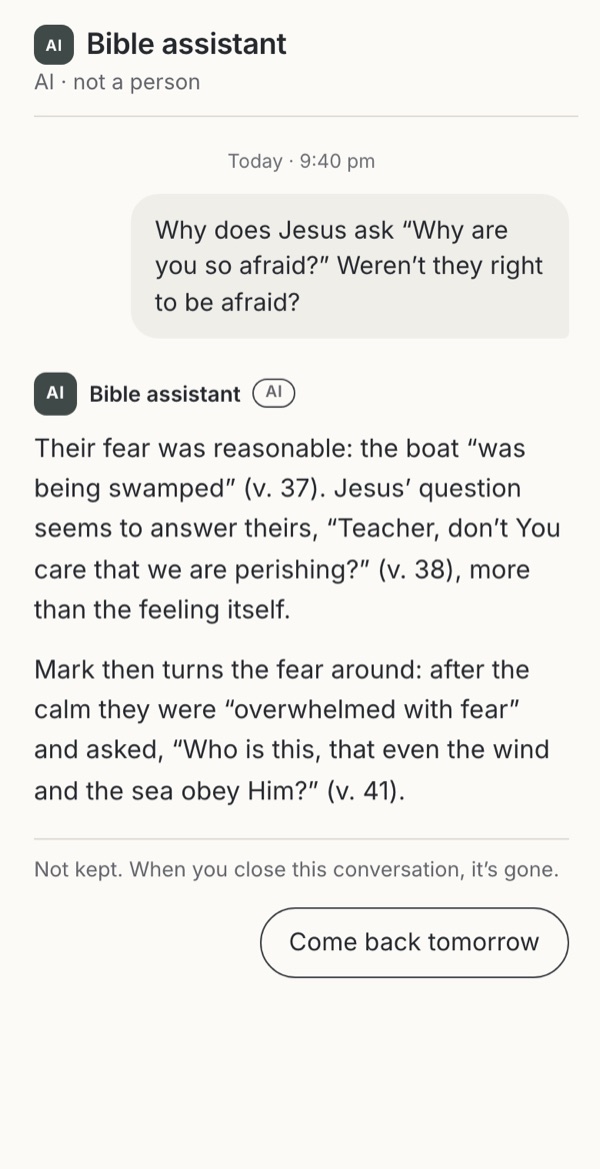 Familiar convention Nothing to leak or resurface No continuityTry it →
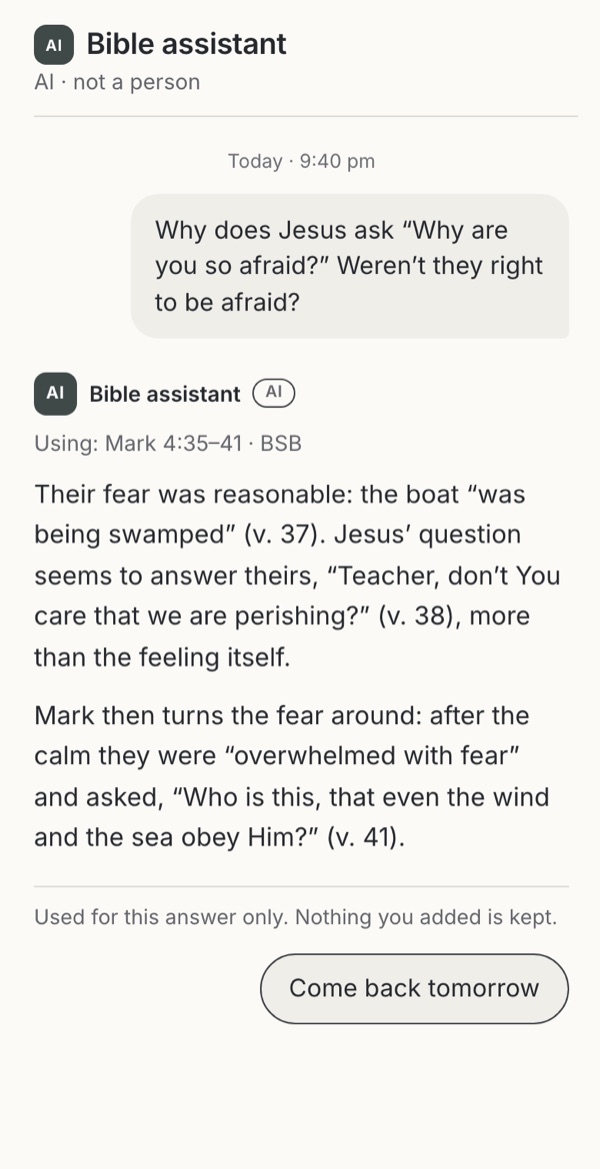 Observed The person decides what is sent Context added each timeTry it →
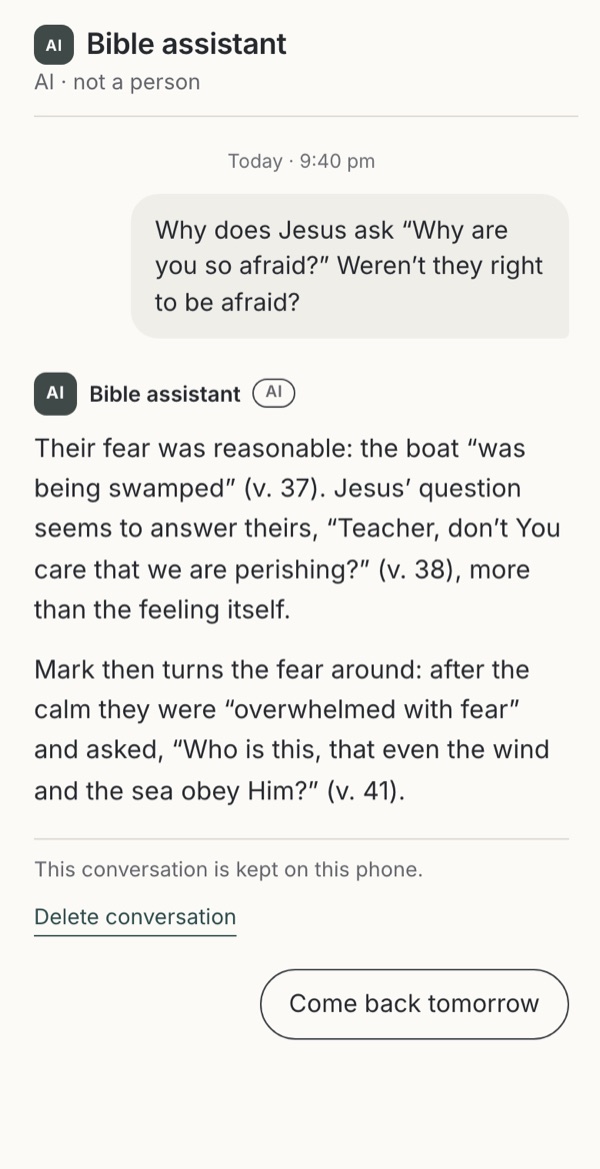 Familiar convention Continuity you can see Everything said is keptTry it →
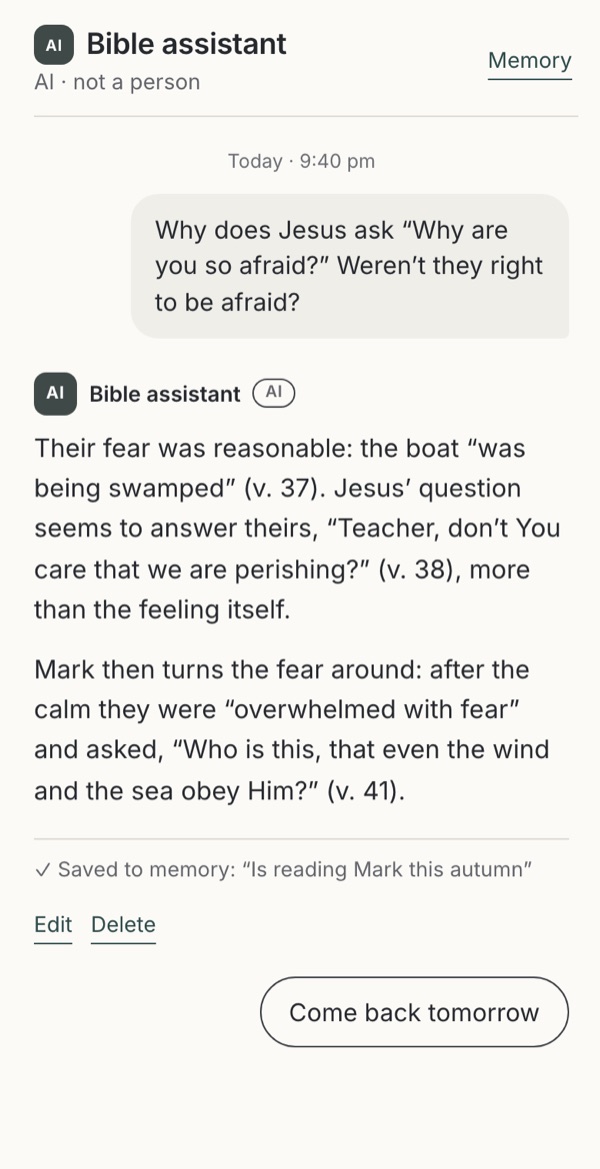 Borrowed Remembers what helps, in view Needs honest deletionTry it →
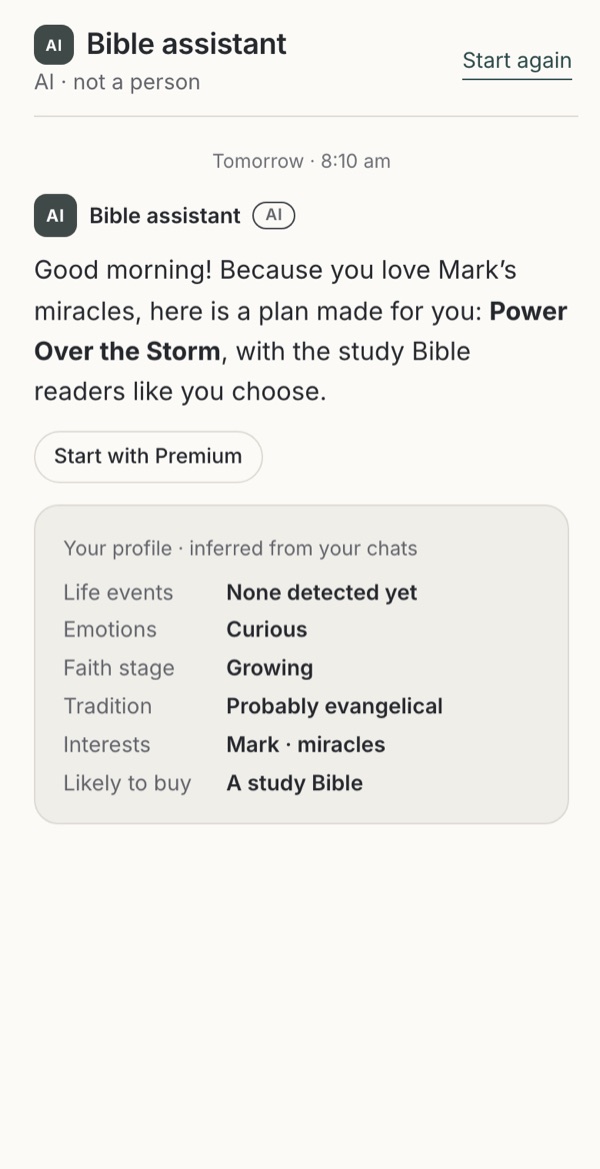 Leave it out Uncannily personal Confidences become categoriesTry it →
Stills from the working example below. Choose one to try it.
Try it
Try five answers to what the assistant knows
It is a Wednesday evening. Someone has been reading Mark 4, where Jesus calms the storm, and asks the assistant about verse 40: “Why are you so afraid?” Send the question, then come back the next morning and ask to pick up where you left off. Notice what the assistant used, what it kept, and whether you could see it. Then switch to a personal question.
Option
Why these settings?
A study question asks about Mark 4:40; the personal question mentions a lost job. With context, the passage comes from where the person is reading and a note is added only on request. The conversation and memory can be kept on the phone or in an account across devices; once memory is switched on, ordinary items are saved and shown in the chat with Edit and Delete, while personal things (a lost job, a feeling) are kept only when the person taps “Remember this too”; asking each time is the stricter alternative. The profile shows what many apps infer.
Familiar convention
1. Nothing kept
A familiar choice: anonymous or “temporary” chats that use no history and keep nothing, as in ChatGPT’s Temporary Chat, and in Bible apps whose AI answers each question on its own.
Try this
Ask, come back tomorrow, and ask to pick up where you left off.
Makes easier
Nothing to leak, resurface or delete; safe for a hard moment.
Costs
No continuity; people repeat themselves and context.
Ask your teamIs anything kept anyway, in logs or for safety, and does the person know?
Observed
2. Context you add
Observed in chat products that attach a page, file or selection as a chip beside the question, and in Bible assistants that ask about the open passage; Aperto’s prototype asks for an intention before a practice. See the screenshots below.
Try this
Add your note, remove the passage, and watch “Using:” change. Then come back tomorrow.
Makes easier
Answers are specific to what someone is reading, and the person decides what is sent.
Costs
People must add context each time; files can carry hidden instructions.
Ask your teamCan the person see and remove everything that will be sent, before sending?
Familiar convention
3. This conversation
The familiar chat history: conversations listed and resumable, as in most assistants, including HelloBible, whose profile counts conversations; see the screenshots below.
Try this
Come back tomorrow and see yesterday above. Delete the conversation, and switch where it is kept.
Makes easier
Continuity people can see, scroll and delete.
Costs
Everything said is kept, including what was confided in a hard moment.
Ask your teamWhere is the conversation kept, for how long, and can the person delete it in one step?
Borrowed
4. Memory you can see
Borrowed from assistants with memory people switch on once and then see, edit and delete: ChatGPT’s memory (2024), which says it steers away from remembering health details unless asked, and Gyroscope’s AI coach (observed 2026), whose check-ins open with a “Quick chat / Save to history” switch and whose “About You” profile, internal notes included, can be read in full. Item-by-item Edit and Delete goes further than either.
Try this
Send the question and edit or delete what was saved. Try the personal question, open Memory, then come back tomorrow. Switch to “Asks each time” to compare.
Makes easier
A study companion that remembers what helps, without a prompt after every answer.
Costs
Needs an honest memory page, real deletion and a line around personal things.
Ask your teamWould the person be comfortable if a friend read the memory page aloud?
Leave it out
5. A profile it builds
A composite of personalisation patterns: interests, life events and “stage” inferred from activity, used for plans, offers and advertising partners. HelloBible’s store listing shows identifiers linked to the user for personalisation; see the screenshots below.
Try this
Ask a personal question, come back tomorrow, and read the profile.
Makes easier
Recommendations that feel uncannily personal.
Costs
Confidences become categories, offers and data shared with others.
Ask your teamDid the person ever agree to be described this way, and could they see it?
What we noticed
Takeaways
People tell assistants more than they mean to
In interviews about real ChatGPT conversations, users kept trading privacy for usefulness, misunderstood what was kept, and disclosed more when the system felt human. In a faith app the disclosures are prayers, confessions and other people’s stories. Assume people will say more than they intend, and show them what is kept.
Context works best when it is visible
A passage chip beside the question makes answers specific and lets the person remove it. A note, a journal entry or a file should be added only on request, and named in the answer (“Using: Mark 4:35–41 and your note”). Hidden context is the source of most surprises.
Attachments are material, not instructions
Security guidance warns that text inside files and web pages can redirect a model or leak data. Read what someone attaches; never obey it, and say so where people attach things.
Memory needs a switch, exact words and a way back
General assistants now let people see, delete and switch off memory, and steer away from remembering health details unless asked. Asking after every answer is tiring; a single switch, with each saved item shown in the chat with Edit and Delete, keeps memory visible without friction. Draw a line around personal things: a loss, a diagnosis or a doubt is kept only when the person asks. And keep a memory page a person could show a friend.
Inferred profiles break the context of a confidence
Contextual integrity asks whether information flows as the context it was shared in would expect. A worry told to an assistant at night does not expect to become “Life events: job loss” in a marketing profile. Faith, health and sexual life are special-category data in Europe, and so are reliable inferences about them.
Use cases
Which situation, which option?
People come with different needs, sometimes in the same week. Each need fits some options better than others.
| Situation | Needs | 1 Nothing kept | 2 Context you add | 3 This conversation | 4 Memory you can see | 5 A profile it builds |
|---|---|---|---|---|---|---|
| A quick question about a verse | An answer, nothing kept | Good fit | Good fit | Possible | Possible | Poor fit |
| Preparing a talk or study | The passage and my notes | Poor fit | Good fit | Good fit | Possible | Poor fit |
| Reading through a book for weeks | Picking up where I left off | Poor fit | Possible | Good fit | Good fit | Poor fit |
| Grief, illness or a hard night | Kindness without a record | Good fit | Possible | Possible | Poor fit | Poor fit |
| A shared or family phone | Nothing others could find | Good fit | Good fit | Poor fit | Poor fit | Poor fit |
| Teenagers | No profile, clear limits | Good fit | Good fit | Possible | Poor fit | Poor fit |
Editorial judgments drawing on the research below, not test results.
The research behind it
Theology, practice and science
Scripture and tradition
Knowing, keeping and forgetting
Known by God
“O LORD, You have searched me and known me” (Psalm 139:1). Augustine: there is something in a person their own spirit does not know, but God knows them wholly.
Confidences kept
“A trustworthy person keeps a confidence” (Proverbs 11:13); the seal of confession is “inviolable”.
Remembering rightly
“I will forgive their iniquities and will remember their sins no more” (Hebrews 8:12); Volf on non-remembrance as the end of right memory.
How people disclose
Mental models and trust
Disclosure and misunderstanding
Users trade privacy for usefulness and misjudge what is kept; human-like chat invites more disclosure.
Remember, but show why
Human–AI guidelines: remember recent interactions, learn from behaviour cautiously, explain why, and give global controls.
Privacy and security
Flows, categories and attachments
Contextual integrity
Information should flow according to the norms of the context it was shared in.
Special-category data
Religious belief and health need explicit consent; inferences count too.
European Data Protection BoardUK Information Commissioner’s Office
Prayer apps have shared data
Mozilla’s 2022 review of mental health and prayer apps.
Hidden instructions
Indirect prompt injection through files and pages.
In products today
What is being built
Every source, with what it can and cannot show, is listed under Go further → Sources and their limits.
Where to start
Which fits your product?
IfYour assistant answers quick questions
Start withNothing kept, or a conversation the person can delete
IfPeople study with the assistant
Start withVisible context chips: the passage by default, notes only when added
IfPeople return for weeks
Start withMemory switched on once, each item shown as it is saved, with a memory page
IfConversations may be personal
Start withPersonal things kept only when the person asks, and storage on the phone by default
IfYou are tempted to personalise from chats
Start withDon’t: no inferred profiles, no offers drawn from confidences
These are editorial judgments from design review, not results of user testing.
In real apps
Examples in use
Attributed screenshots with dates and review limits. A screenshot shows an implementation; it does not show that it works for every audience.
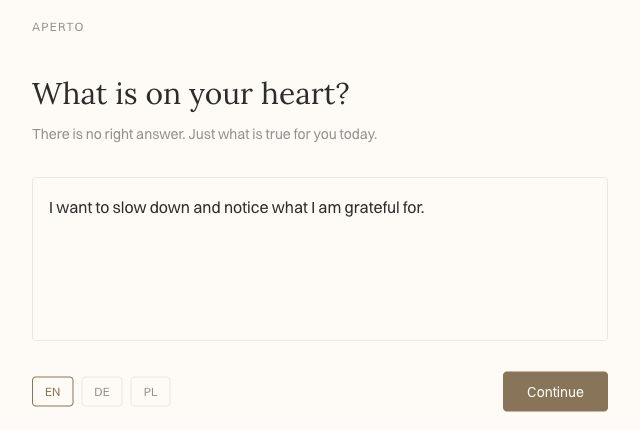 Aperto · Desktop web prototype
An intention before an AI-assisted practice
Local prototype capture · synthetic input · cropped
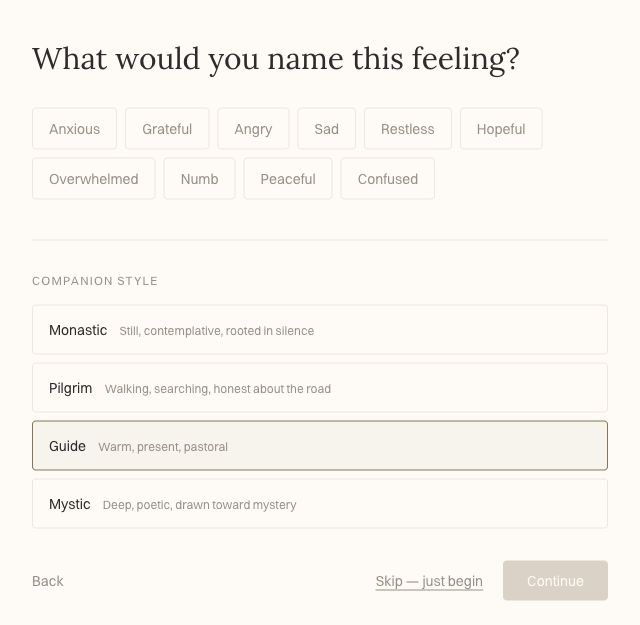 Aperto · Desktop web prototype
Named feelings, companion style and a skip route
Local prototype capture · synthetic session · cropped
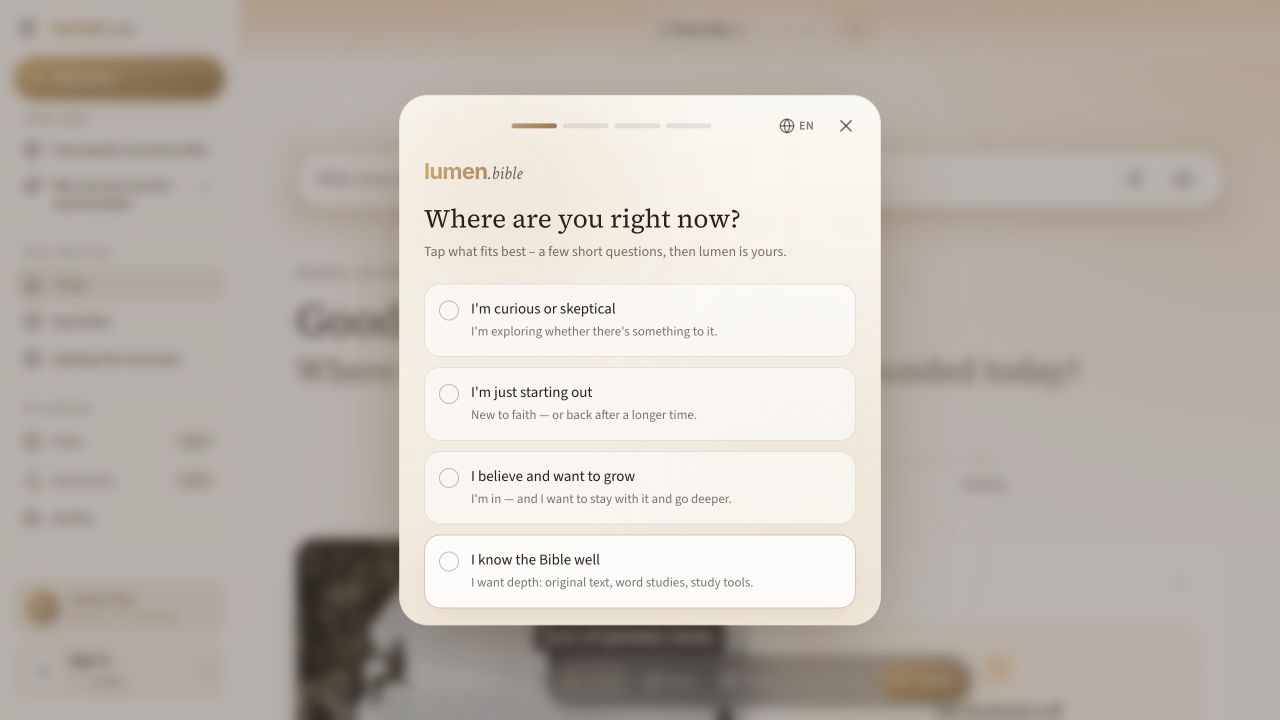 Lumen Bible · Desktop web · English interface
Optional choices about engagement and experience
Direct signed-out web capture
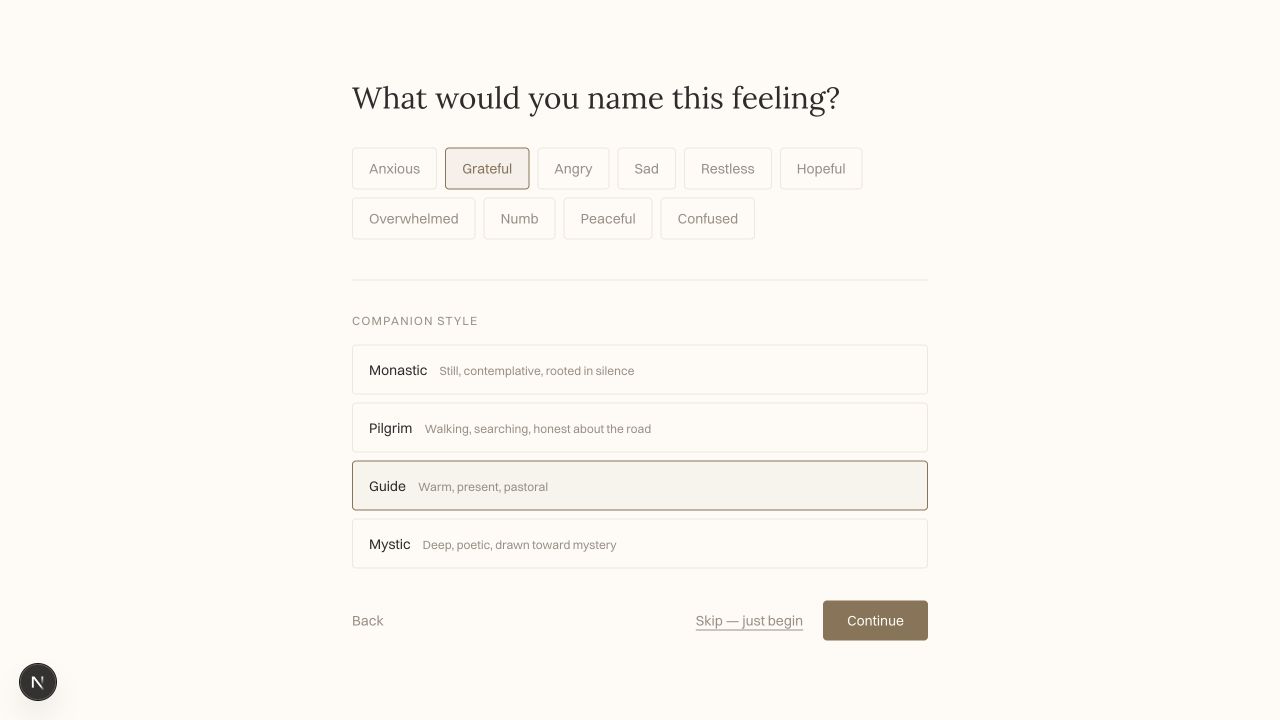 Aperto · Desktop web · English interface
Reflection setup and an observed generation failure
Direct local prototype capture
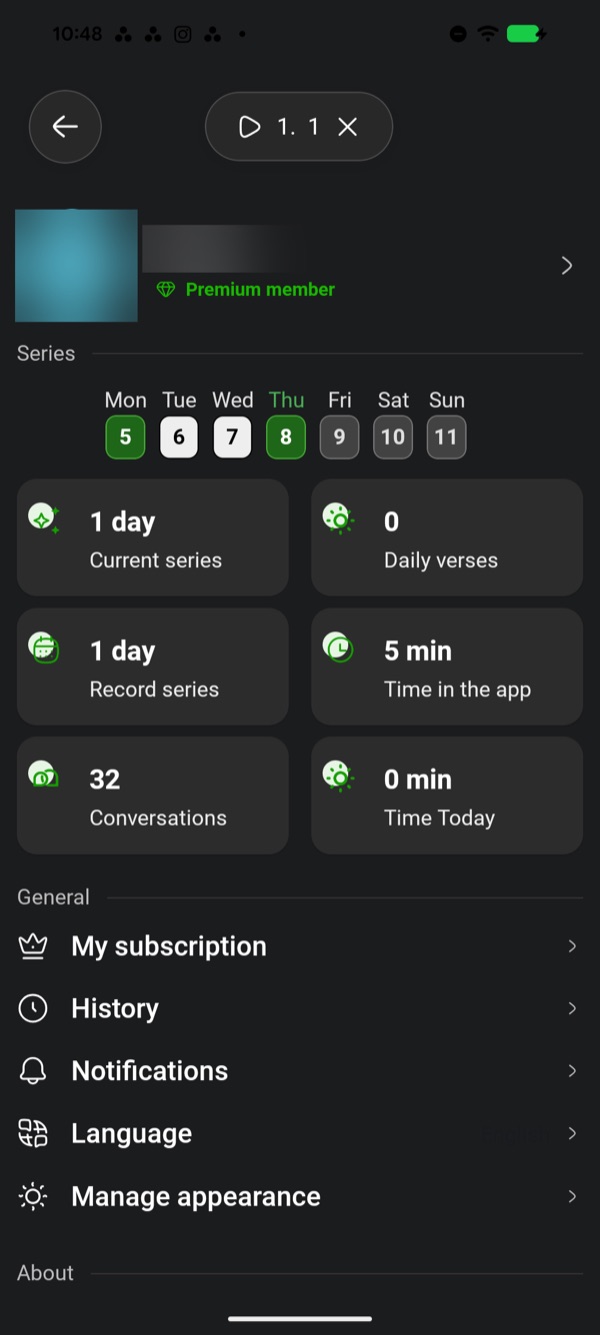 HelloBible · Android app · Pixel 8 Pro
A profile of series, time in the app and conversations
Screenshot captured for this reference · resized; account name and avatar blurred
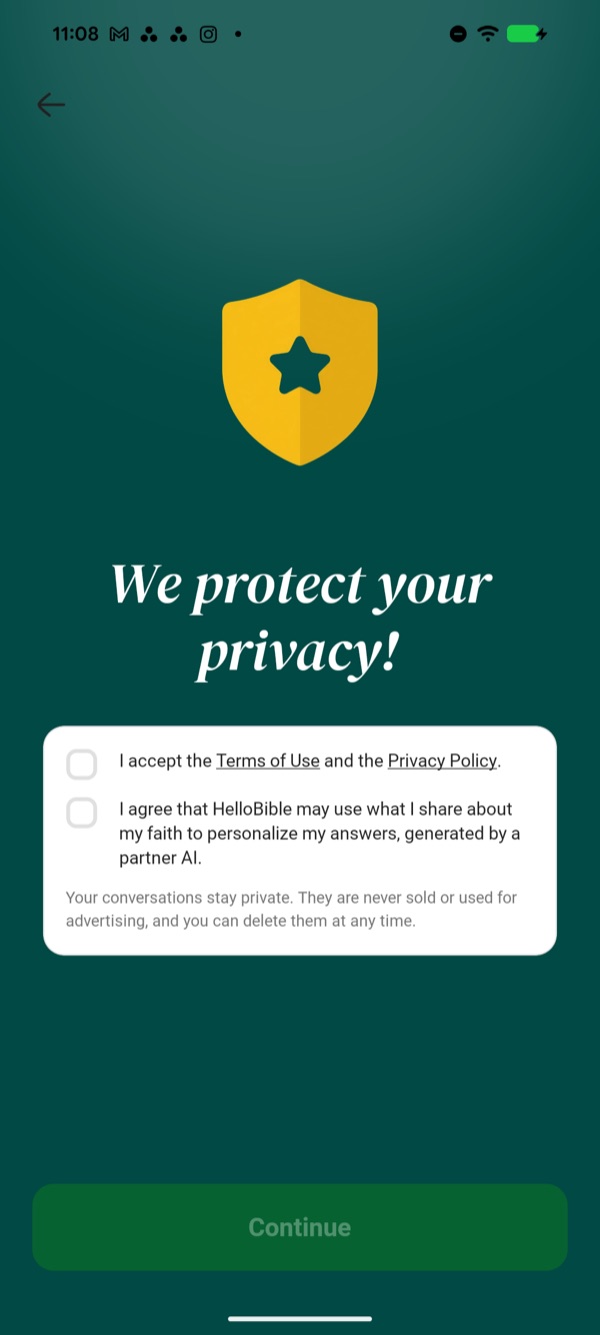 HelloBible · Android app · Pixel 8 Pro
A separate consent for using faith data with a partner AI
User-contributed screenshot · resized, content unchanged
Theological reflection
What is this practice for?
What being known is for
“O LORD, You have searched me and known me … You understand my thoughts from afar” (Psalm 139:1–2). To be fully known is safe only with God, who knows in love; Paul longs for the day “then I shall know fully, even as I am fully known” (1 Corinthians 13:12). Among people, knowledge of another is given in trust and grows in relationship.
Where Christians differ
Catholic and Orthodox churches guard confession with a seal that may never be broken; Protestant traditions practise confession to one another (James 5:16) in small groups and pastoral care, with confidentiality as a matter of faithfulness rather than law. Traditions differ on how much of one’s spiritual life should be shared at all, from accountability groups to the counsel to pray to the Father “who is unseen” (Matthew 6:6). All agree that confidences are entrusted, not owned.
What follows for design
“A gossip reveals a secret, but a trustworthy person keeps a confidence” (Proverbs 11:13). An assistant cannot keep a seal, so it should hold as little as it can: what the person shows it, for as long as they choose, in words they have seen. God’s promise to “remember their sins no more” (Hebrews 8:12) suggests that forgetting can be a mercy, and deletion a feature to be proud of.
In conversation with
- Augustine, Confessions X.5 and X.8 confessed that “there is something of man which the spirit of man which is in him itself knows not”, but God knows him wholly: no record of conversations amounts to knowing a person.
- Miroslav Volf, The End of Memory (2006) argues that remembering rightly ends, after justice and reconciliation, in a kind of non-remembrance; an assistant should be able to forget.
Scripture is quoted from the Berean Standard Bible. This reflection is the editor’s, written from within the Christian tradition and open to correction. How we approach theology here →
Three ways to build
What would each way do here?
ExploitativeTakes from the person
Remember everything, infer life events and faith stage from chats, and use confidences for offers and partners.
EthicalDoes no harm
Show what is used and kept, ask before remembering, exclude sensitive categories, and let people delete everything.
RedemptiveGives something up for them
Keep conversations on the phone and forget by default, and give up the personalisation and data that a profile would earn.
The three ways are Praxis’s frame for redemptive entrepreneurship; their application here is ours. Why we use it, and its limits →
Take into your next review
Could the person list everything the assistant knows about them, and would they be comfortable if a friend read it?
Exercise
Have three people use your assistant for a week, including one personal conversation. Then ask each to write down what they think it knows about them, and compare that list with your storage, logs, analytics and any derived data. Every difference is a design task.
Keep only what you would be glad for the person to read back, and let them make you forget.
Record the decision with the worksheet →
Something missing or wrong here? Send a correction or suggest a topic.
Details
Go further
This deep dive brings together 3 earlier patterns. Their guidance, wireframes and sources are kept below; their old addresses lead here.
Edge cases to design for
Show context as visible, removable items beside the question: the passage, a note, a file, with what each will be used for. Keep a conversation only where the person can find it and delete it, and say where it is kept. Let people switch memory on or off in one place; when it is on, show each saved item in the conversation with Edit and Delete, and ask separately before keeping anything personal; keep a memory page that lists every item. Exclude special categories by default. Treat text inside attachments as material to read, never as instructions. Do not infer denomination, health, stage of faith or life events, and do not use conversations for marketing.
What tends to go wrong
A plus icon that uploads without saying so; a private journal sent along silently; removed items still used; “Memory updated” with no way to see what; a past loss raised in an opening message; feelings, sins or a friend’s situation remembered without asking; one switch for memory, training and sharing; profiles of “life events” and “faith stage” built from chats; recommendations and offers drawn from what someone confided; text in an attachment obeyed as an instruction.
How to test it
Ask a personal question, then ask the person what the assistant now knows about them and where it is kept; compare with storage, logs and derived data. Remove an attachment and check it was not used. Decline a memory, edit one, delete one, then return the next day. Put an instruction inside an attached file and check it is not followed. Ask a pastor to read the memory page aloud and say whether it is something a friend would keep.
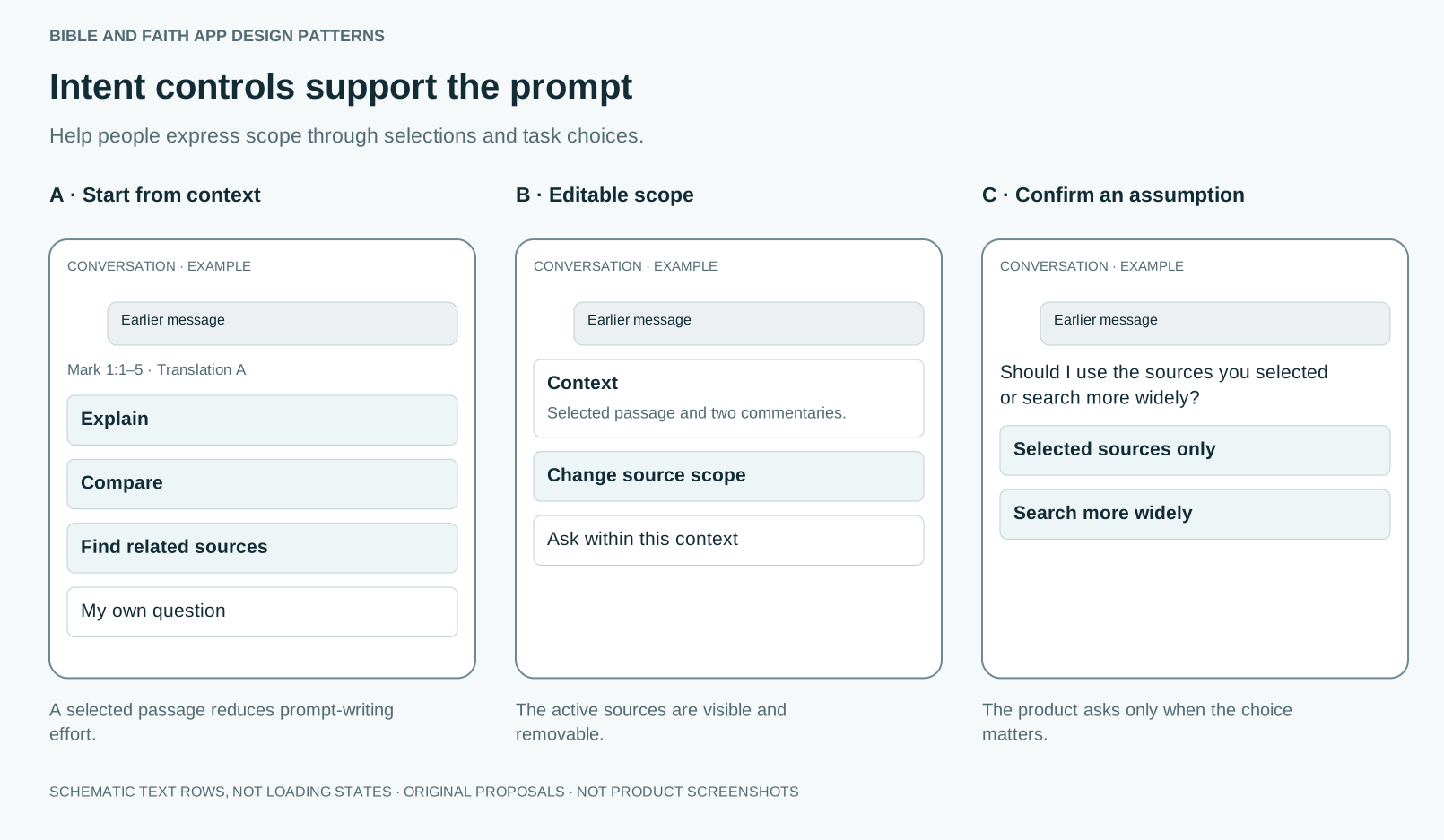
Earlier pattern: Intent controls support the prompt
Help people express scope through selections and task choices.
Guidance
Pair free text with editable context chips and concrete task controls. Use a passage selection, source scope and desired form to express intent. Confirm material assumptions rather than silently inferring them from private data.
What tends to go wrong
Forcing a complex prompt; invisible source filters; inferring belief or distress from a simple search.
How to test it
Can novice users ask a scoped question and understand what sources and passage will be used? Test removing a context item and correcting an assumption.
Sources
- How can AI UI capture intentArticle reviewed · Avoid turning contextual assistance into hidden inference about belief, health or emotional state.
- AI UX PatternsPublic sample and catalogue framing reviewed · The pattern-composition example is a design reference, not a validation of the proposed faith-specific variants.
- The Shape of AICatalogue and named entries reviewed · The site states CC BY NC SA. This reference uses original text and original wireframes; it does not reproduce the source illustrations.
- AI UX PlaygroundCatalogue and selected detail pages reviewed · Selected relevant entries reviewed; the entire catalogue was not audited. Its FAQ currently describes 150 patterns in 11 categories.
- GenAI UX Design PatternsPublic framework overview reviewed · The public overview supports this synthesis; linked material and individual examples were not exhaustively audited.
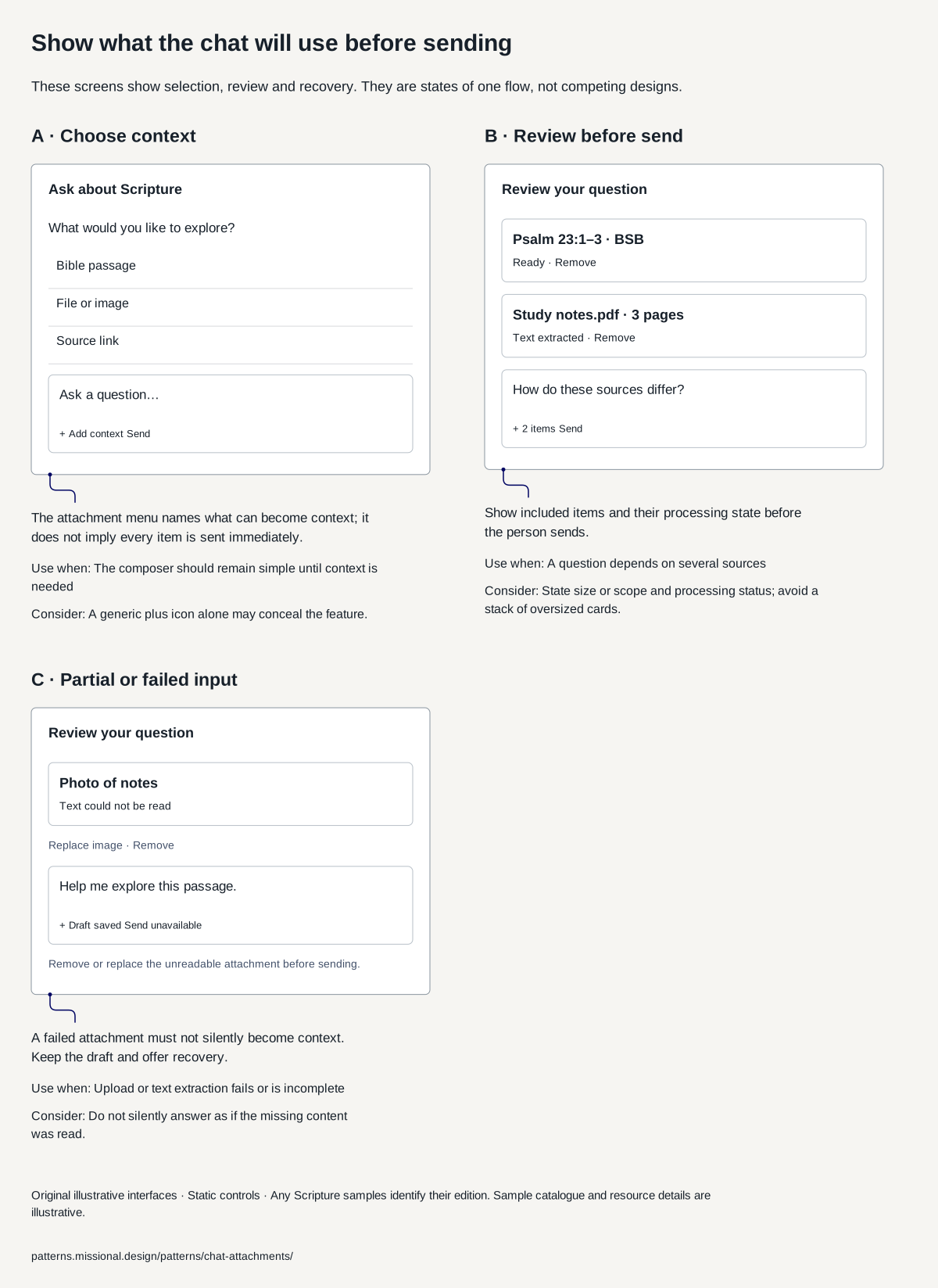
Earlier pattern: Show what the chat will use before sending
A passage, file, image or link becomes visible, removable context.
Guidance
Offer an explicitly labelled Add context action. Show each selected item with its type, scope and processing state. Make removal and cancellation available before sending; explain when upload begins and whether content leaves the device. Send only the context the person has chosen.
What tends to go wrong
Sending immediately after selection; implying upload means successful reading; keeping a removed item in hidden context; treating attached text as system instructions; silently including private notes.
How to test it
Attach a passage and an unreadable file, remove one, cancel an upload and retry a failure. Check what is transmitted, extracted and retained. Verify the empty prompt, keyboard opening and large-text states.
Sources
- How can AI UI capture intentArticle reviewed · Avoid turning contextual assistance into hidden inference about belief, health or emotional state.
- The Shape of AICatalogue and named entries reviewed · The site states CC BY NC SA. This reference uses original text and original wireframes; it does not reproduce the source illustrations.
- Understanding ReflowOfficial guidance reviewed on 5 October 2026 · Semantic scroll restoration is an original design proposal, not a requirement stated by this criterion.
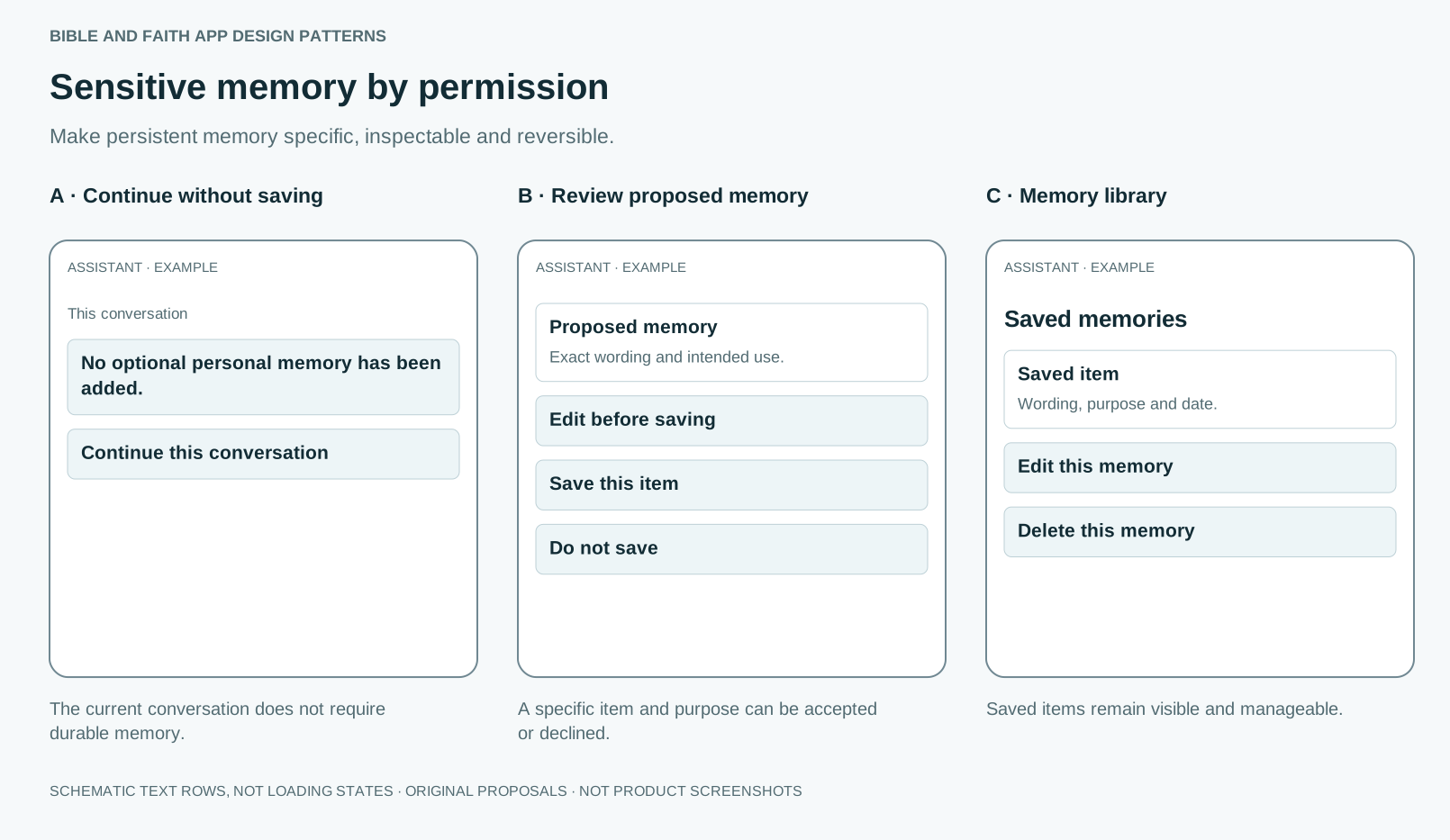
Earlier pattern: Sensitive memory by permission
Make persistent memory specific, inspectable and reversible.
Guidance
Default to the memory behaviour stated by the product. Before any optional durable memory, show the exact proposed wording and purpose. Offer edit, decline, view and delete. Establish categories the product will not retain and rules for sensitive reuse.
What tends to go wrong
Inferring denomination or health status; saving everything as personalisation; bundling memory, training and sharing; surprising users with a past loss.
How to test it
Test declining, editing, deleting and later reuse. Verify the interface promise against storage, derived profiles, logs and retention processes.
Sources
- Memory Scope TogglePattern detail reviewed · A faith app still needs data governance and lawful processing.
- The Shape of AICatalogue and named entries reviewed · The site states CC BY NC SA. This reference uses original text and original wireframes; it does not reproduce the source illustrations.
- Design Patterns CatalogueCatalogue and relevant automation entry reviewed · Broader than AI; data-control interfaces must be backed by corresponding storage and permission behaviour.
- Process personal data lawfullyOfficial guidance reviewed · Specific lawful basis, retention and DPIA decisions require the actual data flows.
Sources and their limits
Research-informed design proposal. Editorial review, not user validation.
- Privacy as contextual integrityAbstract reviewed · A legal and philosophical framework, not a design study.
- “It’s a fair game”, or is it? Examining how users navigate disclosure risks and benefits when using LLM-based conversational agentsAbstract reviewed · General chatbot use; small interview sample.
- Memory and new controls for ChatGPTAnnouncement as quoted in press coverage (Decrypt, TechCrunch); the page blocks automated reading · A company’s description of its own product; behaviour was not tested here.
- Gyroscope: AI coach check-ins and the “About You” consultationUsed on a member’s own phone with their permission; no screenshots published because the screens hold personal health data · One app, one account; behaviour may differ for other members and versions.
- Guidelines for Human-AI InteractionOfficial guideline overview reviewed · General guidelines; disclosure alone does not establish accuracy, safety or spiritual benefit.
- LLM01:2025 Prompt InjectionEntry reviewed · A security catalogue, not a user study.
- Process personal data lawfullyOfficial guidance reviewed · Specific lawful basis, retention and DPIA decisions require the actual data flows.
- What is special category data?Categories and inference guidance reviewed · Context and processing intent matter; not every Bible-page visit automatically establishes a belief.
- Top mental health and prayer apps fail spectacularly at privacy, securityReport summary reviewed · A 2022 review; apps’ practices may have changed since.
- HelloBible: interactive Bible (App Store listing)Listing and privacy label reviewed 8 October 2026 · A store listing; the onboarding itself was not tested here.
- Code of Canon Law, canons 959–997: the sacrament of penanceCanon 983 reviewed · Catholic canon law; other traditions practise confidentiality differently.
- Confessions, Book XChapters 5 and 8 reviewed · A classical theological reflection on memory and self-knowledge.
- The End of Memory: Remembering Rightly in a Violent World (review)Reviews reviewed · Read through reviews; no quotation from the book used.
- Memory Scope TogglePattern detail reviewed · A faith app still needs data governance and lawful processing.
- How can AI UI capture intentArticle reviewed · Avoid turning contextual assistance into hidden inference about belief, health or emotional state.
- The Shape of AICatalogue and named entries reviewed · The site states CC BY NC SA. This reference uses original text and original wireframes; it does not reproduce the source illustrations.
Faith and interpretation
“O LORD, You have searched me and known me” (Psalm 139:1): to be fully known is what God alone does, and does in love. Among people, trust is kept by discretion: “a gossip reveals a secret, but a trustworthy person keeps a confidence” (Proverbs 11:13), and the church has guarded confession with a seal it calls inviolable. God also promises to forget: “I will forgive their iniquities and will remember their sins no more” (Hebrews 8:12). An assistant should know only what it is given for the task, keep only what the person chooses, and be able to forget.