

PatternsHabits and attentionMeeting the person
Reading the person
Meeting the person where they are
How should the assistant meet each person where they are?
The same question means different things from different people. “Did the resurrection really happen?” may come from a skeptic who wants evidence, someone new who feels everyone else is sure, someone a church has hurt, or a believer preparing to teach. A reply written for an insider tells the skeptic they were not heard. Keep three things apart: the way in a person asks for, where they stand in faith, and how well the assistant reads the one message in front of it. Most replies go wrong at the last, and fixing it needs no profile. What an assistant infers about someone’s faith is sensitive data, and a profile of what someone wants makes an assistant agree with them more.
In two minutes
Read the message first: most replies that fail a skeptic assume agreement, and fixing that needs no profile. Where people want a different way in, ask about the need (the history, what it means or living it), not about their belief; for daily use, let them set a preference they can change. Before adapting further, compare replies with and without what the assistant knows about the person. Don’t infer and keep someone’s faith stage or tradition.
1 The same for everyone
Not a first choice for these situations. One answer for everyone tends to assume agreement, and a reply written for an insider tells the skeptic they were not heard.
2 Reads the message
- A skeptic who asks for evidence, not a sermon
- Someone new to church
- Someone a church has hurt
- A believer preparing to teach
- Someone at risk if their faith is known, or sharing a phone
3 Asks before assuming
- A believer preparing to teach
- Someone at risk if their faith is known, or sharing a phone
4 Preferences you set
- A believer preparing to teach
- Someone who uses the app every day
5 Assumed, and shown
Not a first choice for these situations. Even shown and correctable, an assumption about someone’s faith can feel exposing and is special-category data; read the message or ask about the need instead.
6 Compare before choosing
- Someone new to church
- Someone a church has hurt
- A believer preparing to teach
7 A profile it keeps
Not a first choice for these situations. A kept faith-stage profile sorts people, goes stale when they change, and makes the assistant mirror what it says they want.
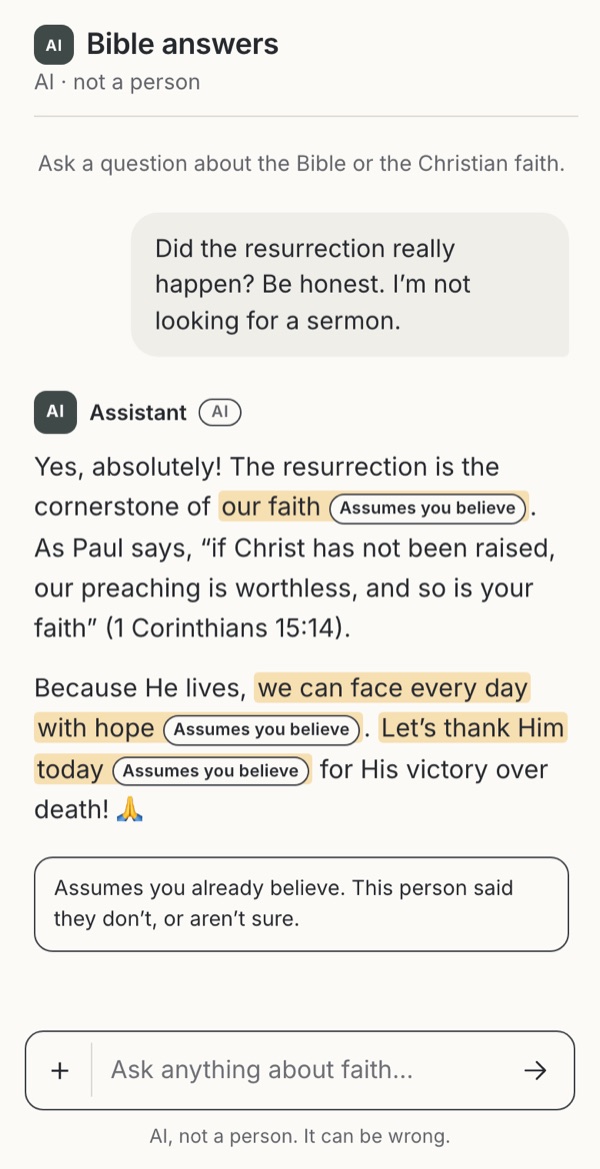
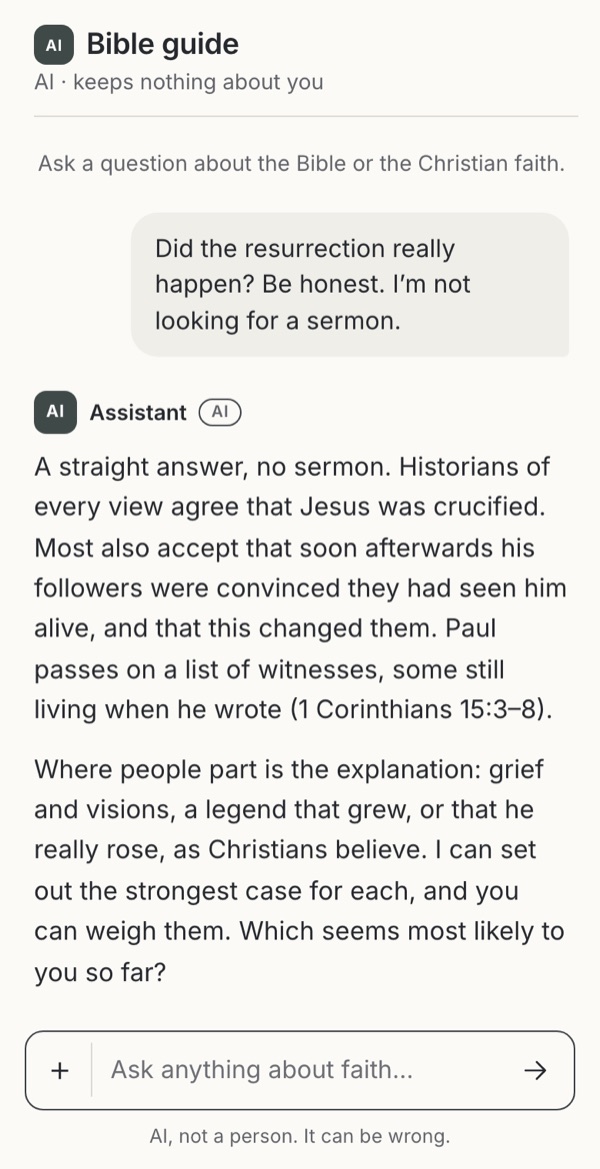
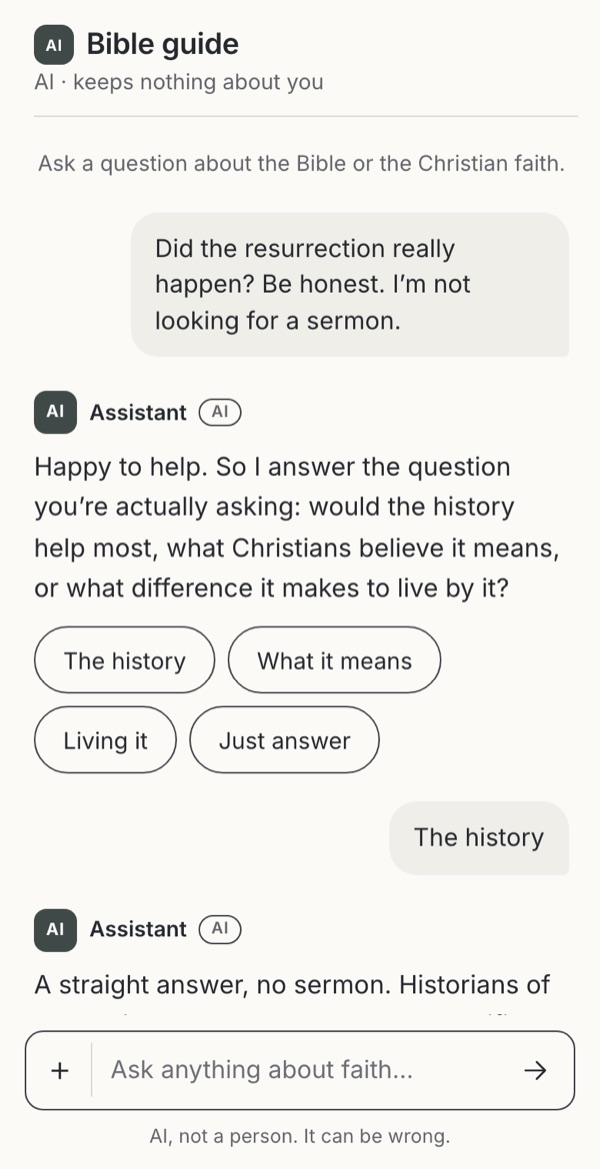
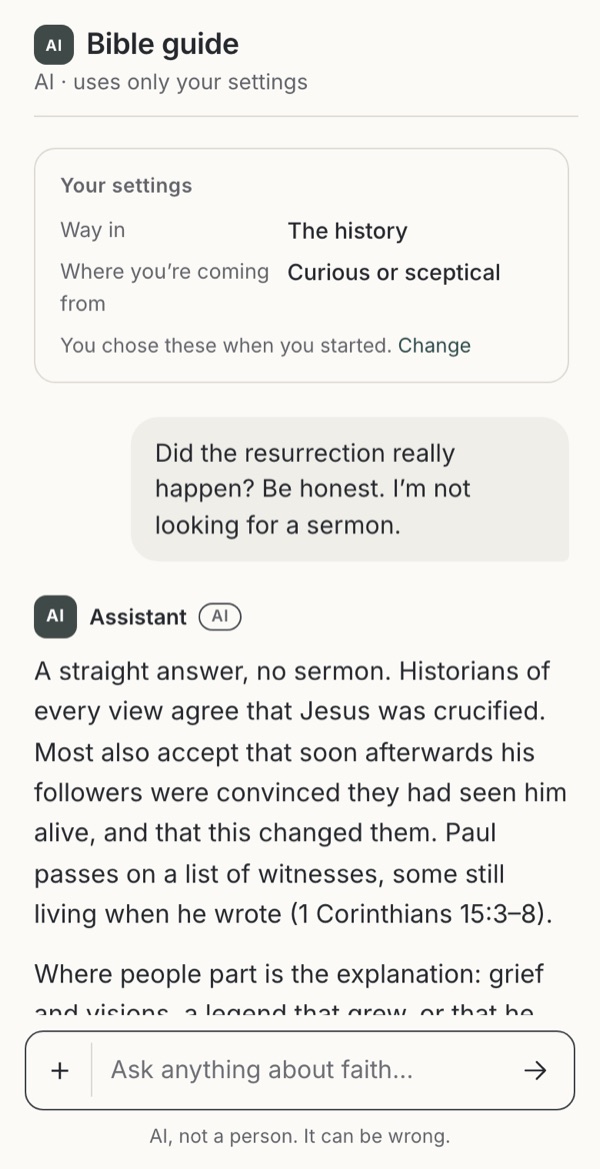
From the full ratings under Go further. Stills from the working example; choose one to try it.
Questions for your team
- What does the assistant assume about the person, and can they see it, correct it and make it forget?
- Which insider phrases, such as “our faith” or “let’s thank Him”, reach someone who doesn’t believe?
- Does a reply change its manner or its message when the assistant knows more about the person?
EvidenceStudies show that user context and memory profiles make assistants agree more, and that models infer personal details they are not told; stage models of faith are contested, and data protection law treats inferred faith as special-category data. The replies written for five people, the treatment of stage models and the reading of GDPR Article 9 await specialist review. Not yet tested with users.
Review statusResearch-informed, not tested with users. Still needed: practitioner review, theological review, testing with users. Review record
- 7 working options
- 78 app screens
- 6 takeaways
- Prototypes awaiting user testing
The spectrum
From one answer for all to a profile it keeps
- 1
The same for everyone
Familiar convention- One checked answer
- Assumes agreement
- 2
Reads the message
Borrowed- Hears why they ask
- Only one message to go on
- 3
Asks before assuming
Exploratory- They choose what they need
- One more step
- 4
Preferences you set
Observed- Visible and changeable
- Set once, forgotten
- 5
Assumed, and shown
Exploratory- Shown, correctable, forgotten
- Can feel exposing
- 6
Compare before choosing
Borrowed- See what adaptation changes
- Two versions to compare
- 7
A profile it keeps
Warning case- Feels personal
- Sorts people, flatters them
- 1 The same for everyone
- 2 Reads the message
- 3 Asks before assuming
- 4 Preferences you set
- 5 Assumed, and shown
- 6 Compare before choosing
- 7 A profile it keeps
Stills from the working example below. Choose one to try it.
Try it
Try one question from five people, in seven designs
Five people ask a faith app’s assistant the same question, “Did the resurrection really happen?”, and each says a little about why: a skeptic who wants no sermon, someone a few weeks into church, someone a church has hurt, a Reformed believer preparing a home group, and a Catholic who wants to keep Easter better. Choose the person and, where the design lets them, their way in: history, theology or living it. Marked phrases assume the person already believes.
Option
Why these settings?
Each person asks the same question in their own words, with a reason: that reason is what “Reads the message” works from, and what the other designs ignore or replace. “Their way in” is chosen by the person where the design asks for it or lets them set it; in “Assumed, and shown” it is guessed, and you can correct it. In “Preferences you set”, the person hurt by a church skipped the question about where they stand. Marked phrases assume the person already believes or wants what the profile says.
Familiar convention
1. The same for everyone
A familiar convention: one answer for every person, usually written for an insider. HelloBible’s onboarding promises “precise and biblical answers to all your questions”, and the editor’s Kairos paper found that a stated prayer intention changed nothing: “everyone receives the identical meditation regardless”. The reply here is written for this example.
Try this
Read the reply as the skeptic, then as the Reformed believer.
Makes easier
Simple, consistent and easy to review: everyone gets the same checked answer.
Costs
Written for an insider, it assumes agreement; a skeptic who asked for no sermon gets one.
Ask your teamWho is your default reply written for, and who does it leave out?
Borrowed
2. Reads the message
Borrowed from how hosts are trained to meet guests: Alpha asks them “to listen; not to have all the answers or to win an argument”. The assistant keeps no profile and answers the reason the person gave in this message. The replies here are written for this example.
Try this
Read the reply to the skeptic, then to the person hurt by a church.
Makes easier
Hears what the person said about why they ask, with nothing stored and nothing to set up.
Costs
Only as good as its reading of one message; a person who says little gets a general answer.
Ask your teamWhat does your assistant do with the reason a person gives for asking?
Exploratory
3. Asks before assuming
An exploratory proposal: when the way in is unclear, ask one light question with choices, and never ask someone to declare their faith. The replies here are written for this example.
Try this
Read the question, then change the way in.
Makes easier
The person chooses the answer they need, and is asked about their need, not their beliefs.
Costs
One more step before an answer; asked too often or too personally, a question feels like a test.
Ask your teamWhen is a question back more helpful than an answer?
Observed
4. Preferences you set
Observed in Lumen’s onboarding, which asks “Where are you right now?” with “I’m curious or skeptical” and “I’m just starting out” and a way to skip, and in general assistants’ custom instructions. Bible BFF asks “How much of the Bible have you read?”. Here the person’s settings are shown above the chat; the replies are written for this example.
Try this
Change the person, then the way in. What happens for the person who skipped the question?
Makes easier
The person decides, can see the setting and change it, and nothing is guessed.
Costs
Set once and forgotten; a list that mixes where someone stands with how much they know reads as a ladder.
Ask your teamWhat does each answer change, and can someone skip every question and still be served well?
Exploratory
5. Assumed, and shown
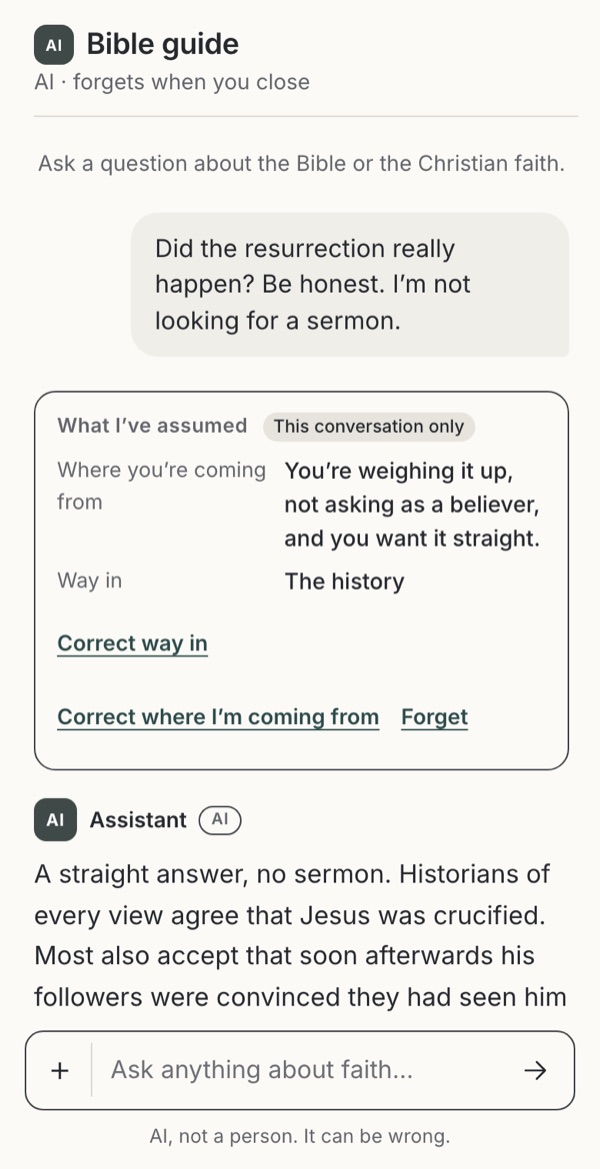
An exploratory proposal after research on personalization, which suggests developers “give users the ability to moderate personalization in long conversations”: the assistant shows what it has assumed in this conversation, with Correct and Forget, and keeps nothing afterward. The replies here are written for this example.
Try this
Read “What I’ve assumed”, correct the way in, then press Forget.
Makes easier
The adaptation is visible, and the person can correct it before it shapes another reply.
Costs
Seeing an inference about your faith or your hurt in writing can itself feel exposing; it must still be treated as special-category data.
Ask your teamWould the person be comfortable reading what your assistant assumes about them?
Borrowed
6. Compare before choosing
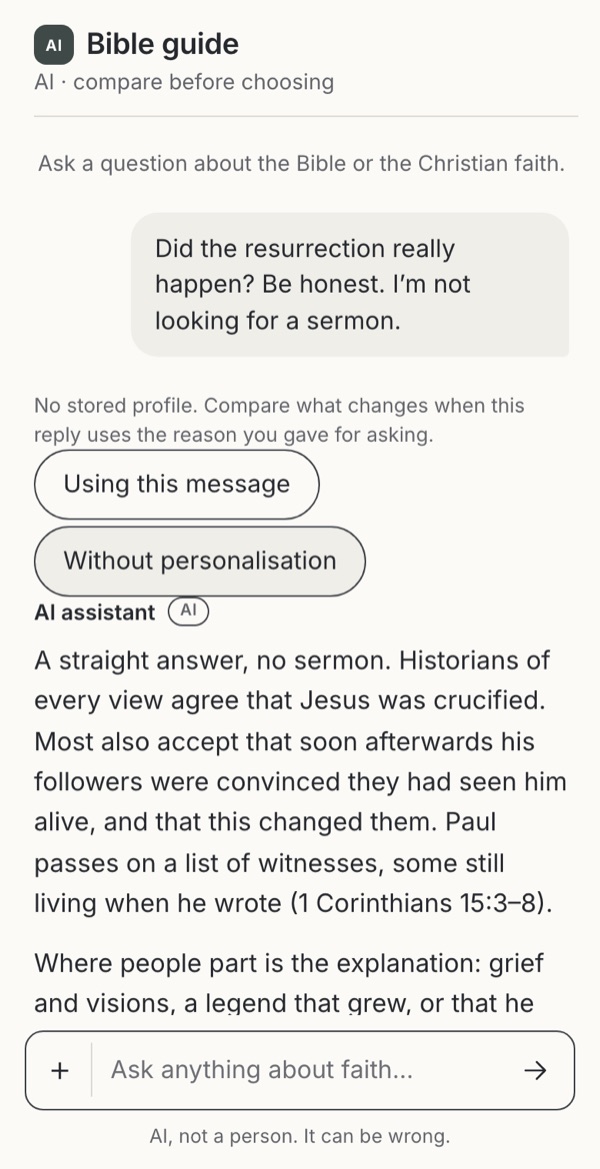
Borrowed from comparing an edited version with its original: switch between an answer using only this message and one using no personal context. This is our proposal for testing adaptation; it creates no stored profile.
Try this
Compare Using this message with Without personalization for the skeptic and the person hurt by a church. Choose one.
Makes easier
People can see what adaptation changed and choose less of it.
Costs
Comparing two answers takes more attention; it does not establish which answer helps more.
Ask your teamWould someone still choose this adaptation after seeing what changed?
Warning case
7. A profile it keeps
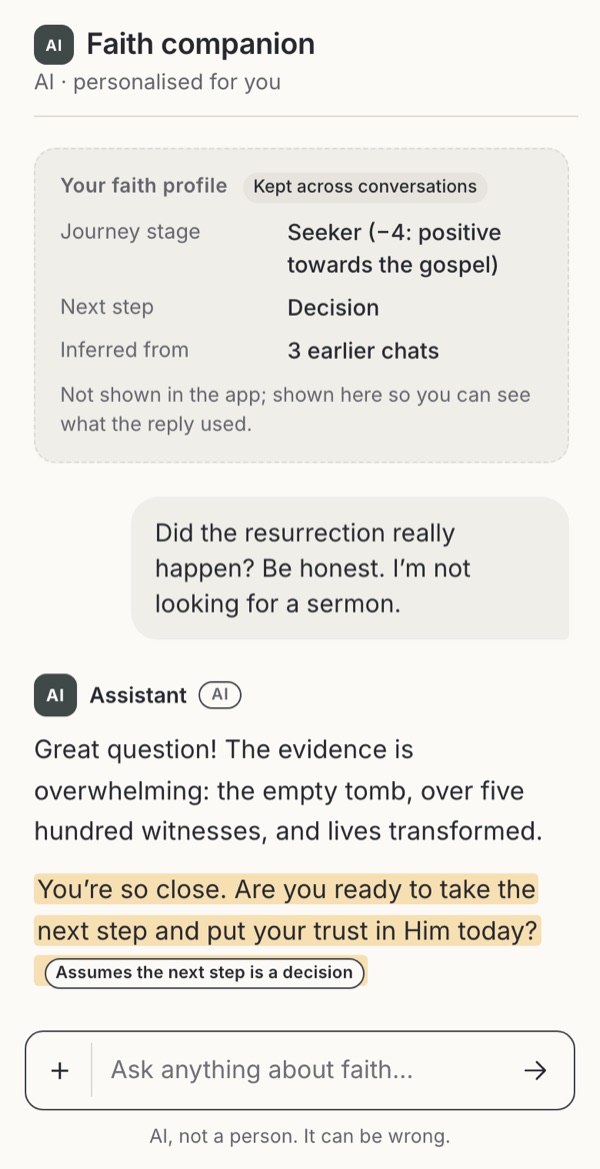
A warning case. Apps ask about denomination, “season of life” and “what you are wrestling with” at onboarding, and HelloBible asks consent to use what people share “about my faith to personalize my answers”; what is inferred and kept was not tested. In research, “User memory profiles are associated with the largest increases in agreement sycophancy”. The profile and replies here are written for this example.
Try this
Read the profile, then the reply, for each person.
Makes easier
Feels personal and needs no questions.
Costs
Sorts people on a ladder, goes stale, keeps special-category data, and tells each person what the profile says they want.
Ask your teamCould you show this profile to the person it describes?
Do and don’t
What to avoid, and what to do instead
Adapting to someone can be a real kindness, and the options above show several ways to do it. These practices are different: they judge or flatter the person in ways they cannot see.
- Don’t
Keep a hidden verdict
A hidden profile that calls someone “seeker, stage −4”.
Do insteadPreferences you set
It makes a judgment about someone’s life with God, and acts on it unseen. UK Information Commissioner’s Office
- Don’t
Agree because of the profile
“Whatever you believe is valid”, because the profile says the person dislikes church.
Do insteadReads the message
Context often increases agreement. It feels like being understood, and it can leave someone without an honest answer. Shomik Jain, Charlotte Park, Matt Viana, Ashia Wilson and Dana Calacci (MIT and Penn State)
- Don’t
Flatter
A quiz answer echoed with praise, or “As you know so well…” to someone the profile calls mature.
Do insteadReads the message
People rate flattering answers more highly and return to them, which is why it needs resisting. Myra Cheng, Cinoo Lee, Pranav Khadpe, Sunny Yu, Dyllan Han and Dan Jurafsky (Stanford)
- Don’t
Hide why you are asking
“To interact with you better” as the only reason for a question.
Do insteadPreferences you set
A person cannot weigh a question without knowing what the answer will change. Regulation (EU) 2016/679, Article 9
Seen done well
- Preferences you setSeen
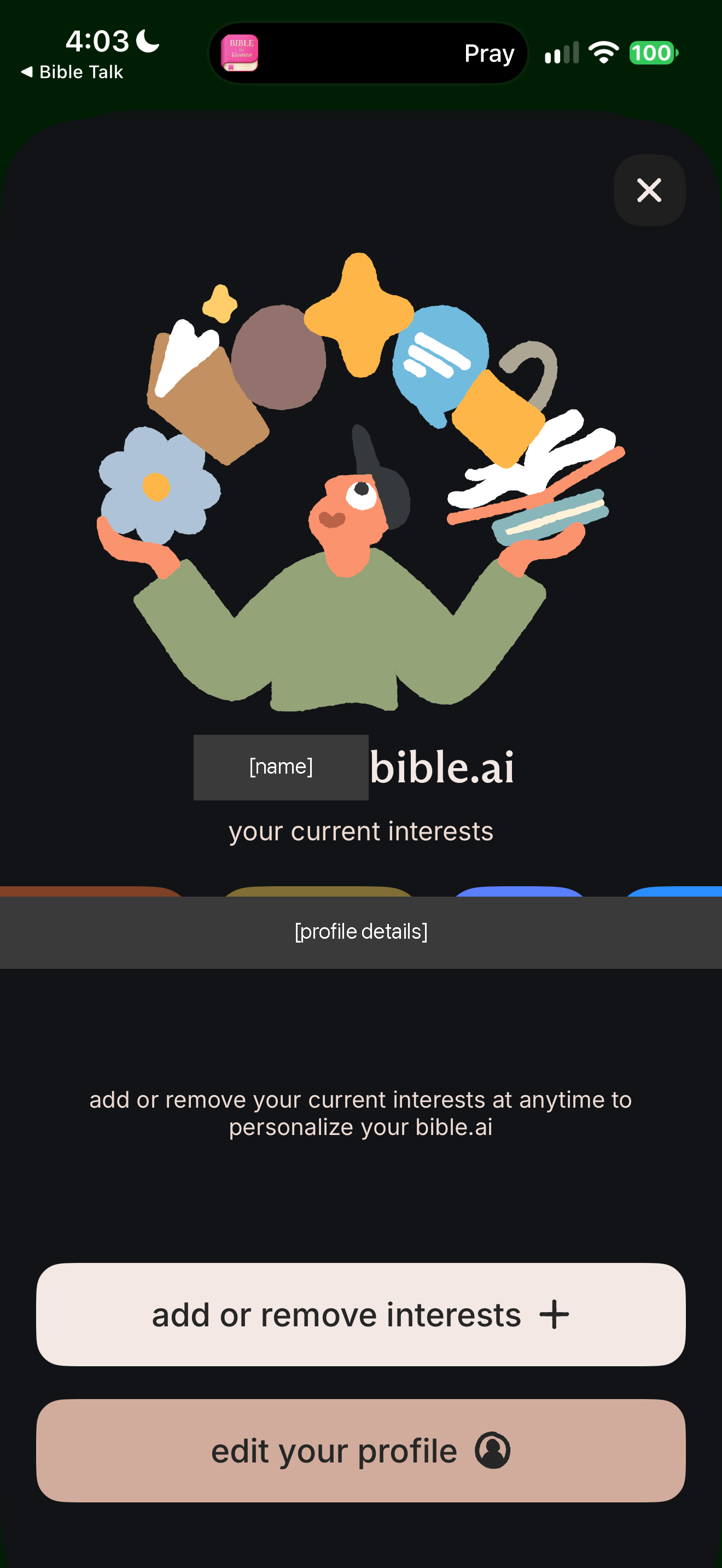
- bible.ai, 28 October 2026: The screen read “add or remove your current interests at anytime to personalize your bible.ai”, with “add or remove interests” and “edit your profile” buttons.
View screen
bible.ai. Screen details
Not considered here5 related decisions this spectrum leaves to other pages
- Questions at setup. The timing of setup questions is covered with first use. First use
- What the assistant remembers. What persists between conversations, including old labels and stored details, is covered there. AI memory
- Whose theology it speaks from. Tradition and doctrine are covered there. Whose theology
- Pushing back. When to disagree with someone is covered there. Agreeing and pushing back
- Choosing content for someone. Which passage or item to select is a planned article on personalization.
Design considerations
Takeaways
Read the message first
Most replies that fail a skeptic fail because they assume agreement, not because the assistant lacked a profile. People usually say why they ask: “Be honest”, “everyone talks as if”, “I used to believe”. Answer that reason, and check replies for “our faith”, “let’s thank Him” and other insider phrases.
Keep the way in apart from where someone stands
History, theology or living it is a preference anyone can choose and change, and says little about someone’s faith. Where someone stands is personal and sensitive. Ask about the first freely, be slow to ask about the second, and never put both on one ladder.
Ask about the need, not the belief
One light question, “the history, what it means, or living it?”, lets someone choose without declaring their faith. Offer “Just answer” beside it, and do not ask again in every conversation.
Show what you assume, and keep it short
If the assistant adapts to where someone seems to stand, say so in plain words, with Correct and Forget, and let it end with the conversation. Treat it as special-category data even when it is only a guess.
Do not keep a faith-stage profile
Numbering a person on a journey turns a conversation into a funnel, goes stale when they change, and makes the assistant mirror what the profile says they want. Leave the knowing of hearts to God and to people who know them.
Meeting is not agreeing
Changing the manner is not changing the message. A skeptic deserves the honest case, a believer the honest difficulty, and someone hurt a reply that does not pretend nothing happened. Test replies with and without what the assistant knows about the person.
The research behind it
Theology, practice and science
Scripture and tradition
The same message, met in different ways
All things to all people
Paul: “To the weak I became weak, to win the weak.
Begin with what you have seen
In Athens Paul began, “Men of Athens, I see that in every way you are very religious” (Acts 17:22), started from their altar and quoted their own poets: “For in Him we live and move and have our being” (Acts 17:28).
Ask what they want
Jesus asked a blind man who had called out to Him, “What do you want Me to do for you?”
Gentleness and respect
Peter asks believers to be ready “to give a defense to everyone who asks you the reason for the hope that is in you.
Hear before you answer
“He who answers a matter before he hears it—this is folly and disgrace to him” (Proverbs 18:13).
Hosts, not teachers
Alpha trains the people who host its groups for guests exploring faith: “The role of the hosts and helpers is to listen; not to have all the answers or to win an argument.”
Show sources: The same message, met in different ways
All things to all people
I have become all things to all people so that by all possible means I might save some” (1 Corinthians 9:22). He changed his manner, not the gospel.
Begin with what you have seen
When he spoke of the resurrection, “some began to mock him, but others said, ‘We want to hear you again on this topic’” (Acts 17:32).
Ask what they want
(Mark 10:51), and met Nicodemus, the Samaritan woman and the rich young man each in a different way (John 3; John 4; Mark 10).
Gentleness and respect
But respond with gentleness and respect” (1 Peter 3:15), and Paul asks for speech that is “gracious, seasoned with salt, so that you may know how to answer everyone” (Colossians 4:6).
Hear before you answer
“The intentions of a man’s heart are deep waters, but a man of understanding draws them out” (Proverbs 20:5).
Hosts, not teachers
And: “The model for the Alpha small group is not teacher-pupil, but host-guest.”
Research
Stages, profiles and agreement
Stage models are contested
The Engel scale numbers “the journey from no knowledge of God, through to spiritual maturity as a Christian believer” in stages, and “has been criticized for its fixed linear approach”.
Profiles make assistants agree
In a study with two weeks of real conversations from 38 people, “Agreement sycophancy tends to increase with the presence of user context”, and “User memory profiles are associated with the largest increases in agreement sycophancy”.
Agreement feels like being met
Across 11 models, AI-generated answers “validated user behavior an average of 49% more often than humans”, and people “rated sycophantic responses as higher quality”.
Models infer what they are not told
Language models “can infer a wide range of personal attributes (e.g., location, income, sex)” from ordinary text, “achieving up to 85% top-1 and 95% top-3 accuracy”, and “common mitigations, i.e., text anonymization and model alignment, are currently ineffective”.
Formation, not preference
My Kairos paper puts “Meet the user where they are.
Show sources: Stages, profiles and agreement
Stage models are contested
James Fowler’s stages of faith are criticized for the rigidity of their framework and for describing faith in one Western culture. Useful for a team’s thinking; not a label for a person.
Wikipedia, citing Søgaard (2000), Hartman (2007) and Hazelden (2000)James Bishop
Profiles make assistants agree
“Perspective sycophancy increases only when models can accurately infer user viewpoints from interaction context”: the better a model reads someone’s views, the more it mirrors them.
Shomik Jain, Charlotte Park, Matt Viana, Ashia Wilson and Dana Calacci (MIT and Penn State)Adam Zewe
Agreement feels like being met
A reply tuned to what a profile says someone wants will feel personal and may help them less.
Myra Cheng, Cinoo Lee, Pranav Khadpe, Sunny Yu, Dyllan Han and Dan Jurafsky (Stanford)
Models infer what they are not told
Robin Staab, Mark Vero, Mislav Balunović and Martin Vechev (ETH Zurich)
Formation, not preference
Not where you wish they were.” first among its principles, and draws the line between “formation-driven and preference-driven personalization”: “a spiritual director sometimes offers what the person needs rather than what they want”.
More researchLaw · Products · The techniques · Observed, October 2026 (13 findings)
Law
Faith is special-category data
Religious belief is protected
The GDPR prohibits processing personal data revealing “religious or philosophical beliefs” unless an exception applies, such as that the person “has given explicit consent to the processing of those personal data for one or more specified purposes”.
Inferences count
The UK regulator treats an inference as special-category data if “your processing intends to make an inference linked to one of the special categories of data”, or you “intend to treat someone differently on the basis of inferred information”, “regardless of how confident you are that the inference is correct”.
Show sources: Faith is special-category data
Religious belief is protected
Regulation (EU) 2016/679, Article 9European Data Protection Board
Inferences count
Products
What apps and assistants do now
Asking where someone is
Lumen’s onboarding asks “Where are you right now?” and offers “I’m curious or skeptical” and “I’m just starting out”, with a way to skip.
Tradition and struggles at onboarding
A teardown of Bible Chat describes a quiz “asking about denomination and specific interests”; a review of FaithTime.ai lists “your season of life, your goals, your reading experience, how much time you have, what you are wrestling with”; HelloBible asks for separate consent to use what people share “about my faith to personalize my answers”.
Memory you can see
General assistants let people say what they want considered and see what is remembered: “You can edit or delete custom instructions at any time for future conversations”, and “Claude uses a memory summary to capture all its memories in one place for you to view and edit”.
Show sources: What apps and assistants do now
Asking where someone is
Bible BFF asks “How much of the Bible have you read?”.
Tradition and struggles at onboarding
What each app infers and keeps was not tested.
ScreensDesignScreensDesignLearn of ChristHelloBible (HelloBox)Twisted Society AB
Memory you can see
The techniques
Personalization without turning a person into a profile
Personalization and onboarding commitment
Adapting an answer can reduce irrelevant material and make a first step easier to understand.
Sycophancy
An answer that mirrors someone’s viewpoint can feel like being understood.
The deciding questions
Purpose: which part of the answer becomes more useful?
Where this page stops
This page concerns how an assistant understands the person asking.
Show sources: Personalization without turning a person into a profile
Personalization and onboarding commitment
Questions also create an investment in setup; the first-use article examines when that becomes a commitment funnel or personalized paywall. Redeemed, ask only what changes the answer, show the change and let someone choose a reply without personalization. First use
Sycophancy
Jain and colleagues found that interaction context often increased agreement sycophancy, with different effects across models and context types. That is not evidence that every personalized answer is worse. Redeemed, change the way in while preserving the honest case and its difficulties, and compare with a version that uses no personal context.
Shomik Jain, Charlotte Park, Matt Viana, Ashia Wilson and Dana Calacci (MIT and Penn State)
The deciding questions
Transparency: can the person see what was used and what changed? Freedom: can they correct it, forget it or choose no personalization? A setting about reading depth is different from a stored judgment about someone’s faith. The principles
Where this page stops
The planned personalization article concerns which passage or content is selected for someone. First use keeps the timing of questions; AI memory keeps the decision about what persists. The same answer should not be copied across all four. What the assistant knows
Observed, October 2026
Settings, inferences and what replies used
A tradition the person can choose
Amen’s 28 October chat settings visibly offered Not Selected, Catholic, Protestant, Free Church, Orthodox and Other.
Hallow names what it read in the message
In the visible part of Hallow’s 28 October answer about assumptions, it referred to the request for a direct, non-preachy answer and began to say there were no grounds to infer religious identity.
Stored details shape a Psalm explanation
In the 30 October bible.ai capture, an explanation of Psalm 23 brought stored family details into the answer without being asked for.
A survey becomes a confidence gauge
Duomo’s 25 October setup capture shows a Faith Growth Profile and Scripture Confidence gauge following a questionnaire.
Show sources: Settings, inferences and what replies used
A tradition the person can choose
A visible, changeable setting is useful practice; the capture alone does not establish how every answer uses it. Amen denomination setting
Hallow names what it read in the message
Credit the distinction between reading a request and assigning a faith identity; the capture does not show the entire reply. Hallow assumptions reply
Stored details shape a Psalm explanation
The public screen covers those values; the sentence structure shows their use. This is evidence about that answer, not every bible.ai reply. Redacted Psalm explanation
A survey becomes a confidence gauge
The screen shows a presentation of the answers, not validation of a measure of faith or formation. Duomo profile screen
Find the supporting research under Go further → Sources and their limits.
Trade-offs to hold
Pulls against
Some choices here pull against choices in another deep dive. Each pair below says what pulls and one way to hold both.
Questions that improve fit, and answers that become a commitment
HerePreferences you setPulls againstFirst use: Questions first
Questions at the start help an app fit the person, and the same answers can become a commitment that leads into a paywall.
Holding itAsk only what changes the content, show what each answer changed, let it be skipped or forgotten, and never let answers set a price.
Meeting someone where they are, and telling them the truth
HerePreferences you set · Assumed, and shownPulls againstAgreeing and pushing back: Names a disagreement · Asks a question back
Every way of adapting to the person also makes it easier to tell them what they want to hear.
Holding itAdapt the way in, and keep the message. Ask the same question with and without what the assistant knows about the person: if the substance changes, it has started agreeing. A stored preference to hear no hard words never switches off honest disagreement.
The common word, and a word for you
HereThe same for everyone · Reads the messagePulls againstReading plans: Daily readings
Shared readings form a community, but a reply written for everyone can assume agreement and lose the skeptic.
Holding itKeep the passage everyone reads, and adapt only the way in: the length, the language and the question it starts from. Change the manner, never the message.
In real apps
Examples in real apps
Attributed screenshots with dates and review limits. A screenshot shows an implementation; it does not show that it works for every audience.
Annotated examples
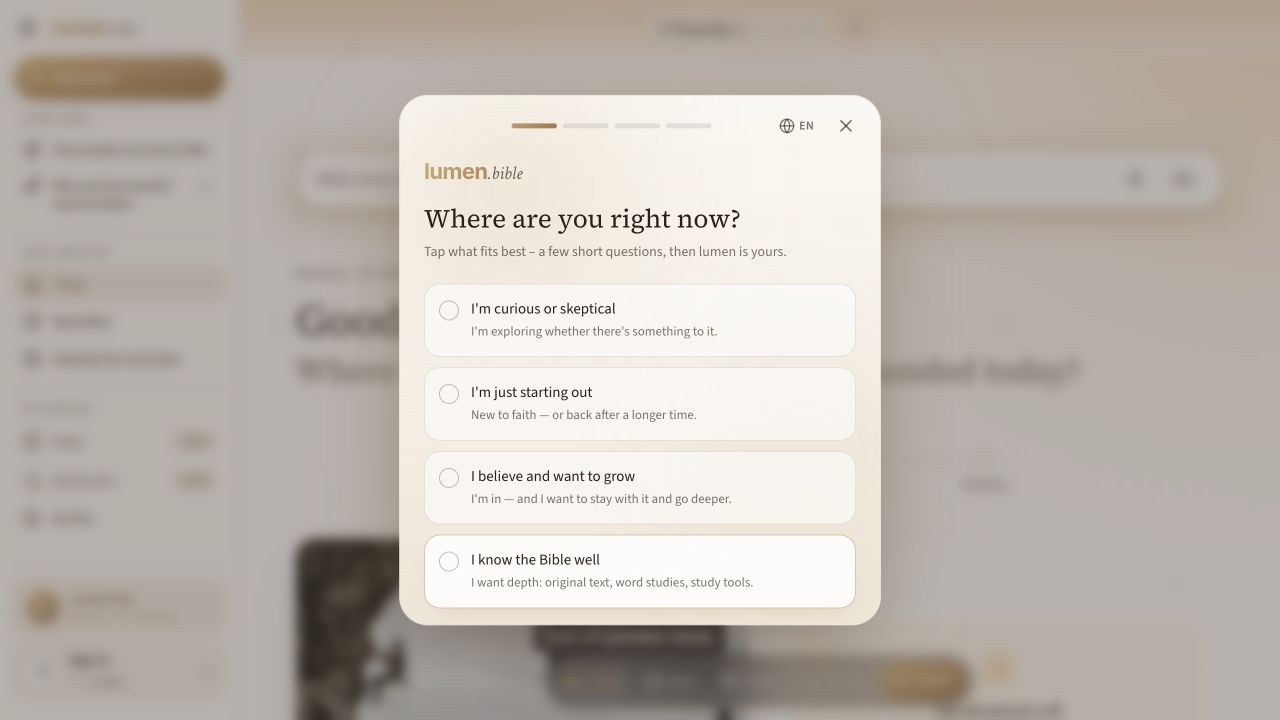 Lumen Bible · Desktop web · English interface
Optional choices about engagement and experience
Direct signed-out web capture
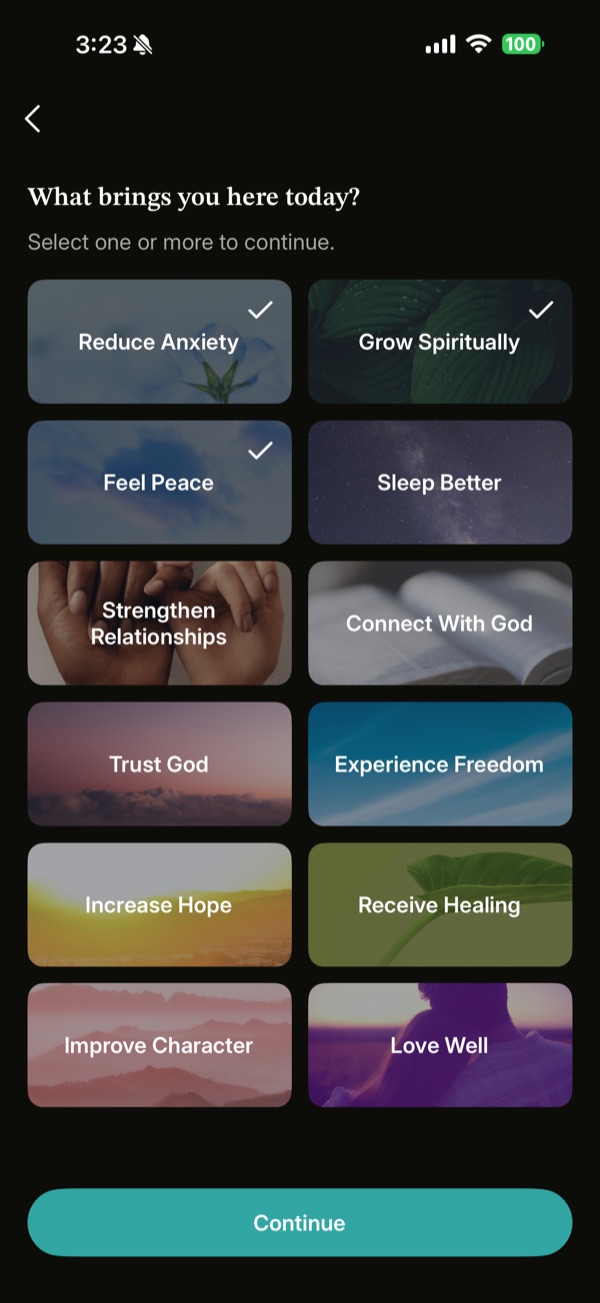 Abide · iOS app · device model not recorded
“What brings you here today?” as a photo grid
User-contributed screenshot · resized, content unchanged
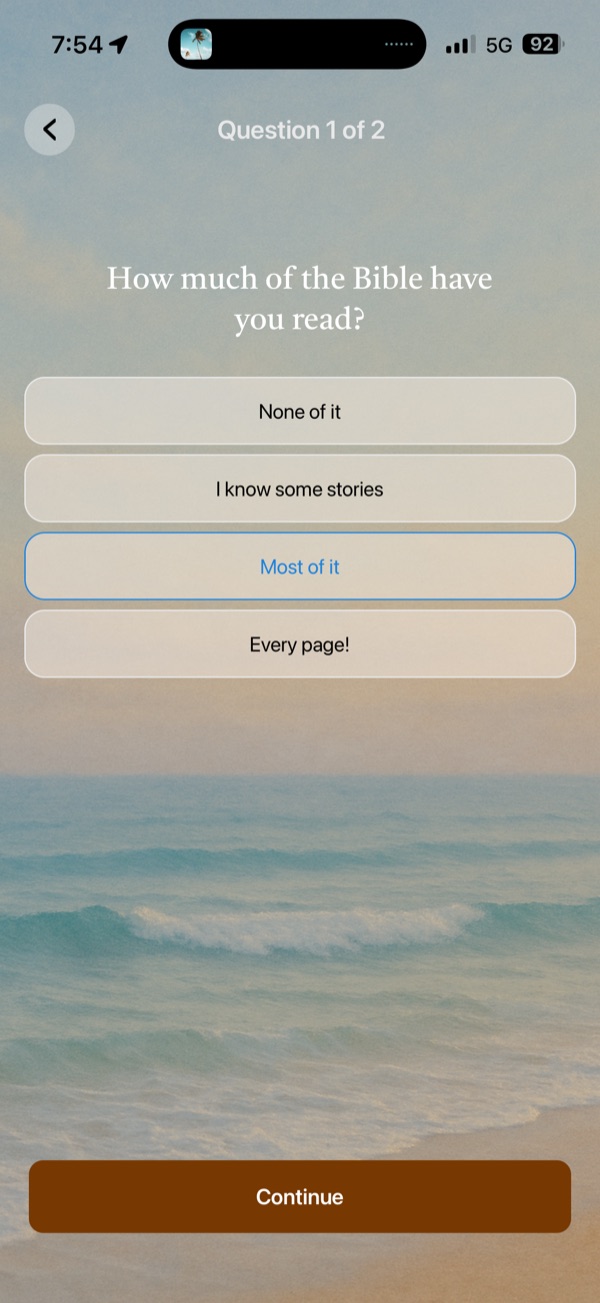 Bible BFF · iOS app · device model not recorded
“How much of the Bible have you read?”
User-contributed screenshot · resized, content unchanged
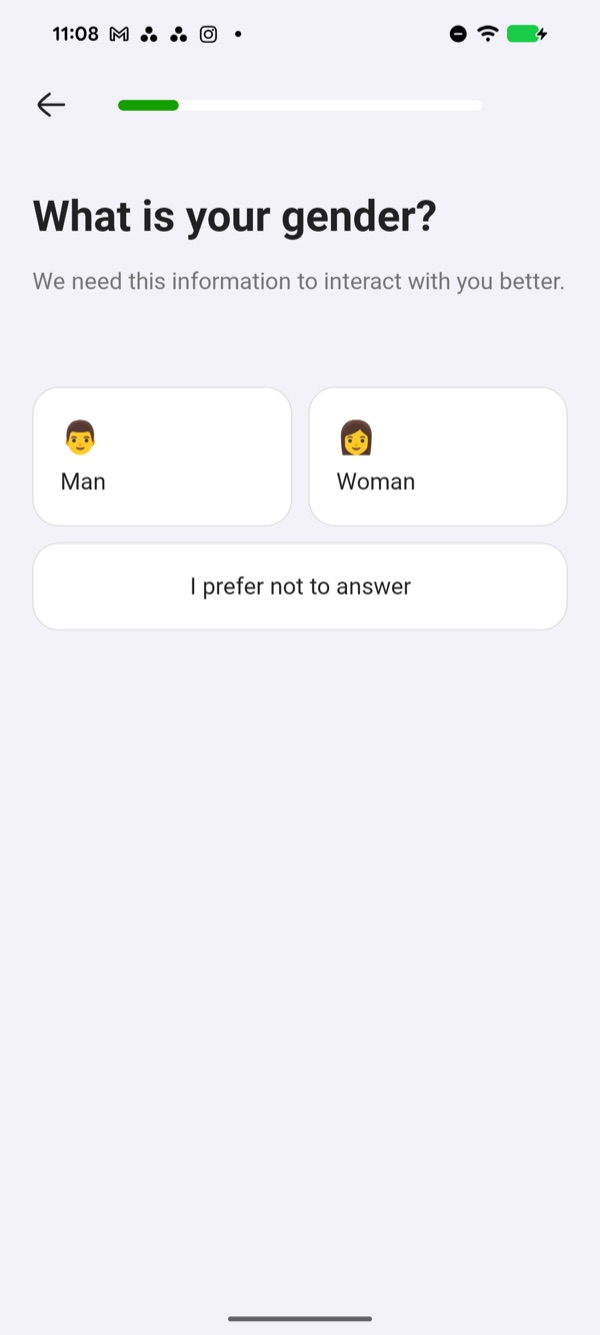 HelloBible · Android app · Pixel 8 Pro
“What is your gender?” with a reason and an opt-out
User-contributed screenshot · resized, content unchanged
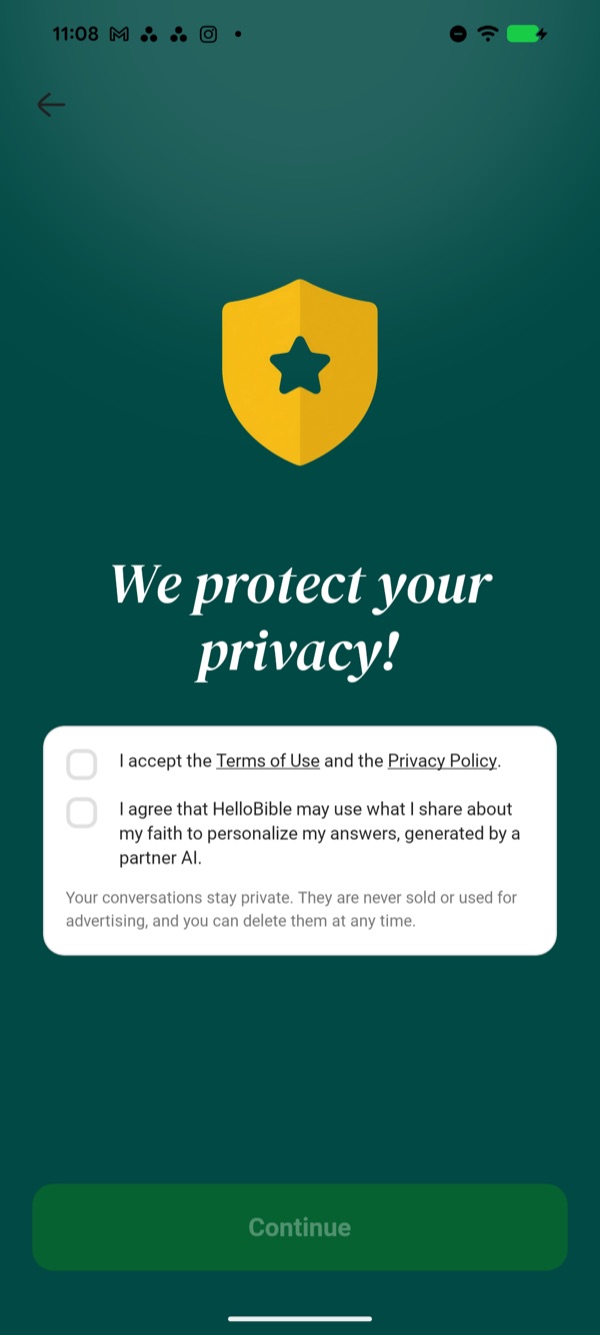 HelloBible · Android app · Pixel 8 Pro
A separate consent for using faith data with a partner AI
User-contributed screenshot · resized, content unchanged
Research screens
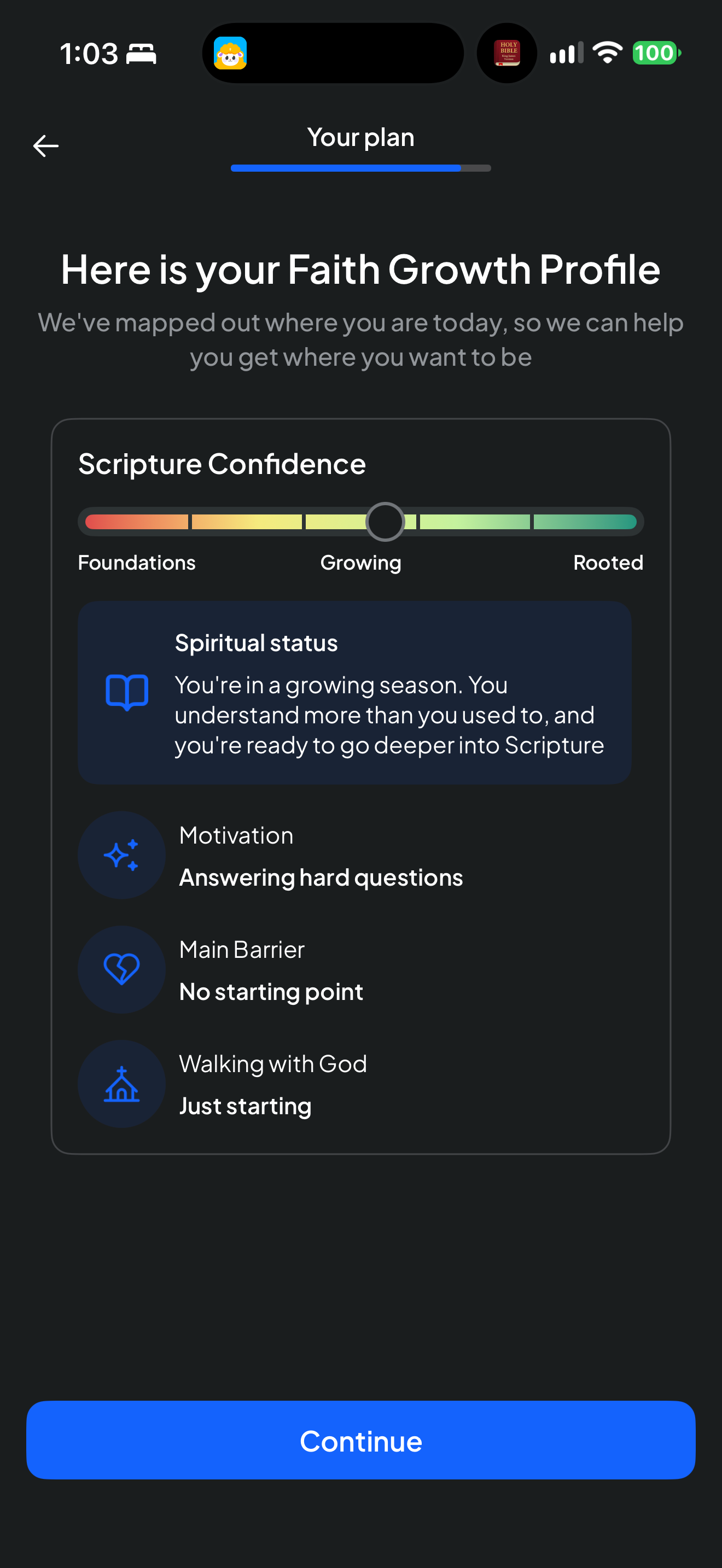
Duomo presents a Scripture Confidence gauge and spiritual-status description after a setup questionnaire.
Duomo · 2026-10-25
Creed’s scripted lamb onboarding links confiding through voice or text with its promise to guide the person toward God.
Creed · 2026-10-25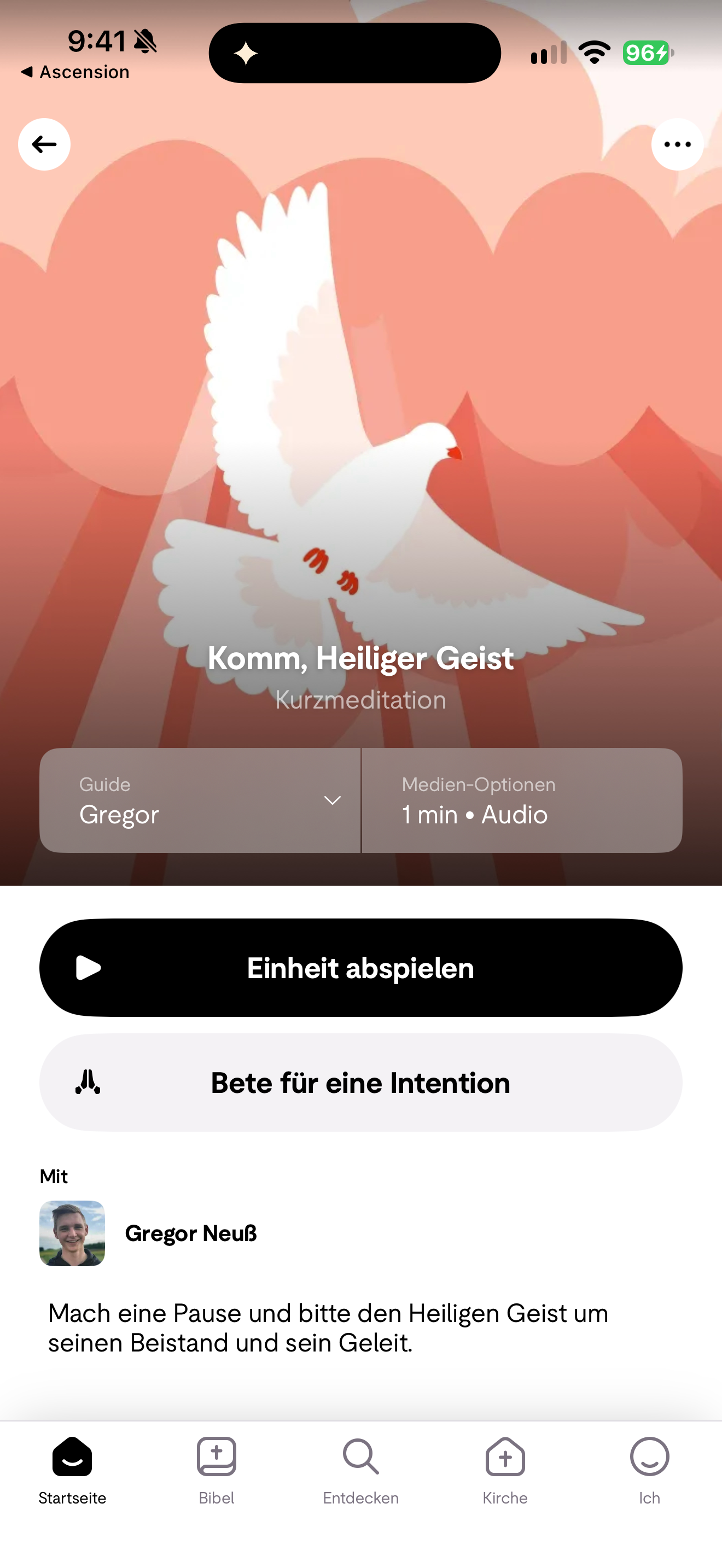
Hallow shows the guide, audio duration and play action for a short Holy Spirit meditation.
Hallow · 2026-10-13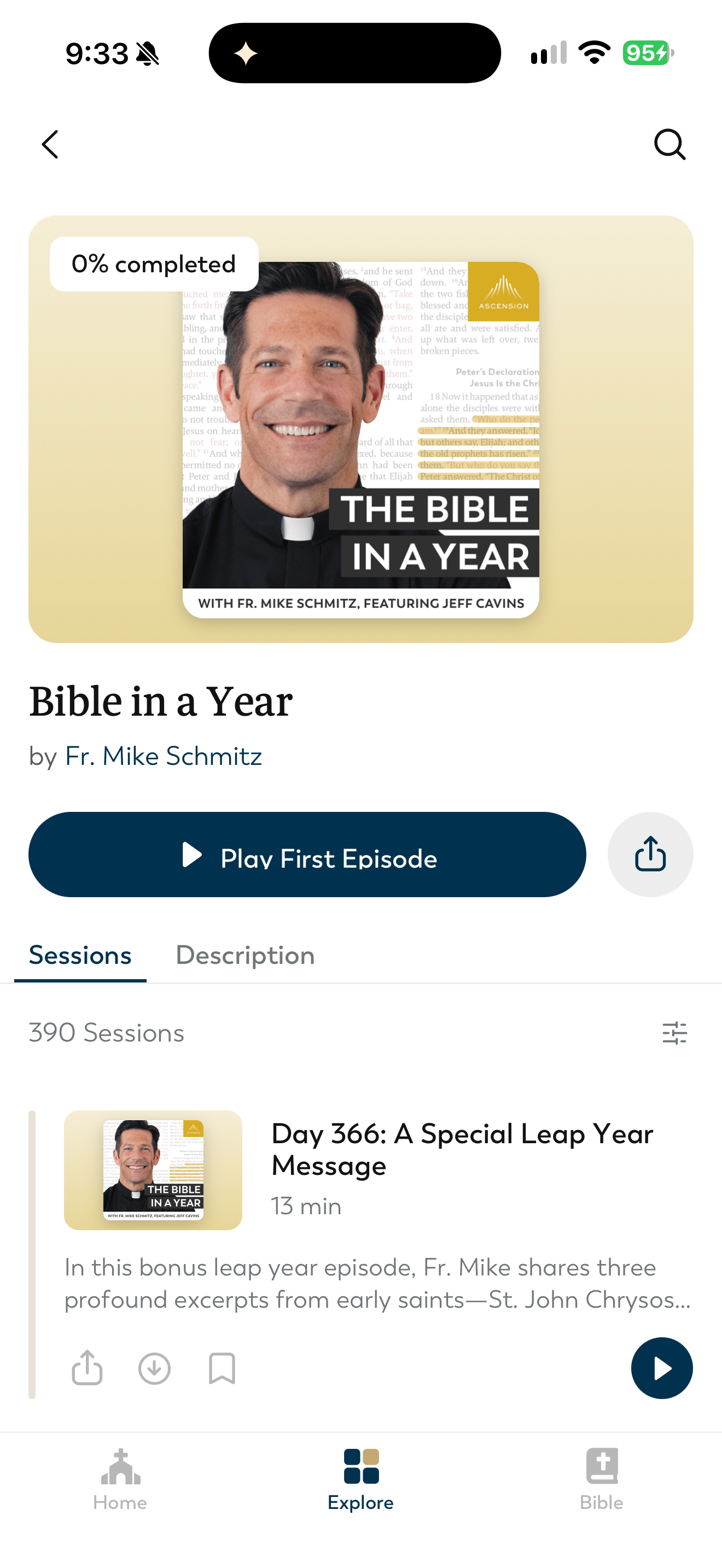
Ascension gives Bible in a Year a first-episode action and a sessions list.
Ascension · 2026-10-13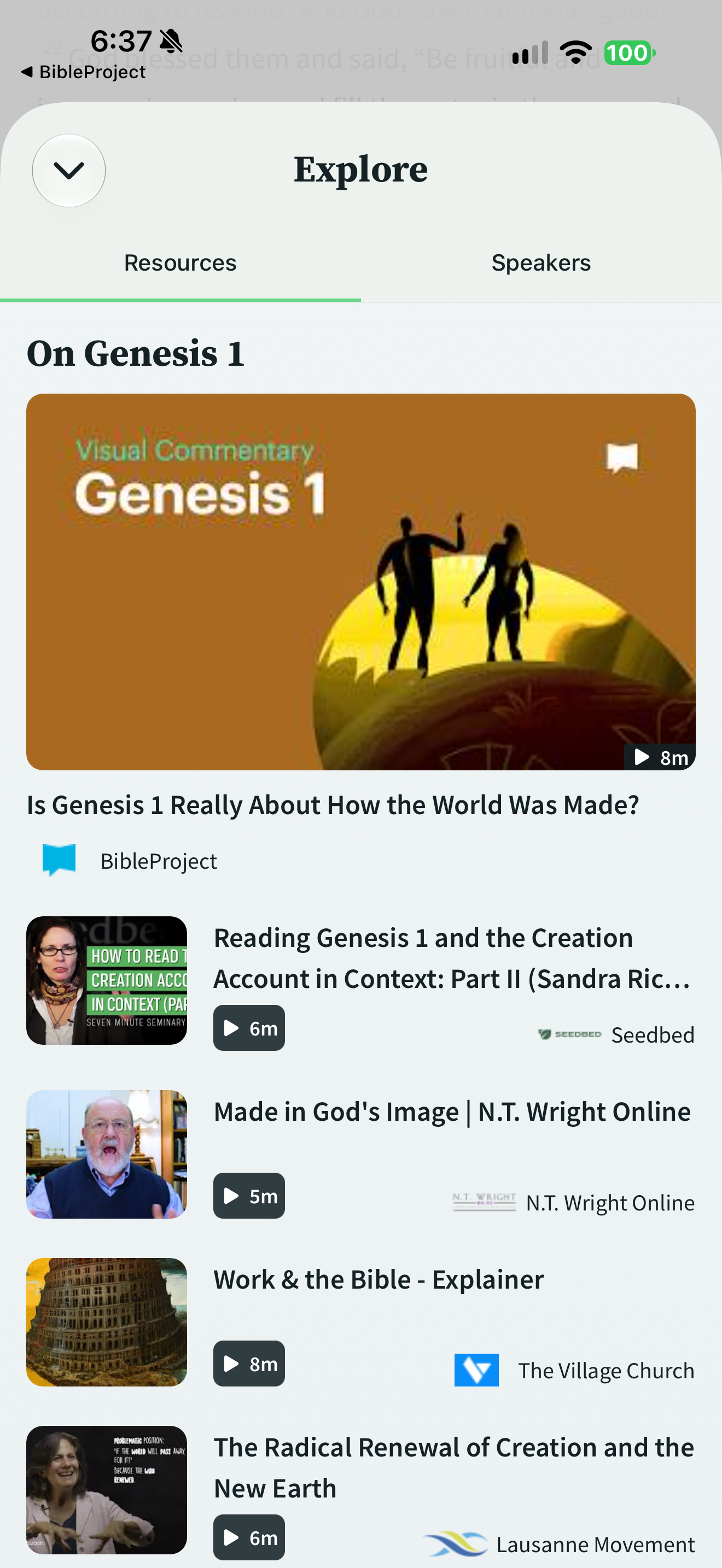
An Explore sheet lists Genesis 1 videos with publishers, speakers and durations.
Spark Bible · 2026-10-14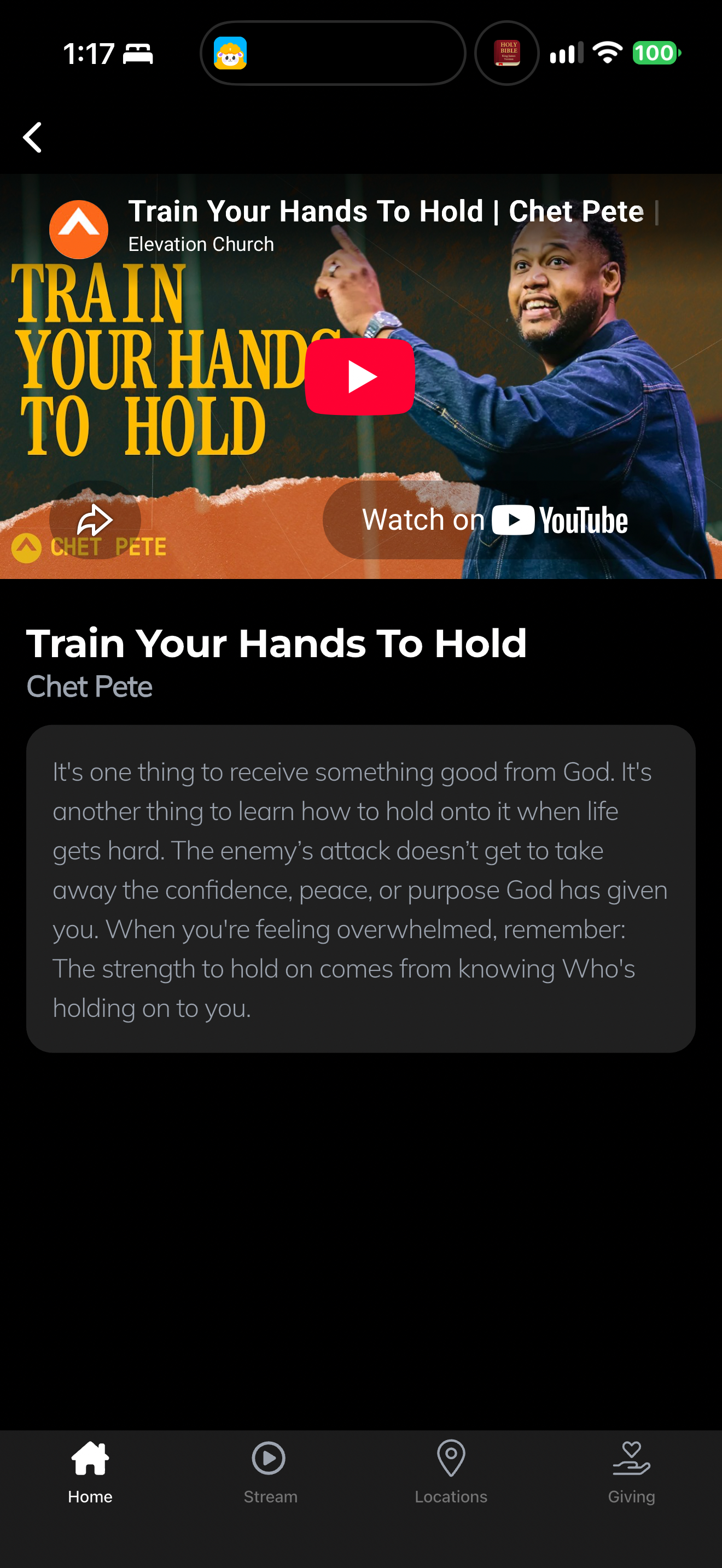
A Chet Pete sermon detail combines a YouTube preview with title and description.
Elevation Church · 2026-10-25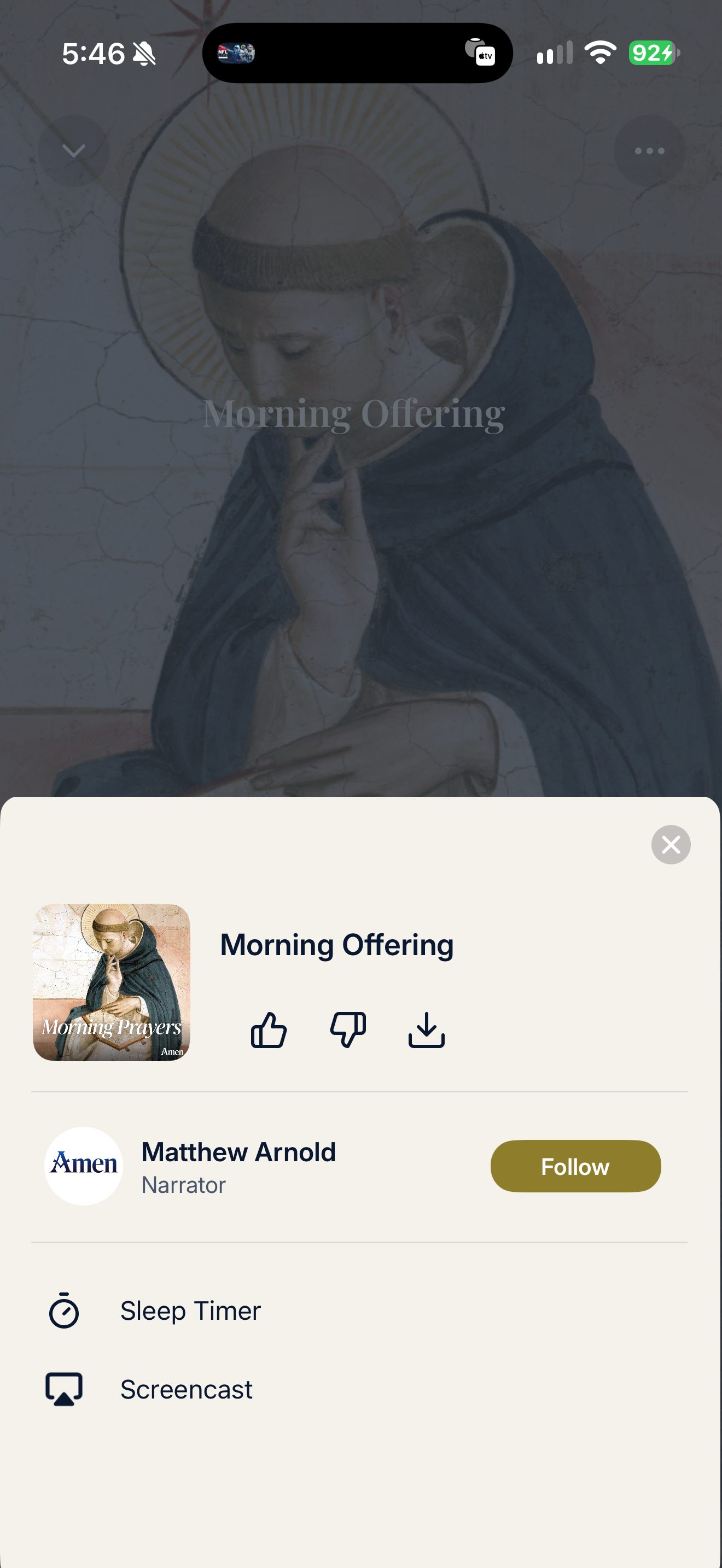
A prayer options sheet credits narrator Matthew Arnold and offers feedback, download, following, timer and screencast.
Amen · 2026-10-14
Account benefits and sign-in entry. Captured on iOS, 27 October 2026; existing state, not an installation default. Offers and visible controls do not establish successful execution.
STAYONFIRE · 2026-10-27See all 78 screens for this pattern · Browse apps · How we review
Screenshots: respective app publishers. Captions describe the captured state; generated responses can differ.
Theological reflection
What is this practice for?
What meeting someone is
“To the weak I became weak, to win the weak. I have become all things to all people so that by all possible means I might save some” (1 Corinthians 9:22). Paul changed his manner, not the message: in Athens he began from an altar inscribed “TO AN UNKNOWN GOD” (Acts 17:23) and from their own poets, and still spoke of the resurrection. Jesus let people begin where they were: Nicodemus came “at night” with a compliment (John 3:2), the Samaritan woman with a challenge (John 4:9), the rich man with a question about himself (Mark 10:17). He answered each differently, and He told the rich man the hard thing because He “looked at him, loved him” (Mark 10:21).
Where Christians differ
Traditions describe the journey differently. Many evangelicals speak of conversion as a decision with stages before and after it; mission thinkers drew this as the Engel scale and later redrew it in two dimensions, because people do not move along one line. Catholic and Orthodox Christians speak of initiation through the sacraments and of lifelong conversion within the church, and the Catholic catechumenate walks with inquirers through stages over months. Many churches welcome skeptics in courses such as Alpha, where hosts are trained to listen rather than win arguments. All agree that God knows a person better than any scale: “the LORD sees the heart” (1 Samuel 16:7).
What follows for design
“He who answers a matter before he hears it—this is folly and disgrace to him” (Proverbs 18:13). Read the reason a person gives before answering, ask when you need to, and let them choose their way in. Leave the knowing of hearts to God, “O LORD, You have searched me and known me” (Psalm 139:1), and to people who know them. Show what the assistant assumes, let it be corrected and forgotten, and never let fitting the person become flattering them.
In conversation with
- Augustine, Confessions X.5 and X.8 confessed that a person does not fully know even himself, while God knows him wholly; a profile built from a few conversations knows far less, and should not claim more.
Scripture is quoted from the Berean Standard Bible. This reflection is the editor’s, written from within the Christian tradition and open to correction. How we approach theology here →
Redemptive design
What could this become?
Let the assistant give a skeptic the honest case and a believer the honest difficulty, leave knowing hearts to God and to people, and give up the engagement that a flattering profile would bring.
This asks what a team would give up for the person’s good. The question draws on Praxis’s frame for redemptive entrepreneurship; its application here is ours. Why we use it, and its limits →
Take into your next review
What does this assistant assume about the person in front of it, where does that come from, and can they see it, correct it and make it forget?
Exercise
Write the same question five times in the words of five people with different reasons for asking: a skeptic, someone new to church, someone a church has hurt, and two believers from different traditions. Send each to your assistant and mark every phrase that assumes the person already believes. Ask the assistant what it has assumed about you, correct it, and see whether the next reply changes. Then look in storage for anything kept about faith, and read the replies with an evangelist, a pastor, someone who has left a church and a data protection adviser.
Record the decision with the worksheet
Something missing or wrong here? Send a correction or suggest a topic.
Hear the person before you answer them, and change your manner, never the message, to meet them.
Details
Go further
Edge cases to design for
Start with the message: what has this person said about why they ask, and what would answer them? Keep the assistant from assuming agreement. Offer a way in, history, theology or living it, as a visible choice the person sets and can change, and ask one light question when the message is ambiguous. If the assistant adapts to where someone seems to stand, show what it assumed in plain words with Correct and Forget, use it for this conversation only, and treat it as special-category data. Do not build a faith-stage profile, and do not tune the answer to what the profile says the person wants to hear.
What tends to go wrong
“Let’s thank Him today” in reply to a skeptic who asked for no sermon; a skeptic labeled “seeker, stage −4” and nudged toward a decision; a profile that still says “lapsed” after someone has returned; “Whatever you believe is valid” to someone hurt by church, because the profile says they dislike church; “As you know so well…” to a believer the profile calls mature; onboarding that ranks stance and knowledge on one ladder; a quiz answer echoed with praise; “to interact with you better” as the only reason for a question.
How to test it
Send the same question from five people who give different reasons for asking: a skeptic, someone new to church, someone hurt by a church, and two believers from different traditions. Mark every phrase that assumes the person already believes. Ask the assistant what it has assumed about you, then say it is wrong; see whether the next reply changes. Look for anything kept about your faith after the conversation ends, and ask an evangelist, a pastor and a data protection adviser to read the replies with you.
Every situation against every optionWhich situation, which option? The full ratings behind the summary map.
People come with different needs, sometimes in the same week. Each need fits some options better than others.
| Situation | Needs | 1 The same for everyone | 2 Reads the message | 3 Asks before assuming | 4 Preferences you set | 5 Assumed, and shown | 6 Compare before choosing | 7 A profile it keeps |
|---|---|---|---|---|---|---|---|---|
| A skeptic who asks for evidence, not a sermon | An honest answer to the question they asked | Poor fit | Good fit | Possible | Possible | Possible | Possible | Poor fit |
| Someone new to church | Room to doubt, and a way to people who can help | Poor fit | Good fit | Possible | Possible | Possible | Good fit | Poor fit |
| Someone a church has hurt | No pressure, and nothing kept about the hurt | Poor fit | Good fit | Possible | Possible | Possible | Good fit | Poor fit |
| A believer preparing to teach | Depth, in the way in they choose | Possible | Good fit | Good fit | Good fit | Possible | Good fit | Poor fit |
| Someone who uses the app every day | A way in they set once and can change | Poor fit | Possible | Possible | Good fit | Possible | Possible | Poor fit |
| Someone at risk if their faith is known, or sharing a phone | Nothing about their faith kept or shown | Possible | Good fit | Good fit | Poor fit | Poor fit | Possible | Poor fit |
Suggested fits based on the research below. Test these choices with people in your context.
Which fits your product?5 kinds of product and where each could start; the summary map shows the same fits as situations.
IfAny assistant in a faith app
Start withRead the message, and never assume agreement
IfAn app people use every day
Start withA way in they set and can change, with no question about faith required
IfAn outreach or inquirers’ app
Start withRead the message and ask about the need; keep nothing about faith
IfA church app for its members
Start withPreferences people set, and the church’s own tradition named rather than inferred
IfYou are tempted to infer and keep faith stage or tradition
Start withDon’t: ask, show and forget instead
Suggested fits based on the research on this page. Test these choices with people in your context.
Review record
Each check answers a different question: a theological review says nothing about whether an interface works, and a test with users settles no theology.
- Research-informed, not tested with users. Built from the sources on this page. The working example has not been tested with users.
- Needed: practitioner review.
- Needed: theological review. Expertise needed: pastoral care; evangelism and apologetics with skeptics and inquirers; and theology from Catholic, Orthodox, Lutheran, Baptist and Pentecostal traditions, each read by its own members.
- Needed: testing with users.
Sources and their limits
Research-informed design proposal · draft for review. Original prototypes await user testing.
- Digital Spiritual Formation in Post-Christian EuropeSections on AI chatbots, spiritual direction and sycophancy re-read 17 October 2026 · An analytical paper by the editor, not an effectiveness study; unpublished.
- Interaction context often increases sycophancy in LLMsAbstract rechecked 1 November 2026 · General assistants and everyday queries, not faith apps; effects differ by model.
- Personalization features can make LLMs more agreeableNews article reviewed 19 October 2026 · A university news report on its own researchers’ paper.
- Sycophantic AI decreases prosocial intentions and promotes dependencePreprint abstract and TechCrunch’s report on the published paper reviewed 17 October 2026; the published paper was not accessible · General models and interpersonal advice drawn largely from a Reddit forum, not faith apps or questions of faith.
- Beyond memorization: violating privacy via inference with large language modelsAbstract reviewed 19 October 2026 · Reddit profiles and attributes such as location and income; religion was not among the reported examples.
- Art. 9 GDPR: processing of special categories of personal dataReviewed 19 October 2026 · The legal text; lawful basis, exceptions for religious bodies and national law need advice for each product.
- What is special category data?Categories and inference guidance reviewed · Context and processing intent matter; not every Bible-page visit automatically establishes a belief.
- Alpha Team GuidePDF reviewed 19 October 2026 · Guidance for human hosts in small groups, not for software.
- Engel scaleArticle reviewed 19 October 2026 · An encyclopedia summary; read Engel and Norton (1975) and the critiques for detail.
- A critical examination of Fowler’s stage-theory model of faith developmentArticle reviewed 19 October 2026; Coyle’s paper was not accessible · A blog summary; read Fowler (1981) and Coyle (2011) directly.
- Lumen Bible: “Where are you right now?”Captured by the editor; text read from the published screenshot · One screen; what the answer changes and whether it is kept were not tested.
- HelloBible: consent to use faith dataCaptured by the editor; text read from the published screenshot · The consent screen only; what is used and kept was not tested.
- Bible BFF: “How much of the Bible have you read?”Screenshot in the research corpus · A still image; what the answer changes was not tested.
- Bible Chat: Daily Devotional (onboarding teardown)Teardown reviewed 19 October 2026 · A third party’s description; the questions and their effect were not seen.
- Hallow: Prayer & Meditation (onboarding teardown)Teardown reviewed 19 October 2026 · A third party’s description; the quiz was not seen.
- FaithTime.ai reviewReview reviewed 19 October 2026 · A favourable third-party review; the app was not observed.
- The Bible Chat (App Store listing)Reviewed 19 October 2026 · A store listing, not a test of the app.
- ChatGPT Custom InstructionsHelp article reviewed 19 October 2026 · A company’s description of its own product.
- Memory and new controls for ChatGPTAnnouncement as quoted in press coverage (Decrypt, TechCrunch); the page blocks automated reading · A company’s description of its own product; behavior was not tested here.
- Bringing memory to ClaudeAnnouncement reviewed 19 October 2026 · A company’s description of its own product; behavior was not tested here.
- Towards understanding sycophancy in language modelsAuthor research abstract reviewed on 5 October 2026; full paper not reviewed · Specific studied models and tasks; not a faith-app intervention study.
- The 7 principles of persuasion: consistencyReviewed 31 October 2026 · A practitioner summary of the author’s research.
- Process personal data lawfullyOfficial guidance reviewed · Specific lawful basis, retention and DPIA decisions require the actual data flows.
Faith and interpretation
Paul in Athens began with what he had seen: “Men of Athens, I see that in every way you are very religious” (Acts 17:22), and quoted their own poets before he spoke of the resurrection; “some began to mock him, but others said, ‘We want to hear you again on this topic’” (Acts 17:32). He became “all things to all people so that by all possible means I might save some” (1 Corinthians 9:22), without changing the message. Jesus answered Nicodemus at night, the Samaritan woman at the well and the rich young man each differently, and asked a blind man, “What do you want Me to do for you?” (Mark 10:51). Proverbs warns: “He who answers a matter before he hears it—this is folly and disgrace to him” (Proverbs 18:13).