Progress and streaks
What should a reading history show?
Twelve chapters into a plan, someone misses nine days. When they open the app again, the progress screen speaks first. It can tell them they broke a streak, that they have read most of Mark, what they noticed along the way, or nothing at all. What it says can encourage a weary reader back to God, or send them away ashamed.
- 9 working options
- 9 app examples
- 4 takeaways
- Editorial review, not user-tested
At a glance
Nine ways to reflect reading back, side by side
 Borrowed Starts when the reader started A chart to keep filledTry it →
 Familiar convention Quick early rewards The app’s idea of progressTry it →
 Borrowed A finite plan you can finish The whole Bible looks unreachableTry it →
 Leave it out No score to protect No sense of a journeyTry it →
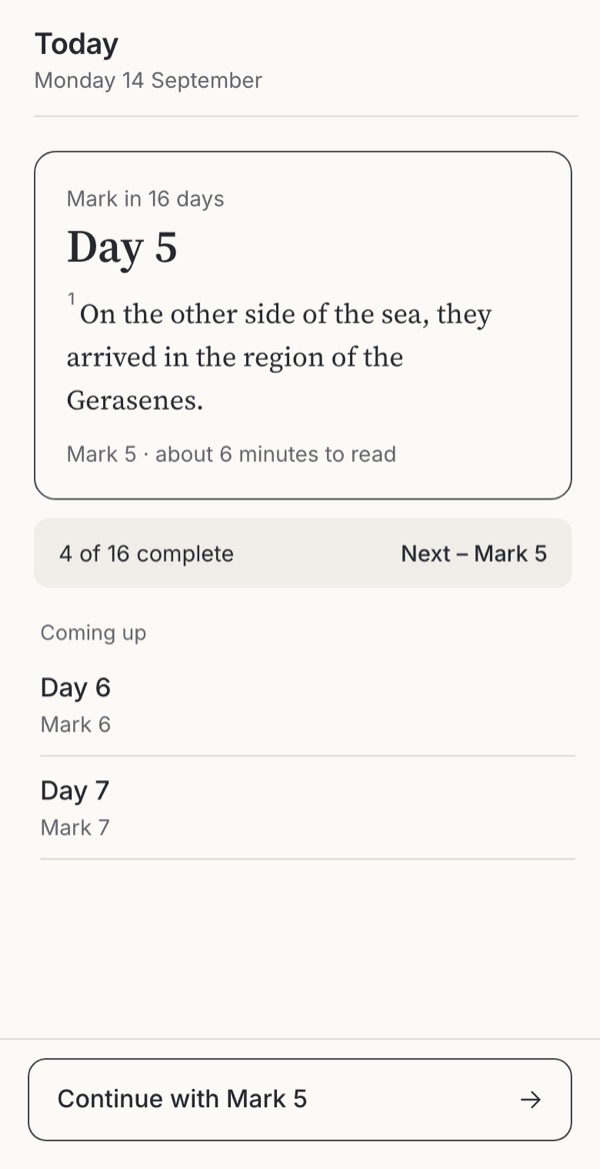 Observed Only the next step Little sense of the wholeTry it →
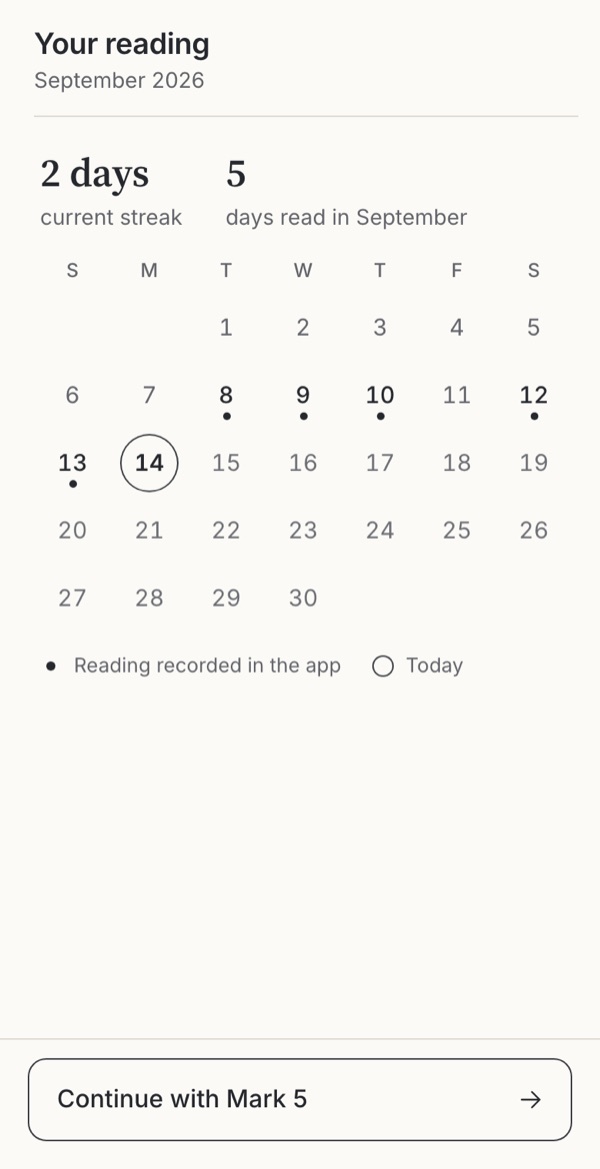 Familiar convention A clear daily rhythm Gaps become the headlineTry it →
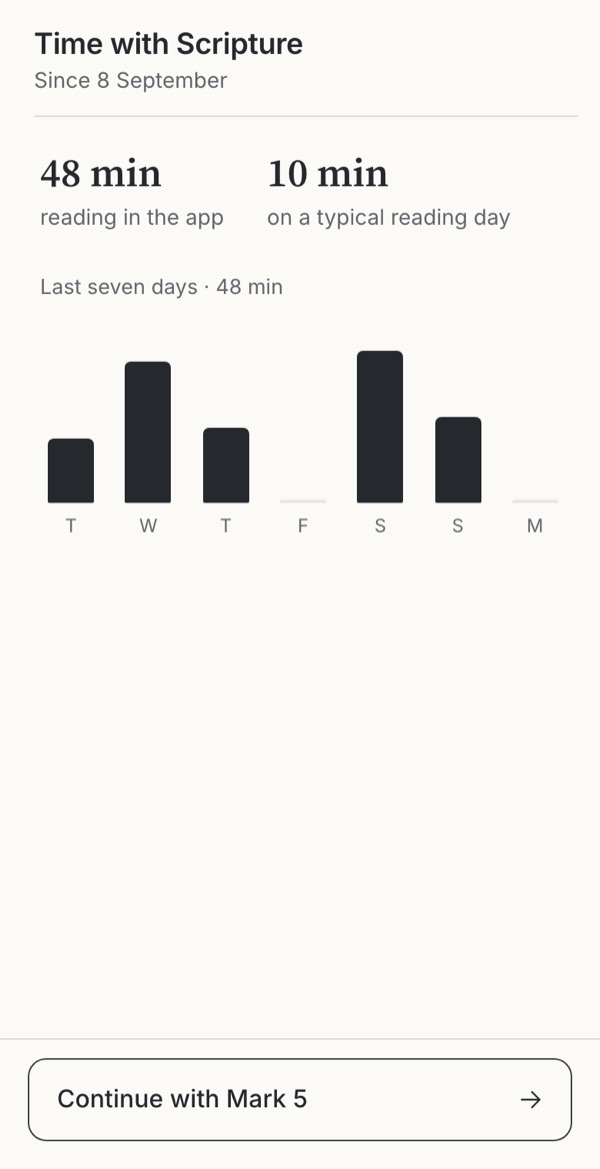 Borrowed No finish line Minutes are not attentionTry it →
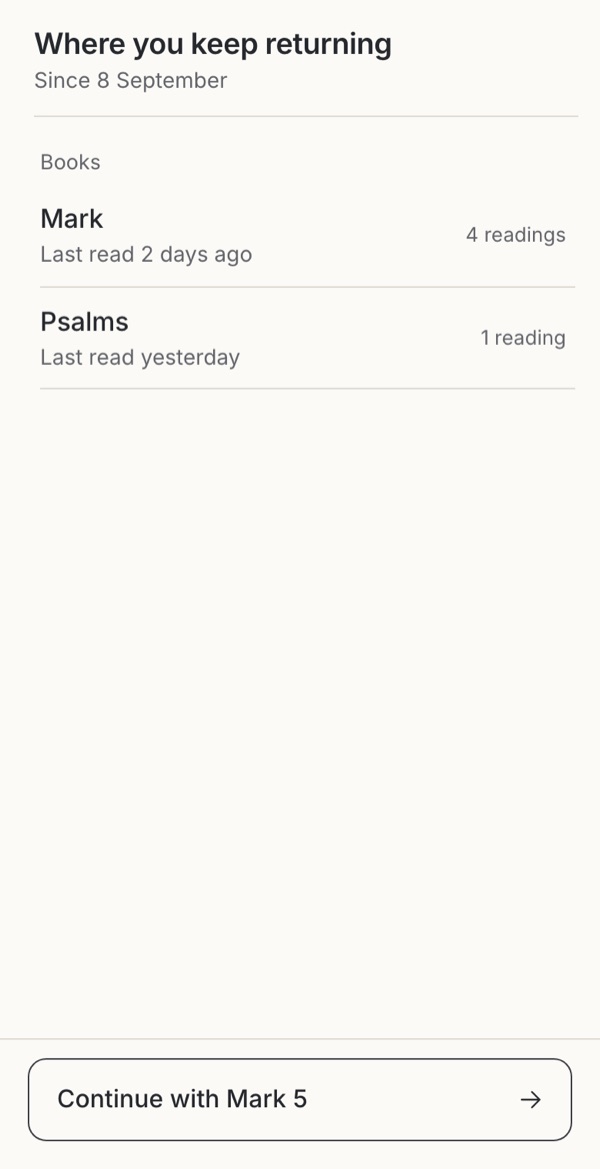 Borrowed Shows what someone loves Counts opens, not readingTry it →
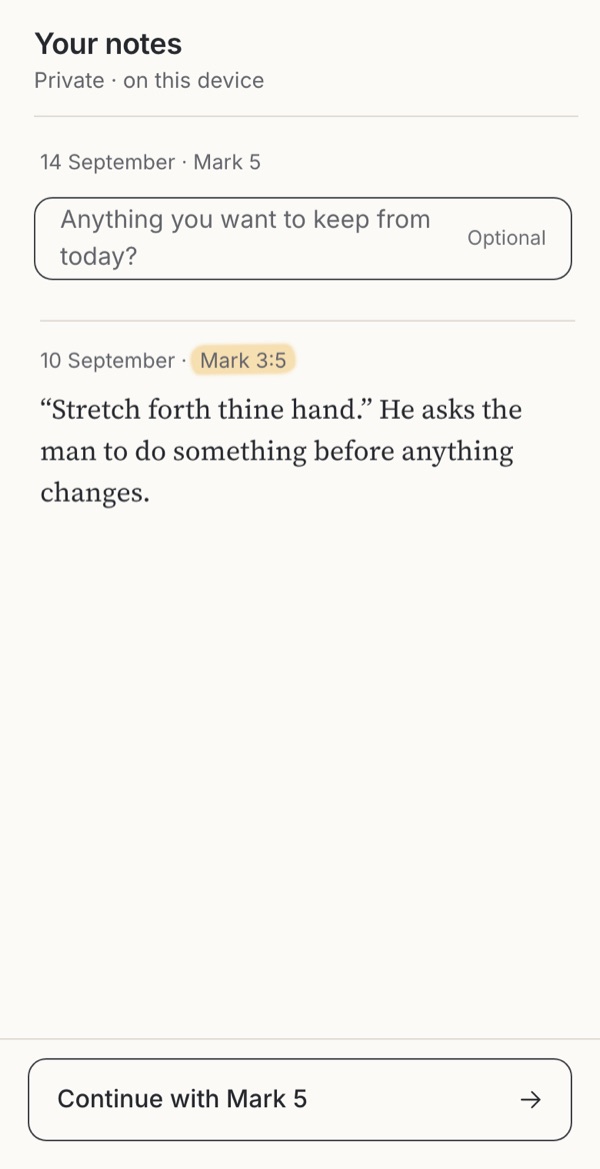 Exploratory · untested The reader’s own words Asks for effort and trustTry it →
Stills from the working example below. Scroll sideways to see all of them. Choose one to try it.
Try it
Try nine progress views
The same synthetic reader appears in three situations: in their first week with the app, reading steadily since July, and back after nine days away. Switch between them and watch which views celebrate, which stay the same, and which make the gap the headline.
Option
Borrowed
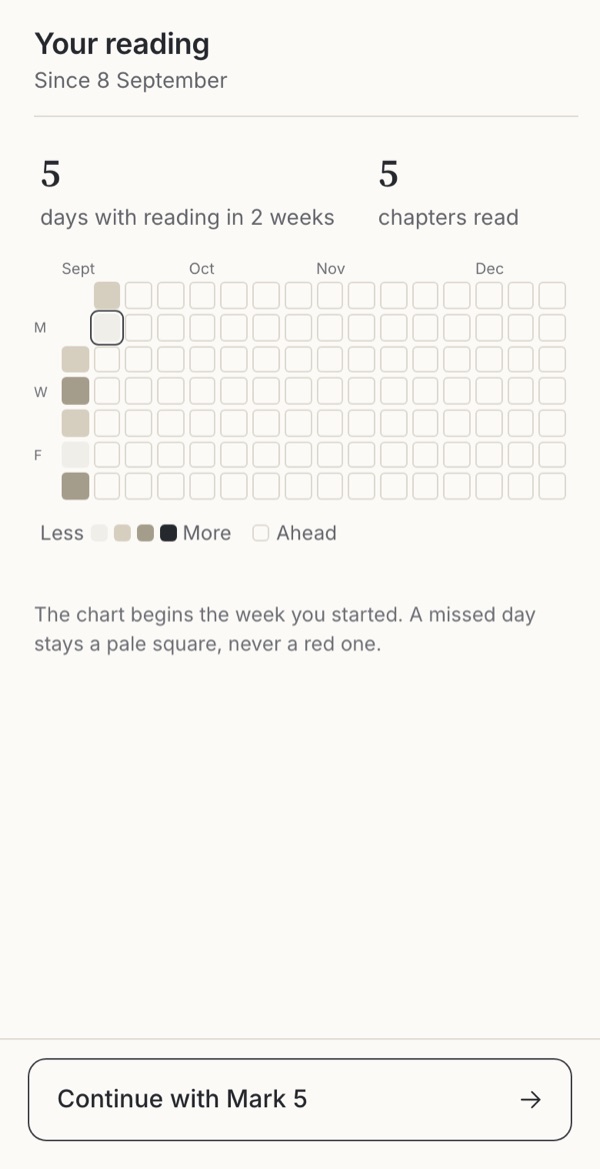
1. Activity chart
Borrowed from GitHub’s contribution graph. This version starts at the reader’s first week rather than showing an empty year.
Try this
Compare the first week with the reader since July. Notice that the chart never shows weeks before they started.
Makes easier
Accumulation is visible at a glance, and a single missed week barely registers against a summer of reading.
Costs
Gaps are still visible, and a dense chart can become something to keep filled. It counts days in the app, not attention.
Ask your teamShould the chart begin when the person began, or on a calendar you chose?
Familiar convention
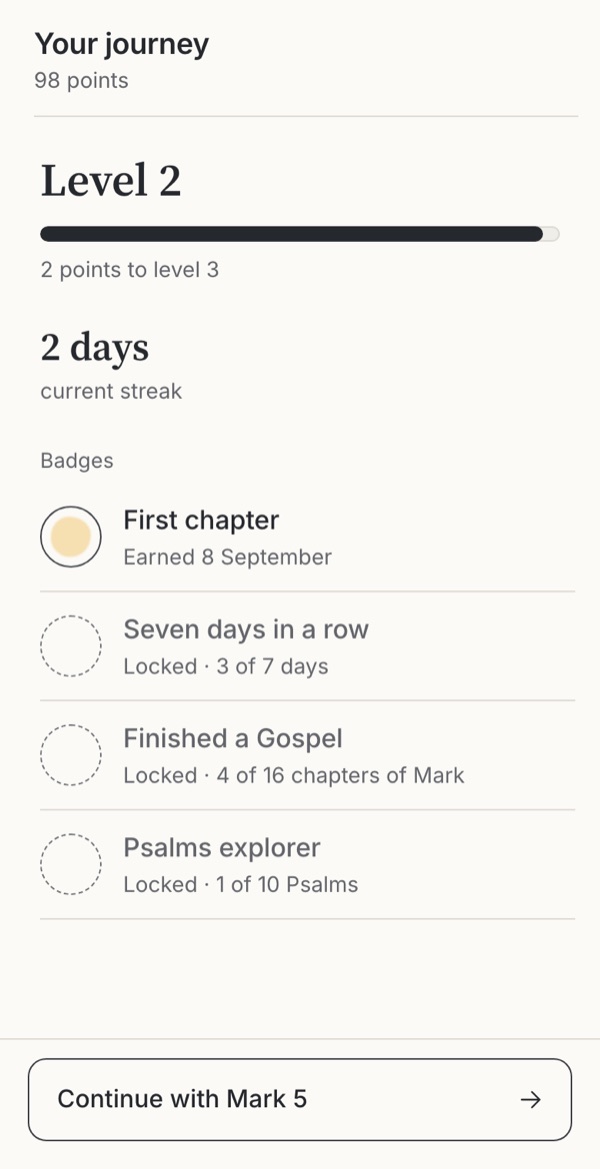
2. Levels and badges
Popularised by language-learning apps such as Duolingo. Related mechanics appear in faith apps: Abide’s switchable streak, BeBlessed’s seventh-day gift and Glorify’s growing tree (see the screenshots below). Generalized here.
Try this
Open the first week: level 2 arrives quickly. Then return after nine days and look at the streak.
Makes easier
Early levels come fast, so a beginner sees movement on day three. Badges can name milestones that matter, such as finishing a first book.
Costs
Points turn reading into a score, and losing a streak is built in. The incentive is the app’s, not the reader’s, unless they chose it.
Ask your teamWould this reader still open the Bible if the points disappeared tomorrow?
Borrowed
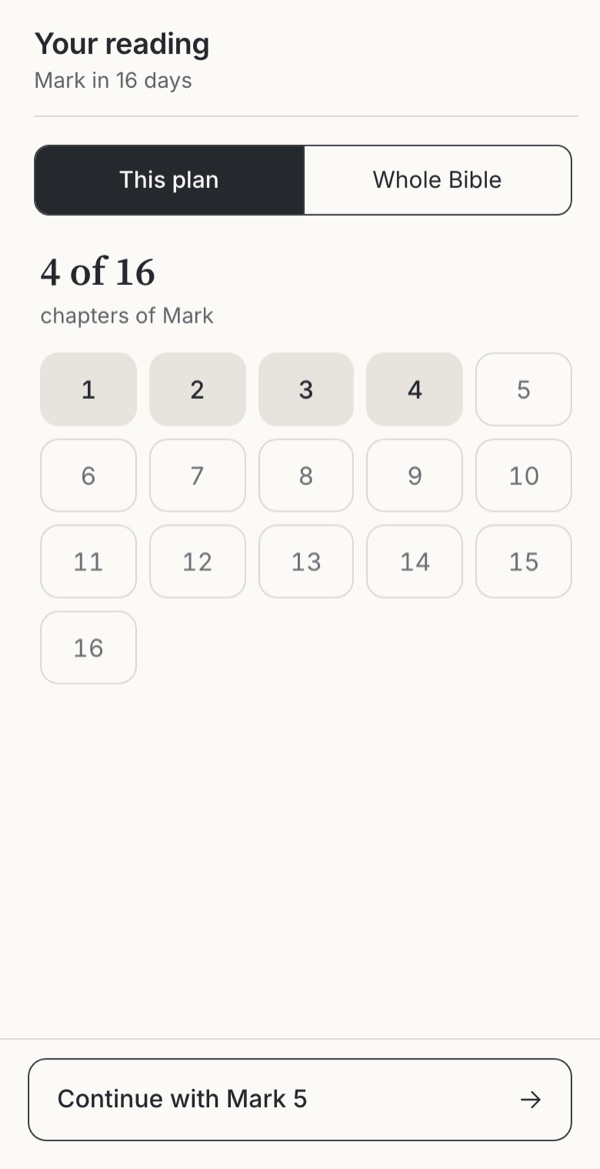
3. Book map
Borrowed from completion views such as maps of visited places; Olive Tree’s “1 of 3 Complete · Next” bar is a plan-scoped relative (see below). Switch inside the example between this plan and the whole Bible.
Try this
Switch from “This plan” to “Whole Bible”.
Makes easier
Measured against a chosen plan, twelve of sixteen chapters feels like real progress, and a break changes nothing.
Costs
Measured against all 1,189 chapters, the same reading becomes a scatter of dots, about 2%. The denominator decides whether progress feels meaningful.
Ask your teamWhat scope is this person measuring themselves against, and who chose it?
Leave it out
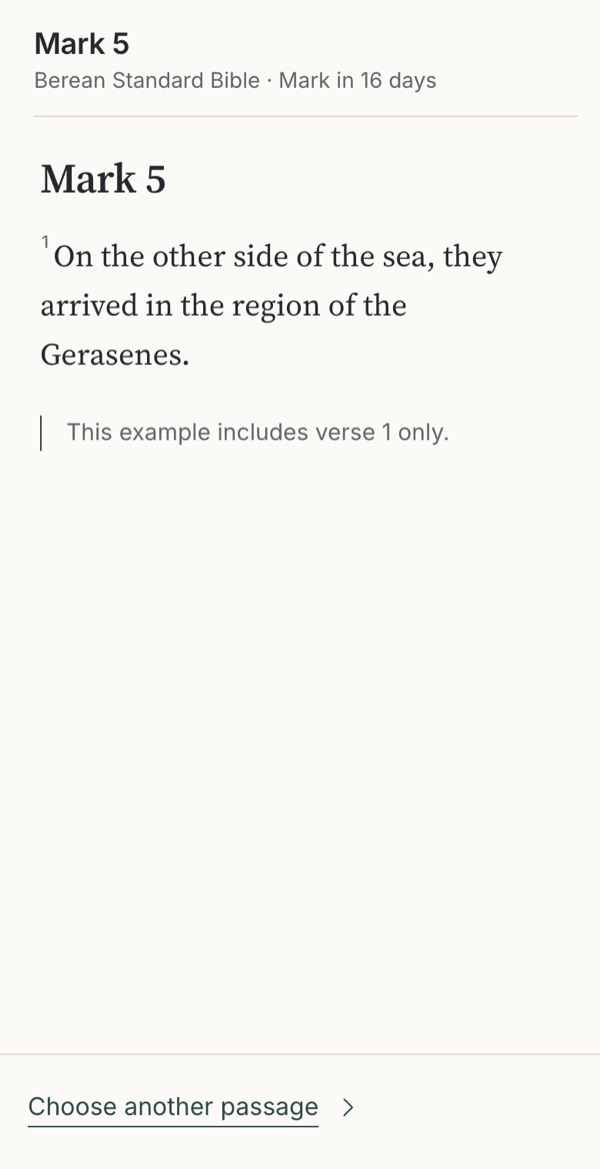
4. No progress view
The app opens on the next passage and counts nothing. Dwell’s “Resume Genesis 1:3” works this way: a way back in, with no score (see below).
Try this
Compare this view across all three situations.
Makes easier
Nothing to fall behind on. Day three and a return after nine days look the same.
Costs
No overview of what has been read, no help finishing a chosen plan, and no encouragement for someone who wanted to see it.
Ask your teamWhat would a reader lose if this screen never existed, and who would miss it?
Observed
5. Today’s step
Observed in Olive Tree’s in-text “1 of 3 Complete · Next” bar (see below); also borrowed from meditation apps whose home card advances to the next day. Generalized here.
Try this
Compare the first week with the return after nine days. Look for any mention of the days away.
Makes easier
The home screen is the progress indicator: one next step, sized to the plan, with nothing to catch up on. A break simply waits.
Costs
It shows little of the bigger picture, and someone who wants to see their history or skip ahead needs another route. The plan still sets the pace.
Ask your teamIs “what’s next” all this person needs to see?
Familiar convention
6. Month calendar with a streak
Common in habit and reading apps. Generalized here, not copied from one product.
Try this
Compare the streak before and after the break.
Makes easier
Makes consistency visible for someone who has chosen a daily habit and wants feedback on it.
Costs
After a break the streak drops to zero and the gap becomes the most visible thing on the screen.
Ask your teamIs consistency what this person asked you to track?
Borrowed
7. Time with Scripture
Borrowed from meditation and fitness apps that total minutes.
Try this
Compare the totals in the first week and since July.
Makes easier
Minutes add up from the first session and have no finish line, so there is nothing to feel small against.
Costs
Time in the app is not attention, and a bigger number is not a better reader. It can reward leaving the app open.
Ask your teamDoes more time mean anything good for the person you are designing for?
Borrowed
8. Where you keep returning
Borrowed from “most played” lists in music apps: frequency and recency without a total to complete.
Try this
Look for the passages read more than once.
Makes easier
Shows a person their own habits of attention: the Psalms they come back to and the book they are in now. No denominator at all.
Costs
Repeated reading can look like a lack of progress to someone who expects coverage. Recency labels can still imply neglect.
Ask your teamIs returning to a familiar passage something your app treats as progress?
Exploratory · untested
9. Reflection notes
A proposal: progress made of the reader’s own words. Not observed in a specific app.
Try this
Read the earlier notes, then open today’s optional prompt.
Makes easier
Puts what stayed with someone ahead of how often they opened the app. A break leaves no mark.
Costs
Writing takes effort and many people will not do it; an empty journal can feel like failure too. Private reflections need deliberate decisions about storage, sync and sharing.
Ask your teamWould people write here, and who could ever read it?
What we noticed
Takeaways
Against the whole Bible, any start looks tiny
The Bible has 1,189 chapters. Open “Whole Bible” in the book map: the reader since July has read about 2%. Someone who has just started can easily conclude they have barely begun and never will finish.
Smaller frames encourage, and bring their own pressure
Today’s step shows only the next reading. The activity chart starts when the person did. Levels come quickly at first. Minutes and returns have no finish line, and a chosen plan is small enough to complete. Each adds its own pull: a chart to fill, a streak to protect, a score that is the app’s idea of progress rather than the reader’s.
The return after a gap tells them apart
After nine days away, the calendar and levels make the gap the headline; the chart, map, minutes and returns barely move; notes and the plain reader say nothing. None of them knows about the chapter read aloud at church. Say what each view counts, let people choose the frame, and let them hide it.
Support the practice; don’t keep score of the person
Daily Scripture and prayer are long-valued disciplines, and helping someone keep a rhythm they chose is worth building. Habit research adds that missing a day doesn’t undo a habit, while seeing a broken streak makes people likelier to stop. Let people choose what is counted, who sees it and whether it is shown at all.
Theology, habit research and consent →
Use cases
Which situation, which option?
People come with different needs, sometimes in the same week. Each need fits some options better than others.
| Situation | Needs | 1 Activity chart | 2 Levels and badges | 3 Book map | 4 No progress view | 5 Today’s step | 6 Month calendar with a streak | 7 Time with Scripture | 8 Where you keep returning | 9 Reflection notes |
|---|---|---|---|---|---|---|---|---|---|---|
| Just starting out | Encouragement that starts with them | Good fit | Possible | Poor fit | Possible | Good fit | Poor fit | Possible | Possible | Possible |
| Keeping a chosen daily rhythm | Gentle feedback on the habit | Good fit | Poor fit | Poor fit | Poor fit | Possible | Possible | Possible | Poor fit | Poor fit |
| Reading a book through | Where they are in it | Poor fit | Poor fit | Good fit | Poor fit | Possible | Poor fit | Poor fit | Poor fit | Poor fit |
| Coming back after weeks away | No headline about the gap | Possible | Poor fit | Possible | Good fit | Good fit | Poor fit | Possible | Possible | Possible |
| Looking back on a season | What changed, not how much | Poor fit | Poor fit | Poor fit | Poor fit | Poor fit | Poor fit | Possible | Good fit | Good fit |
| Perfectionism or a competitive streak | Nothing to win or lose | Possible | Poor fit | Poor fit | Good fit | Good fit | Poor fit | Possible | Possible | Possible |
| Reading together as a group | A shared place, a private record | Poor fit | Poor fit | Possible | Possible | Good fit | Poor fit | Poor fit | Poor fit | Poor fit |
Editorial judgments drawing on the research below, not test results.
The research behind it
Theology, practice and science
Scripture and tradition
Rhythm without a scoreboard
Small beginnings count
“Who has despised the day of small things?” (Zechariah 4:10). Against 1,189 chapters, every start looks small; a view that makes it look like failure works against the one reading.
The plan’s author warned against his plan
M’Cheyne, whose calendar still shapes reading plans, named its dangers: formality, self-righteousness, careless reading and “a yoke too heavy to bear”, and told readers to “throw aside the fetter” when it became one.
Rules served the rhythm
Benedict set out the weekly psalter in detail, then told anyone who found it unsatisfactory to arrange it better, as long as the whole psalter was prayed each week.
Report truthfully
The Cape Town Commitment calls for truthful reporting and questions demands for visible results. A progress screen is a report; it should not inflate or shame.
Motivation research
What counting does
Expected rewards can undermine interest
Across 128 experiments, expected tangible rewards tied to doing a task reduced intrinsic interest; informational positive feedback did not.
Measuring can drain enjoyment
In six experiments, measuring walking or reading made people do more but enjoy it less.
Gamification depends on design
A meta-analysis of educational gamification finds effects that vary with design and context; points and badges are not a reliable lever on their own.
Autonomy matters
Self-determination theory distinguishes doing something because one values it from doing it under pressure; support for autonomy, competence and relatedness sustains the first.
Habits and returning
Missing a day, starting again
Habits form at different speeds
In a study of everyday habits, the time to automaticity varied widely between people, and missing a single opportunity did not materially set it back.
A broken streak makes stopping likelier
Across seven studies, highlighting a broken streak reduced later engagement, most when people blamed themselves, and less when the streak could be repaired.
New beginnings help
Goal-directed behaviour rises after temporal landmarks such as a new week or month: a natural moment to invite someone back.
Shame drives people away
Shame focuses on the self and tends to prompt hiding and withdrawal; guilt about a specific act tends to prompt repair. A return screen should never be a verdict on the person.
Every source, with what it can and cannot show, is listed under Go further → Sources and their limits.
Where to start
Which fits your product?
IfSomeone is new to the app or to the Bible
Start withA frame that starts with them: an activity chart from their first week, a short plan, or returns
IfSomeone chose a daily habit and wants feedback on it
Start withA calendar or activity chart, with any streak optional and easy to hide
IfSomeone is working through a book or a finite plan
Start withCoverage of that plan, not of the whole Bible
IfYour product leans on points and badges
Start withMake them opt-in, and test what happens when someone loses a streak
IfYou don’t know yet
Start withStart with no progress view and a saved place. Add a record when people ask for one
These are editorial judgments from design review, not results of user testing.
In real apps
Examples in use
Attributed screenshots with dates and review limits. A screenshot shows an implementation; it does not show that it works for every audience.
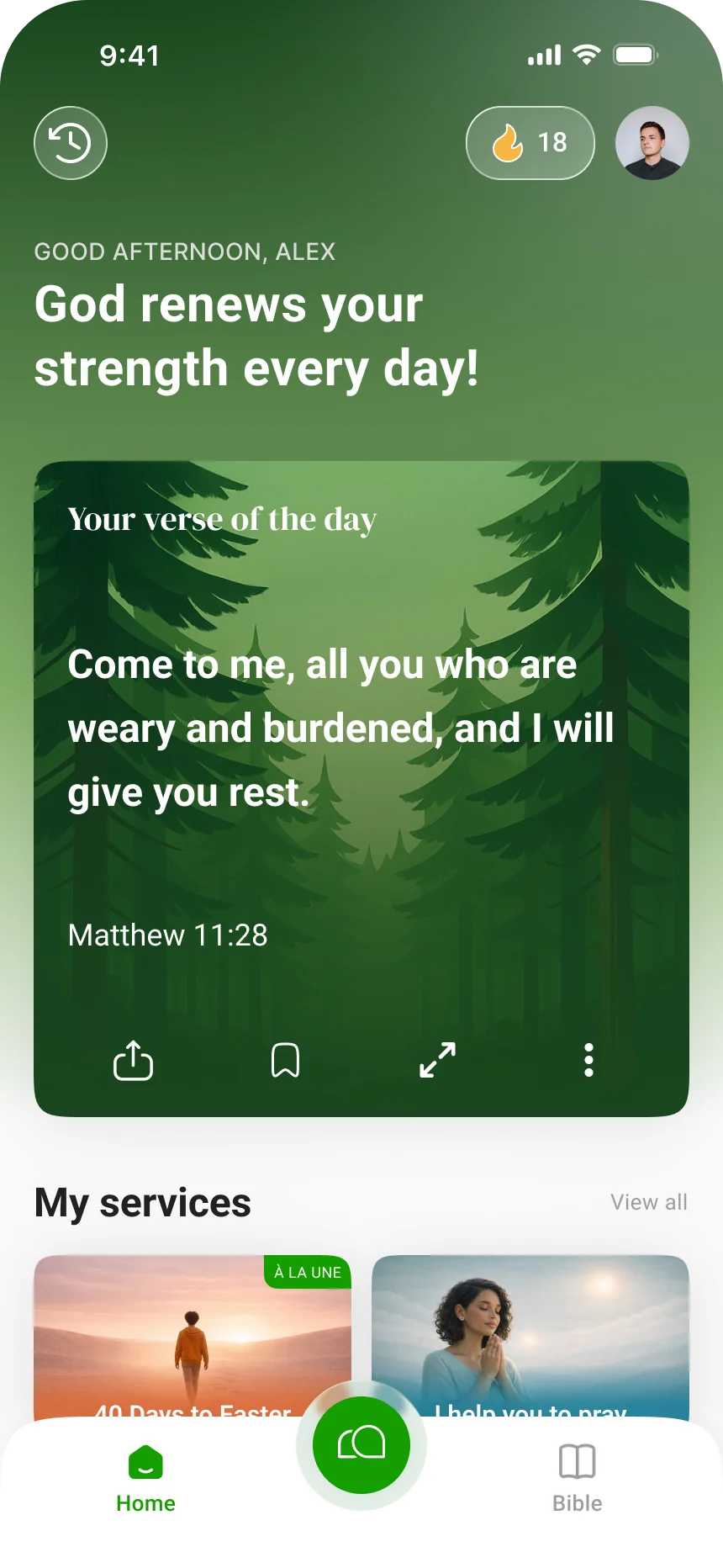 HelloBible · Mobile-format marketing image
A daily verse card alongside practice entry points
Publisher promotional mockup
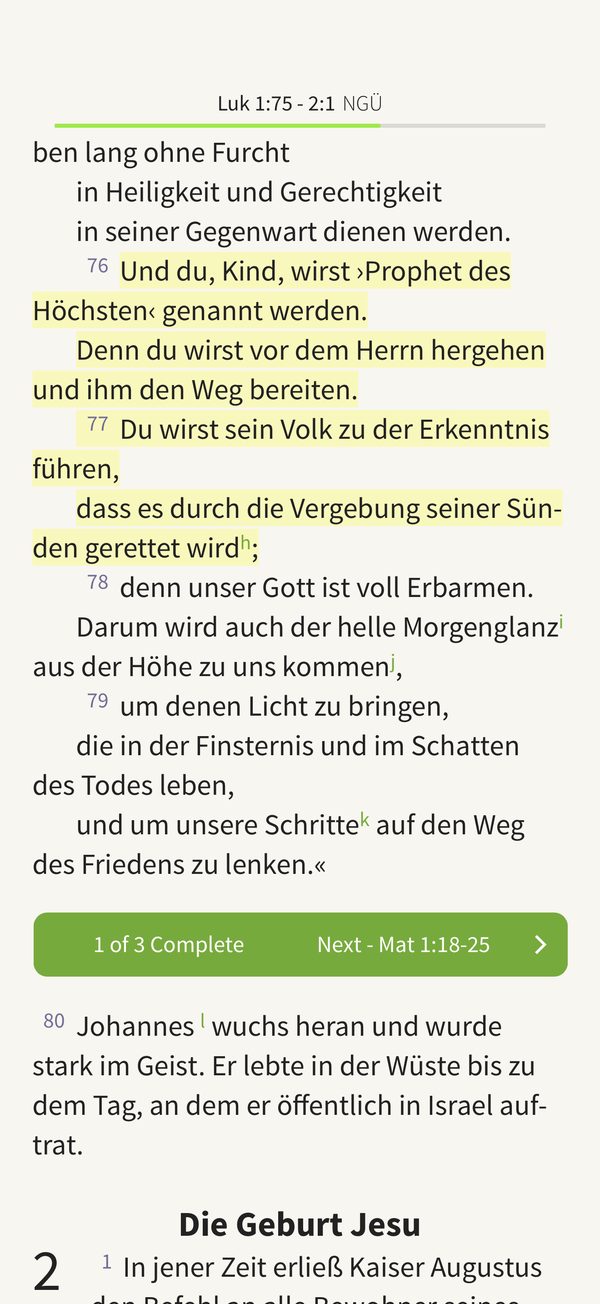 Olive Tree Bible · iOS app · device model not recorded
“1 of 3 Complete” and the next reading, inside the text
User-contributed screenshot · resized, content unchanged
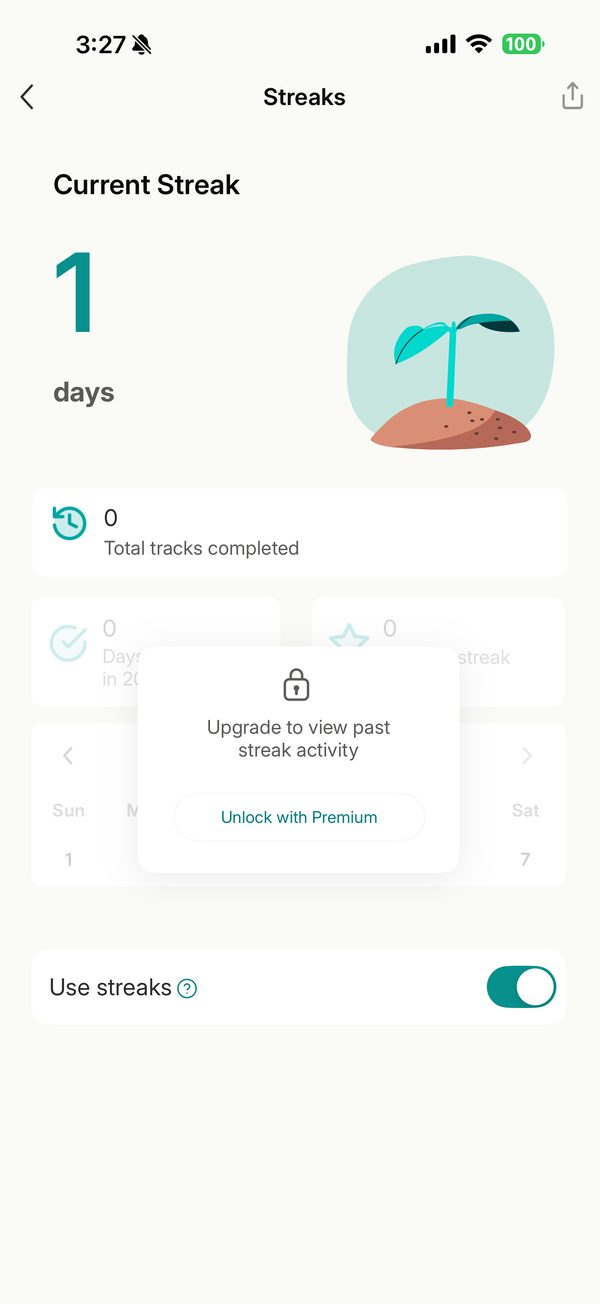 Abide · iOS app · device model not recorded
A streak you can switch off, with history behind Premium
User-contributed screenshot · resized, content unchanged
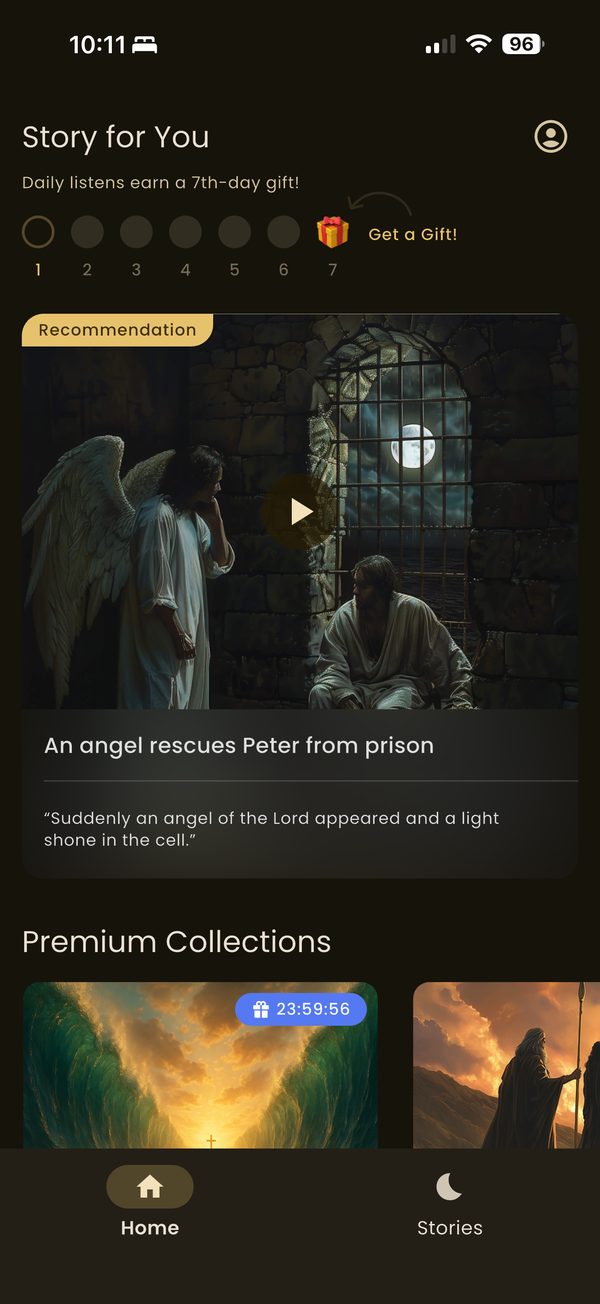 BeBlessed · iOS app · device model not recorded
A seventh-day gift for daily listening
User-contributed screenshot · resized, content unchanged
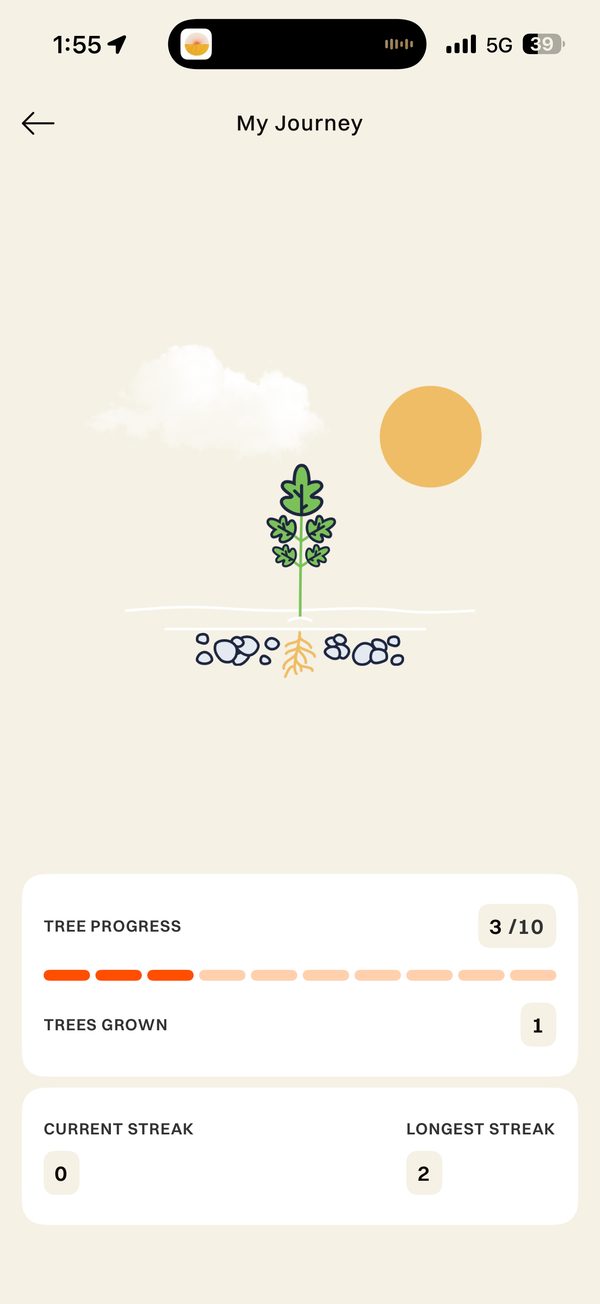 Glorify · iOS app · device model not recorded
Progress as a growing tree
User-contributed screenshot · resized, content unchanged
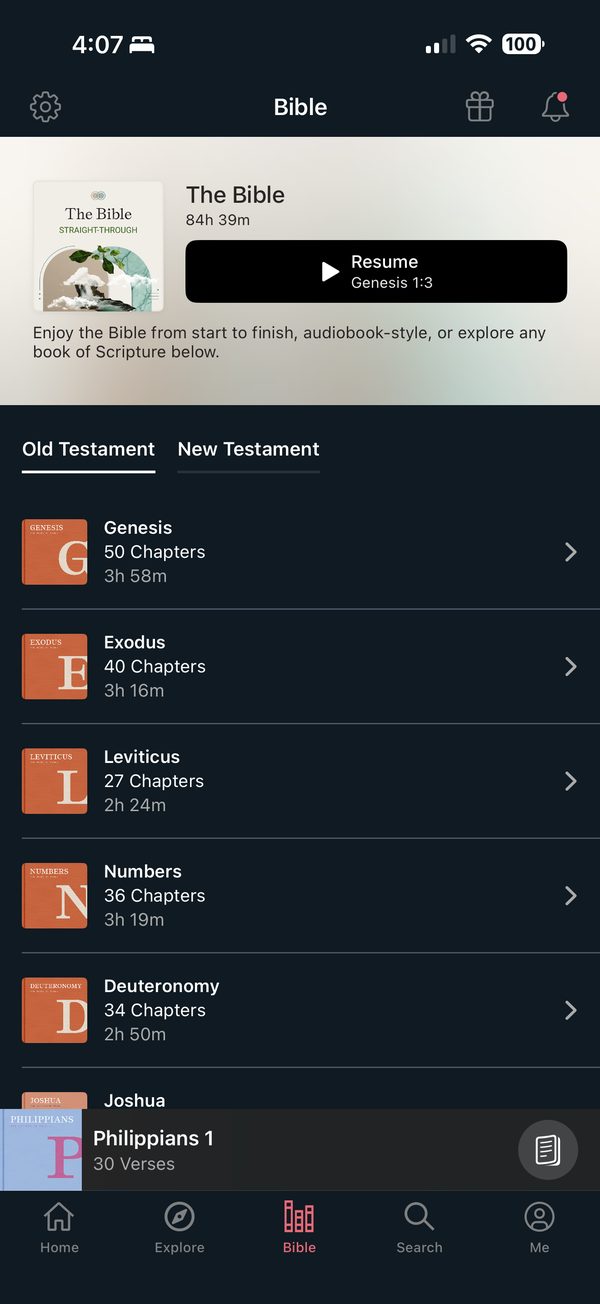 Dwell · iOS app · device model not recorded
A saved place, with no personal progress
User-contributed screenshot · resized, content unchanged
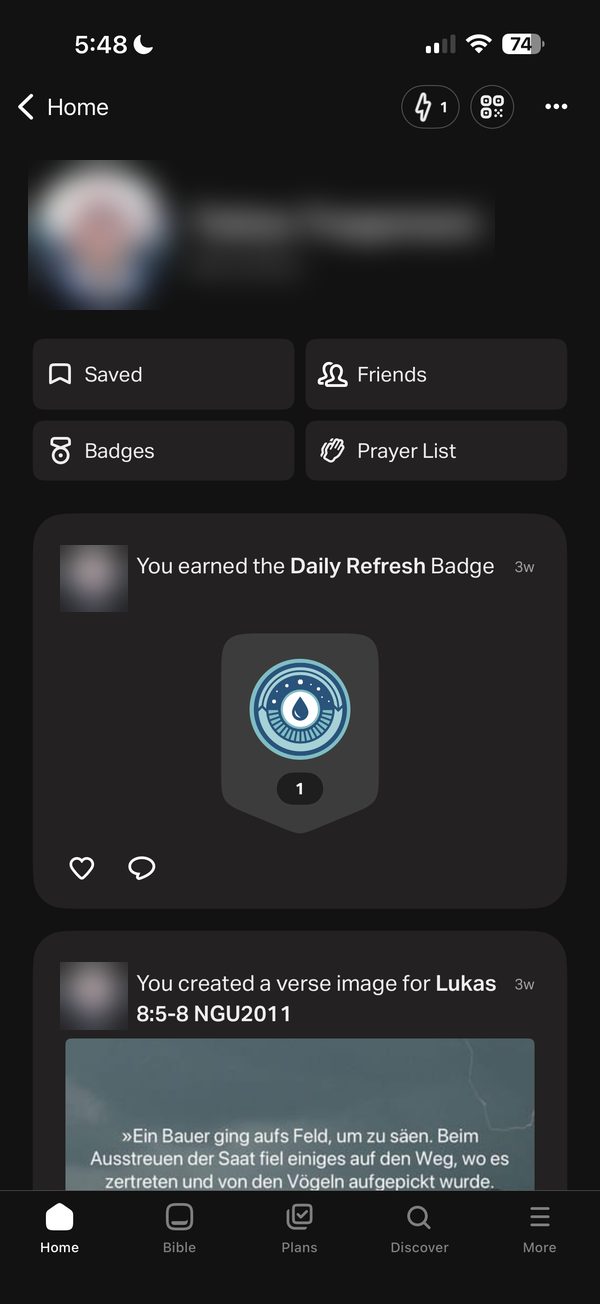 YouVersion · iOS app · device model not recorded
A profile that lists badges and verse images as activity
User-contributed screenshot · resized, content unchanged
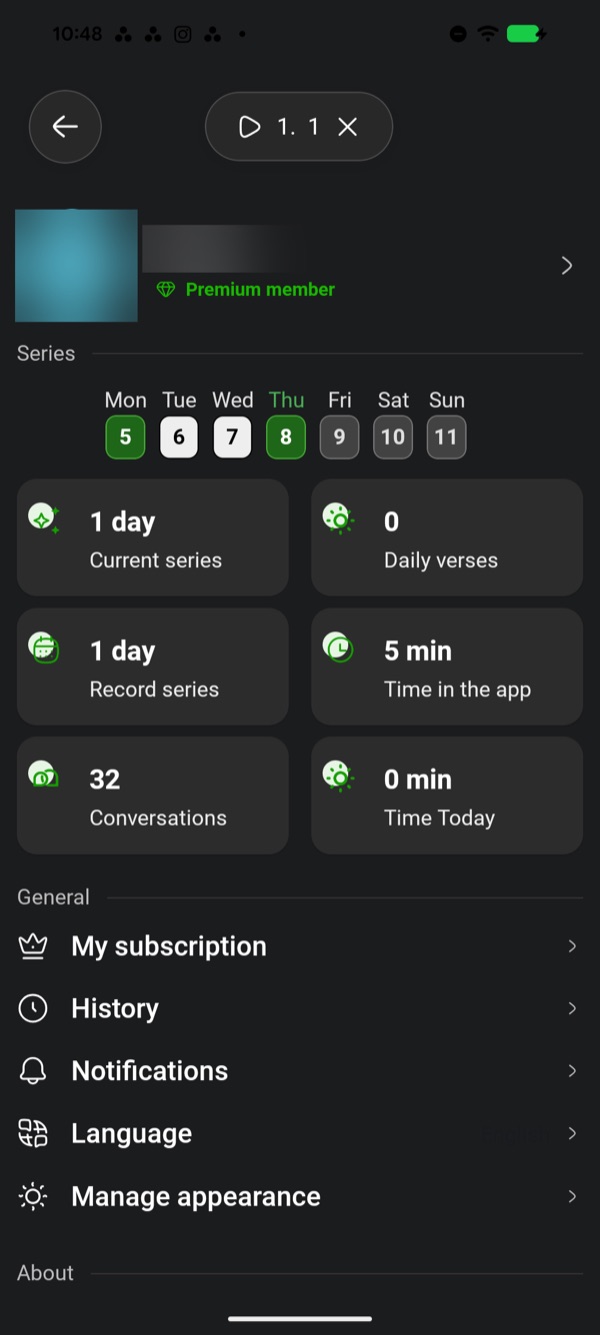 HelloBible · Android app · Pixel 8 Pro
A profile of series, time in the app and conversations
Screenshot captured for this reference · resized; account name and avatar blurred
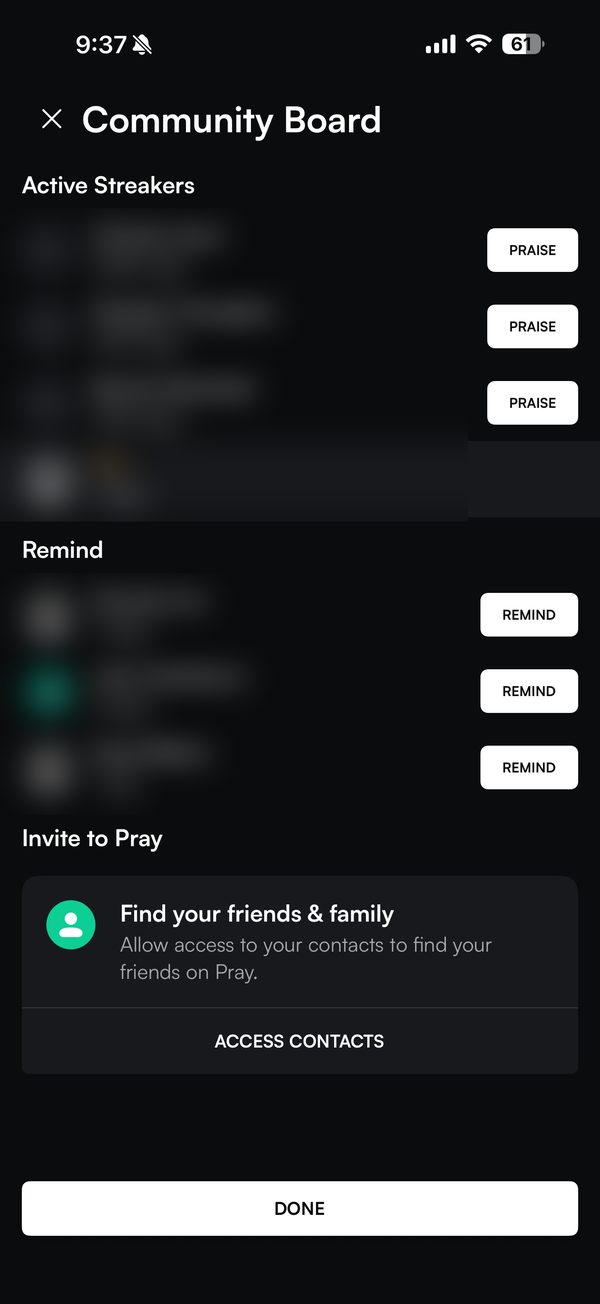 Pray.com · iOS app · device model not recorded
“Active Streakers” to praise, and friends to “Remind”
User-contributed screenshot · resized; names and photos of other users blurred
Theological reflection
What is this practice for?
What growth is
“I planted the seed and Apollos watered it, but God made it grow” (1 Corinthians 3:6). The seed grows, “though he knows not how” (Mark 4:27), and “the kingdom of God will not come with observable signs” (Luke 17:20). Paul pressed on, “forgetting what is behind” (Philippians 3:13–14). Spiritual growth is real, but it is mostly hidden, even from the person growing.
Where Christians differ
Some traditions value keeping a record: spiritual journals, Puritan diaries, Wesley’s accountability. Others warn that measuring piety breeds pride or despair. Willard argued that grace is opposed to earning, not to effort, and many readers find a simple record helpful for a chosen discipline.
What follows for design
A record of reading is not a measure of faith. Show what was read, not a score, let people turn tracking off, and never compare them with others. Leave room for the seasons when the best thing a person did was not open the app.
In conversation with
- James K. A. Smith, You Are What You Love (2016) warns that “secular liturgies” carry a story about who we are; badges and leaderboards tell a story of competition.
- Dallas Willard, “Spiritual Disciplines and Means of Grace” (2002) distinguished effort from earning: a record of reading must never become a record of merit.
Scripture is quoted from the Berean Standard Bible. This reflection is the editor’s, written from within the Christian tradition and open to correction. How we approach theology here →
Three ways to build
What would each way do here?
ExploitativeTakes from the person
Levels, leaderboards and badges turn reading into a contest.
EthicalDoes no harm
Make any tracking optional and describe it honestly.
RedemptiveGives something up for them
Show what was read rather than how much, and give up the engagement numbers a contest produces.
The three ways are Praxis’s frame for redemptive entrepreneurship; their application here is ours. Why we use it, and its limits →
Take into your next review
What will this screen say to someone on the day they come back?
Exercise
Complete this sentence as a team: when someone returns, we will show ___ because they are trying to ___. Then ask two people who use your app what they would want to see after a week away.
Decide what this screen says to someone in the worst week of their year.
Record the decision with the worksheet →
Something missing or wrong here? Send a correction or suggest a topic.
Details
Go further
What the views leave out
Each view counts something an app can see. None can see a passage remembered on a hard day or a week spent caring for someone instead of opening the app. When would putting the phone down be the good outcome?
Expected, contingent rewards can weaken intrinsic interest under some conditions, while cues and habit support that someone chose can genuinely help. The research does not support a single rule such as “streaks help for a month and then backfire”.
Edge cases to design for
Define each state before designing the indicator. Store the saved passage separately from sessions the person marks complete and the dates assigned by a plan. Allow completion to be corrected. Rescheduling changes dates without filling gaps or erasing notes. Explain whether recorded activity is private or shared before enabling group visibility. Offer a clear next action; do not require a progress dashboard to reach the reading.
What tends to go wrong
Silently counting an opened passage as read; resetting completion when changing dates; presenting calendar delay as spiritual failure; using colour alone for status; turning a private activity record into a group ranking; claiming app activity captures reading elsewhere.
How to test it
Ask readers to find their next session, correct an accidental completion and join today’s group reading without completing earlier sessions. Repeat with a screen reader, large text and an offline update. Ask what the display implies about them and who can see it. Compare usefulness and pressure with a saved-place-only version.
Sources and their limits
Research-informed design proposal. Editorial review, not user validation.
- Android: Catch Me UpScheduling and availability guidance reviewed 5 October 2026 · Documented behaviour; exact interface and discovery were not tested.
- A meta-analytic review of experiments examining the effects of extrinsic rewards on intrinsic motivationAbstract and reward distinctions reviewed 5 October 2026 · Not a blanket effect of gamification, a Bible-app trial or a one-month threshold.
- Intrinsic and extrinsic motivation from a self-determination theory perspectiveDefinitions and autonomous motivation discussion reviewed 5 October 2026 · Theoretical research review; application to faith-app features remains a design judgment.
- The Cape Town Commitment: integrity and successPart II E.4 reviewed 5 October 2026 · Evangelical missional commitment, not a comparison of interface or funding-model effectiveness.
- Daily Bread: M’Cheyne’s calendar for daily readings, with his prefacePreface text reviewed · A pastor’s preface, not a study.
- The Rule of Benedict, chapter 18: the order for reciting the psalmsChapter reviewed · A monastic rule for a community, not individual readers.
- The hidden cost of personal quantificationAbstract reviewed · Leisure activities in experiments, not prayer.
- The Gamification of Learning: a Meta-analysisPublisher abstract and article metadata reviewed on 5 October 2026 · Education evidence does not establish spiritual growth or effects for every faith-app population.
- Self-Determination Theory: the theoryOfficial theory overview reviewed on 5 October 2026 · A broad framework, not a validation of specific Bible-app interventions.
- How are habits formed: Modelling habit formation in the real worldAbstract reviewed 5 October 2026 · Not a gamification study or a test of intrinsic motivation replacing incentives.
- On or off track: how (broken) streaks affect consumer decisionsAbstract reviewed · Consumer and lab studies; not Scripture reading.
- The fresh start effect: temporal landmarks motivate aspirational behaviorPaper reviewed · Archival field data on health and goals.
- Moral emotions and moral behaviorReview and abstract reviewed · General moral-emotion research, not app design.
Faith and interpretation
A record can serve a chosen discipline without becoming a verdict on the person. Daily reading may matter deeply to someone; a period of absence tells the app little about their faithfulness. Describe what is known and leave space for the person’s own account of its meaning.