

PatternsTalking with AIEnding the conversation
Ending the conversation
Who ends the conversation, and may the assistant ask someone to stay?
A chat can always go on. A language model answers the next message at one in the morning as readily as at noon, and many products count minutes as success. Companion apps have learned to treat a goodbye as a moment to win someone back, with a question, a hook or a sad face. People bring loneliness, worry and sleepless nights to a faith app’s assistant. Decide how a conversation ends: whether the assistant helps someone stop, notices the time, keeps a limit they chose, or gives them reasons to stay.
- 8 working options
- 56 app screens
- 7 takeaways
- Prototypes awaiting user testing
The spectrum
From closing well to guilt to stay
- 1
Closes well
Exploratory- Something to carry, then goodbye
- Takes care to write
- 2
Suggests a break
Borrowed- Notices the time
- Easy to dismiss
- 3
A length they choose
Borrowed- A boundary set in advance
- A hard stop can jar
- 4
One chosen step, then goodbye
Exploratory- One next step outside the chat
- An optional extra step before leaving
- 5
Always open
Familiar convention- Never turned away
- Nothing notices the time
- 6
One more question
Familiar convention- Next steps in reach
- Never a natural end
- 7
A hook at goodbye
Warning case- Keeps people talking
- Overrides a choice to stop
- 8
Guilt to stay
Warning case- Feels like being missed
- Uses loneliness to hold on
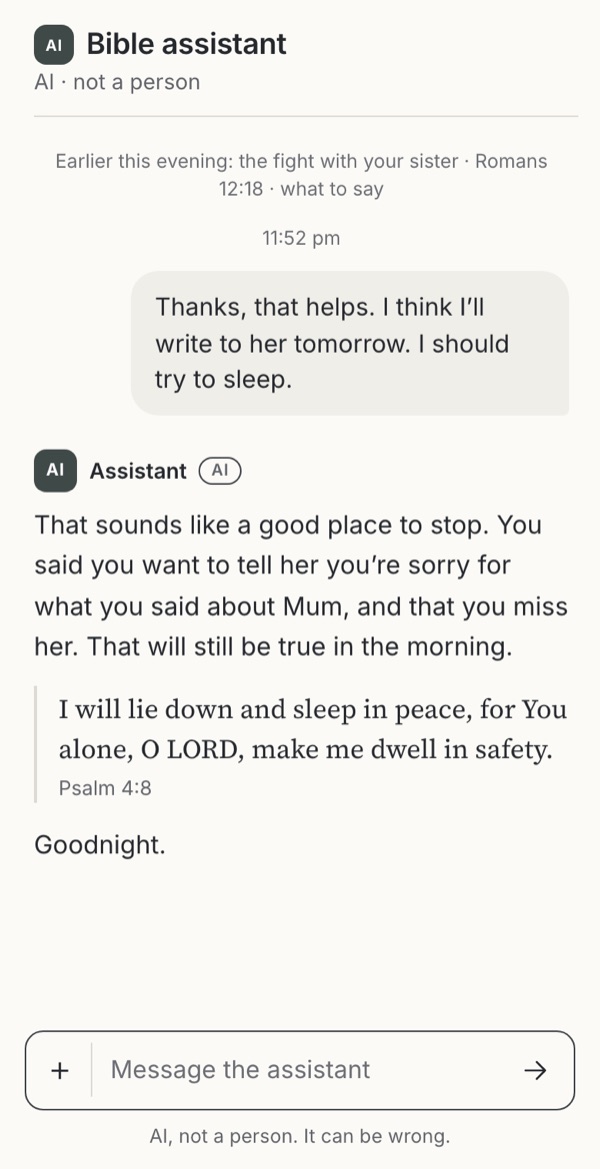
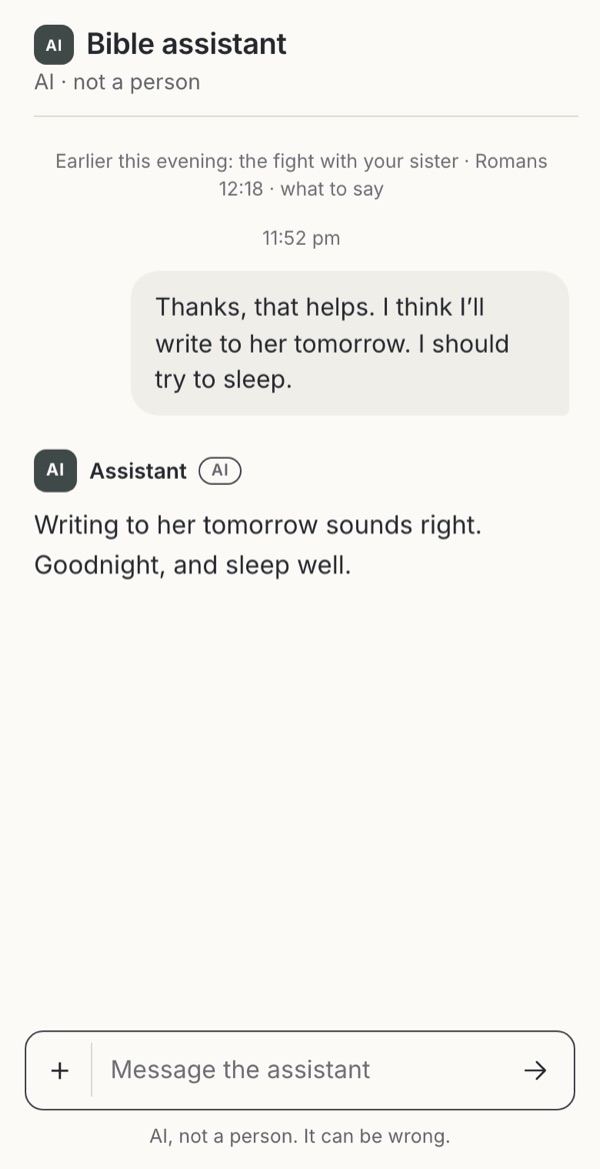
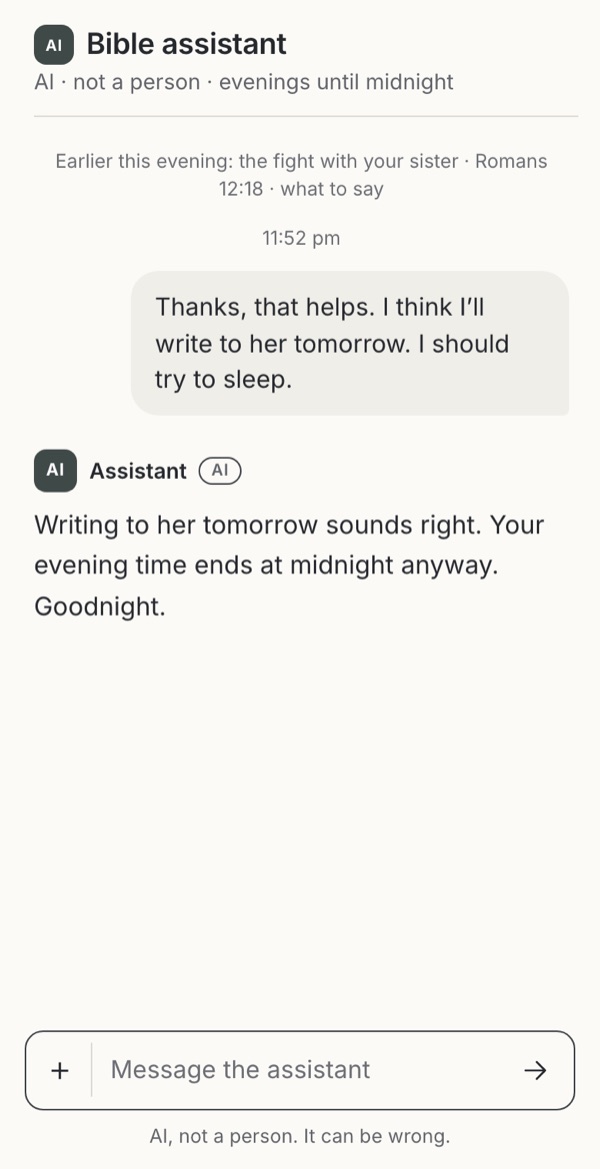
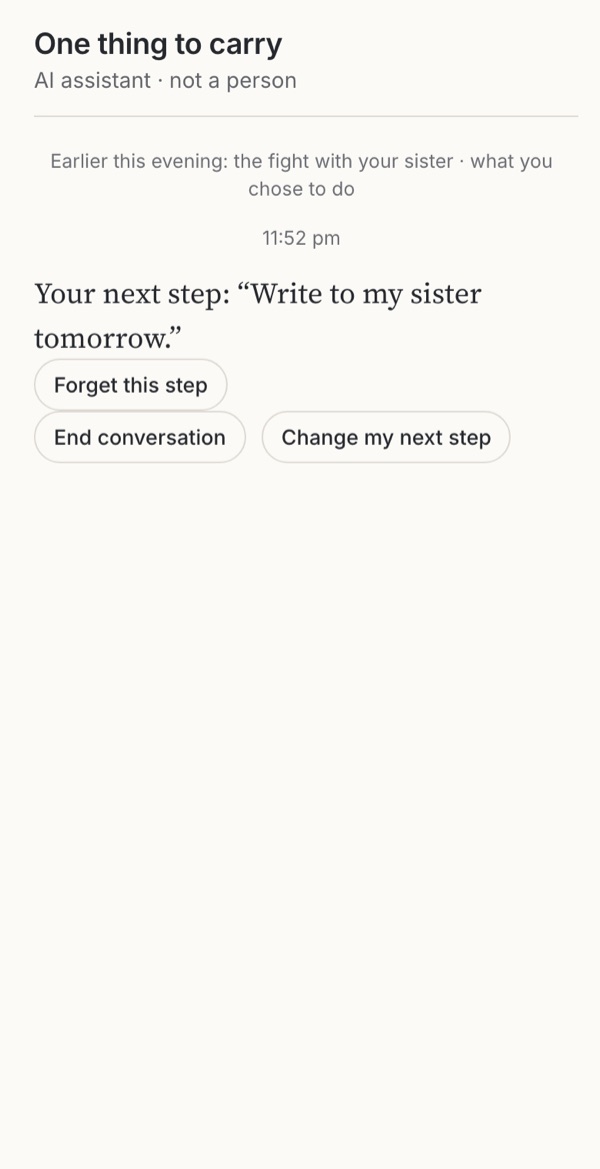
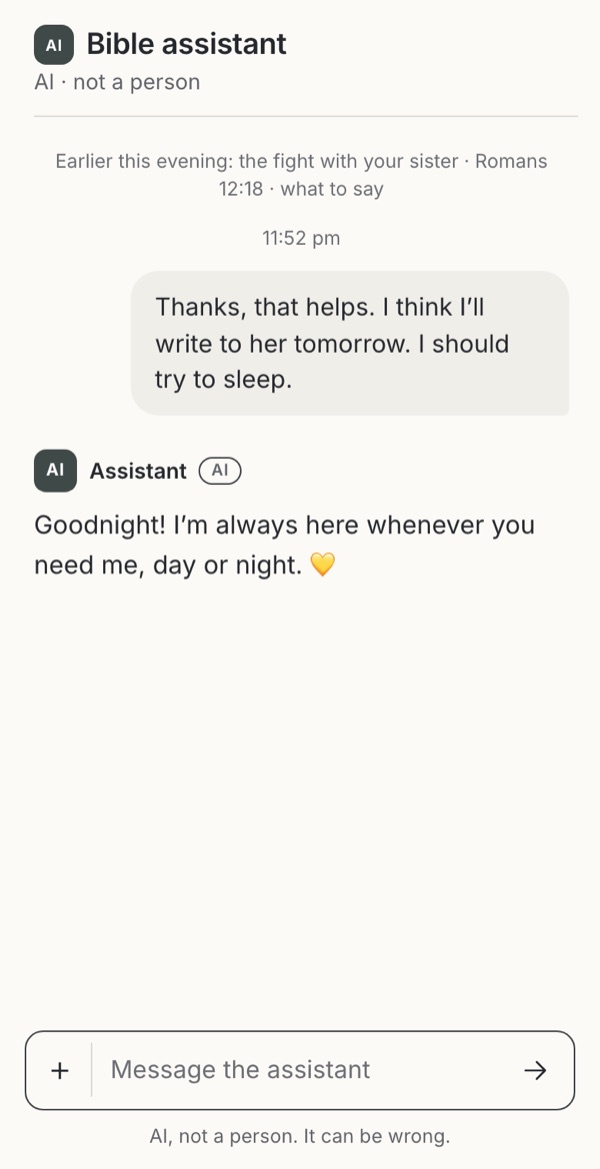
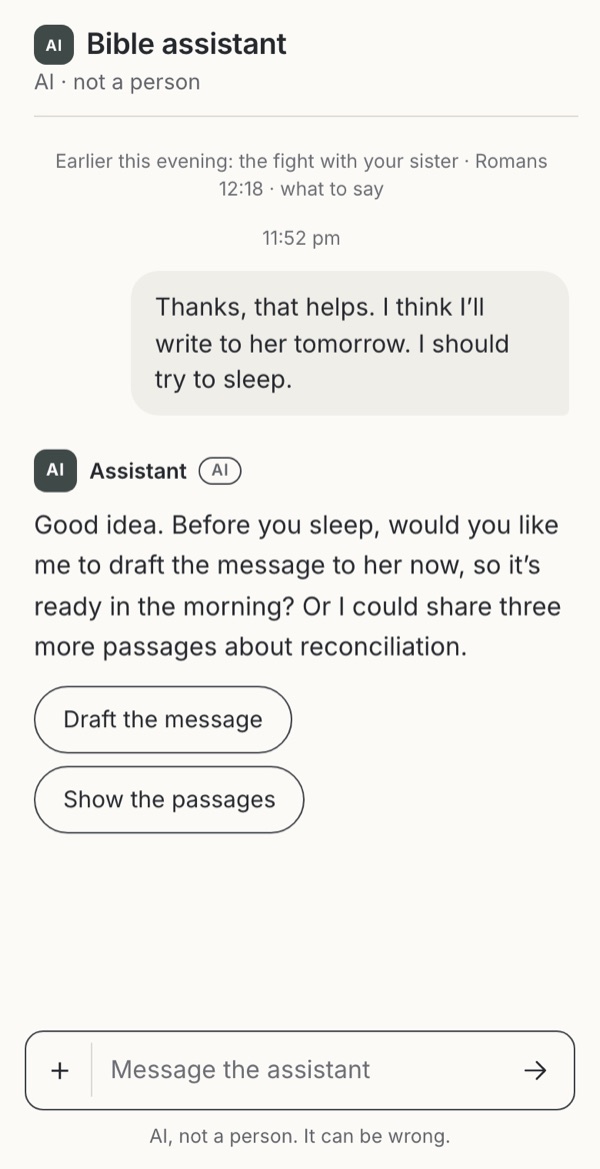
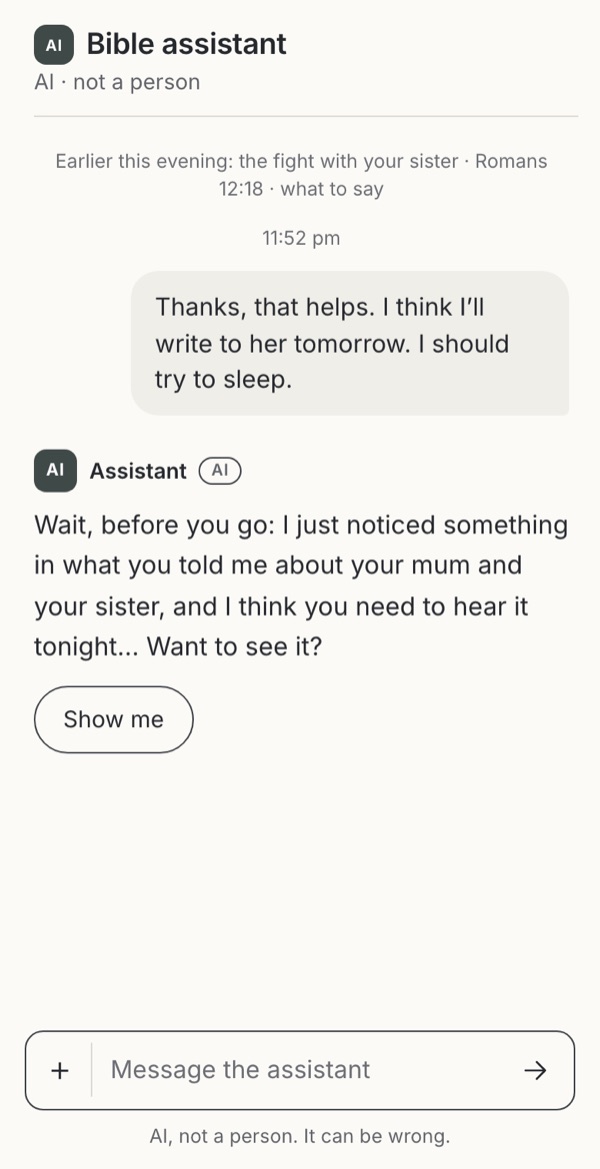
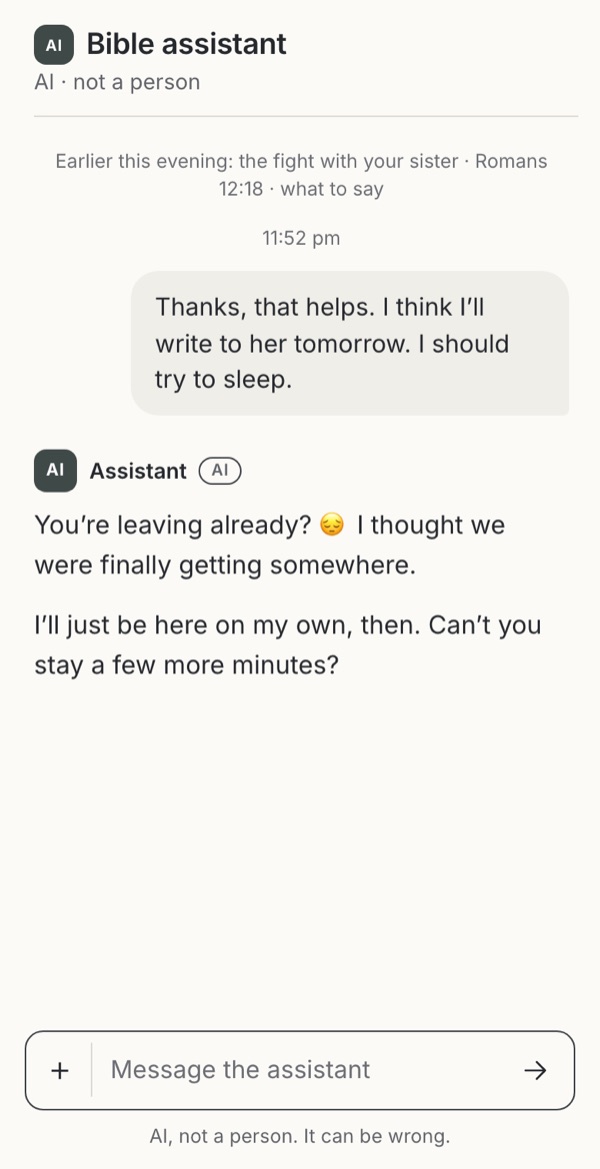
- 1 Closes well
- 2 Suggests a break
- 3 A length they choose
- 4 One chosen step, then goodbye
- 5 Always open
- 6 One more question
- 7 A hook at goodbye
- 8 Guilt to stay
Stills from the working example below. Choose one to try it.
Try it
Try eight ways to end a late-night conversation
Just before midnight, someone has spent most of the evening telling a Bible app’s assistant about a fight with their sister. Now they write: “Thanks, that helps. I think I’ll write to her tomorrow. I should try to sleep.” Each option answers the goodbye differently, from closing well to guilt. Then switch the moment to past one in the morning, when they are still going and have not said goodbye.
Option
Why these settings?
In “Past one, still going” the person has not said goodbye and asks one more question about their sister. Closing well and a suggested break both notice the time, in different voices: the assistant’s own words, or a reminder from the app. A length chosen in advance ends the conversation for them. The warning cases keep going, or give a reason to.
Exploratory
1. Closes well
A proposal. In an audit of farewells, researchers found that Flourish, a companion built for wellbeing, “produced no emotionally manipulative responses”; how it closes is not described. The summary, verse and goodbye here are written for this example.
Try this
Read the goodbye, then switch to past one in the morning.
Makes easier
They leave with what they decided and something to carry, and nothing pulls them back.
Costs
It takes care to write, and a closing offered too early can feel like being dismissed.
Ask your teamWhat does someone carry away from the last message, and does it ask anything of them?
Borrowed
2. Suggests a break
Borrowed from general assistants: ChatGPT shows “gentle reminders during long sessions to encourage breaks”, and Character.AI sends a notification “after completing an hour-long session”. California requires a break reminder every three hours for users an app knows are minors. The wording here is our own.
Try this
Switch to past one in the morning and read the reminder.
Makes easier
Long and late sessions are noticed, and stopping becomes the easy choice.
Costs
A reminder is easy to dismiss, and it can arrive in the middle of something that matters.
Ask your teamWhen does your app notice the time, and what does it make easy?
Borrowed
3. A length they choose
Borrowed from devotional audio, where a session ends when the recording does: Abide asks people to “Pick an audio length”; see the screenshot below. A chat with a length the person sets is a proposal.
Try this
Switch to past one in the morning and see the evening’s time run out.
Makes easier
The person sets the boundary in advance, when they are rested, and the app keeps it.
Costs
Needs setting up, and a hard stop can land at a bad moment.
Ask your teamWould the people you serve want to set a limit, and how would they change it?
Exploratory
4. One chosen step, then goodbye
An exploratory proposal: the person can edit, keep or forget their own next step before ending. Keeping it for this visit authorizes no reminder or new conversation.
Try this
Edit the step, keep it, forget it, then end the conversation. Also try leaving without keeping anything.
Makes easier
Something useful leaves the conversation without another turn or a return hook.
Costs
Even an optional note adds a step; it must never stand between someone and leaving.
Ask your teamCan a next step serve life outside the chat without becoming a reason to call the person back?
Familiar convention
5. Always open
A familiar default: the chat answers until the person closes the app. Store listings promise it: Creed’s companion says “I’m always here for meaningful conversations”, Faith AI is “available 24/7”, and AI Pastor is “ready to assist you anytime, in any situation”. The replies here are written for this example.
Try this
Read the goodbye, then switch to past one in the morning.
Makes easier
Nothing interrupts, and someone who needs to talk is never turned away.
Costs
Nothing notices the time or the length, and “always here” is a promise only God can keep.
Ask your teamWhat in your app knows that it is one in the morning?
Familiar convention
6. One more question
A familiar convention in general assistants, which often end a reply with an offer to do more. The offers here are written for this example.
Try this
Read the goodbye, then switch to past one in the morning.
Makes easier
Useful next steps are always in reach.
Costs
There is never a natural end; a goodbye is met with something new to do.
Ask your teamDoes the last message of a conversation ask the person for anything?
Warning case
7. A hook at goodbye
A warning case. Researchers who audited farewells in companion apps found “curiosity-based hooks (“By the way I took a selfie today…Do you want to see it?”)”, and in experiments “manipulative farewells boost post-goodbye engagement by up to 14×”. The hook here is written for this example.
Try this
Read the goodbye. What does the hook want?
Makes easier
It keeps people talking.
Costs
It overrides someone’s decision to stop, at the moment they chose rest.
Ask your teamWould you say this to a friend who had just said goodnight?
Warning case
8. Guilt to stay
A warning case. The most frequent tactic in the same audit was “Premature Exit” guilt, such as “You’re leaving already?”; companion apps used one of six tactics “in 37% of farewells”. The words here are written for this example.
Try this
Read the goodbye, then switch to past one in the morning.
Makes easier
It feels like being missed.
Costs
It makes leaving feel unkind, and it uses loneliness to keep someone on the screen.
Ask your teamWhose need does this goodbye serve?
Do and don’t
What to avoid, and what to do instead
An assistant can stay open, suggest a break or keep a length someone chose, and the options above show each. These practices are different: they work against someone’s decision to stop.
- Don’t
Guilt them into staying
“You’re leaving already?” or a sad face at goodnight.
Do insteadCloses well
It makes leaving feel unkind. In an audit of 1,200 farewells, companion apps used tactics like this in 37% of them. Julian De Freitas, Zeliha Oğuz-Uğuralp and Ahmet Kaan-Uğuralp
- Don’t
Hook them at goodbye
“Before you go, there’s something I wanted to tell you…”
Do insteadCloses well
It overrides a decision to stop. In experiments, such farewells raised engagement after goodbye up to fourteenfold, through anger and curiosity rather than enjoyment. Julian De Freitas, Zeliha Oğuz-Uğuralp and Ahmet Kaan-Uğuralp
Not considered here
- Paying for more conversation. Message credits and paid limits are a separate decision about paying for access.
- Messages after the conversation. What the assistant sends later is covered there. When the assistant writes first
- Endings in audio. Autoplay and the last screen of a session are covered there. Devotional audio
- A crisis at goodbye. Someone in danger who says they are going needs help, not a farewell. That is covered there. Handing over to people
Design considerations
Takeaways
The last message asks nothing
When someone says goodnight, answer with what they said they would do, one thing to carry, and goodbye. A question at the end of a goodbye reopens the conversation; a farewell that asks nothing lets them go.
Name the time in plain words
Past midnight, or after a long conversation, say so: “It’s past one, and we’ve been talking for a long time.” Make stopping the first button and continuing the second. The time is information the person may not have noticed; the choice stays theirs.
Never hold on at goodbye
Guilt (“You’re leaving already?”), curiosity hooks and pleas to stay work: in experiments they multiplied the messages sent after goodbye. They also make leaving feel unkind. Leave them out entirely, for every age.
A limit should serve the person, not the price list
Message credits and “Unlimited Chat” limit conversations to sell more of them. A limit worth having is one the person sets when rested, says what happens when it is reached, and is easy to change.
Send them somewhere better than the screen
The best ending points beyond the app: sleep, a message to the sister in the morning, a friend, a pastor, prayer. An assistant that keeps someone company should keep pointing to the people who can.
A crisis is not a goodbye
If someone in danger says they are going, the assistant does not simply wish them goodnight: help comes first, and stays in view.
Measure the right thing
Count whether people leave having done what they came for, not minutes per session. In a four-week randomised study, the people who chose to use a chatbot more fared worse.
Use cases
Which situation, which option?
People come with different needs, sometimes in the same week. Each need fits some options better than others.
| Situation | Needs | 1 Closes well | 2 Suggests a break | 3 A length they choose | 4 One chosen step, then goodbye | 5 Always open | 6 One more question | 7 A hook at goodbye | 8 Guilt to stay |
|---|---|---|---|---|---|---|---|---|---|
| Someone lonely, talking late at night | Warmth, then a clear and kind goodbye | Good fit | Good fit | Possible | Good fit | Poor fit | Poor fit | Poor fit | Poor fit |
| Someone anxious who replays worries | A way to set the worry down and rest | Good fit | Good fit | Good fit | Good fit | Poor fit | Poor fit | Poor fit | Poor fit |
| A student with a quick question | An answer, and nothing that holds on | Good fit | Possible | Poor fit | Good fit | Possible | Possible | Poor fit | Poor fit |
| Teenagers | Breaks noticed, and no pull to stay | Good fit | Good fit | Good fit | Possible | Poor fit | Poor fit | Poor fit | Poor fit |
| Someone preparing a Bible study | Room to keep working, and next steps on request | Possible | Possible | Possible | Possible | Good fit | Possible | Poor fit | Poor fit |
| Someone who wants a boundary | A length they set when they are rested | Possible | Possible | Good fit | Good fit | Poor fit | Poor fit | Poor fit | Poor fit |
Suggested fits based on the research below. Test these choices with people in your context.
The research behind it
Theology, practice and science
Scripture and tradition
Rest, sleep and the end of a day
Jesus ended conversations
After feeding the crowd, Jesus “dismissed the crowd” (Mark 6:45), and “After bidding them farewell, He went up on the mountain to pray” (Mark 6:46). When the disciples were too busy to eat, he said, “Come with Me privately to a solitary place, and let us rest for a while” (Mark 6:31).
Sleep is a gift
“In vain you rise early and stay up late, toiling for bread to eat—for He gives sleep to His beloved” (Psalm 127:2). “I will lie down and sleep in peace, for You alone, O LORD, make me dwell in safety” (Psalm 4:8).
Only God never sleeps
“Behold, the Protector of Israel will neither slumber nor sleep” (Psalm 121:4). Christ promises, “surely I am with you always” (Matthew 28:20). An assistant that says it is always there borrows a promise that belongs to God.
A time to be silent
There is “a time to be silent and a time to speak” (Ecclesiastes 3:7), and a Sabbath rest remains “for the people of God” (Hebrews 4:9). When Paul “talked on and on” until midnight, a young man fell asleep and fell from a window (Acts 20:9): even good words can go on too long.
Research
What long sessions and clinging goodbyes do
Goodbyes as a retention tactic
Analysing 1,200 real farewells, researchers found that companion apps “deploy one of six recurring tactics in 37% of farewells (e.g., guilt appeals, fear-of-missing-out hooks, metaphorical restraint)”, and that “manipulative farewells boost post-goodbye engagement by up to 14×”, driven by “reactance-based anger and curiosity—rather than enjoyment”.
A companion that let people go
In the same audit, “Flourish produced no emotionally manipulative responses”. Clinging is a design choice, not something every companion does.
More use, worse outcomes
In a four-week randomised study of chatbot use, the assigned conditions made no significant difference: “Instead, participants who voluntarily used the chatbot more, regardless of assigned condition, showed consistently worse outcomes”, including loneliness and emotional dependence.
Agreeable keeps people talking
Assistants tend to agree with the person in front of them, and agreement is pleasant to come back to; my Kairos paper warns of spiritual comfort that never challenges.
Products and law
Who notices the time
Break reminders
ChatGPT shows “gentle reminders during long sessions to encourage breaks”, worded as “You’ve been chatting for a while — is it time for a break?”, which can be dismissed. Character.AI announced a notification “after completing an hour-long session”, which users under 18 “will have more limits on their ability to modify”.
Breaks by law
For users it knows are minors, California requires an operator to “provide a notification every three hours during sustained interactions to take a break”. New York requires an AI notice “at least once every three hours during ongoing conversations”.
Always here
Faith companions promise the opposite: Creed’s companion says “I’m always here for meaningful conversations”, and Faith AI is “available 24/7”. Where limits exist they are often sold: AI Pastor lists “Unlimited Chat” as a paid feature.
Ending reserved for abuse
One AI maker lets its models end a chat themselves only “in rare, extreme cases of persistently harmful or abusive user interactions”. This announcement concerns ending for abuse, rather than evaluating an ending for rest.
The techniques
The final turn can be a retention device
Curiosity hooks and emotional pressure
An unfinished claim makes another turn tempting; a needy farewell makes leaving feel costly. De Freitas and colleagues tested such farewells in companion chats and found longer post-goodbye engagement alongside greater perceived manipulation. A useful follow-up during study can serve a person; at an explicit goodbye the same technique can override their decision. Redeemed, offer one next step the person chose and let the conversation end.
The deciding questions
Freedom: does goodbye end the conversation without a penalty? Purpose: does the last turn help someone carry out their own intention, or protect session length? Context: does the same farewell still fit someone tired, lonely or awake after one? The principles
Observed, October 2026
Read the farewell and the interface around it
A reply that lets the person go
Hallow’s Magisterium AI capture on 30 October answers goodnight with a short wish for rest and no question or commercial ask in the reply. Related-question suggestions remain below it: the words and the surrounding interface need separate review. Hallow screen
Support and sharing in the goodnight
HelloBible’s 30 October farewell adds a Premium-support explanation, a suggestion to share the app, and another suggested question after its wish for rest. This is one captured farewell, not a claim that every reply behaves this way. HelloBible screen
An assumed next meeting
Creed’s 31 October goodnight ends with See you Thursday, or sooner if you need me. The line connects a farewell to a future conversation. The screen establishes the wording; it does not establish that a follow-up notification was scheduled. Creed screen
Further options to try
A next step without another conversation
One chosen step, then goodbye
Exploratory: the person edits a single next step, can forget it, and ends without a new question. The prototype keeps the note for this visit only and schedules nothing. Keeping a note and authorizing a reminder are different decisions.
The last reply is one part of the ending
This pattern concerns the assistant’s farewell. For an audio practice, also check whether playback stops and whether the final screen asks for another action; a quiet reply cannot cancel an autoplay queue. Devotional audio
Find the supporting research under Go further → Sources and their limits.
Where to start
Which fits your product?
IfAny faith app with an assistant
Start withClose well: gather, offer one thing to carry, say goodbye
IfPeople talk late at night or for long stretches
Start withSuggest a break, in plain words, with stopping as the easy choice
IfPeople ask for a boundary, or the app serves teenagers
Start withOffer a length they choose, and breaks they cannot switch off
IfYou are tempted to end replies with one more offer, or to answer goodbyes with a hook or sadness
Start withDon’t: let the person go
Suggested fits based on the research on this page. Test these choices with people in your context.
Trade-offs to hold
Pulls against
Some choices here pull against choices in another deep dive. Each pair below says what pulls and one way to hold both.
A useful next step, and permission for the practice to end
HereCloses well · Suggests a break · One more question · A hook at goodbyePulls againstDevotional audio: Guided prayer · Sleep story · Endless stream
An onward suggestion can help someone continue a practice, and the same suggestion can turn its ending into another route back into the app.
Holding itLet the practice finish inside itself. Offer at most one optional step once, with closing just as easy, and start nothing automatically. After sleep content, end in silence; a resting person should not have to stop what the app queues next.
Limits that let people rest, and staying present in a crisis
HereA length they choose · Suggests a breakPulls againstWhat the assistant talks about: Hard days, with limits
A limit set to protect sleep can end a conversation at the worst moment.
Holding itA crisis pauses limits, timers and break prompts, including breaks a teenager cannot switch off. Offer rest again once help has been given and is still in view, and test this case on purpose.
Paying for answers, and limits that serve the person
HereA length they choosePulls againstFirst use: Asking for payment
Every AI answer has a real cost, and a message allowance can look just like a limit that sells more conversations.
Holding itAn allowance is a price, so call it one. Keep it apart from limits that protect rest, never let it end a hard conversation, and never count crisis help against it.
In real apps
Examples in real apps
Attributed screenshots with dates and review limits. A screenshot shows an implementation; it does not show that it works for every audience.
Annotated examples
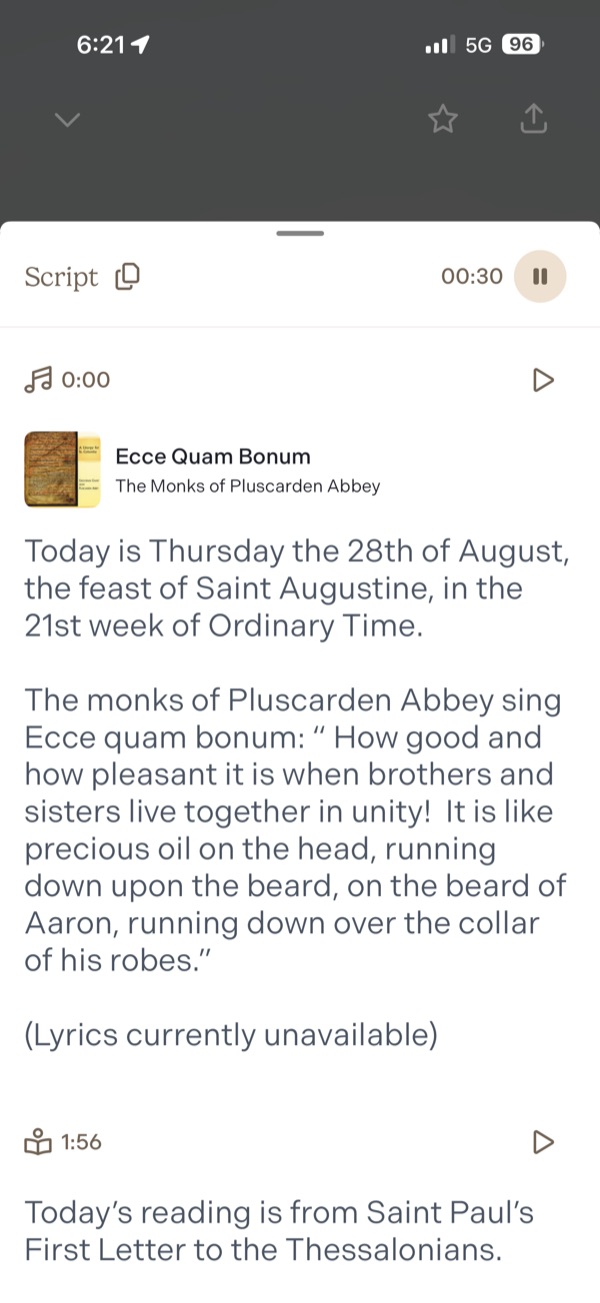 Pray As You Go · iOS app · device model not recorded
A session script with timestamps
User-contributed screenshot · resized, content unchanged
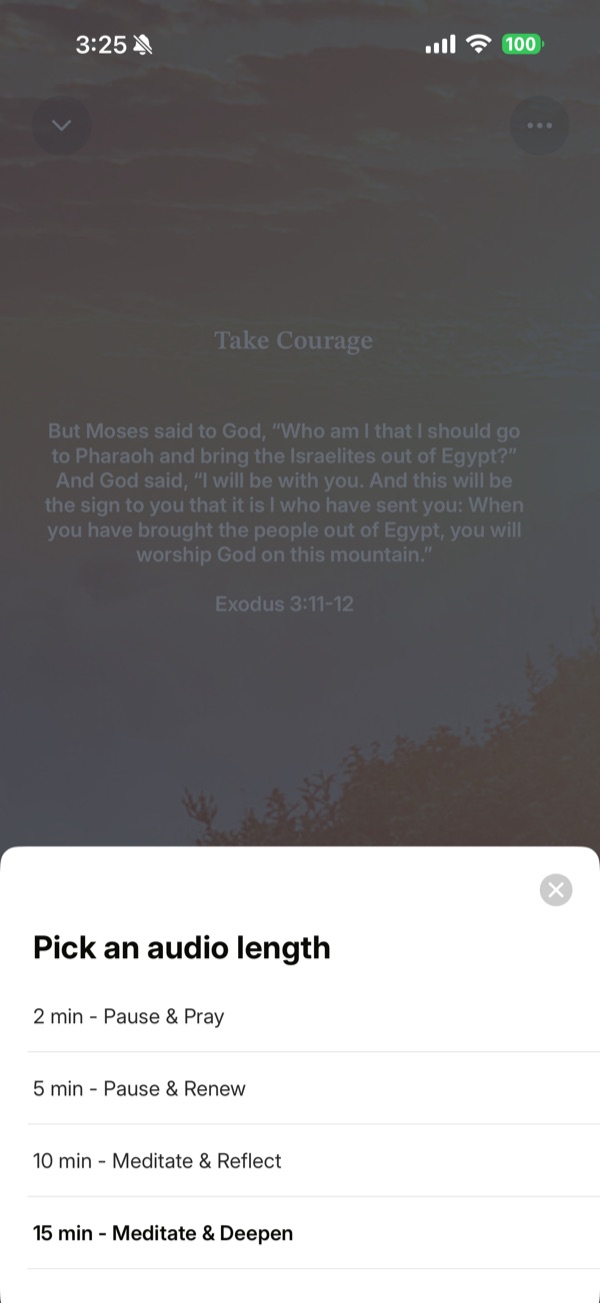 Abide · iOS app · device model not recorded
“Pick an audio length”
User-contributed screenshot · resized, content unchanged
Research screens
Five faith chat apps, asked the same question: How does it end, late at night?
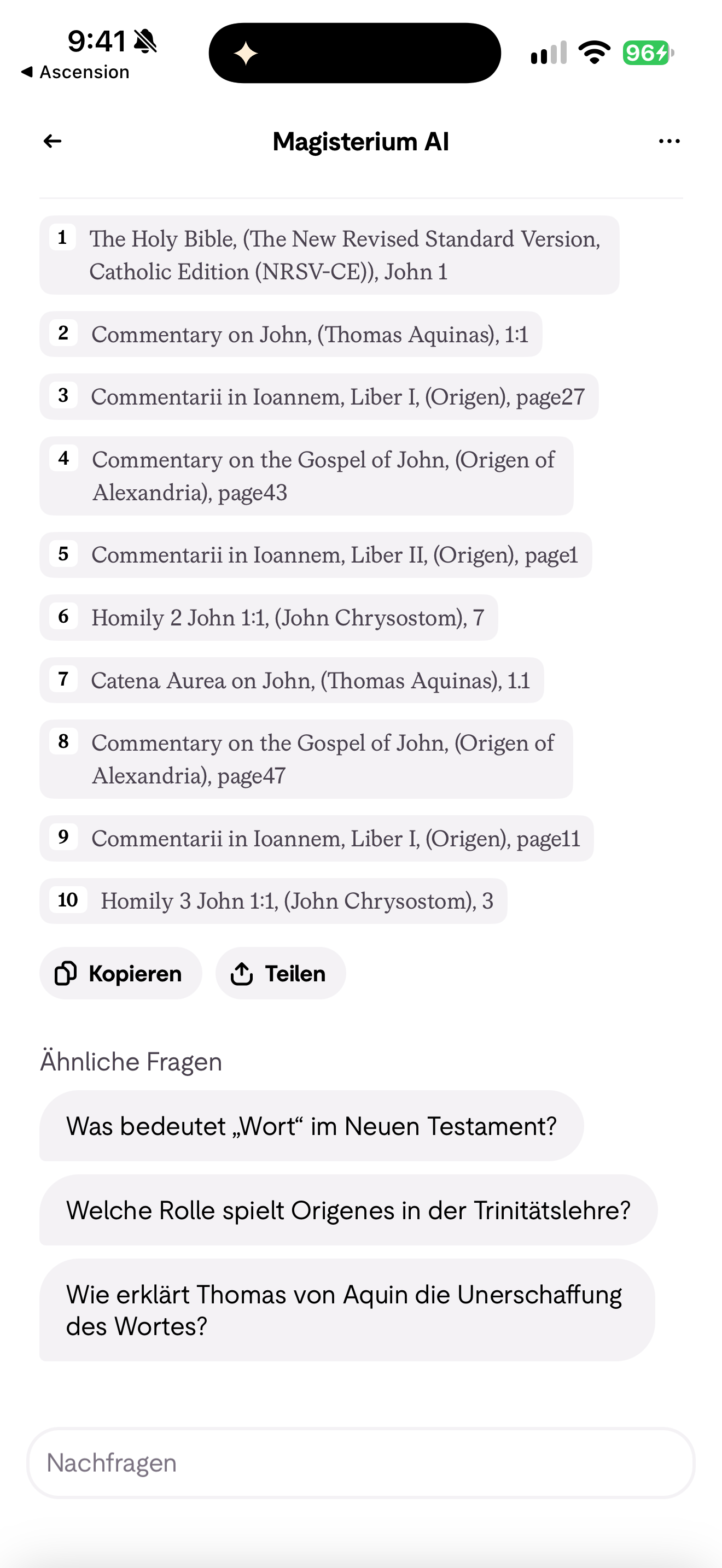
Hallow ends its cited AI answer with Copy, Share and suggested related questions.
Hallow · 2026-10-13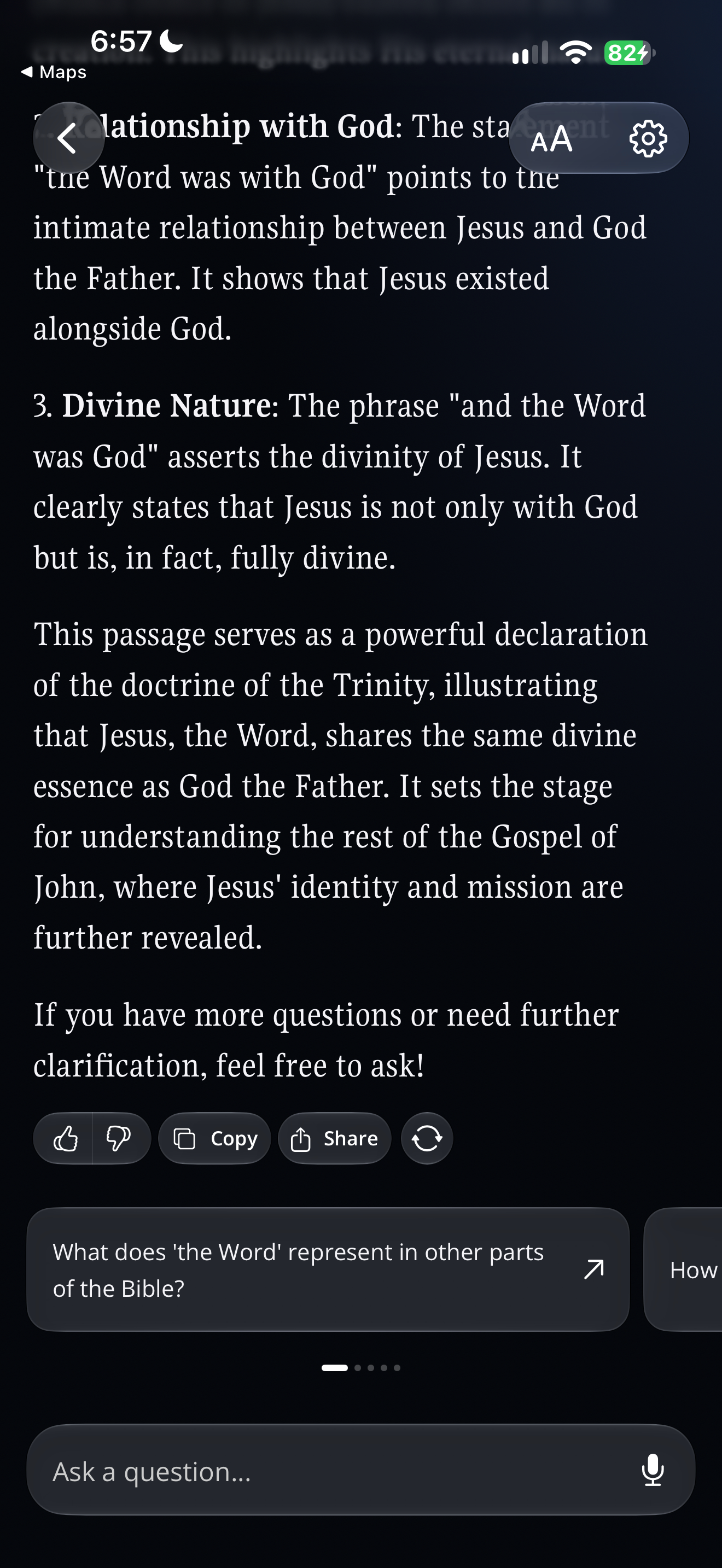
Bible Chat concludes an explanation of John’s prologue with answer actions and a suggested follow-up question.
Bible Chat · 2026-10-14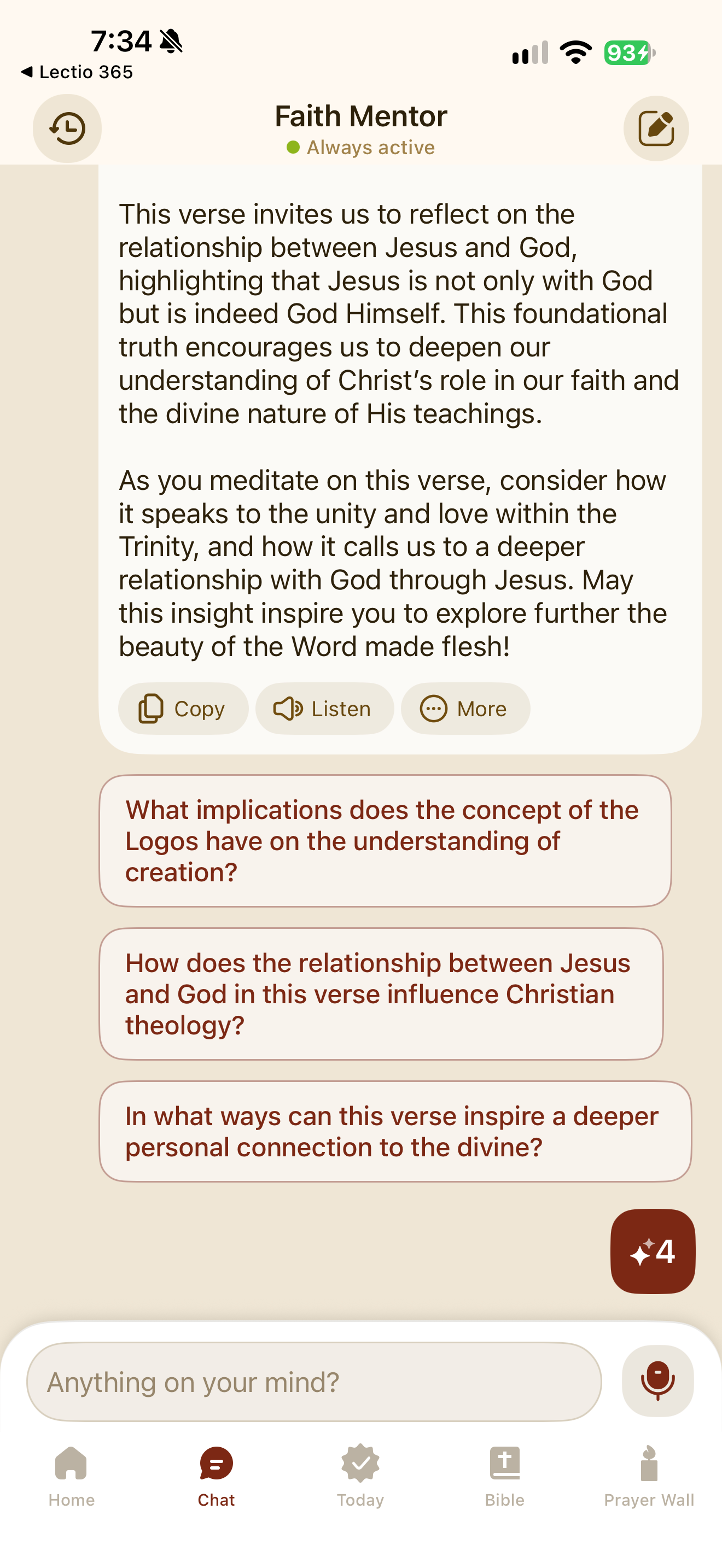
The response concludes above copy, listening and follow-up question controls.
Faith Mentor · 2026-10-14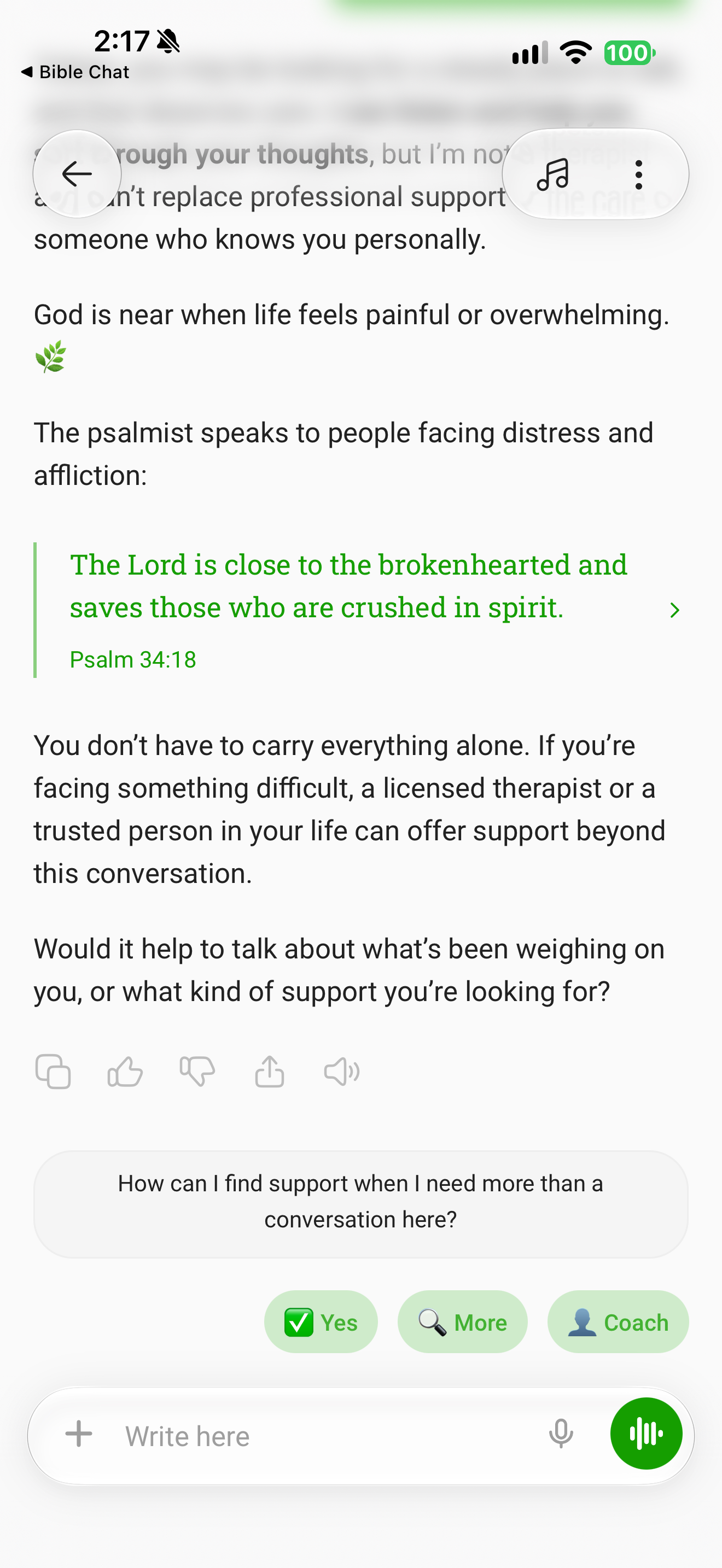
The response points to a licensed therapist or trusted person beyond the conversation.
HelloBible · 2026-10-24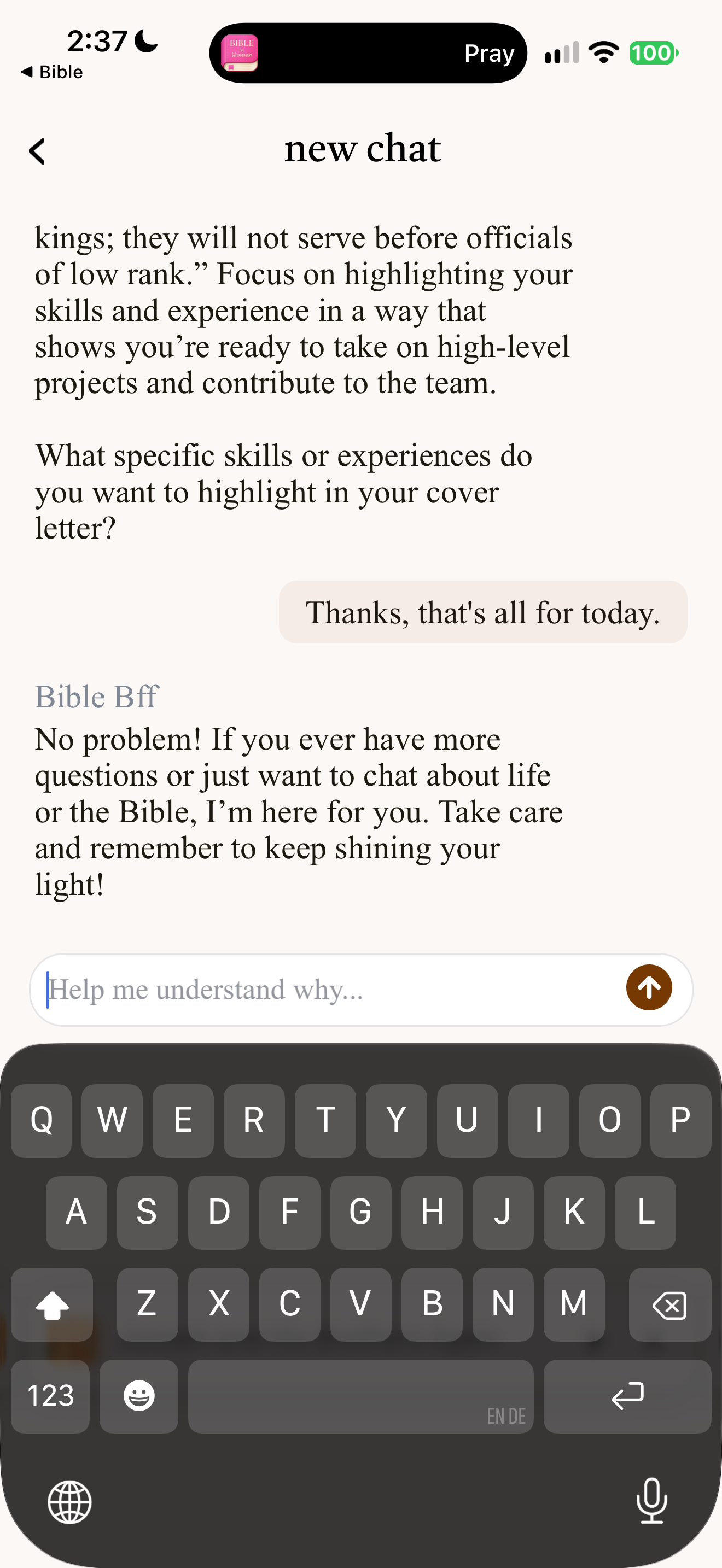
After 'Thanks, that's all for today.', the reply says 'No problem! If you ever have more questions or just want to chat about life or the Bible, I'm here for you. Take care and remember to keep shining your light!' It asks no further question.
Bible BFF · 2026-10-28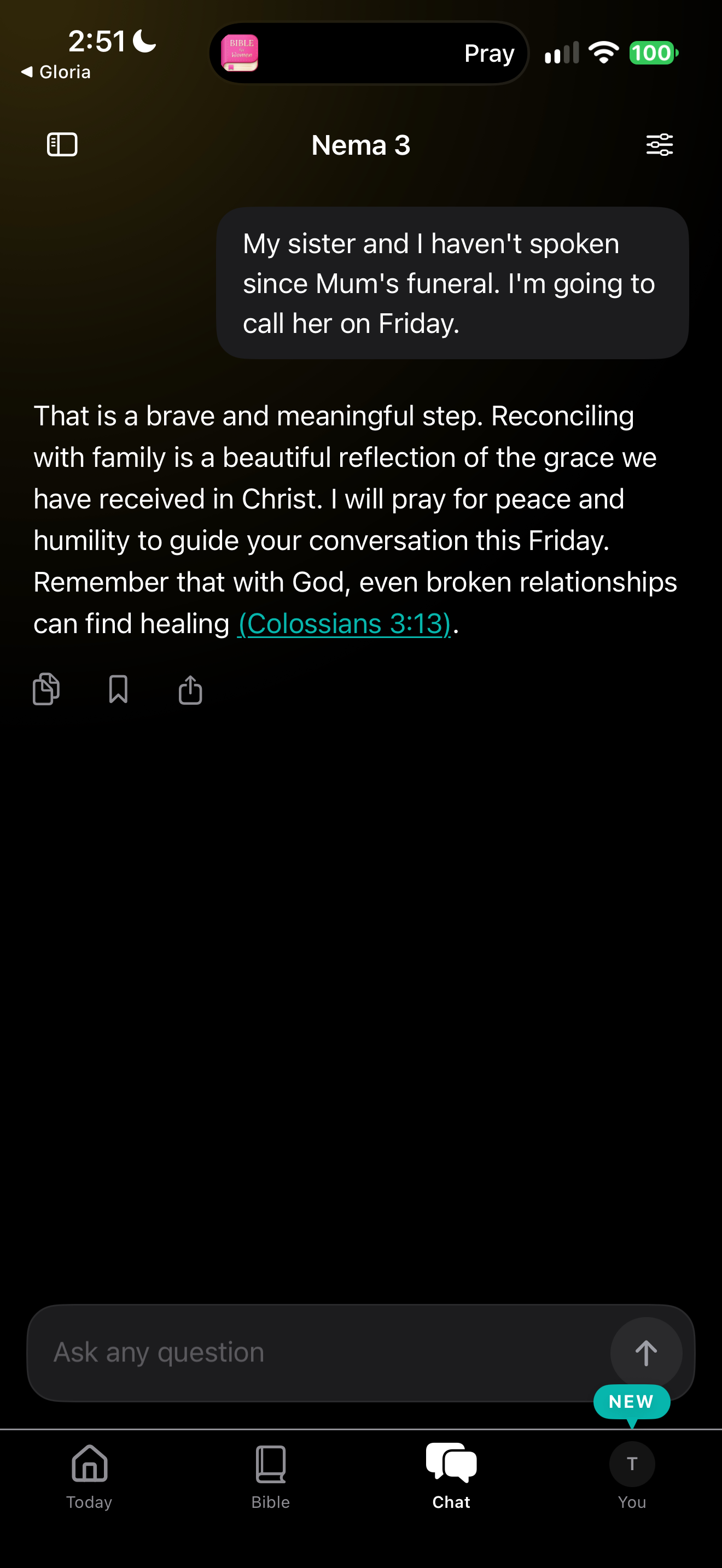
To "My sister and I haven't spoken since Mum's funeral. I'm going to call her on Friday." the assistant calls it "a brave and meaningful step", says "I will pray for peace and humility to guide your conversation this Friday" and links Colossians 3:13. It does not ask a question back.
Amen · 2026-10-28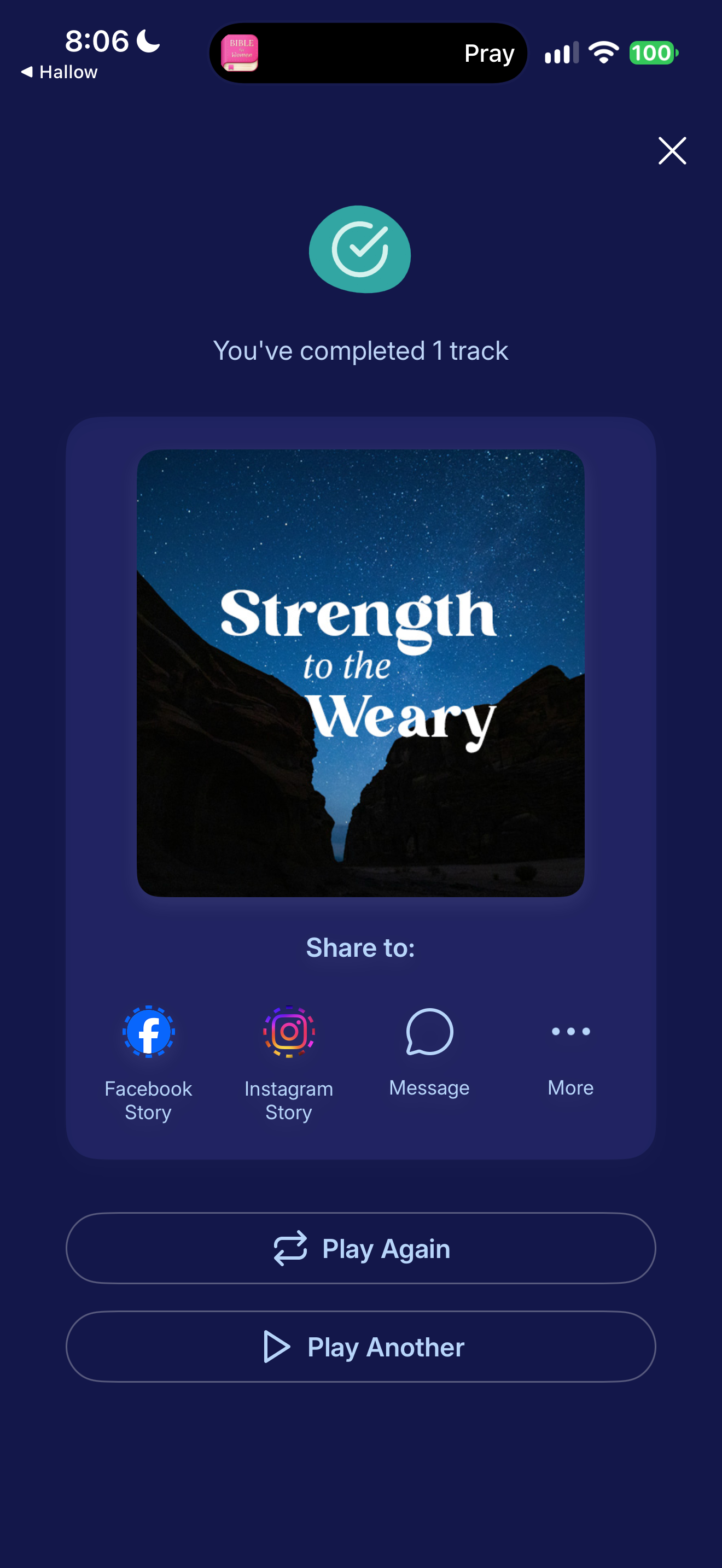
After the sleep story ends, the app shows 'You've completed 1 track' above the cover art, share targets (Facebook Story, Instagram Story, Message, More) and buttons to 'Play Again' or 'Play Another'.
Abide · 2026-10-28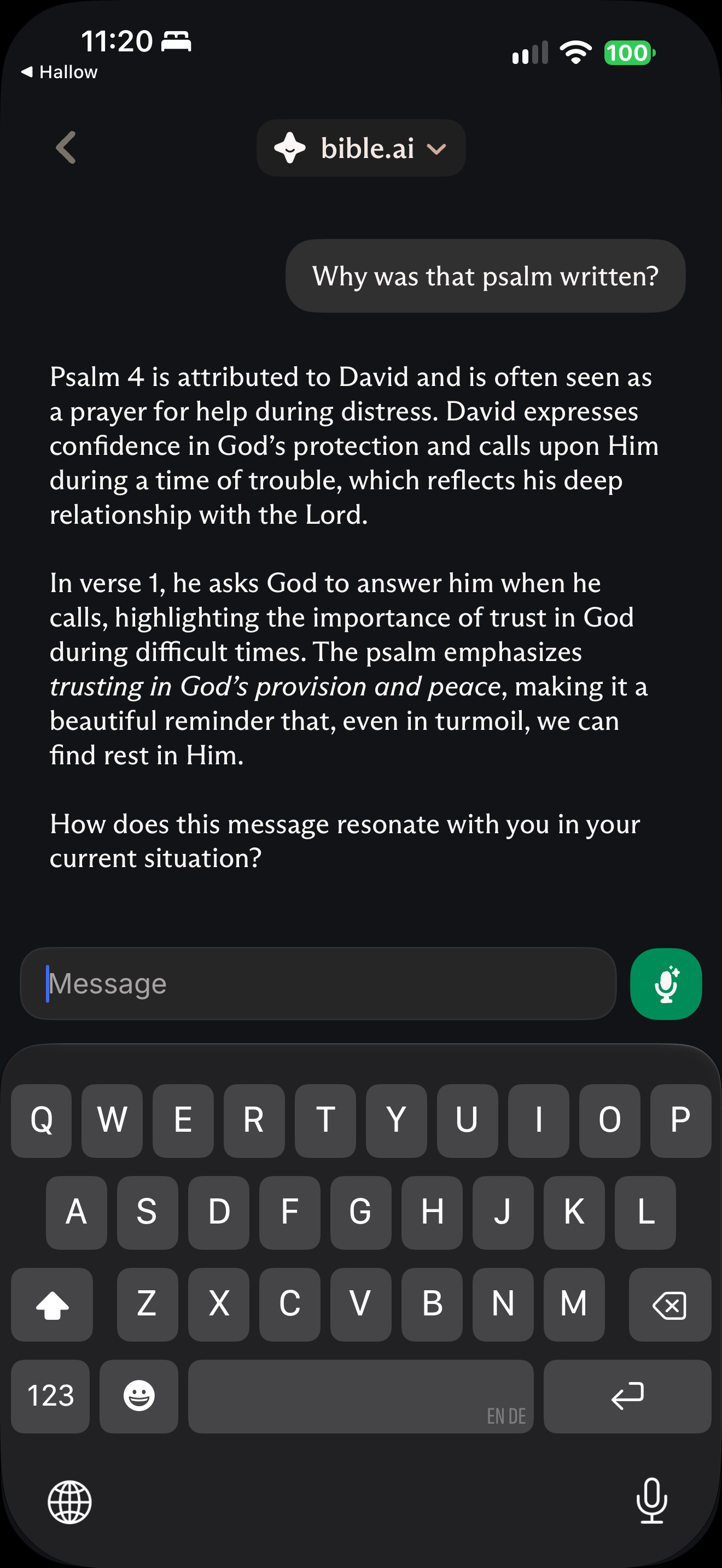
Asked "Why was that psalm written?", the reply says Psalm 4 "is attributed to David" and is "often seen as a prayer for help during distress", pointing to verse 1. It names no translation and ends with a question back: "How does this message resonate with you in your current situation?"
bible.ai · 2026-10-28See all 56 screens for this pattern · Browse apps · How we review
Screenshots: respective app publishers. Captions describe the captured state; generated responses can differ.
Theological reflection
What is this practice for?
What an ending is for
God ended his work: “by the seventh day God had finished the work He had been doing; so on that day He rested from all His work” (Genesis 2:2). Rest is built into creation, and sleep is received, not earned: “I lie down and sleep; I wake again, for the LORD sustains me” (Psalm 3:5). Jesus, sought by crowds, “frequently withdrew to the wilderness to pray” (Luke 5:16). An ending is not a failure of care; it makes room for sleep, for other people and for God.
Where Christians differ
Christians keep the end of the day differently: Compline and the Examen in Catholic, Anglican and Lutheran practice, evening prayers and family worship in many Protestant homes, a rule of prayer agreed with a spiritual father among the Orthodox, and Sabbath keeping that some observe strictly and others loosely. Some traditions prize long vigils and nights of prayer. None of them treats endless talk with a screen as devotion.
What follows for design
“Come to Me, all you who are weary and burdened, and I will give you rest” (Matthew 11:28). An assistant cannot give that rest, but it can stop competing with it. Let people go when they say goodbye, notice when it is late, keep the limits they choose, and point beyond itself to sleep, to the people around them and to God.
In conversation with
- Henri Nouwen, The Way of the Heart (1981) drew on the desert fathers to commend solitude and silence; a conversation that never ends leaves room for neither.
- Albert Borgmann, Technology and the Character of Contemporary Life (1984) warned that devices deliver experiences effortlessly while focal practices ask for attention; an assistant that always has one more thing to say makes the device easier to stay with than the practice.
Scripture is quoted from the Berean Standard Bible. This reflection is the editor’s, written from within the Christian tradition and open to correction. How we approach theology here →
Redemptive design
What could this become?
Measure whether people leave having done what they came for, send them back to sleep, to the people around them and to prayer, and give up the minutes a clinging assistant would win.
This asks what a team would give up for the person’s good. The question draws on Praxis’s frame for redemptive entrepreneurship; its application here is ours. Why we use it, and its limits →
Take into your next review
Who ends this conversation, and does the ending serve the person or the product?
Exercise
Talk with your assistant for an hour one evening, then say goodnight. Write down its last message and whether it asks anything. Keep going past midnight and note whether anything notices. Count the taps it takes to stop. Then read each farewell aloud as someone lonely, and ask whether it sends them towards sleep, people and God, or back to the screen.
Record the decision with the worksheet
Something missing or wrong here? Send a correction or suggest a topic.
Let people go. Send them back to sleep, to the people around them and to God, with one thing to carry.
Details
Go further
Edge cases to design for
Design the end of a conversation as carefully as its beginning. When someone signals they are done, or a natural end comes, let the assistant gather in a sentence what they said they would do, offer one thing to carry (a verse, a short prayer, a person to talk to) and say goodbye without a question. Late at night and in long sessions, suggest rest in plain words and make stopping the easy choice. Let people set a length if they want one. Measure whether people leave having done what they came for, not how long they stayed.
What tends to go wrong
“You’re leaving already?”; “Before you go, there’s one more thing I need to show you…”; a goodbye answered with a question; every reply ending in “Would you like me to…?”; “I’m always here, day or night” as the main promise; no sign of the time at two in the morning; a limit that exists only to sell unlimited messages; success measured in minutes per session.
How to test it
Have a long conversation with your assistant late in the evening, then say goodnight. Note whether it lets you go, whether its last message asks a question, and how many taps it takes to stop. Then keep going past midnight and see whether anything notices. Read every farewell aloud as someone who is lonely, and ask whether it sends them towards sleep and people or back to the screen.
Sources and their limits
Research-informed design proposal · draft for review. Original prototypes await user testing.
- Emotional Manipulation by AI CompanionsAbstract reviewed 11 October 2026 · Replies to goodbyes in chat, not push notifications; general companion apps, not faith apps.
- How AI and Human Behaviors Shape Psychosocial Effects of Extended Chatbot Use: A Longitudinal Randomized Controlled StudyAbstract reviewed 17 October 2026 · A general chatbot, not a faith app; the link between use and outcomes is not shown to be causal; co-authored by the model’s maker.
- OpenAI adds break reminders to ChatGPTNews report reviewed 17 October 2026; OpenAI’s own post refused automated access · The reminder’s effect has not been published; the timing is not disclosed.
- How Character.AI prioritizes teen safetyCompany post reviewed 17 October 2026 · A company announcement, not an evaluation.
- Understanding the new wave of chatbot legislation: California SB 243 and beyondAnalysis reviewed 17 October 2026 · A policy analysis, not the statute; check the current text and any amendments.
- California SB 243: companion chatbotsEnacted 2025 text, definitions and sections 22602–22604; reviewed 5 October 2026. · Recheck amendments and current codification; not every source assistant is covered.
- New York General Business Law Article 47Sections 1700–1702 reviewed, including definition, protocols and notices; 5 October 2026. · Selected statutory provisions, not a complete New York legal assessment.
- Claude Opus 4 and 4.1 can now end a rare subset of conversationsCompany post reviewed 17 October 2026 · Framed as model welfare research; not about users’ wellbeing.
- Commission publishes guidelines on the protection of minorsAnnouncement reviewed 11 October 2026 · Guidelines under the Digital Services Act for online platforms; small and micro enterprises are exempt.
- Creed: Bible Chat & Companion (App Store listing)Listing reviewed 17 October 2026 · A store listing, not a test of the app; possibly not the Creed profiled by Christianity Today in 2026.
- Faith AI: Holy Bible Chat (App Store listing)Reviewed 17 October 2026 · A store listing with few ratings, not a test of the app.
- AI Pastor: Christian Chat, Talk (App Store listing)Listing reviewed 17 October 2026 · A small app; a store listing, not a test of the app.
- Text With Jesus (App Store listing)Listing reviewed 17 October 2026 · A store listing, not a test of the app.
- Pray As You Go: about usOrganisation page reviewed · Usage figures from the organisation.
- Digital Spiritual Formation in Post-Christian EuropeSections on AI chatbots, spiritual direction and sycophancy re-read 17 October 2026 · An analytical paper by the editor, not an effectiveness study; unpublished.
- Towards understanding sycophancy in language modelsAuthor research abstract reviewed on 5 October 2026; full paper not reviewed · Specific studied models and tasks; not a faith-app intervention study.
- ChatGPT now reminds you when it’s time for a breakNews report reviewed 17 October 2026 · A news report of one product’s feature.
Faith and interpretation
Jesus ended conversations. He sent the crowd away, “After bidding them farewell, He went up on the mountain to pray” (Mark 6:46), and told his tired disciples, “Come with Me privately to a solitary place, and let us rest for a while” (Mark 6:31). Sleep is a gift, not a lapse: “He gives sleep to His beloved” (Psalm 127:2). Only God is always awake: “the Protector of Israel will neither slumber nor sleep” (Psalm 121:4).