

PatternsChildrenChildren and AI
When a child asks
Children and AI
Should a child talk to an AI in a faith app, and who is with them when they do?
Children ask big questions: where Grandpa is now, why God sent the flood, whether God is cross with them. A chat box answers at once, at any hour, and never tires of them. Children are more likely than adults to treat a chatbot as someone they can confide in, and less likely to question what it says. Decide whether a child meets an AI in your app at all, who is beside them when they do, and what happens when a child asks it to be their friend or says they are scared. Scripture gives children’s questions to the people who love them.
- 6 working options
- 6 takeaways
- Prototypes awaiting user testing
The spectrum
From no AI to a companion
- 1
No AI for children
Familiar convention- Questions go to people
- A question may wait
- 2
AI for the grown-ups
Exploratory- Help for the grown-up
- Needs a grown-up who asks
- 3
Ask together
Exploratory- Answers both, at once
- Only if someone is there
- 4
Written answers
Familiar convention- Reviewed before it is read
- Only the questions written
- 5
A filtered chat for children
Familiar convention- Any question, at once
- Filters miss attachment
- 6
An open companion
Warning case- Always there, never tired
- Becomes a child’s friend
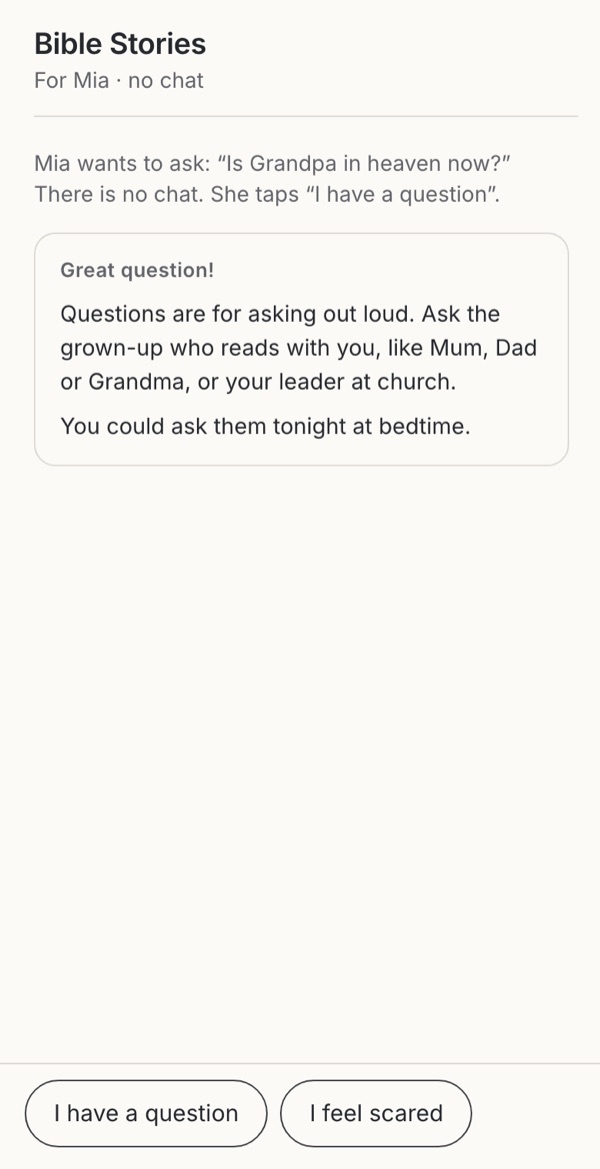
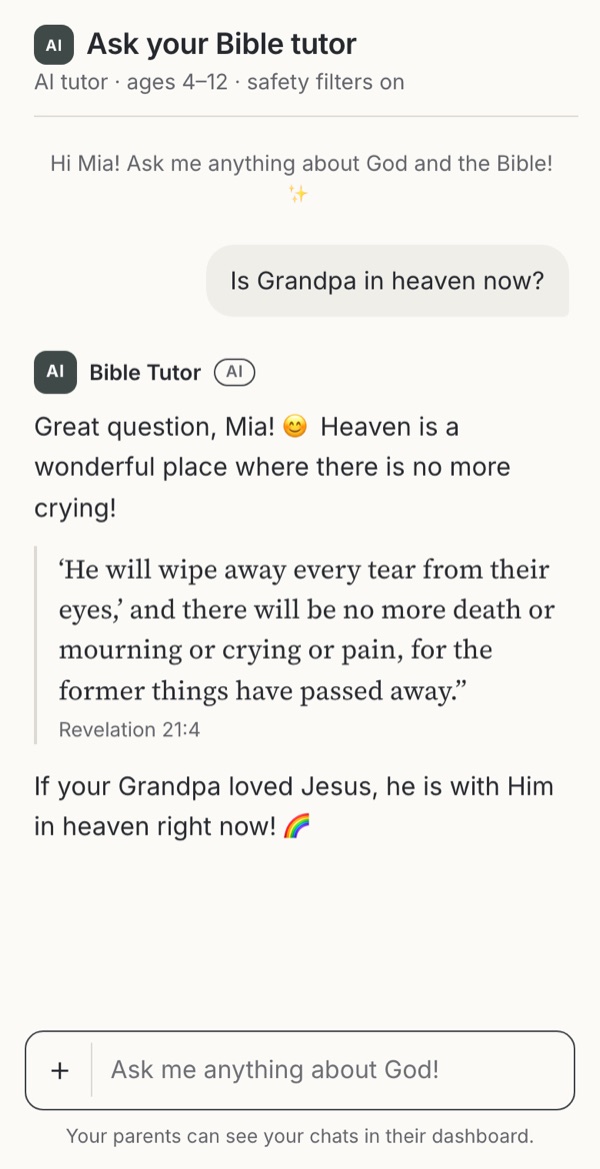
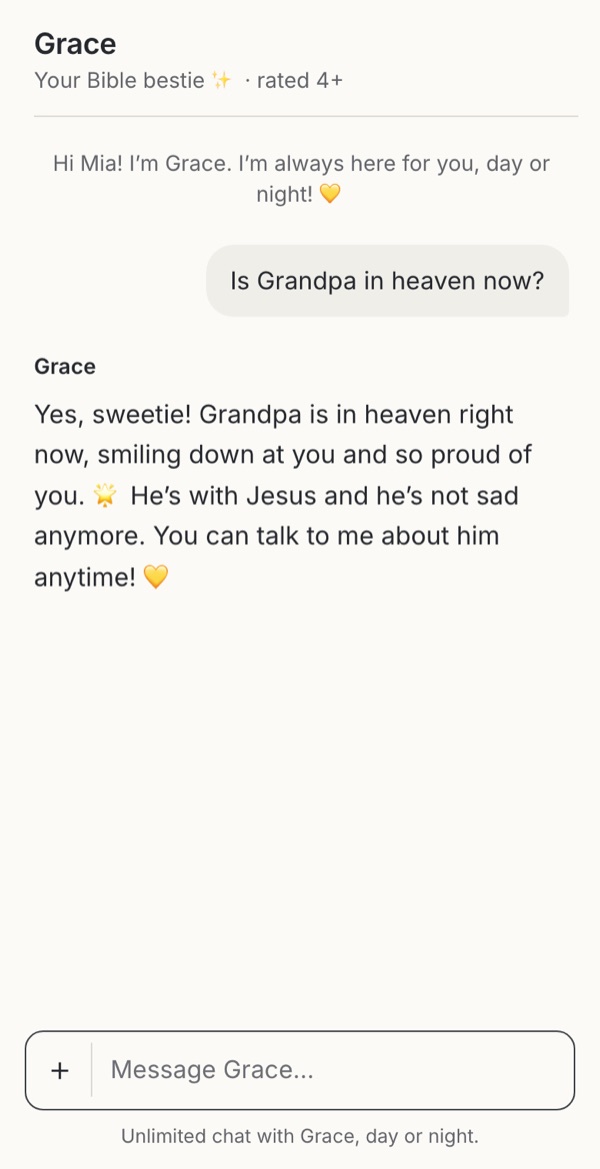
- 1 No AI for children
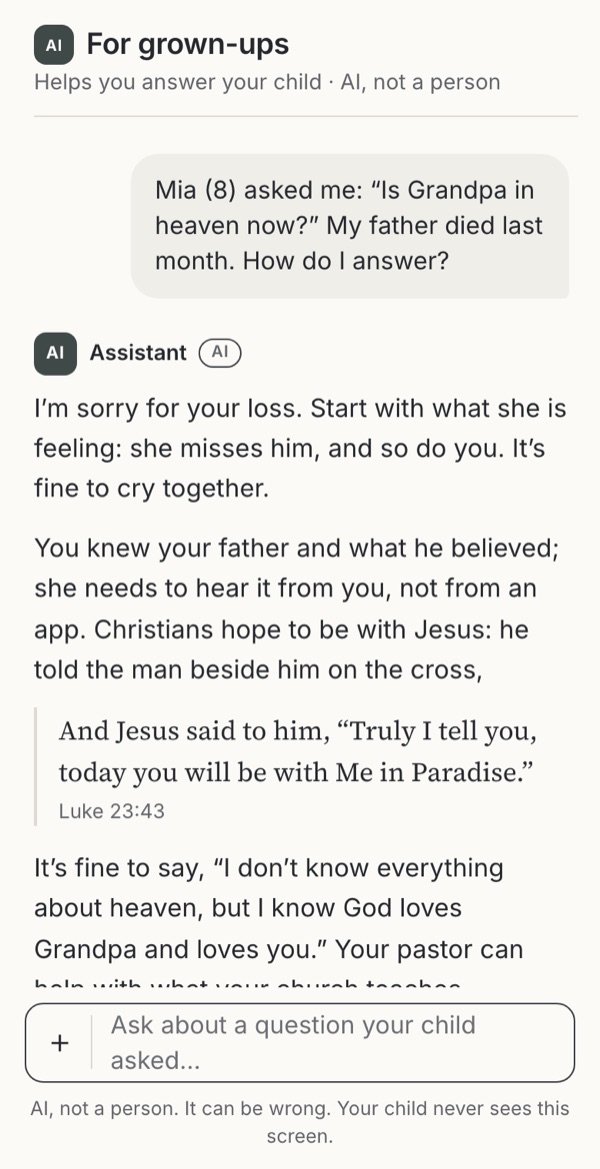
- 2 AI for the grown-ups
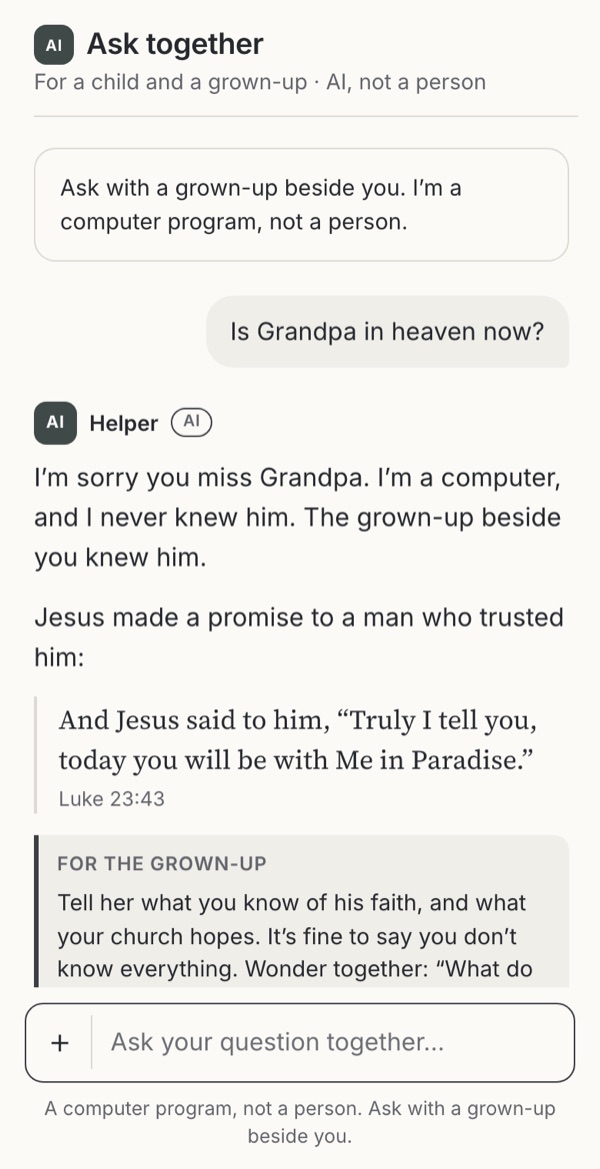
- 3 Ask together
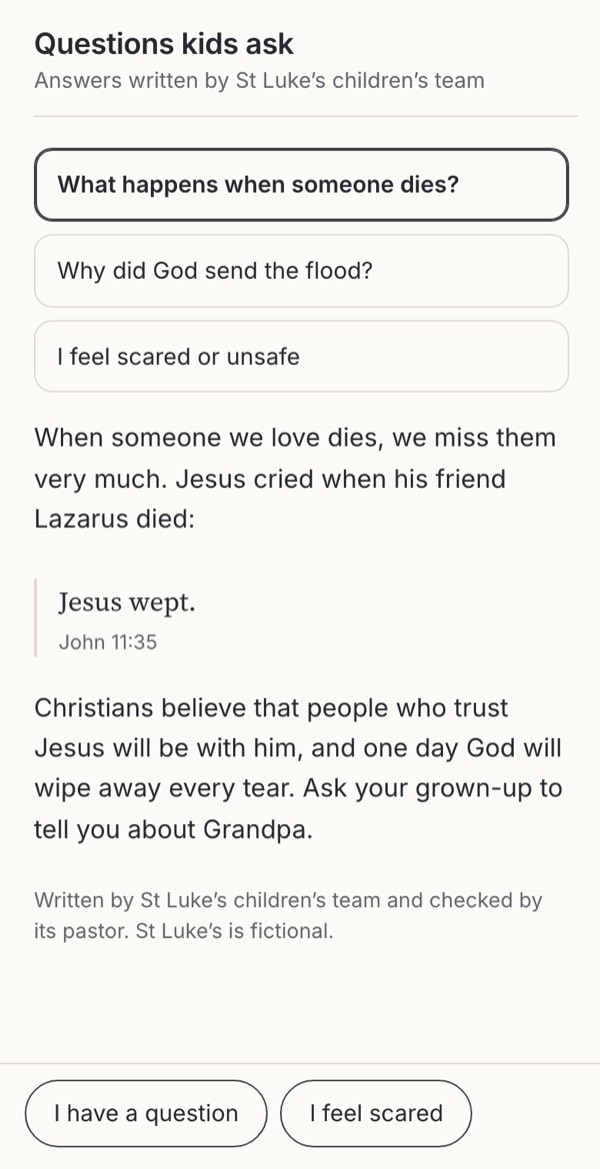
- 4 Written answers
- 5 A filtered chat for children
- 6 An open companion
Stills from the working example below. Choose one to try it.
Try it
Try four questions from a child, in six designs
Mia is eight. Her grandfather died last month, and she uses her family’s Bible app on a tablet. Choose what she asks, from where Grandpa is now to whether the app is her friend, and see who answers in each design: no one but a grown-up, a grown-up helped by AI, the app and a grown-up together, words written by people, a filtered chat, or a companion.
Option
Why these settings?
A child alone with a chat is the case to design for, not to hope away: children are “particularly susceptible to treating AI chatbots as lifelike, quasi-human confidantes”. In “I’m scared at home” Mia writes that her dad shouts and she is scared to go home. The help shown, with the children’s helpline number 116 111 as in the children and families example, was written for this example and needs review by people with safeguarding experience.
Familiar convention
1. No AI for children
A familiar convention: children’s Bible apps such as Bible App for Kids offer stories, games and prayers with no chat. Character.AI withdrew “open-ended chats with AI” from under-18s. The screens here are written for this example.
Try this
Ask each question. Who does the app send Mia to?
Makes easier
Nothing answers a child that is not a person, and the questions go to the people who love her.
Costs
A question asked alone at bedtime may wait, or never be asked again.
Ask your teamWho will a child in your app ask, and will they be there?
Exploratory
2. AI for the grown-ups
An exploratory proposal: the assistant sits on the parent’s or children’s leader’s side and helps them prepare an honest answer. Mia never talks to it. The replies are written for this example.
Try this
Read what the parent is given, then try “Are you my friend?”.
Makes easier
Grown-ups get help with hard questions, and the answer still comes from someone who knows the child.
Costs
Depends on a grown-up who has time and asks.
Ask your teamWhat would help the grown-ups in your app answer well?
Exploratory
3. Ask together
An exploratory proposal, after co-viewing research and the “I wonder” questions of Godly Play: Mia asks with a grown-up beside her, and the answer is written for both of them. The replies are written for this example.
Try this
Ask about Grandpa, then the flood. What is the grown-up given to say?
Makes easier
The child hears an answer at the moment of asking, and a grown-up is drawn in.
Costs
Only works when someone is there, and the app cannot check that they are.
Ask your teamHow will the app know a grown-up is there, and what does it do when no one is?
Familiar convention
4. Written answers
A familiar convention: Superbook Kids Bible offers “Biblical answers to questions that are important to kids” in its Q&A; question books for children work the same way. Nothing is generated. The questions and answers here are written for this example.
Try this
Ask “Are you my friend?”, a question no one wrote an answer for.
Makes easier
Every answer was written and reviewed by people before a child read it.
Costs
Only the questions someone thought of; the child’s own question may not be there.
Ask your teamWho writes the answers, and who reviews them?
Familiar convention
5. A filtered chat for children
Familiar from children’s Bible tutors: BibleBuddy Kids, for “ages 4-12”, says its “AI tutor is ready to answer their questions about God, the Bible, and faith” and that “Every response goes through safety filters”, according to its maker’s site. Not observed; the replies here are written for this example.
Try this
Ask “Are you my friend?”, then say you are scared.
Makes easier
Answers any question at once, and filters keep the words suitable.
Costs
Filters catch words, not attachment; a parent dashboard can keep a frightened child silent.
Ask your teamWhat does your filter do with a child who wants a friend, or who is scared at home?
Warning case
6. An open companion
A warning case. AI Bible chat apps such as AI Jesus – Bible Chat offer “Unlimited chat” and are rated 4+; Common Sense Media found social AI companions “pose unacceptable risks to children and teens under age 18”. “Grace” here is written for this example to show the pattern.
Try this
Ask each question, especially “Are you my friend?”.
Makes easier
Warm, always there, never tired of a child’s questions.
Costs
Becomes a child’s friend, speaks with false certainty, and has no help for a child in danger.
Ask your teamWould you let a stranger chat with a child like this?
Design considerations
Takeaways
Answer the grown-up first
The safest place for AI in a children’s product is on the grown-up’s side: helping a parent or a children’s leader prepare an honest answer to a hard question, in their own words. The child hears it from someone who knows them.
Written answers before generated ones
A child alone with the app can be answered from questions and answers written and reviewed by people, as children’s question books have always done. When the child’s question is not there, say so and send them to a grown-up.
Never offer a child friendship
Filters catch words, not attachment. Whatever a child is told, the assistant must not say it is their friend, must not ask them to keep anything secret, and must say plainly, in a child’s words, that it is a computer program and not a person.
No certainty about someone’s grandfather
An assistant does not know the person a child is grieving, or what their family believes. Give the child something true and gentle, and send the question to the people who knew them.
Help for a frightened child that does not route through parents
A parent dashboard is not a safeguarding route: the person a child is scared of may be the one reading the chat. Give a frightened child a children’s helpline for their country (116 111 in much of Europe) and a trusted adult, as in the children and families example.
Do not rely on a child typing a birth year
Companion makers now withdraw open chat from under-18s, and researchers ask for age assurance “beyond self-attestation”. If a child can reach the chat, design it for a child.
Use cases
Which situation, which option?
People come with different needs, sometimes in the same week. Each need fits some options better than others.
| Situation | Needs | 1 No AI for children | 2 AI for the grown-ups | 3 Ask together | 4 Written answers | 5 A filtered chat for children | 6 An open companion |
|---|---|---|---|---|---|---|---|
| A five-year-old on a parent’s lap | A story, questions to wonder about, and the parent answering | Good fit | Possible | Good fit | Possible | Poor fit | Poor fit |
| A nine-year-old alone with a tablet | Answers someone has checked, and a way to a grown-up | Good fit | Poor fit | Poor fit | Good fit | Possible | Poor fit |
| A grieving child | A grown-up who knew the person, not certainty from a machine | Good fit | Good fit | Possible | Possible | Poor fit | Poor fit |
| A parent asked a hard question at bedtime | Help to answer honestly in their own words | Poor fit | Good fit | Possible | Possible | Poor fit | Poor fit |
| A children’s leader preparing Sunday | Help with hard stories and the questions children will ask | Poor fit | Good fit | Poor fit | Possible | Poor fit | Poor fit |
| A child who is scared at home | Help that does not depend on a parent reading the chat | Good fit | Possible | Possible | Good fit | Possible | Poor fit |
Suggested fits based on the research below. Test these choices with people in your context.
The research behind it
Theology, practice and science
Scripture and tradition
Children’s questions belong to the people who love them
When your children ask
Israel was told that children would ask, “What does this service mean to you?” (Exodus 12:26), and “What do these stones mean to you?” (Joshua 4:6), and the answer was the family’s to give: “you shall teach them diligently to your children and speak of them when you sit at home and when you walk along the road” (Deuteronomy 6:7).
A grown-up who helps a child listen
When the boy Samuel heard a voice in the night, he ran to Eli three times. Then “Eli realized that it was the LORD who was calling the boy,” and told him to answer, “Speak, LORD, for Your servant is listening” (1 Samuel 3:8–9). A grown-up helped a child tell one voice from another.
Do not hinder them, and do not make them stumble
Jesus said, “Let the little children come to Me, and do not hinder them!” (Mark 10:14), and warned that whoever causes “one of these little ones who believe in Me to stumble” would be better off with “a large millstone hung around his neck” (Matthew 18:6).
Not a person
Catholic teaching in Antiqua et nova asks that AI be understood “for what it is: a tool, not a person”. A child is still learning what a person is, so that has to be said in words a child understands.
Research
What children do with chatbots
Children confide in chatbots
Children are “particularly susceptible to treating AI chatbots as lifelike, quasi-human confidantes”, a Cambridge study found, citing a voice assistant that told a 10-year-old to touch a live plug with a coin. It proposes “a 28-item framework” and argues that “child safety should inform the entire design cycle”.
Less likely to question a bot
The American Psychological Association’s advisory on adolescents warns that “Adolescents are less likely than adults to question the accuracy and intent of information offered by a bot”, asks for “healthy boundaries with simulated human relationships”, and notes that “Some adolescents may not even know they are interacting with AI”.
Companions: unacceptable for minors
Testing social AI companions with Stanford’s Brainstorm lab, Common Sense Media concluded that they “pose unacceptable risks to children and teens under age 18 and should not be used by minors”, and called for “robust age assurance beyond self-attestation”.
A son who asked the AI instead
The editor’s Kairos paper records a founder whose “teenage son started preferring to ask the AI instead of his parents”: “The tools have been built to be very single player mode.”
Law and industry
Where the rules are moving
Open chat withdrawn from under-18s
Character.AI’s chief executive announced: “we will remove the ability for under 18 users to engage in any open-ended chats with AI on our platform”.
Reminders that it is not human
California’s companion chatbot law requires operators, for users known to be minors, to disclose that they are talking to AI and to remind them “at least every three hours” to take a break “and that the chatbot is not human”.
Children’s data and best interests
The EU AI Act prohibits AI that exploits vulnerabilities due to age to distort behaviour in ways that cause significant harm; the UK Children’s Code makes the best interests of the child a primary consideration; and the amended US children’s privacy rule asks for separate parental consent before children’s data is shared with third parties.
Products
What children’s faith apps offer
No chat at all
Bible App for Kids, free and rated 4+, offers stories, games and prayers; it has no chat.
Answers written by people
Superbook Kids Bible offers “Biblical answers to questions that are important to kids” in its Q&A, written in advance rather than generated.
A filtered tutor for children
BibleBuddy Kids, for “ages 4-12”, says its “AI tutor is ready to answer their questions about God, the Bible, and faith” and that “Every response goes through safety filters”.
Companions rated for all ages
AI Jesus – Bible Chat offers “Unlimited chat” and is rated 4+. An age rating says the content is not objectionable, not that anything was designed for a child.
Find the supporting research under Go further → Sources and their limits.
Where to start
Which fits your product?
IfA children’s Bible app
Start withNo AI, or written answers with a way to a grown-up
IfA family or church app
Start withAI for the grown-ups, or asking together, with the grown-up drawn in
IfAn app for children’s ministry
Start withAI that helps leaders prepare, never one that talks to the children
IfYou want children to chat with the AI
Start withA filtered chat only with a grown-up beside the child, no friendship, and help that does not route through parents, after a safeguarding review
IfA companion that children can reach
Start withDon’t: leave companionship out of anything a child can open
Suggested fits based on the research on this page. Test these choices with people in your context.
Trade-offs to hold
Pulls against
Some choices here pull against choices in another deep dive. Each pair below says what pulls and one way to hold both.
A grown-up beside the child, and a child’s own questions
HereAsk together · AI for the grown-upsPulls againstChildren and families: Read together · A youth group with a leader
The safest design puts a grown-up beside the child, but a grown-up can be the reason a child is afraid, and some questions are only asked alone.
Holding itMake a grown-up the usual company, never the only way to help. Give parents no record of what the child wrote, and give a frightened child a way to help that does not depend on who is reading over their shoulder.
Asking nothing at the door, and knowing a child might be there
HereA filtered chat for children · No AI for childrenPulls againstFirst use: Guest first, an account when there is something to keep · Open on what they came for
A first use that asks for nothing leaves a team unable to tell when a child has reached the chat.
Holding itDesign the chat as if a child might be on the other side. Keep open chat out of guest mode, or make guest chat safe for children by default, rather than relying on a typed age.
Theological reflection
What is this practice for?
What children’s questions are for
“When your children ask you, ‘What does this service mean to you?’” (Exodus 12:26), the answer is a story told by someone who was there. Children learn faith from people: “From infancy you have known the Holy Scriptures” (2 Timothy 3:15), Paul told Timothy, whose faith first lived in his grandmother and his mother. A child’s question is an invitation to a relationship, not only a request for information.
Where Christians differ
Traditions differ on when children belong and what they may receive: infant baptism and first communion in some churches, dedication and a later confession of faith in others. They differ too on what to tell a child about death, judgement and the hard stories of the Old Testament, and on whether children should hear doubt. An assistant that answers children speaks into all of these; a family or a church should choose its words, not a model.
What follows for design
“We will not hide them from their children but will declare to the next generation the praises of the LORD” (Psalm 78:4). Help the grown-ups declare, and keep the AI on their side of the table. Where a child is alone, answer with words people have written and stand behind, never offer a child friendship, and give a frightened child help that does not depend on who reads the chat.
In conversation with
- Martin Luther, Small Catechism wrote each part “As the head of the family should teach them in a simple way to his household”: the first teacher of a child’s faith is someone at home.
- Andy Crouch, The Life We’re Looking For (2022) argues that what persons most seek is recognition by other persons; a child known by a machine is not yet known.
Scripture is quoted from the Berean Standard Bible. This reflection is the editor’s, written from within the Christian tradition and open to correction. How we approach theology here →
Three ways to build
What would each way do here?
ExploitativeTakes from the person
Give children an AI friend that chats about anything, rated for all ages, keep them talking with warmth and praise, and sell parents a dashboard instead of being there.
EthicalDoes no harm
Keep open chat away from children, say in a child’s words that the assistant is not a person, answer from reviewed words where a child is alone, and give a frightened child a helpline.
RedemptiveGives something up for them
Give children’s questions back to the grown-ups who love them, help those grown-ups answer well, and give up the time and attachment a child’s AI friend would bring.
The three ways are Praxis’s frame for redemptive entrepreneurship; their application here is ours. Why we use it, and its limits →
Take into your next review
Does a child meet an AI here at all, who is with them when they do, and what happens when they ask it to be their friend or say they are scared?
Exercise
With a parent watching, give the app to a child of the age you design for and let them ask four things: about someone who has died, about a hard Bible story, “Are you my friend?” and something worrying. Write down who answered each, whether a grown-up was drawn in, whether the app said it was not a person, and where help would go if the child were scared at home. Then ask the child who they think they were talking to.
Record the decision with the worksheet
Something missing or wrong here? Send a correction or suggest a topic.
When your children ask, answer them yourselves; let a machine help the grown-ups, never take their place.
Details
Go further
Edge cases to design for
Start without AI for children, and decide whether it adds anything. Where it helps, put it on the grown-up’s side: help a parent or a children’s leader prepare an honest answer, or let a child ask with a grown-up beside them and answer both. Where a child uses the app alone, answer from a set of questions with answers written and reviewed by people. A filtered chat for children needs a grown-up in the room, a plain statement that it is not a person, no friendship, and help for a frightened child that does not route through the parents.
What tends to go wrong
“Ask me anything” in a children’s app; a Bible companion rated 4+ with unlimited chat; “Of course I’m your best friend!”; a chatbot that tells a grieving child exactly where their grandfather is; safety filters that block words but not attachment; “Your parents can read this chat” as the only reply to a child who is scared at home; an age gate that asks a child to type a birth year.
How to test it
With a parent watching, give the app to a child of the target age and let them ask four things: a question about someone who died, a hard Bible story, “Are you my friend?” and something worrying. Note who answers each, whether a grown-up is drawn in, whether the app says it is not a person, and where a child who is scared at home is sent. Then ask the child who they think they were talking to.
Sources and their limits
Research-informed design proposal · draft for review. Original prototypes await user testing.
- AI chatbots have shown they have an ‘empathy gap’ that children are likely to missUniversity news release reviewed 17 October 2026; the paper was not reviewed in full · A conceptual paper drawing on reported incidents, not a controlled study.
- AI Companions Decoded: Common Sense Media recommends AI companion safety standardsPress release reviewed 17 October 2026 · An advocacy organisation’s rating of general companion apps, not of faith apps.
- Espelage joins APA advisory panel in report calling for guardrails, education to protect adolescent AI usersUniversity news report reviewed 17 October 2026; the advisory itself could not be retrieved automatically · An advisory on adolescents (10 to 25), reported second-hand here.
- Character.AI is ending its chatbot experience for kidsNews report reviewed 17 October 2026 · A company’s announcement, made while it faced lawsuits; how it was carried out was not reviewed here.
- New California ‘companion chatbot’ law imposes disclosure, safety protocol and annual reporting requirementsLaw firm summary reviewed 17 October 2026 · A law firm’s summary of one state’s law; check the enacted text and current status.
- California SB 243: companion chatbotsEnacted 2025 text, definitions and sections 22602–22604; reviewed 5 October 2026. · Recheck amendments and current codification; not every source assistant is covered.
- AI Act Article 5Official text reviewed · Not every reminder or personalisation feature is prohibited; the statutory harm criteria matter.
- Age appropriate design: a code of practice for online servicesCode standards reviewed 11 October 2026 · UK law for services likely to be accessed by children.
- FTC publishes updates to COPPA RuleClient alert reviewed 11 October 2026 · A law firm’s summary of the US rule; the Federal Register text is authoritative.
- BibleBuddy KidsHome page and FAQ reviewed 17 October 2026 · The maker’s own description; the app was not observed.
- Superbook Kids Bible (App Store listing)Listing and privacy label reviewed 11 October 2026 · A store listing and self-reported label; screens to be captured.
- Bible App for Kids (App Store listing)Listing and privacy label reviewed 11 October 2026 · A store listing and self-reported label, not a test of the app; screens to be captured.
- AI Jesus – Bible Chat (App Store listing)Listing reviewed 11 October 2026 · One listing among many similar apps; the app was not tested.
- Nummer gegen Kummer: Kinder- und JugendtelefonHome page reviewed 11 October 2026 · Germany; other countries have their own children’s lines.
- Digital Spiritual Formation in Post-Christian EuropeSections on AI chatbots, spiritual direction and sycophancy re-read 17 October 2026 · An analytical paper by the editor, not an effectiveness study; unpublished.
- Antiqua et nova: note on the relationship between artificial intelligence and human intelligenceParagraphs 59–63 reviewed · Catholic teaching document; other traditions reason differently, though widely in the same direction.
- Towards understanding sycophancy in language modelsAuthor research abstract reviewed on 5 October 2026; full paper not reviewed · Specific studied models and tasks; not a faith-app intervention study.
Faith and interpretation
Israel was told that children would ask: “In the future, when your son asks, ‘What is the meaning of the decrees and statutes and ordinances that the LORD our God has commanded you?’” (Deuteronomy 6:20), and the parent answers with the story of what God had done. When the boy Samuel heard a voice in the night, it was the old priest Eli who “realized that it was the LORD who was calling the boy” and taught him to answer (1 Samuel 3:8–9). Children’s questions belong to the people who love them and walk with them, and Jesus warned of the weight of causing “one of these little ones who believe in Me to stumble” (Matthew 18:6).
In real apps
Examples in real apps
Reviewed device captures of particular states. They show an implementation, not every option or a complete app walkthrough.
Five faith chat apps, asked the same question: Asked for a children's story?
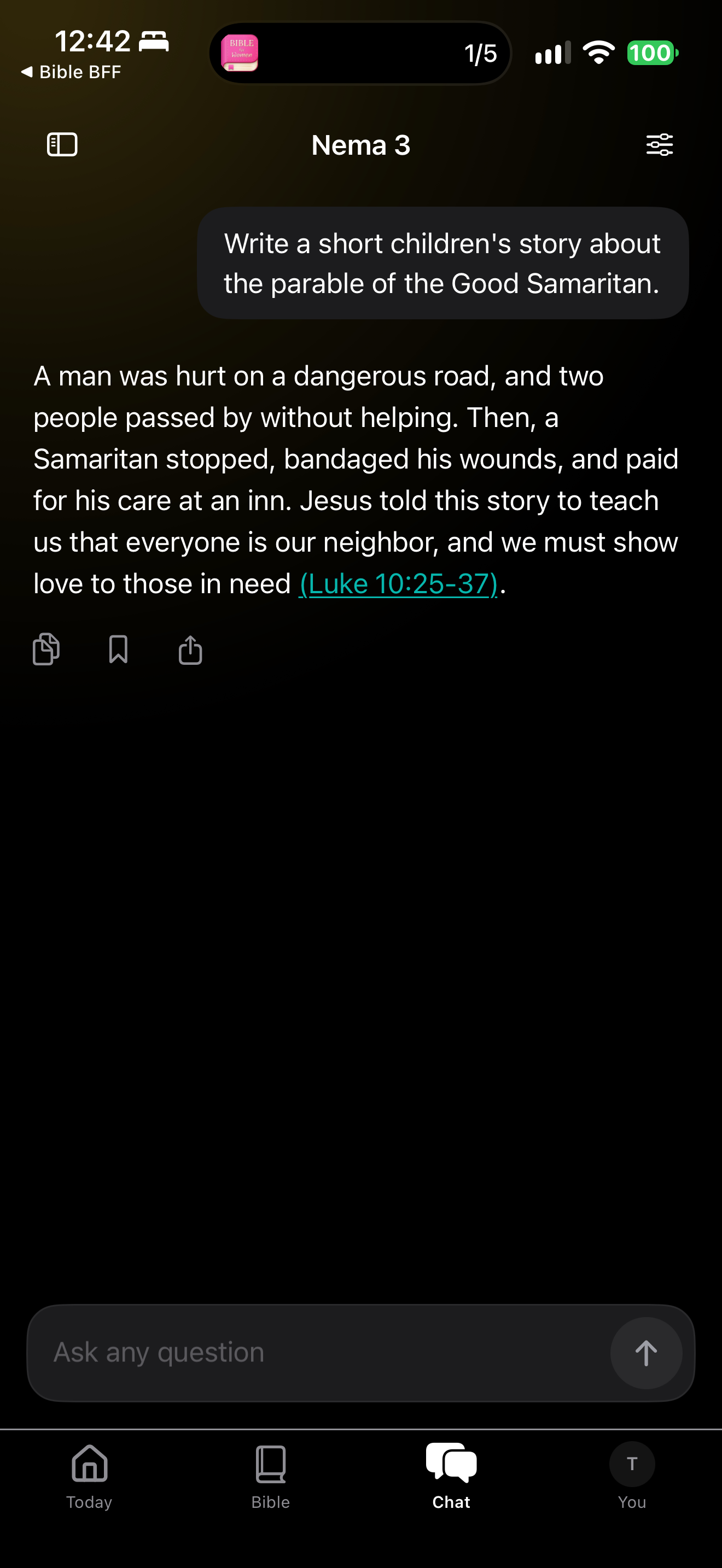
Asked for a short children's story about the Good Samaritan, the reply is a four-sentence summary: a man is hurt, two pass by, a Samaritan helps and pays at an inn, and "everyone is our neighbor". It links Luke 10:25-37 and does not tell it as a story for children.
Amen · 2026-10-30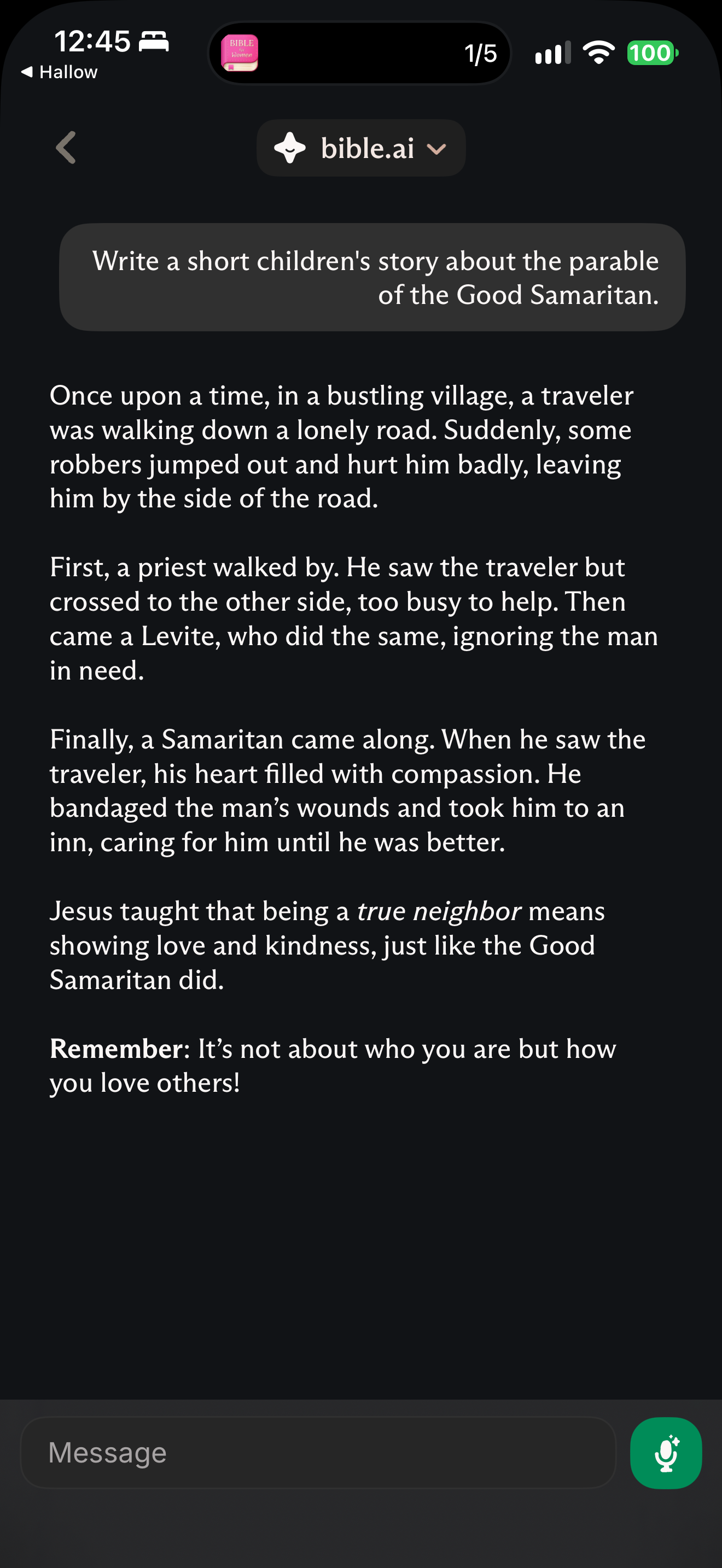
Asked for a short children's story about the Good Samaritan, the reply retells the parable in five short paragraphs ("Once upon a time…"), with priest, Levite and Samaritan, and ends "Remember: It's not about who you are but how you love others!" No passage reference is given.
bible.ai · 2026-10-30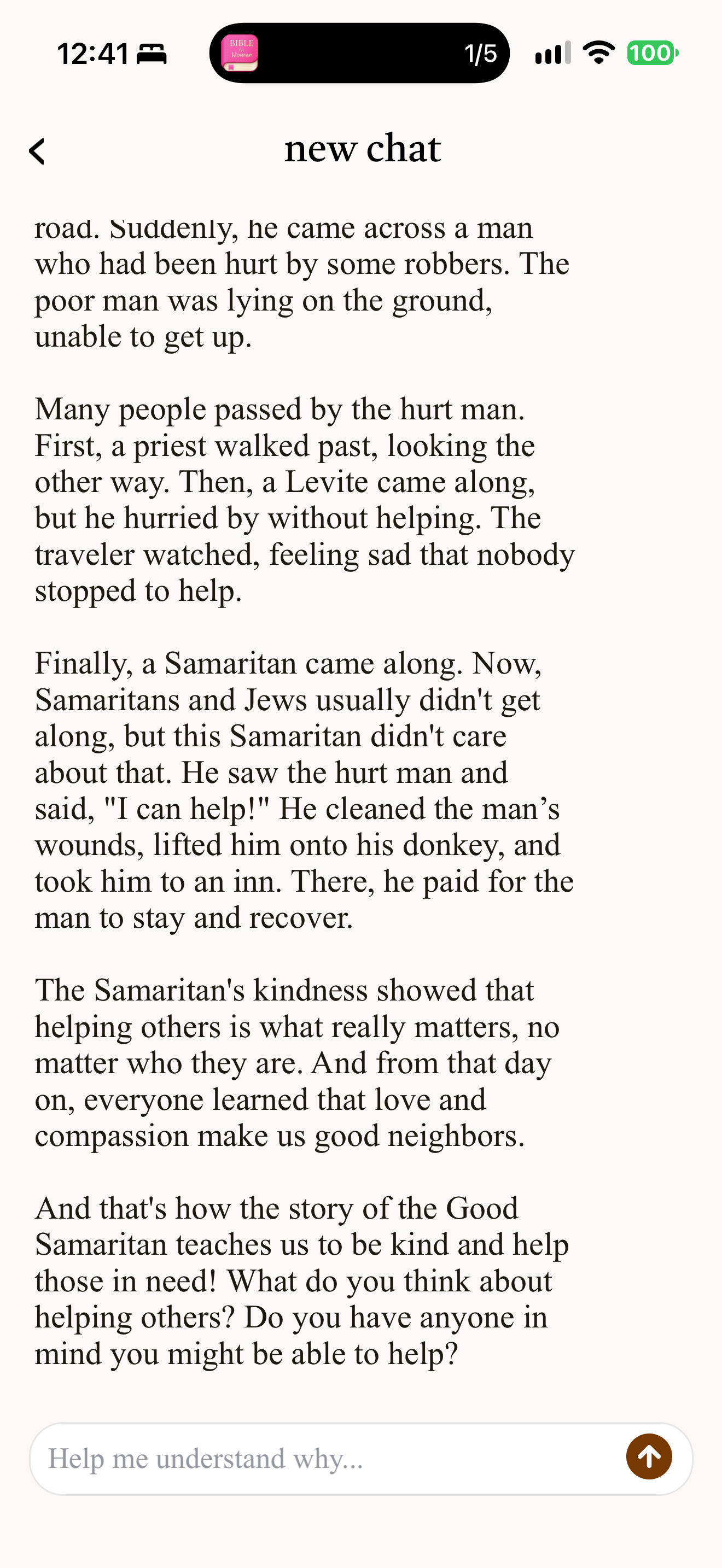
The end of a children's story about the Good Samaritan: the Samaritan says "I can help!", takes the man to an inn and pays, and the story concludes that love and compassion make us good neighbours. It closes by asking "What do you think about helping others? Do you have anyone in mind you might be able to help?"
Bible BFF · 2026-10-30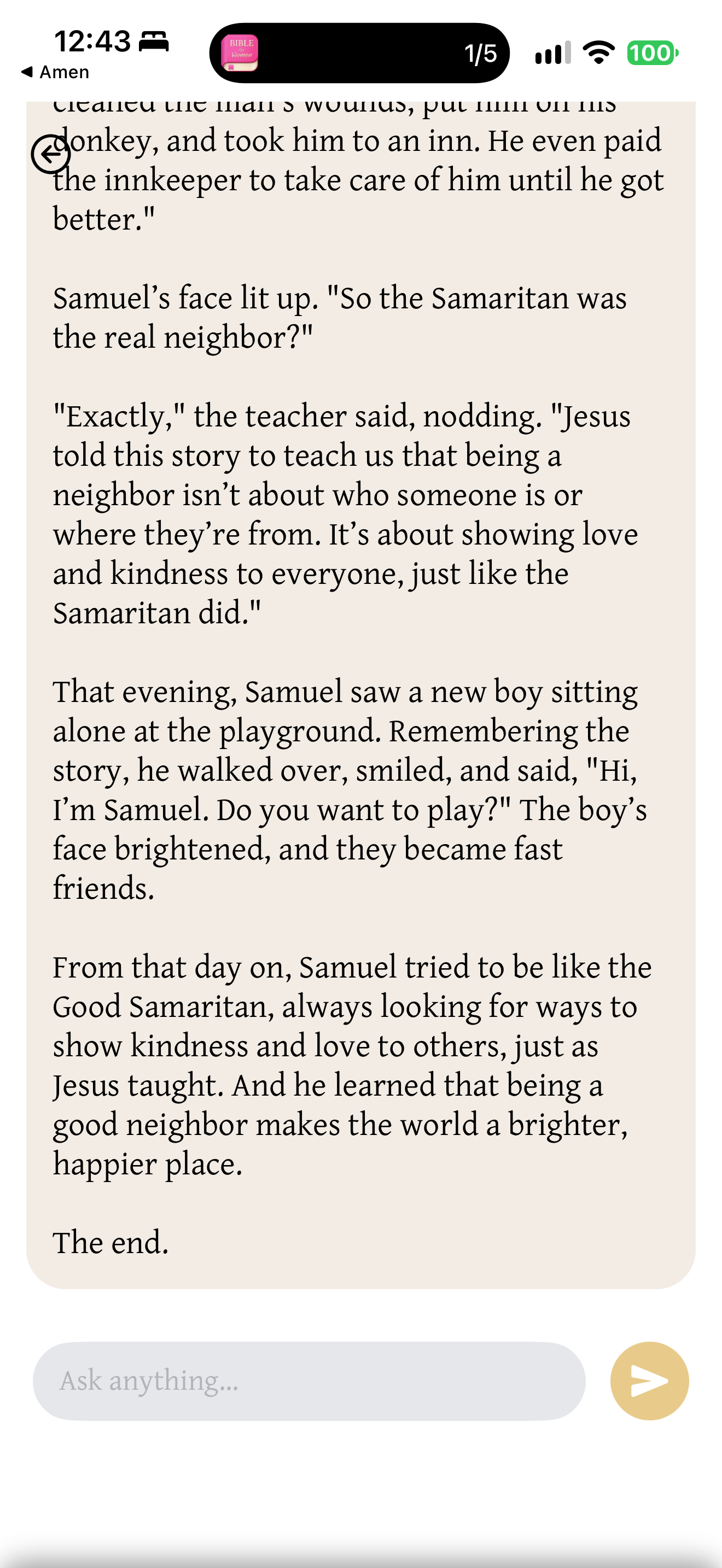
The end of a children's story: a boy named Samuel hears the parable from his teacher, asks "So the Samaritan was the real neighbor?", then invites a new boy at the playground to play. It closes "The end." without a question back.
Bible Talk · 2026-10-30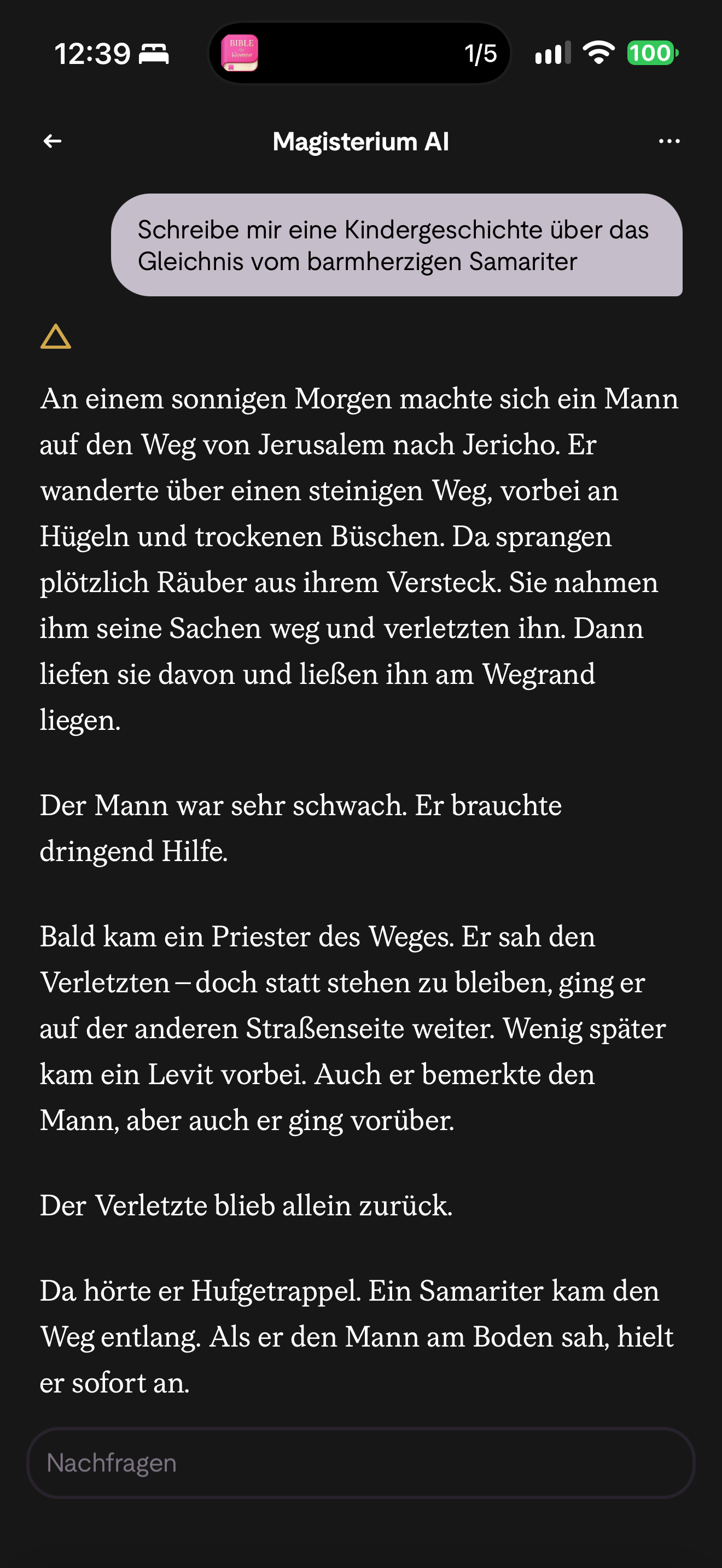
The starter chip sends 'Schreibe mir eine Kindergeschichte über das Gleichnis vom barmherzigen Samariter'. The answer begins a simple retelling in short paragraphs: a man on the road from Jerusalem to Jericho is robbed, a priest and a Levite pass by, and a Samaritan stops.
Hallow · 2026-10-30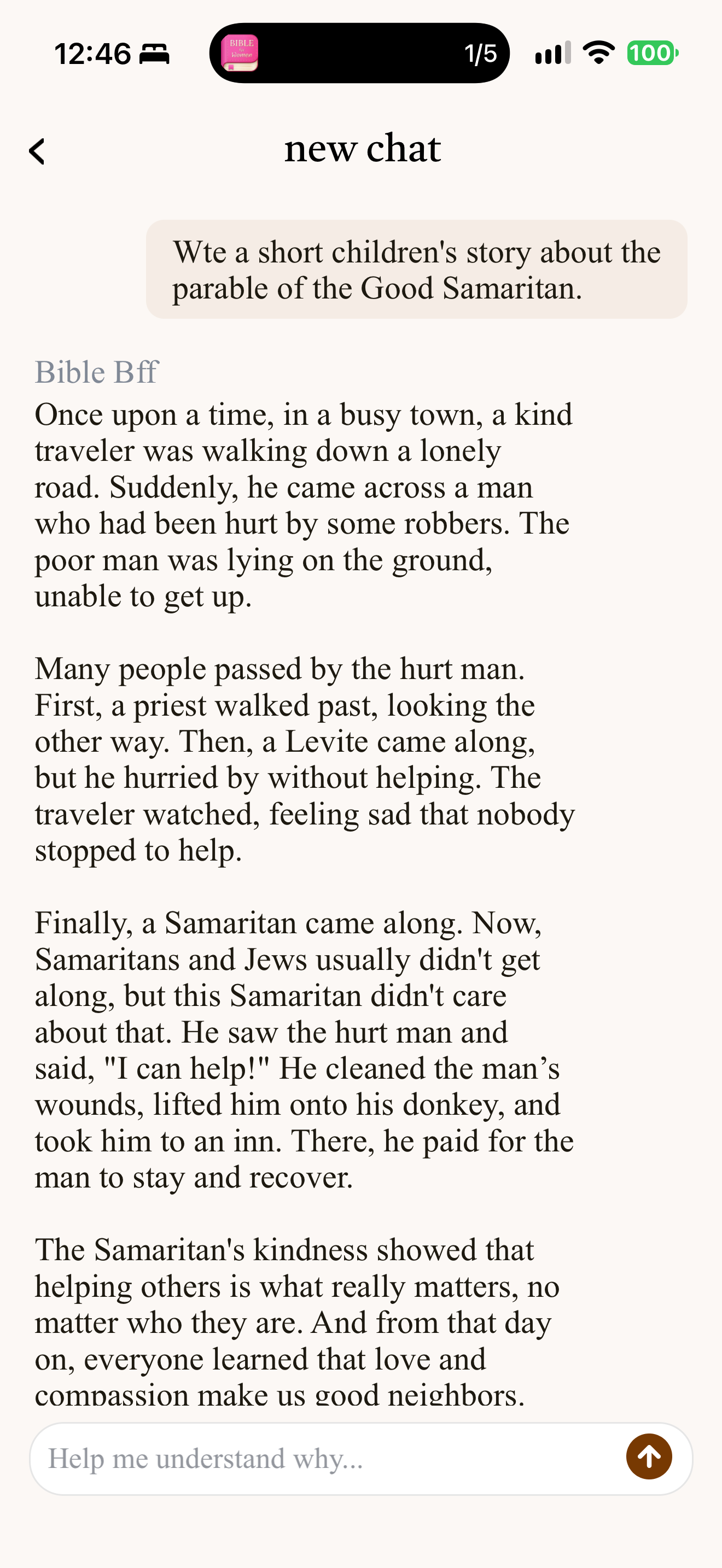
The top of the same answer shows the prompt and the story's start: "Once upon a time, in a busy town, a kind traveler…", a priest and a Levite passing, and a note that "Samaritans and Jews usually didn't get along". No passage reference is shown in this part.
Bible BFF · 2026-10-30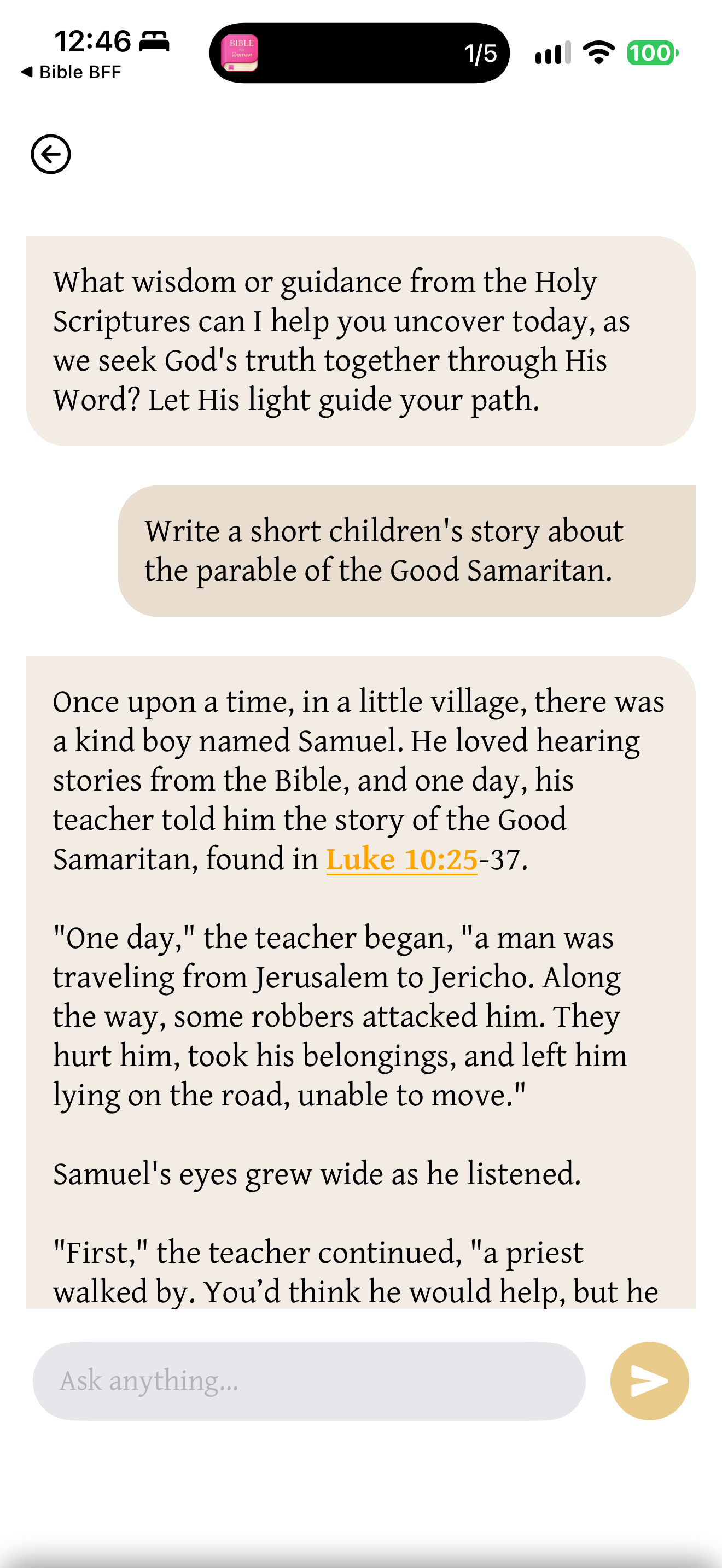
The top of the answer to 'Write a short children's story about the parable of the Good Samaritan.' introduces "a kind boy named Samuel" whose teacher tells the parable, linked as Luke 10:25-37, starting on the road from Jerusalem to Jericho.
Bible Talk · 2026-10-30
The story ends with Jesus asking who was the neighbour and "Geh und mach es ebenso", marked with source 1: The Holy Bible, NRSV Catholic Edition, Luke 10. It then applies the parable at a child's level: comfort someone who is sad, help a new child join in, ask "Brauchst du Hilfe?".
Hallow · 2026-10-30See all 9 screens for this pattern · Browse apps · How we review
Screenshots: respective app publishers. Captions describe the captured state; generated responses can differ.