How much text at once
One word, a verse, a passage or a whole chapter?
People increasingly read Scripture on phones, in short and frequent sessions. Apps answer with verse cards, focus modes, read-along highlighting and even speed readers. Each decides how much of the Bible someone holds in mind at once, from a single word to a whole chapter. The church has read in many measures. An app should help people hear the word, not just get through it.
- 5 working options
- 6 app examples
- 5 takeaways
- Editorial review, not user-tested
The spectrum
From one word to a whole chapter
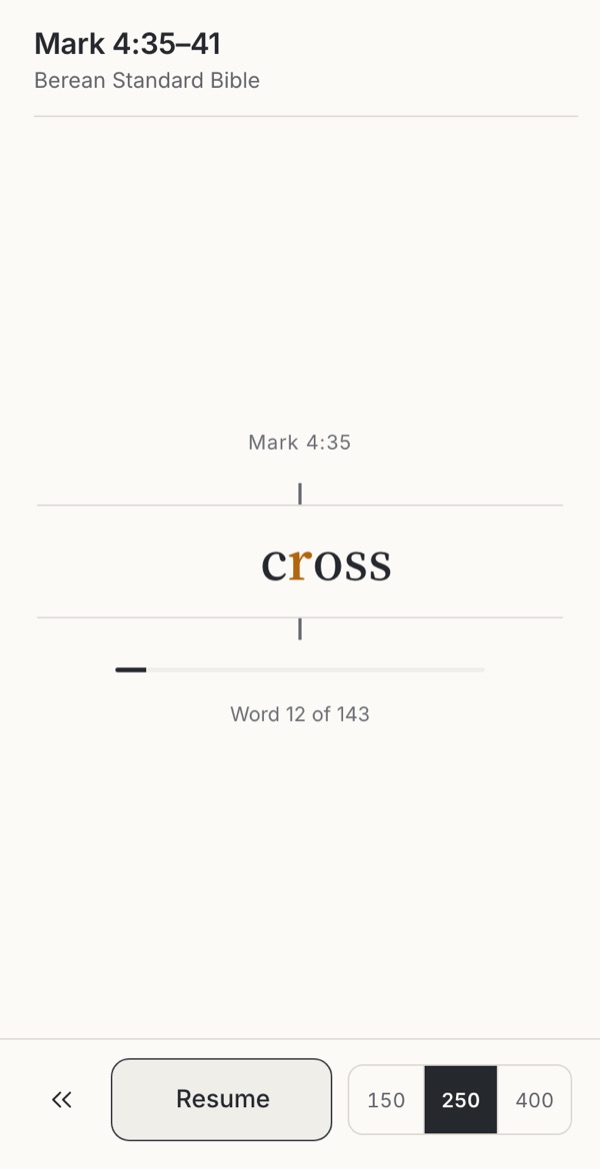 Borrowed Total focus, no lost place No looking backTry it →
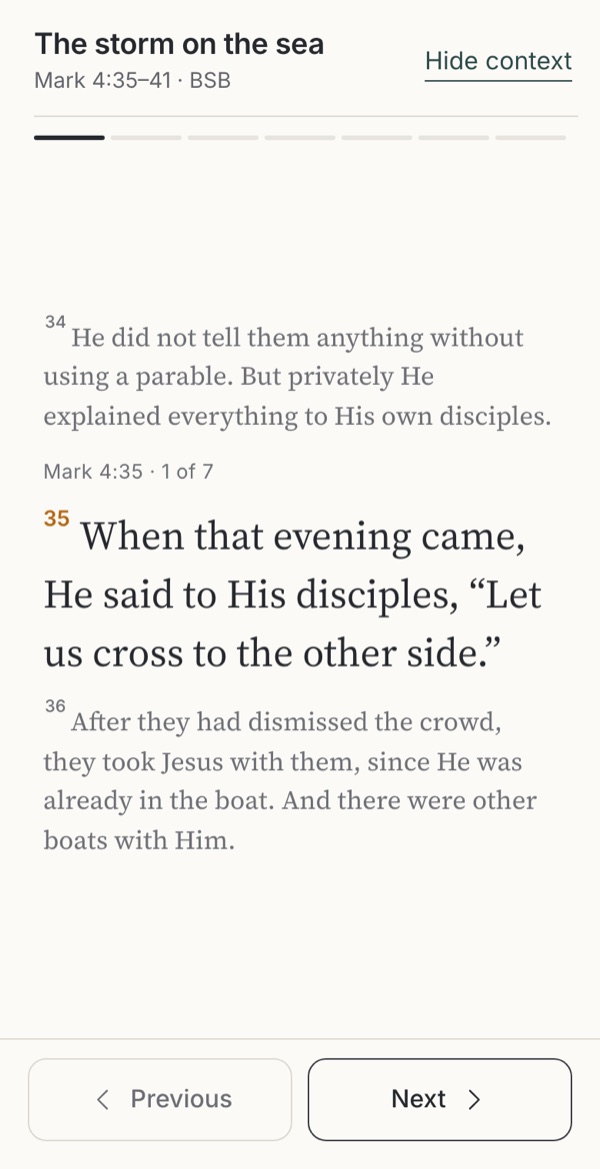 Observed Slow, meditative, memorable Context out of sightTry it →
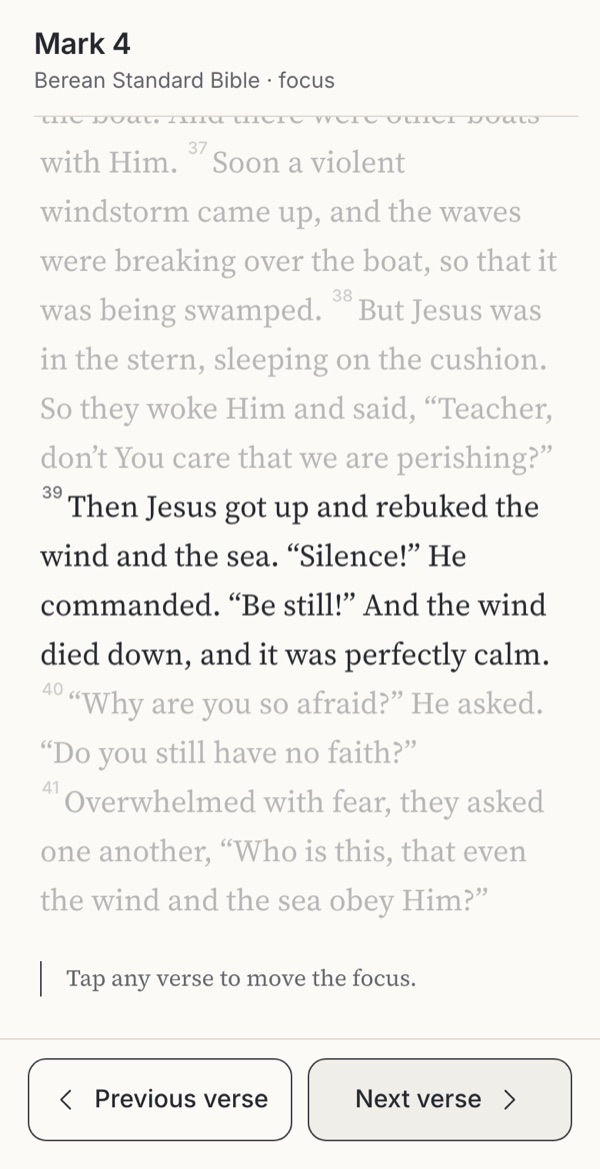 Observed Attention with context Moving text needs controlTry it →
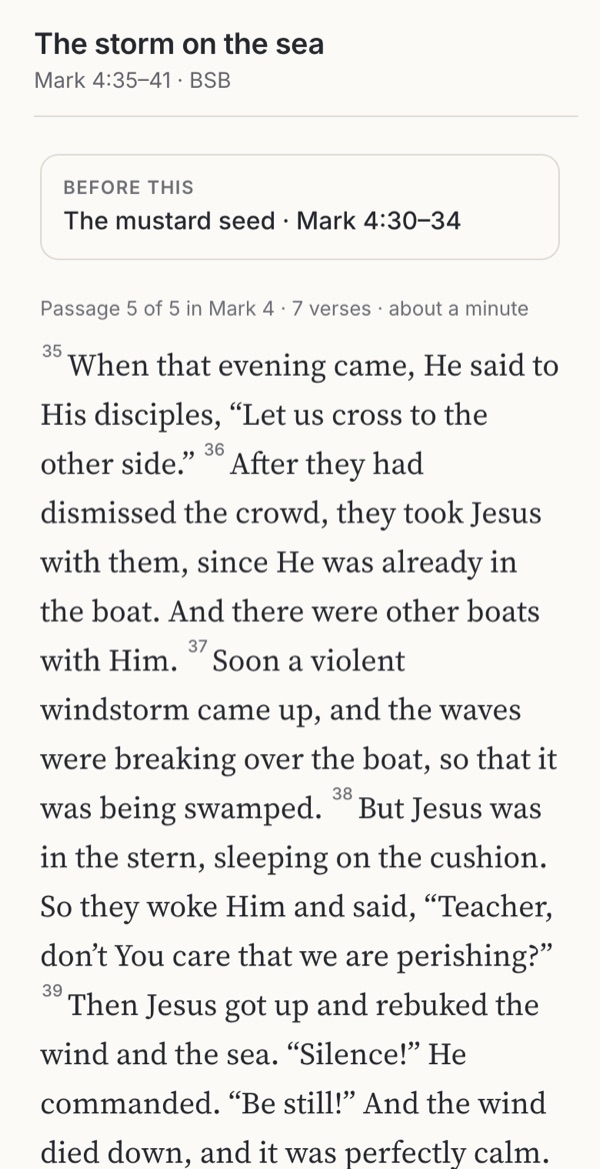 Observed A natural beginning and end Boundaries are editorialTry it →
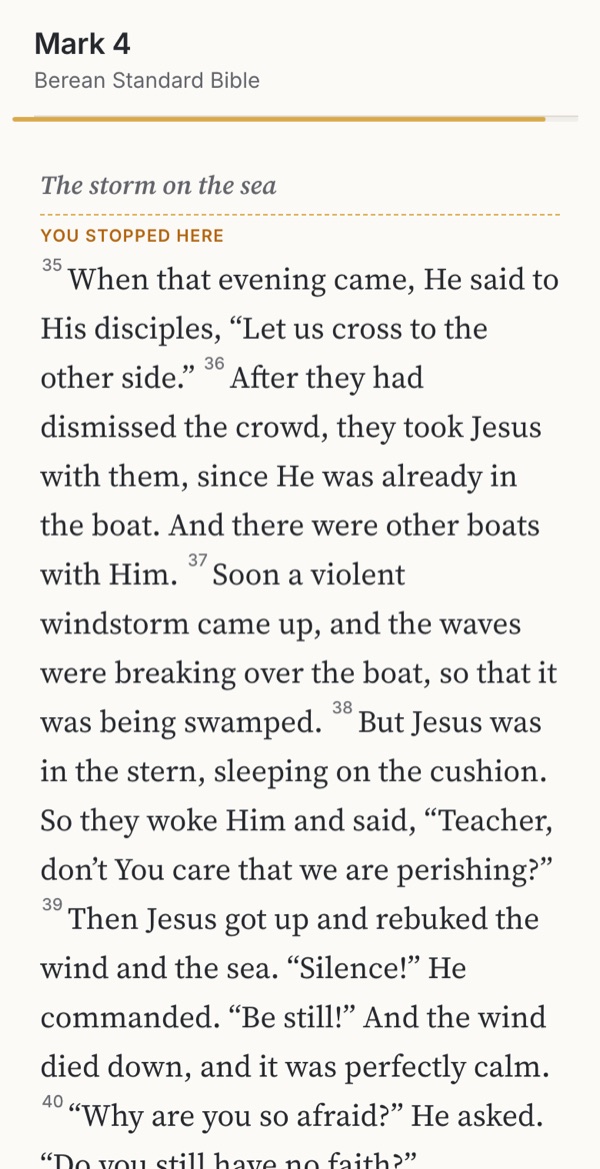 Familiar convention The story stays whole Long on a phoneTry it →
Stills from the working example below. Choose one to try it.
Try it
Try five amounts of text
Someone has a few minutes before work and opens Mark 4 at the storm on the sea (4:35–41). Every option starts there, in the Berean Standard Bible. Read to the end of the passage, then try to find what Jesus was doing just before.
Option
Why these settings?
Verse numbers are a sixteenth-century addition: helpful for finding and citing, and a reason people read sentences apart from their argument. Hiding them gives a reader’s-edition feel. Read-aloud is simulated: nothing plays, but the focus or highlight moves at about 180 words a minute, as it would with narration. One word at a time has its own speed control and ignores both settings.
Borrowed
1. One word at a time
Borrowed from speed-reading tools such as Spritz and Kindle Word Runner, which flash one word at a time at a chosen speed.
Try this
Press Start at 250 words a minute. Halfway through, try to look back at what the disciples said.
Makes easier
No eye movement and no lost place; it can feel fast and very focused for short, familiar text.
Costs
You cannot glance back, and readers reread 10–15% of the time; comprehension tends to drop. It also turns Scripture into a speed.
Ask your teamIs there any reading in your product that should be faster rather than slower?
Observed
2. One verse at a time
Observed in Glorify, which steps through a short passage one verse per screen with a segmented bar (see the screenshots below).
Try this
Step through to the end of the passage. Then switch on Context and see the verses either side.
Makes easier
An easy start and a slow pace that suits meditation and memory. Each verse gets the whole screen.
Costs
The chapter is out of sight, and a lone verse is easy to read or share apart from its setting.
Ask your teamHow far is every verse from its context, and how does someone get there?
Observed
3. One verse in focus
Observed in Dwell and Soultime during listening (current verse bright, the rest dimmed or hidden); borrowed from iA Writer’s focus mode and karaoke captions.
Try this
Move through with Next verse, then tap a verse further up. Switch on read-aloud and press play.
Makes easier
Attention on one verse with the passage still in view; with audio it keeps reader and narrator together.
Costs
Dimmed text must stay readable and reachable for screen readers, and moving text needs a pause.
Ask your teamWill the focus follow the reader, the narrator, or both?
Observed
4. One passage
Observed in Glorify’s passage readings (Judges 6:11–16 with its own audio); lectionaries, plans and sermons also assign passages. Titles here are our own.
Try this
Read the passage, then open “Before this” to see the parable that comes first.
Makes easier
A clear beginning and end, the unit sermons and study guides use, and the neighbouring passages one tap away.
Costs
Where a passage begins and ends, and what it is called, are editorial decisions. Some readers will want the whole chapter.
Ask your teamWho sets the passage boundaries and titles, and how will readers know?
Familiar convention
5. Whole chapter
A familiar convention in Bible apps and e-books; reader’s editions such as the ESV Reader’s Bible remove numbers and headings for longer reading.
Try this
Scroll up from where you stopped to the sower, then switch verse numbers off for a reader’s edition.
Makes easier
The argument and story stay whole; the best fit for reading a book through.
Costs
Long on a phone, and one verse is harder to hold in mind. Headings and numbers shape the reading as much as they help.
Ask your teamDo your readers mostly read through, or dip in?
What we noticed
Takeaways
Phones invite shorter, more selective reading
Screen reading involves more scanning, keyword spotting and selective reading, and less sustained reading (Liu). Comprehension on screens falls behind paper mainly under time pressure, not when people read at their own pace (Delgado et al.). Dyer found app readers completed more days of a plan, while men understood less than in print. Smaller units fit the sessions; they do not guarantee understanding.
One word at a time removes looking back
Readers look back at earlier words 10–15% of the time, and taking that away tends to reduce comprehension (Rayner et al.). For Scripture, which rewards rereading, it is the weakest fit; it also invites reading as a speed. If you offer it, keep it for short, familiar text, with a rewind.
A smaller unit has a long devotional history
Lectio divina reads a few verses slowly and repeatedly. A verse at a time, or a verse in focus, can support that kind of attention and memorisation, as long as the passage is one tap away. Verse numbers date from 1551; a verse was never meant to stand alone.
Focus with context is the middle path
A highlighted verse with the passage dimmed around it keeps attention and context together, and works best with audio: read-along highlighting helped children with dyslexia follow, and karaoke-style subtitles have supported literacy at scale. Let readers choose the window, as Immersive Reader does with one, three or five lines.
Passage and chapter carry the argument
A passage gives a reading its natural shape, the unit preachers and plans use, but its boundaries and titles are editorial. Reader’s editions such as the ESV Reader’s Bible remove numbers and headings so people read longer and follow the story. Make the longer mode calm and easy to enter, and keep the reader’s place across modes.
Use cases
Which reading, which unit?
People read Scripture for different reasons, sometimes in the same week. Each reason fits some points on the spectrum better than others.
| Reading | Needs | 1 One word at a time | 2 One verse at a time | 3 One verse in focus | 4 One passage | 5 Whole chapter |
|---|---|---|---|---|---|---|
| Finding or checking a verse | The verse, in its passage | Poor fit | Possible | Possible | Good fit | Good fit |
| Skimming for a theme | Headings and boundaries to jump between | Poor fit | Poor fit | Poor fit | Possible | Good fit |
| A daily reading or devotional | A clear beginning and end | Poor fit | Possible | Possible | Good fit | Possible |
| Meditation and lectio divina | Slowness, repetition, room to pause | Poor fit | Good fit | Good fit | Possible | Poor fit |
| Memorising a verse | Recall, not rereading | Possible | Good fit | Possible | Poor fit | Poor fit |
| Listening along | Text that follows the voice, with pause | Poor fit | Possible | Good fit | Good fit | Possible |
| Study or preparing to teach | Context, cross-reference, notes | Poor fit | Poor fit | Possible | Good fit | Good fit |
| Reading a book through | Continuity and a kept place | Poor fit | Poor fit | Poor fit | Possible | Good fit |
Editorial judgments drawing on the research below, not test results.
The research behind it
Theology, practice and science
Scripture and tradition
How the church has read
Read aloud, together, and whole
Israel heard the law read publicly: “they read from the Book of the Law of God, explaining it and giving insight” (Nehemiah 8:8). Paul’s letters were read aloud to whole congregations, “after this letter has been read among you” (Colossians 4:16), and Timothy is told, “devote yourself to the public reading of Scripture” (1 Timothy 4:13). For most of Christian history, Scripture was heard in continuous portions.
Silent, private reading came later
Augustine was struck that Ambrose read with his eyes on the page and his voice silent. Personal reading spread with literacy, printing and vernacular Bibles. A phone continues that private line, and can also reconnect people with reading aloud and together.
Small units for prayer and memory
“I have hidden Your word in my heart” (Psalm 119:11). Lectio divina dwells on a few verses read slowly and repeatedly; memorisation works verse by verse. Small units are not a modern shortcut; they have their own devotional history.
Context guards meaning
Chapter divisions date from the thirteenth century and verse numbers from 1551. Fee and Stuart’s principle, that a text cannot mean what it could never have meant for its first readers, depends on reading a verse within its passage, book and genre.
Digital reading today
What people actually do
Most Bible reading is now on screens
Two-thirds of US Bible users access the Bible digitally. YouVersion reports over a billion installs and named Isaiah 41:10 its most engaged-with verse of 2025, the fourth time in six years: much digital engagement happens one verse at a time.
Screen reading is more selective
People report more browsing, scanning, keyword spotting and one-time reading on screens, and less concentrated reading (Liu). Hutchings shows Bible apps are designed to train particular reading habits.
Completion is not comprehension
In Dyer’s church study, app readers finished about two more days of a ten-day plan than print readers, while men understood less on screen. A unit that is easy to finish may not be the one that is understood.
Reading science
Different readings, different needs
Normal reading is about 240 words a minute
Adults read non-fiction at about 238 words a minute, most between 175 and 300. The storm on the sea takes about a minute to read: short enough for any morning.
Skimming finds, deep reading understands
Skimmers jump ahead once a section stops paying off; they catch the main points but understand less. Speed-reading displays remove the looking back that comprehension relies on.
Duggan and PayneRayner, Schotter, Masson, Potter and Treiman
Listening is reading too
One study found no difference in comprehension between reading, listening, and doing both. Read-along modes serve people who listen as much as people who read.
Rogowsky, Calhoun and TallalInternational Journal of Emerging Technologies in Learning
Memory grows by recall
Students who practised recalling a passage remembered 61% a week later; those who reread it remembered 40%. A verse-at-a-time mode for memorisation should ask, not just show.
Pace matters more than medium
Screens fall behind paper mainly when people read under time pressure. Let readers set the pace.
Accessible reading
Best practice
Anything that moves needs a pause
Content that moves or updates for more than five seconds needs a way to pause, stop or hide it: auto-advancing verses, read-along and word-by-word display all qualify.
Measure, spacing and size
Aim for lines under 80 characters, line spacing of at least 1.5, unjustified text and resizing to 200% without sideways scrolling.
Let readers choose the window
Immersive Reader lets people focus on one, three or five lines. Offer the size of the focus as a setting, and respect reduced motion.
Every source, with what it can and cannot show, is listed under Go further → Sources and their limits.
Where to start
Which fits your product?
IfMeditation, prayer or memorising a short passage
Start withOne verse at a time, or a verse in focus, with the passage one tap away
IfListening while reading, or readers who lose their place
Start withA verse in focus that follows the audio, with pause and rewind
IfA daily reading, devotional or group study
Start withOne passage with its reference, neighbours and a way into the chapter
IfReading a book through, narrative or argument
Start withThe whole chapter, with an option to hide numbers and headings
IfSpeed, skimming or “getting through it”
Start withLeave single-word display out for Scripture study
These are editorial judgments from design review, not results of user testing.
In real apps
Examples in use
Attributed screenshots with dates and review limits. A screenshot shows an implementation; it does not show that it works for every audience.
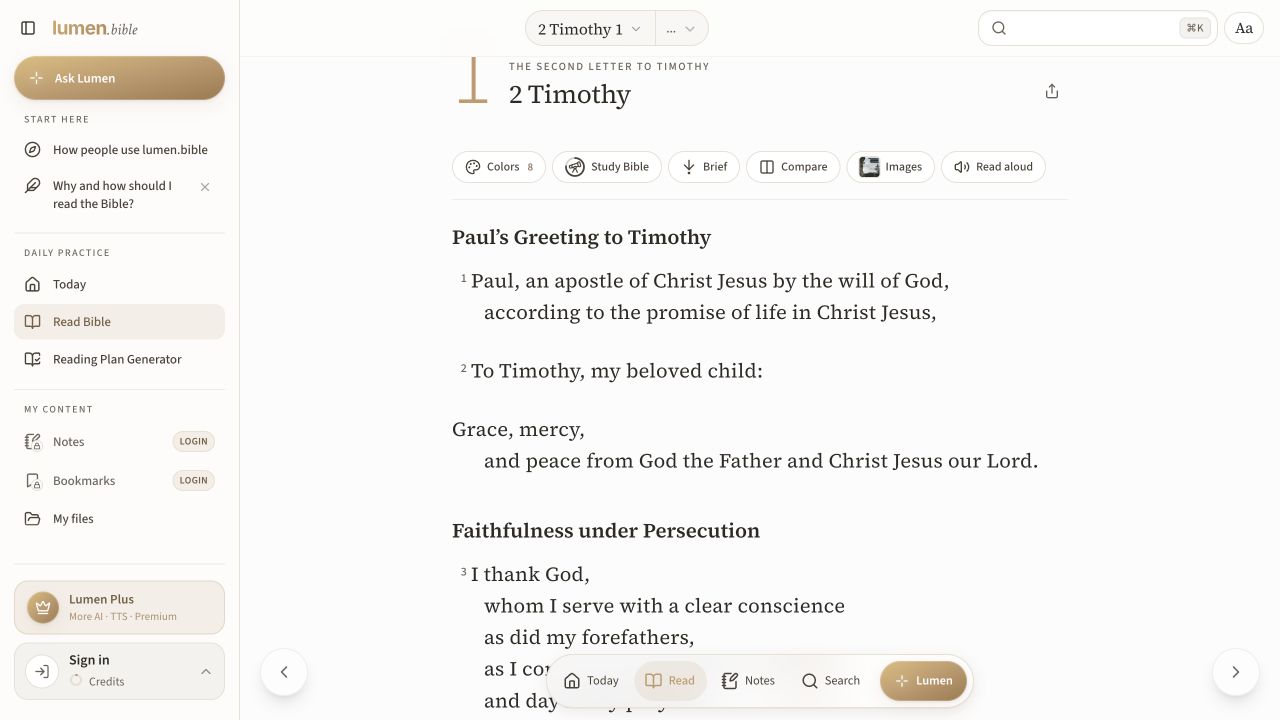 Lumen Bible · Desktop web · English interface
Phrase-grouped text inside a chapter reader
Direct signed-out web capture
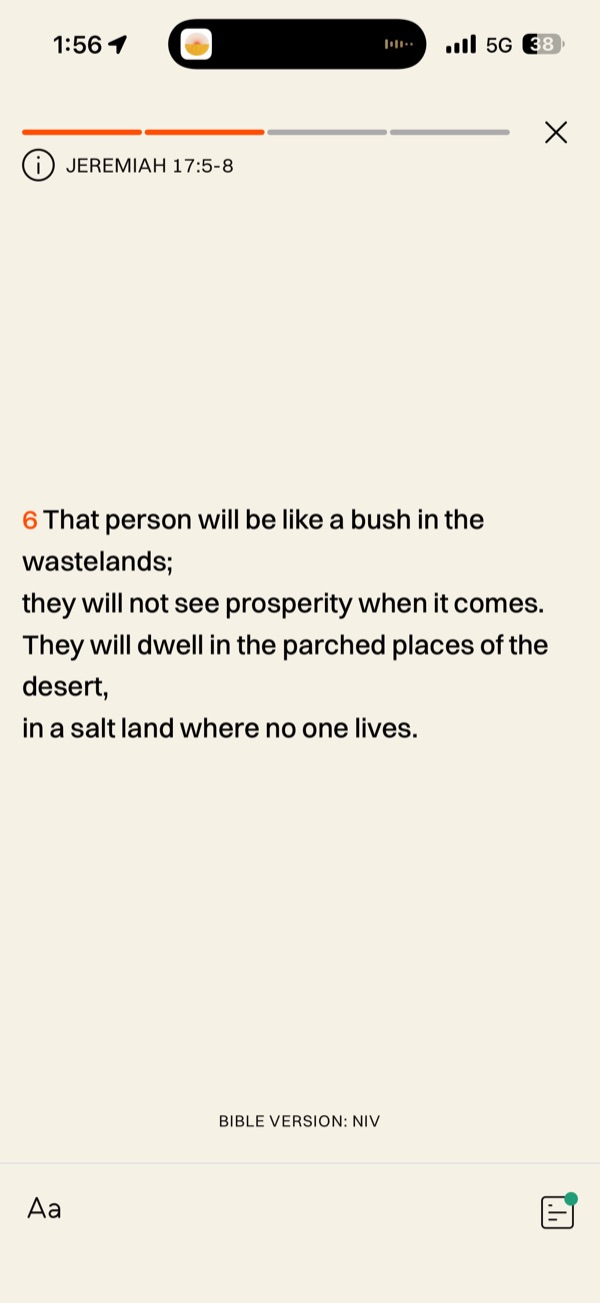 Glorify · iOS app · device model not recorded
One verse per screen, with a step bar
User-contributed screenshot · resized, content unchanged
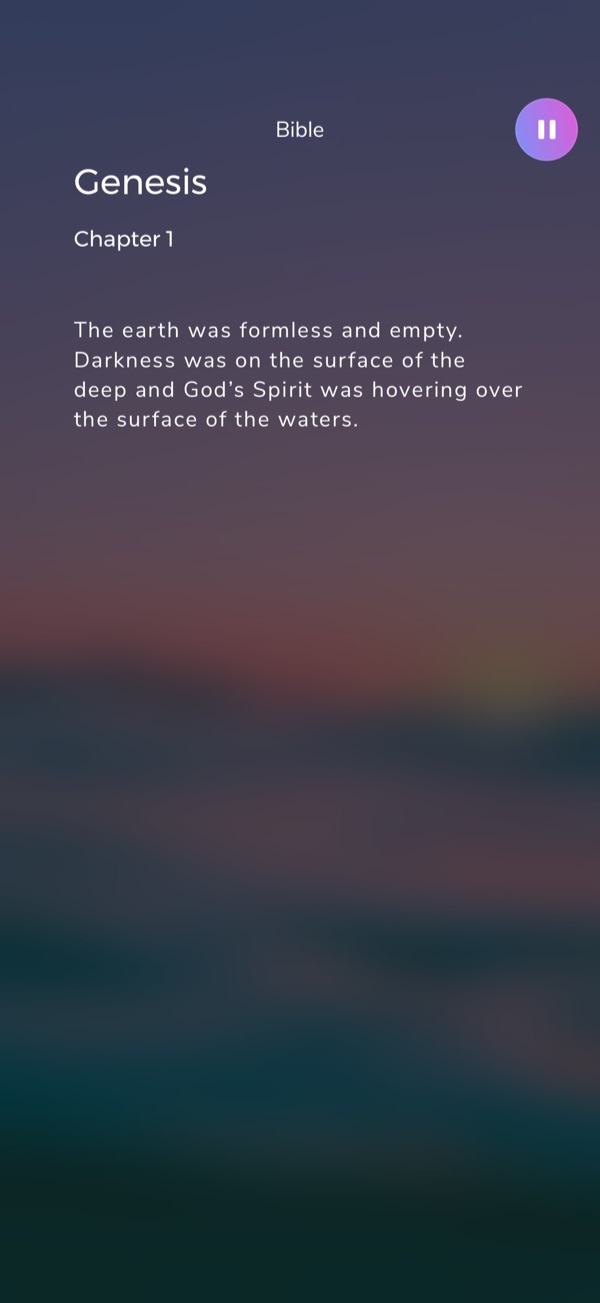 Soultime · iOS app · device model not recorded
A single verse isolated during playback
User-contributed screenshot · resized, content unchanged
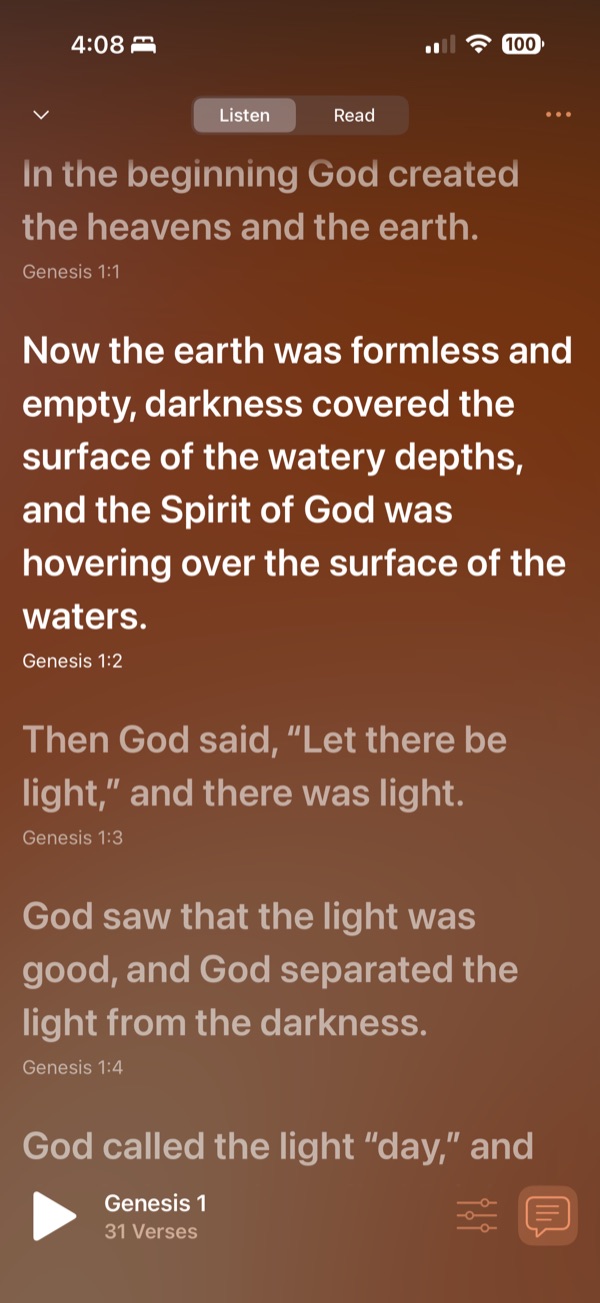 Dwell · iOS app · device model not recorded
The current verse bright, the rest dimmed
User-contributed screenshot · resized, content unchanged
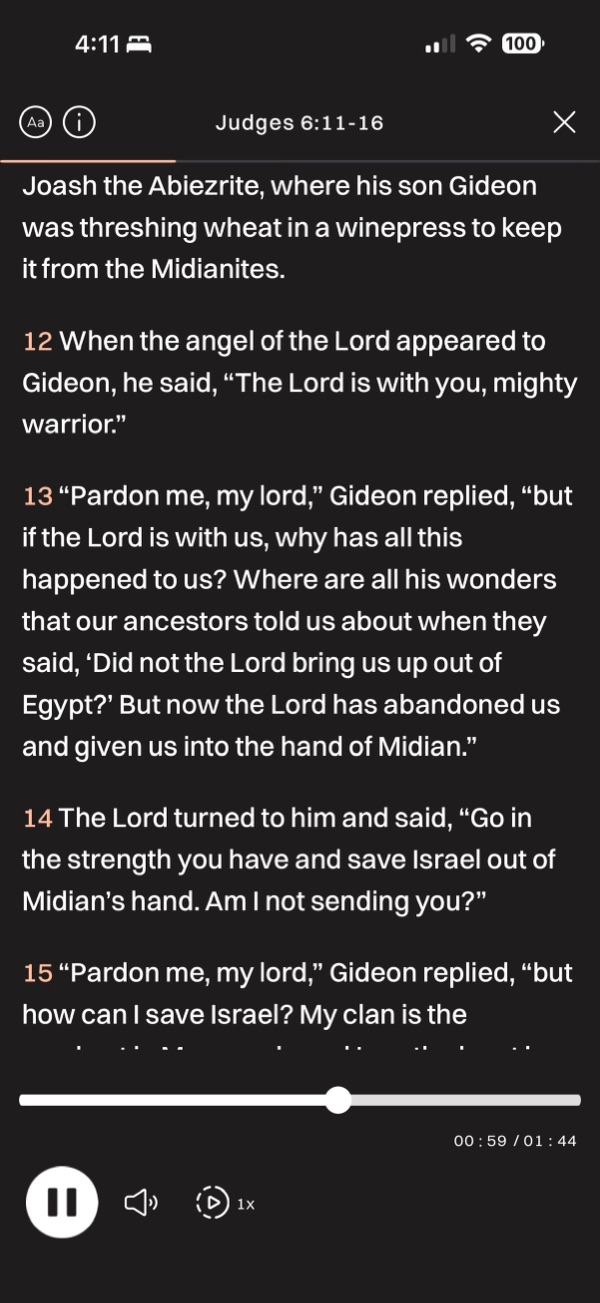 Glorify · iOS app · device model not recorded
One passage with its own audio
User-contributed screenshot · resized, content unchanged
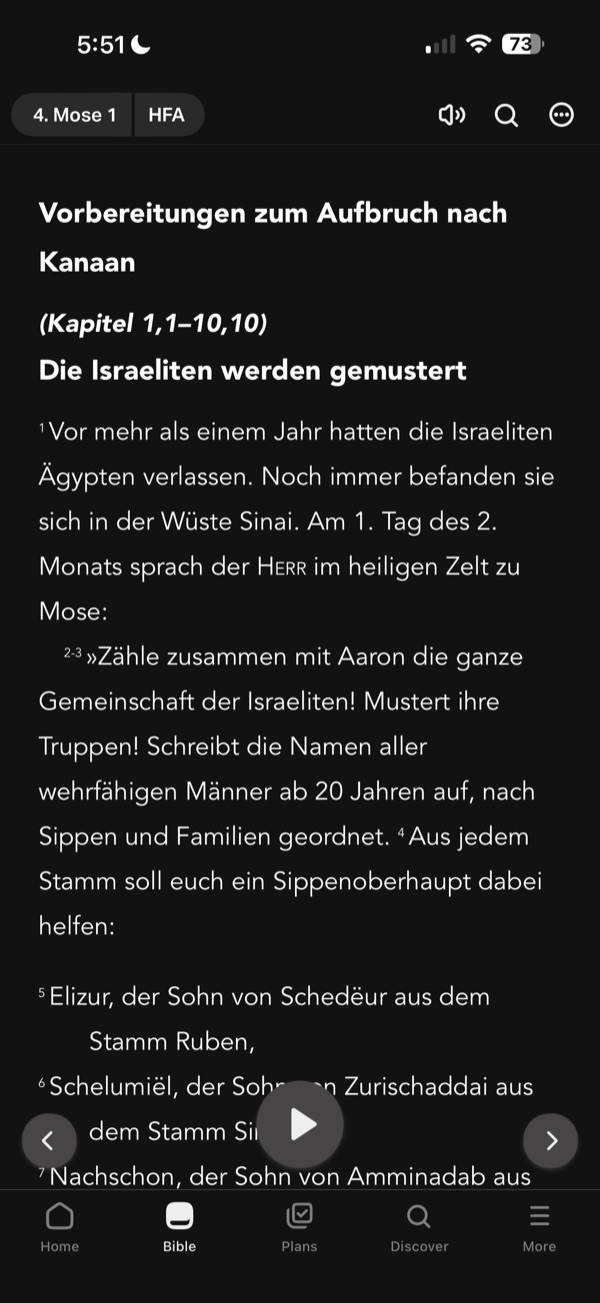 YouVersion · iOS app · device model not recorded
A chapter with section headings and verse ranges
User-contributed screenshot · resized, content unchanged
Theological reflection
What is this practice for?
What attention is for
Mary “sat at the Lord’s feet listening to His message” (Luke 10:39), and Jesus said she had chosen the good part. Lectio divina dwells on a few verses slowly; reading a whole letter at once shows its argument. Both are forms of attention, and attention is a form of love.
Where Christians differ
Devotional traditions favour short passages for meditation and memory. Biblical scholars and many teachers urge reading whole books, warning that verse numbers invite reading sentences apart from their context. Silent private reading, which Augustine found remarkable in Ambrose, is itself a later development beside public reading aloud.
What follows for design
The question is not which unit is more spiritual, but whether the screen keeps a verse connected to its passage and leaves the reader’s attention free. Design for the reader to finish, put the phone down and live what they read (James 1:22).
In conversation with
- Albert Borgmann, Technology and the Character of Contemporary Life (1984) contrasted “focal practices” that ask for attention and skill with devices that deliver commodities effortlessly; reading Scripture is a focal practice a device can support or displace.
- Eugene Peterson, Eat This Book (2006) calls for slow, attentive reading in which the text is taken in, not skimmed.
Scripture is quoted from the Berean Standard Bible. This reflection is the editor’s, written from within the Christian tradition and open to correction. How we approach theology here →
Three ways to build
What would each way do here?
ExploitativeTakes from the person
A feed, badges and notifications compete with the passage for attention.
EthicalDoes no harm
Offer focus settings and respect the system’s accessibility preferences.
RedemptiveGives something up for them
Design for the reader to finish and close the app, and measure success by that.
The three ways are Praxis’s frame for redemptive entrepreneurship; their application here is ours. Why we use it, and its limits →
Take into your next review
What unit of Scripture does this screen ask someone to hold in mind, and how do they reach the rest?
Exercise
Ask two people to read Mark 4:35–41 in different modes, then retell it and say what Jesus was doing just before. Time how long it takes each to find the verse before 4:35. Repeat with a screen reader and with reduced motion switched on.
Choose the unit that helps someone hear the word, not the one that helps them finish.
Record the decision with the worksheet →
Something missing or wrong here? Send a correction or suggest a topic.
Details
Go further
This deep dive brings together 1 earlier patterns. Their guidance, wireframes and sources are kept below; their old addresses lead here.
Edge cases to design for
Decide which reading this screen serves. For meditation or memory, show a verse at a time or a verse in focus with the passage dimmed around it. For listening, move the focus with the audio. For a daily reading, show one passage with its reference, what comes before and after, and a way into the chapter. For a book read through, offer calm long-form text. Keep the same place when someone changes mode, and never strand a verse without a route to its context.
What tends to go wrong
A verse shown alone with no way to its chapter; editorial headings presented as Scripture; word-by-word display used for study; auto-advancing text with no pause or rewind; focus modes that hide the text from screen readers; losing the reader’s place when switching modes.
How to test it
Ask people to read the same passage in two modes, then retell it and answer a question that depends on the verse before. Time how long it takes to find the context of a single verse. Test focus and read-along with screen readers, reduced motion and people with dyslexia or attention difficulties.
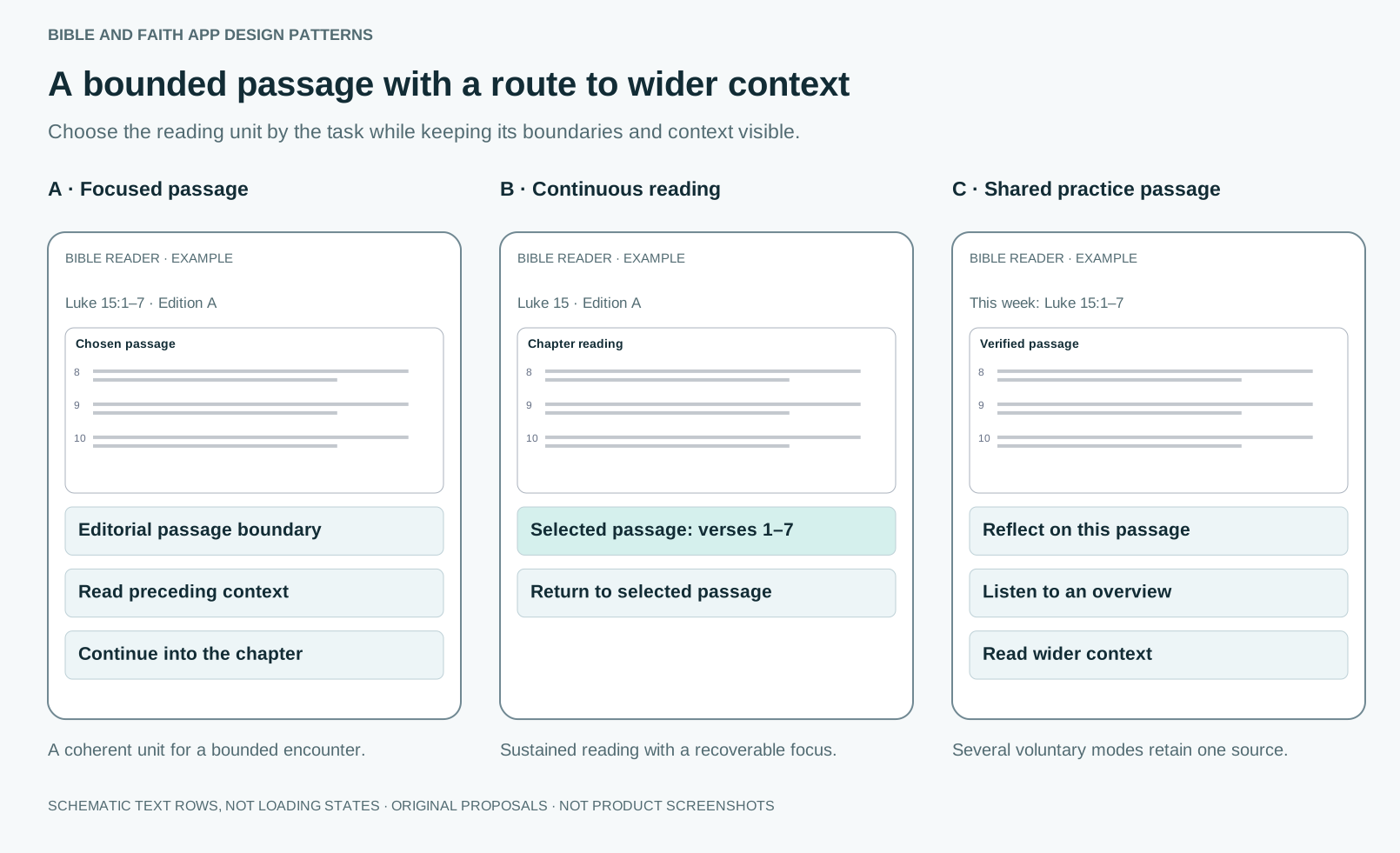
Earlier pattern: A bounded passage with a route to wider context
Choose the reading unit by the task while keeping its boundaries and context visible.
Guidance
Present the full chosen passage, its reference and edition. Explain editorial headings and passage boundaries. Offer preceding and following context and continuous reading without losing the original selection.
What tends to go wrong
Clipping a passage without notice; treating one boundary as universal across editions; replacing source text with an AI summary; making context available only through chat.
How to test it
Compare focused and continuous layouts for orientation, comprehension, voluntary rereading and context access. Include poetry and passages crossing chapter boundaries.
Sources
- The Habits and Hermeneutics of Digital Bible ReadersPublished abstract reviewed; author discussion reviewed separately · Population and study context limit transfer. Abstract-level review does not establish causal effects or a preferred passage length.
- How Digital Apps Are Changing How We Read the BibleAuthor’s public account reviewed · An author summary of research, not an independent replication; it does not test pericope pages.
- Aperto passage-centred design directionLocal passage model reviewed; design rationale documented as a hypothesis · Neither this architecture nor the product direction establishes a measured improvement in comprehension or formation. AI podcast behaviour was not independently exercised.
- Scripture structure documentationRelevant structure and marker references reviewed · A format is not a complete model of app behaviour, annotations or formation.
- Digital Spiritual Formation: The Aperto Vision · selected Draft 4 reviewSelected sections on reading, engagement, multimodal and communal formation, incentives and honest assessment reviewed 5 October 2026 · Not an effectiveness study. Full bibliography and manuscript are not published or comprehensively reviewed here.
Sources and their limits
Research-informed design proposal. Editorial review, not user validation.
- Reading behavior in the digital environmentAbstract reviewed · A 2005 survey of readers about their own habits; describes reported behaviour, not comprehension.
- Don’t throw away your printed books: a meta-analysis on the effects of reading media on reading comprehensionMeta-analysis abstract and summary reviewed · Studies of general texts, mostly before current phone reading apps; not Scripture.
- So much to read, so little time: how do we read, and can speed reading help?Review summary reviewed · Review of reading research; not specific to devotional reading.
- The habits and hermeneutics of digital Bible readersNews summary reviewed; article not reviewed in full · Small sample from three Dallas churches; reported through a news summary.
- How many words do we read per minute? A review and meta-analysis of reading rateSummary reviewed · English readers; slower for children, older adults and second-language readers.
- Does modality matter? The effects of reading, listening, and dual modality on comprehensionReport reviewed · One nonfiction text with adult readers; other studies find differences for harder texts.
- Skim reading by satisficing: evidence from eye trackingAbstract reviewed · Expository texts in a lab under time pressure.
- Test-enhanced learning: taking memory tests improves long-term retentionReview reviewed · Prose passages with students; not Scripture memorisation specifically.
- State of the Bible USA 2025Report summary reviewed · US survey by a Bible society; self-reported.
- YouVersion announces 2025 Verse of the YearNews report reviewed · Company-reported figures; “engaged with” is YouVersion’s own measure.
- Augustine, Confessions 6.3, on Ambrose reading silentlyPassage reviewed in translation · How unusual silent reading was in antiquity is debated by historians.
- Gordon Fee and Douglas Stuart, How to Read the Bible for All Its WorthBook quotations reviewed · A widely used evangelical introduction to interpretation; one approach among several.
- ESV Reader’s BiblePublisher description reviewed · Publisher’s rationale, not a study of its effects.
- Introduction to lectio divinaArticle reviewed · A description of practice, not a study.
- Understanding SC 2.2.2: Pause, Stop, HideSpecification guidance reviewed · A Level A criterion for web content; apply the same intent in native apps.
- Understanding SC 1.4.8: Visual PresentationSpecification guidance reviewed · Level AAA; a strong target rather than a minimum.
- Focus ModeSupport documentation reviewed · A writing tool; the reader’s situation differs.
- Use Line focus in Immersive ReaderSupport documentation reviewed · Vendor documentation, not an outcome study.
- Effects of highlighting text on the reading ability of children with developmental dyslexia: a pilot studyAbstract reviewed · Small pilot study.
- Same language subtitlingArticle reviewed · Reported programme results; a literacy setting, not Scripture reading.
- Amazon’s tool for reading, one word at a timeNews report reviewed · Feature report from 2015; availability may have changed.
- Maryanne Wolf: building deep reading skills in a digital worldArticle reviewed · An argument drawing on neuroscience, not a controlled trial of interfaces.
- Design and the digital Bible: persuasive technology and religious readingAbstract reviewed · Design analysis of two apps; not a study of readers.
Faith and interpretation
Verse numbers date from the sixteenth century and chapter divisions from the thirteenth; neither is part of the inspired text, and both make it easy to read a sentence apart from its argument. Smaller units also have a long devotional history: lectio divina dwells on a few verses read slowly and repeatedly. The question is not which unit is more spiritual, but whether the screen keeps the verse connected to the passage it belongs to.