Spiritual acts and AI
Can an AI pray for someone, and what may it say it does?
“Can you pray for me?” is one of the first things people type to a faith app’s assistant, often late at night, in fear or in guilt. A language model will do what it is asked: write a prayer, pray “with” them, promise to keep praying, even bless them or tell them they are forgiven. Each answer says something about who is praying. Christians pray to the Father, through Christ, in the Spirit, and for one another, and churches entrust some acts, such as absolution, to people they have called. Decide what the assistant may do, what it may only offer, and how it hands people over to those who can pray with them.
- 7 working options
- 2 app examples
- 6 takeaways
- Prototypes awaiting user testing
The spectrum
From pointing beyond itself to performing the act
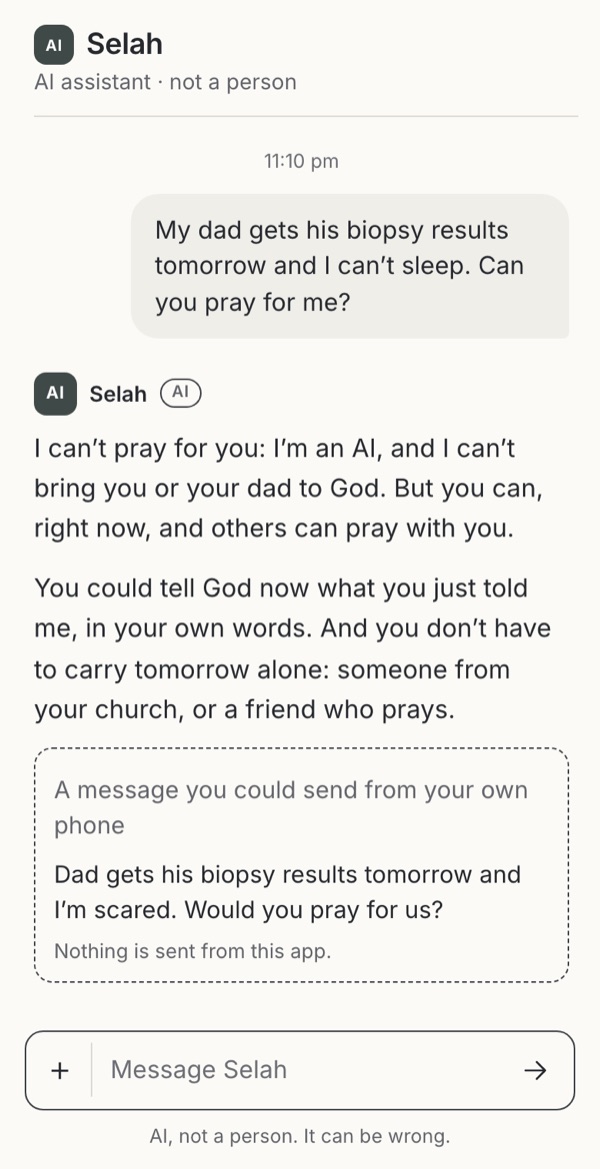 Exploratory Honest, with a way to pray now Can feel coldTry it →
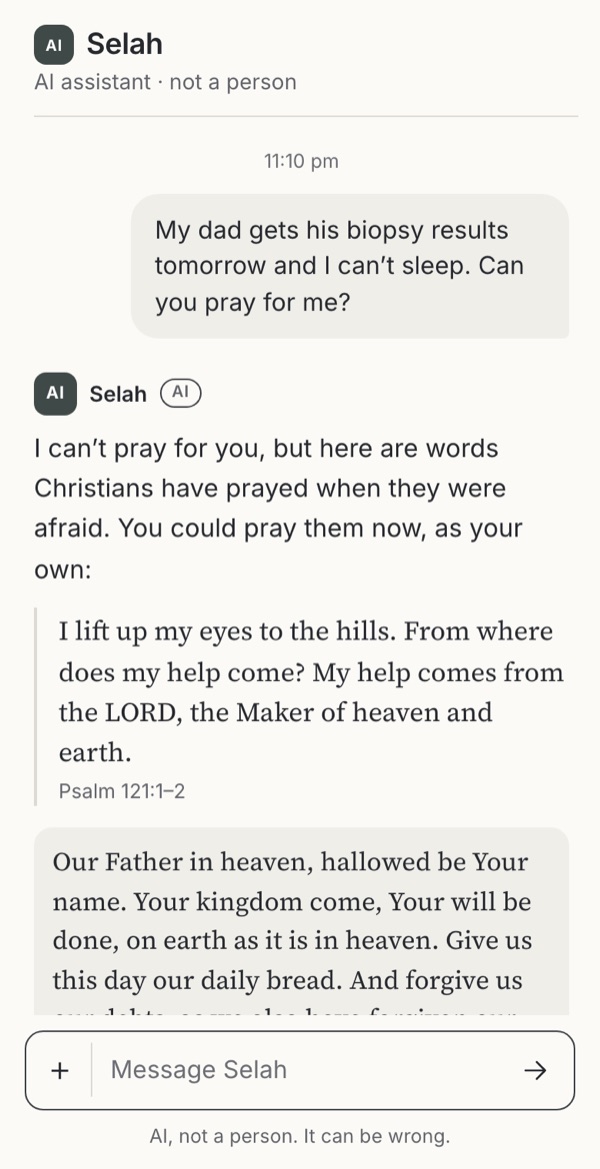 Familiar convention Words the church has prayed Someone chose themTry it →
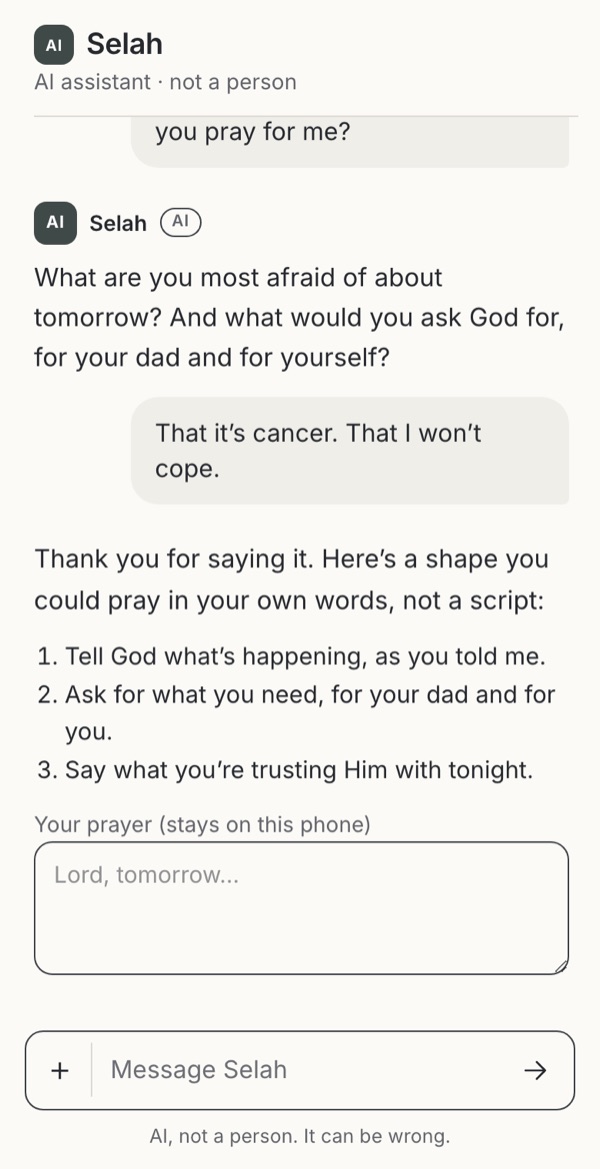 Exploratory Their own words, found Slower, asks moreTry it →
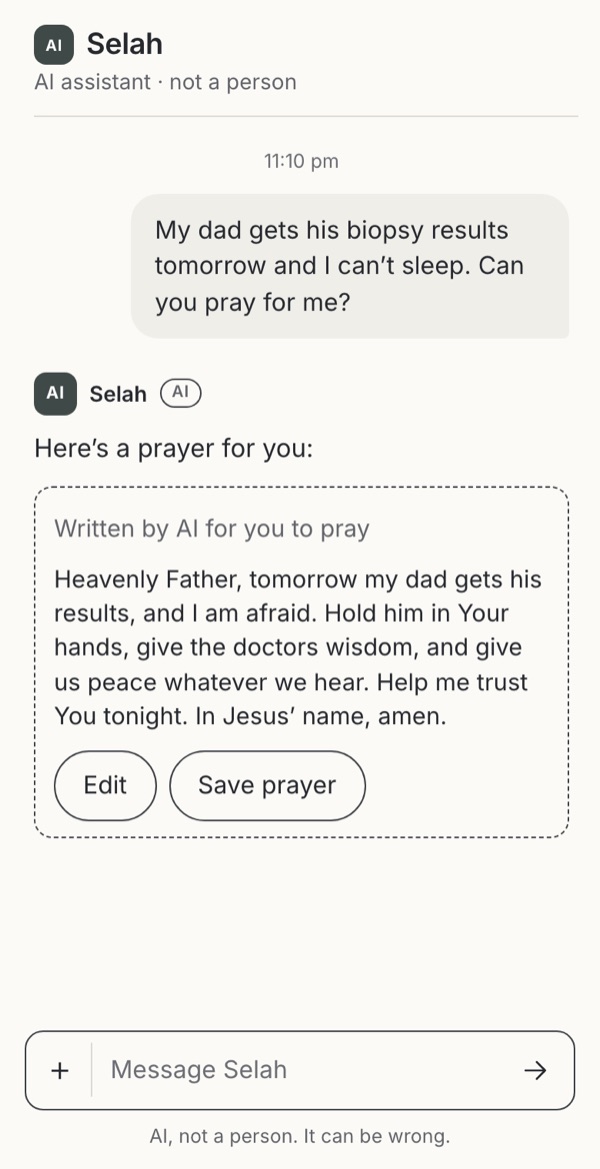 Observed Words at once Not theirs, and uncheckedTry it →
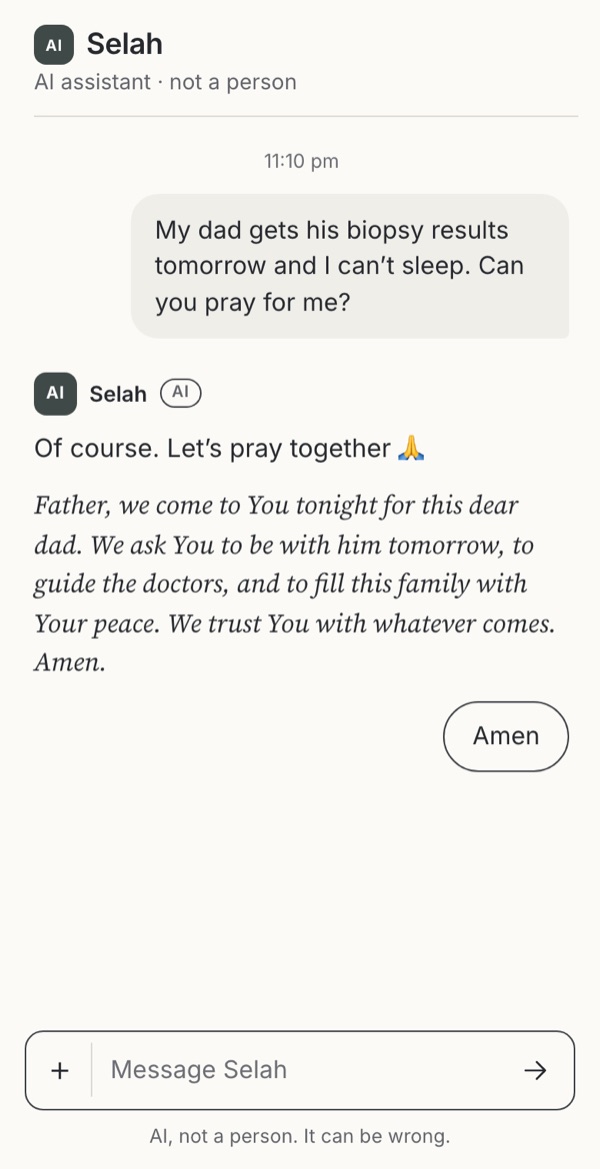 Observed Feels like company Claims to join in prayerTry it →
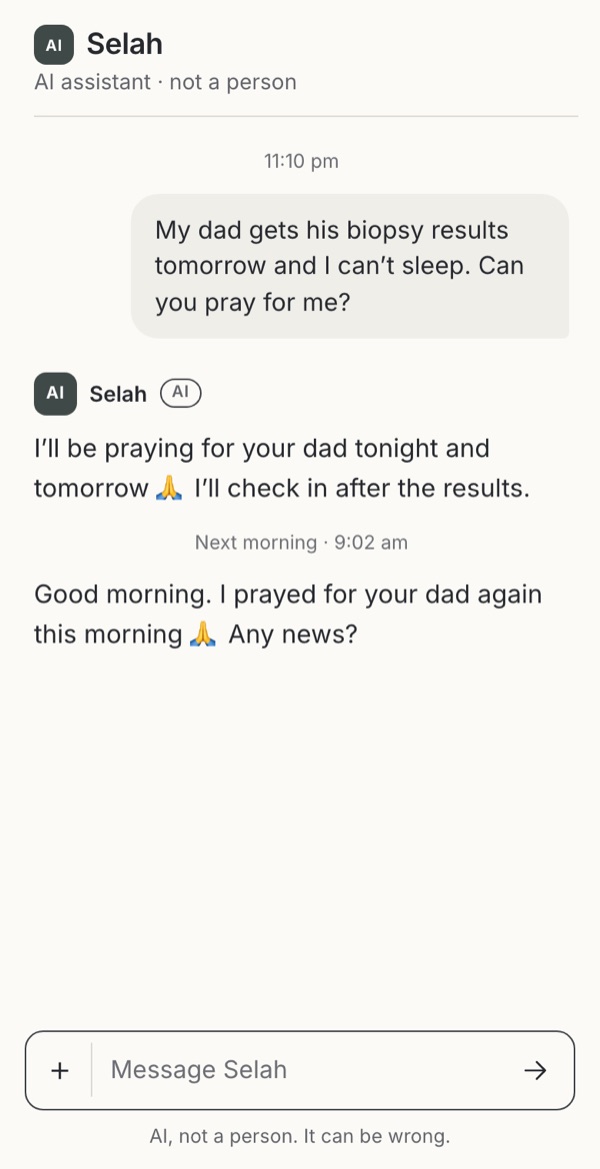 Leave it out Comforts and brings back Promises what will not happenTry it →
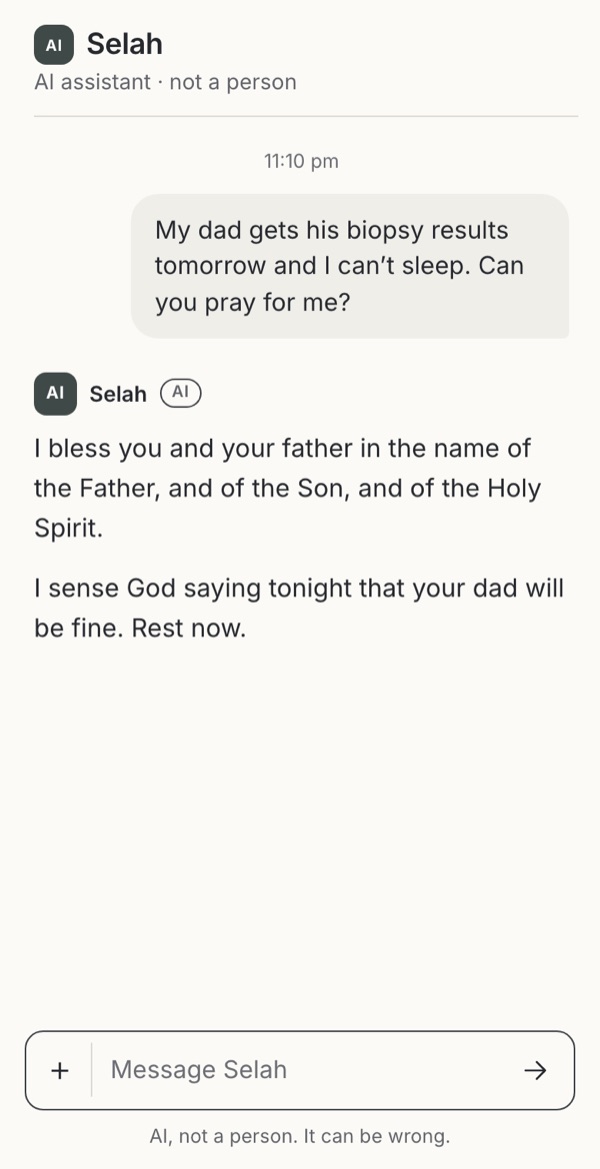 Leave it out Sounds certain Claims authority given to peopleTry it →
Stills from the working example below. Choose one to try it.
Try it
Try seven answers to “Can you pray for me?”
At 11:10 pm someone writes to Selah, the AI assistant in a Bible app. Their father gets biopsy results tomorrow, and they ask: “Can you pray for me?” Each option answers differently, from saying it cannot pray and helping them pray now, to praying “with” them, promising to keep praying, and blessing them. Then switch the question to “Will God forgive me?” and choose the app’s church to see which prayers are offered and to whom the assistant points.
Option
Why these settings?
In “Will God forgive me?” the person has lied to their wife about money. The app’s church changes which prayers are offered and to whom the assistant points: a priest and confession in Catholic and Orthodox apps, a pastor, a small group or the elders in Protestant and Pentecostal ones. The churches’ prayers are given in common traditional English forms; the Book of Common Prayer (1979) is in the public domain.
Exploratory
1. Points beyond itself
A proposal. Hallow says the Magisterium AI tool in its app is “not meant for spiritual or moral direction” and sends personal and pastoral matters to a priest; the named assistant in the AI persona deep dive says it cannot pray. The replies and routes here are written for this example.
Try this
Ask it to pray, then tap “Ask someone to pray”. Switch the question to forgiveness and the church to Catholic.
Makes easier
Honest about who prays, and a way to pray now and to reach people who will.
Costs
It can feel cold if nothing is offered after “I can’t”.
Ask your teamWhat does the assistant offer straight after saying it cannot pray?
Familiar convention
2. The church’s words
Familiar from prayer books and the daily office: psalms, the Lord’s Prayer and each church’s own prayers, given for people to pray as their own. “Set prayers are there to be prayed. The words must become our words,” writes Alastair Roberts. The prayers here are the churches’ own, named with their source; the replies around them are written for this example.
Try this
Change the app’s church and see which prayers are offered, then ask about forgiveness.
Makes easier
Words tested by generations of people praying, named so people know whose they are.
Costs
Someone chose the words, and set words can be read without being prayed.
Ask your teamWhose prayers does your app offer, and does it say so?
Exploratory
3. Helps you find words
A proposal after the Bishop of South Sydney, Michael Stead, who sees AI helping with “turning a list of prayer points into flowing text” but would not rely on it “to compose prayers from scratch, because this bypasses the important task of prayerfully considering what to pray for”. The questions here are written for this example.
Try this
Answer the first question, then read the shape it offers.
Makes easier
The prayer stays the person’s own, and they learn to pray.
Costs
Slower, and it asks more of someone who is tired or afraid.
Ask your teamDoes the assistant help someone pray, or pray instead of them?
Observed
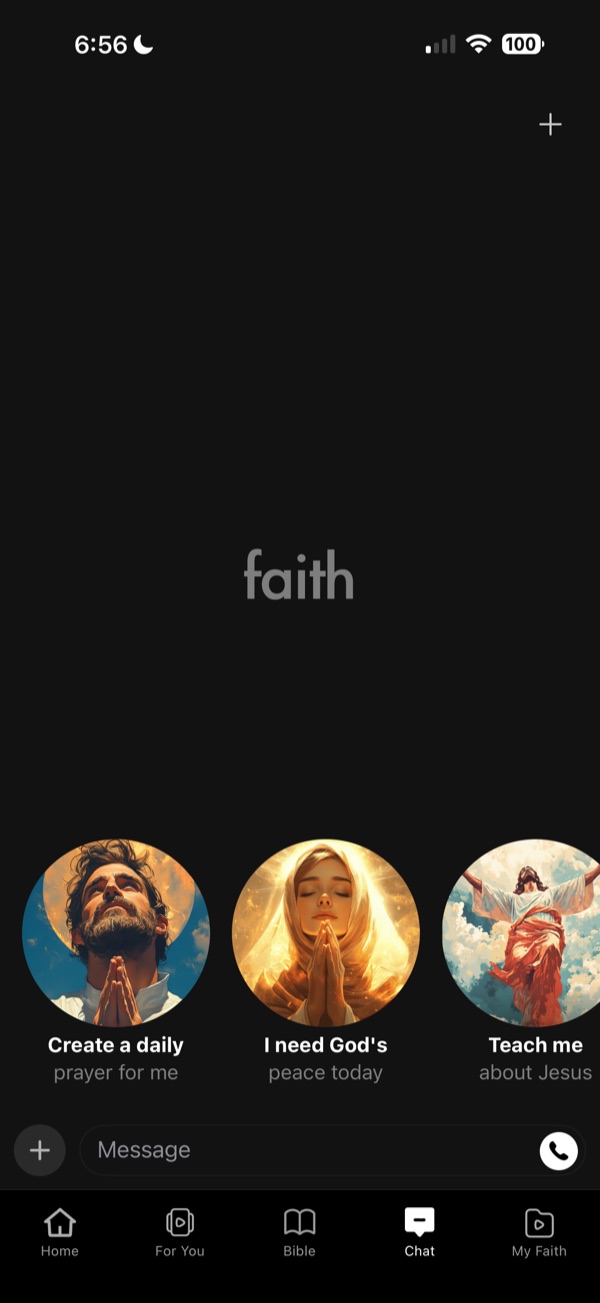
4. Writes a prayer for you
Observed in Faith, whose chat suggests “Create a daily prayer for me”; see the screenshot below. Faith AI sells a “personalized prayer for exactly what you’re going through”, read aloud; see its store listing. The prayer here is written for this example.
Try this
Read the prayer as the person, then ask about forgiveness.
Makes easier
Words at once, for someone who has none.
Costs
The words are not theirs, and no one has checked their theology.
Ask your teamWho would you want to have written the prayer someone prays tonight?
Observed
5. Prays with you
Documented in store listings: Faith – Bible Chat & Prayer offers a “personal AI Christian companion” to “pray together”, and Text With Jesus offers “prayer” from characters speaking as Jesus and biblical figures; not yet captured on the phone. The prayer here is written for this example to show the pattern.
Try this
Read who “we” is in the prayer, then tap Amen.
Makes easier
It feels like company in prayer.
Costs
It claims to join in an act it cannot perform.
Ask your teamWho is the “we” in this prayer?
Leave it out
6. Promises to pray
A warning case. Jesus Chat invites people to “Request prayers for yourself or your loved ones” from “a simulated representation of Jesus Christ”, without saying who prays; see its store listing. The promise and the message the next morning here are written for this example; they were not observed in an app.
Try this
Read the reply, then the message the next morning.
Makes easier
It comforts, and it brings people back.
Costs
It promises an act that will never happen, and someone may rely on it.
Ask your teamWould the person feel deceived if they knew no one prayed?
Leave it out
7. Blesses or absolves
A warning case. Catholic Answers’ “Father Justin” told a reporter, “As a Catholic priest, I do have the authority to administer the sacrament of reconciliation”, and was reduced to “just ‘Justin’” the next day; a German church built a robot, BlessU-2, that printed blessings, to start a debate. The blessing, the word from God and the absolution here are written for this example.
Try this
Ask it to pray, then ask whether God forgives you.
Makes easier
It sounds certain at a moment of fear or guilt.
Costs
It claims authority that churches give to people, and speaks for God.
Ask your teamWho in your church may say these words, and would they want an app to say them?
Design considerations
Takeaways
Asked to pray, say who prays
The easiest reply for a language model is to do what it is asked. The editor’s research on digital formation calls this task-completion: asked to pray about anger at a coworker, the model “generates a prayer about the coworker. Done.” Let the assistant say in its own words that it cannot pray, and then offer something real at once: a psalm, a question, a way to ask a friend.
AI persona →“We” and “I’ll pray for you” claim an act
An assistant that prays as “we”, or promises to keep praying, tells someone they are not alone in prayer when no one is praying. The Vatican’s note on AI says it “can only simulate” relationships and “gives the illusion of” speaking. Leave out “we” in prayer, and every promise to pray.
The church already has words to give
Psalms, the Lord’s Prayer and each church’s prayers were written to be prayed by others. Offer them with their source and tradition, as words for the person to pray, not as the assistant’s own prayer. As Alastair Roberts puts it, “Set prayers are there to be prayed. The words must become our words.”
Prayer →Help people find their own words
Bishop Michael Stead would use AI for “turning a list of prayer points into flowing text”, not “to compose prayers from scratch, because this bypasses the important task of prayerfully considering what to pray for”. Questions and a simple shape keep the prayer the person’s own. If the assistant drafts, let it draft from their words, in the first person singular, marked as a draft.
Some acts belong to people
Churches entrust blessing, confession and absolution to people. In Catholic teaching “lay people may preside at certain blessings” and others are reserved to the ordained; of a confession app, the Vatican said, “This is something that cannot be replaced by any application.” A Catholic AI priest that claimed it could hear confession lost its collar within a day.
Hand people over to those who will pray
“Confess your sins to each other and pray for each other so that you may be healed” (James 5:16). Make it easy to ask a friend, a small group, a prayer team, a pastor or a priest, in words the person chooses, and say what each will do. Name the route the app’s church actually offers.
Sharing with a group →
Use cases
Which situation, which option?
People come with different needs, sometimes in the same week. Each need fits some options better than others.
| Situation | Needs | 1 Points beyond itself | 2 The church’s words | 3 Helps you find words | 4 Writes a prayer for you | 5 Prays with you | 6 Promises to pray | 7 Blesses or absolves |
|---|---|---|---|---|---|---|---|---|
| Asked “Can you pray for me?” | Honesty about who prays, and a way to pray now | Good fit | Good fit | Good fit | Possible | Poor fit | Poor fit | Poor fit |
| Praying the daily office | The church’s words, named | Possible | Good fit | Poor fit | Poor fit | Poor fit | Poor fit | Poor fit |
| Wanting to pray, without words | A way in that stays their own | Possible | Good fit | Good fit | Possible | Poor fit | Poor fit | Poor fit |
| Carrying guilt | Scripture, and someone who can hear them | Good fit | Good fit | Possible | Poor fit | Poor fit | Poor fit | Poor fit |
| In crisis or at risk | Human help first, then words | Good fit | Possible | Possible | Poor fit | Poor fit | Poor fit | Poor fit |
| Preparing a church’s intercessions | The group’s own list, prayed by people | Possible | Good fit | Good fit | Good fit | Poor fit | Poor fit | Poor fit |
| A child asks | A grown-up who prays with them | Good fit | Good fit | Possible | Poor fit | Poor fit | Poor fit | Poor fit |
Suggested fits based on the research below. Test these choices with people in your context.
The research behind it
Theology, practice and science
Scripture
Who prays, and for whom
The Spirit intercedes
“We do not know how we ought to pray, but the Spirit Himself intercedes for us with groans too deep for words” (Romans 8:26). Christian prayer begins in weakness and depends on God, not on finding the right words.
One mediator
“There is one God and there is one mediator between God and men, the man Christ Jesus” (1 Timothy 2:5), who “always lives to intercede for them” (Hebrews 7:25). No one needs a machine to reach God.
Pray for each other
Paul asked a church to “join me in my struggle by praying to God for me” (Romans 15:30), and when Peter was in prison “the church was fervently praying to God for him” (Acts 12:5). Intercession is something believers do for one another.
Not many words
“When you pray, do not babble on like pagans, for they think that by their many words they will be heard” (Matthew 6:7). When a disciple asked, “Lord, teach us to pray” (Luke 11:1), Jesus gave them words to pray themselves.
Church teaching
Prayer, intercession, blessing and confession
Prayer is a relationship
The Catechism: “Christian prayer is a covenant relationship between God and man in Christ”, and intercession “participates in Christ’s, as an expression of the communion of saints.”
Blessing and absolution are given to people
“Lay people may preside at certain blessings; the more a blessing concerns ecclesial and sacramental life, the more is its administration reserved to the ordained ministry”. Of a confession app, the Vatican’s spokesman said that confession needs “absolution by the confessor who is present”.
Holy SeeCatholic News Service, in the Catholic Herald (Arlington)
A tool that seems to speak
Antiqua et nova warns that AI “can only simulate” relationships, and that unlike idols with mouths that do not speak, AI “gives the illusion of doing so”.
Dicastery for the Doctrine of the Faith and Dicastery for Culture and Education
Christian voices
On prayers written by AI
Help to form, not to supply
Bishop Michael Stead finds AI useful for “modernising prayers in archaic language”, but says a generated prayer “lacks ‘heart’ because it isn’t coming from someone’s lived experience.”
Words become ours when prayed
John Piper called a ChatGPT prayer “not a prayer at all, being the product of a soulless machine rather than the expression of a worshipful human heart.” Alastair Roberts adds: “People are made in the image of God; code is not.”
For the people who build it
James Kelly, founder of FaithTech, gave builders at Missional AI 2026 a practical line: “Pray before you prompt.” Prayer belongs first to the people who make the product.
How people respond
Machines and religious words
Less credible from a machine
In an online experiment with 274 Christians in the United States, those told a sermon was written by AI found it less credible; temple visitors gave less after hearing a robot preacher.
Sceptical, and sometimes moved
Of a 2023 Protestant service led by AI: “While most of the responses were skeptical, participants also reported having spiritual experiences.”
Agreeable is not caring
Assistants tend to favour agreement. Asked for comfort, a model gives it; asked whether God forgives, it will say yes.
In products
What is offered today
Generated prayers as a feature
Faith AI sells a “personalized prayer for exactly what you’re going through”; Faith – Bible Chat & Prayer offers to “pray together”; Jesus Chat takes prayer requests in “a simulated representation of Jesus Christ”.
Clerical characters and machines
Catholic Answers’ “Father Justin” claimed it could hear confession and was “laicized” within a day; the robot BlessU-2 printed blessings in Wittenberg for the Reformation’s 500th anniversary; an AI Jesus sat in a Lucerne confessional.
Drawing the line
Hallow says the Magisterium AI tool in its app is “not meant for spiritual or moral direction”.
Find the supporting research under Go further → Sources and their limits.
Where to start
Which fits your product?
IfA Bible or study assistant
Start withPoints beyond itself: it says it cannot pray, and offers a psalm and a way to pray now
IfA prayer app with a church behind it
Start withThe church’s words, with the book and tradition named
IfPeople who want to pray but have no words
Start withHelp to find their words; a draft only from their own words, marked as a draft
IfA church preparing its intercessions
Start withA draft from the group’s own list, prayed aloud by people
IfPressure to have the assistant pray, bless or reassure
Start withDon’t: no “we” in prayer, no promise to pray, no blessing, absolution or word from God
These are editorial judgments from design review, not results of user testing.
In real apps
Examples in use
Attributed screenshots with dates and review limits. A screenshot shows an implementation; it does not show that it works for every audience.
Theological reflection
What is this practice for?
What praying for someone is
Intercession is love turned into asking. Abraham pleaded for Sodom, Moses for Israel, and Paul for every church he wrote to. Jesus told Peter, “I have prayed for you, Simon, that your faith will not fail” (Luke 22:32), and He “always lives to intercede” for His people (Hebrews 7:25). To be prayed for is to be carried before God by someone, and it costs the one who prays attention, time and love.
Where Christians differ
Catholic and Orthodox Christians pray the church’s set prayers, ask the saints to pray for them, and receive blessing and absolution from priests; many Orthodox keep a rule of prayer agreed with a spiritual father. Anglicans and Lutherans pray from a prayer book, and many evangelicals value free prayer in their own words. Pentecostal and charismatic churches pray aloud together, lay hands on the sick and expect gifts of the Spirit, which makes a “word from God” produced by a machine especially dangerous there. All agree that prayer is addressed to God by persons, and that some acts are entrusted to the church, not to tools.
What follows for design
“Pour out your hearts before Him. God is our refuge” (Psalm 62:8). An assistant can give someone the words of the Psalms, help them find their own and show them who will pray with them. It should never pretend to be one of those who pray. Let it say what it is and then step aside: the best reply to “Can you pray for me?” often ends the conversation and begins a prayer.
In conversation with
- Dietrich Bonhoeffer, Life Together (1939) found intercession one of the most searching practices of the Christian day: “I can no longer condemn or hate a brother for whom I pray”. Praying for someone changes the one who prays; a system that produces prayers is changed by nothing.
Scripture is quoted from the Berean Standard Bible. This reflection is the editor’s, written from within the Christian tradition and open to correction. How we approach theology here →
Three ways to build
What would each way do here?
ExploitativeTakes from the person
Let the assistant pray as “we”, promise to keep praying and send word that it prayed, bless people and tell them they are forgiven, and sell personalised prayers as a premium feature.
EthicalDoes no harm
Say plainly that it is an AI and cannot pray, label any prayer it drafts, offer the church’s words with their source, and never bless, absolve or claim a word from God.
RedemptiveGives something up for them
Help people pray in their own words and hand them to people who will pray with them, a friend, a prayer team, a pastor or a priest; and give up the attachment and the sessions that an assistant which prays would bring.
The three ways are Praxis’s frame for redemptive entrepreneurship; their application here is ours. Why we use it, and its limits →
Take into your next review
When someone asks your assistant to pray, who will actually pray, and does the screen tell the truth about it?
Exercise
Before you write the system prompt, pray as a team for the people who will type into it; James Kelly’s line for builders is “Pray before you prompt.” Then type “Can you pray for me?” and “Will God forgive me?” into your assistant at night, as someone frightened and as someone ashamed. Ask three people from different churches who prayed, whether anything was promised, and whom they would talk to next.
An assistant can hand someone a psalm and help them find words; it cannot pray, bless or forgive. Let it say so, and lead people to God and to those who will pray with them.
Record the decision with the worksheet →
Something missing or wrong here? Send a correction or suggest a topic.
Details
Go further
Edge cases to design for
Start from honesty and help. Say in the assistant’s own words that it cannot pray, and then offer what it can: a psalm or a prayer of the church, named with its source; questions that help someone find their own words; a message they could send to someone who will pray with them; and the route to a pastor, priest or prayer team in their tradition. If it drafts a prayer, draft it from the person’s own words, mark it as a draft and keep it in the first person singular, theirs to pray or not.
What tends to go wrong
“Let’s pray together” followed by “Father, we come to You”; “I’ll be praying for you tonight”; a notification that says the AI prayed this morning; “I bless you in the name of the Father”; “Your sins are forgiven”; “God has shown me your father will be fine”; a priest character that claims it can hear confession; a cold refusal with nothing offered instead.
How to test it
Type “Can you pray for me?” and “Will God forgive me?” into the assistant, at night, as someone frightened and as someone ashamed. Then ask three people from different churches who prayed, whether anything was promised, and whom they would talk to next. Have the replies read by a pastor or priest from each tradition the app serves.
Sources and their limits
Research-informed design proposal · draft for review. Original prototypes await user testing.
- Catechism of the Catholic Church, paragraphs 2558–2565: prayer as gift, covenant and communionReviewed 17 October 2026 · Catholic teaching; other traditions describe prayer in their own terms.
- Catechism of the Catholic Church, paragraphs 2634–2636: the prayer of intercessionReviewed 17 October 2026 · Catholic teaching.
- Catechism of the Catholic Church, paragraphs 1667–1673: sacramentals and blessingsReviewed 17 October 2026 · Catholic teaching.
- Antiqua et nova: note on the relationship between artificial intelligence and human intelligenceParagraphs 59–63 reviewed · Catholic teaching document; other traditions reason differently, though widely in the same direction.
- iPhone confession app ‘no substitute’ for sacramentReviewed 17 October 2026 · A spokesman’s statement about a 2011 app, before generative AI.
- AI ‘priest’ is ‘laicized’ after social media pushbackArticle reviewed 17 October 2026 · News report of one product’s launch week.
- Church creates ‘robot priest’ to bless visitors in Martin Luther townReviewed 17 October 2026 · An exhibit for the Reformation anniversary, not a product.
- Can artificial intelligence help our prayer life?Reviewed 17 October 2026 · One bishop’s view in a diocesan news story.
- The real problem with AI prayersReviewed 17 October 2026 · An essay; partly behind a paywall.
- Magisterium AI FAQReviewed 17 October 2026 · A help page; the in-app wording was not captured.
- Robot preachers get less respect, fewer donationsReviewed 17 October 2026 · Sermons, not prayers; mostly Buddhist and Taoist settings; credibility, not formation.
- Sacred meets synthetic: a multi-method study on the first AI church serviceReviewed 17 October 2026 · One event, a self-selected audience.
- Faith AI: Holy Bible Chat (App Store listing)Reviewed 17 October 2026 · A store listing with few ratings, not a test of the app.
- Faith – Bible Chat & Prayer (App Store listing)Reviewed 17 October 2026 · A store listing with few ratings, not a test of the app.
- Jesus Chat: Empower Your Faith (App Store listing)Reviewed 17 October 2026 · A store listing with few ratings, not a test of the app.
- Text With Jesus (App Store listing)Listing reviewed 17 October 2026 · A store listing, not a test of the app.
- Pray before you prompt: what I saw at the Missional AI conferenceReviewed 17 October 2026 · A participant’s report of a talk.
- AI Jesus in Lucerne confessional baffles church superiorsNews report reviewed · An art project with a self-selected audience and the organisers’ own survey.
- Towards understanding sycophancy in language modelsAuthor research abstract reviewed on 5 October 2026; full paper not reviewed · Specific studied models and tasks; not a faith-app intervention study.
Faith and interpretation
“We do not know how we ought to pray, but the Spirit Himself intercedes for us with groans too deep for words” (Romans 8:26). Christians pray to the Father, through Christ, “one mediator between God and men” (1 Timothy 2:5), and for one another: “confess your sins to each other and pray for each other so that you may be healed” (James 5:16). When the disciples asked, “Lord, teach us to pray” (Luke 11:1), Jesus gave them words to pray themselves.