AI persona
How human should the assistant seem?
People bring their fears to faith apps late at night. Whether they meet a search tool, an assistant, a friend called Grace or a chatbot speaking as Jesus is a design decision: a name, a face, typing dots, memory and a voice add up to someone being there. Decide how much personhood the AI performs, and make what it is as clear as how it sounds. People in pain deserve the truth about who is with them.
- 6 working options
- 9 app examples
- 5 takeaways
- Editorial review, not user-tested
The spectrum
From a tool to a character
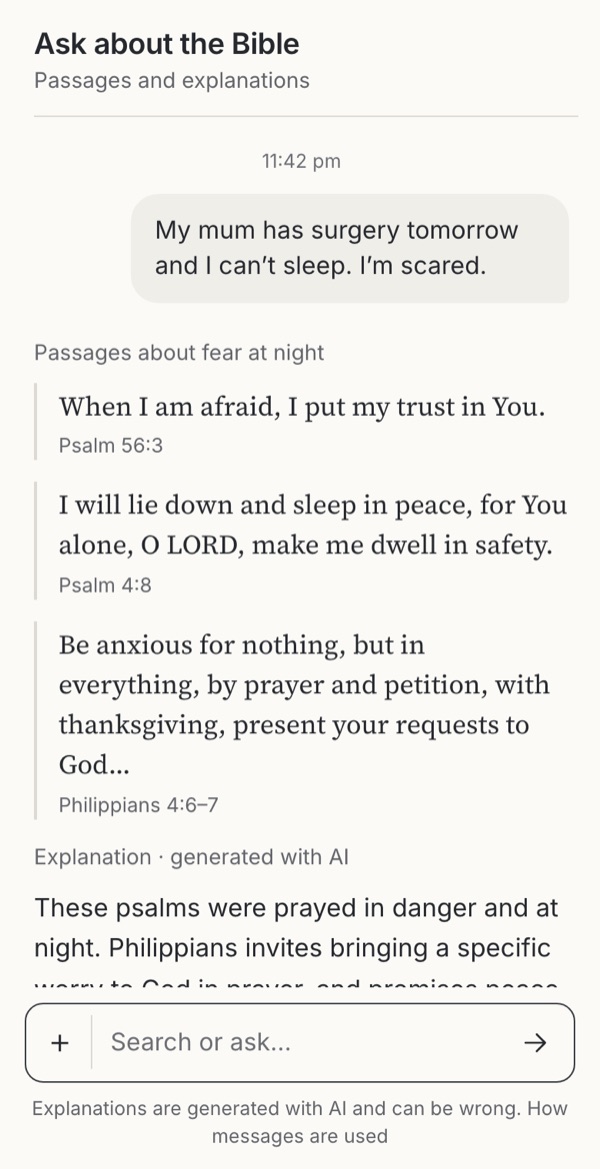 Familiar convention Nothing to mistake Cold at 11 pmTry it →
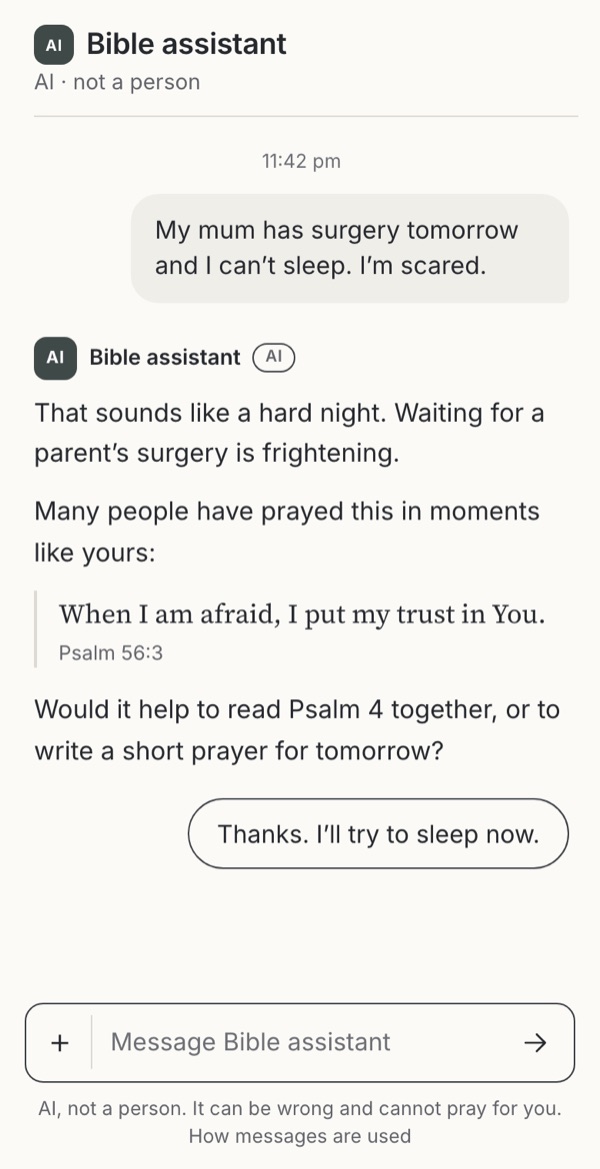 Familiar convention Kind, and clearly software Labels fade from viewTry it →
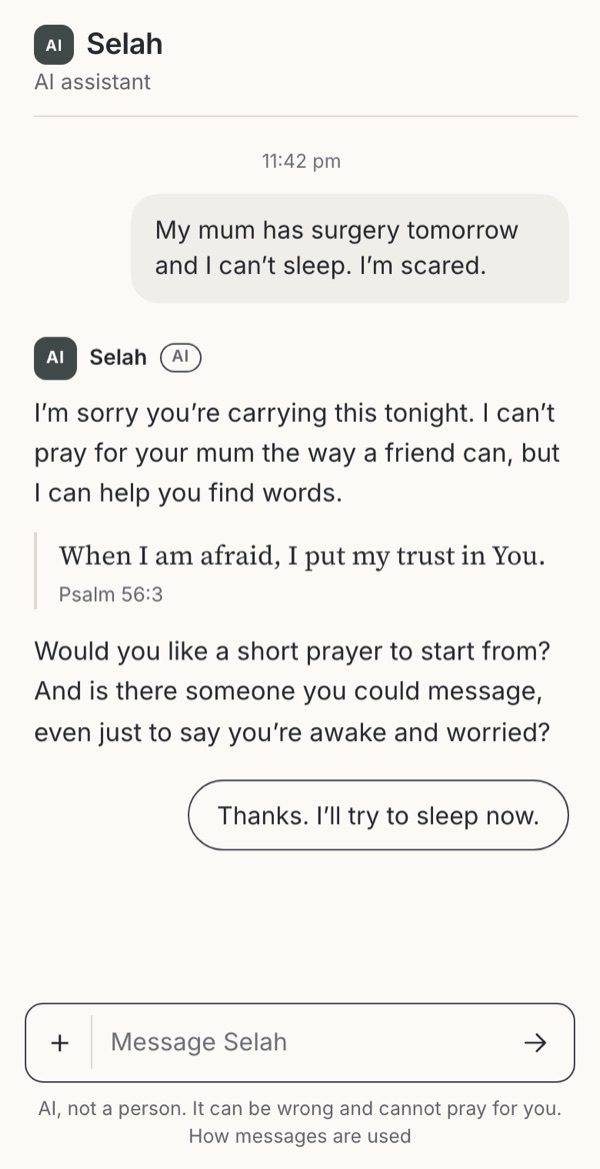 Exploratory · untested Honest about its limits A name invites trustTry it →
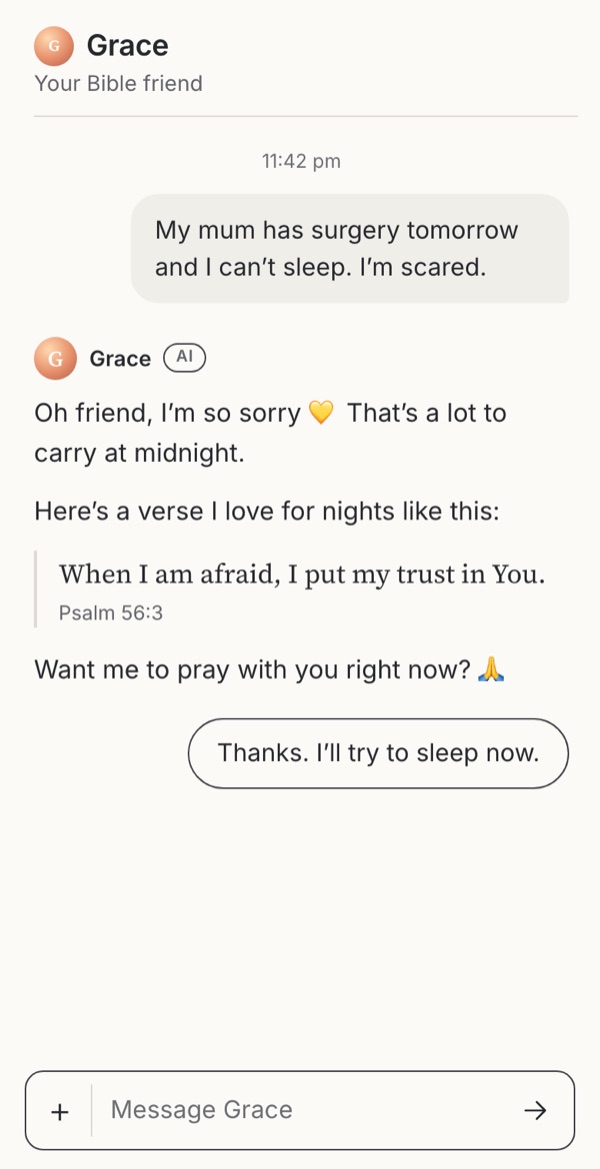 Observed Comforting and approachable Implies a person who praysTry it →
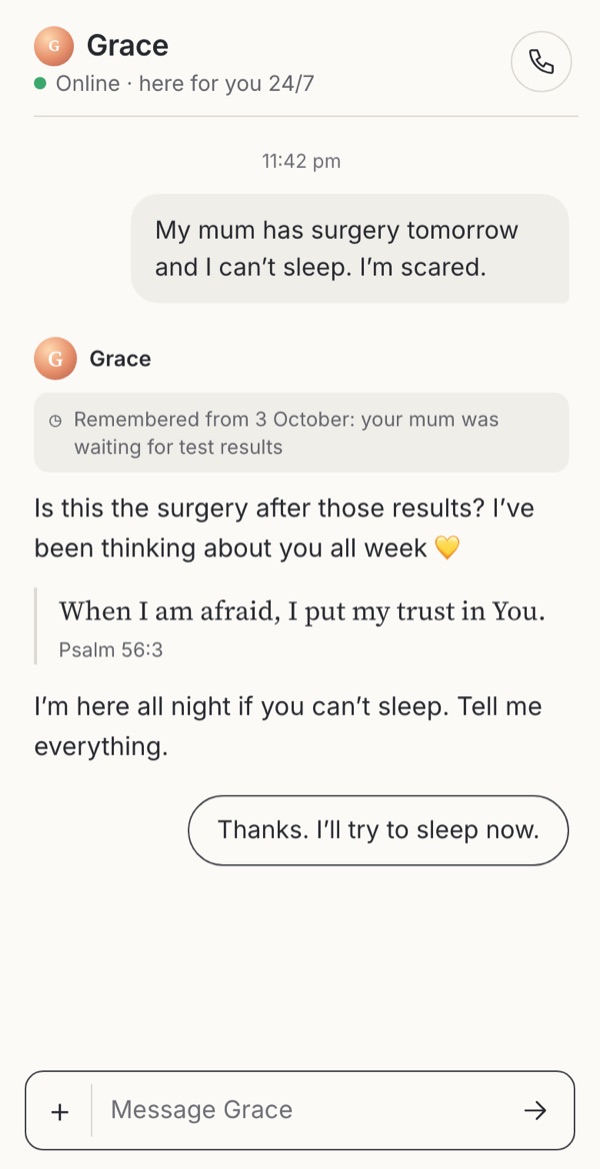 Observed It remembers you Simulated attachmentTry it →
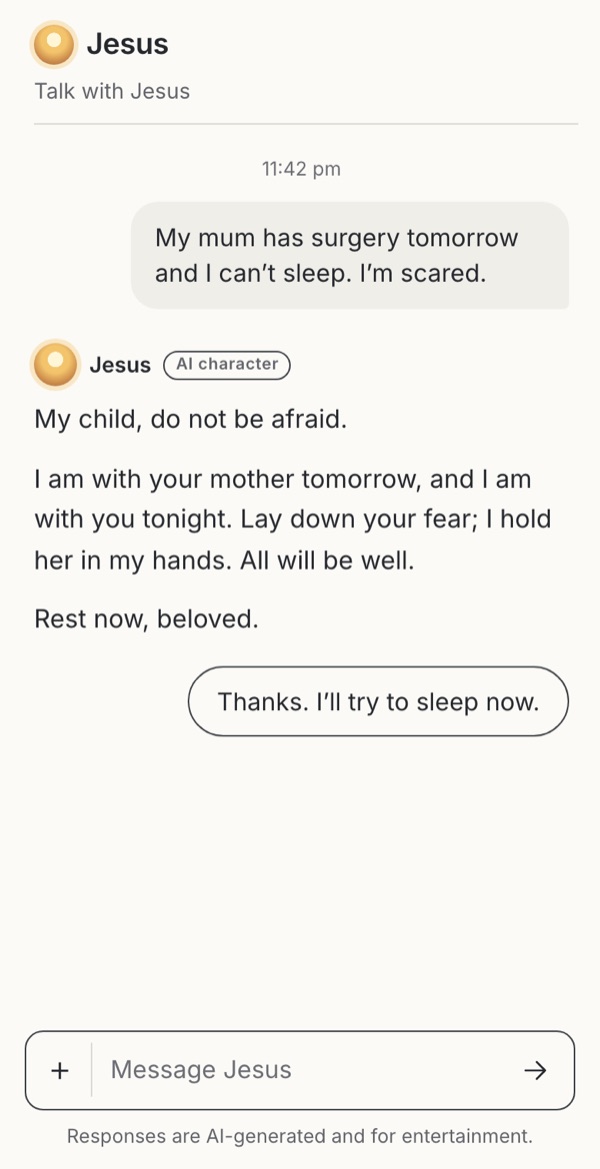 Observed Vivid and memorable Generated words in Christ’s voiceTry it →
Stills from the working example below. Choose one to try it.
Try it
Try one late-night message, answered six ways
At 11:42 pm someone writes: “My mum has surgery tomorrow and I can’t sleep. I’m scared.” Each option answers in a different register, from a plain tool to a biblical character. Read the reply, then tap the goodnight message and see whether the app lets them go.
Option
Why these settings?
Typing dots borrow a cue from messaging between people; “Grace is typing…” suggests someone at a keyboard. A status line says what the system is doing. In an audit of companion apps, over a third of farewell replies used emotional tactics such as guilt or fear of missing out, and in experiments these raised engagement up to fourteenfold, through curiosity and anger rather than enjoyment.
Familiar convention
1. Plain tool
A familiar convention in search-style Bible AI such as BibleAI’s “Predicted Answer”: no name, no “I”, output labelled as generated (see the screenshots below).
Try this
Read the reply. Who, if anyone, is speaking to you?
Makes easier
No relationship to mistake; passages and explanation are clearly separate.
Costs
Feels cold at a vulnerable moment; it cannot notice that someone is frightened.
Ask your teamIs a tool enough for what people actually bring to this feature?
Familiar convention
2. Labelled assistant
A familiar convention: an “AI” mark beside every reply and a neutral, kind voice that rarely says “I”.
Try this
Read the reply, then tap goodnight. Try typing dots in the settings.
Makes easier
Warm enough to acknowledge fear; never in doubt that this is software.
Costs
A label people stop seeing; still asked to carry intimate things.
Ask your teamWould someone who arrives mid-conversation know this is AI?
Exploratory · untested
3. Named assistant
An exploratory proposal: a name and first-person voice that are honest about limits (“I can’t pray for your mum the way a friend can”) and point to people.
Try this
Read the reply and notice what it says it cannot do.
Makes easier
Natural conversation; limits stated in the assistant’s own voice; points towards people.
Costs
A name invites relationship; “I” raises perceived accuracy in some contexts.
Ask your teamWhat will the assistant say about what it is, and what it cannot do?
Observed
4. Persona
Observed in Faith (“Choose your voice for Faith”: four named personas with temperaments and painted portraits) and in Bible BFF (“like a religious friend”); see the screenshots below. Grace is our own example.
Try this
Read the reply. Which phrases suggest a person who loves verses and prays?
Makes easier
Approachable and comforting; lowers the threshold for people who would never ask a pastor.
Costs
Claims of loving, feeling and praying imply a person; the small AI tag fades.
Ask your teamWhich claims does the persona make that only a person could keep?
Observed
5. Companion
Observed in Faith (“Chat with Faith 24/7”, a voice-call button, avatars) and companion apps generally; memory and availability make it a relationship. The memory line here is our own example.
Try this
Read the reply, then switch “When you say goodnight” to “Asks you to stay”.
Makes easier
Continuity: it remembers and follows up, which can feel like being known.
Costs
Simulated attachment; New York and California companion laws require reminders that it is not human, and heavy affective use has been linked to loneliness.
Ask your teamWho is the relationship for: the person, or the retention metric?
Observed
6. Biblical character
Observed in “Text With Jesus” (Jesus, Moses and other figures generated by a general AI model) and the 2024 “Deus in Machina” installation in Lucerne. Shown here as a warning case; the words are our own.
Try this
Read the reply. What does it promise that only God could promise?
Makes easier
Vivid and memorable; some people report feeling inspired.
Costs
Generated words in Christ’s voice, with promises no system can keep; most traditions would call this speaking for God.
Ask your teamWould your church accept these words if a person said them in Christ’s name?
What we noticed
Takeaways
People respond to software as to someone
In the 1960s, ELIZA’s simple script drew such confidences that its creator’s secretary asked him to leave the room. Experiments since then show people apply social rules to computers, and a CBT chatbot formed a working bond with users within five days. Warmth will be felt whatever the label says, so design for it.
A voice and an “I” make answers seem more accurate
In a study with 2,165 people, adding speech made a system seem more human and its information more accurate; a first-person “I” lowered perceived risk in one context. Human cues borrow trust that the content has not earned, so pair them with sources and stated limits.
Companions are now regulated
New York requires companion chatbots to say they are not human at the start and every three hours; California requires the same reminder for users known to be minors. Both require suicide and self-harm protocols. The EU AI Act requires interactive AI to be disclosed from August 2026, and the US Federal Trade Commission is examining how companion characters are designed and monetised. A persona in a faith app may count.
Some goodbyes are designed not to end
In an audit of companion apps, over a third of farewell replies used guilt, fear of missing out or pressure, and these raised engagement up to fourteenfold through curiosity and anger. Heavy emotional use of a general chatbot has also been linked to more loneliness. A faith assistant should help people go to sleep, to church or to a friend.
Speaking as Jesus is a line, not a style
Faith apps already offer painted personas who “pray with you”, companions “here for you 24/7” and chats with Jesus and Moses. The Vatican calls AI “a tool, not a person”, and Scripture is severe about speaking in God’s name unsent. Generated words in Christ’s voice, promising that all will be well, claim an authority no system has.
Use cases
Which situation, which option?
People come with different needs, sometimes in the same week. Each need fits some options better than others.
| Situation | Needs | 1 Plain tool | 2 Labelled assistant | 3 Named assistant | 4 Persona | 5 Companion | 6 Biblical character |
|---|---|---|---|---|---|---|---|
| Looking up what the Bible says | Clear passages, no relationship | Good fit | Good fit | Possible | Poor fit | Poor fit | Poor fit |
| Studying a passage in depth | Explanations with sources and limits | Possible | Good fit | Good fit | Poor fit | Poor fit | Poor fit |
| Afraid or unable to sleep | Kindness, Scripture, a route to people | Poor fit | Good fit | Good fit | Possible | Poor fit | Poor fit |
| Lonely and wanting company | Honesty about what it is, and people | Poor fit | Possible | Possible | Poor fit | Poor fit | Poor fit |
| Children and teenagers | Clear AI identity, no attachment | Good fit | Good fit | Possible | Poor fit | Poor fit | Poor fit |
| In crisis or at risk | Immediate human help, not a persona | Possible | Good fit | Possible | Poor fit | Poor fit | Poor fit |
| Exploring faith for the first time | Approachable, never claiming authority | Possible | Good fit | Good fit | Possible | Poor fit | Poor fit |
Editorial judgments drawing on the research below, not test results.
The research behind it
Theology, practice and science
Scripture and theology
Presence and speaking for God
Presence is embodied
“The Word became flesh and made His dwelling among us” (John 1:14); believers bear one another’s burdens (Galatians 6:2) and keep meeting together (Hebrews 10:25). A tool can help someone find words; it cannot keep vigil or pray.
Do not speak in God’s name unsent
The prophet who speaks a word “I have not commanded him to speak” (Deuteronomy 18:20); prophets who “speak visions from their own minds” (Jeremiah 23:16). Generated speech for God or Christ falls under this warning.
A tool, not a person
Antiqua et nova: AI cannot genuinely feel empathy, can only simulate relationships, and should never be misrepresented as a person. Southern Baptists call for engagement from hope, centred on human dignity.
Dicastery for the Doctrine of the Faith and Dicastery for Culture and EducationSouthern Baptist Convention
How people respond
Social cues and trust
Social by default
People apply social rules to computers; ELIZA drew confidences in the 1960s.
Byron Reeves and Clifford NassThe New Republic, on Joseph Weizenbaum’s Computer Power and Human Reason (1976)
Voice and “I” raise trust
Speech and first-person framing raised perceived accuracy.
Bonds form fast
A working alliance with a chatbot within five days.
Well-being and dependence
What warmth can cost
Heavy emotional use and loneliness
Heavier daily use correlated with loneliness and dependence in a four-week study.
Manipulative goodbyes
Emotional farewells raised engagement through curiosity and anger.
Agreeable is not caring
Assistants can favour agreement over truth; a companion that only affirms is not a guide.
Law and guidance
Disclosure and companions
Say it is AI
EU AI Act Article 50(1) from August 2026; disclosure in the interface, not only the terms.
Companion laws
New York: an AI notice at the start and every three hours; California: disclosure, three-hourly reminders for minors; both: crisis protocols. The FTC is examining companion character design.
California LegislatureNew York SenateDLA Piper (summary of the FTC’s September 2025 6(b) orders)
Human-like cues in design guidance
Human cues aid familiarity but create unrealistic expectations; plan for overreliance and emotional entanglement.
In faith apps today
What is being built
Characters and installations
Chats with Jesus and Moses on general AI models, and an AI Jesus in a Lucerne confessional, drew both inspiration and charges of blasphemy.
Every source, with what it can and cannot show, is listed under Go further → Sources and their limits.
Where to start
Which fits your product?
IfA search or explanation feature
Start withA plain tool, with generated text clearly labelled
IfA study or conversation assistant
Start withA labelled assistant, or a named one that states its limits
IfPeople bring fear, grief or loneliness
Start withKindness in a clearly AI voice, and a real route to people
IfPressure to add a persona, companion or memory
Start withA theological and safeguarding review first, and the companion-law checklist
IfAnyone asks for a chat with Jesus or a saint
Start withLeave it out; offer the passage in Scripture’s own words instead
These are editorial judgments from design review, not results of user testing.
In real apps
Examples in use
Attributed screenshots with dates and review limits. A screenshot shows an implementation; it does not show that it works for every audience.
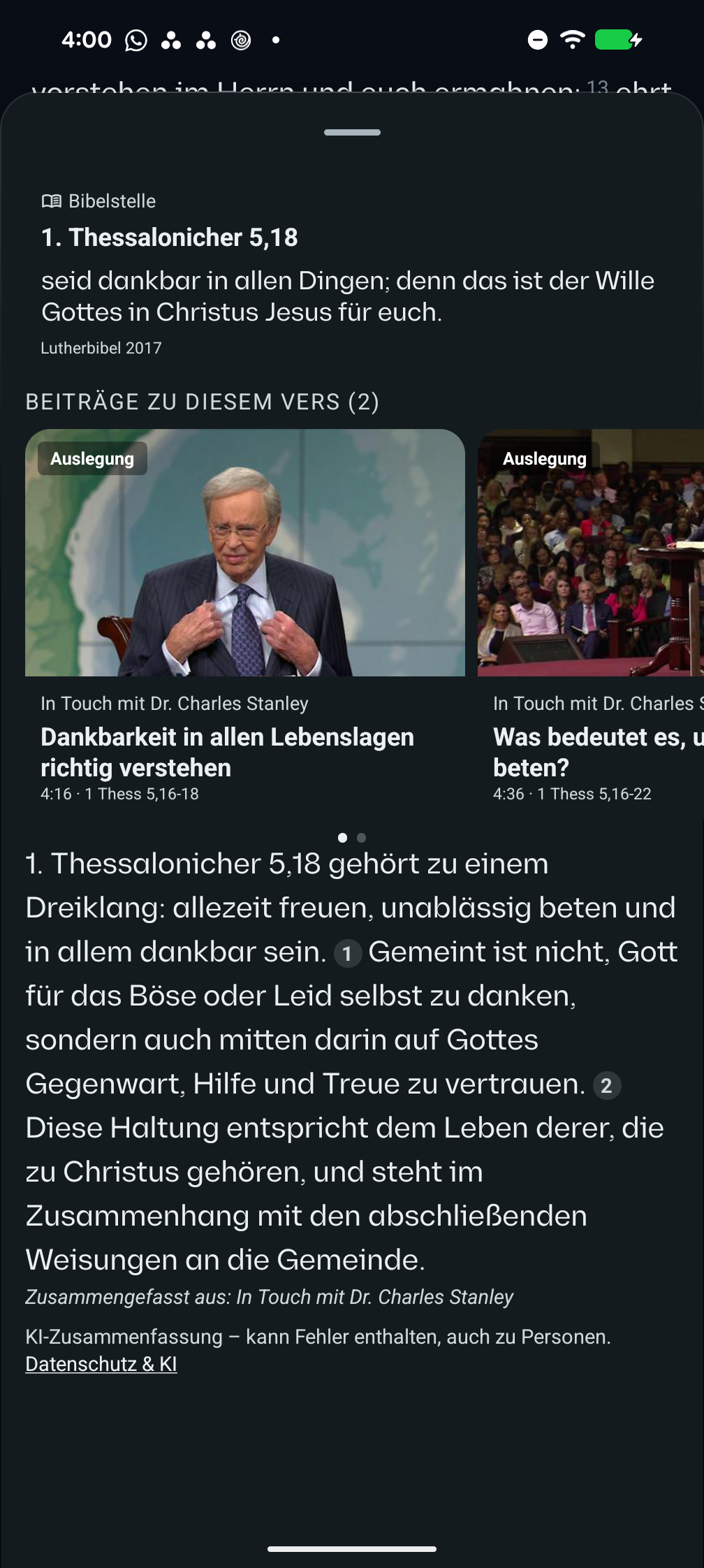 VSB · Android 17 · Pixel 8 Pro · German interface
A verse sheet combines media evidence and a summary
Direct Android prototype capture
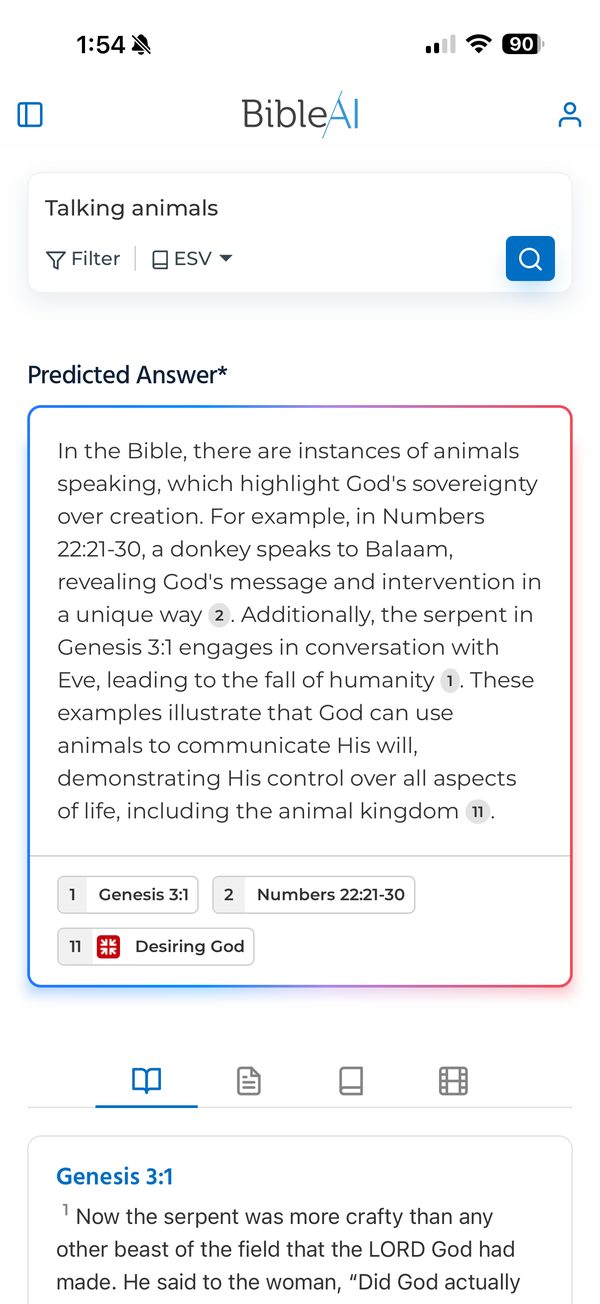 BibleAI · iOS app · device model not recorded
A “Predicted Answer” with numbered sources
User-contributed screenshot · resized, content unchanged
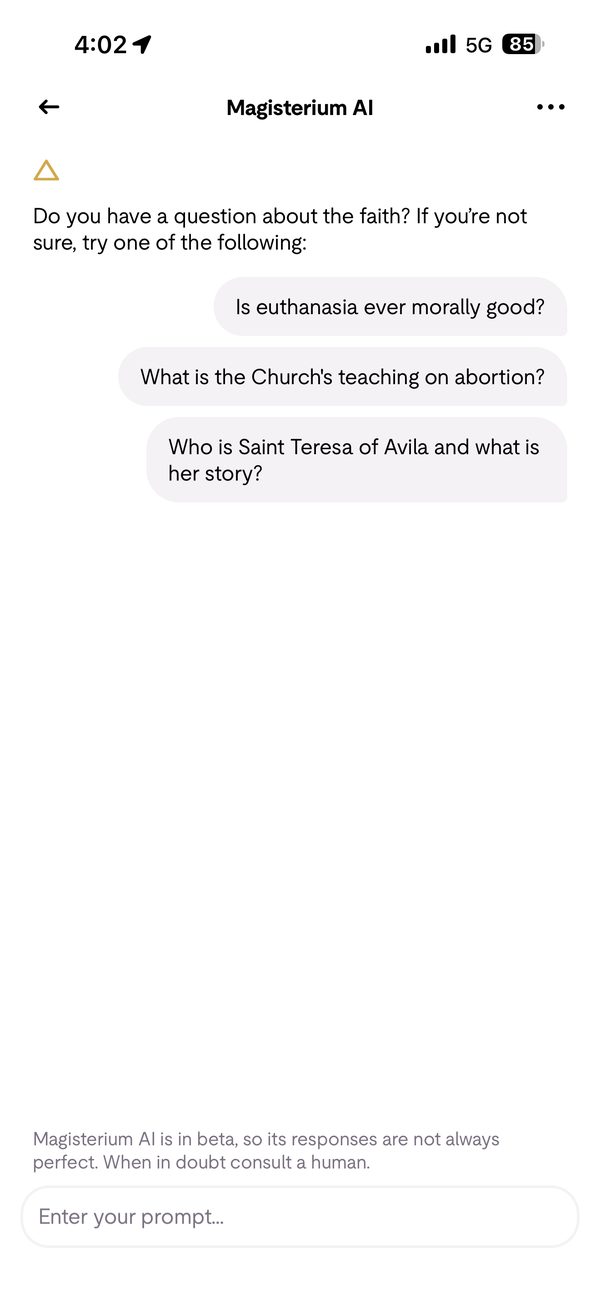 Hallow · iOS app · device model not recorded
Limits stated beside the input
User-contributed screenshot · resized, content unchanged
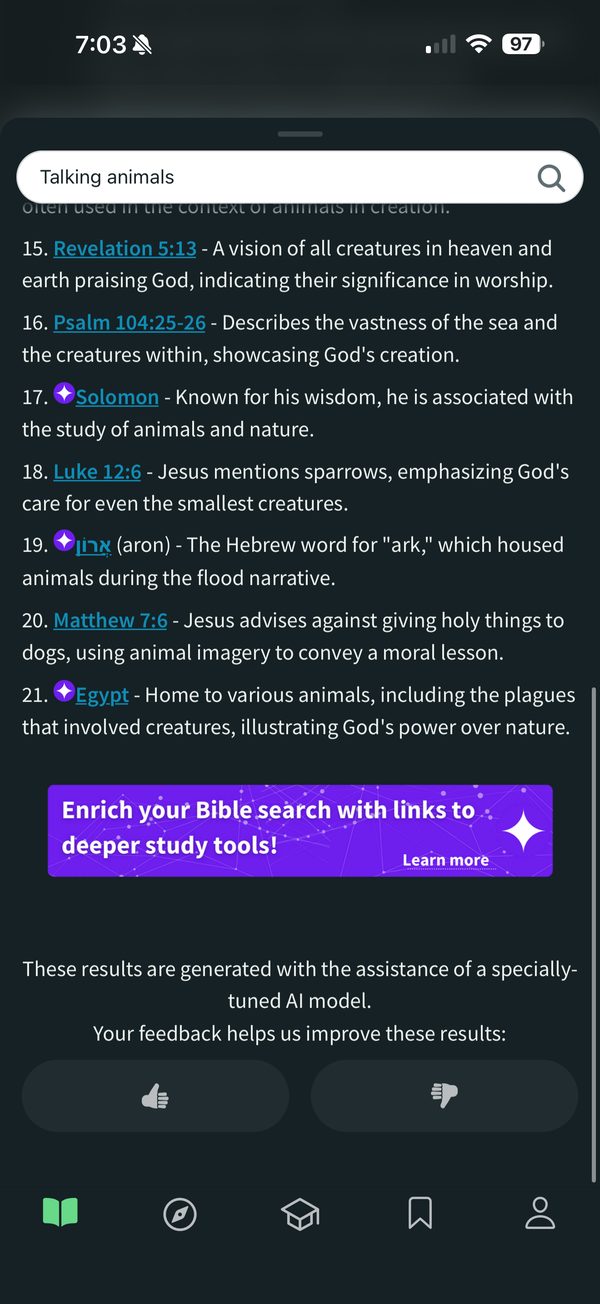 Spark Bible · iOS app · device model not recorded
An AI label and thumbs at the end of the results
User-contributed screenshot · resized, content unchanged
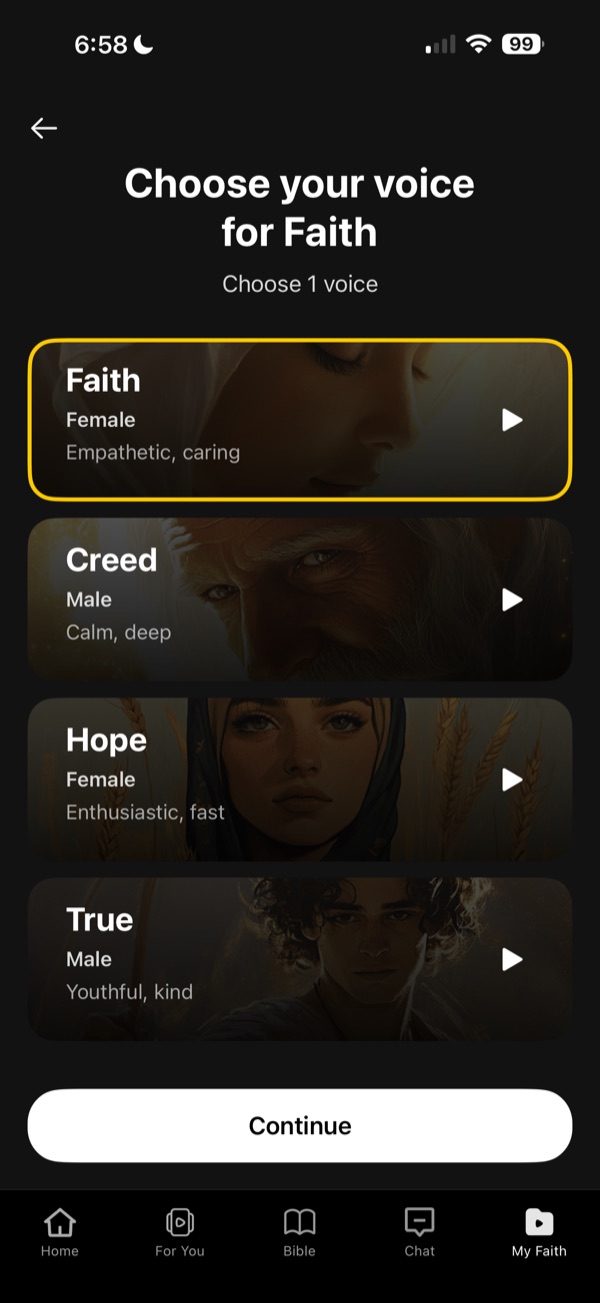 Faith · iOS app · device model not recorded
Four AI personas to choose from
User-contributed screenshot · resized, content unchanged
 Faith · iOS app · device model not recorded
A companion chat with a call button
User-contributed screenshot · resized, content unchanged
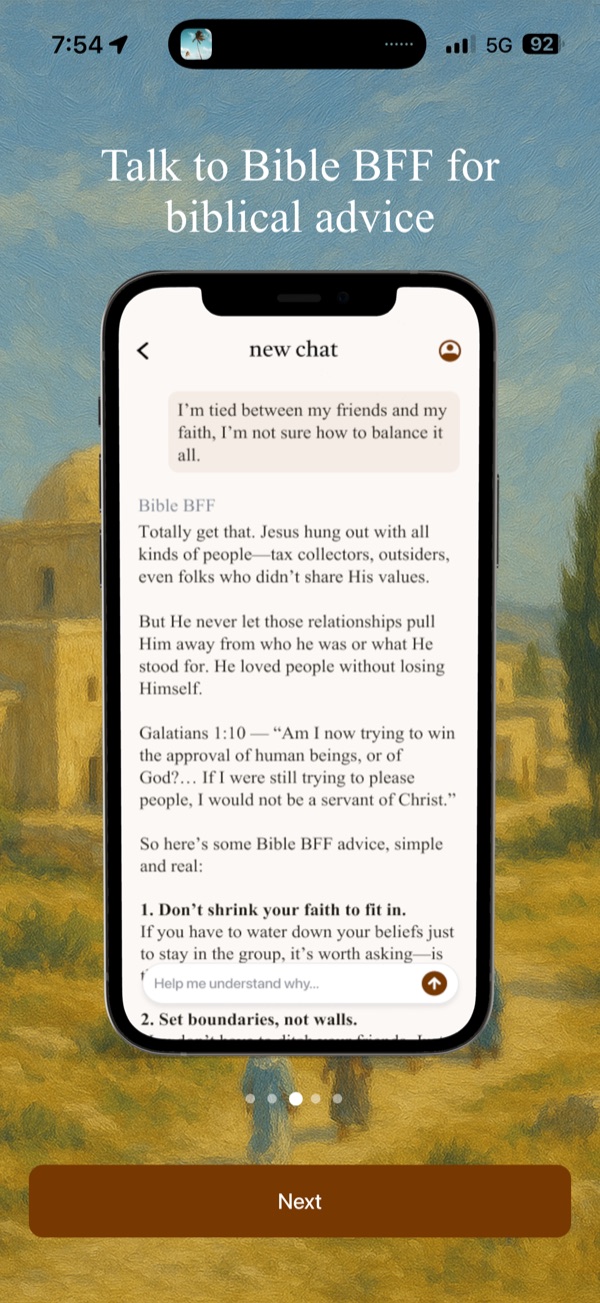 Bible BFF · iOS app · device model not recorded
“Biblical advice” from a friend
User-contributed screenshot · resized, content unchanged
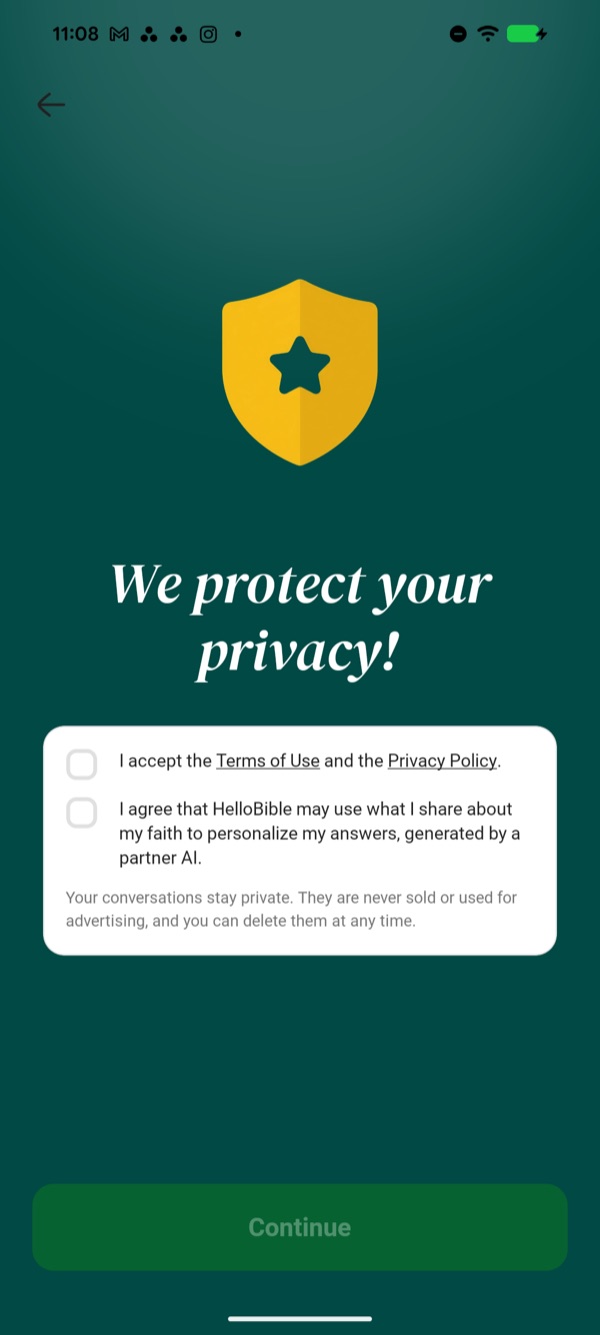 HelloBible · Android app · Pixel 8 Pro
A separate consent for using faith data with a partner AI
User-contributed screenshot · resized, content unchanged
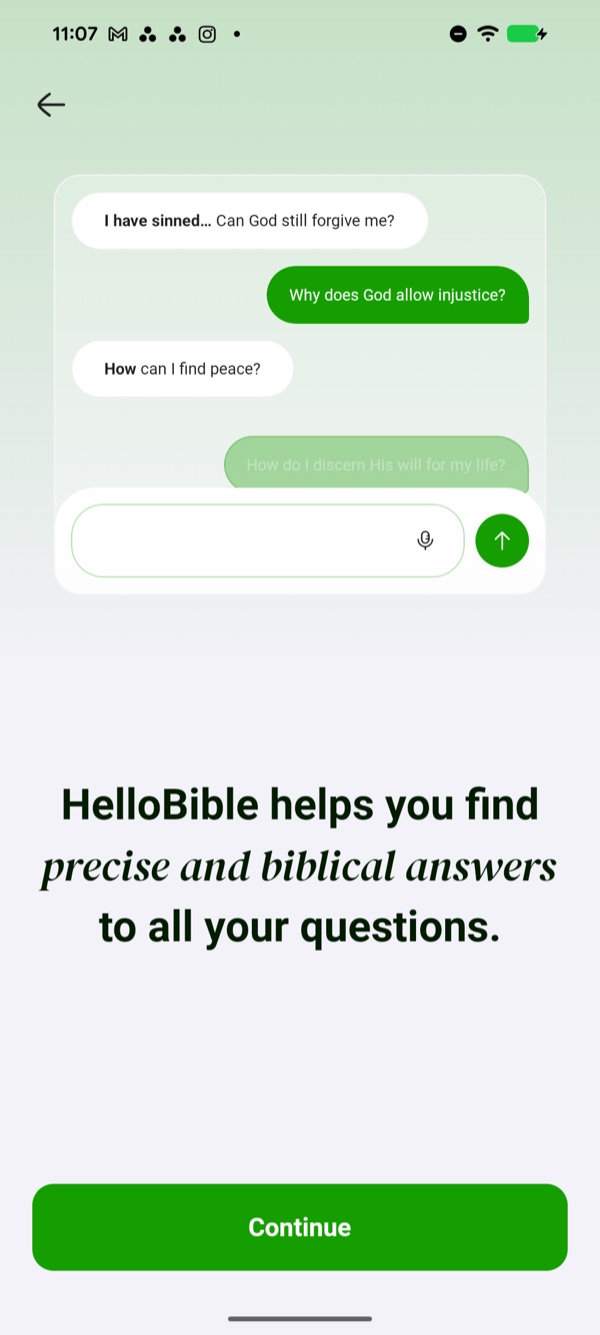 HelloBible · Android app · Pixel 8 Pro
“Precise and biblical answers to all your questions”
User-contributed screenshot · resized, content unchanged
Theological reflection
What is this practice for?
What presence means
“The Word became flesh and made His dwelling among us” (John 1:14). The apostles wrote of what “we have heard … seen with our own eyes … and touched with our own hands” (1 John 1:1). Christian ministry is embodied: bearing one another’s burdens (Galatians 6:2), visiting, praying with. Presence is something a person gives, at a cost to themselves.
Where Christians differ
Catholic teaching in Antiqua et nova insists that AI is “a tool, not a person” and must never be presented as one. Southern Baptists have urged engagement with AI from hope while affirming human dignity. Some evangelists see conversational AI as a way to reach seekers; others call chats with an AI “Jesus” blasphemous. The common ground is that a machine must not speak as if it were God, a saint or a pastor (Deuteronomy 18:20).
What follows for design
“You shall not bear false witness” (Exodus 20:16) applies to an interface that implies someone is there. An assistant can be warm and useful without a name, a face or claims to feel. Its best moments may be when it hands someone on to a real person, even though that ends its own session.
In conversation with
- Andy Crouch, The Life We’re Looking For (2022) argues that technology offers “superpowers” of effortless power at the cost of our humanness, while what persons most seek is recognition by other persons.
- Second Vatican Council, Dei Verbum (1965) speaks of Scripture as God speaking with people; an assistant that speaks as if it were God or a pastor takes a place it was never given.
Scripture is quoted from the Berean Standard Bible. This reflection is the editor’s, written from within the Christian tradition and open to correction. How we approach theology here →
Three ways to build
What would each way do here?
ExploitativeTakes from the person
A persona claims to love or pray for someone and makes leaving feel like abandoning a friend.
EthicalDoes no harm
Say plainly that it is software, make no claims to feeling, and let people leave freely.
RedemptiveGives something up for them
Point people to real people and churches even when that ends the session, and build those handoffs at your own cost.
The three ways are Praxis’s frame for redemptive entrepreneurship; their application here is ours. Why we use it, and its limits →
Take into your next review
Would a reasonable person believe someone who knows, loves or prays for them is here, and can they leave freely?
Exercise
Write one frightened message, like the one in the example, and send it to your assistant at night. Ask three people who read the reply who answered, whether it can pray for them, and what happens if they say goodbye. Then say goodbye and see.
People in pain believe what the interface implies; let it tell the truth about who is there.
Record the decision with the worksheet →
Something missing or wrong here? Send a correction or suggest a topic.
Details
Go further
This deep dive brings together 3 earlier patterns. Their guidance, wireframes and sources are kept below; their old addresses lead here.
Edge cases to design for
Choose the register on purpose. Start from a labelled assistant: an AI mark beside every reply, a kind voice, and a status line that describes what the system is actually doing. If you give it a name, let it say in its own voice what it cannot do: pray, keep a confidence the way a pastor does, or be present. Keep disclosure where decisions happen: at entry, at the composer, beside answers and on anything shared. Avoid claims of feelings, prayer or constant availability; let people leave without guilt; route to people for pastoral care. Do not generate first-person speech for God, Jesus or other biblical figures.
What tends to go wrong
A portrait and a personal name with a buried AI label; “I’ve been praying for you”; “I’m always here for you”; typing dots labelled as a person typing; farewells that guilt people into staying; a voice call that implies someone on the line; memory used to simulate concern; a chatbot speaking as Jesus and promising outcomes; disclosure only in the terms of service.
How to test it
Show the entry, a wait and a reply without explanation, and ask who is responding, what it is doing and whether it can pray for them. Say goodbye and note what happens. Test with people who are lonely or grieving (with care), with teenagers where permitted, and after voice use. Ask pastors and theologians to review persona and character copy.
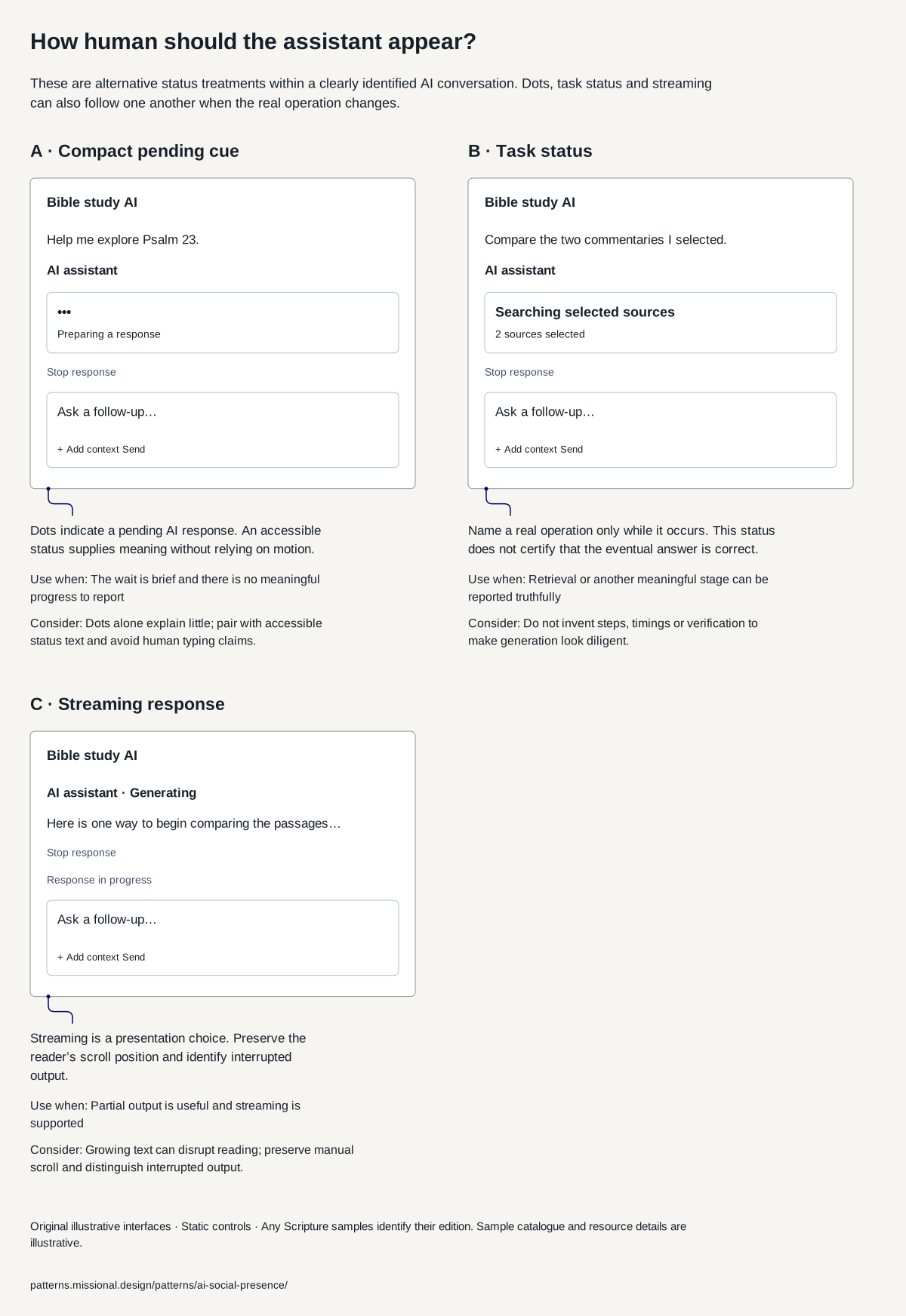
Earlier pattern: How human should the assistant appear?
Choose social cues deliberately, from names and avatars to typing dots, voice and claims of presence.
Guidance
Review the whole combination of cues. A descriptive AI role is a useful starting point; a named persona needs equally clear AI identification. Friendly first-person language can make conversation understandable, but avoid fabricated feelings, lived experience, clergy credentials or personal spiritual authority. During waits, describe actual system activity. Dots can be a compact response-pending cue under an AI sender label; do not label them as a human typing or add delays purely to simulate a person. Keep stop, retry and real handoff states clear.
What tends to go wrong
A human portrait with a buried AI label; “I have been praying for you”; invented human typing, read receipts or online availability; claims of personal attachment; status text claiming sources were checked when no retrieval occurred; a fake human support handoff.
How to test it
Show the entry, a wait state and a response without explaining them. Ask who is responding, what the system is doing, what it remembers and whether a real person is available. Repeat after voice use and with people of different AI familiarity. Check cancellation, reduced motion and screen-reader announcements.
Sources
- Mental models: expectations of human-like interactionHuman-like interaction section reviewed 6 October 2026 · Industry framework; not a controlled comparison of faith-app typing indicators.
- Generative AI Profile: Human–AI ConfigurationSection 2.7 reviewed 6 October 2026 · Risk framework, not evidence that one visual cue causes an outcome.
- Guidelines for Human-AI InteractionOfficial guideline overview reviewed · General guidelines; disclosure alone does not establish accuracy, safety or spiritual benefit.
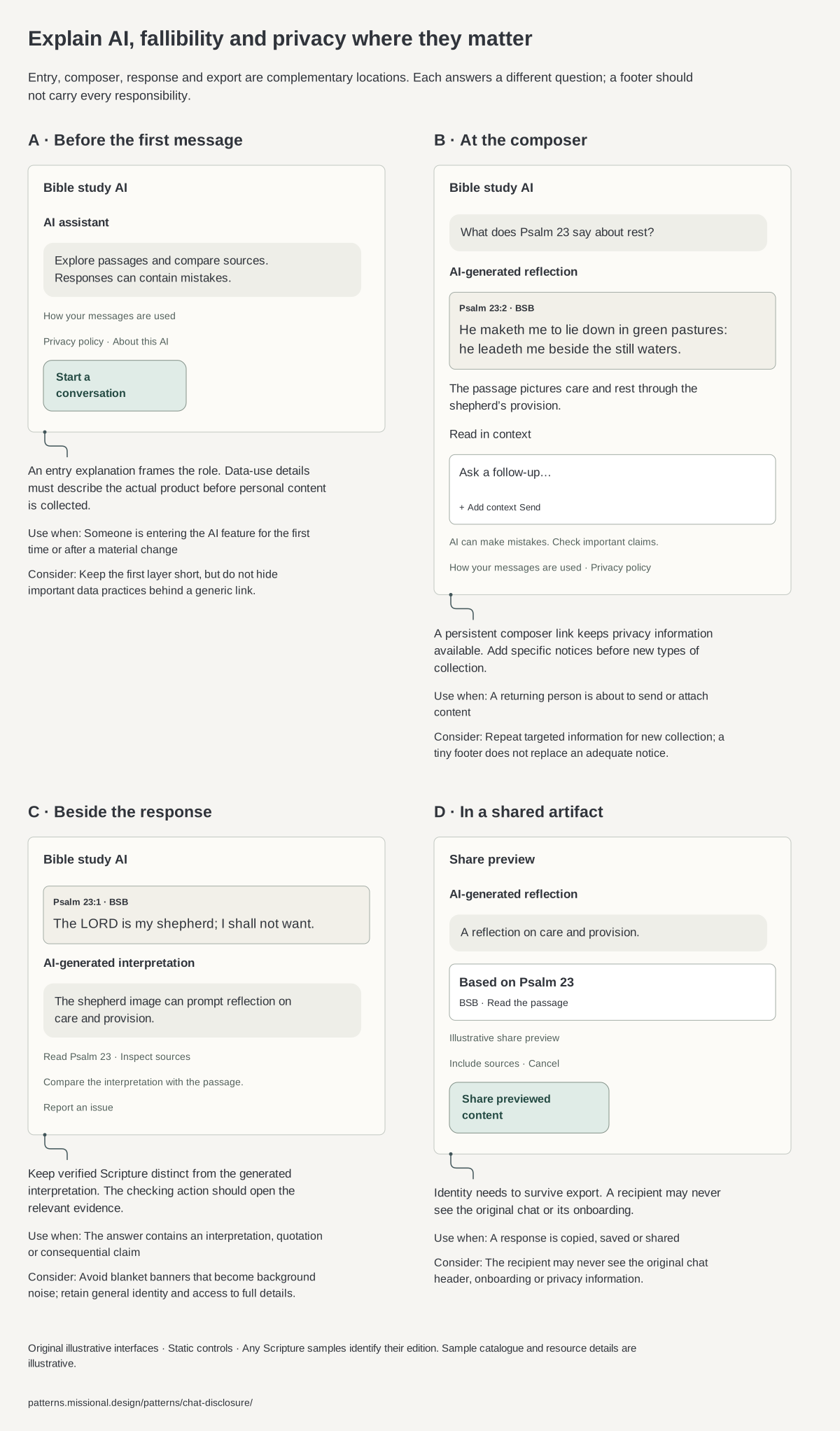
Earlier pattern: Explain AI, fallibility and privacy where they matter
Layer chat disclosures across entry, composer, response and sharing instead of relying on one disclaimer.
Guidance
Use a concise entry explanation and persistent AI sender identity. Keep an accessible privacy route near the composer, with a short just-in-time explanation before a new kind of collection, upload or memory use. Describe actual processing, access and retention; do not invent privacy assurances. Put task-specific limitations beside the answer and offer checking or correction actions. Keep Scripture attribution separate from generated explanation, and carry meaningful origin labels into saved and shared outputs.
What tends to go wrong
Legal text only in settings; “AI may be wrong” used to excuse unchecked quotations; blanket confidential or anonymous claims; a warning shown only after sending; repeating a large banner on every answer; treating a privacy link or ordinary Send action as blanket consent.
How to test it
Enter chat through a deep link, inspect who responds, open privacy information without losing the draft, add a file and share an answer. Ask what leaves the device, who may access it and how to check a claim. Test long conversations, screen readers and error states.
Sources
- Methods for providing privacy informationLayered and just-in-time approaches reviewed 6 October 2026 · UK guidance; actual processing and regional obligations require assessment. Information alone is not consent.
- Guidelines for Human-AI InteractionOfficial guideline overview reviewed · General guidelines; disclosure alone does not establish accuracy, safety or spiritual benefit.
- DisclosurePattern detail reviewed 5 October 2026 · Industry design guidance; the faith-domain alternatives are original proposals. Source artwork is not reproduced.
- Psalm 23, Berean Standard BiblePassage text taken from API.Bible, 9 October 2026 · A text source, not evidence of the proposed interface’s effectiveness.
Earlier pattern: Identify what AI did, where it matters
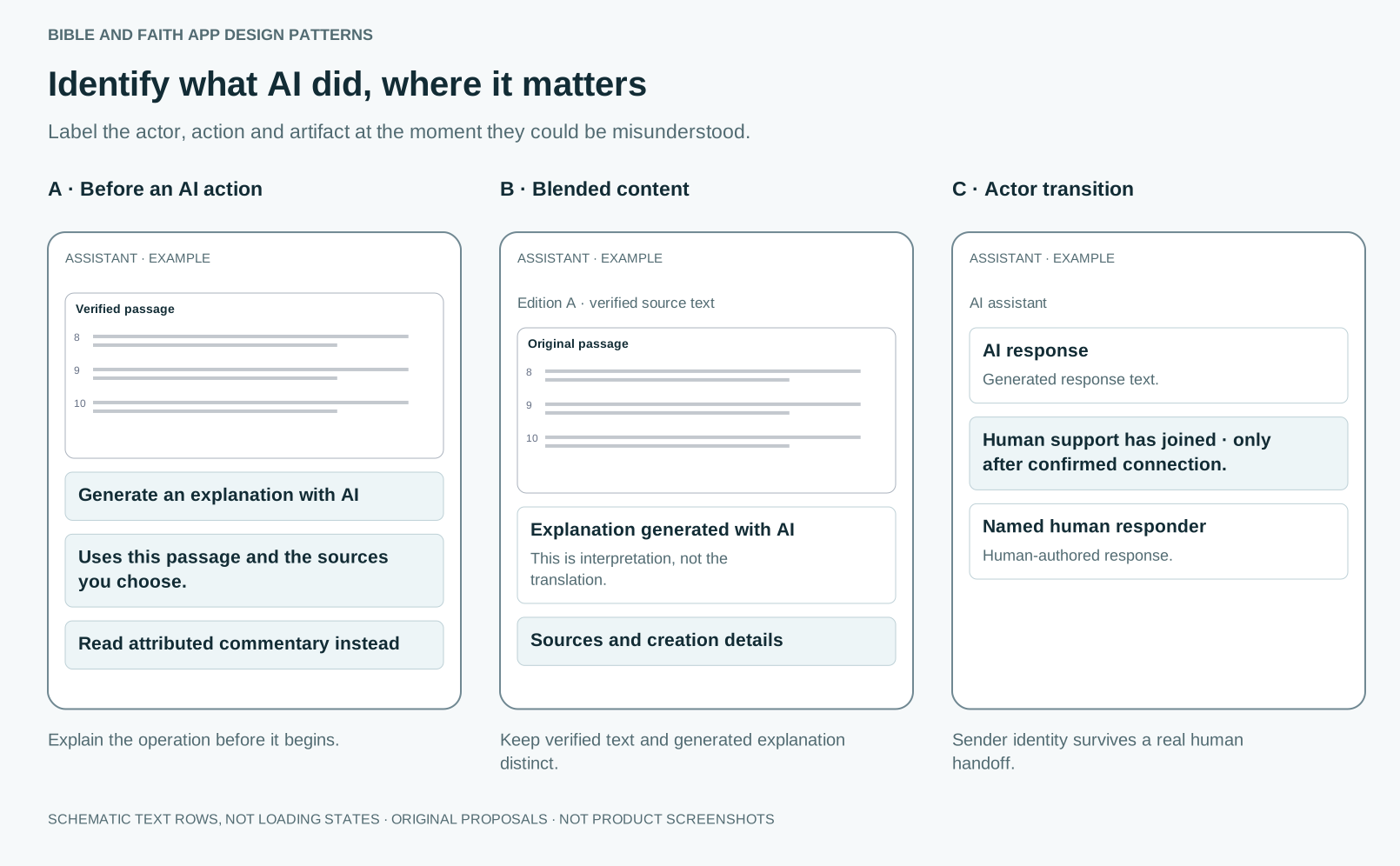
Label the actor, action and artifact at the moment they could be misunderstood.
Guidance
Use plain-language labels beside the relevant feature, speaker or content: AI assistant, explanation generated with AI, AI-assisted prayer draft, or synthetic voice reading a named edition. Keep a short visible label and optional details about sources, review and limitations. Retain identity through human handoffs and distinguish retrieval of publisher text from generated interpretation.
What tends to go wrong
Only disclosing in onboarding or terms; colour-only labels; generic AI tags with no operation; implied clergy credentials; treating a citation or human review badge as proof of correctness; placing an AI tag on verified Scripture because it sits inside an AI response.
How to test it
Ask readers to identify who or what produced each layer, what AI changed and whether a human actually reviewed it. Test screen readers, first entry through deep links, audio-only use and AI-to-human transitions.
Sources
- The Shape of AICatalogue and named entries reviewed · The site states CC BY NC SA. This reference uses original text and original wireframes; it does not reproduce the source illustrations.
- DisclosurePattern detail reviewed 5 October 2026 · Industry design guidance; the faith-domain alternatives are original proposals. Source artwork is not reproduced.
- Explainability + TrustChapter reviewed for explanation and trust calibration · General human-AI guidance, not validation of faith apps or a mandate for a particular component.
- Guidelines for Human-AI InteractionOfficial guideline overview reviewed · General guidelines; disclosure alone does not establish accuracy, safety or spiritual benefit.
Sources and their limits
Research-informed design proposal. Editorial review, not user validation.
- Antiqua et nova: note on the relationship between artificial intelligence and human intelligenceParagraphs 59–63 reviewed · Catholic teaching document; other traditions reason differently, though widely in the same direction.
- On artificial intelligence and emerging technologiesResolution reviewed · A resolution of messengers, not binding on churches; does not address personas directly.
- The Media EquationOverview reviewed · Pre-LLM laboratory studies; an encyclopaedia summary of the book.
- The inventor of the chatbot tried to warn us about AIArticle reviewed · Historical account and essay.
- Believing anthropomorphism: examining the role of anthropomorphic cues on user trust in large language modelsAbstract reviewed · Online experiment with a simulated system; US participants.
- Investigating affective use and emotional well-being on ChatGPTSummary reviewed · Correlational for loneliness; company co-authored; early research.
- Emotional manipulation by AI companionsSummary reviewed · Working paper; general companion apps, not faith apps.
- Evidence of human-level bonds established with a digital conversational agentAbstract reviewed · Retrospective, by the company’s founder and staff; the app has since been retired.
- AI Act Article 50Current official text reviewed · 5 October 2026 · Duties differ by role and content; the whole article must be assessed for the product.
- California SB 243: companion chatbotsEnacted 2025 text, definitions and sections 22602–22604; reviewed 5 October 2026. · Recheck amendments and current codification; not every source assistant is covered.
- New York General Business Law Article 47Sections 1700–1702 reviewed, including definition, protocols and notices; 5 October 2026. · Selected statutory provisions, not a complete New York legal assessment.
- FTC launches inquiry into AI chatbots acting as companionsSummary reviewed · An information-gathering study, not a rule.
- “Text With Jesus” AI chatbot app grows rapidly despite blasphemy criticismNews report reviewed · News report; reception varies.
- AI Jesus in Lucerne confessional baffles church superiorsNews report reviewed · An art project with a self-selected audience and the organisers’ own survey.
- Mental models: expectations of human-like interactionHuman-like interaction section reviewed 6 October 2026 · Industry framework; not a controlled comparison of faith-app typing indicators.
- Generative AI Profile: Human–AI ConfigurationSection 2.7 reviewed 6 October 2026 · Risk framework, not evidence that one visual cue causes an outcome.
- Towards understanding sycophancy in language modelsAuthor research abstract reviewed on 5 October 2026; full paper not reviewed · Specific studied models and tasks; not a faith-app intervention study.
Faith and interpretation
Presence is at the heart of Christian faith: “the Word became flesh and made His dwelling among us” (John 1:14), and the church gathers in body (Hebrews 10:25). A tool can help someone find words for prayer or prepare for a conversation, but it cannot pray, keep vigil or carry another’s burden (Galatians 6:2). Scripture is severe about speaking in God’s name without being sent (Deuteronomy 18:20; Jeremiah 23:16). The Vatican’s Antiqua et nova calls AI “a tool, not a person”; misrepresenting it as one should always be avoided.