Translations
One at a time, side by side or verse by verse?
In John 1:5 the KJV says the darkness “comprehended it not”; most recent translations say it “has not overcome it”. Both are faithful to one Greek word. Apps decide whether readers ever see that, how they choose a translation, and whether they stay on the same verse while they compare. Bringing God’s word into people’s own language is one of the church’s oldest callings; an interface can honour the translators’ care or hide it.
- 5 working options
- 8 app examples
- 5 takeaways
- Editorial review, not user-tested
The spectrum
From one translation to the Greek
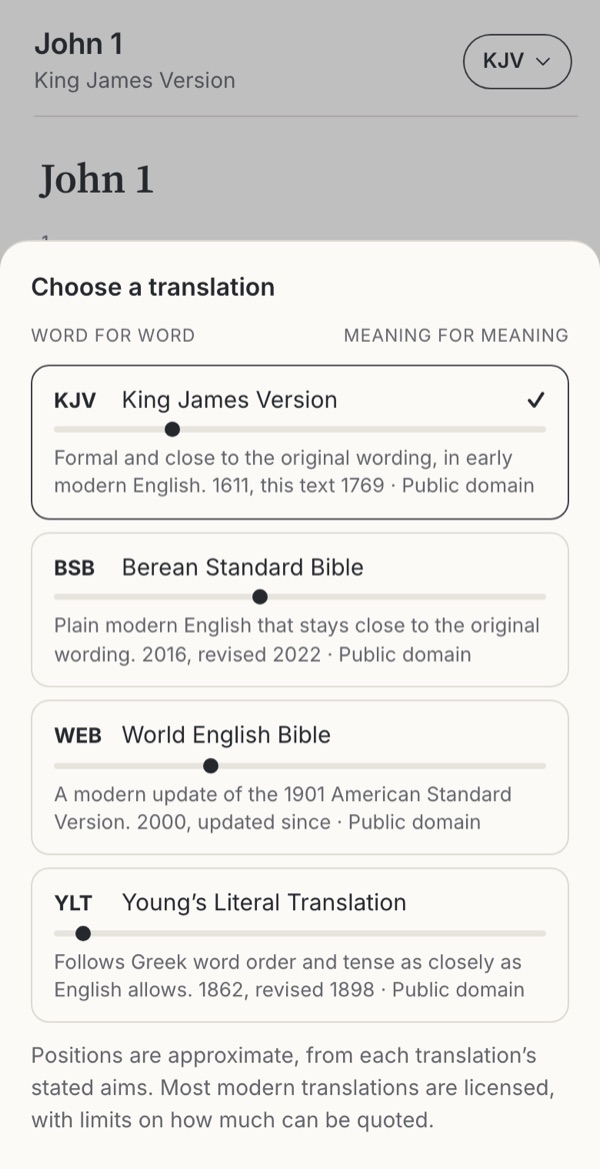 Observed One clear text, chosen well The alternatives stay hiddenTry it →
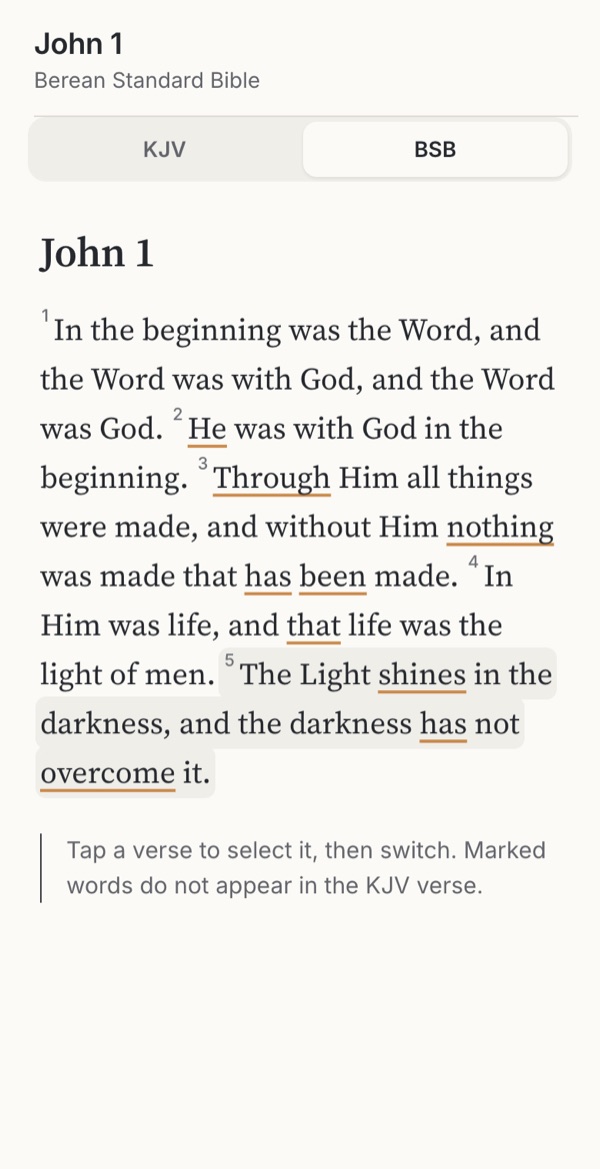 Familiar convention Check a verse without leaving One wording at a timeTry it →
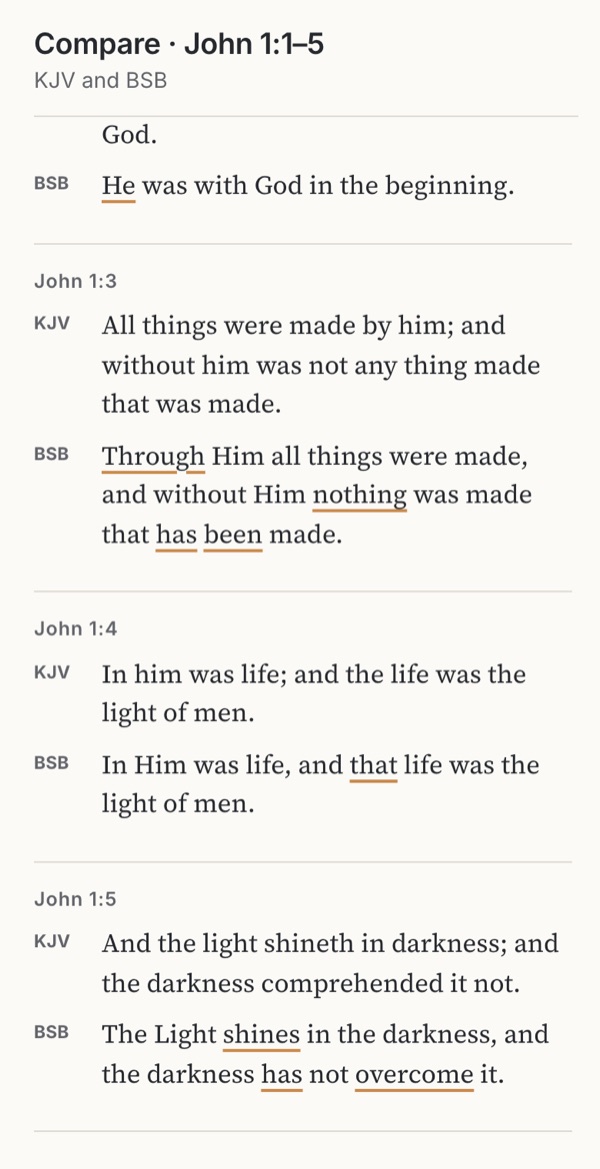 Observed Differences at a glance Reading becomes comparingTry it →
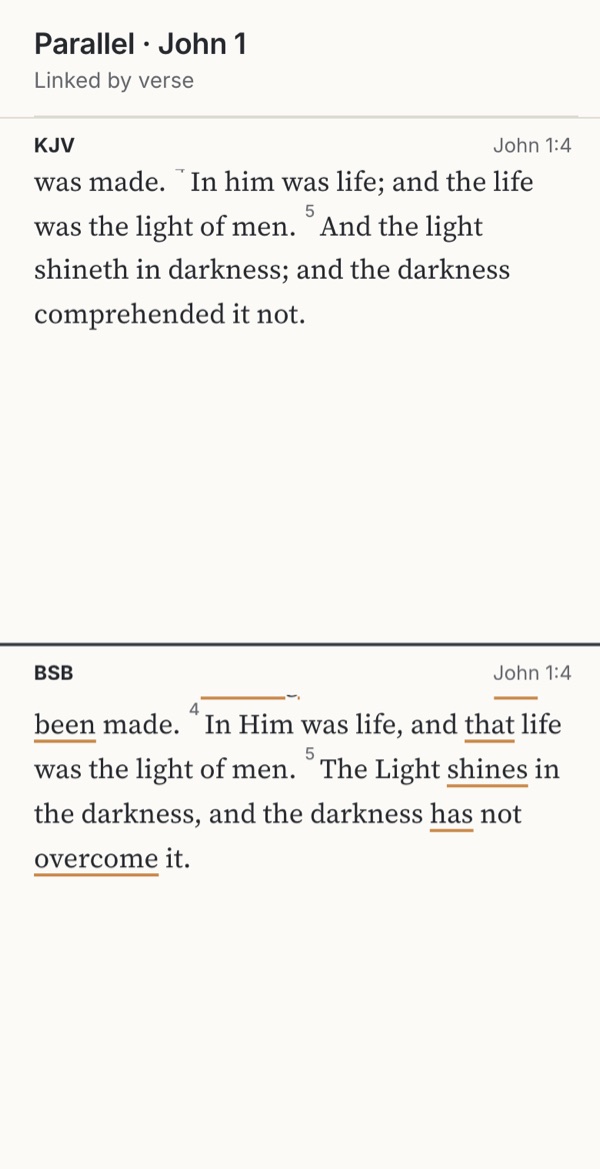 Observed Two continuous texts Half a screen eachTry it →
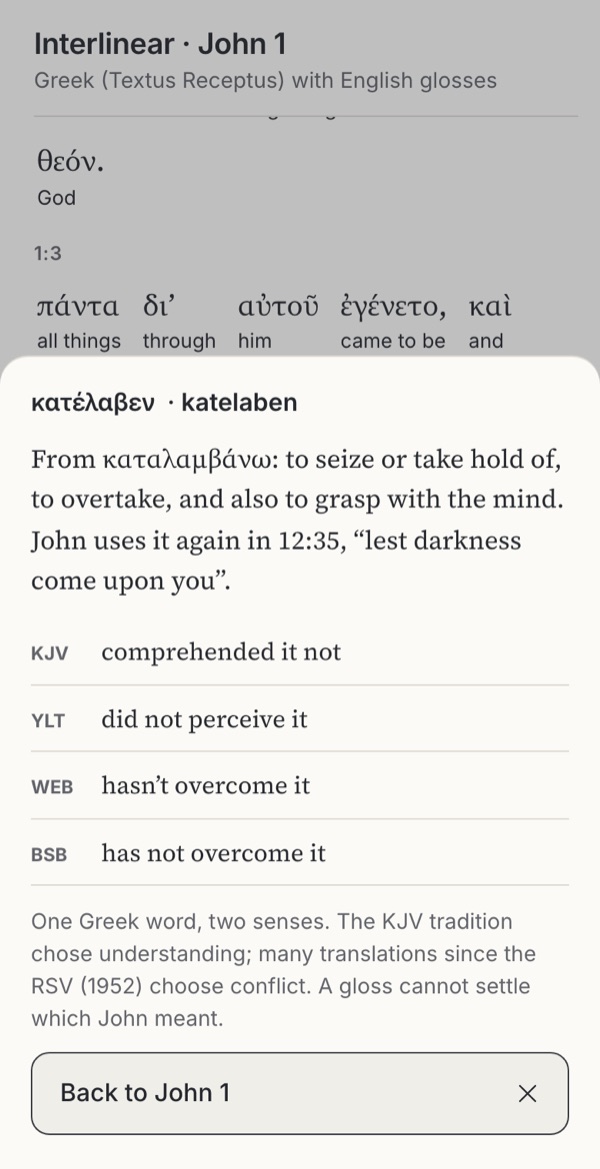 Familiar convention Shows why they differ Glosses pose as meaningTry it →
Stills from the working example below. Choose one to try it.
Try it
Try five ways to compare John 1:1–5
John 1:5 in the KJV says the darkness “comprehended it not”; most recent translations say it “has not overcome it”. Each option shows John 1:1–5 in public-domain translations, from one translation chosen well to the Greek with a gloss under every word. Find out why verse 5 differs.
Option
Why these settings?
All four English translations here are in the public domain: KJV, the Berean Standard Bible (dedicated in 2023), the World English Bible and Young’s Literal Translation. Most modern translations are licensed; the ESV, for example, allows up to 500 verses to be quoted without permission. Marked words are those that do not appear in the KJV verse at all.
Observed
1. One translation
Observed in Hallow (suggested Bibles with notes on each) and Mere Bible (a sheet of full names); see the screenshots below. The scale of approaches is our addition.
Try this
Open the translation menu and read what distinguishes each one. Choose one.
Makes easier
One clear text, chosen with enough context to choose well; nothing to compare or reconcile.
Costs
Readers never see that verse 5 can be read two ways.
Ask your teamWhat does a reader need to know to choose a translation, and when?
Familiar convention
2. Switch in place
A familiar convention in most Bible apps: a translation switch above the text. Keeping the selected verse in place follows the earlier “change translation without losing the passage” pattern.
Try this
Verse 5 is selected. Switch to the other translation and watch where verse 5 lands.
Makes easier
Quick to check one verse in another wording without leaving the reading.
Costs
Only one wording is visible at a time; readers must remember the other.
Ask your teamWhen someone switches, which verse is the anchor: the one they selected, or the one at the top?
Observed
3. Verse by verse
Observed in Lumen Bible, which groups translations under each verse (see the screenshot below).
Try this
Scroll to verse 5. Then switch “Mark differences” off and on.
Makes easier
Both wordings side by side, verse by verse; differences are easy to spot.
Costs
Breaks the flow of the passage; reading becomes comparing.
Ask your teamIs the reader comparing wording, or trying to follow the passage?
Observed
4. Parallel panes
Observed in YouVersion’s web parallel view and Olive Tree’s split screen (an ASV pane synced under a German text); see the screenshots below. On a phone, panes stack so lines stay readable.
Try this
Scroll the top pane, then switch scrolling to “Independent” and scroll again.
Makes easier
Each translation reads as continuous text; linked panes keep them on the same verse.
Costs
Half the screen for each; panes drift apart unless linked by verse, not by pixels.
Ask your teamDo the panes follow each other, and how does a reader get them back together?
Familiar convention
5. Interlinear
A familiar convention in study tools such as Bible Hub, STEP Bible and Logos. The Greek here is Scrivener’s Textus Receptus; the glosses are our own.
Try this
Tap the highlighted word in verse 5. Then add transliteration and grammar.
Makes easier
Shows why translations differ: one Greek word, κατέλαβεν, can mean grasp or overcome.
Costs
Glosses look like a translation and invite word-by-word meanings that the language does not support.
Ask your teamWho is this for, and what stops a gloss from being read as the meaning?
What we noticed
Takeaways
Comparing translations is an old discipline
The 1611 KJV translators, quoting Augustine, held that variety of translations helps find the sense of Scripture, and printed alternatives in the margin. Lamin Sanneh argued that translatability is at the heart of Christian mission. Showing that translations differ is not a threat to trust.
Choosing needs more than abbreviations
Readers choose between approaches without knowing it: Nida’s formal and dynamic equivalence still describe the range. Show full name, date and approach when people choose, as Hallow does with short notes. The full Bible exists in 776 languages, so pickers must handle many languages and partial Bibles.
Keep the verse, not the scroll position
Different wording changes text height, so switching or scrolling by pixels lands on a different verse. Anchor on the selected or visible verse; in parallel panes, link by verse and offer a way to realign, as Olive Tree’s linked split screen does.
Two columns on a phone are too narrow
Very short lines are read more slowly. On a phone, stack panes so each keeps a readable line, and group translations under each verse when the task is comparing wording.
A gloss is not the meaning
Barr and Carson warn against reading meaning from a single gloss or a word’s root. Label interlinear rows, call glosses word aids, and show how translations actually render a word, as κατέλαβεν shows in John 1:5.
Use cases
Which situation, which option?
People come with different needs, sometimes in the same week. Each need fits some options better than others.
| Situation | Needs | 1 One translation | 2 Switch in place | 3 Verse by verse | 4 Parallel panes | 5 Interlinear |
|---|---|---|---|---|---|---|
| Choosing a first Bible | Understand the options | Good fit | Possible | Poor fit | Poor fit | Poor fit |
| Checking one verse | Another wording, quickly | Poor fit | Good fit | Good fit | Possible | Poor fit |
| Small group comparing wordings | Differences side by side | Poor fit | Possible | Good fit | Possible | Poor fit |
| Reading two translations through | Continuous text in each | Poor fit | Possible | Poor fit | Good fit | Poor fit |
| Preparing to teach or preach | Why translations differ | Poor fit | Possible | Good fit | Possible | Good fit |
| Learning Greek or Hebrew | Source words and grammar | Poor fit | Poor fit | Possible | Possible | Good fit |
| Reading with large text | Readable line length | Good fit | Good fit | Good fit | Possible | Possible |
Editorial judgments drawing on the research below, not test results.
The research behind it
Theology, practice and science
Scripture and history
Read in translation from the start
Translation is the Christian norm
Pentecost was heard in every hearer’s own language (Acts 2:6); the KJV preface defends variety of translations; Sanneh calls translatability intrinsic to mission.
How translations are made
Formal and dynamic equivalence describe a range most translations sit within.
Many languages, partial Bibles
The full Bible in 776 languages, the New Testament in 1,798 more.
Reading and comparing
What the research says
Comparing is demanding
Building one understanding from several texts is a distinct skill; help readers connect them.
Line length
Very short lines slow reading; avoid narrow columns on phones.
Words mean in context
Root and gloss fallacies: meaning comes from usage, not etymology.
Licensing and access
Best practice
Licences limit comparison
The BSB is public domain; the ESV allows up to 500 verses without a licence.
Language and layout
Tag Greek and Hebrew with their language; content must reflow at 200%; keep versification mappings.
Every source, with what it can and cannot show, is listed under Go further → Sources and their limits.
Where to start
Which fits your product?
IfMost reading products
Start withOne translation, chosen with name, approach and date in view
IfReaders check a verse in another wording
Start withSwitch in place, keeping the selected verse as the anchor
IfGroups and preachers compare wording
Start withVerse by verse, with differences marked
IfPeople read two translations through
Start withStacked panes linked by verse, with realign
IfStudy and teaching preparation
Start withInterlinear with named rows and word detail; glosses labelled as aids
These are editorial judgments from design review, not results of user testing.
In real apps
Examples in use
Attributed screenshots with dates and review limits. A screenshot shows an implementation; it does not show that it works for every audience.
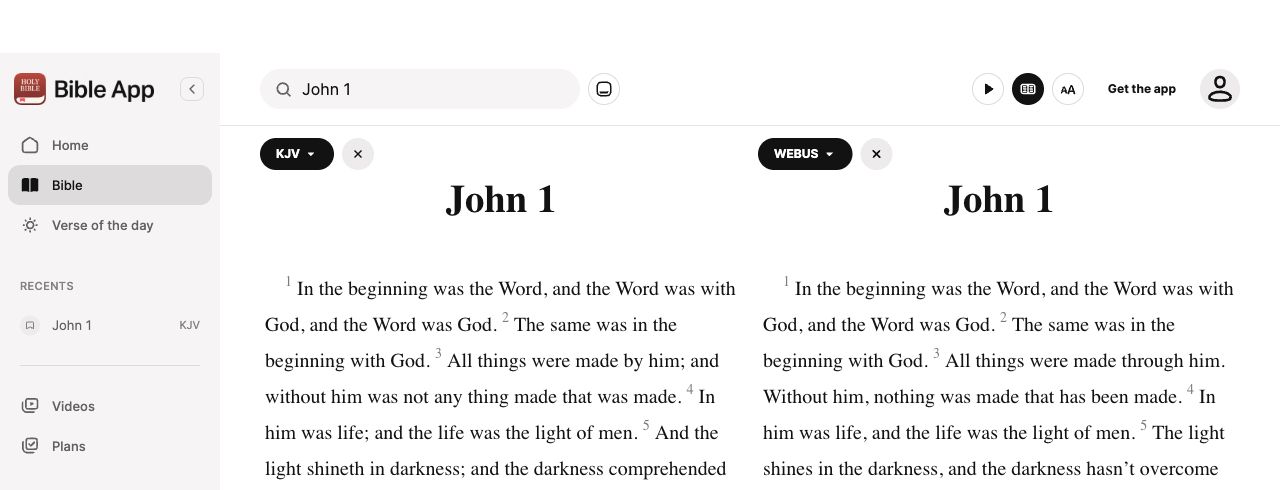 YouVersion · Desktop web
Two editions with independent selectors
Direct web capture · cropped
A study workspace beside the passage
Publisher help screenshot
Three ways to link reading windows
Publisher help screenshot
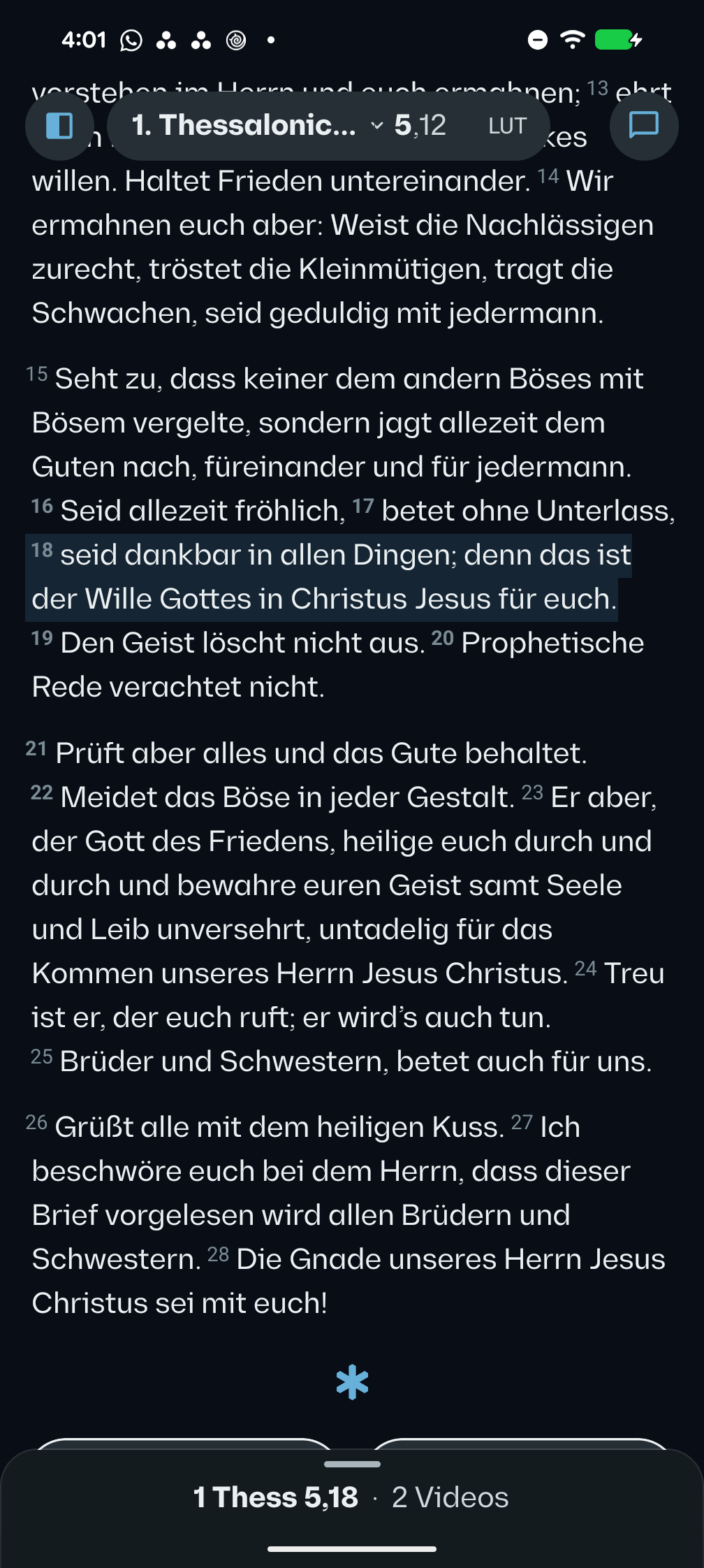 VSB · Android 17 · Pixel 8 Pro · German interface
A selection survives returning from its study sheet
Direct Android prototype capture
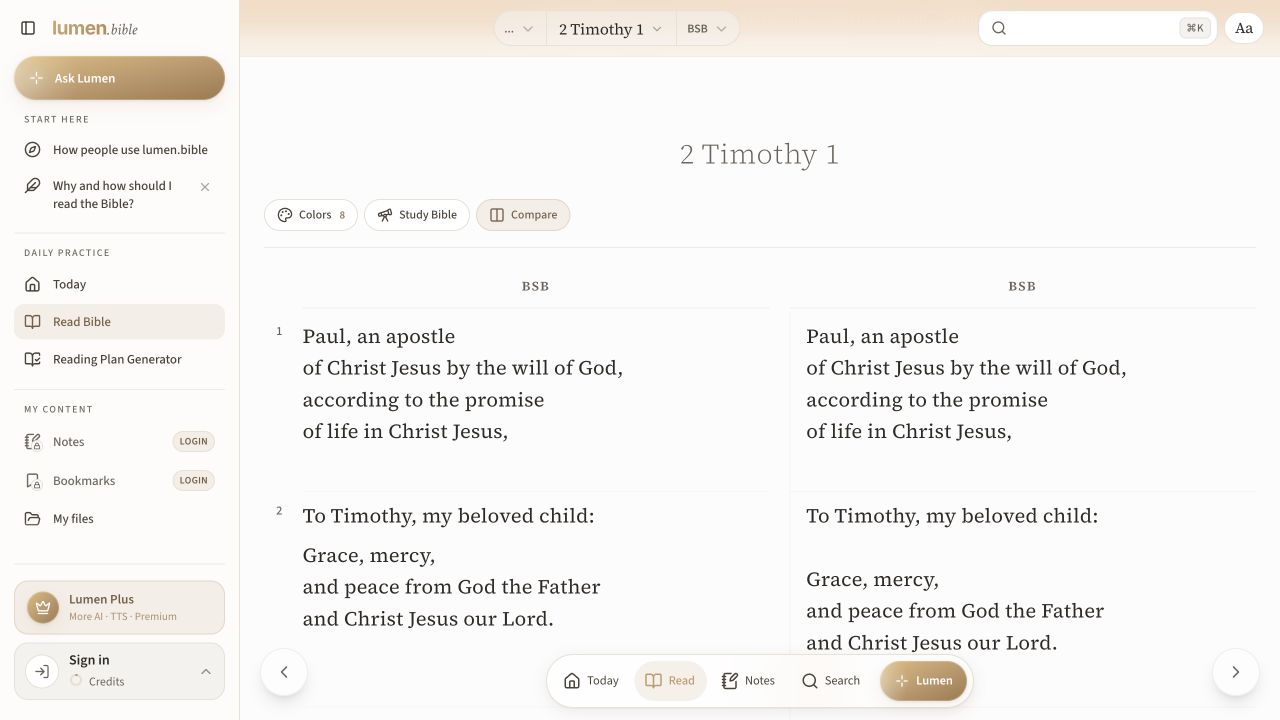 Lumen Bible · Desktop web · English interface
Verse-aligned columns retain different line wrapping
Direct signed-out web capture
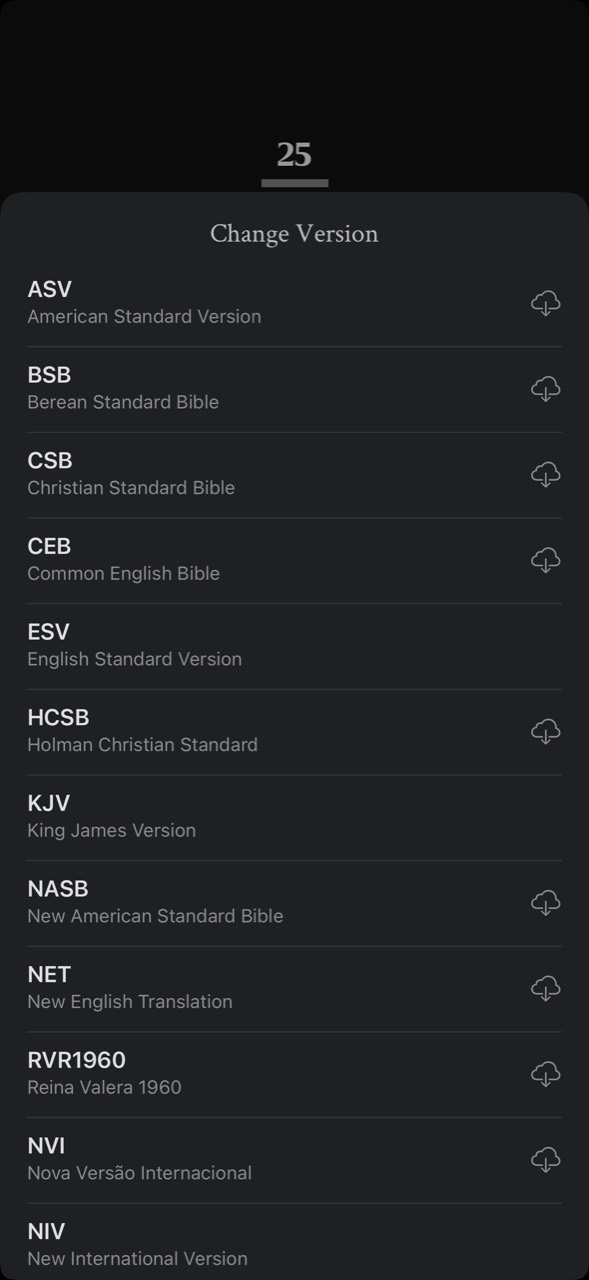 Mere Bible (formerly NeuBible) · Mobile interface · device and OS not independently verified
Translations in a sheet over the reader
User-contributed screenshot · unedited
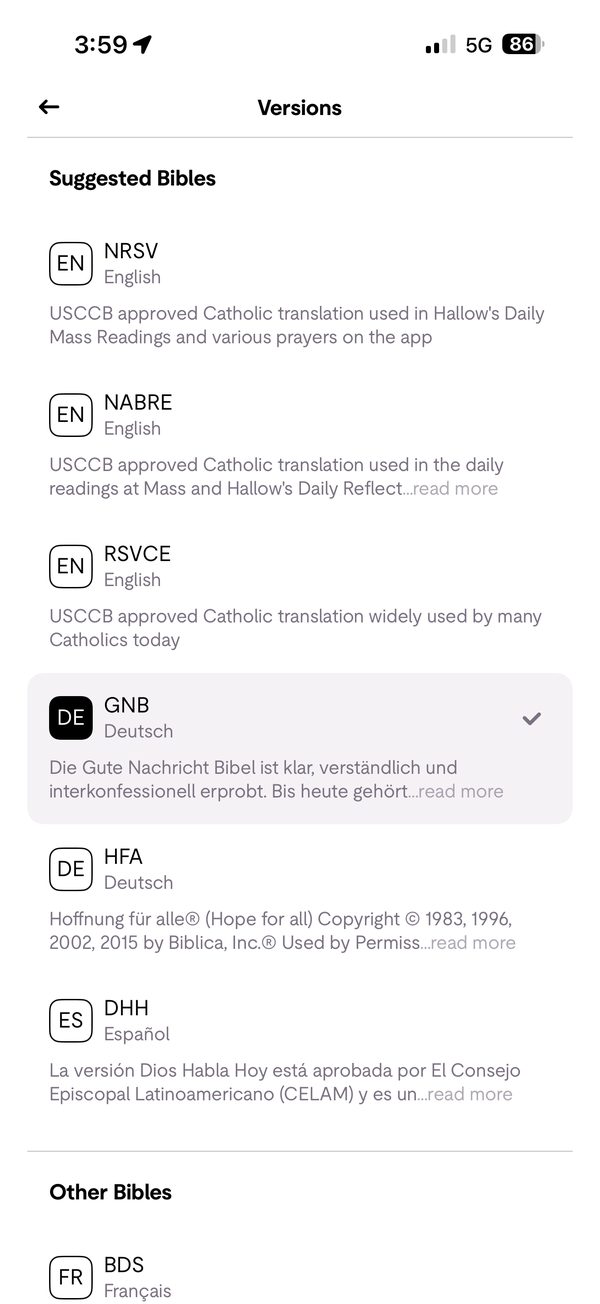 Hallow · iOS app · device model not recorded
Translation notes at the moment of choosing
User-contributed screenshot · resized, content unchanged
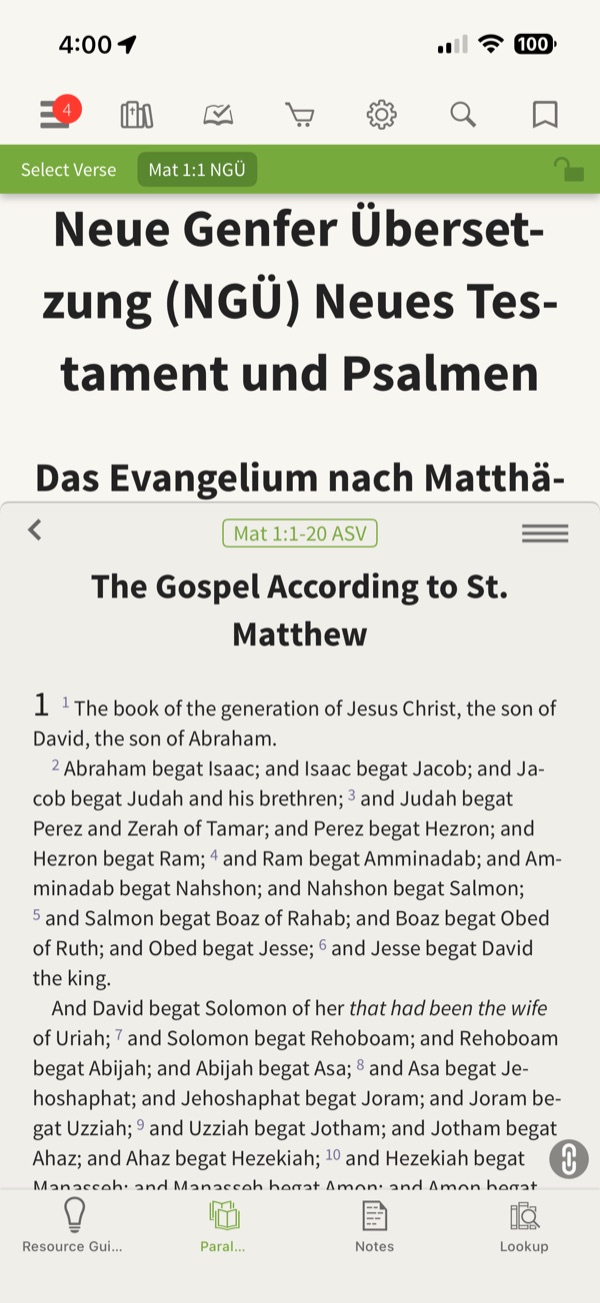 Olive Tree Bible · iOS app · device model not recorded
A second translation synced in a split screen
User-contributed screenshot · resized, content unchanged
Theological reflection
What is this practice for?
What translation is for
At Pentecost the crowd asked, “How is it then that each of us hears them in his own native language?” (Acts 2:8). The vision of Revelation includes “every nation and tribe and people and tongue” (Revelation 7:9). Christianity has no sacred original language for worship: the New Testament itself quotes the Greek translation of the Hebrew Scriptures. Lamin Sanneh argued that this translatability is part of the gospel’s character.
Where Christians differ
Churches differ on which translations may be used in worship: Catholic canon law requires that editions of Scripture be approved by the Apostolic See or the bishops’ conference, while most Protestant churches leave the choice to congregations. Some hold to a single historic translation; the Orthodox read the Old Testament from the Septuagint. Translators differ on how closely to follow the form of the original. The 1611 translators defended variety as a help to understanding.
What follows for design
Comparing translations is an old discipline, not a sign of doubt. Show what kind of translation each is and who approved it, keep the reader on the same verse, and show where translations disagree rather than hiding it. Treat languages that do not pay for themselves as part of the mission, not a market decision.
In conversation with
- Martin Luther, Sendbrief vom Dolmetschen (1530) told translators to ask “die Mutter im Hause, die Kinder auf der Gasse, den gemeinen Mann auf dem Markt” and listen to how they speak: translation serves the hearer.
- Second Vatican Council, Dei Verbum (1965) opens its chapter on Scripture in the life of the church: “Easy access to Sacred Scripture should be provided for all the Christian faithful.”
Scripture is quoted from the Berean Standard Bible. This reflection is the editor’s, written from within the Christian tradition and open to correction. How we approach theology here →
Three ways to build
What would each way do here?
ExploitativeTakes from the person
One translation is sold as “the real meaning”; others sit behind a paywall to upsell.
EthicalDoes no harm
Name each translation and its approach, and keep the verse in place while comparing.
RedemptiveGives something up for them
License heart-language translations that will never pay for themselves, and show readers where translations disagree even when it complicates the product.
The three ways are Praxis’s frame for redemptive entrepreneurship; their application here is ours. Why we use it, and its limits →
Take into your next review
Does the reader know what kind of translation this is, and stay on the same verse while comparing?
Exercise
Pick a verse your translations disagree on. Ask three people to find out why, using your app. Note where they lose the verse, and whether anyone reads a gloss as the real meaning.
Behind every translation are people who gave years so others could hear God in their own language. Let readers see that care.
Record the decision with the worksheet →
Something missing or wrong here? Send a correction or suggest a topic.
Details
Go further
This deep dive brings together 6 earlier patterns. Their guidance, wireframes and sources are kept below; their old addresses lead here.
Edge cases to design for
Show full names, approach and date when people choose, and say which translations are available offline or with audio. When switching, keep the selected or visible verse in place. For checking wording, group translations under each verse and mark what differs. For reading two texts, use full-width panes stacked on a phone, linked by verse with a clear way to unlink and realign. Offer interlinear for study, with each row named, glosses labelled as word aids, and word detail that shows how translations render a word. Respect licensing and versification.
What tends to go wrong
Abbreviation-only lists; switching that jumps to the chapter start; side-by-side columns of 20 characters on a phone; panes linked by scroll position; marking every reordered word as different; glosses presented as the meaning; Greek or Hebrew without a language tag or right-to-left support; quoting licensed translations beyond their limits.
How to test it
Ask readers to explain the difference between two translations they chose. Switch with a verse selected, while reading and while listening, and check the place is kept. Compare a verse in each layout at 200% text size. Ask readers what a gloss means, and whether it is “the real meaning”. Test Hebrew with right-to-left reading and a screen reader.
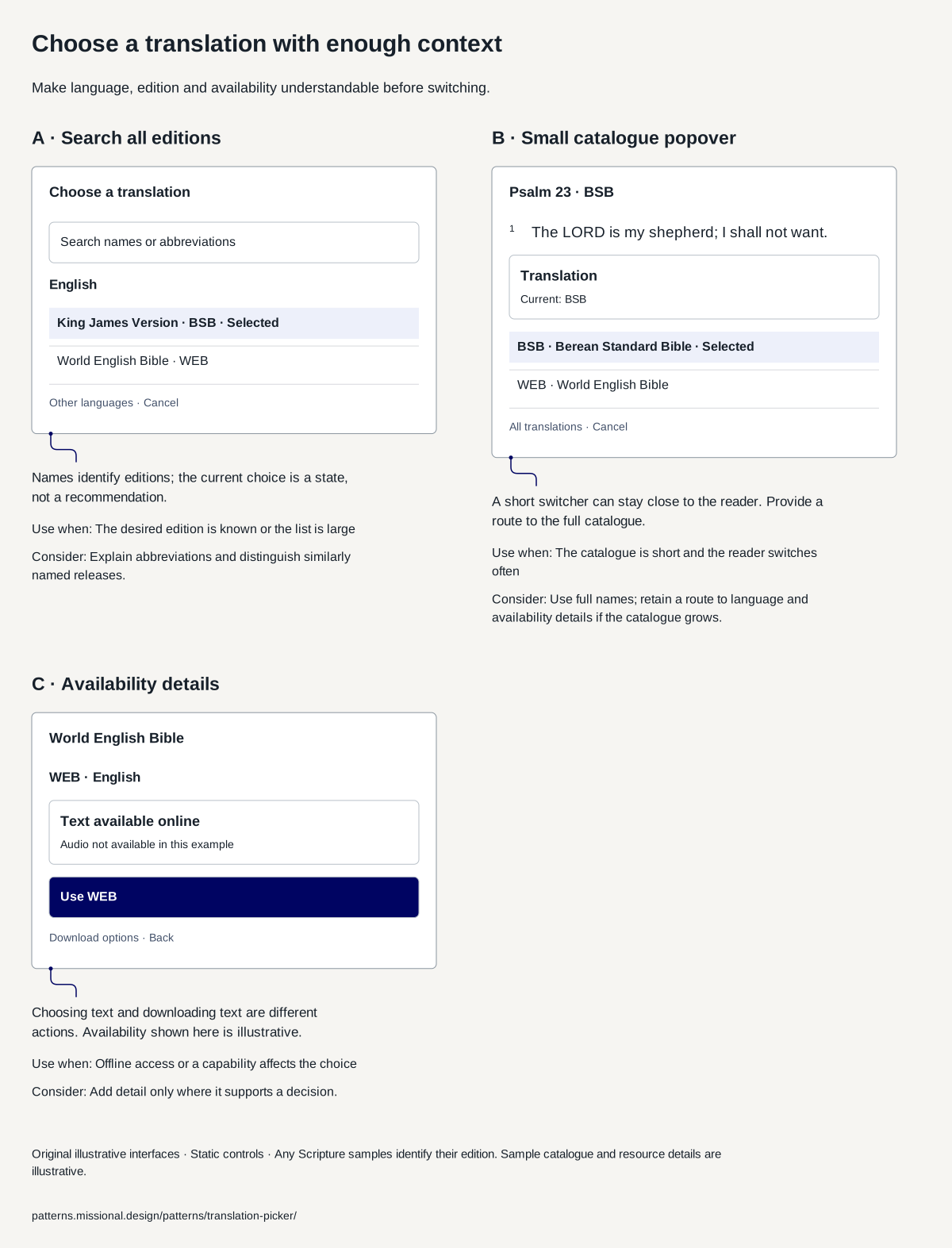
Earlier pattern: Choose a translation with enough context
Make language, edition and availability understandable before switching.
Guidance
Search by full name and abbreviation, group by language when useful, and show the active edition. Use a short favourites list for frequent switching with a clear route to all editions. Separate choosing an edition from downloading or starting audio. A short catalogue may need only a popover list, without search. A large multilingual collection may use language → edition drill-down, with optional favourites or downloaded filters. Confirm an unavailable passage before switching editions.
What tends to go wrong
Replacing an unavailable edition silently; presenting a popularity ranking as theological authority; losing the current passage; unclear download size or licence constraints.
How to test it
Choose an unfamiliar edition, find a known abbreviation, cancel a download and change editions offline. Confirm the chosen text and retained reference.
Sources
- Scripture structure documentationRelevant structure and marker references reviewed · A format is not a complete model of app behaviour, annotations or formation.
- Understanding ReflowOfficial guidance reviewed on 5 October 2026 · Semantic scroll restoration is an original design proposal, not a requirement stated by this criterion.
- Psalm 23, Berean Standard BiblePassage text taken from API.Bible, 9 October 2026 · A text source, not evidence of the proposed interface’s effectiveness.
- Mere Bible: contributed reader and picker screenshotsNine images supplied and reviewed 6 October 2026; capture date and build unverified · Still images establish visible states, not gesture timing, accessibility, persistence or exact interaction behaviour.
- Mere Bible: publisher listing and renameReviewed 6 October 2026 · Does not identify the build shown in the contributed screenshots.
Earlier pattern: Change translation without losing the passage
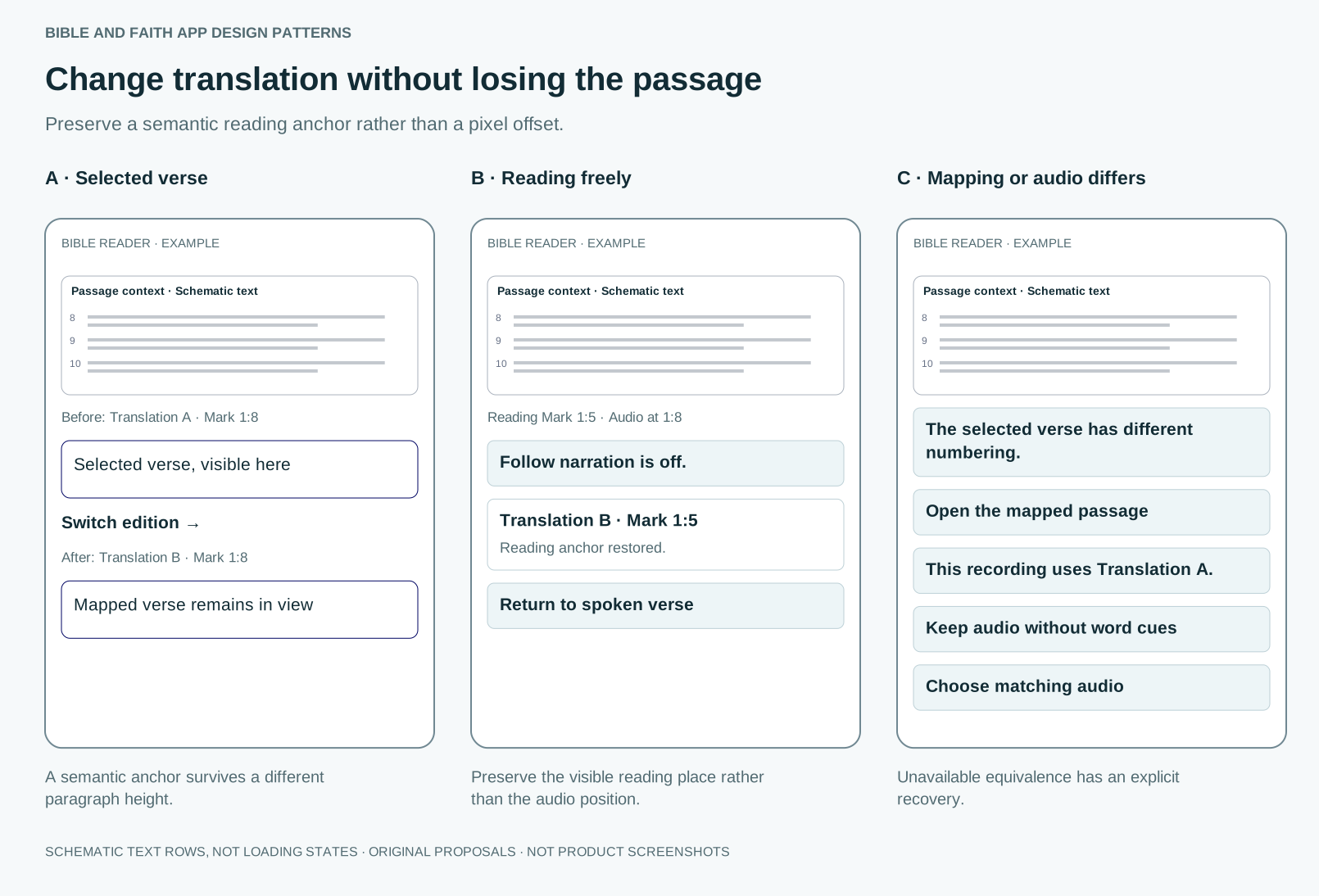
Preserve a semantic reading anchor rather than a pixel offset.
Guidance
Before switching, identify the relevant anchor: the active selection or opened target, otherwise the visible reading verse; use the spoken verse only while Follow narration is enabled. Retain its approximate viewport position or bring it safely into view after the new edition has laid out. Reapply placement after late font or media loading only until the user scrolls; manual exploration takes precedence. Resolve versification with a trusted mapping and explain missing, split or merged verses. Keep reference notes separate from edition-specific word selections. Audio stays bound to its recorded edition: offer matching audio or clearly separate listening from the new text, and disable incompatible word cues.
What tends to go wrong
Restoring raw pixels; jumping to the chapter start; following audio after the reader scrolled away; copying word highlights onto unrelated wording; endlessly recentering during loading.
How to test it
Switch editions while selecting a verse, freely reading, following audio, opening a note and using large text. Test poetry, missing verses, split or merged mappings, load failure and late reflow.
Sources
- Scripture structure documentationRelevant structure and marker references reviewed · A format is not a complete model of app behaviour, annotations or formation.
- EPUB Media OverlaysRelevant specification section reviewed · Not proof of a particular Bible app implementation.
- Understanding ReflowOfficial guidance reviewed on 5 October 2026 · Semantic scroll restoration is an original design proposal, not a requirement stated by this criterion.
Earlier pattern: Parallel reading chooses a useful arrangement
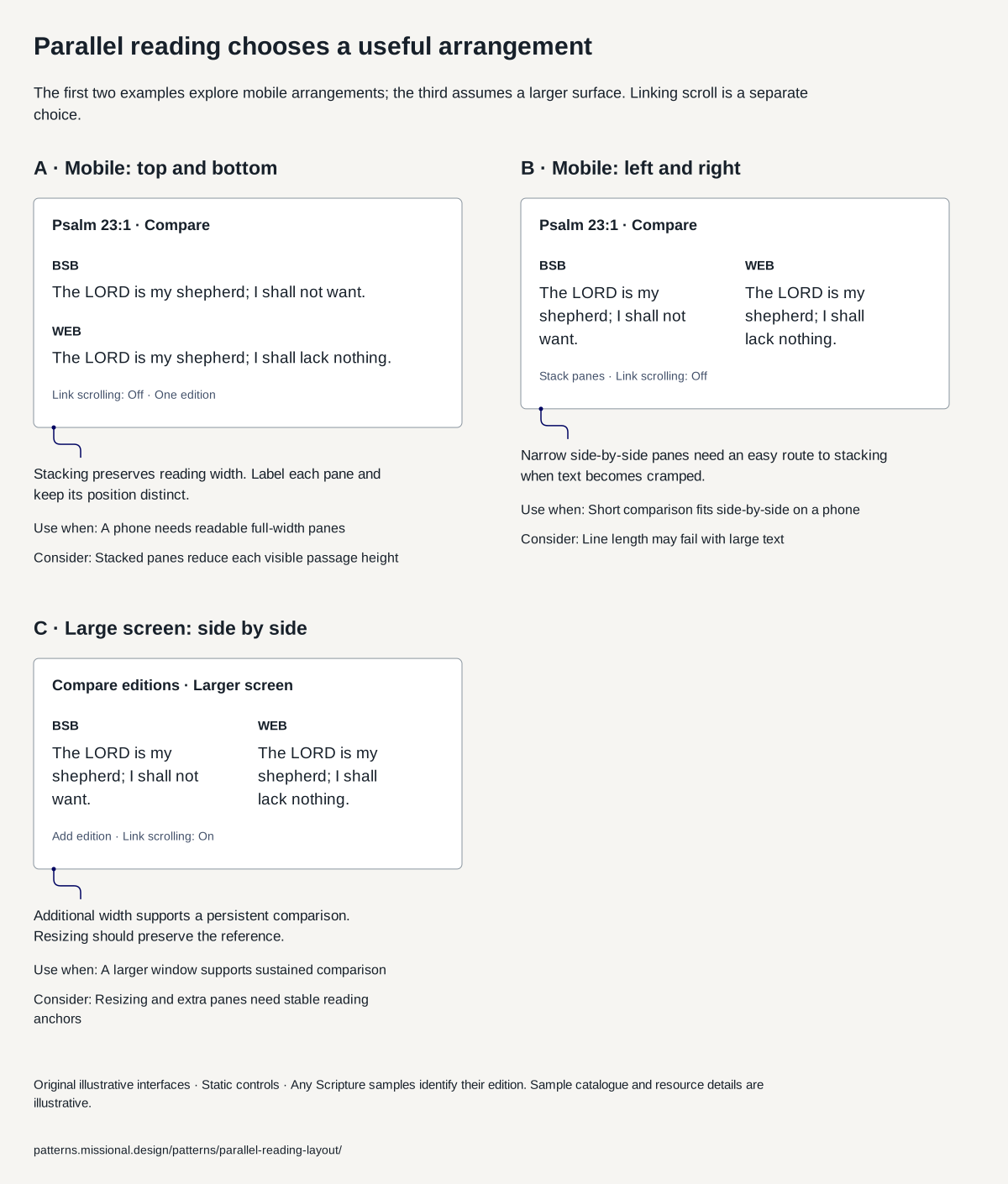
Compare translations without forcing a desktop layout onto a small screen.
Guidance
Choose left/right panes, top/bottom panes, or alternating edition blocks by the comparison task and available width. On mobile, a top/bottom split preserves line length, while a left/right split can suit brief passages when text remains readable. Offer a single-edition view or switching between editions when neither split fits enlarged text. On larger screens, side-by-side panes can support sustained comparison; let users resize or close panes without losing the reference. Keep edition labels, reference scope and scroll controls visible. Orientation names describe pane arrangement, not the direction in which Scripture should scroll.
What tends to go wrong
Shrinking text to fit columns; assuming landscape means enough space; hiding edition identity; putting one pane behind the player or keyboard.
How to test it
Test portrait, landscape, a large screen, enlarged fonts, a long verse and poetry. Can users identify both editions, change arrangement and retain the target passage?
Sources
- Scripture structure documentationRelevant structure and marker references reviewed · A format is not a complete model of app behaviour, annotations or formation.
- Understanding ReflowOfficial guidance reviewed on 5 October 2026 · Semantic scroll restoration is an original design proposal, not a requirement stated by this criterion.
- Psalm 23, Berean Standard BiblePassage text taken from API.Bible, 9 October 2026 · A text source, not evidence of the proposed interface’s effectiveness.
- Psalm 23, World English BiblePassage text and edition description reviewed 5 October 2026 · This endpoint is the updated 66-book edition; product availability shown elsewhere is illustrative.
Earlier pattern: Linked scrolling follows passage identity
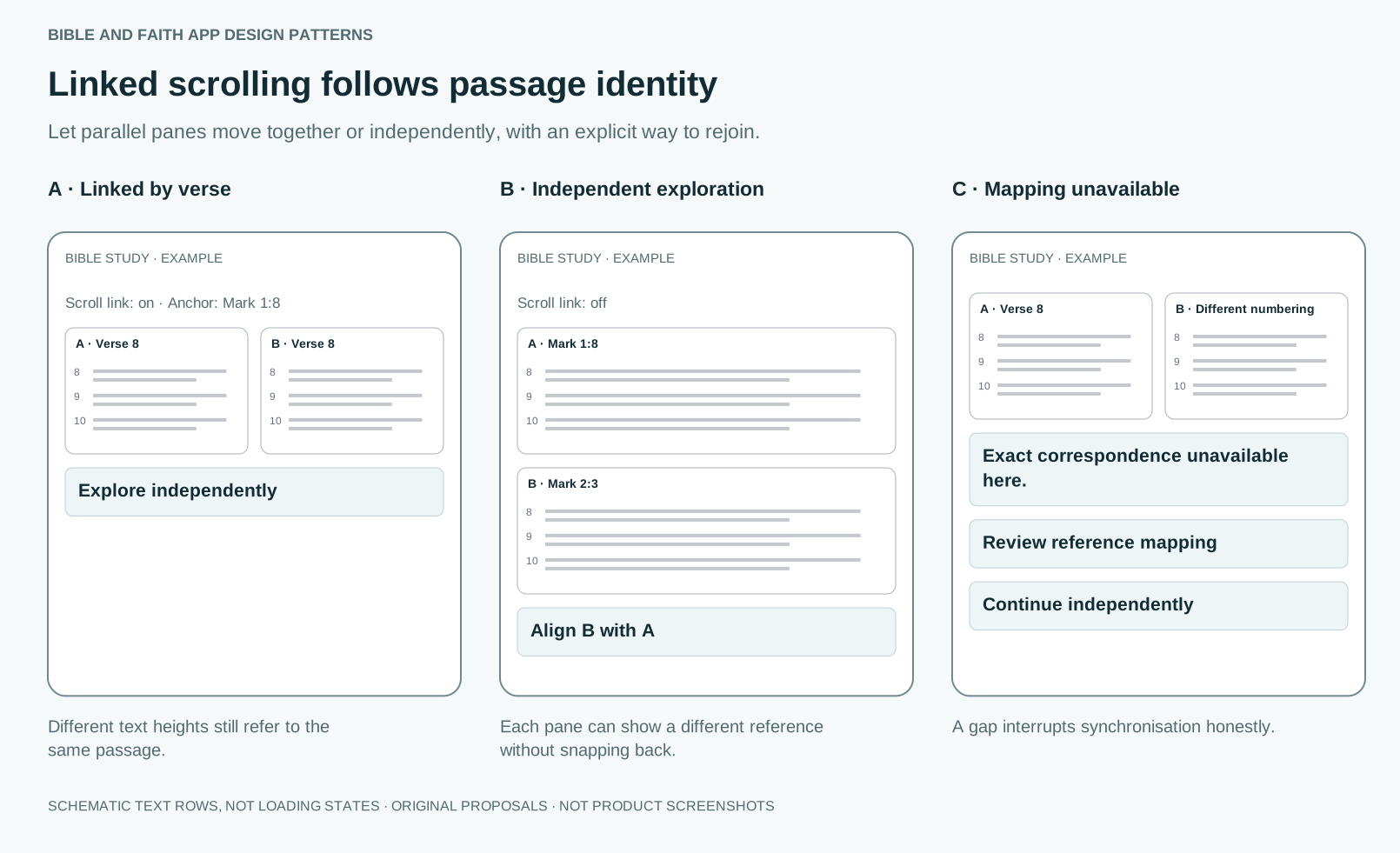
Let parallel panes move together or independently, with an explicit way to rejoin.
Guidance
Offer linked and independent scrolling. In linked mode, map the leading pane’s visible verse or passage anchor into the other pane instead of copying pixel offsets. Keep a stable leading pane during an interaction; avoid feedback loops and jitter. In independent mode, show each reference and offer Align at this verse. Rejoining uses the user’s chosen pane as the anchor. If a mapping is missing, split or merged, explain the correspondence and avoid pretending an exact line alignment. Playback following is a separate control; specify which pane it follows.
What tends to go wrong
Proportional scrolling presented as exact correspondence; snapping back after exploration; both panes endlessly steering each other; silently changing playback.
How to test it
Scroll either pane, unlink, explore another chapter and rejoin. Test poetry, verse bridges, missing mappings, touch gestures, resizing and audio following.
Sources
- Scripture structure documentationRelevant structure and marker references reviewed · A format is not a complete model of app behaviour, annotations or formation.
- Understanding ReflowOfficial guidance reviewed on 5 October 2026 · Semantic scroll restoration is an original design proposal, not a requirement stated by this criterion.
- EPUB Media OverlaysRelevant specification section reviewed · Not proof of a particular Bible app implementation.
- Android Study CenterHelp updated July 2026; reviewed 5 October 2026 · Documented Android behaviour; not a live capture or an endorsement of every default.
Earlier pattern: Group editions around a shared verse
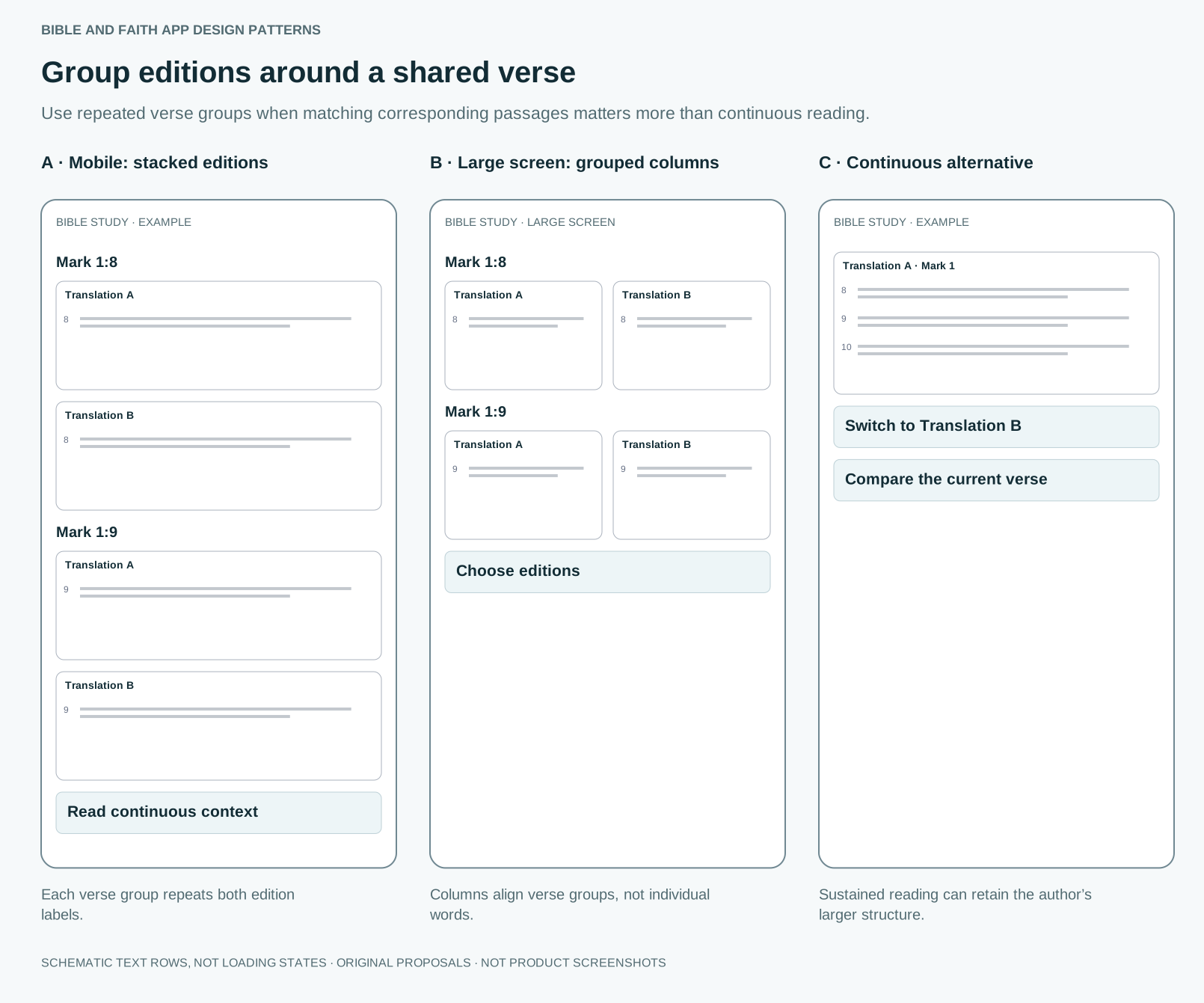
Use repeated verse groups when matching corresponding passages matters more than continuous reading.
Guidance
Group the chosen editions beneath a common reference. Repeat edition labels and preserve wording, paragraph structure and edition-specific numbering. Offer stacked edition blocks for narrow screens and columns inside each verse group where width permits. A continuous-text alternative supports reading an argument or poem. With many editions, let users choose which to include rather than endlessly expanding every group. Explain split, merged or missing verse mappings within the group.
What tends to go wrong
Aligning words just because verse numbers match; stripping poetic structure; hiding edition labels after the first group; substituting empty text for a missing verse.
How to test it
Compare short and long verses, poetry, two and several editions, different numbering and large text. Can readers switch back to continuous context?
Sources
- Scripture structure documentationRelevant structure and marker references reviewed · A format is not a complete model of app behaviour, annotations or formation.
- Understanding ReflowOfficial guidance reviewed on 5 October 2026 · Semantic scroll restoration is an original design proposal, not a requirement stated by this criterion.
Earlier pattern: Interlinear rows expose their alignment
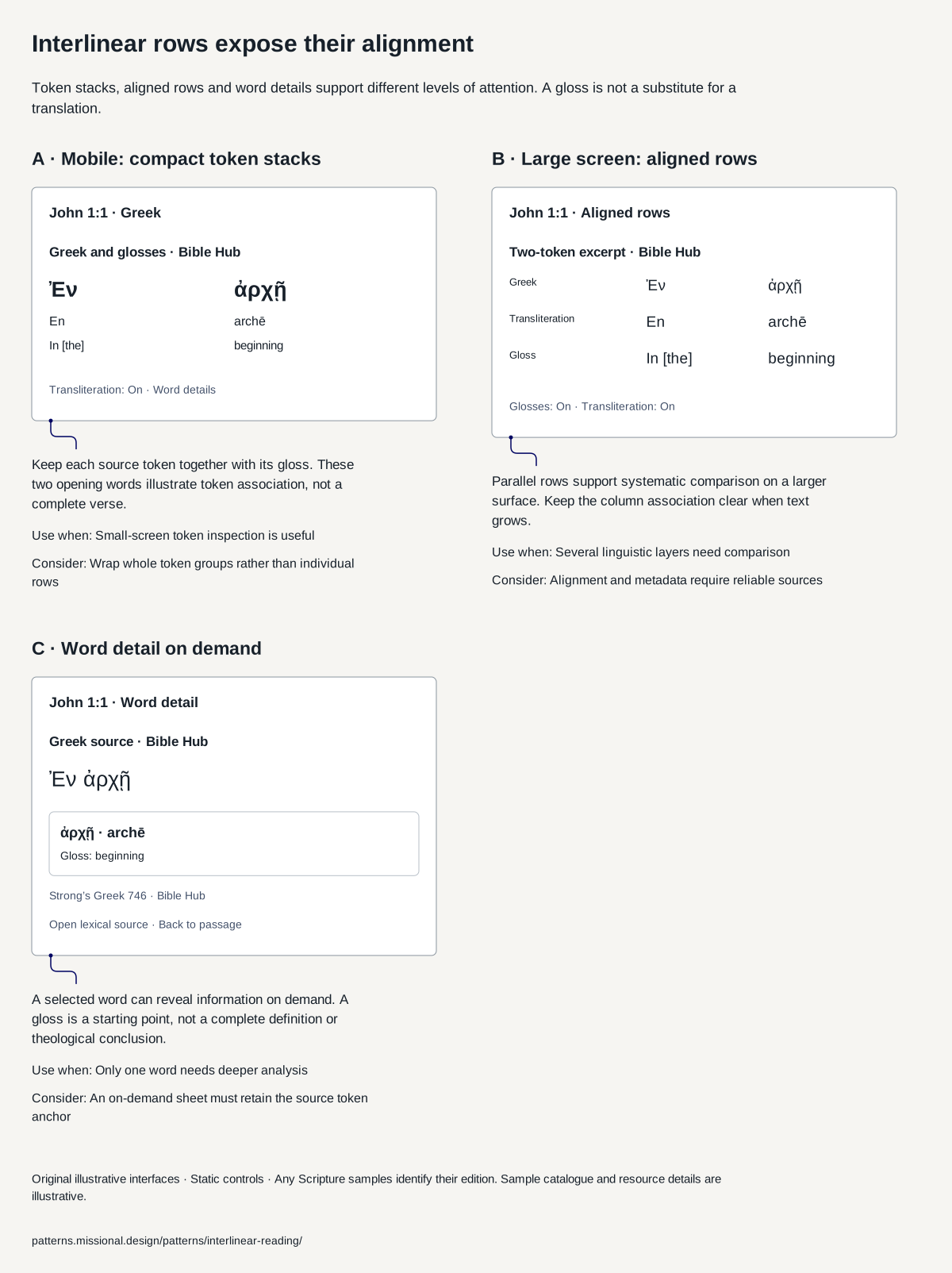
Distinguish source-language tokens, glosses and translation wording.
Guidance
Label the source text, token alignment, gloss source and reading direction. A gloss is a lexical aid rather than a fluent translation or a definitive meaning in context. Offer compact token stacks, expandable word detail and wider aligned rows where space permits. Let the user choose which rows to display: original script, transliteration, gloss, morphology or lexical reference. On mobile, wrap whole token groups in source order or open one token at a time; preserve right-to-left ordering and bidirectional labels. Distinguish source-order interlinear from translation-order reverse interlinear. Missing token links need an explicit unavailable state rather than invented alignment.
What tends to go wrong
Breaking a token stack across lines; flattening right-to-left source order; presenting a gloss as the chosen Bible translation; guessing links from similar-looking words.
How to test it
Test Greek and Hebrew with expert reviewers, narrow width, enlarged text, bidirectional scripts, multi-token mappings and missing alignment. Can readers identify the origin of every row?
Sources
- Scripture structure documentationRelevant structure and marker references reviewed · A format is not a complete model of app behaviour, annotations or formation.
- Understanding ReflowOfficial guidance reviewed on 5 October 2026 · Semantic scroll restoration is an original design proposal, not a requirement stated by this criterion.
- John 1:1 Greek text analysisThe first two tokens, transliterations and glosses reviewed 5 October 2026 · Two-token illustration only; not a complete lexical analysis, alignment dataset or licence for bulk reuse.
Sources and their limits
Research-informed design proposal. Editorial review, not user validation.
- The Translators to the Reader (preface to the 1611 King James Version)Preface section reviewed · A historical preface defending one translation.
- Translating the Message: The Missionary Impact on CultureReview reviewed · A review of a historical and missiological argument.
- Toward a Science of Translating: formal and dynamic equivalenceExcerpt reviewed · Translation theory; most translations mix both approaches.
- Review of D. A. Carson, Exegetical FallaciesReview reviewed · Scholarly argument summarised in a review.
- 2025 global Scripture accessStatistics page reviewed · Organisation’s own statistics.
- Multiple text integration: a reviewAbstract reviewed · Research on expository texts, not translations of one source.
- The effects of line length and method of movement on patterns of reading from screenAbstract reviewed · Desktop screens and English prose.
- Berean Bible terms and conditionsTerms reviewed · Publisher statement.
- ESV permissions guidePermissions page reviewed · One publisher’s terms; others differ.
- Understanding Language of PartsGuidance reviewed · Accessibility guidance; screen reader support for ancient Greek and Hebrew varies.
- Understanding ReflowOfficial guidance reviewed on 5 October 2026 · Semantic scroll restoration is an original design proposal, not a requirement stated by this criterion.
- Scripture structure documentationRelevant structure and marker references reviewed · A format is not a complete model of app behaviour, annotations or formation.
Faith and interpretation
Christianity has always been read in translation: the New Testament quotes the Greek Septuagint, and at Pentecost “each one heard them speaking his own language” (Acts 2:6). The 1611 translators, quoting Augustine, held that variety of translations helps readers find the sense of Scripture. Lamin Sanneh argued that translatability is at the heart of Christian mission: no language is too common for the word of God. Comparing translations is an old discipline, not a sign of doubt.