Bible audio
How should Scripture be heard: as text, voice or read-along?
Scripture was heard long before it was read silently, and for many people today listening is the main way in: on the way to work, before sleep, or because reading is hard. Apps decide how much the voice leads, whose voice it is, and what happens when the reading ends. Giving Scripture a voice is an old ministry, and a serious one: whoever shapes the voice shapes how people hear the word.
- 5 working options
- 7 app examples
- 5 takeaways
- Editorial review, not user-tested
The spectrum
From the page to the ear
 Leave it out Nothing to produce Leaves listeners outTry it →
 Familiar convention Audio wherever the text is Voice and text drift apartTry it →
 Observed Text follows the voice Moving text needs controlTry it →
 Observed Works with the screen dark Autoplay runs onTry it →
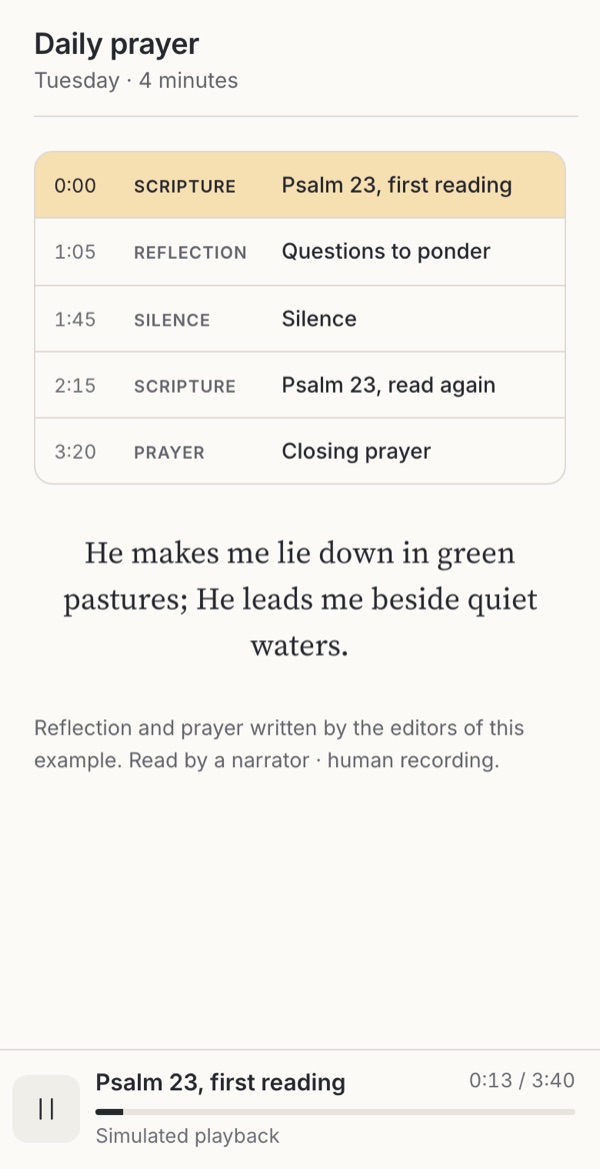 Observed A whole practice in minutes Editors’ voices beside ScriptureTry it →
Stills from the working example below. Choose one to try it.
Try it
Try five ways of hearing Psalm 23
Psalm 23 in the Berean Standard Bible, from text alone to a produced daily prayer. Press play in each option and watch what the text does; then try a synthetic voice and music. Playback is simulated: nothing sounds.
Option
Why these settings?
Synthetic voices are now hard to tell from people; listeners trust voices less when told they are AI, and from August 2026 the EU AI Act requires generated audio to be marked. The example labels the voice in every player. Music is optional because background music mildly disturbs reading, while many listeners value it.
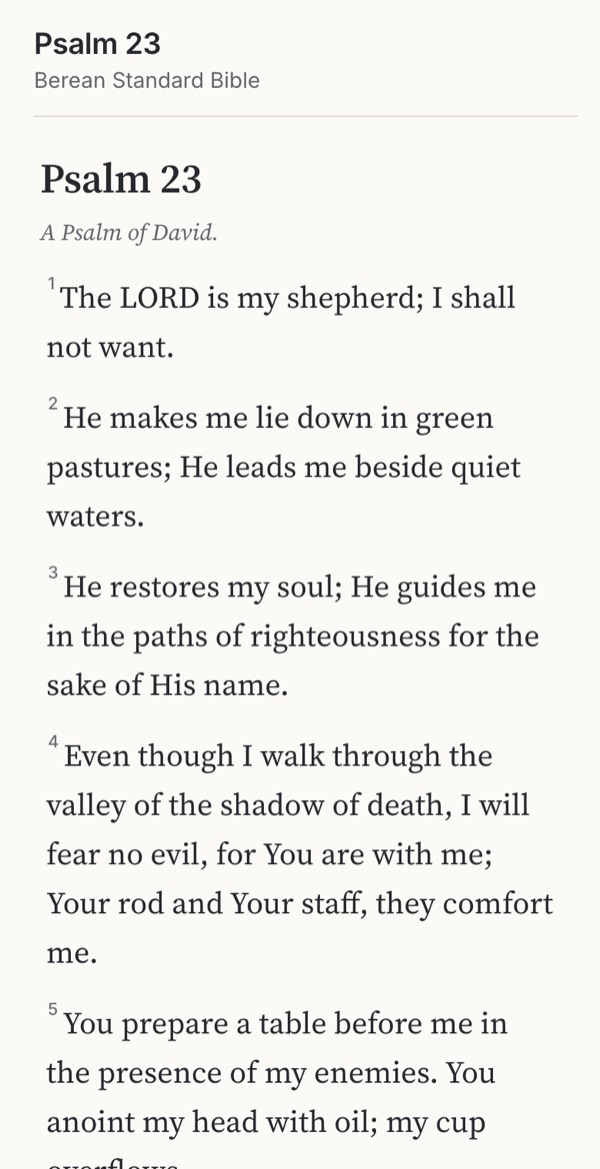
Leave it out
1. Text only
Leaving audio out, as many study-focused apps do.
Try this
Read the psalm. Then imagine reading it while driving, or with low vision.
Makes easier
Nothing to produce, license or moderate; the text is the whole experience.
Costs
Leaves out commuters, people with low vision or dyslexia, and anyone who receives Scripture by ear.
Ask your teamWho cannot use your product without audio?
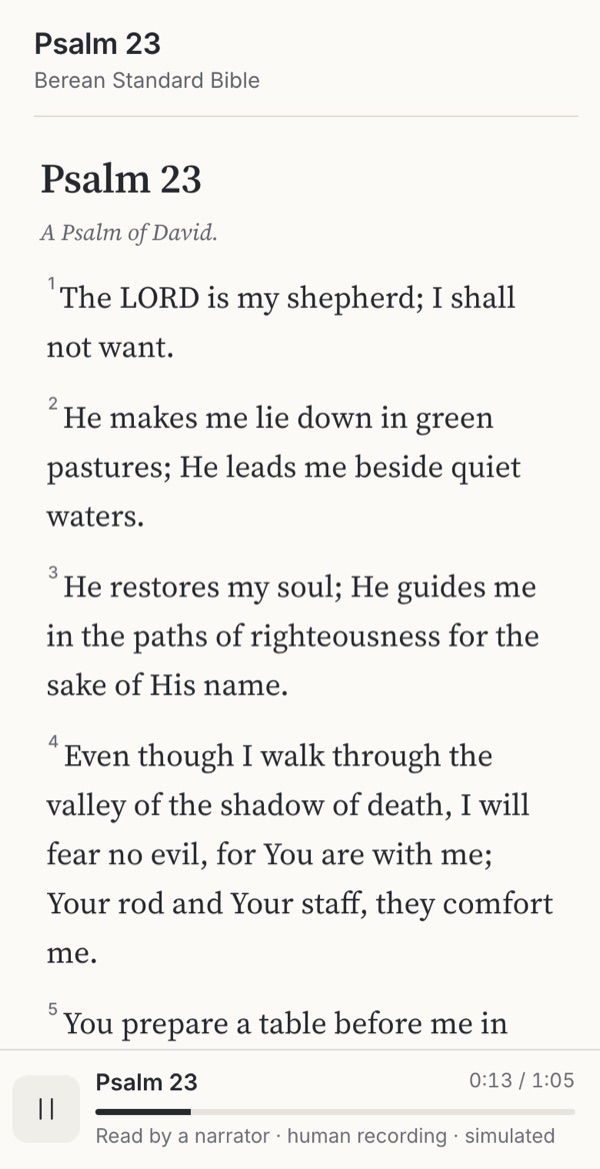
Familiar convention
2. Listen button
A familiar convention: most Bible apps offer narration with a play button above or below the text.
Try this
Press play and follow along by yourself.
Makes easier
Audio is available wherever the text is, with no change to reading.
Costs
Voice and text drift apart; the listener has to keep their own place.
Ask your teamIs the audio for listening alone, or for reading along?
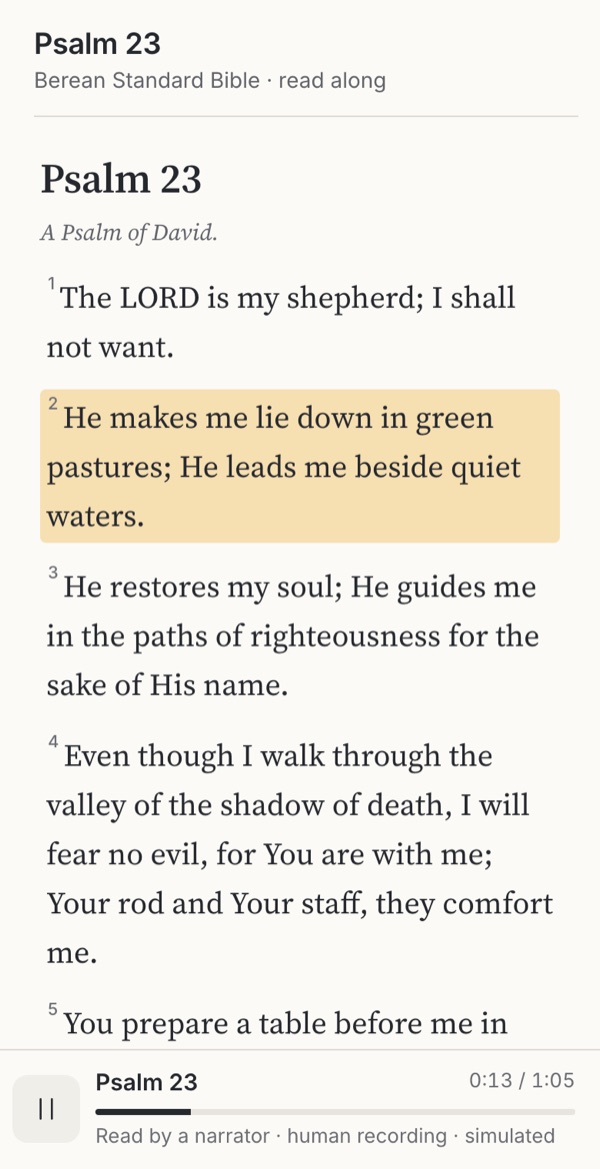
Observed
3. Read-along
Observed in Dwell and Soultime, where the verse being read is highlighted or isolated (see the screenshots in the related deep dives).
Try this
Press play and watch the highlight move. Then pause it mid-verse.
Makes easier
Text and voice stay together; helpful for learning to read, for dyslexia and for following closely.
Costs
A moving highlight needs a pause, and timing must be accurate to the verse or sentence.
Ask your teamAt what level should the text follow the voice: verse, sentence or word?
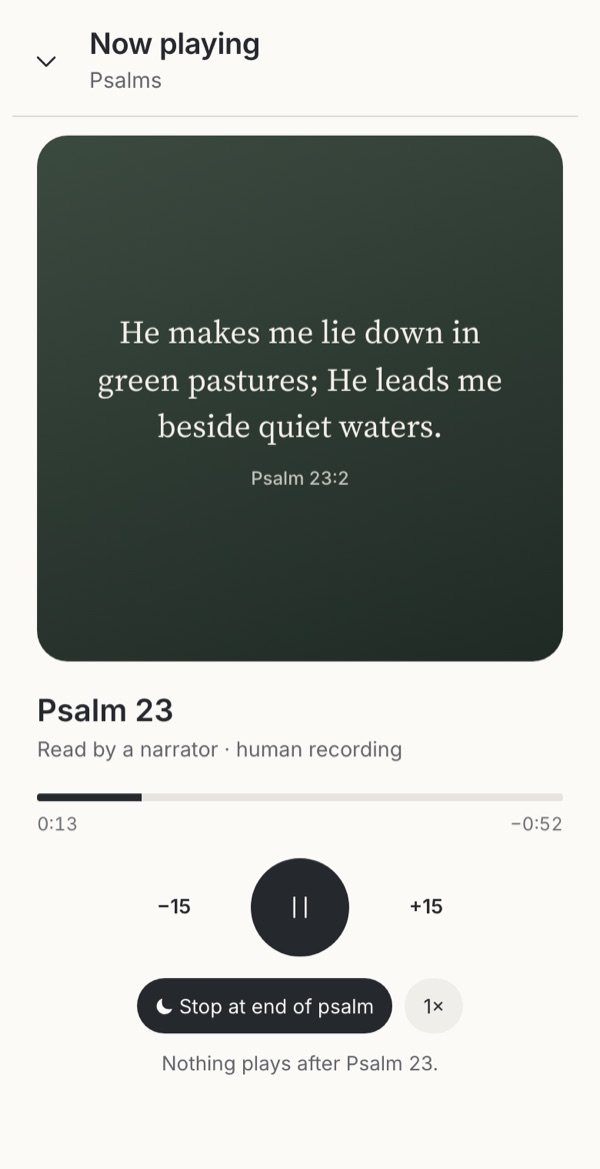
Observed
4. Audio first
Observed in Dwell, the Joseph Prince app and Abide: full players with skip, speed and a sleep timer (see the screenshots below).
Try this
Press play, skip back 15 seconds, then switch the sleep timer off and see what plays next.
Makes easier
Works with the screen dark: walking, driving, falling asleep.
Costs
The text is out of sight; autoplay can run on into the next chapter, or into something else entirely.
Ask your teamWhat happens when the passage ends?
Observed
5. Produced devotional
Observed in Pray As You Go, whose sessions combine music, Scripture read twice and reflection questions, with a timestamped script (see the screenshots below). The reflection here is our own.
Try this
Play the session and jump between segments. Then switch music off and see what changes.
Makes easier
A whole practice in a few minutes: Scripture, silence and prayer held together.
Costs
Editors’ reflections sit beside Scripture; music can comfort or distract.
Ask your teamWho wrote the words around the Scripture, and how will listeners know?
What we noticed
Takeaways
Hearing is the older way of receiving Scripture
Letters were written to be read aloud to whole churches, and Revelation blesses “they that hear”. Faith Comes By Hearing began as a tape library in 1972 and now records Scripture in over 1,580 languages; a Bible-in-a-year podcast reached No. 1 in the US. Audio is not an accessory to reading.
Listening can be understood as well as reading
In one study, comprehension was the same whether people read, listened, or did both. Read-along highlighting helped children with dyslexia follow, and karaoke-style subtitles have built literacy at scale. Let the text follow the voice when the screen is on.
The ending is a design decision
Audio-first players work with the screen dark, which makes the ending matter: autoplay can run on into the next chapter, or something else entirely. A sleep timer that stops at the end of the passage, or a moment of silence, keeps the listener in charge. Pray As You Go ends every session without a next track.
Whose voice it is matters
Listeners told a voice is AI trust it less, and from August 2026 the EU AI Act requires generated audio to be marked. Label synthetic voices plainly, name human narrators, and never imitate a known pastor’s voice without consent. A voice interprets, as a reader in church does.
Music and reflections add other voices
Background music mildly disturbs reading but many people value it emotionally, so make it optional. In produced devotionals, say who wrote the reflections and keep them audibly distinct from Scripture.
Use cases
Which situation, which option?
People come with different needs, sometimes in the same week. Each need fits some options better than others.
| Situation | Needs | 1 Text only | 2 Listen button | 3 Read-along | 4 Audio first | 5 Produced devotional |
|---|---|---|---|---|---|---|
| Commuting or walking | Screen off, skip and pause | Poor fit | Possible | Poor fit | Good fit | Good fit |
| Falling asleep | A gentle end, no autoplay | Poor fit | Possible | Poor fit | Good fit | Possible |
| Learning to read, or dyslexia | Text that follows the voice | Poor fit | Possible | Good fit | Poor fit | Poor fit |
| Close study | The text, at your own pace | Good fit | Possible | Possible | Poor fit | Poor fit |
| Daily prayer | Scripture, silence and prayer together | Poor fit | Poor fit | Possible | Possible | Good fit |
| Low vision | Audio with large controls | Poor fit | Possible | Possible | Good fit | Possible |
| Oral cultures and low literacy | Audio as the main way in | Poor fit | Possible | Possible | Good fit | Good fit |
Editorial judgments drawing on the research below, not test results.
The research behind it
Theology, practice and science
Scripture and tradition
Heard before read
Written to be read aloud
“Faith comes by hearing” (Romans 10:17). “Blessed is the one who reads aloud the words of this prophecy, and blessed are those who hear” (Revelation 1:3). Paul’s letters were read to whole congregations, and Israel heard the law read publicly (Nehemiah 8:8).
A voice interprets
A reader’s pace and emphasis shape meaning, which is why churches train readers. In an app, the narrator, the music and any reflection are all part of how the passage is received.
Listening today
What people actually do
Audio as a first language
Faith Comes By Hearing reports recordings in over 1,580 languages and launched Bible.is in 2010. Advocacy networks estimate most of the world are oral learners; the figures are contested, but the need is real.
Faith Comes By HearingScripture Engagement (Taylor University)
Mass listening and daily practice
Bible in a Year reached No. 1 among US podcasts, with 170 million downloads reported in 2021. Pray As You Go has offered a daily ten-minute prayer since 2006.
Listening science
What helps, what distracts
Listening matches reading
No significant comprehension difference between reading, listening and both in one study.
Text that follows the voice
Synchronised highlighting helped children with dyslexia read along; same-language subtitles have supported literacy.
International Journal of Emerging Technologies in LearningWorld Bank blog on Brij Kothari’s work
Music is a trade-off
Background music slightly disturbs reading but supports emotional response.
Voices, law and access
Best practice
Label synthetic voices
Listeners trust voices less when told they are AI; the EU AI Act requires generated audio to be marked from August 2026.
NSF public access repositoryPotter Clarkson (law firm summary)
Pause, stop and end
Anything that moves for more than five seconds needs a pause; for audio, also skip back, speed and a sleep timer that stops at the end.
Every source, with what it can and cannot show, is listed under Go further → Sources and their limits.
Where to start
Which fits your product?
IfPeople listen on the move or before sleep
Start withAudio first, with a sleep timer that stops at the end of the passage
IfPeople read and listen together, or are learning to read
Start withRead-along at verse or sentence level, with pause
IfYour product is a daily prayer practice
Start withA produced devotional with named authors and optional music
IfYou use synthetic narration
Start withA visible label wherever the voice plays, and a human-recorded option if you can
These are editorial judgments from design review, not results of user testing.
In real apps
Examples in use
Attributed screenshots with dates and review limits. A screenshot shows an implementation; it does not show that it works for every audience.
 Dwell · iOS · publisher release article
Separate narration and background music choices
Publisher comparison image · historical
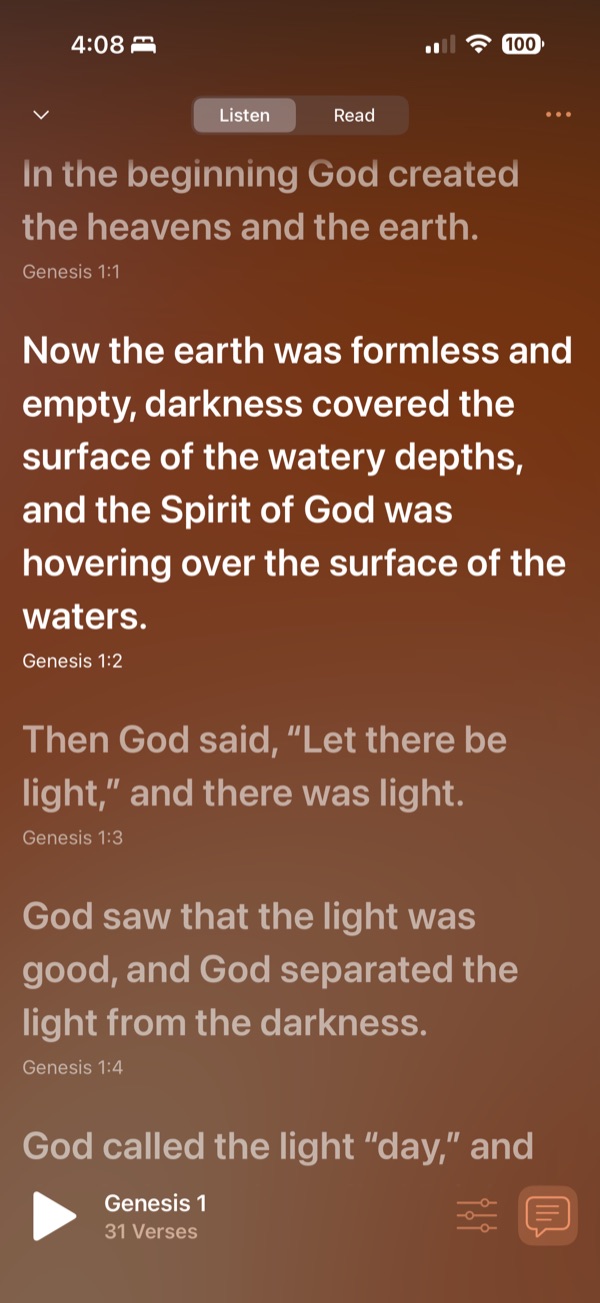 Dwell · iOS app · device model not recorded
The current verse bright, the rest dimmed
User-contributed screenshot · resized, content unchanged
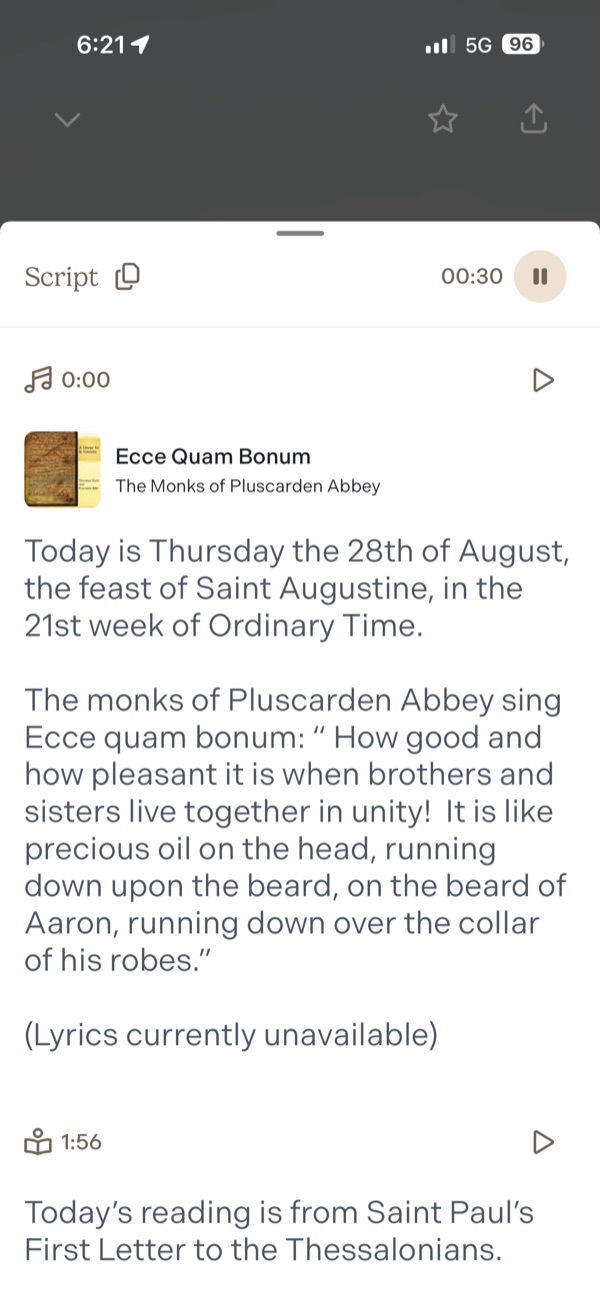 Pray As You Go · iOS app · device model not recorded
A session script with timestamps
User-contributed screenshot · resized, content unchanged
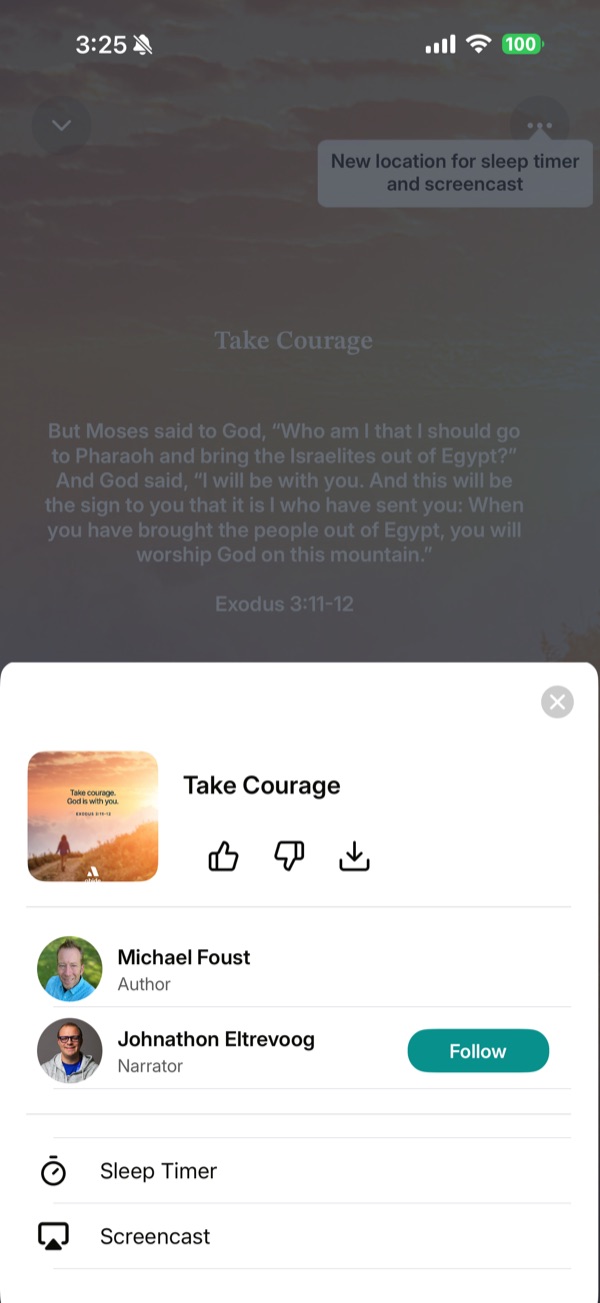 Abide · iOS app · device model not recorded
The author and narrator, named
User-contributed screenshot · resized, content unchanged
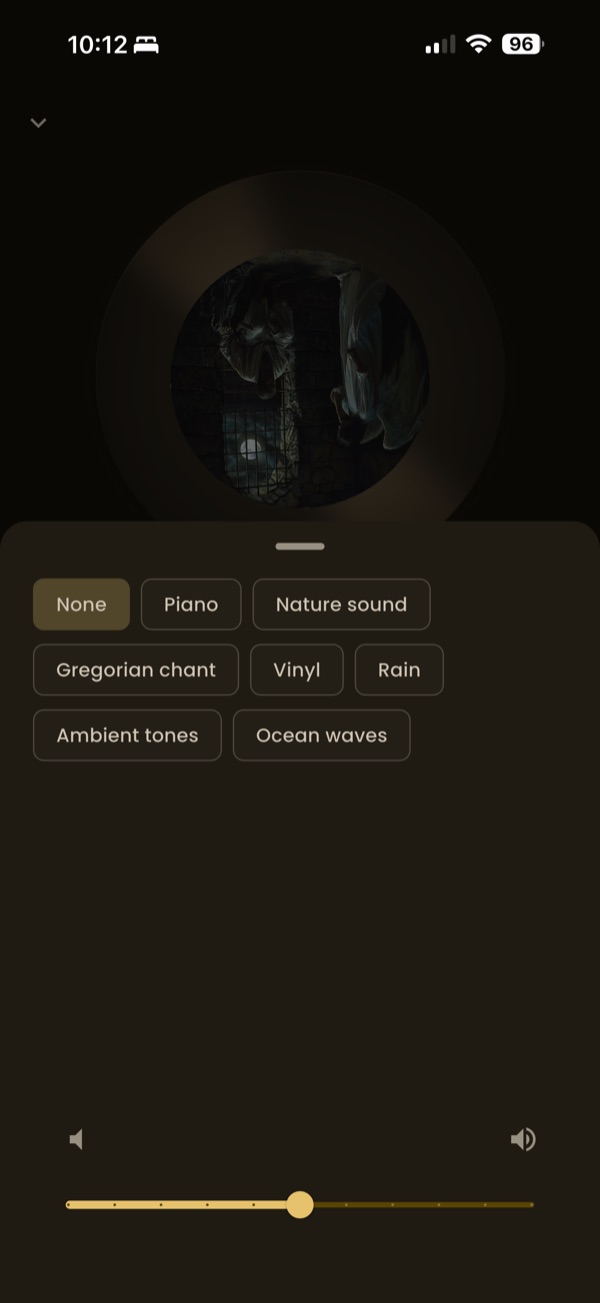 BeBlessed · iOS app · device model not recorded
A choice of background sound
User-contributed screenshot · resized, content unchanged
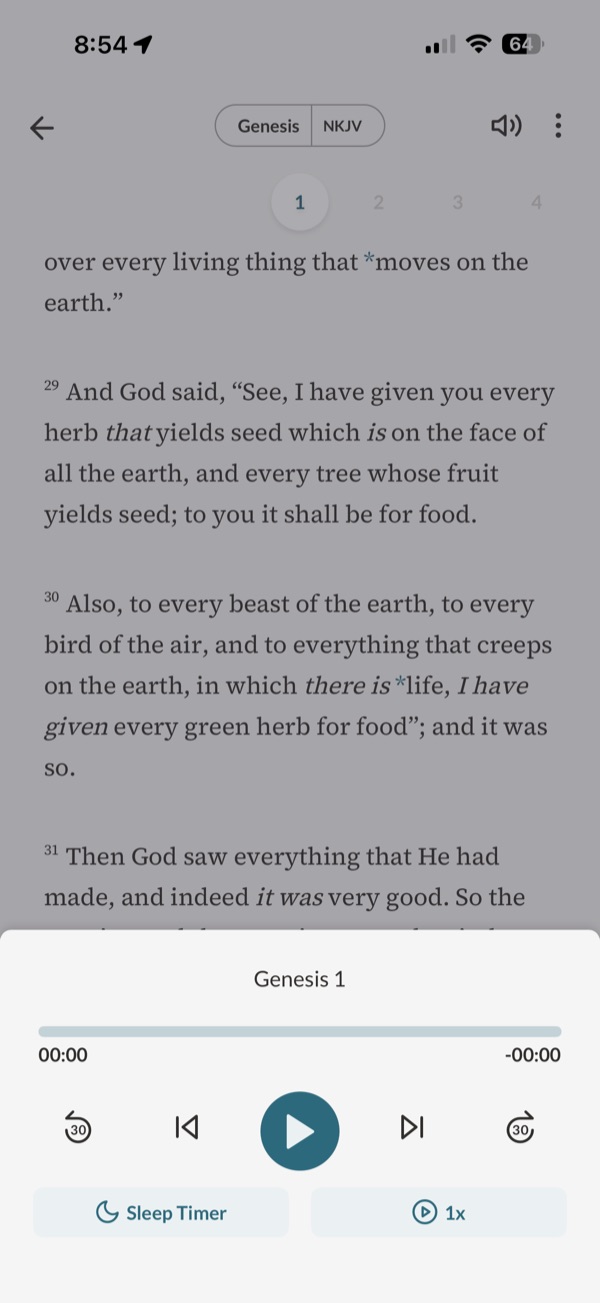 Joseph Prince · iOS app · device model not recorded
A chapter player with a sleep timer
User-contributed screenshot · resized, content unchanged
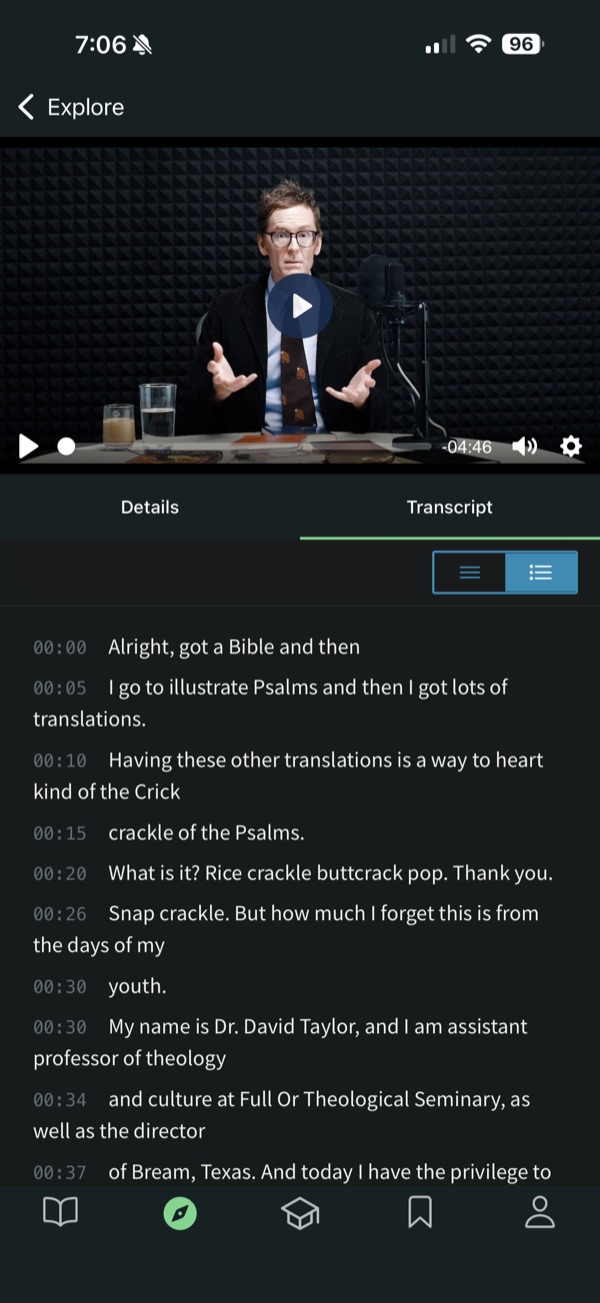 Spark Bible · iOS app · device model not recorded
A timestamped transcript, with recognition errors
User-contributed screenshot · resized, content unchanged
Theological reflection
What is this practice for?
What hearing is for
For most of Christian history, Scripture reached people through the ear. Jesus “stood up to read” in the synagogue at Nazareth (Luke 4:16), Paul told Timothy, “devote yourself to the public reading of Scripture” (1 Timothy 4:13), and “faith comes by hearing” (Romans 10:17). Public reading is not a delivery format but an act of the community: one voice reads, and everyone hears the same words at the same time.
Where Christians differ
Liturgical churches treat the reading of Scripture as worship in its own right: the Gospel is often read by a deacon or priest, with the people standing. Many Protestant churches centre the sermon, with the reading as its text. Traditions also differ on who may read publicly. All agree that a reader interprets by tone and pace; that is why churches choose and train readers.
What follows for design
An app chooses a reader for millions of people. Name that voice, and say whether it is a person. Let the passage end as a reading ends, in silence, rather than rolling into whatever comes next. Treat listening together, in a family or a church, as a first-class case, not an afterthought to solitary listening.
In conversation with
- Second Vatican Council, Dei Verbum (1965) asks that prayer accompany reading “so that God and man may talk together”, quoting Ambrose: “we hear Him when we read the divine saying.”
- Dietrich Bonhoeffer, Life Together (1939) describes a community beginning the day by reading Scripture aloud together, as something received in common before anyone reads alone.
Scripture is quoted from the Berean Standard Bible. This reflection is the editor’s, written from within the Christian tradition and open to correction. How we approach theology here →
Three ways to build
What would each way do here?
ExploitativeTakes from the person
Autoplay rolls into the next episode or an upsell; a synthetic voice is presented as a person.
EthicalDoes no harm
Name the reader and edition, stop when the passage ends, offer text alongside.
RedemptiveGives something up for them
Pay for human readers in the languages and dialects a market overlooks, and give audio free and offline to people who cannot read.
The three ways are Praxis’s frame for redemptive entrepreneurship; their application here is ours. Why we use it, and its limits →
Take into your next review
Whose voice reads Scripture here, and what happens when it ends?
Exercise
Listen to your own audio on a commute with the screen off. Note every moment you have to look at the phone, and what plays when the passage ends. Then ask three listeners whether the voice is a person, and how they know.
Someone will hear Scripture for the first time in the voice you choose.
Record the decision with the worksheet →
Something missing or wrong here? Send a correction or suggest a topic.
Details
Go further
This deep dive brings together 3 earlier patterns. Their guidance, wireframes and sources are kept below; their old addresses lead here.
Edge cases to design for
Offer audio wherever the text is, and say whose voice it is: a named narrator, or a clearly labelled synthetic voice. When the screen is on, let the text follow the voice at verse or sentence level, with pause and rewind. Build a full player that works with the screen off, with skip, speed and a sleep timer that stops at the end of a passage. In produced devotionals, name who wrote the reflections, keep Scripture distinct from commentary, make music optional, and end with silence or a choice rather than the next track.
What tends to go wrong
Unlabelled synthetic voices; voices that imitate a known pastor without consent; autoplay that runs into the next chapter or an advert; read-along that cannot be paused; music that cannot be turned off; reflections that sound like Scripture; audio that stops when the screen locks.
How to test it
Ask listeners whether a voice is human or synthetic and how they know. Listen on a commute with the screen off and check skip, pause and sleep. Compare recall of a passage heard with and without music. Test read-along with screen readers and people with dyslexia.
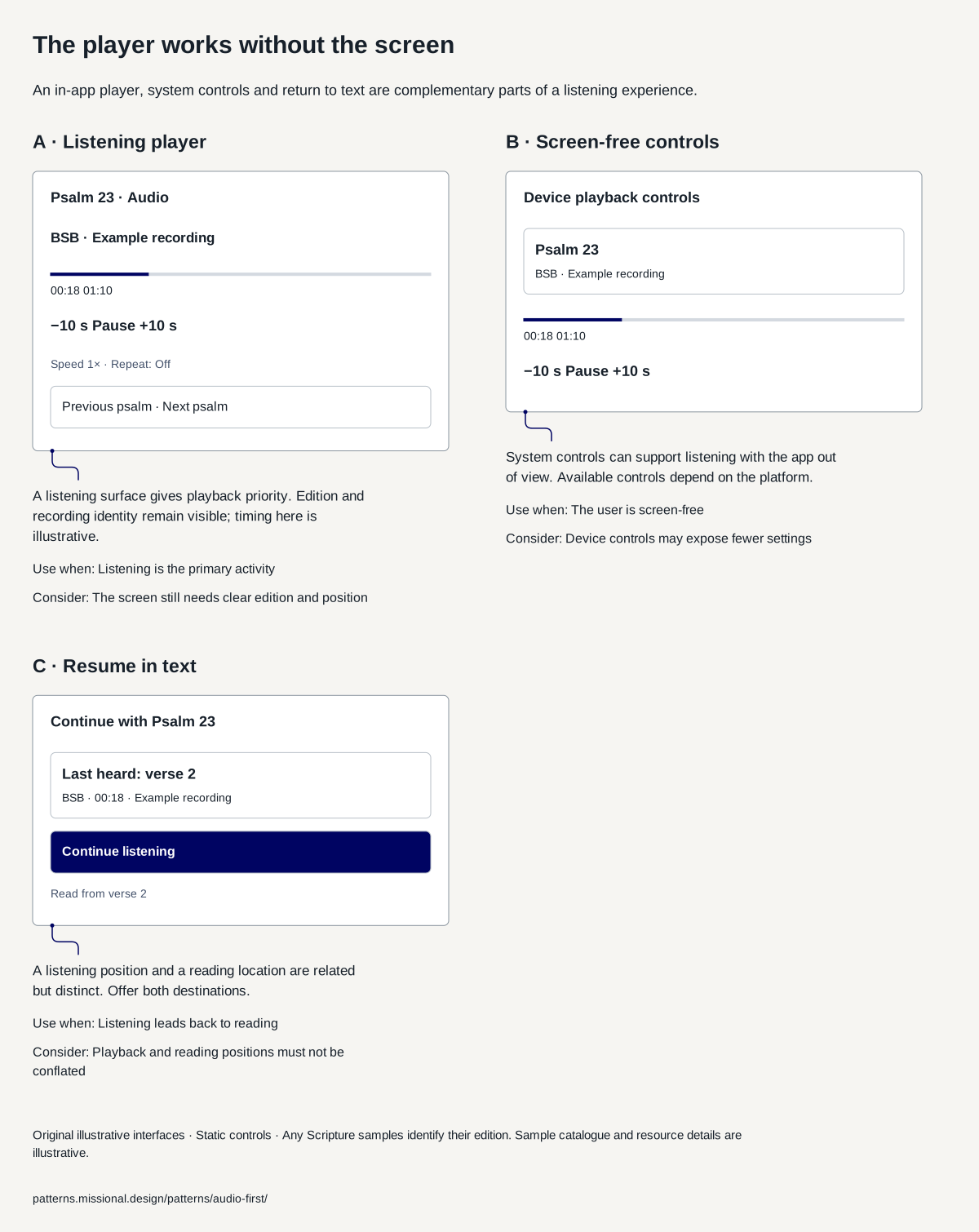
Earlier pattern: The player works without the screen
Support listening as a complete mode of use.
Guidance
Make current passage, playback, interruption and resumption available through suitable device and accessibility controls. Offer speed and sleep options where supported. Preserve the last listening position and a route into reading.
What tends to go wrong
Voice-only stopping; a hidden player; resuming at the wrong chapter; treating listening as microphone consent.
How to test it
Test lock-screen use, interruptions, headphones, connectivity loss and switching to text. Confirm what the selected edition actually supports.
Sources
- Android Audio BibleOfficial help article reviewed · Documented behaviour; no direct product usability audit performed.
- Designing Audio AI People Actually TrustArticle reviewed · The author scopes this to responsible audio AI, not a complete conversational-agent guideline.
- 8 voice AI UX patternsArticle reviewed · A design analysis rather than a clinical or Bible-app validation study. The original short link leads through another Friedman post.
- Digital Spiritual Formation: The Aperto Vision · selected Draft 4 reviewSelected sections on reading, engagement, multimodal and communal formation, incentives and honest assessment reviewed 5 October 2026 · Not an effectiveness study. Full bibliography and manuscript are not published or comprehensively reviewed here.
- Towards Full PresenceSections 30–38 on attention and listening reviewed 5 October 2026 · Catholic pastoral reflection on social media; application to app interfaces is an editorial adaptation.
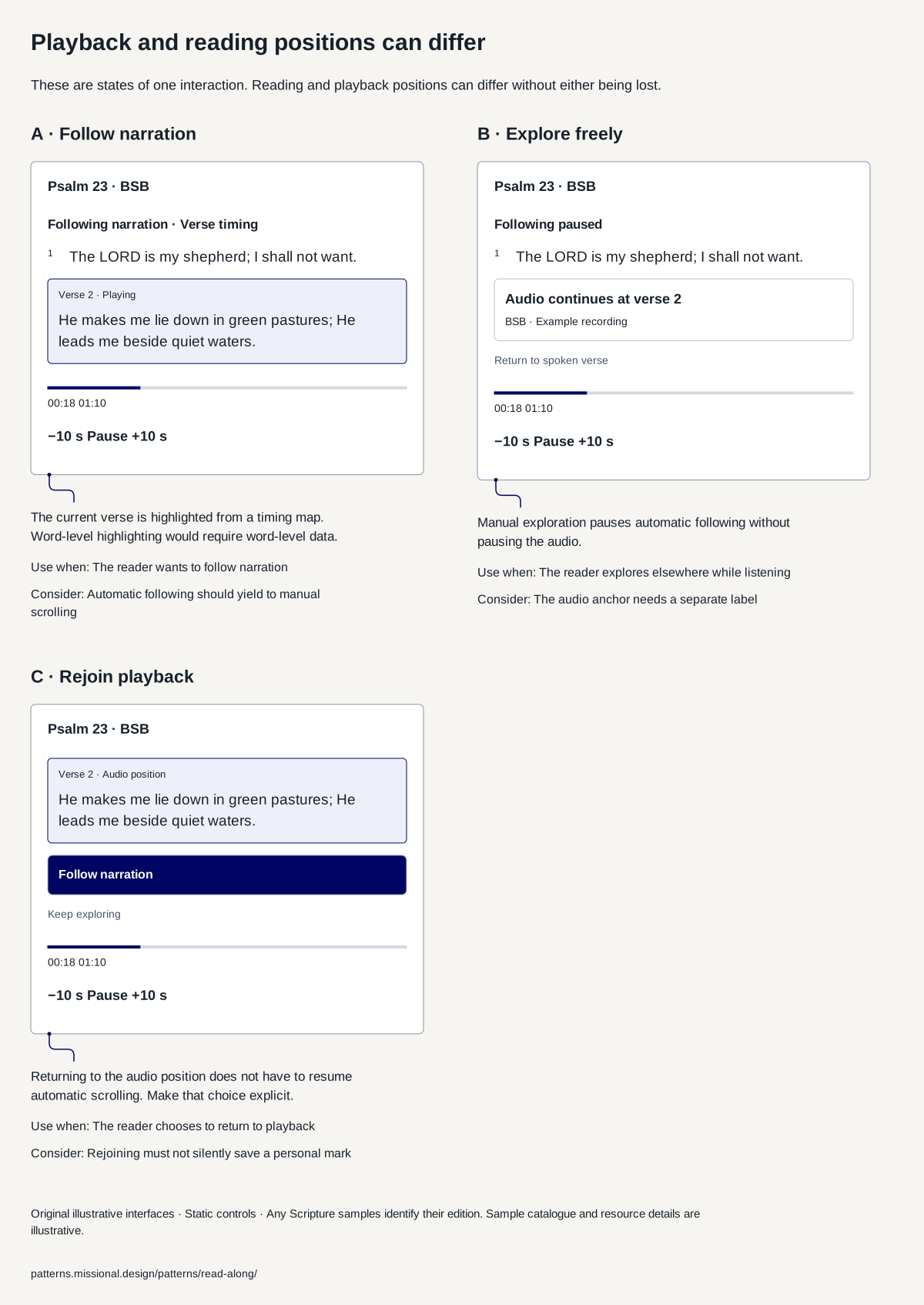
Earlier pattern: Playback and reading positions can differ
Follow the narration without forcing the reader to follow every movement.
Guidance
Show the current playback anchor separately from the viewport. Let users follow or explore freely, then deliberately return to the spoken passage. Use continuous text where the task is sustained reading.
What tends to go wrong
Automatic recentering after manual scroll; stopping playback whenever someone explores; treating the visible paragraph as the actual playback position.
How to test it
Scroll away during playback, change text size and return to the spoken verse. Does each position remain understandable?
Sources
- Dwell Read AlongPublisher feature description reviewed · Publisher claims about comprehension are not independent study results.
- Return to the playing versePublisher release description reviewed · Behaviour reference, not a fresh hands-on audit.
- Android Audio BibleOfficial help article reviewed · Documented behaviour; no direct product usability audit performed.
- Psalm 23, Berean Standard BiblePassage text taken from API.Bible, 9 October 2026 · A text source, not evidence of the proposed interface’s effectiveness.
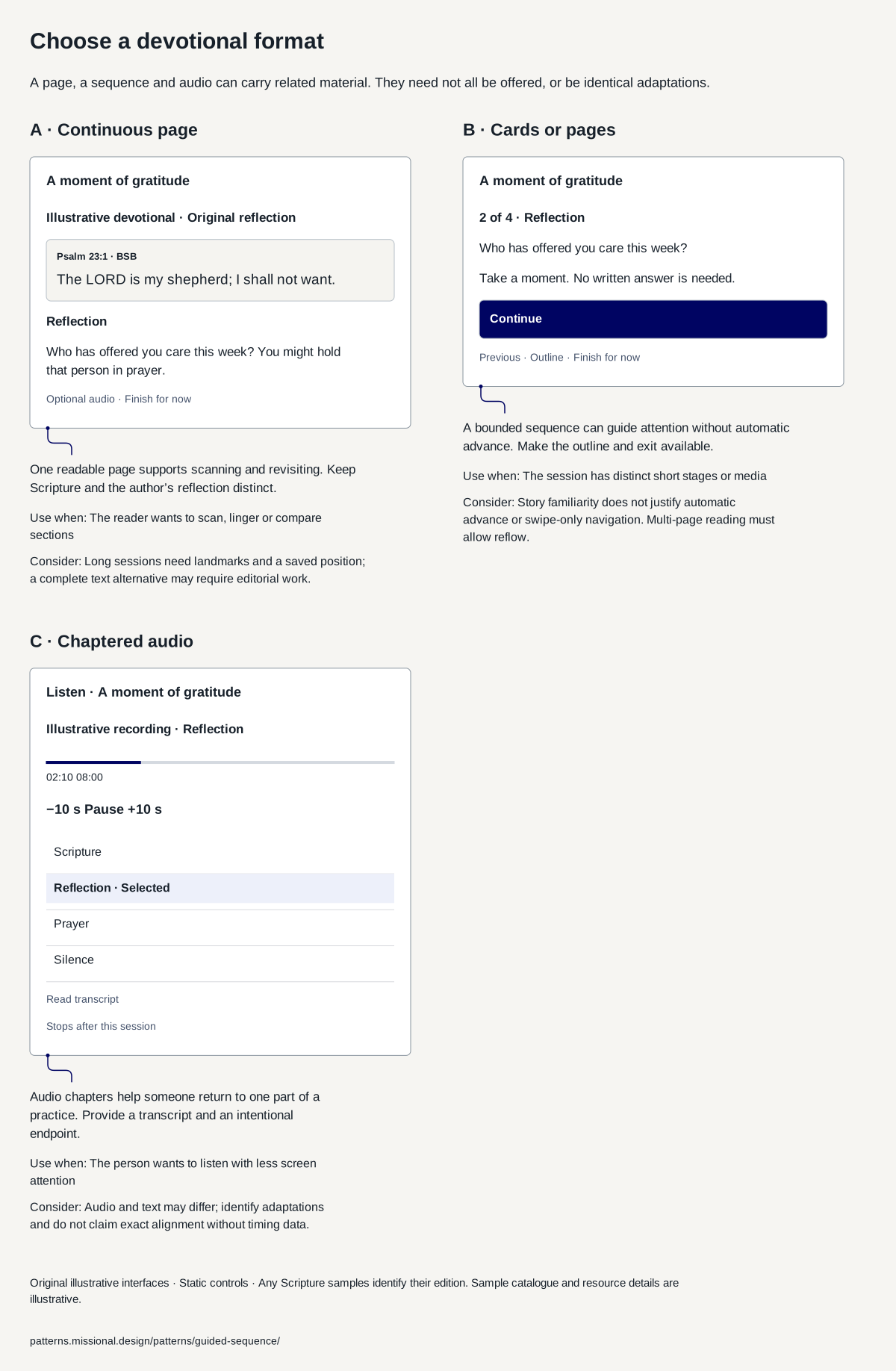
Earlier pattern: Choose a devotional format
Compare a continuous reading, a sequence of cards and a chaptered audio session.
Guidance
Separate the content model from its presentation: Scripture, reflection, video, prayer and silence retain their identity in each format. A continuous page supports scanning; multi-page steps offer explicit pacing; story-style cards can combine short media segments. Offer visible Previous, Next and an outline rather than relying on swipes. Avoid timed advance for text by default. Audio needs pause, chapter navigation, transcript and an explicit end. Switching formats should preserve a semantic section where correspondence exists; do not invent word-level synchronisation.
What tends to go wrong
A story that advances before the reader finishes; tiny text fitted to one card; essential teaching available only in uncaptioned video; media playback counted as prayer; a disabled Next button until personal disclosure; automatic playback of another devotional.
How to test it
Move through a mixed-media session with sound off, large text, keyboard or screen reader navigation, and an unavailable video. Leave during a section and return. Verify the selected content version and section are restored, and ask what is required versus optional.
Sources
- Android: Guided ScriptureSections and navigation reviewed 5 October 2026 · Documentation, not a captured UI or outcome study.
- Bible.com: PlansPlan contents and completion reviewed 5 October 2026 · Web documentation; platform behaviour differs.
- Daily Prayer app and podcastOfficial search-index excerpts reviewed 5 October 2026; full-page fetch blocked · Documented overview only; no live app capture or exhaustive liturgical rules review.
- Psalm 23, Berean Standard BiblePassage text taken from API.Bible, 9 October 2026 · A text source, not evidence of the proposed interface’s effectiveness.
Sources and their limits
Research-informed design proposal. Editorial review, not user validation.
- Does modality matter? The effects of reading, listening, and dual modality on comprehensionReport reviewed · One nonfiction text with adult readers; other studies find differences for harder texts.
- Effects of highlighting text on the reading ability of children with developmental dyslexia: a pilot studyAbstract reviewed · Small pilot study.
- Same language subtitlingArticle reviewed · Reported programme results; a literacy setting, not Scripture reading.
- Faith Comes By Hearing: our storyOrganisation history reviewed · Figures are the ministry’s own.
- St Thomas alumnus hosts No. 1 podcast in USNews report reviewed · Download figures from the publisher.
- Pray As You Go: about usOrganisation page reviewed · Usage figures from the organisation.
- The impact of background music on adult listeners: a meta-analysisPaper reviewed · Mixed study designs; reading rather than listening tasks.
- Human vs synthetic voices and listener trustAbstract reviewed · Lab studies with short clips; not Scripture.
- EU AI Act Article 50: transparency obligationsSummary reviewed · Secondary legal summary; applicability depends on role and use.
- International Orality NetworkOverview reviewed · An advocacy estimate; definitions and figures vary and are contested.
- Understanding SC 2.2.2: Pause, Stop, HideSpecification guidance reviewed · A Level A criterion for web content; apply the same intent in native apps.
Faith and interpretation
“Faith comes by hearing, and hearing by the word of Christ” (Romans 10:17). Scripture was written to be read aloud: “Blessed is the one who reads aloud the words of this prophecy, and blessed are those who hear” (Revelation 1:3). A voice is not neutral: tone, pace and emphasis interpret, as a reader in church does. Whose voice reads Scripture, and whether it is a person at all, is a question of trust as well as design.