Devotional audio
Guided prayer, a podcast, a talk or a sleep story?
Devotional audio comes in many shapes: guided prayer, teaching podcasts, morning talks, sleep stories, and now generated daily episodes. Each decides how much Scripture is heard, who speaks around it, whether there is silence, and whether the session ever ends. Choose the shape for the listener’s moment, not for listening time. Done well, it gives people Scripture and stillness in the middle of ordinary days.
- 5 working options
- 5 app examples
- 5 takeaways
- Editorial review, not user-tested
At a glance
Four ways to hear a passage, and one that never ends
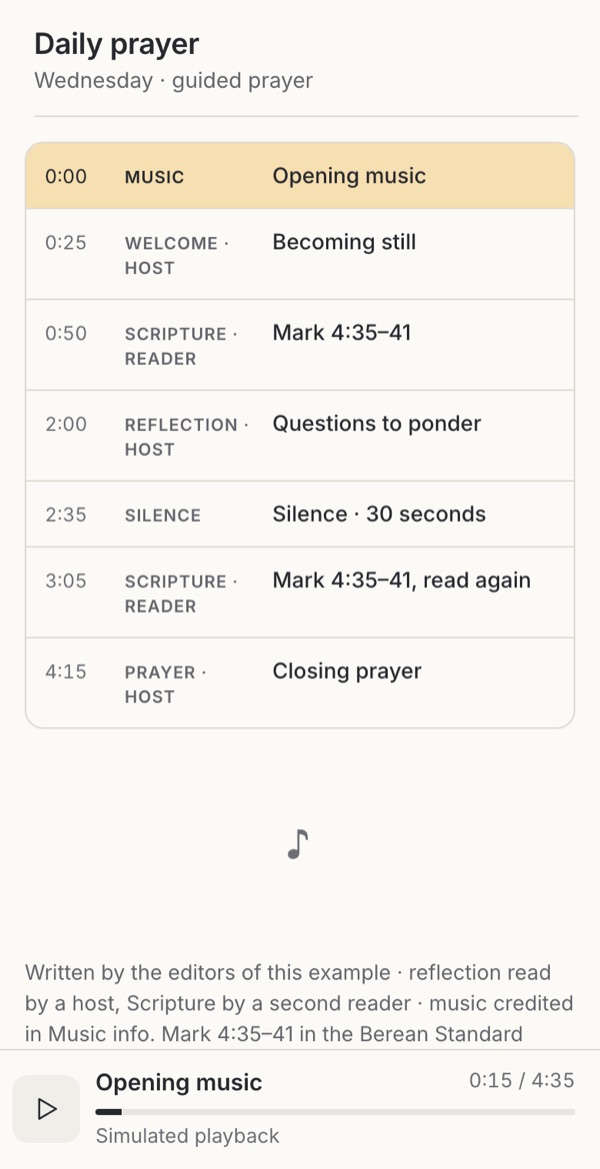 Observed Scripture whole, with silence Silence is easy to cutTry it →
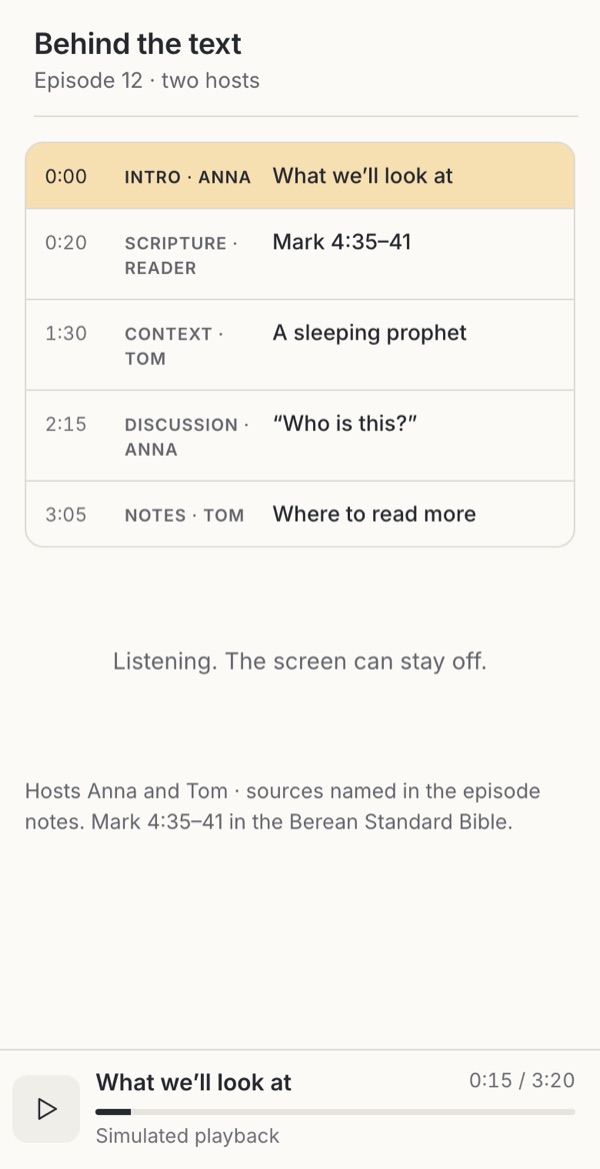 Familiar convention Background and echoes Hosts can sound like the textTry it →
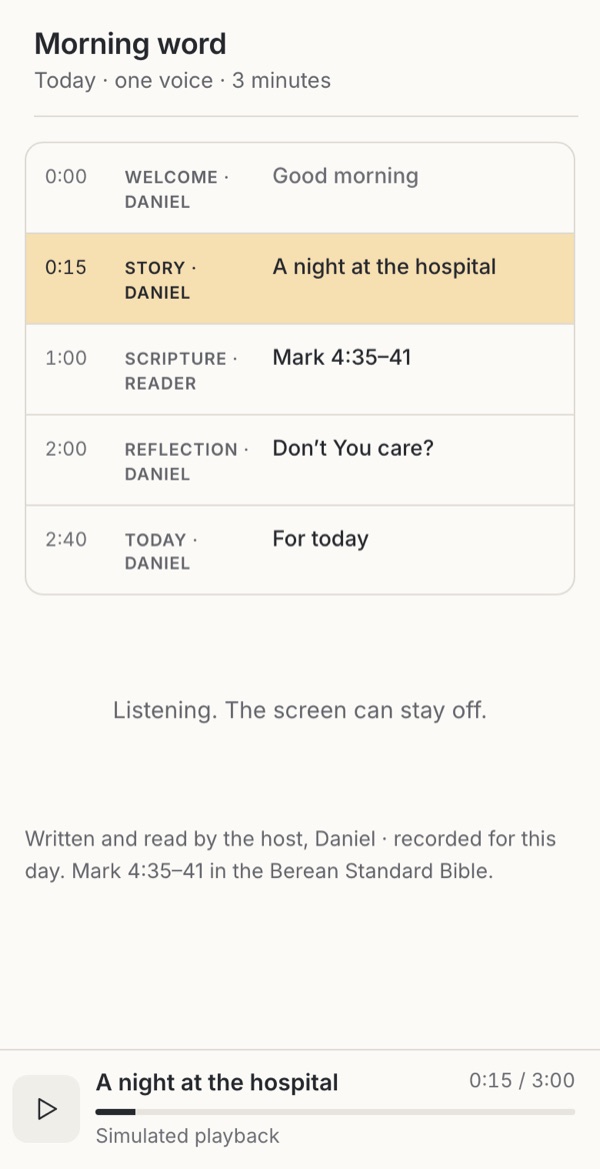 Observed A word for today The story can take overTry it →
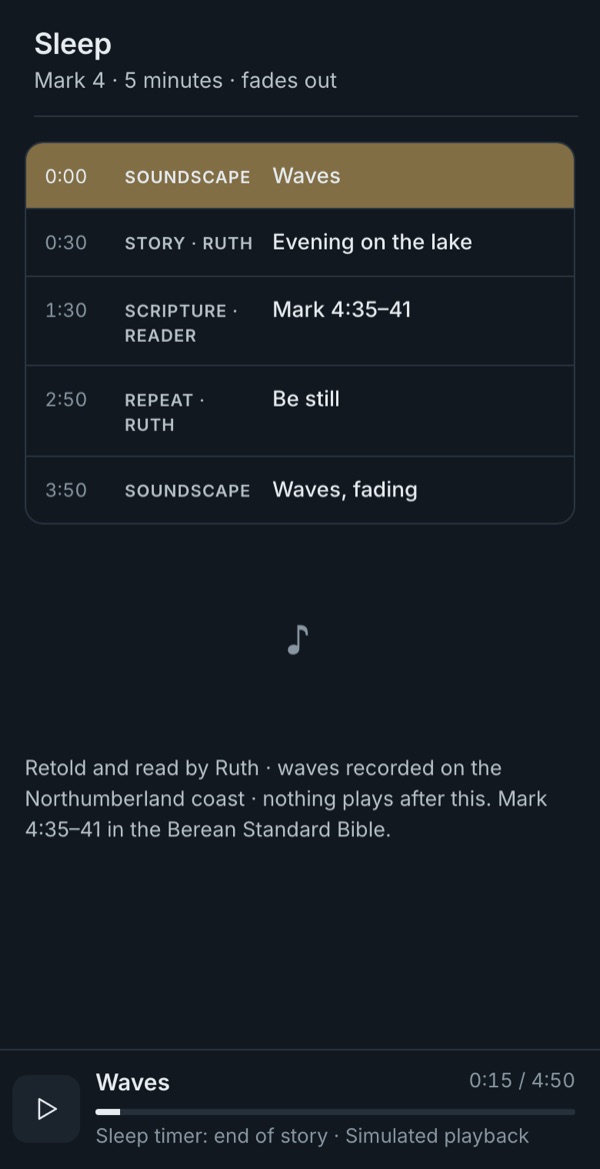 Observed Rest with Scripture in mind Plays to someone asleepTry it →
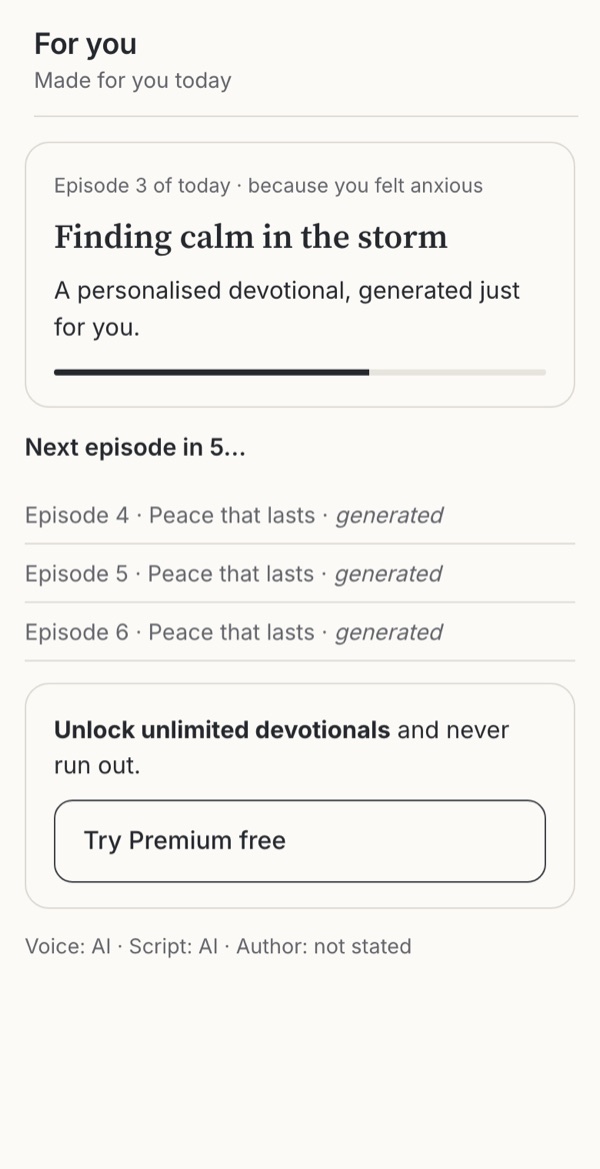 Leave it out Always something new Never ends, no authorTry it →
Stills from the working example below. Choose one to try it.
Try it
Try five shapes of devotional audio
It is a Wednesday. Each format is built around the same passage, Mark 4:35–41, where Jesus calms the storm. Play each one (playback is simulated and speeded up), jump between segments, and notice what you hear of Scripture, who speaks, and what happens at the end. Then put the script on screen, and let the silence wait for you.
Option
Why these settings?
With the script on, each segment shows the line being heard, with Scripture set apart. With the screen off, the screen says it can stay off. In guided prayer, silence can last thirty seconds or wait until the listener continues. The sleep story always fades out and plays nothing after it; the stream shows what many apps do.
Observed
1. Guided prayer
Observed in Pray As You Go, whose daily sessions move from music to a reading, reflection questions, a second reading and a closing prayer, with the script and music credits in the player; see the screenshots below.
Try this
Play the session through. Switch the silence to “waits for you” and play again.
Makes easier
A way of praying with Scripture, read whole and twice, with room for silence.
Costs
Needs a steady pace and careful writing; silence is easy to cut.
Ask your teamIs the reading heard whole, and does the silence belong to the listener?
Familiar convention
2. Teaching conversation
A familiar podcast format: two hosts discuss a passage and its background, as in Bible-teaching podcasts across languages.
Try this
Play it with the script on, and notice where the text ends and the hosts begin.
Makes easier
Understanding: background, echoes in other Scripture, the questions a text leaves open.
Costs
Hosts can overshadow the text, and confident talk can sound like Scripture.
Ask your teamCan the listener tell the passage from the hosts’ interpretation, and find the sources?
Observed
3. Devotional talk
Observed in morning devotionals and in apps such as Abide, which offer sessions by length, from “2 min · Pause & Pray” to “15 min · Meditate & Deepen”; see the screenshots below.
Try this
Play it and ask afterwards whether you remember the story or the passage.
Makes easier
A short word for the day, in a voice people come to trust.
Costs
The host’s story can take over the passage.
Ask your teamIs the passage at the centre, and is the host named as a person with a view?
Observed
4. Sleep story
Observed in Dwell’s “Sleep to Scripture” and Abide’s sleep shelf with named narrators; see the screenshots below.
Try this
Play it to the end and see what comes next.
Makes easier
Rest at night with Scripture in mind.
Costs
The listener may not hear the end; anything that plays next plays to a sleeping person.
Ask your teamDoes it fade to silence, with nothing queued after it?
Leave it out
5. Endless stream
A composite of patterns from podcast and video apps (“Next from:” auto-queues, autoplay countdowns) and from generated daily devotionals.
Try this
Watch the countdown, and look for who wrote this.
Makes easier
There is always something new to hear.
Costs
Listening never ends; no one is accountable for the words.
Ask your teamWho wrote this, and when does it stop?
What we noticed
Takeaways
Let Scripture be heard whole, and distinctly
Pray As You Go reads the passage in full, often twice, in a different voice from the reflection. Ezra’s Levites read “distinctly, and gave the sense”. Keep reading and commentary audibly apart, and set Scripture apart on screen when a script is shown.
Silence belongs to the listener
Guided prayer needs silence, and silence is the first thing cut to hold attention. Dwell offers a “Reflect” pause setting. In prayer, let silence wait until the listener continues.
Hosts become trusted voices
Listeners form friend-like bonds with podcast hosts and feel it when hosts change. Name hosts as people with a perspective and a tradition, and never let a familiar voice stand in for Scripture or for a pastor.
Every session should end
Autoplay and recommendations undermine people’s sense of agency; search and playlists support it. A devotional that rolls into the next episode, or a sleep story followed by more content, plays to someone who did not choose it.
Credit every voice and every note
Pray As You Go’s Music Info names the monks of Pluscarden Abbey; Abide names author and narrator. Generated episodes often name no one. Credit authors, readers and musicians, and label synthetic voices.
Use cases
Which situation, which option?
People come with different needs, sometimes in the same week. Each need fits some options better than others.
| Situation | Needs | 1 Guided prayer | 2 Teaching conversation | 3 Devotional talk | 4 Sleep story | 5 Endless stream |
|---|---|---|---|---|---|---|
| Praying each morning | A way into prayer with Scripture | Good fit | Poor fit | Possible | Poor fit | Poor fit |
| Studying a book | Background and connections | Poor fit | Good fit | Poor fit | Poor fit | Poor fit |
| Commuting | A short word, eyes free | Possible | Possible | Good fit | Poor fit | Poor fit |
| Not sleeping | Rest with Scripture in mind | Poor fit | Poor fit | Poor fit | Good fit | Poor fit |
| Unable to read | Scripture heard whole | Good fit | Possible | Possible | Possible | Poor fit |
| Leading a group | Something to listen to together | Good fit | Good fit | Possible | Poor fit | Poor fit |
Editorial judgments drawing on the research below, not test results.
The research behind it
Theology, practice and science
Scripture and tradition
Reading, praying and resting with the word
A daily shape for prayer
Pray As You Go’s sessions: music, Scripture, reflection, prayer.
Slow, repeated reading
Lectio divina reads a short passage more than once.
Attention to the day
The Examen’s steps behind many guided sessions.
Psychology
Hosts, sleep and agency
Hosts as trusted friends
Listeners’ bonds with podcast hosts, and their loss when hosts change.
Sound can help sleep
Relaxing music may improve sleep quality.
Autoplay takes agency
Autoplay and recommendations undermine sense of agency.
Voices and disclosure
Who is speaking
Synthetic voices
How synthetic voices affect trust, and EU disclosure duties for generated audio.
NSF public access repositoryPotter Clarkson (law firm summary)
Audio for people who cannot read
Scripture recordings for oral cultures.
Every source, with what it can and cannot show, is listed under Go further → Sources and their limits.
Where to start
Which fits your product?
IfPeople want to pray with Scripture
Start withGuided prayer: the passage whole, read twice, with silence that waits
IfPeople want to understand a passage
Start withA teaching conversation with named hosts and sources
IfPeople listen on the way to work
Start withA short talk with the passage at its centre
IfPeople listen to fall asleep
Start withA sleep story that fades out, with nothing after it
IfYou are tempted to fill every minute
Start withDon’t: no autoplay, no endless generated episodes, no listening streaks
These are editorial judgments from design review, not results of user testing.
In real apps
Examples in use
Attributed screenshots with dates and review limits. A screenshot shows an implementation; it does not show that it works for every audience.
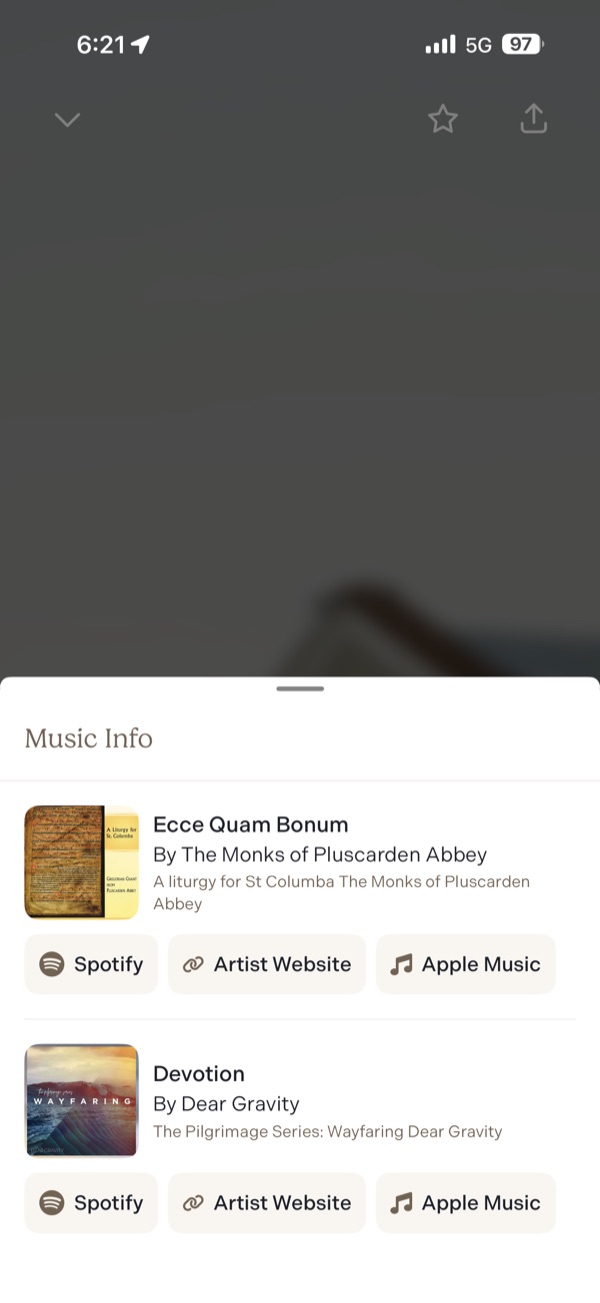 Pray As You Go · iOS app · device model not recorded
Music Info names the monks and the composer
User-contributed screenshot · resized, content unchanged
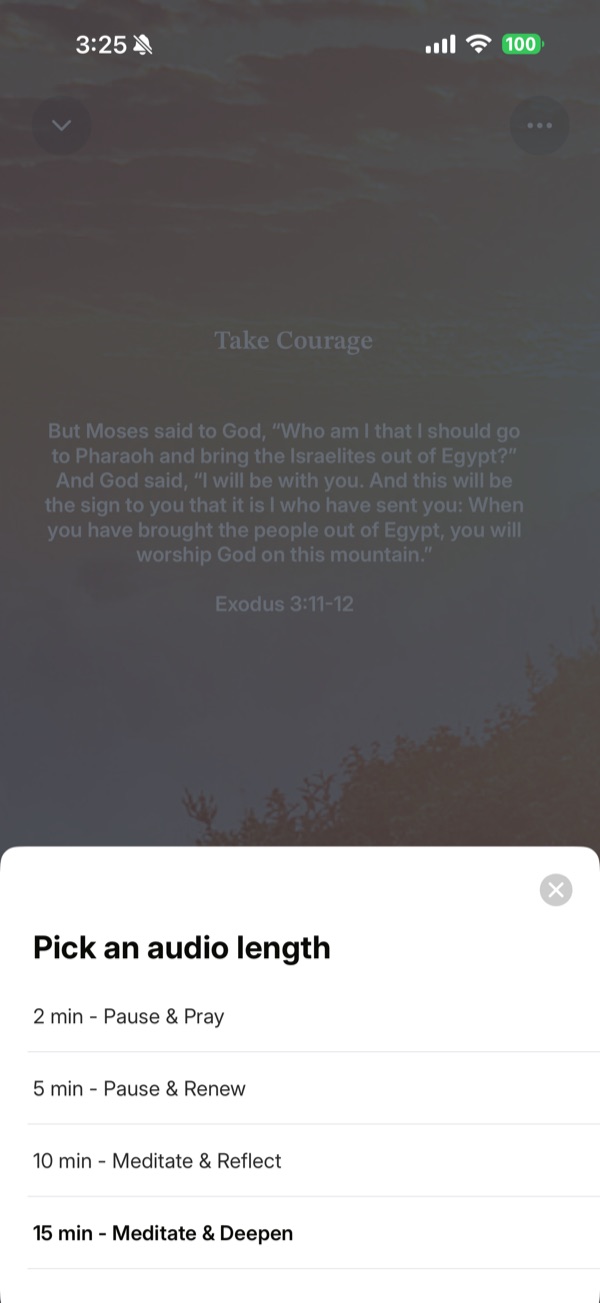 Abide · iOS app · device model not recorded
“Pick an audio length”
User-contributed screenshot · resized, content unchanged
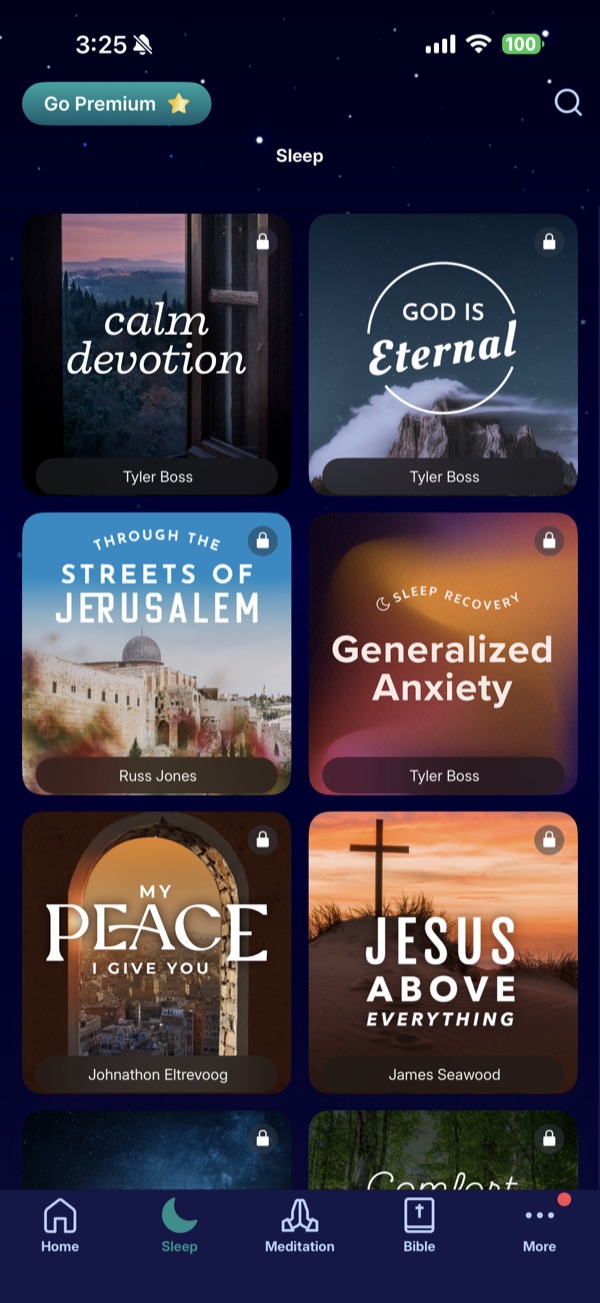 Abide · iOS app · device model not recorded
A sleep shelf with narrators named
User-contributed screenshot · resized, content unchanged
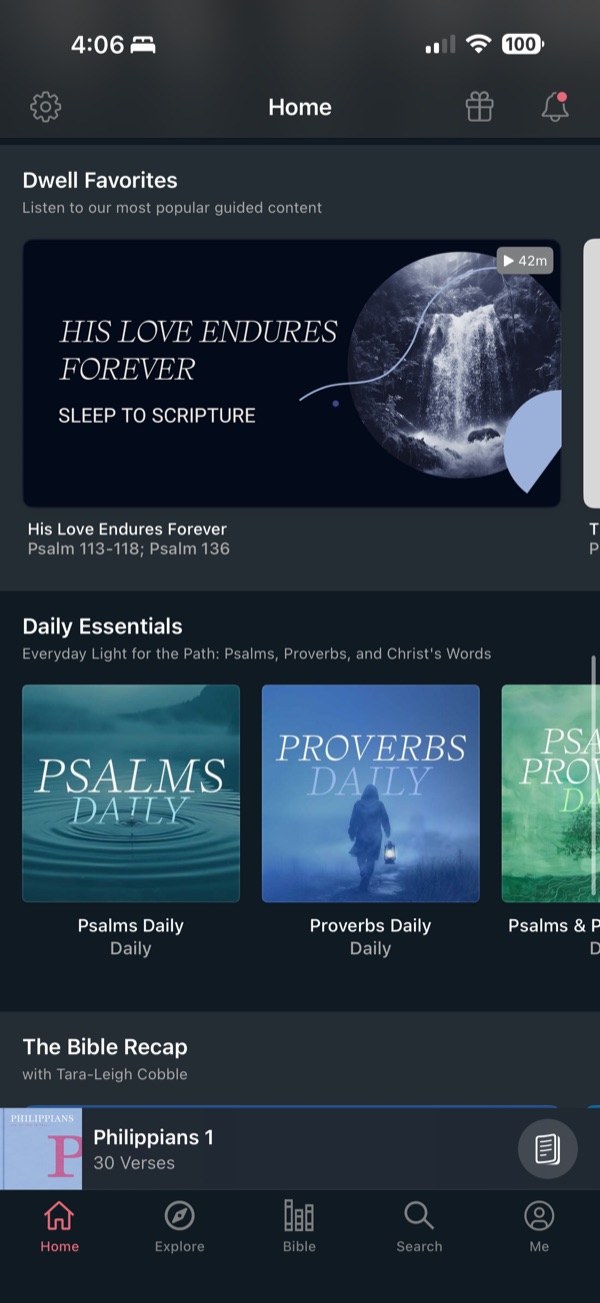 Dwell · iOS app · device model not recorded
“Sleep to Scripture”: Psalms for the night
User-contributed screenshot · resized, content unchanged
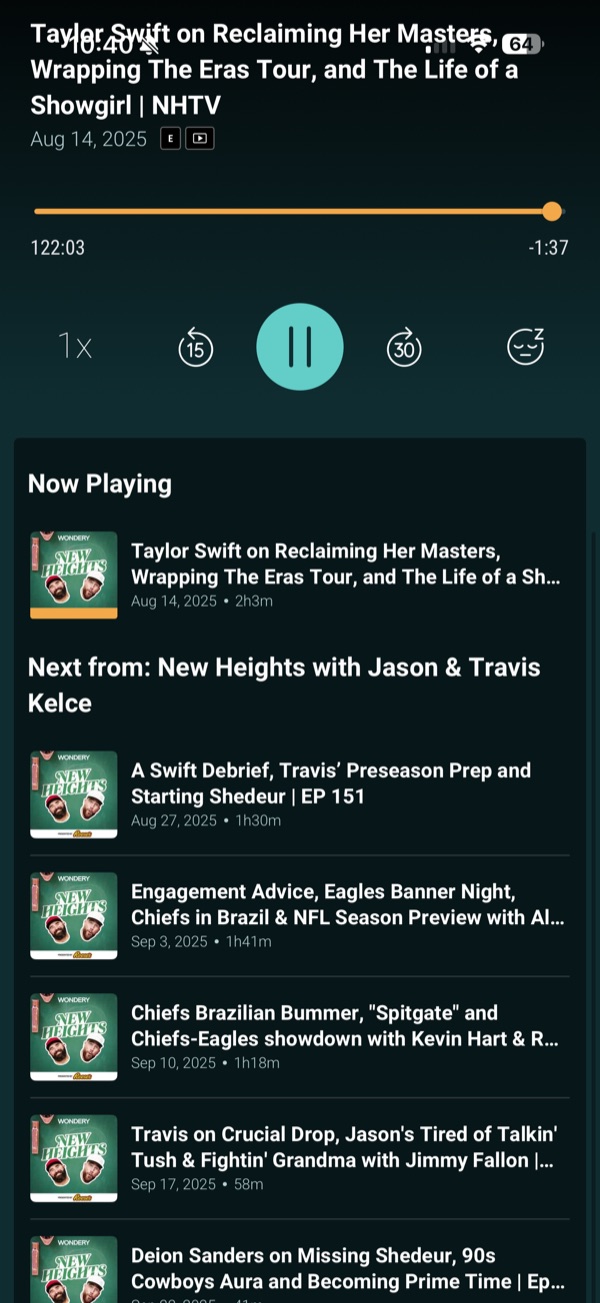 Wondery+ · iOS app · device model not recorded
“Next from”: a podcast player’s auto-queue
User-contributed screenshot · resized, content unchanged
Theological reflection
What is this practice for?
What hearing devotionally is for
The Levites read the Law, “explaining it and giving insight” (Nehemiah 8:8): the reading and the explanation were both heard, and heard as different things. Christians have prayed with Scripture aloud in the office, in lectio and in song, and “about midnight Paul and Silas were praying and singing hymns to God, and the other prisoners were listening to them” (Acts 16:25). The voice that carries Scripture serves it.
Where Christians differ
Liturgical traditions pray set words and readings, often sung; evangelical traditions value teaching and testimony from a trusted voice; contemplative traditions give silence the central place. Christians also differ on music in worship, from unaccompanied psalm singing to full bands. Each shapes what devotional audio should sound like.
What follows for design
“I will lie down and sleep in peace, for You alone, O LORD, make me dwell in safety” (Psalm 4:8). Rest is a gift, not a gap to fill. Read Scripture whole, keep commentary audibly distinct, let silence wait, and end every session. “Why spend … your labor on that which does not satisfy?” (Isaiah 55:2).
In conversation with
- Henri Nouwen, The Way of the Heart (1981) commends silence as a discipline that tends the inner life; a devotional that leaves no silence leaves no room for it.
- Albert Borgmann, Technology and the Character of Contemporary Life (1984) warned that devices deliver experiences effortlessly while focal practices ask for attention; an endless stream is the device paradigm applied to prayer.
Scripture is quoted from the Berean Standard Bible. This reflection is the editor’s, written from within the Christian tradition and open to correction. How we approach theology here →
Three ways to build
What would each way do here?
ExploitativeTakes from the person
Autoplay into the next episode, generated sessions without end, silence cut to hold attention, listening streaks.
EthicalDoes no harm
Name authors, readers and musicians, label synthetic voices, and end the session.
RedemptiveGives something up for them
Pay for real readers and musicians, keep the silences even when listeners skip them, and let sleep audio fade to nothing.
The three ways are Praxis’s frame for redemptive entrepreneurship; their application here is ours. Why we use it, and its limits →
Take into your next review
After the session, could the listener say what Scripture said, who spoke, and why it ended?
Exercise
Listen to your own devotional audio with a stopwatch: how many seconds of Scripture, of commentary, of music and of silence? Then ask three listeners to retell the passage and the host’s point separately, and check what plays when the session ends.
Judge a session by what the listener carries into the day, not by how long they stayed.
Record the decision with the worksheet →
Something missing or wrong here? Send a correction or suggest a topic.
Details
Go further
Edge cases to design for
Name the format and its purpose before playback. For prayer, read Scripture whole, often twice, separate reflection from reading, and leave silence that can wait. For teaching, name sources and distinguish the text from the hosts’ interpretation. For a talk, keep the passage at the centre and the host’s story in service of it. For sleep, fade to silence and play nothing after. Credit voices, authors and music, label synthetic voices, and end every session.
What tends to go wrong
Scripture read in fragments beneath music; commentary that sounds like the text; silence cut to keep attention; hosts presented as friends who know the listener; autoplay into the next episode; sleep content followed by more content; generated episodes without an author; “never run out” offers; streaks for listening.
How to test it
Ask listeners after a session what the passage said and what the host said, and whether they could tell them apart. Time the silences. Check what plays after the session ends. Ask who wrote and who read each part, and whether any voice was synthetic.
Sources and their limits
Research-informed design proposal. Editorial review, not user validation.
- Pray As You Go: about usOrganisation page reviewed · Usage figures from the organisation.
- Introduction to lectio divinaArticle reviewed · A description of practice, not a study.
- How can I pray? The Daily ExamenPage reviewed · A modern adaptation; Ignatius’s own five points in the Spiritual Exercises differ in wording.
- Parasocial intimacy, change, and nostalgia in podcast listener reviewsAbstract reviewed · Reviews of general podcasts, not faith audio.
- Listening to music for insomnia in adultsSummary reviewed · Music, not spoken or Scripture content.
- How the design of YouTube influences user sense of agencyAbstract reviewed · Video, not devotional audio.
- Human vs synthetic voices and listener trustAbstract reviewed · Lab studies with short clips; not Scripture.
- EU AI Act Article 50: transparency obligationsSummary reviewed · Secondary legal summary; applicability depends on role and use.
- Faith Comes By Hearing: our storyOrganisation history reviewed · Figures are the ministry’s own.
Faith and interpretation
“Faith comes by hearing” (Romans 10:17), and the church has always shaped how Scripture is heard: read, sung, preached, prayed. Ezra’s Levites read the Law, “explaining it and giving insight, so that the people could understand what was being read” (Nehemiah 8:8), keeping the reading and the explanation distinct. “I will lie down and sleep in peace” (Psalm 4:8). And the prophet asks, “Why spend … your labor on that which does not satisfy?” (Isaiah 55:2). Devotional audio can serve all of these, or replace them with endless listening.