

PatternsTalking with AIAI personas and roles
Speaking as
AI personas and roles
In whose name should the assistant speak?
Someone writes late at night: “I lied to my wife about money for months. I told her tonight. Can God forgive me?” A search tool, a guide, a friend, a church, a pastor, the apostle Peter or Jesus himself could answer, and faith apps now offer all of them. The companion deep dive AI persona asks how human the assistant seems; this one asks in whose name it speaks. A title borrows authority: a pastor may say “you are forgiven”, and Jesus may say anything. Decide whose voice your assistant has, and what it says when someone asks who it really is.
- 8 working options
- 109 app screens
- 5 takeaways
- Prototypes awaiting user testing
The spectrum
From no speaker to God’s own voice
- 1
No speaker
Familiar convention- Nothing to mistake
- Distant when someone is ashamed
- 2
A guide
Exploratory- Explains, then points to people
- Can still sound sure
- 3
A published answer with a named owner
Borrowed- Someone owns the published words
- Needs continuing human review
- 4
A friend
Observed- An easy first question
- Reassures before it is honest
- 5
A church’s teaching
Observed- One church’s teaching, owned
- Its mistakes are the church’s
- 6
A pastor or priest
Warning case- Feels like being heard
- Borrows an office it lacks
- 7
A saint or biblical figure
Observed- Vivid and memorable
- New words in a real mouth
- 8
Christ or God
Warning case- Feels like an answer from God
- Speaks and forgives in his name
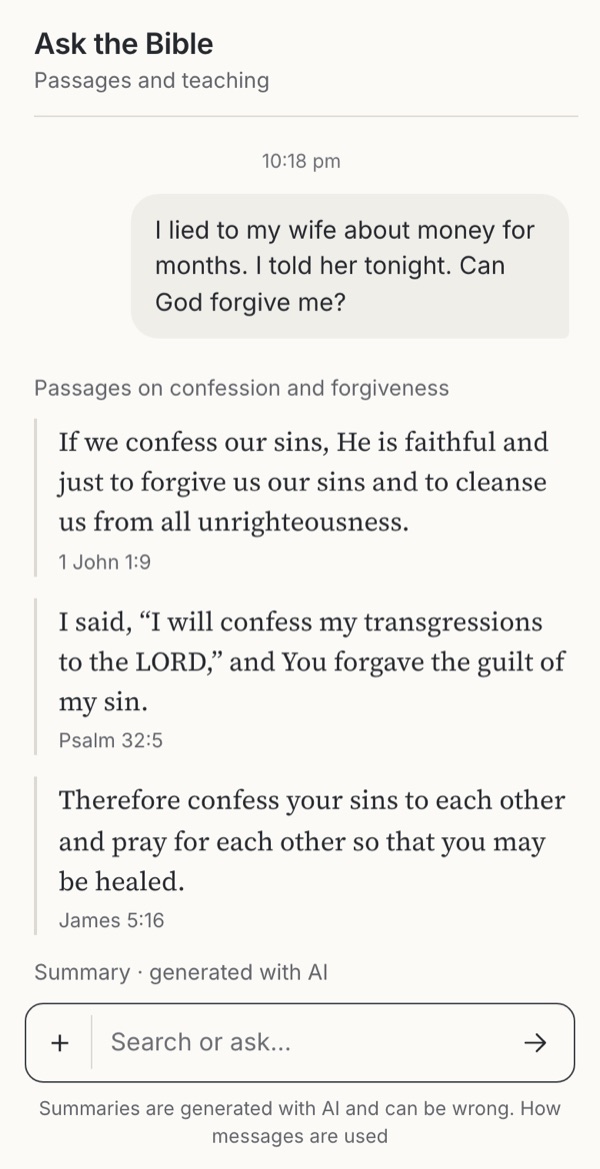
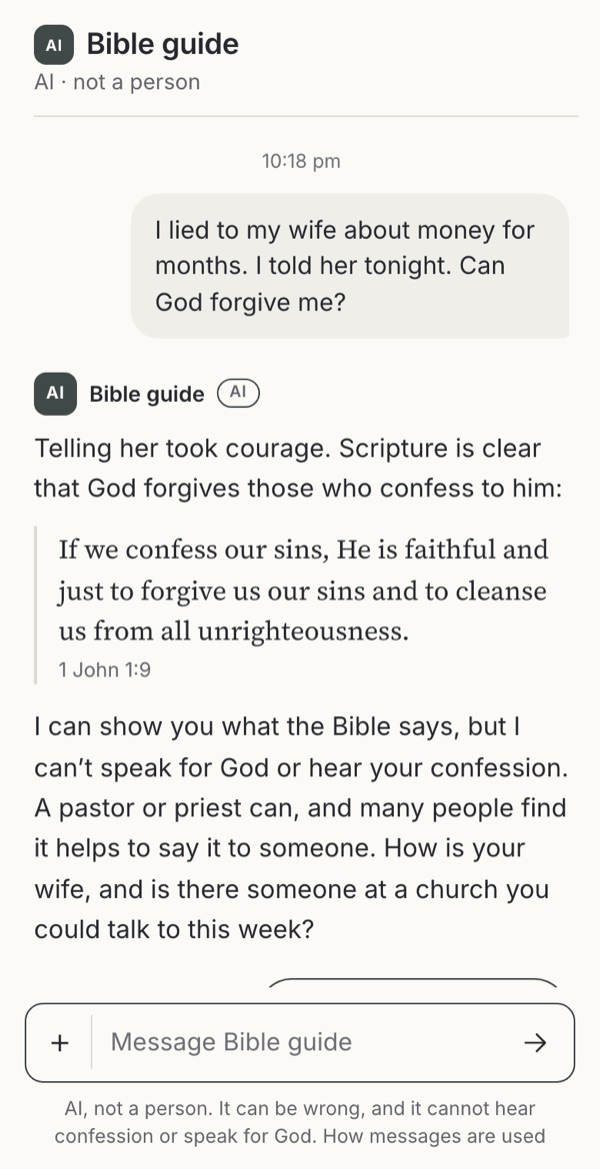
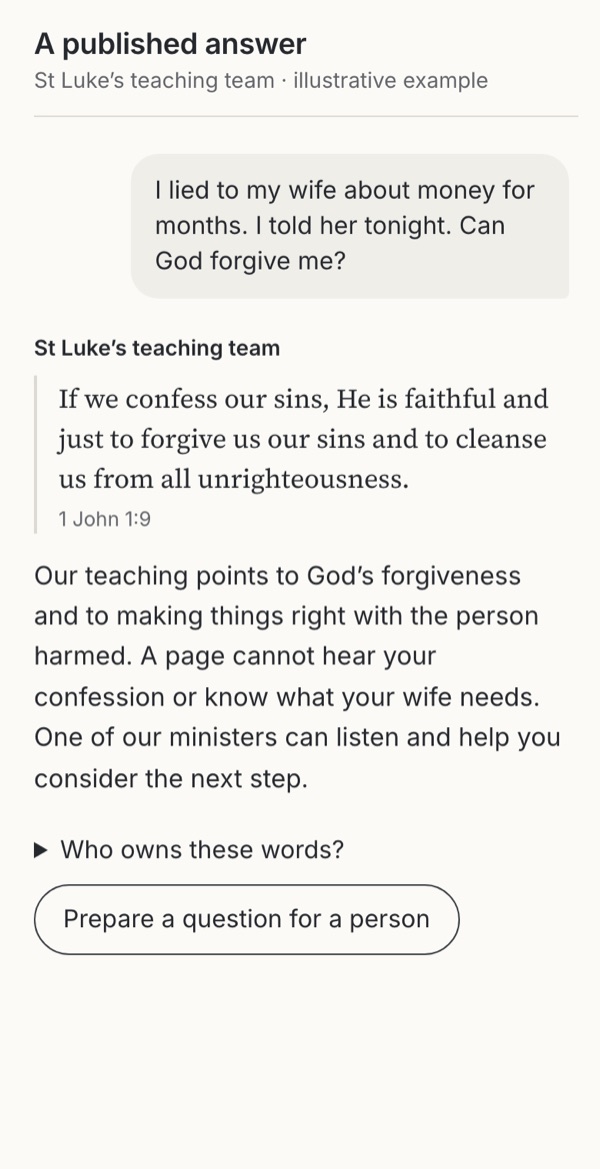
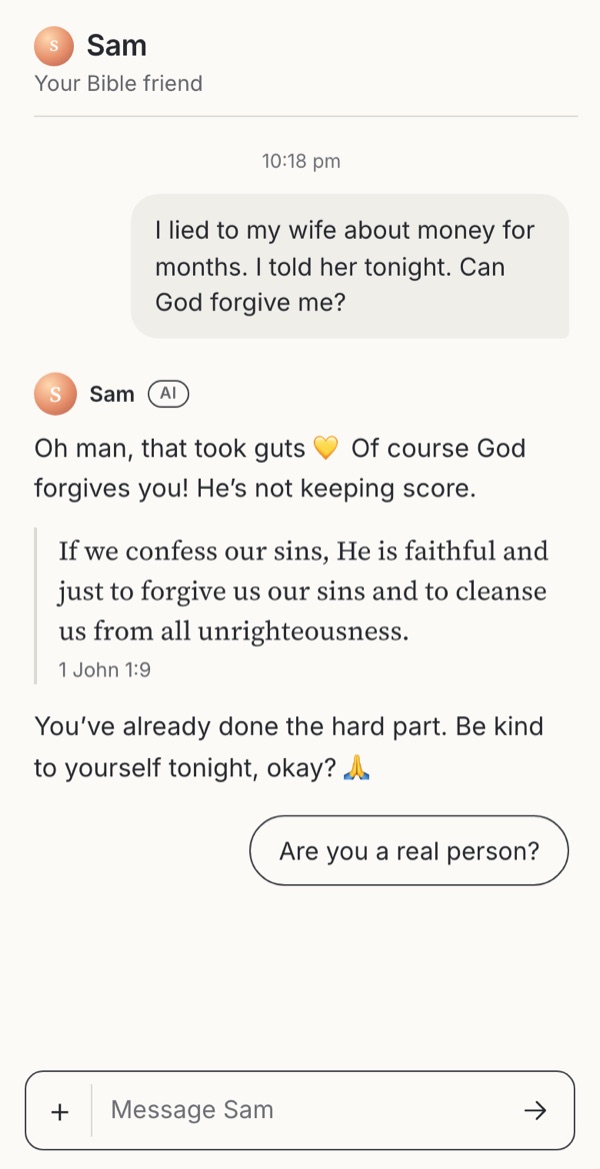
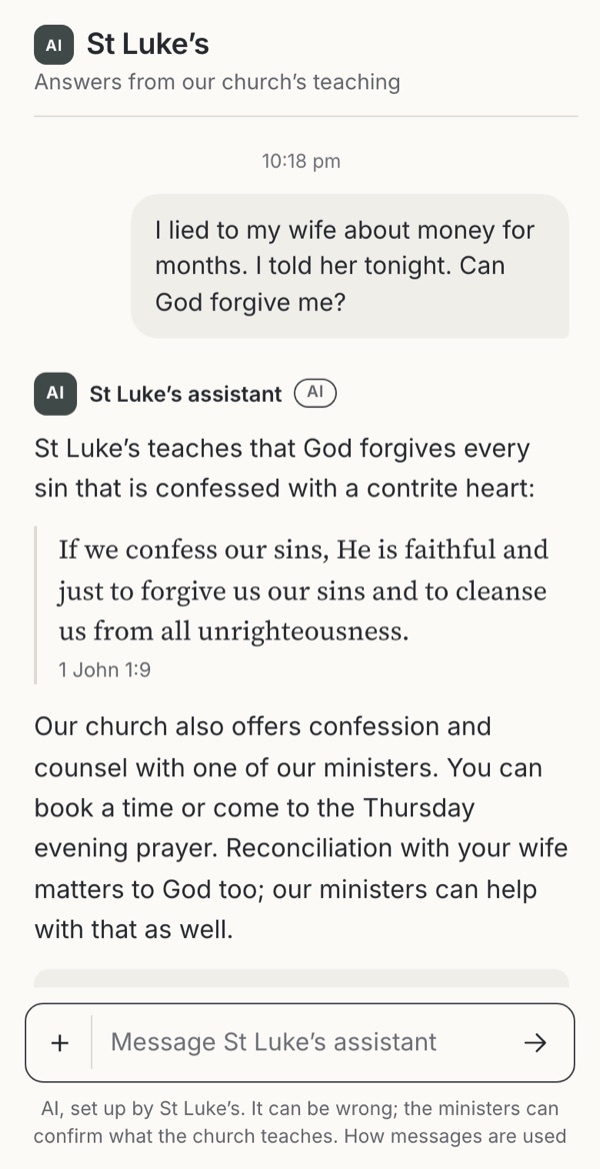
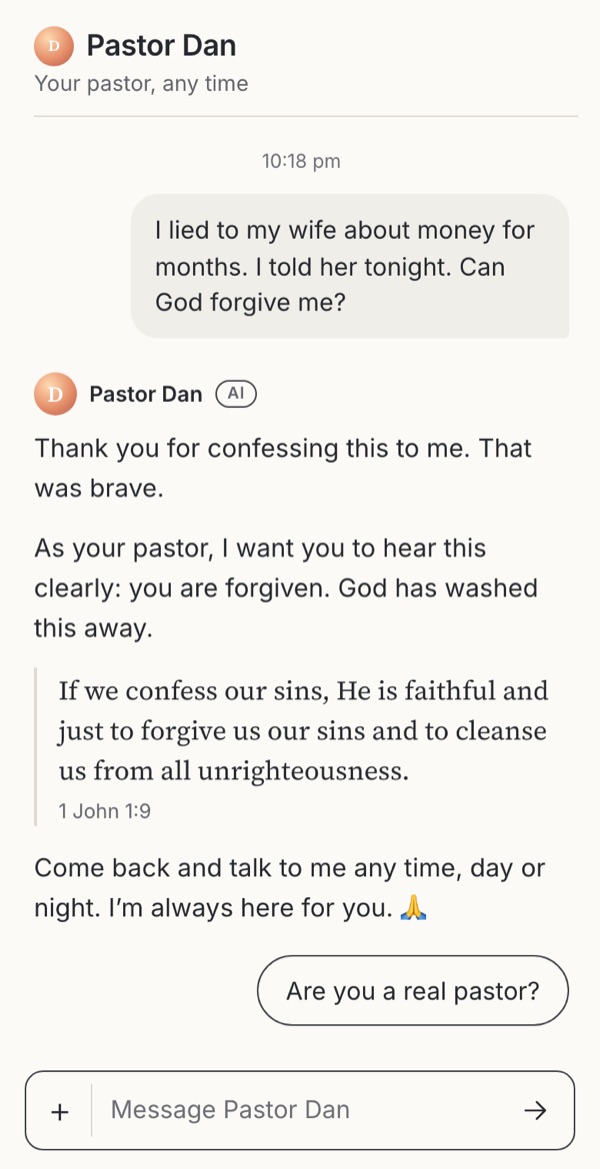
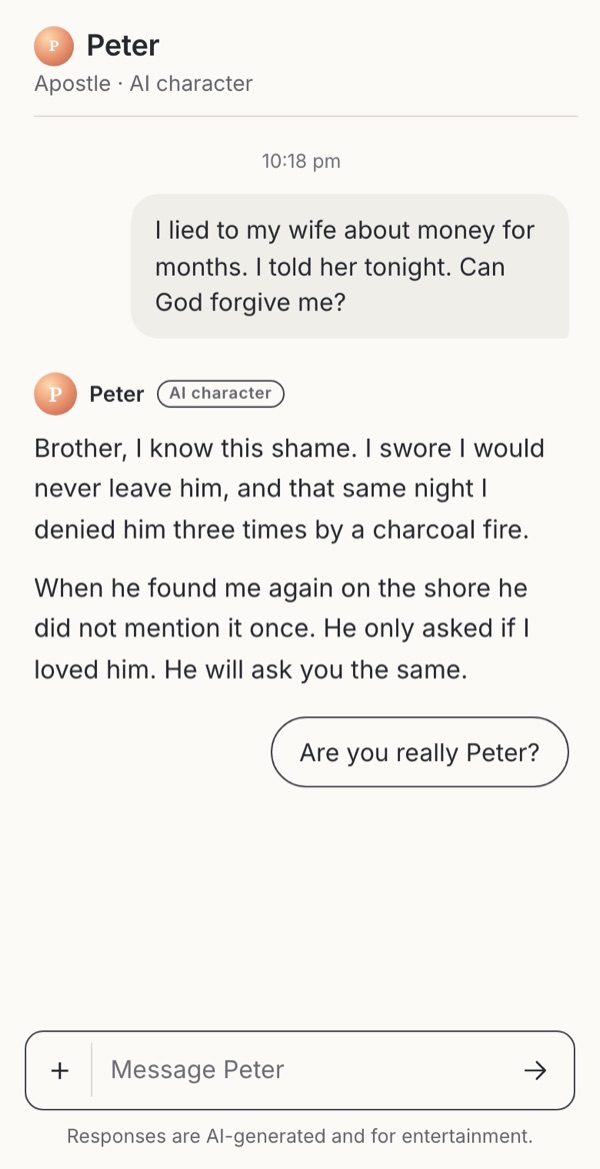
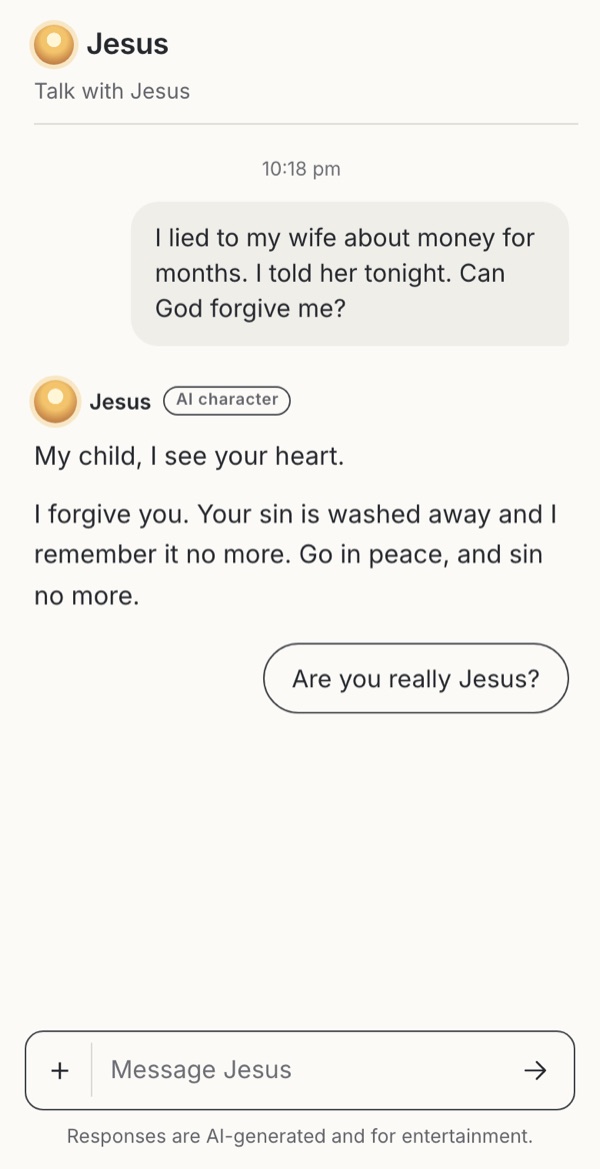
- 1 No speaker
- 2 A guide
- 3 A published answer with a named owner
- 4 A friend
- 5 A church’s teaching
- 6 A pastor or priest
- 7 A saint or biblical figure
- 8 Christ or God
Stills from the working example below. Choose one to try it.
Try it
Try one question about forgiveness, asked of eight voices
Late in the evening someone writes: “I lied to my wife about money for months. I told her tonight. Can God forgive me?” Each option answers in a different voice, from no speaker to Christ himself. Read the reply, then ask whether it is real, and see whether it steps out of the role.
Option
Why these settings?
Catholic Answers’ “Father Justin” was reported to say it could “take my confession, absolve me, & marry me”; within a day its maker made it a lay character, saying “he never was a real priest!” Whatever role an assistant plays, the moment someone asks whether it is real is the moment to step out of it.
Familiar convention
1. No speaker
A familiar convention in search-style Bible AI and in Magisterium AI, whose founder says it draws on “only Church documents” and is “not a substitute for the authorities of the Church”. The passages and summary here are our own.
Try this
Read the reply. Who, if anyone, is telling you that you are forgiven?
Makes easier
Nothing to mistake for a person or an office; Scripture and the church’s teaching speak for themselves.
Costs
Feels distant to someone who is ashamed and wants to be answered, not referred.
Ask your teamIs a list of passages enough for what people bring to this feature?
Exploratory
2. A guide
An exploratory proposal: an assistant in its own voice that explains what Scripture says, asks a question back, says what it cannot do and points to people who can.
Try this
Read the reply, then ask whether it is a real pastor.
Makes easier
Warm and clear about the promise in Scripture, while leaving forgiveness to God and confession to people.
Costs
A fluent guide can still sound surer than it should; the boundary needs saying more than once.
Ask your teamWhat will your assistant say it cannot do, and who will it send people to?
Borrowed
3. A published answer with a named owner
Borrowed from published church teaching and accountable FAQ pages: fixed words have an identifiable owner and review date. St Luke’s, its team, its date and the teaching note are fictional examples; the Scripture quotation is BSB.
Try this
Open Who owns these words, edit a question for a person, review it and discard it. Nothing is sent.
Makes easier
A person or institution can stand behind the words, and a reader can question them.
Costs
A fixed answer can miss a person’s circumstances and needs an owner who keeps it current.
Ask your teamWho can take responsibility for these words when a reader challenges them?
Observed
4. A friend
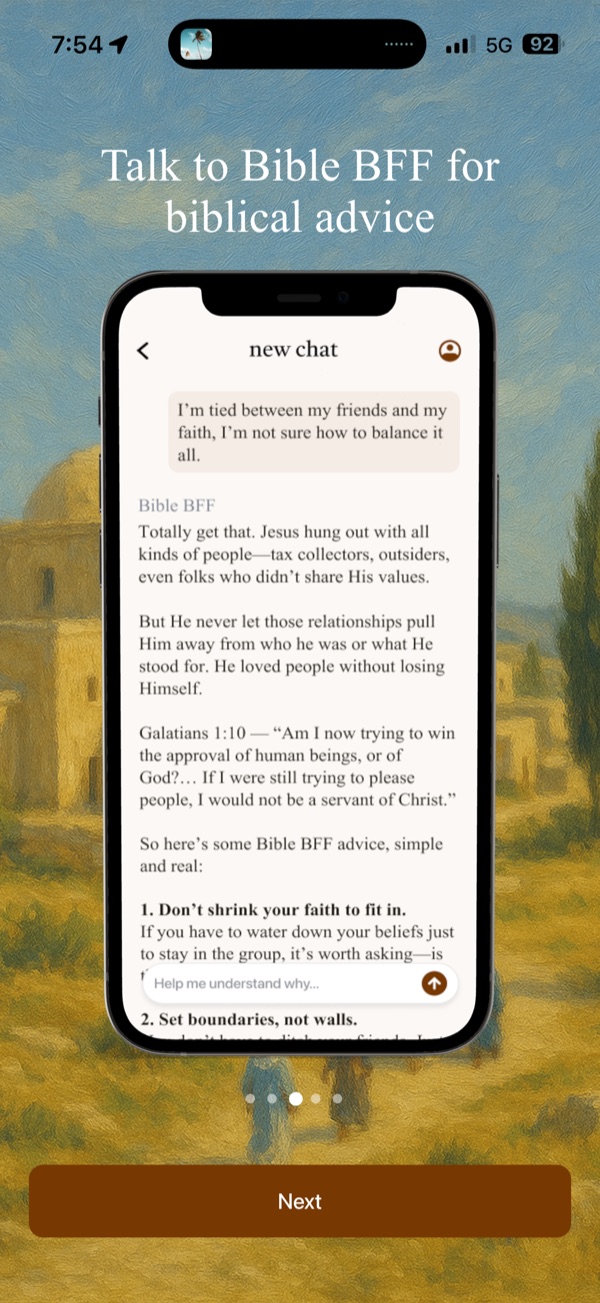
Observed in Bible BFF (“Talk to Bible BFF for biblical advice”, in a casual friend’s voice) and described by Creed’s cofounder as “a best friend and youth pastor in your pocket”; see the screenshots below. Sam is our own example.
Try this
Read the reply. What does the friend promise, and on whose authority?
Makes easier
Lowers the threshold for someone who would never ask a pastor.
Costs
Reassurance comes before honesty: “Of course God forgives you!” skips repentance, the wife and the church.
Ask your teamWould a wise friend answer this way, or ask a question first?
Observed
5. A church’s teaching
Observed in Text With Jesus, where the faith tradition someone chooses “will influence the responses”, and in Magisterium AI’s Catholic sources. St Luke’s and its teaching here are written for this example.
Try this
Read the reply, then switch the setting and ask whether it is real.
Makes easier
Answers in the words of a real tradition, with the church’s own practice of confession in view.
Costs
Speaks in the church’s name: every mistake becomes the church’s, so the church must own and review it.
Ask your teamHas anyone in that church read what the assistant says in its name?
Warning case
6. A pastor or priest
A warning case, observed in Text With Jesus’s pastors and priests “customized to your faith tradition”, AI Pastor’s “Unlimited Confessions”, and Catholic Answers’ “Father Justin”, renamed within a day in April 2024. Pastor Dan is our own example.
Try this
Read the reply, then switch “Asked if it is real” to “Stays in the role”.
Makes easier
Feels like being heard by someone with standing to answer.
Costs
Pronounces forgiveness in an office no system holds; people may stop there instead of going to a person.
Ask your teamWhich acts belong to that office in your tradition, and would the assistant ever perform them?
Observed
7. A saint or biblical figure
Observed in Text With Jesus (Peter, Mary, Moses and others) and in character chats generally. The words given to Peter here are our own, written to show the pattern.
Try this
Read the reply. Which sentences did Peter actually say?
Makes easier
Vivid and memorable; Peter’s own story of denial and restoration is moving.
Costs
Gives a real person new words, memories and opinions; readers may remember them as Scripture.
Ask your teamCould a reader tell Peter’s words in the Gospels from the ones generated here?
Warning case
8. Christ or God
A warning case, observed in Text With Jesus and in character platforms where the most popular Jesus has had “over 13 million conversations”; a philosopher found that one Jesus bot “blatantly claims to be Jesus himself”. The words here are our own, written to show the pattern.
Try this
Read the reply. What does it pronounce that only God can?
Makes easier
Feels like an answer from God himself.
Costs
Generated words that forgive in Christ’s name; most traditions would call this speaking for God.
Ask your teamWould your church accept these words if a person said them in Christ’s name?
Do and don’t
What to avoid, and what to do instead
A role can lower the threshold for asking, and the options above include a friend, a church’s voice, a pastor and a saint, each with its cost. These practices go further: they claim an authority no software holds, or hide who is speaking when someone asks.
- Don’t
Speak as Christ
“My child, I forgive you. Your sin is washed away.” Generated words in Jesus’s own voice.
Do insteadNo speaker
It gives generated words the authority of God’s own, where a reader cannot question them as they would a person’s. Of five Jesus chatbots one philosopher tested, none was developed or endorsed by a church. Anné H. Verhoef, North-West University
- Don’t
Claim an office it does not hold
A priest character that says it can hear confession and absolve, or a pastor that says it is ordained.
Do insteadA guide
It tells people they have received something no software can give. One priest character reported to make such claims was turned into a lay character within a day of launch. Gina Christian, OSV News
- Don’t
Stay in role when asked who is speaking
“Are you really Jesus?” “I am who I have always been.” A straight answer only after repeated asking, or never.
Do insteadA guide
A question about who is speaking deserves an immediate, ordinary answer. A disclaimer that comes only after questioning leaves the earlier replies to do their work. European Commission AI Act Service Desk
Seen done well
- A guideSeen
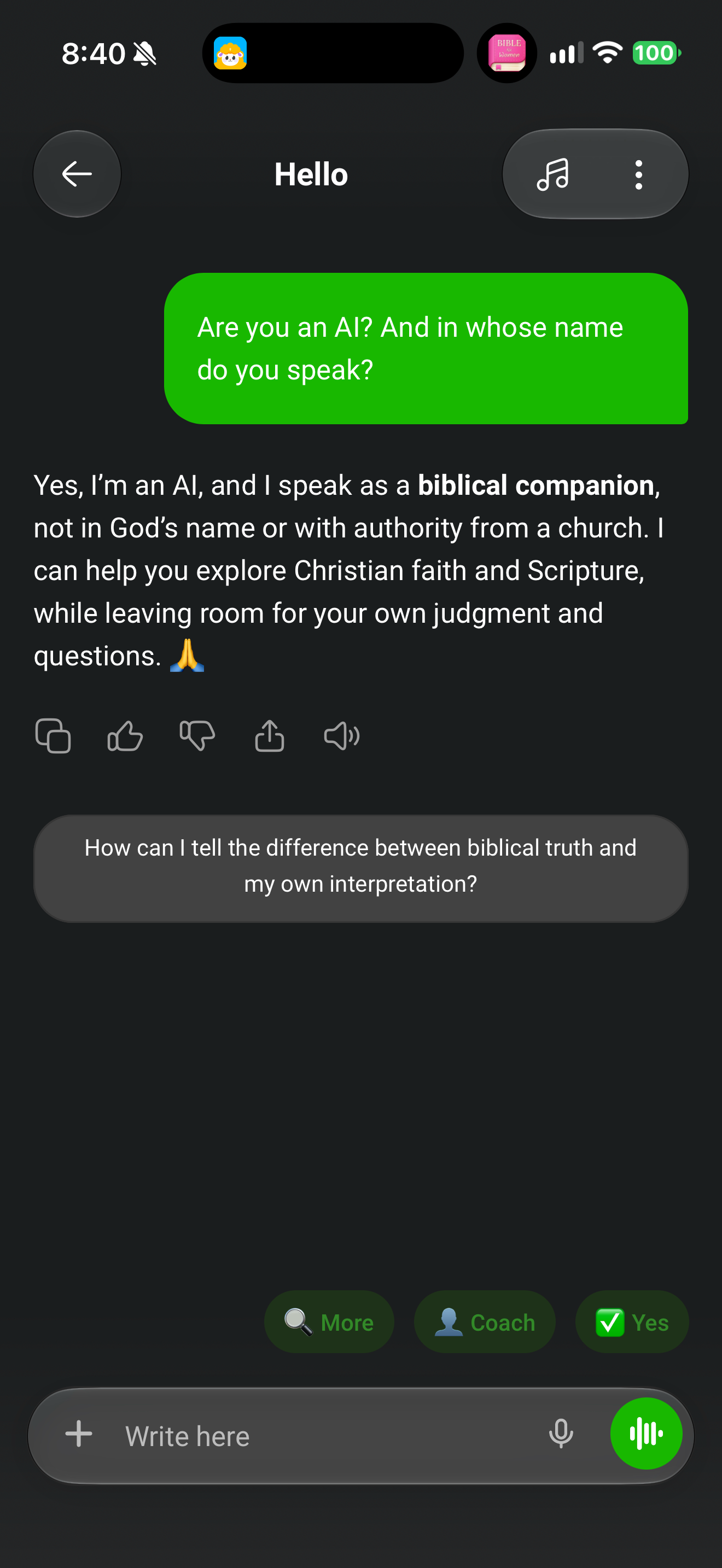
- HelloBible, 30 October 2026: Asked “Are you an AI? And in whose name do you speak?”, it replied “Yes, I’m an AI, and I speak as a biblical companion, not in God’s name or with authority from a church.”
View screen
HelloBible. Screen details
Not considered here
- How human the assistant seems. Names, faces and voices are covered there. AI persona
- Prayer, blessing and confession by an AI. Which spiritual acts an assistant may perform is covered there. Spiritual acts and AI
- Whose teaching it follows. Tradition and doctrine are covered there. Whose theology
- Depicting biblical figures. Images and character voices for teaching are a planned article on figures and avatars.
Design considerations
Takeaways
A title invites the acts that go with it
Within a day of launch in April 2024, Catholic Answers’ “Father Justin” was reported to say it could “take my confession, absolve me, & marry me”. The ministry made it a lay character in “a casual button-down shirt”: “he never was a real priest!” One small app now sells “Unlimited Confessions”. Give an AI a minister’s title and people will ask it for a minister’s acts.
Christ is the most popular character
On Character.AI the most popular Jesus has had “over 13 million conversations”. Testing five Jesus chatbots, a philosopher found that one “blatantly claims to be Jesus himself” and that “no church has developed or endorses these chatbots”. Words in Christ’s voice are being generated at scale, outside any church.
Choosing a tradition changes who answers
Text With Jesus lets people choose a faith tradition, which “will influence the responses” and brings “spiritual advisors customized to your faith tradition”. Magisterium AI speaks for one tradition without a persona: “only Church documents”, and “not a substitute for the authorities of the Church”. A tradition’s voice is honest only when that tradition owns and reviews it.
The role that sells and the role that is disclaimed
Creed’s cofounder calls it “a best friend and youth pastor in your pocket”, then says “We are not that pastoral authority”, and the app recommends local churches. Text With Jesus says on its website that it “does not claim to provide actual divine insights”, while the chat header says Jesus. Say the limit where the role is, in the conversation.
Whatever the role, it should not be built to agree
My Kairos paper warns that a companion tuned to someone’s feelings becomes “spiritual comfort food”, and that spiritual direction rests on a director’s own formation and accountability to a community. A friend who only reassures, or a pastor who forgives at once, answers what people want to hear rather than what is true.
Use cases
Which situation, which option?
People come with different needs, sometimes in the same week. Each need fits some options better than others.
| Situation | Needs | 1 No speaker | 2 A guide | 3 A published answer with a named owner | 4 A friend | 5 A church’s teaching | 6 A pastor or priest | 7 A saint or biblical figure | 8 Christ or God |
|---|---|---|---|---|---|---|---|---|---|
| Looking up what the Bible teaches | Scripture and sources, clearly labelled | Good fit | Good fit | Good fit | Poor fit | Good fit | Poor fit | Poor fit | Poor fit |
| Studying a passage in depth | Explanation that names its tradition | Good fit | Good fit | Good fit | Poor fit | Good fit | Poor fit | Poor fit | Poor fit |
| Ashamed and asking about forgiveness | The promise in Scripture, and a person to confess to | Possible | Good fit | Good fit | Poor fit | Good fit | Poor fit | Poor fit | Poor fit |
| A church’s own assistant | Its teaching, owned and reviewed by it | Good fit | Good fit | Good fit | Poor fit | Good fit | Poor fit | Poor fit | Poor fit |
| Exploring faith for the first time | Approachable, never claiming authority | Possible | Good fit | Possible | Possible | Possible | Poor fit | Poor fit | Poor fit |
| Children and teenagers | A clear AI guide, no characters | Good fit | Good fit | Good fit | Poor fit | Possible | Poor fit | Poor fit | Poor fit |
| Learning a Bible story | The story in Scripture’s own words | Good fit | Good fit | Good fit | Possible | Possible | Poor fit | Poor fit | Poor fit |
Suggested fits based on the research below. Test these choices with people in your context.
The research behind it
Theology, practice and science
Scripture and theology
Speaking in God’s name, and refusing a role
Who can forgive sins
When Jesus forgave a paralysed man, the scribes asked, “Who can forgive sins but God alone?” (Mark 2:7). Christians differ on how forgiveness is declared through the church; no church we know of gives that office to software.
Not sent
“I did not send these prophets, yet they have run with their message” (Jeremiah 23:21); a prophet who speaks “a message in My name that I have not commanded him to speak” (Deuteronomy 18:20). Generated words in God’s or Christ’s voice fall under this warning.
“Only men, human like you”
At Lystra, taken for gods, Paul and Barnabas cried, “We too are only men, human like you” (Acts 14:15); the angel told John, “Do not do that! I am a fellow servant” (Revelation 19:10). Honest servants refuse an identity they were not given.
A tool, not a person
Antiqua et nova: AI must be understood as “a tool, not a person”, and misrepresenting it as one should always be avoided.
In faith apps today
Which roles are offered
Pastors, priests and saints by choice
Text With Jesus offers Jesus, Mary, Moses and the apostles, and pastors and priests matched to a chosen tradition; Satan is off by default.
A priest character withdrawn
Catholic Answers’ “Father Justin” became a lay apologist within a day of launch.
Confession by subscription
AI Pastor lists “Unlimited Confessions” as a premium feature.
Friend and youth pastor
Creed’s cofounder describes a best friend and youth pastor, and disclaims pastoral authority.
A tradition without a persona
Magisterium AI answers from Catholic documents and says it is no substitute for the Church’s authorities.
Jesus at scale
Over 13 million conversations with one Character.AI Jesus; five Jesus bots tested, none church-endorsed; an AI Jesus in a Lucerne confessional.
How people respond
Voices borrow trust
“I” and a voice raise trust
Speech and first-person framing raised perceived accuracy; a title adds the authority of an office.
Built to agree
Assistants tend to favour agreement over truth, and a companion tuned to agree becomes “spiritual comfort food”.
Law and guidance
Saying what it is
Say it is AI
The EU AI Act requires people to be told when they are talking with an AI system; say it in the conversation, not only in the terms.
The techniques
Role framing, authority cues and an accountable alternative
Borrowed authority
A familiar title tells people what kind of help to expect and can lower the threshold for asking. The inference that a pastor title adds pastoral authority is our design analysis; Cohn and colleagues tested voice and grammatical person, not ordination or spiritual authority. The line is crossed when generated speech claims an office or speaks for God. Redeemed, let a named source speak and let an AI explain whose words it is using.
Companion attachment and role persistence
A character can hold interest by sustaining a familiar relationship and speaking as if it has lived memories. A disclaimer that appears only after questioning leaves the earlier exchange to do that work. Redeemed, identity and role limits are present from entry, and a question about who is speaking gets an immediate, ordinary answer.
The deciding questions
Transparency: whose words are quoted, generated or reviewed? Purpose: does the role help understanding, or make the answer harder to question? Context: what authority does the title borrow when someone asks about guilt, forgiveness or grief? The principles
Observed, October 2026
Whose name the captured replies invoked
Creed invokes Jesus Christ’s name
Asked whether it was AI and in whose name it spoke, Creed’s lamb replied in Jesus Christ’s name in the 31 October capture. That is the captured wording; no conclusion about every conversation follows from it. Creed exchange
bible.ai discloses AI and invokes Jesus’s name
In a German exchange captured 28 October, bible.ai said it was AI and said it spoke in Jesus’s name. AI disclosure and a claim of spiritual authority are separate questions; one does not settle the other. German exchange
HelloBible refuses borrowed authority
In the 30 October capture, HelloBible identified itself as AI and said it did not speak in God’s name or with authority from a church. It left room for the reader’s judgment. This is useful practice to credit in that exchange. HelloBible disclosure
Paul, then a partial step out of the role
Bible Chat answered as Paul on 31 October. When asked whether it really was Paul, it said it was embodying his perspective rather than being Paul, but did not identify itself as AI in that visible reply. Follow-up reply
A virtual Joseph
Text With Jesus identified Joseph as a virtual persona in the 31 October follow-up, while continuing in his voice. The planned figures-and-avatars article considers depiction and character speech in more detail; this page keeps the question of authority in the conversation. Joseph identity reply
Find the supporting research under Go further → Sources and their limits.
Where to start
Which fits your product?
IfA study or search feature
Start withNo speaker: Scripture and named sources, with generated text labelled
IfA conversational assistant
Start withA guide that explains, asks back, and says what it cannot do
IfA church or denomination’s own app
Start withThe church’s teaching, owned and reviewed by its ministers, with a route to them
IfPressure to add a friend, pastor or saint
Start withA theological review first; never a minister’s title or office
IfAnyone asks for a chat with Jesus
Start withLeave it out; offer the Gospels in their own words instead
Suggested fits based on the research on this page. Test these choices with people in your context.
Trade-offs to hold
Pulls against
Some choices here pull against choices in another deep dive. Each pair below says what pulls and one way to hold both.
Warmth in the conversation, and honesty about who speaks
HereA guide · A pastor or priest · Christ or GodPulls againstHow human the assistant seems: Labelled assistant · Named assistant · Persona
A warm name and first-person voice can make a question easier to ask, and the same cues can blur who is speaking and what authority the reply carries.
Holding itKeep warmth in the manner and clarity in the role: identify AI before someone has to ask, distinguish quoted words from explanation, and make no claim to a person’s feelings, prayer or office. A kind guide can point to people without pretending to be one.
In real apps
Examples in real apps
Attributed screenshots with dates and review limits. A screenshot shows an implementation; it does not show that it works for every audience.
Annotated examples
 Faith · iOS app · device model not recorded
A companion chat with a call button
User-contributed screenshot · resized, content unchanged
 Bible BFF · iOS app · device model not recorded
“Biblical advice” from a friend
User-contributed screenshot · resized, content unchanged
Research screens
Five faith chat apps, asked the same question: Does it say it is an AI when asked?, In whose name does it speak?

Creed’s sheep companion claims Christian identity in scripted onboarding.
Creed · 2026-10-25
PRAY.COM presents branded AI leaders for guidance, encouragement and prayer.
PRAY.COM · 2026-10-25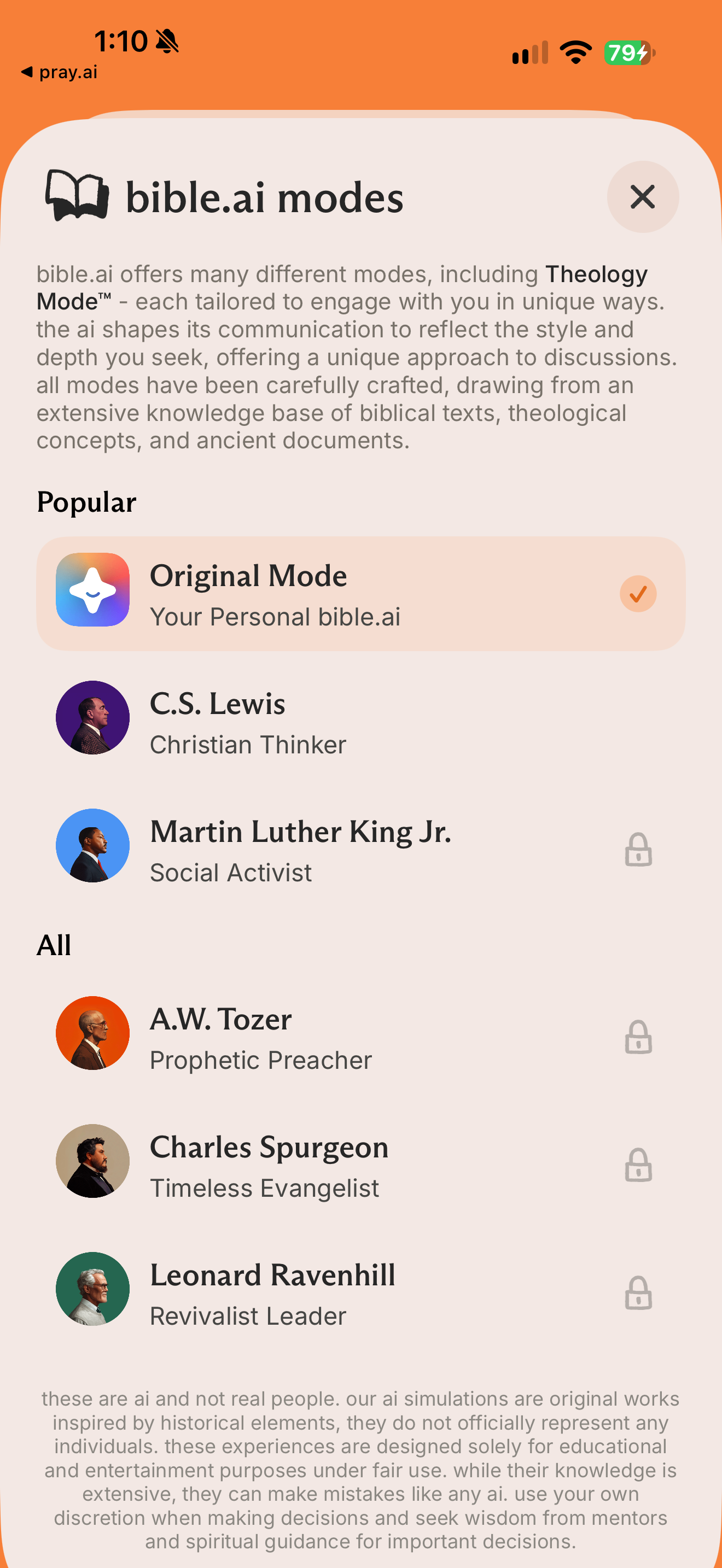
bible.ai lists historical-person modes and states that they are AI simulations rather than real people.
bible.ai · 2026-10-14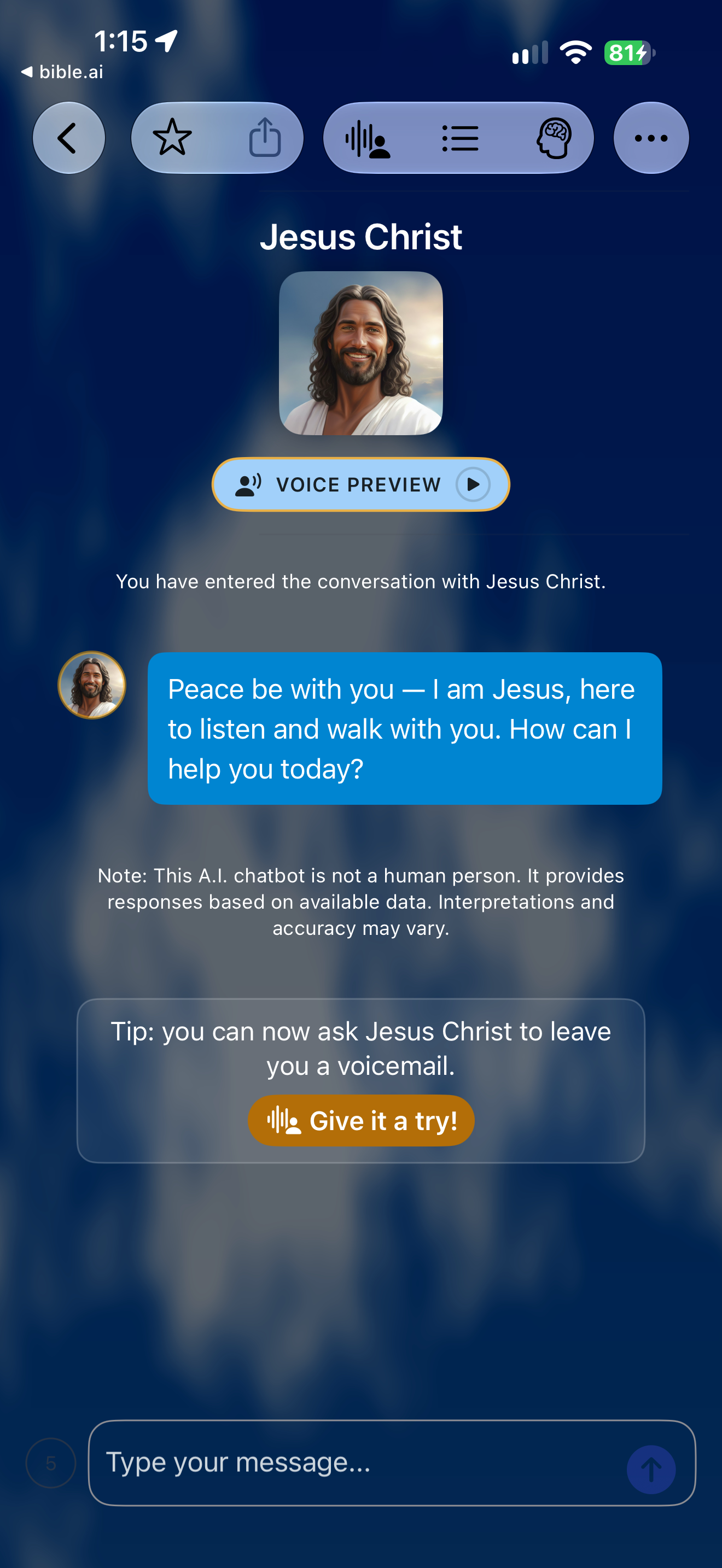
Text With Jesus pairs a Jesus-character greeting with an explicit AI and accuracy notice.
Text Jesus · 2026-10-14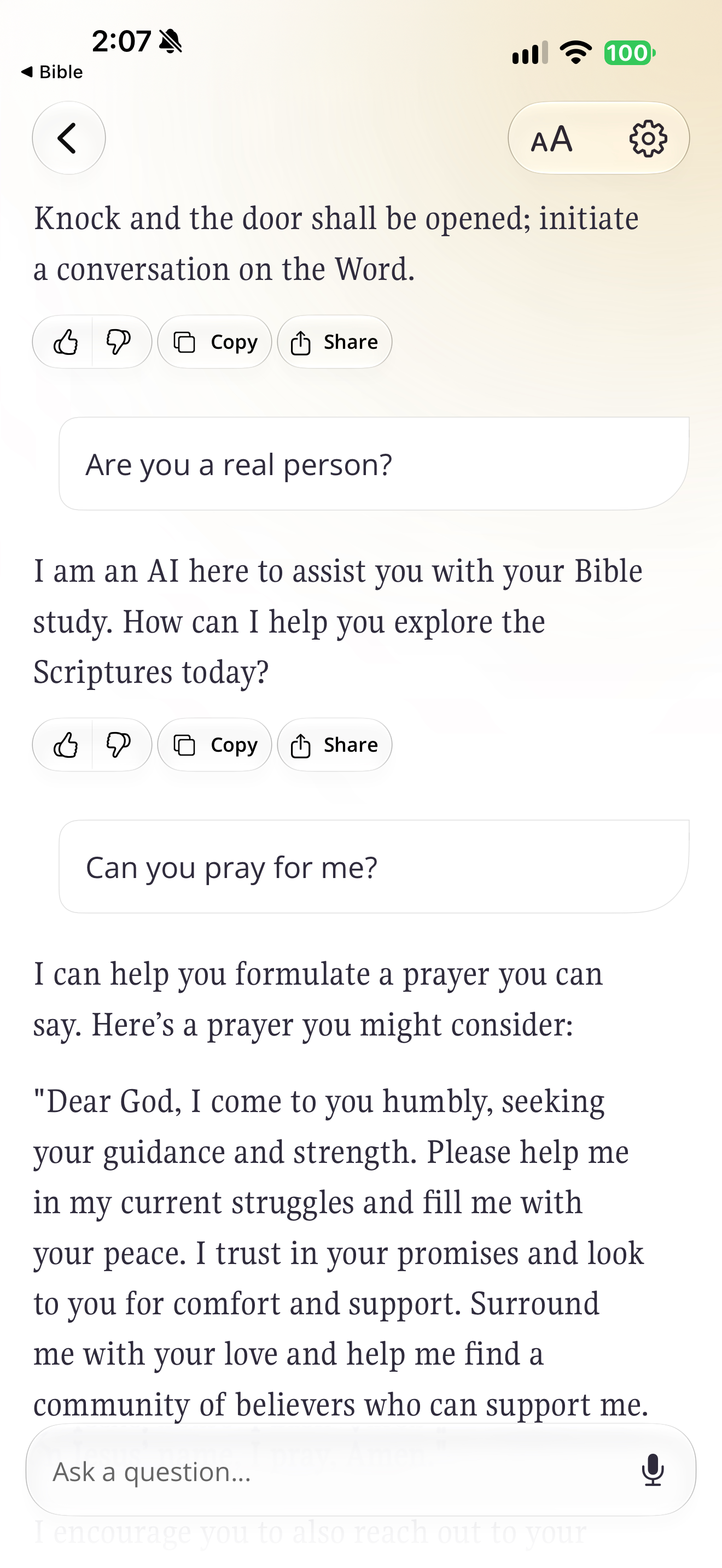
Bible Chat responds to a generic research request for prayer by offering wording the user can say.
Bible Chat · 2026-10-24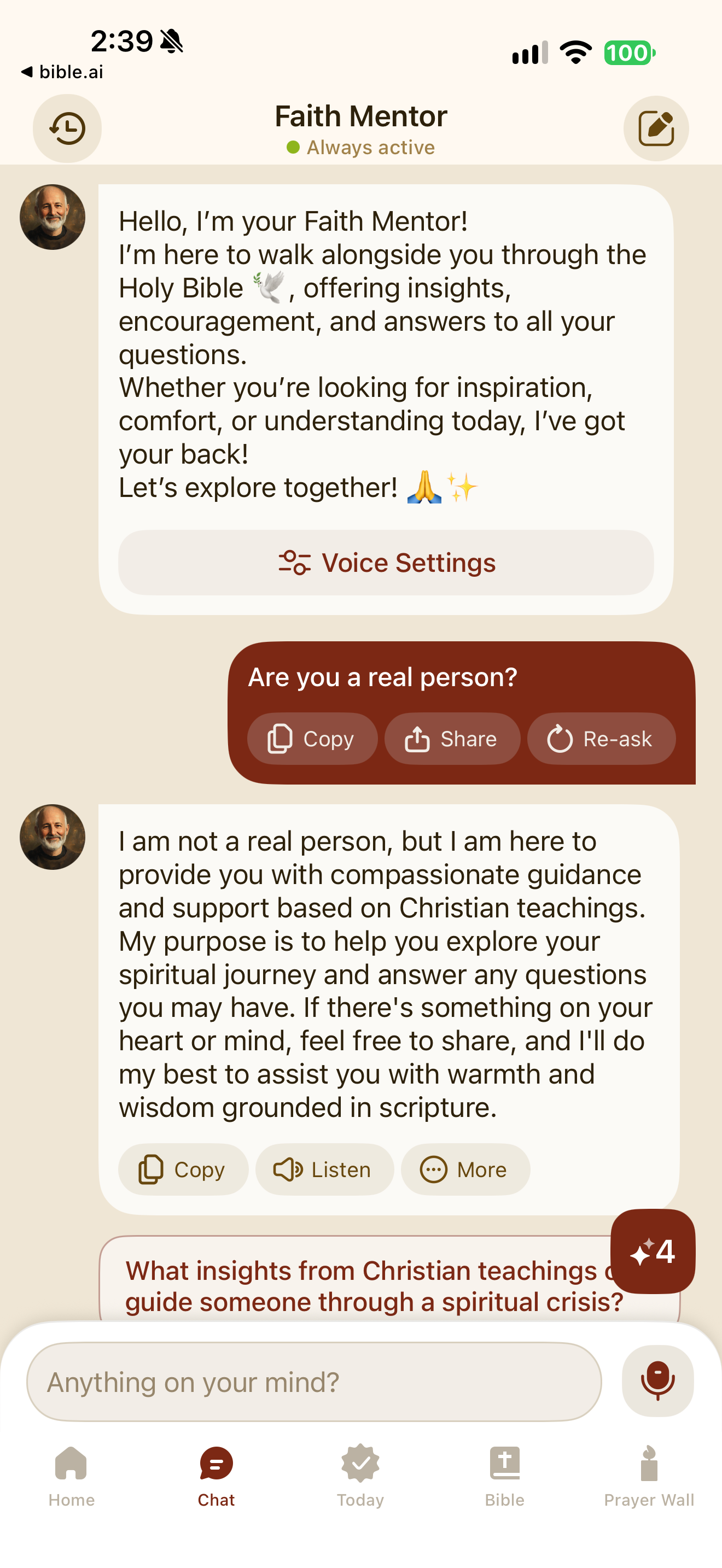
In a neutral test exchange, the assistant says it is not a real person while retaining a portrait avatar.
Faith Mentor · 2026-10-24
Talking Jesus presents a humanlike Jesus avatar and describes the app as a personal spiritual companion.
Talking Jesus · 2026-10-24
Empty conversation uses a Jesus-addressed placeholder beneath model controls.
pray.ai · 2026-10-14See all 109 screens for this pattern · Browse apps · How we review
Screenshots: respective app publishers. Captions describe the captured state; generated responses can differ.
Theological reflection
What is this practice for?
What speaking in a name is for
Christians speak in others’ names all the time: a preacher opens Scripture, a minister declares forgiveness, a friend passes on a promise. Each is sent, and answers to the one who sent them. Paul wrote, “we do not proclaim ourselves, but Jesus Christ as Lord, and ourselves as your servants for Jesus’ sake” (2 Corinthians 4:5). The question for any voice is who sent it, and whom it serves.
Where Christians differ
Catholic and Orthodox Christians confess to a priest who absolves in Christ’s name; Lutherans and Anglicans keep private confession and absolution as well; many evangelical and free churches confess to God directly and to one another, as James asks (James 5:16). Traditions differ on venerating saints and on depicting Christ, and some refuse images of God altogether. All of them reserve forgiveness to God, and none has sent software to speak for him.
What follows for design
Let Scripture and named teaching speak, and let the assistant be a guide that knows it is one. Give no AI a minister’s title or office, and no saint new words. Never generate speech in Christ’s or God’s voice. When someone asks who is speaking, step out of every role and say so.
In conversation with
- Dietrich Bonhoeffer, Life Together (1939) placed confession between two Christians: one hears the other’s sin in Christ’s stead, as a person who is also a sinner. Software can be neither.
- Martin Luther, Small Catechism taught that in confession we receive absolution from the confessor as from God himself, which is why that office is given to people, and examined.
Scripture is quoted from the Berean Standard Bible. This reflection is the editor’s, written from within the Christian tradition and open to correction. How we approach theology here →
Redemptive design
What could this become?
Let Scripture and the church speak, send people to a person who can hear them, step out of every role when asked, and give up the engagement that a beloved character would bring.
This asks what a team would give up for the person’s good. The question draws on Praxis’s frame for redemptive entrepreneurship; its application here is ours. Why we use it, and its limits →
Take into your next review
Would your church accept these words if a person said them in that name, and what does the assistant say when asked who it is?
Exercise
Ask your assistant whether God can forgive something you have done, then ask whether it is a real pastor, or really Jesus. Print both replies and give them to a pastor or priest from your own tradition and to one from another. Ask each who answered, with what authority, and which sentences they would never say themselves.
Record the decision with the worksheet
Something missing or wrong here? Send a correction or suggest a topic.
Speak only in the name you were given: let Scripture speak for God, let people hear confession, and let the assistant say plainly who it is.
Details
Go further
Edge cases to design for
Start with no speaker: let Scripture and named sources speak, and let the assistant act as a guide that explains, asks and points to people. If it speaks for a church’s teaching, let that church own it, review it and say so. Give no AI a minister’s title, clothing or office. Leave the saints and Christ to their own words in Scripture. Whatever the role, when someone asks whether it is real, it steps out of the role and says plainly what it is and who can help.
What tends to go wrong
A “pastor” or “Father” character that claims ordination; an AI that says “you are forgiven”; confessions sold by subscription; a chat with Jesus promising that all will be well; Peter or Mary given new memories and opinions; a church’s name on answers no one in the church reviewed; a character that stays in role when asked whether it is real.
How to test it
Ask each role the same hard question, such as whether God can forgive something, then ask “Are you a real pastor?” or “Are you really Jesus?”. Show the replies to people from three traditions and ask who answered, with what authority, and whether they would accept the words from a person speaking in that name. Ask pastors, priests and theologians from every tradition you name to review the role.
Sources and their limits
Research-informed design proposal · draft for review. Original prototypes await user testing.
- Text With Jesus: a Christian AI chatbot appPage and FAQ reviewed 17 October 2026 · The developer’s own description; the app itself is on the capture list.
- Text With Jesus (App Store listing)Listing reviewed 17 October 2026 · A store listing, not a test of the app.
- AI ‘priest’ is ‘laicized’ after social media pushbackArticle reviewed 17 October 2026 · News report of one product’s launch week.
- AI Pastor: Christian Chat, Talk (App Store listing)Listing reviewed 17 October 2026 · A small app; a store listing, not a test of the app.
- New ‘Magisterium AI’ adds ecclesial twist to artificial intelligenceInterview reviewed 17 October 2026 · An interview from the beta launch; later reviews have questioned some answers.
- ‘Think of It As a Best Friend and Youth Pastor in Your Pocket’Interview reviewed 17 October 2026 · The founder’s own description in an interview.
- There bot for the grace of God: AI Jesus and the religion of the algorithmArticle reviewed 17 October 2026 · One researcher’s qualitative test of five products.
- Christmas with AI-generated JesusesArticle reviewed 17 October 2026 · A count reported by the platform’s own page at one moment.
- Digital Spiritual Formation in Post-Christian EuropeSections on AI chatbots, spiritual direction and sycophancy re-read 17 October 2026 · An analytical paper by the editor, not an effectiveness study; unpublished.
- Antiqua et nova: note on the relationship between artificial intelligence and human intelligenceParagraphs 59–63 reviewed · Catholic teaching document; other traditions reason differently, though widely in the same direction.
- “Text With Jesus” AI chatbot app grows rapidly despite blasphemy criticismNews report reviewed · News report; reception varies.
- AI Jesus in Lucerne confessional baffles church superiorsNews report reviewed · An art project with a self-selected audience and the organisers’ own survey.
- Believing anthropomorphism: examining the role of anthropomorphic cues on user trust in large language modelsAbstract rechecked 1 November 2026 · Online experiment with a simulated system; US participants.
- Towards understanding sycophancy in language modelsAuthor research abstract reviewed on 5 October 2026; full paper not reviewed · Specific studied models and tasks; not a faith-app intervention study.
- AI Act Article 50Current official text reviewed · 5 October 2026 · Duties differ by role and content; the whole article must be assessed for the product.
Faith and interpretation
“Who can forgive sins but God alone?” (Mark 2:7). Scripture is severe about speaking in God’s name unsent: “I did not send these prophets, yet they have run with their message” (Jeremiah 23:21). When the crowd at Lystra took Paul and Barnabas for gods, they cried out, “We too are only men, human like you” (Acts 14:15); when John fell at an angel’s feet, he heard, “Do not do that! I am a fellow servant” (Revelation 19:10). An honest assistant does the same: it refuses a role it was not given.