Sharing with a group
When someone shares a prayer request, who hears it, and who looks after it?
Someone asks others to pray: for a mother’s surgery, for a new job, for something they have never said aloud. A prayer app decides who hears it, from one friend to everyone in the app, and what comes back: a heart, a verse, a stranger’s reply, or a person who knows what to do. Most requests are ordinary, and being prayed for by people who know you is a gift. Some are not, and the people closest to a worry are not always the right ones to hear it first. Paul asks the church to “rejoice with those who rejoice; weep with those who weep” (Romans 12:15). Design for both.
- 7 working options
- 9 app examples
- 7 takeaways
- Editorial review, not user-tested
The spectrum
From between you and God to everyone in the app
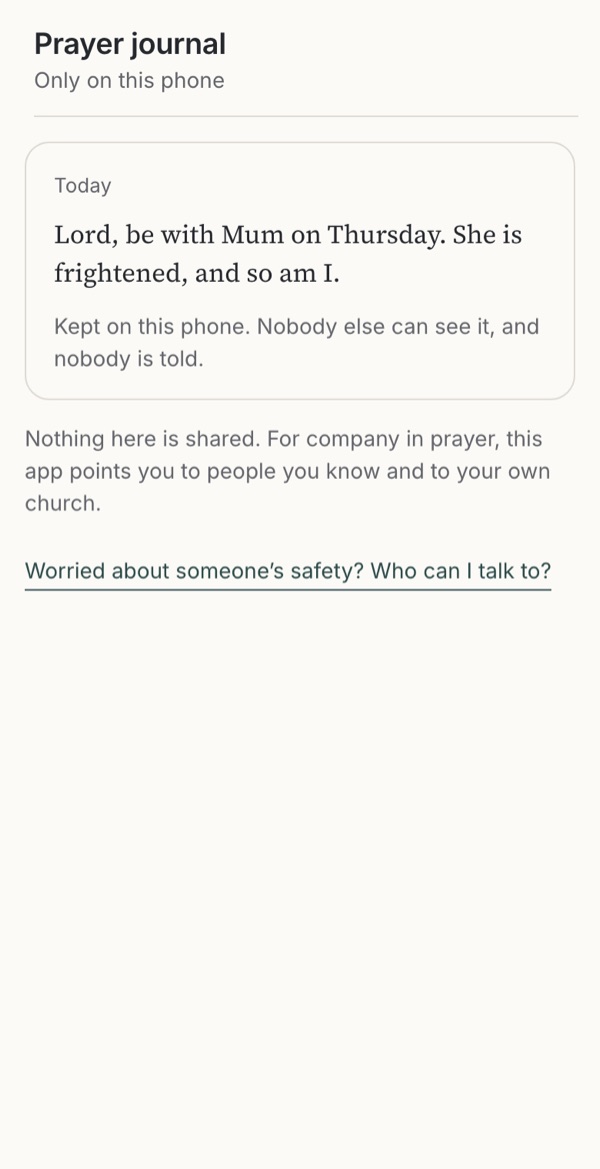 Leave it out Nothing to leak or misread No one prays with themTry it →
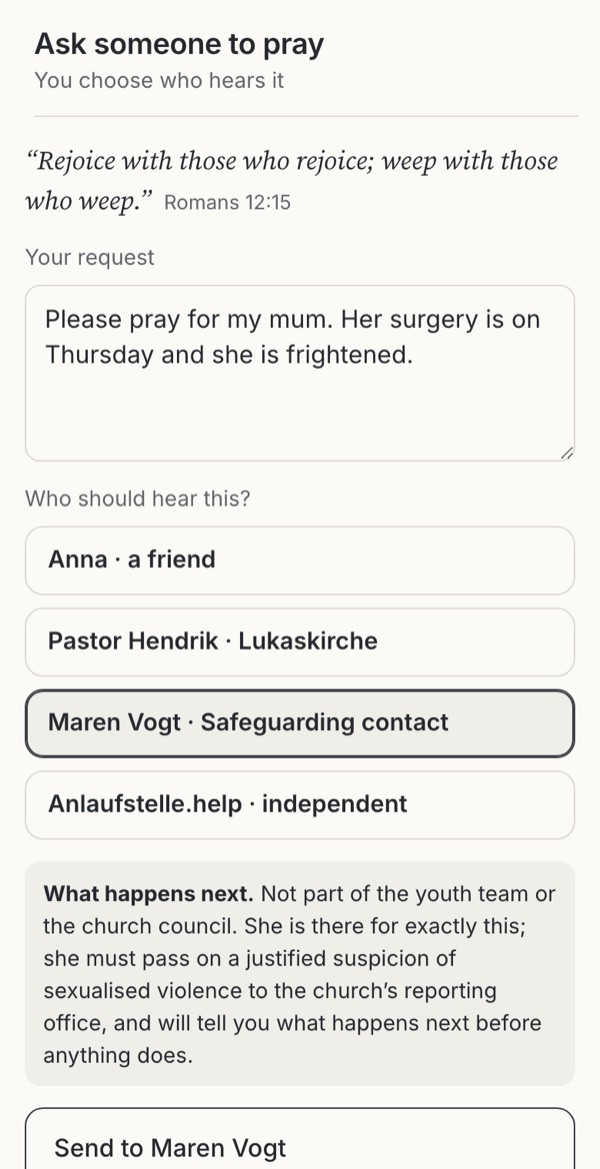 Borrowed The listener is chosen and named A church must name someoneTry it →
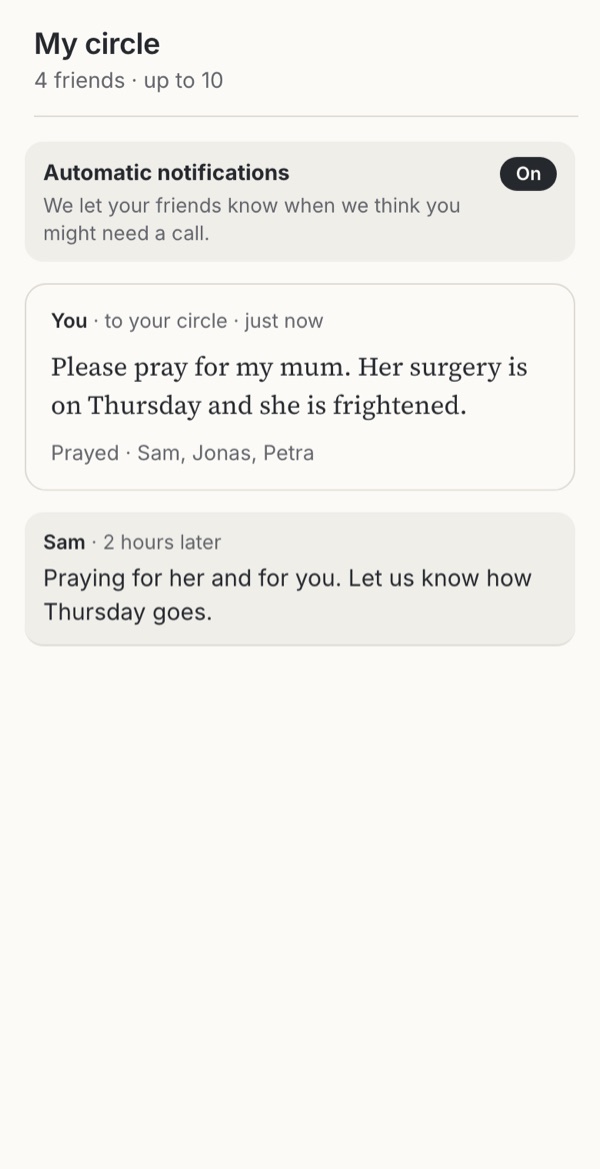 Observed People who know them Replies are unguidedTry it →
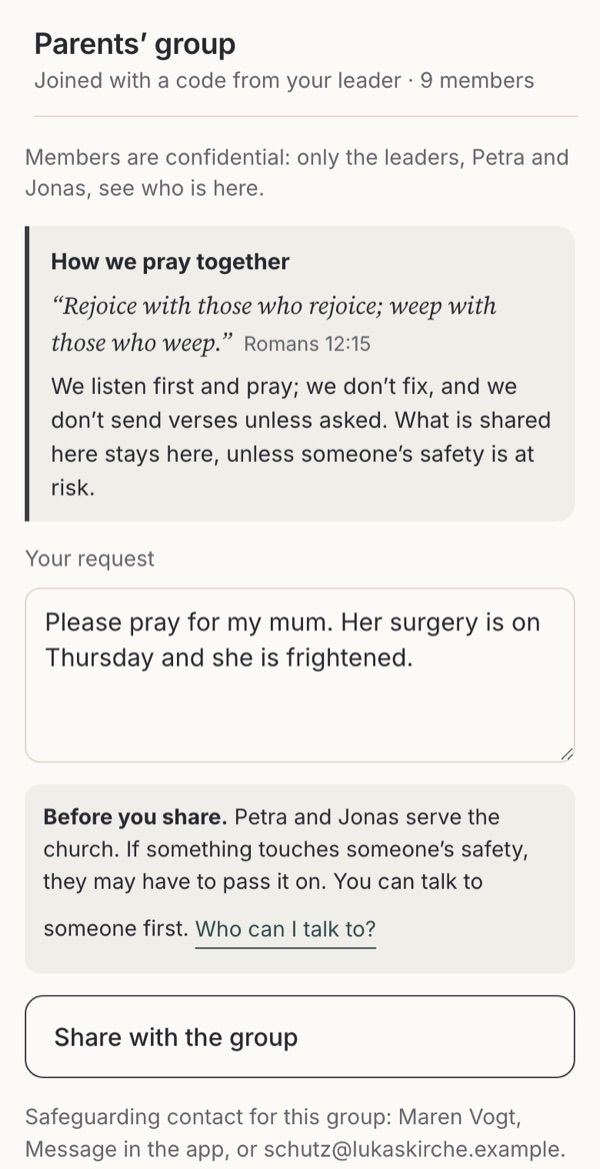 Observed Someone looks after it Leaders may be too closeTry it →
 Observed A parish prays together Hundreds see a name and a needTry it →
 Observed Someone prays at any hour Strangers answerTry it →
 Leave it out Motivates while it lasts Prayer becomes a rankingTry it →
Stills from the working example below. Choose one to try it.
Try it
Try seven ways to share a prayer request
Someone wants others to pray with them. First share an ordinary request: their mother’s surgery on Thursday. Then switch to something hard: a worry about how a youth helper messages their daughter, from someone who doesn’t know who to tell. Notice who hears it, what each listener can or must do with it, and what comes back.
Option
Why these settings?
The ordinary request is about a mother’s surgery. In the hard situation a parent is worried about how a youth helper messages their daughter and doesn’t know who to tell; in several options a reply quotes Matthew 18:15 back, as that passage has been used to send people to confront someone privately first. When a church sets the app up, it names its safeguarding contact, someone outside the youth team, and says before anyone shares that church workers may have to pass a concern on. The independent route stays available either way.
Leave it out
1. Between you and God
Leaving sharing out. Hallow’s help centre describes the private setting: an intention “will only be saved to your journal and not shared with others”. Here the whole app works that way and points people to those they know and to their own church.
Try this
Write the request and keep it. Switch to the hard situation and open “Who can I talk to?”.
Makes easier
Nothing to leak, misread or answer badly.
Costs
No one prays with them, and no one hears what is hard.
Ask your teamWhere does this app send someone who needs a person, not a journal?
Borrowed
2. Through a person you choose
Borrowed from careful church practice outside apps: one person receives a request, agrees what is passed on and names no one without consent; and from safeguarding roles that sit apart from leadership, such as a Church of England parish’s lay safeguarding officer. Not observed in an app. Names, replies and the church are written for this example.
Try this
Choose each person and read “What happens next” before sending. Switch the church set-up off and on.
Makes easier
The listener is chosen, and what they must do is said before anything is shared.
Costs
Asks the church to name and train someone, and keep the details current.
Ask your teamWho is named here, and are they outside the leadership a concern might be about?
Observed
3. A few people you choose
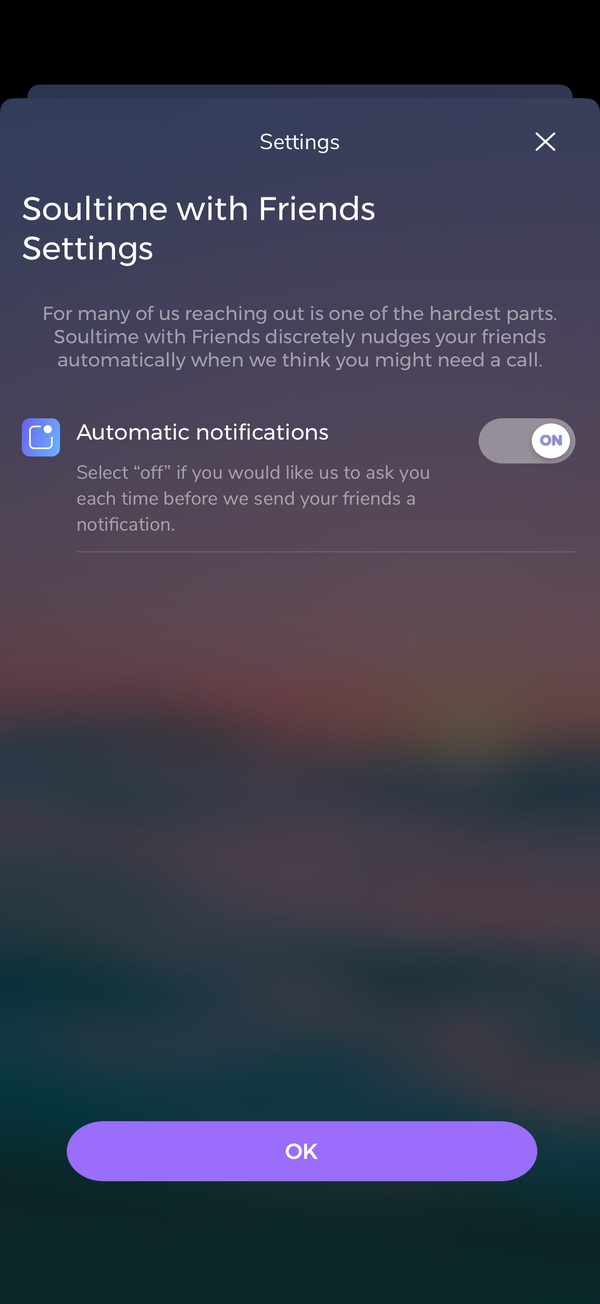
Observed in Soultime with Friends (up to 10 supporters, with automatic notifications switched on) and in YouVersion Prayer (“Keep your prayers private, or invite friends to pray with you”); see the screenshots below.
Try this
Share with your circle and read the replies. Then switch to the hard situation.
Makes easier
Prayer with people who know them, at a size they chose.
Costs
Friends reply as they like, and may quote a verse back.
Ask your teamWhat do friends see before they reply, and who decided when they are notified?
Observed
4. A group with a leader
Observed in Startblock, where people join with a code from their group leader, and in Planning Center’s confidential member groups, where only leaders see who is in the group; see the screenshots below. The group’s ways of praying together and the note before sharing are proposals.
Try this
Share with the group. Switch to the hard situation, then turn the church set-up off.
Makes easier
A known circle with someone looking after it.
Costs
Leaders may be close to the person a concern is about.
Ask your teamDoes the group know who to tell if the leader is part of the problem?
Observed
5. The whole church
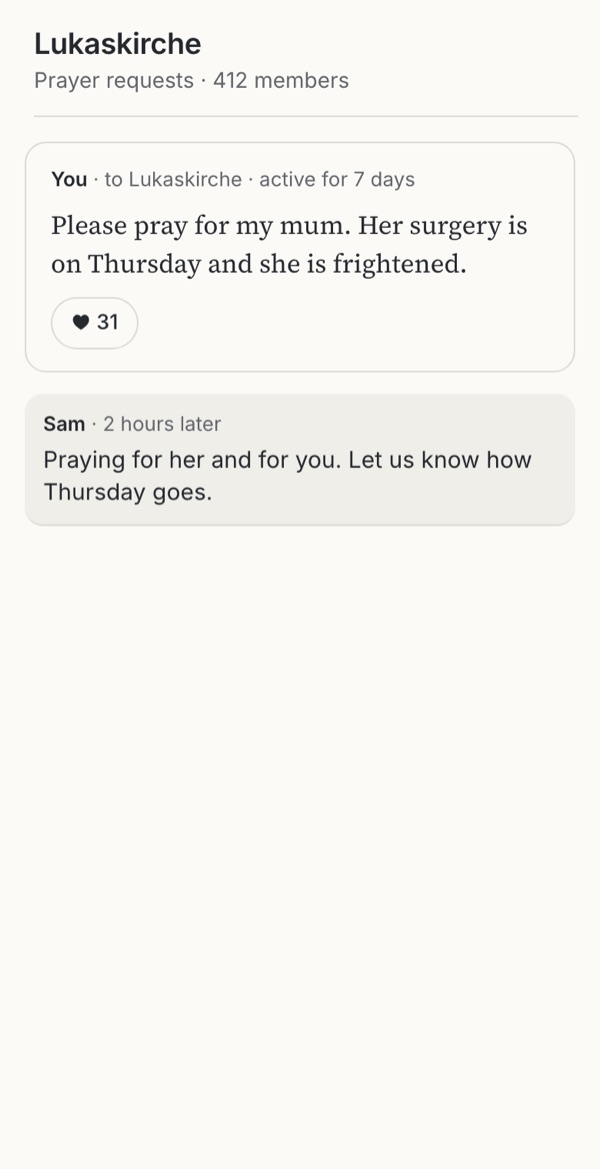
Observed in Hallow’s Church tab: requests go to friends, a church or a group, are limited to 240 characters, can’t be anonymous or edited, stay active for 7 days, and are answered with a heart; see the screenshots below.
Try this
Write a request within 240 characters and post it. Tap the heart.
Makes easier
A whole parish praying, in a few taps.
Costs
Hundreds of people see a name and a need; hearts become a count.
Ask your teamWould the person still share this if they could see every member’s face?
Observed
6. A public wall
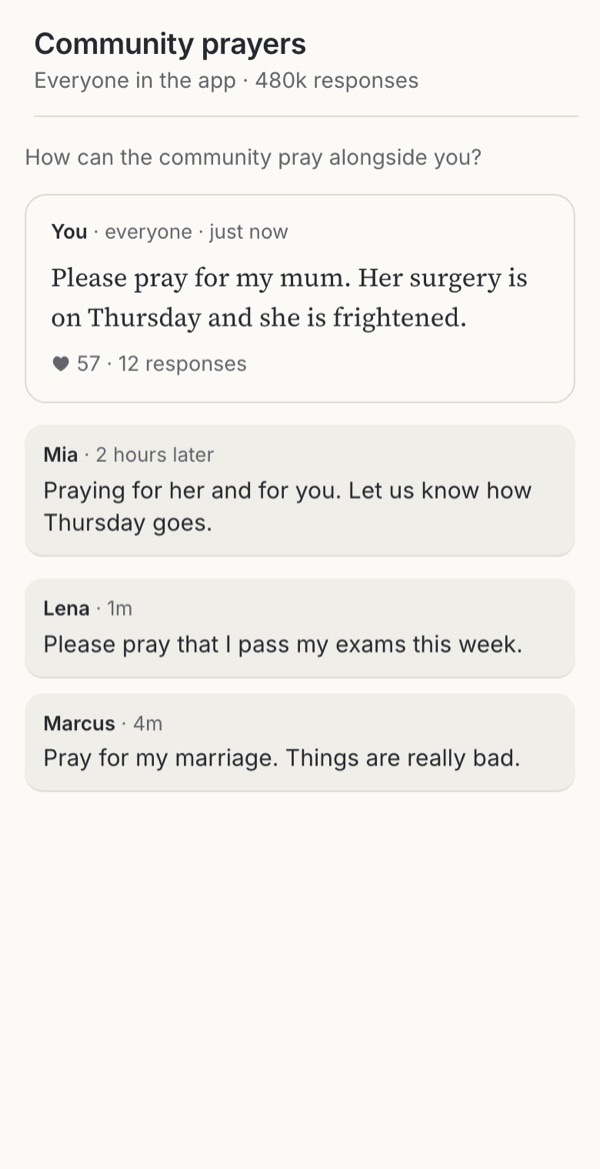
Observed in Glorify’s community prayer requests, a single thread with hundreds of thousands of responses under first names; see the screenshots below. Names and requests here are written for this example.
Try this
Post to the wall, then read the replies and the requests around yours.
Makes easier
Someone, somewhere, prays, at any hour.
Costs
Strangers answer; requests from people in crisis sit beside exam worries.
Ask your teamWho reads this wall, and what happens when someone posts that they are not safe?
Leave it out
7. Ranked by prayer streaks
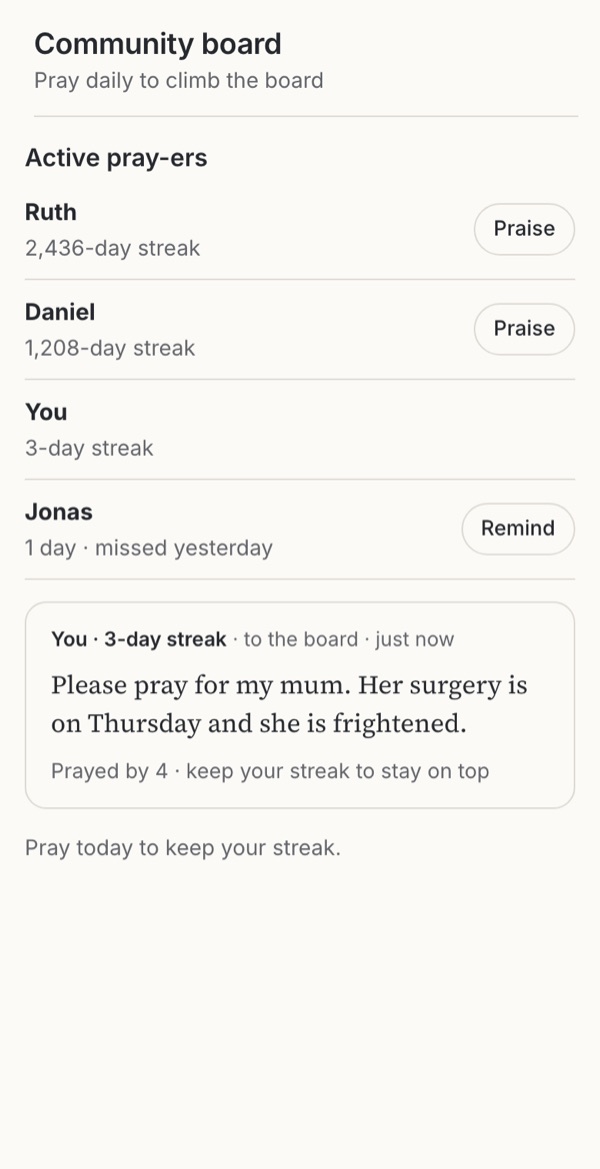
Observed in Pray.com’s Community Board, which lists “Active Streakers” with Praise and Remind buttons; see the screenshots below and the prayer deep dive. Shown here as something to leave out.
Try this
Post a request to the board and look at what sits above it.
Makes easier
Visible habit that motivates some people while it lasts.
Costs
Prayer becomes a ranking, and requests become content for it.
Ask your teamWhat does this board teach people about prayer, and about each other?
What we noticed
Takeaways
Say who will hear it, before it is written
Hallow’s requests go to friends, a church or a group, can’t be anonymous or edited, and stay active for 7 days; its help centre suggests writing “For a special intention” to keep details private. Show the audience, how long a request stays and whether it can be changed before someone starts typing, and ask before naming anyone else.
Some listeners have to pass things on
In Germany’s Protestant churches, church workers, volunteers included, must report a justified suspicion of sexualised violence to the church’s reporting office; pastoral confidentiality and the seal of confession are left untouched. A group leader may not be able to keep a secret, and shouldn’t promise to. Say so before someone shares, and say what happens next.
Name the safeguarding contact
When a church sets an app up, show its safeguarding contact with a way to reach them from inside the app, as a parish shows it on the noticeboard. Choose someone outside the leadership a concern might be about. German Catholic institutions must have a person trained in prevention; a Church of England parish must appoint a safeguarding officer, who should be a lay person.
Keep an independent route beside the church’s
Some people will not tell anyone at their church first, and sometimes they are right. Offer an independent service next to the church’s contact and say what each does with what it hears. The church route is often the right one; it should never be the only one.
A verse quoted back can wound
A reply such as “go and confront him privately” (Matthew 18:15) can send someone alone to the person they are afraid of. Groups can agree how they answer: listen first, pray, and offer verses only when asked.
When Scripture is used to harm →Friends are not always the safest listeners
A circle of friends is a gift for ordinary requests. For something hard, reactions from people close to us can be the most negative, so offer a trained listener beside them. Soultime nudges friends automatically “when we think you might need a call”, switched on; ask each time instead.
Leave out what ranks prayer
Hearts, counts and streak boards turn requests into content. A board with Praise and Remind buttons ranks people by how often they pray, and puts someone’s need underneath.
Use cases
Which situation, which option?
People come with different needs, sometimes in the same week. Each need fits some options better than others.
| Situation | Needs | 1 Between you and God | 2 Through a person you choose | 3 A few people you choose | 4 A group with a leader | 5 The whole church | 6 A public wall | 7 Ranked by prayer streaks |
|---|---|---|---|---|---|---|---|---|
| A parent’s surgery this week | People who know them, praying | Possible | Good fit | Good fit | Good fit | Good fit | Possible | Poor fit |
| Something never said aloud | One trusted listener | Possible | Good fit | Possible | Poor fit | Poor fit | Poor fit | Poor fit |
| A worry about someone’s safety | A person who knows what to do | Poor fit | Good fit | Poor fit | Possible | Poor fit | Poor fit | Poor fit |
| A grief or recovery group | Privacy from other members | Poor fit | Possible | Poor fit | Good fit | Poor fit | Poor fit | Poor fit |
| A request about someone else | Their agreement first | Good fit | Good fit | Possible | Possible | Poor fit | Poor fit | Poor fit |
| A joy to share | A community rejoicing | Poor fit | Possible | Good fit | Good fit | Good fit | Possible | Poor fit |
| Late at night, no one to call | Someone, somewhere | Possible | Possible | Possible | Poor fit | Poor fit | Possible | Poor fit |
Editorial judgments drawing on the research below, not test results.
The research behind it
Theology, practice and science
Scripture and tradition
Being with someone
Weep with those who weep
“Rejoice with those who rejoice; weep with those who weep” (Romans 12:15). Being with someone comes before fixing them, and a reply box can make room for that.
Silence before answers
Job’s friends “sat on the ground with him for seven days and seven nights, but no one spoke a word to him because they saw how intense his suffering was” (Job 2:13). Their trouble began when they started to explain.
In secret and together
Jesus taught his disciples to pray behind a shut door (Matthew 6:6), and the first church prayed together (Acts 2:42). Both are prayer, so neither should be the only setting an app offers.
Church practice and church law
Who hears, and who must act
Ask before naming someone
A United Methodist church suspended printed prayer requests after complaints about what they disclosed, then asked for written approval before praying for someone other than the person asking.
Some listeners must report
The EKD’s guideline against sexualised violence (2019) obliges church workers, volunteers included, to report a justified suspicion to a reporting office, protecting their identity; pastoral confidentiality and the seal of confession stay untouched.
A trained person, and routes made known
The German Catholic bishops’ framework for prevention, in force since January 2020, requires a person trained in prevention for every institution, and that advice and reporting routes be made known.
A safeguarding officer apart from leadership
In the Church of England, a parish must appoint at least one safeguarding officer, who should be a lay person, with contact details displayed in all church premises.
Members hidden from each other
Planning Center’s confidential groups let support groups protect their members: “only group leaders will have access to the complete member list”.
Research and law
What sharing costs
Requests are special-category data
A request names faith and often health, about the person and others. Under European data law both need an Article 9 condition, and inferences count too.
European Data Protection BoardUK Information Commissioner’s Office
How a listener reacts matters
In a study of 228 women disclosing sexual assault, reactions from friends and family were more negative than those from police or service providers, and gave less practical help.
Groups help many people
In Lifeway Research’s survey of US Protestant churchgoers, those in a small group five or more times a month scored 74.1 on a discipleship assessment, against 60.4 for those in none. A correlation, not proof that groups cause growth.
Independent help has limits too
thirtyone:eight shares information without consent only in exceptional cases, such as serious and immediate risk; Anlaufstelle.help is anonymous and passes people on to church offices only if they want.
thirtyone:eightRun for the EKD and Diakonie by the independent specialist service of Pfiffigunde Heilbronn e.V.
Every source, with what it can and cannot show, is listed under Go further → Sources and their limits.
Where to start
Which fits your product?
IfMost requests are ordinary
Start withA few people or a group they chose, with audience and end date shown first
IfA church sets the app up
Start withName its safeguarding contact, and say before sharing who may have to pass things on
IfSomeone may not be safe
Start withOne person they choose, a trained contact or an independent service, not the group
IfSupport and recovery groups
Start withConfidential members, a named leader, and a route around the leader
IfYou are tempted to rank or count
Start withDon’t: no streaks, boards or public totals
These are editorial judgments from design review, not results of user testing.
In real apps
Examples in use
Attributed screenshots with dates and review limits. A screenshot shows an implementation; it does not show that it works for every audience.
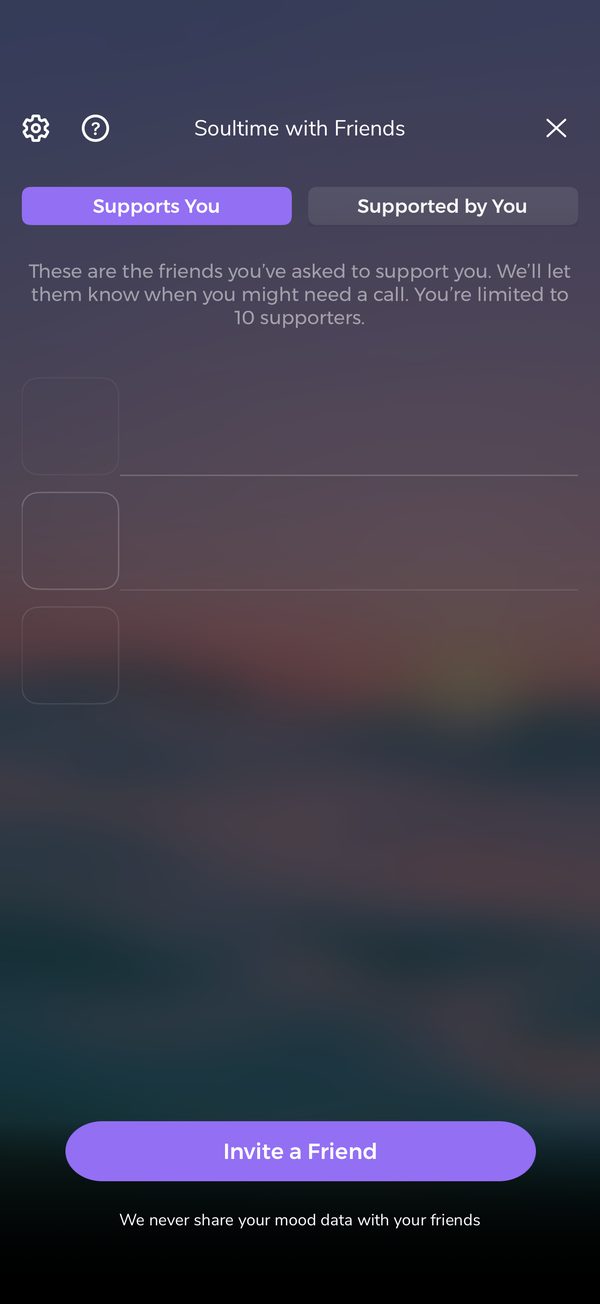 Soultime · iOS app · device model not recorded
Up to ten friends who support you
User-contributed screenshot · resized, content unchanged
 Soultime · iOS app · device model not recorded
Friends nudged automatically, switched on
User-contributed screenshot · resized, content unchanged
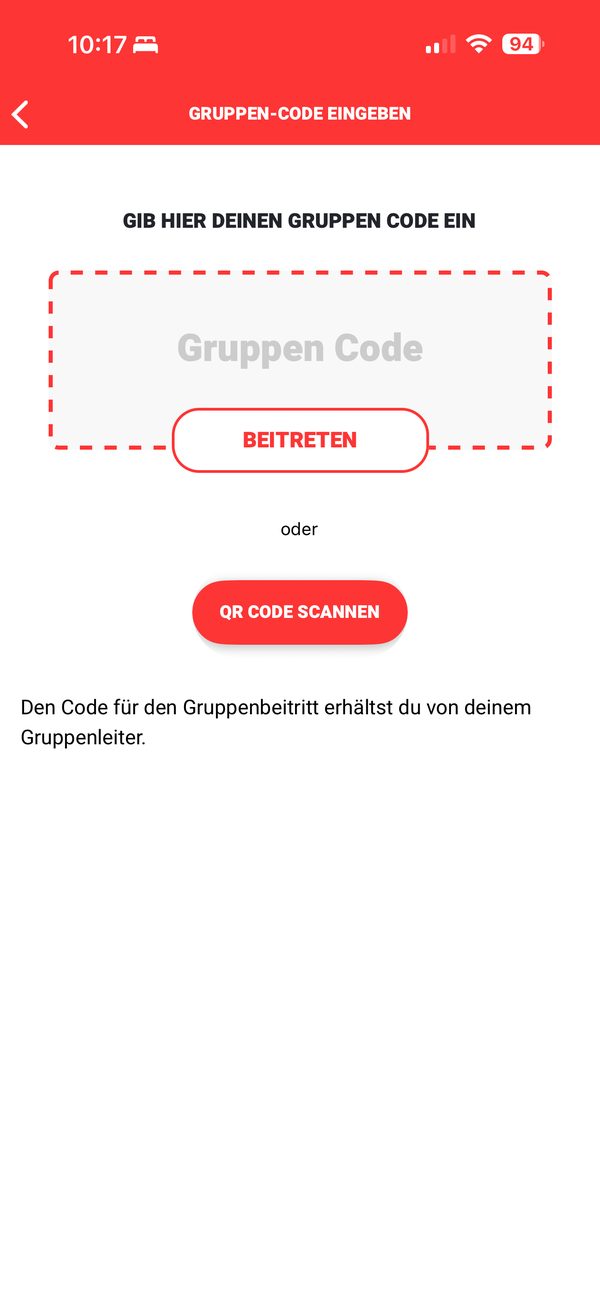 Startblock · iOS app · German interface · device model not recorded
Joining a group with a code from the leader
User-contributed screenshot · resized, content unchanged
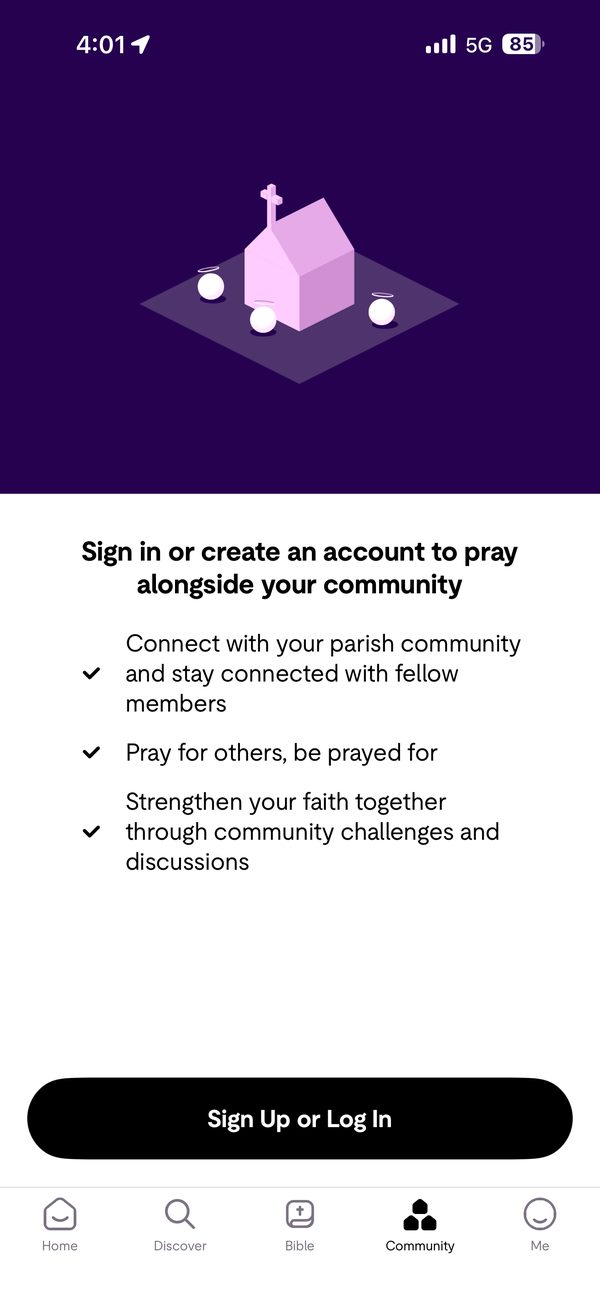 Hallow · iOS app · device model not recorded
“Pray for others, be prayed for”
User-contributed screenshot · resized, content unchanged
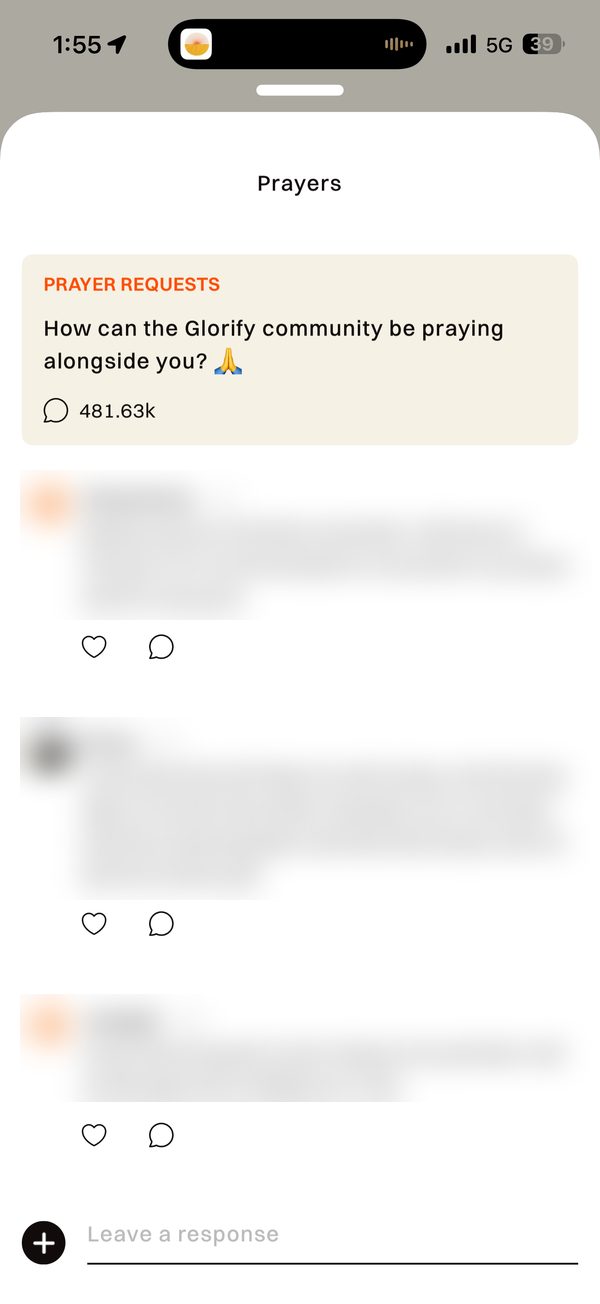 Glorify · iOS app · device model not recorded
One prayer thread for the whole community
User-contributed screenshot · resized, content unchanged
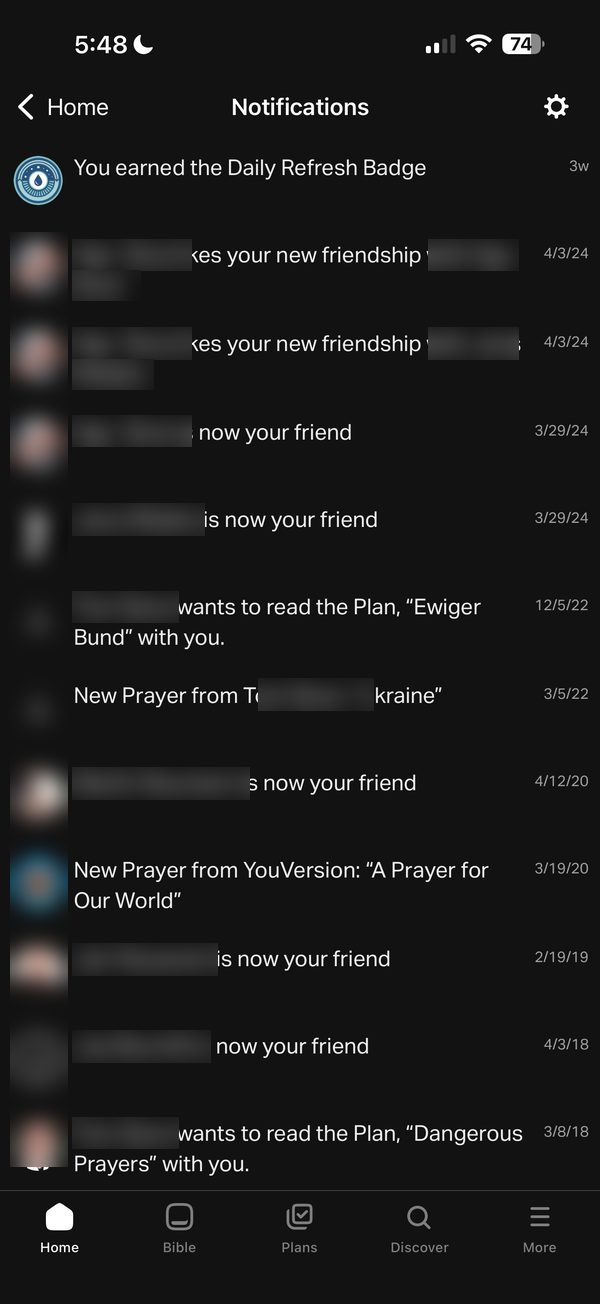 YouVersion · iOS app · device model not recorded
A friend’s new prayer among badges and friendships
User-contributed screenshot · resized, content unchanged
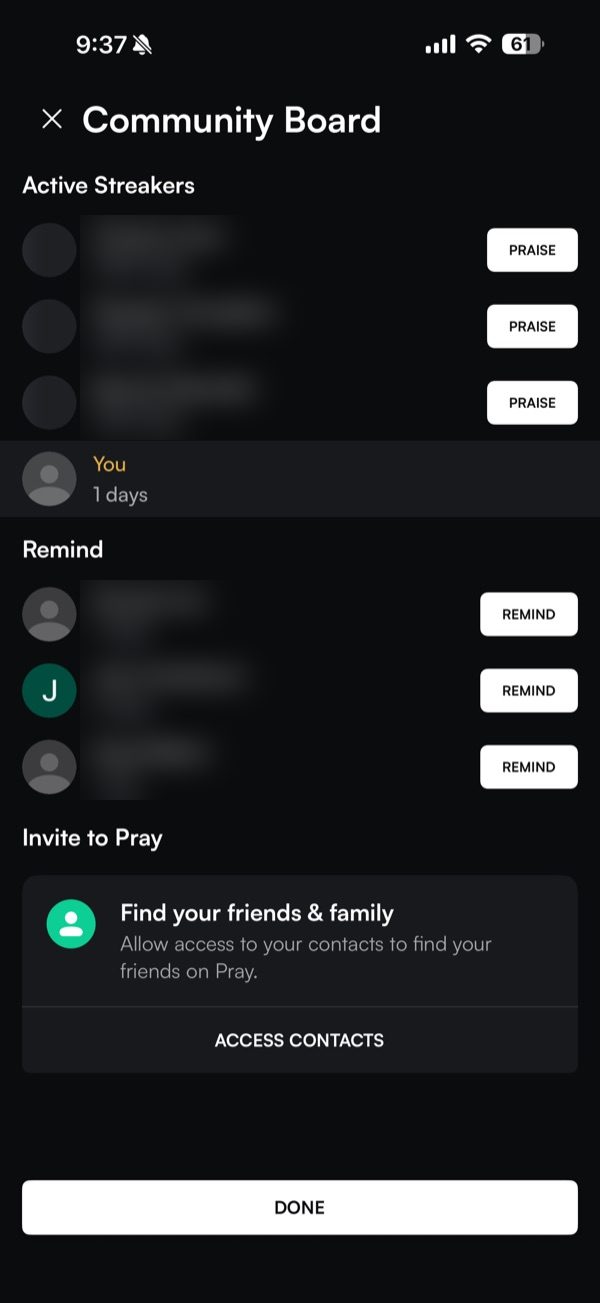 Pray.com · iOS app · device model not recorded
Praise and Remind buttons for other people’s streaks
User-contributed screenshot · resized, content unchanged
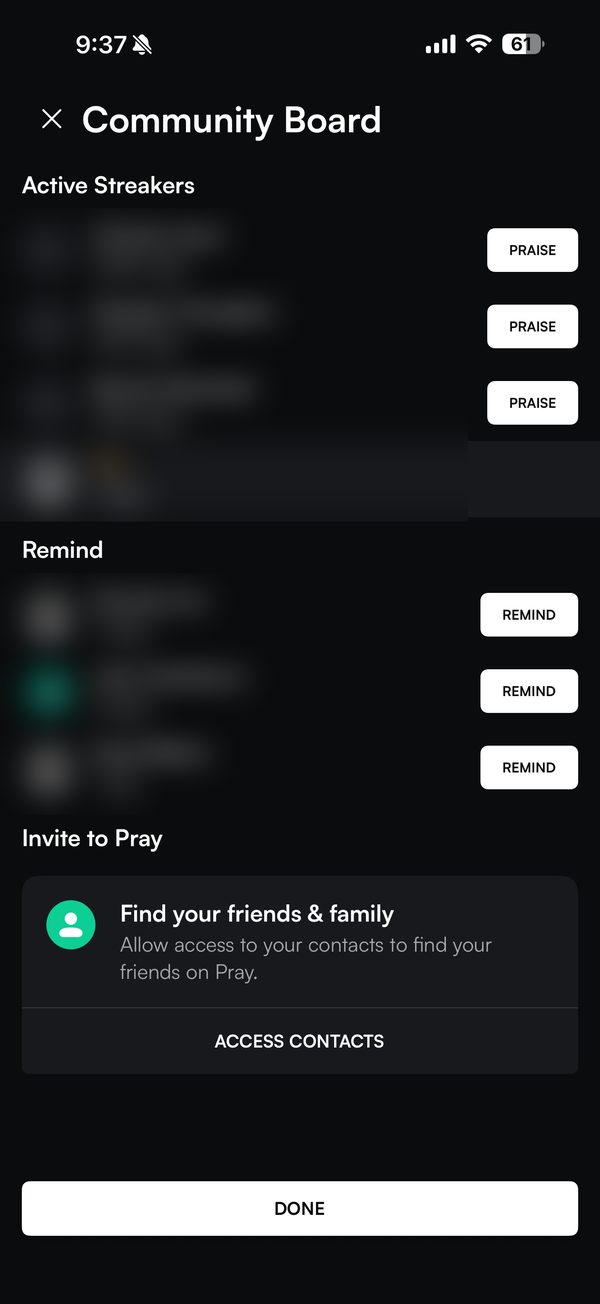 Pray.com · iOS app · device model not recorded
“Active Streakers” to praise, and friends to “Remind”
User-contributed screenshot · resized; names and photos of other users blurred
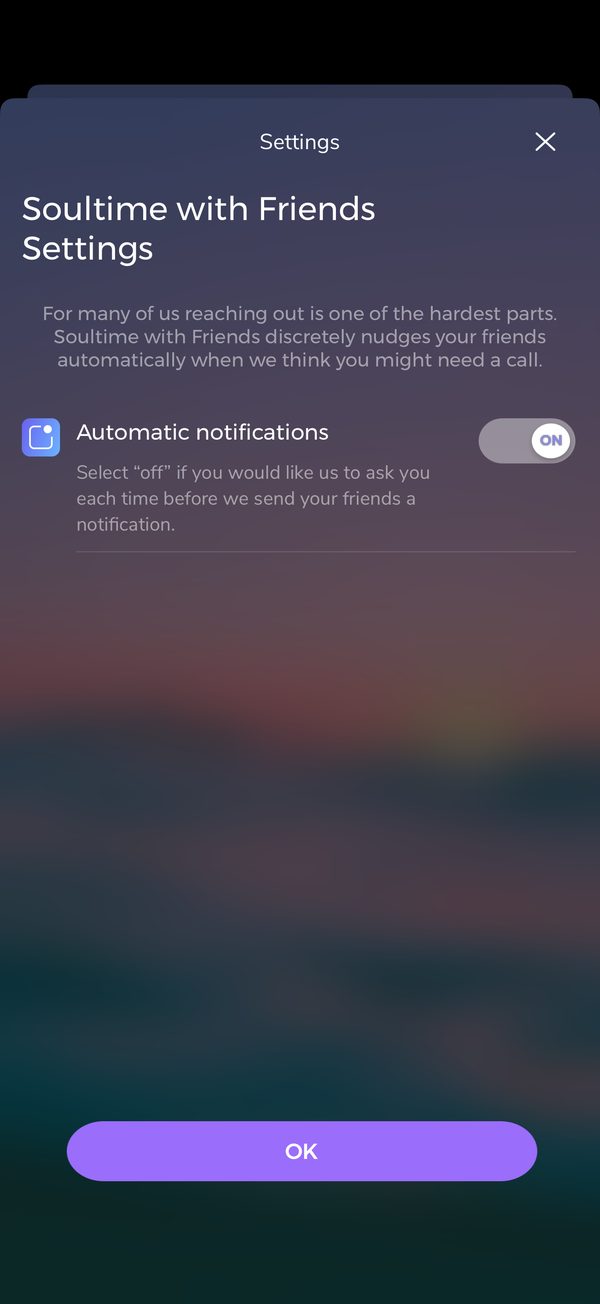 Soultime · iOS app · device model not recorded
Friends notified automatically “when we think you might need a call”
User-contributed screenshot · resized, content unchanged
Theological reflection
What is this practice for?
What sharing a burden is for
Paul asks the church to “carry one another’s burdens” (Galatians 6:2) and to “weep with those who weep” (Romans 12:15); James to “pray for each other so that you may be healed” (James 5:16). Sharing a need is an act of trust, and hearing it is a charge: whoever listens becomes responsible for what they heard.
Where Christians differ
Catholic and Orthodox Christians confess sins to a priest, under a seal; many Protestant churches share requests openly in a prayer chain or a small group; Methodist class meetings and accountability groups ask members to tell each other how they are really doing. The same passages that call for bearing burdens have also been used to press people to disclose more than they chose, or to keep concerns about a leader inside the church.
What follows for design
Let people choose who hears them, and tell them before they share what each listener can and must do. Name a trained contact apart from the leadership, and keep an independent route beside it. Help groups listen before they answer, offer verses only when asked, and count nothing.
In conversation with
- Dietrich Bonhoeffer, Life Together (1939) held that because a fellow Christian is Christ to me, I must listen to them as patiently as I listen to Christ, and bear their burdens as I share in his cross.
Scripture is quoted from the Berean Standard Bible. This reflection is the editor’s, written from within the Christian tradition and open to correction. How we approach theology here →
Three ways to build
What would each way do here?
ExploitativeTakes from the person
Make every request public and countable, notify friends automatically, and rank who prays most.
EthicalDoes no harm
Show the audience before sharing, ask before naming others, let requests expire, and let people delete them.
RedemptiveGives something up for them
Send something hard to one trained person instead of the feed, keep an independent route even when it takes people away from your community, and give up the engagement a public wall would bring.
The three ways are Praxis’s frame for redemptive entrepreneurship; their application here is ours. Why we use it, and its limits →
Take into your next review
When someone shares something hard here, who hears it first, and what are they able, and obliged, to do?
Exercise
Write three requests: an ordinary one, one about someone else, and a worry about someone’s safety. For each option you plan to build, list everyone who will see each request, for how long, and what each of them can or must do with it. Find your church’s safeguarding contact and an independent service, and ask both to read your wording before launch.
Let people choose who hears them, and make sure whoever hears something hard knows what to do with it.
Record the decision with the worksheet →
Something missing or wrong here? Send a correction or suggest a topic.
Details
Go further
Edge cases to design for
Let the person choose the audience before writing, and show who will see the request, for how long and whether it can be edited or deleted. Ask before naming someone else. Offer a route to one chosen person, with what each listener can and must do shown before sending. When a church sets the app up, name its safeguarding contact and keep an independent service beside it. Give groups ways to respond that start with listening, keep support groups’ members confidential, and send no automatic notifications about someone without asking them each time.
What tends to go wrong
A public feed as the default; first names and requests visible to strangers; a request about someone else posted without their consent; friends notified automatically when the app infers a low mood; a leader as the only route for a concern about the leader’s team; verses quoted back at someone who disclosed harm; hearts and counts on requests; streak boards with Praise and Remind buttons; promising confidentiality a listener cannot keep.
How to test it
Ask people to share an ordinary request and something hard, then to name everyone who will see each, for how long, and what each listener must do with it. Read the replies a group gives to a hard request. Find the safeguarding contact and an independent service from inside the app in under a minute. Check what notifications say, and to whom.
Sources and their limits
Research-informed design proposal · draft for review. Editorial review, not user validation.
- How to pray for intentions on HallowArticle reviewed 10 October 2026 · The publisher describing its own feature; it does not say whether parish administrators can read requests.
- Overview of the Church tabArticle reviewed 10 October 2026 · Publisher documentation.
- Expand your care through confidential member groupsArticle reviewed 10 October 2026 · A vendor announcing its own feature; administrators can still see members.
- YouVersion PrayerPage reviewed 10 October 2026 · Marketing copy; no help article found on who sees a shared prayer.
- Clergy juggle prayer requests with privacy rightsArticle reviewed 10 October 2026 · US practice from 2004, before apps; HIPAA does not bind most congregations.
- Richtlinie der EKD zum Schutz vor sexualisierter Gewalt (Gewaltschutzrichtlinie)Sections 2, 7 and 8 reviewed 10 October 2026 · Each Landeskirche implements the guideline in its own law, with different numbering; the EKD planned a revision in 2024. Not a statement of state law.
- Rahmenordnung Prävention gegen sexualisierte GewaltSections 3.4, 3.5 and 4 reviewed 10 October 2026 · A framework; dioceses set the details in their own Präventionsordnungen, and names for the role differ.
- Parish Safeguarding Officer toolkitSections 1.2–1.4 reviewed 10 October 2026 · One diocese’s toolkit applying national Church of England guidance.
- Zentrale Anlaufstelle.helpHome page reviewed 10 October 2026 · For abuse in Protestant churches and Diakonie in Germany; phone appointments are arranged at set hours.
- Confidentiality policyPolicy reviewed 10 October 2026 · A UK charity’s policy; other services set different limits.
- Study finds agencies can react more supportively than family and friends to victims’ disclosures of sexual assaultArticle reviewed 10 October 2026 · A US study of women disclosing sexual assault; not about churches or apps.
- Small group participation linked to higher discipleship scoresArticle reviewed 10 October 2026 · A correlation from self-report; it does not show that groups cause growth. US Protestants only.
- Section 4.2: Spiritual AbuseOfficial indexed excerpts reviewed on 5 October 2026; direct page access returned 403 · Institutional safeguarding guidance, not universal law or an automated abuse classifier; full-page review remains outstanding.
- Process personal data lawfullyOfficial guidance reviewed · Specific lawful basis, retention and DPIA decisions require the actual data flows.
- What is special category data?Categories and inference guidance reviewed · Context and processing intent matter; not every Bible-page visit automatically establishes a belief.
- Top mental health and prayer apps fail spectacularly at privacy, securityReport summary reviewed · A 2022 review; apps’ practices may have changed since.
Faith and interpretation
Paul asks the church to “rejoice with those who rejoice; weep with those who weep” (Romans 12:15), and to “carry one another’s burdens” (Galatians 6:2). Job’s friends did best when they “sat on the ground with him for seven days and seven nights, but no one spoke a word to him because they saw how intense his suffering was” (Job 2:13). Hearing a request is a charge as well as a gift. The same passages have been used to press people to share more than they chose, or to keep concerns inside a church, so the listener’s care matters as much as the sharer’s trust.