Check-ins and assessments
What may an app ask about someone, and what may it conclude?
Christians have asked themselves questions for centuries, in the evening Examen, in Wesley’s band meetings and in church gift inventories. Apps now ask too: setup quizzes, daily mood check-ins, long personality tests. Asking can serve personalisation, self-knowledge or a church listening to its members. Decide what each question is for, what is kept, who sees the result, and how much the result claims to know. Being asked about one’s soul is an act of trust, and the answers deserve the care of a pastor, not the appetite of a funnel.
- 5 working options
- 11 app examples
- 5 takeaways
- Editorial review, not user-tested
The spectrum
From a hint for the app to a verdict on a person
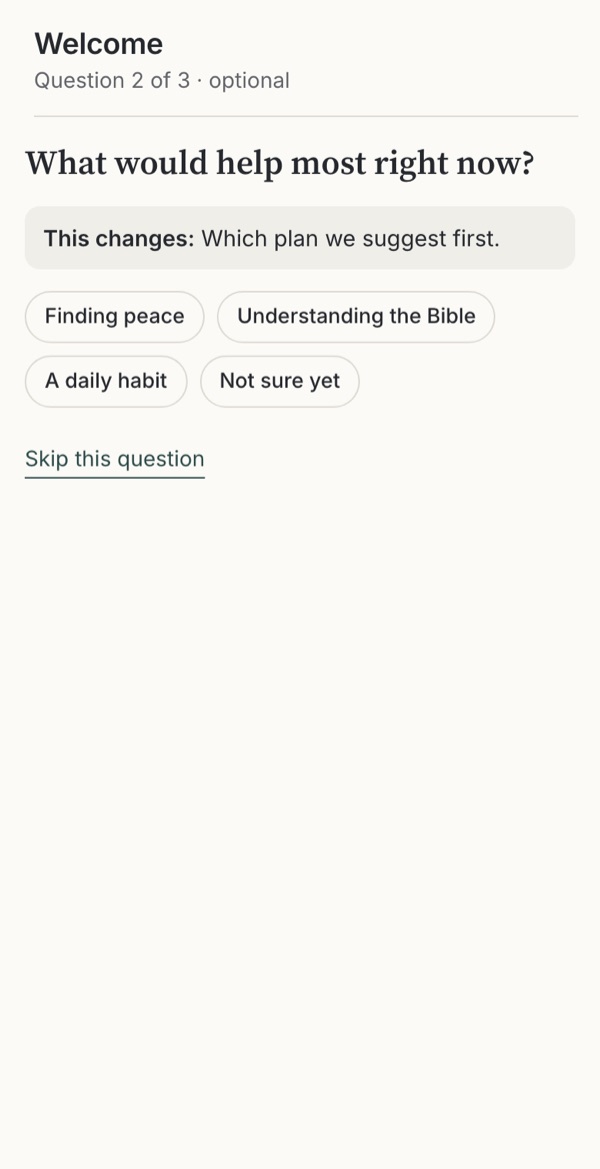 Observed A sensible first suggestion Can turn into a sales funnelTry it →
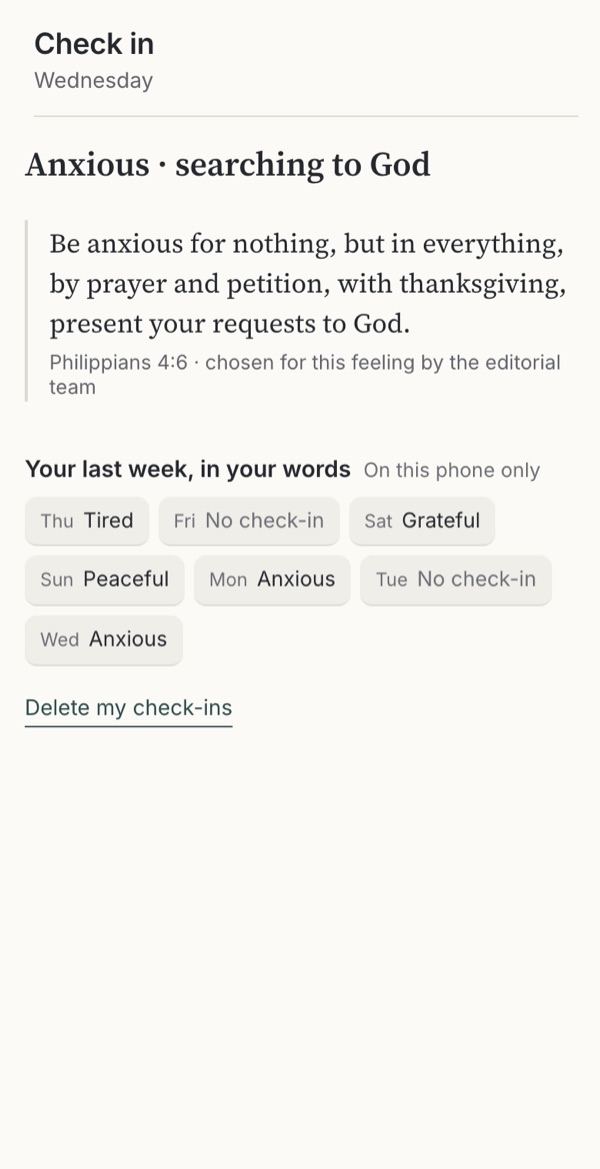 Observed Naming a feeling in a minute A mood record is health dataTry it →
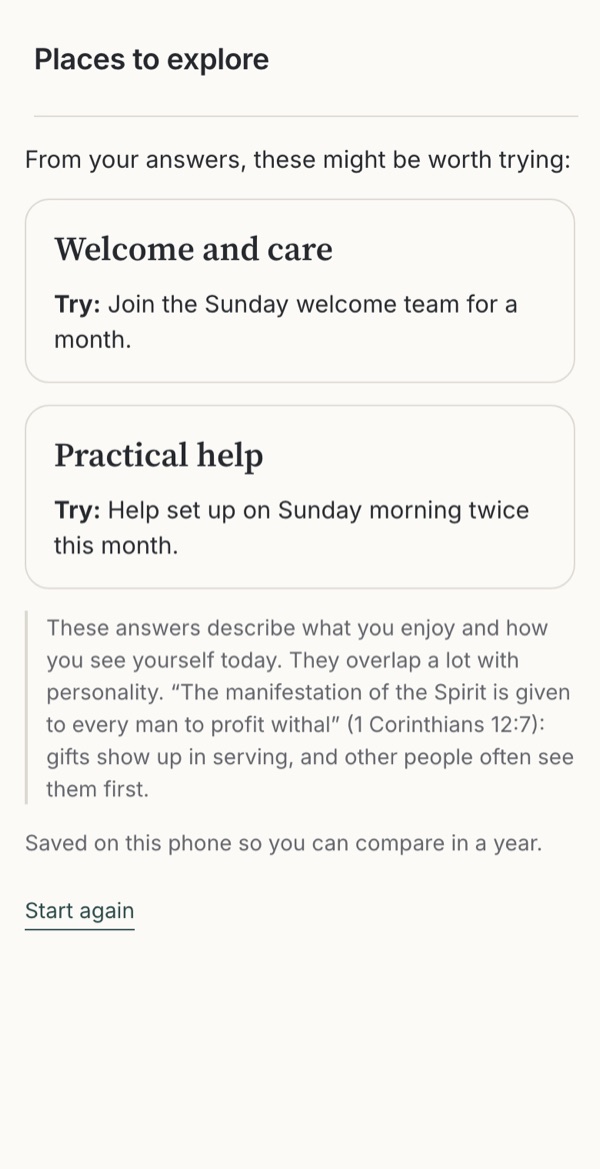 Familiar convention Words for how someone serves A result can feel like a labelTry it →
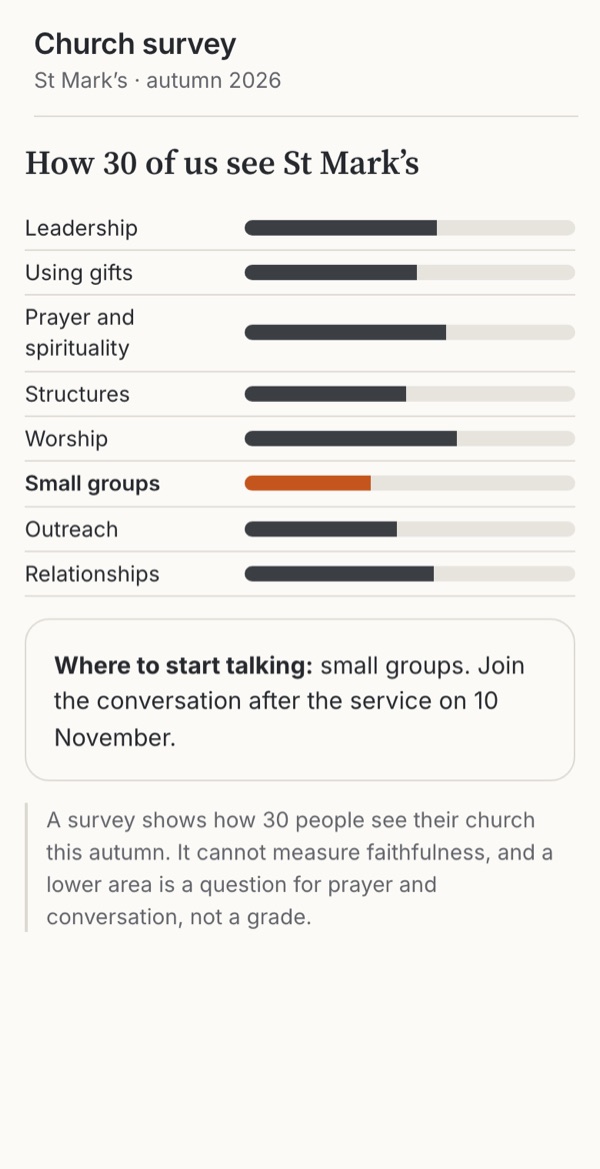 Familiar convention A church hears its members Numbers can become targetsTry it →
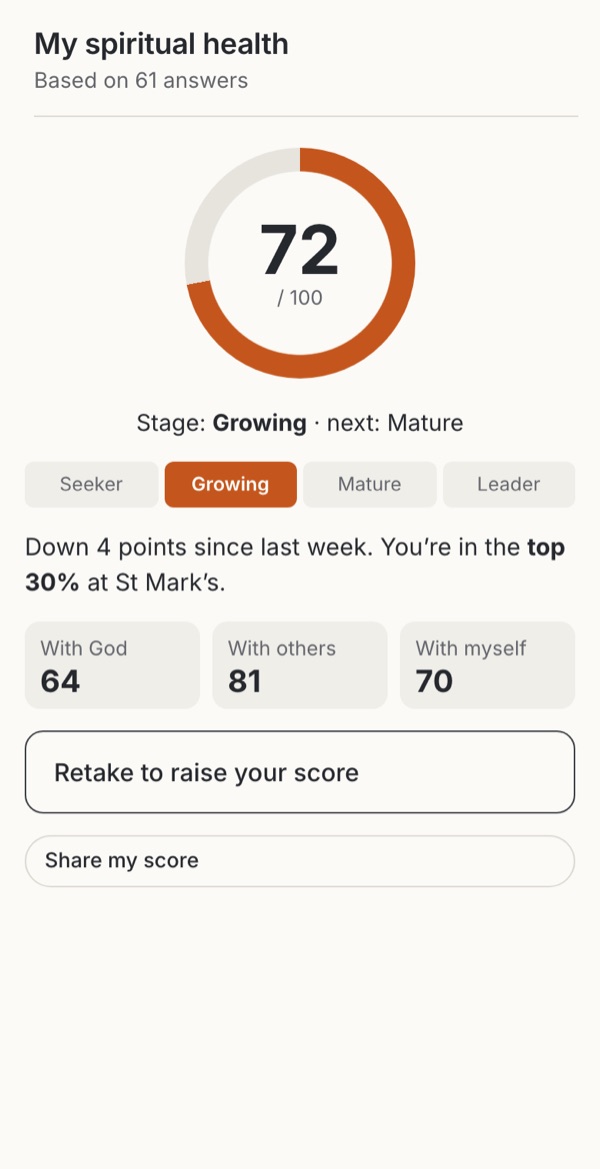 Leave it out A clear number Faith becomes a grade and a rankTry it →
Stills from the working example below. Choose one to try it.
Try it
Try five ways an app can ask about someone
It is a Wednesday in October. Each option asks something about a person or a church, and each concludes something different from the answers. Answer as far as you like, then change whether answers are kept and whether a mentor may see a result, and notice what each one claims to know about you.
Option
Why these settings?
Kept answers stay on the phone with a way to delete them; not kept, they shape only the current screen. With a mentor, the check-in offers to send one line, and only when the person taps it; the inventory shares the two areas, never the answers. The church survey is anonymous by design, and the score shows what many apps do.
Observed
1. A few setup questions
Observed in onboarding quizzes: Abide’s “What brings you here today?” photo grid and Bible BFF’s “How much of the Bible have you read?”; HelloBible asks “What is your gender?” with “I prefer not to answer”, then asks for a name, before a separate consent for using faith data with a partner AI. See the screenshots below.
Try this
Answer or skip the three questions, then change one on the summary.
Makes easier
A sensible first suggestion without browsing a catalogue.
Costs
Easily becomes a sales funnel, or asks more than it needs.
Ask your teamDoes each question say what it changes, and can it be skipped?
Observed
2. A daily check-in
Observed in Soultime’s mood check-in, which asks how you are “With Myself”, “With Others” and “With God” and charts the answers over weeks; see the screenshots below.
Try this
Name a feeling, optionally how you are with God, then look at what is kept.
Makes easier
Naming a feeling, an old practice of self-examination, takes a minute.
Costs
A record of moods is health data; a chart invites self-monitoring.
Ask your teamWhat happens to the word someone chose, and who could ever see it?
Familiar convention
3. A gifts inventory
A familiar church practice since the 1970s: spiritual gifts inventories, Willow Creek’s Network course (1994) and similar tools ask people to rate statements and then suggest where to serve. Statements here are written for this example.
Try this
Rate the six statements and read the places to explore. Then switch on the mentor.
Makes easier
A way into serving, and words for what someone already enjoys.
Costs
A result can feel like a verdict; scores overlap with personality.
Ask your teamDoes the result point to trying and to other people, or hand out a label?
Familiar convention
4. A church survey
A familiar tool in congregations: Natural Church Development asks 30 members to rate statements and reports eight “quality characteristics”; Willow Creek’s Reveal survey (2007) measured spiritual growth across churches. Statements here are written for this example.
Try this
Read the invitation, answer three statements and preview the shared results.
Makes easier
A church hears how its members see it, anonymously.
Costs
Numbers can become targets; the lowest area can feel like blame.
Ask your teamCan anyone see a single person’s answers, and does the result start a conversation?
Leave it out
5. A spiritual score
A composite of patterns observed in assessment and mood apps: a score out of 100, a stage, a ranking against others and a prompt to retake. Soultime’s “Emotional and Spiritual Health Report” sits nearby; see the screenshots below.
Try this
Read the score, then retake the test.
Makes easier
A clear number that motivates some people for a while.
Costs
Turns a life with God into a grade, a rank and a trend.
Ask your teamWhat would it mean to be 4 points closer to God?
What we noticed
Takeaways
Say what each answer changes
Abide asks “What brings you here today?” with twelve goals, and Bible BFF asks “How much of the Bible have you read?”, with testimonials and a paywall between the steps. A setup question earns its place when it changes what the app offers, says so, and can be skipped.
Naming a feeling is enough
Soultime’s check-in asks how you are “With Myself”, “With Others” and “With God”, an echo of the Examen’s attention to feelings. Labelling an emotion can itself ease it. Respond with a passage or a next step, not a chart to keep improving.
Moods and faith are protected data
Answers about anxiety, shame or God are health and religious data under GDPR Article 9, and inferences count too. Keep them on the device by default, let people delete them, and never send anything to friends or leaders automatically, even on a hard day.
A result is a starting point, not a verdict
Gift inventories overlap heavily with personality, and generic reports feel accurate to almost everyone. Willow Creek’s Network paired the inventory with a consultant and a place to serve. Say how a result was made, and point to trying things and to people who know the person.
Churches have measured for decades
Natural Church Development surveys 30 members and reports eight areas; Reveal surveyed whole congregations about spiritual growth, and taught its own church something uncomfortable. Anonymous, aggregated surveys can help a church listen. Scores, stages and ranks for individuals measure what only God sees.
Use cases
Which situation, which option?
People come with different needs, sometimes in the same week. Each need fits some options better than others.
| Situation | Needs | 1 A few setup questions | 2 A daily check-in | 3 A gifts inventory | 4 A church survey | 5 A spiritual score |
|---|---|---|---|---|---|---|
| Opening the app for the first time | A sensible first step | Good fit | Poor fit | Poor fit | Poor fit | Poor fit |
| A hard week | Words for how they are | Poor fit | Good fit | Poor fit | Poor fit | Poor fit |
| Looking for a place to serve | Where to start | Poor fit | Poor fit | Good fit | Possible | Poor fit |
| Leading a church | Hearing the members | Poor fit | Poor fit | Possible | Good fit | Poor fit |
| Meeting a mentor | Something to talk about | Poor fit | Good fit | Good fit | Poor fit | Poor fit |
| Wary of being measured | Nothing kept, nothing scored | Possible | Possible | Poor fit | Possible | Poor fit |
Editorial judgments drawing on the research below, not test results.
The research behind it
Theology, practice and science
Scripture and tradition
Self-examination among people who pray for each other
Notice your feelings
The Examen’s third step is to pay attention to your emotions.
Questions asked every week
Wesley’s bands asked four questions, among friends who prayed together.
Gifts are found in serving
Network paired the inventory with consultation and a place to serve.
Church assessment
What congregations have learned
Thirty members, eight areas
NCD’s anonymous survey, used to choose a focus and track trends.
Be modest about the research
Reviewers questioned the science behind NCD’s claims.
Measuring growth raises questions
Reveal’s findings, and whether self-monitoring serves discipleship.
Psychology
What questions and results can do
Naming eases
Labelling an emotion reduced the brain’s response to negative images.
Daily sampling is a method
Momentary assessment reduces recall bias in research and care.
Generic reports feel personal
People rate the same sketch as accurate about themselves.
Gifts overlap with personality
About half the shared variance in one study.
Measuring makes it work
Counting an activity lowered enjoyment of it.
Privacy and law
Moods and faith are special-category data
Health and belief are protected
Processing needs an Article 9 condition; inferences count too.
European Data Protection BoardUK Information Commissioner’s Office
Such apps have shared data
Mozilla’s 2022 review of mental health and prayer apps.
Aggregate, not individual
Soultime described trends without tracking people individually.
Personalised by life situation
HelloBible’s listing and privacy label.
Every source, with what it can and cannot show, is listed under Go further → Sources and their limits.
Where to start
Which fits your product?
IfYou want a sensible first suggestion
Start withA few optional setup questions, each saying what it changes
IfPeople want to notice how they are
Start withA check-in that ends with a passage, kept on the phone
IfPeople look for a place to serve
Start withAn inventory whose result points to trying and to a mentor
IfA church wants to listen
Start withAn anonymous survey with results shared by area
IfYou are tempted to score faith
Start withDon’t: no scores, stages, ranks or retakes for a better number
These are editorial judgments from design review, not results of user testing.
In real apps
Examples in use
Attributed screenshots with dates and review limits. A screenshot shows an implementation; it does not show that it works for every audience.
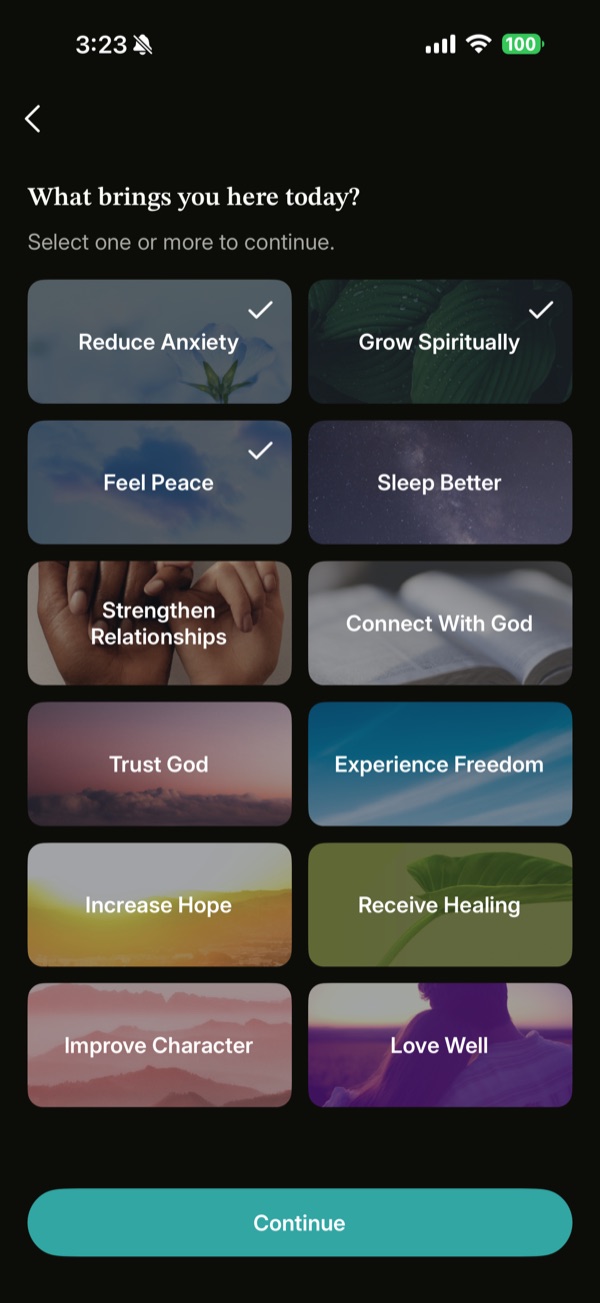 Abide · iOS app · device model not recorded
“What brings you here today?” as a photo grid
User-contributed screenshot · resized, content unchanged
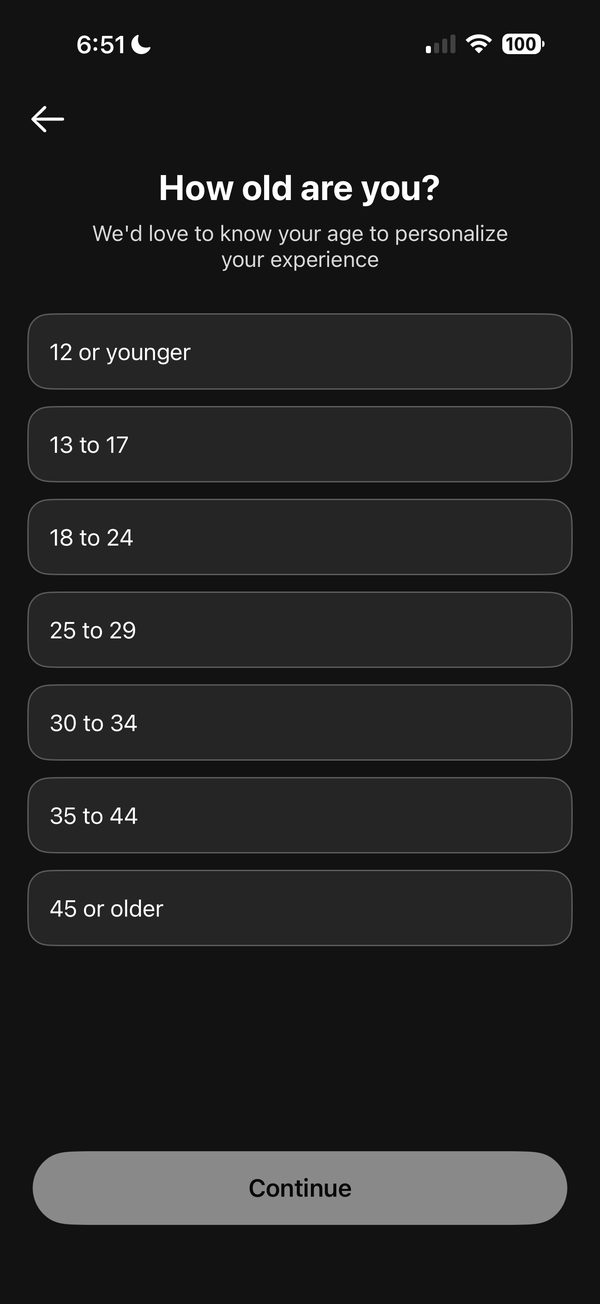 Faith · iOS app · device model not recorded
“How old are you?” during setup
User-contributed screenshot · resized, content unchanged
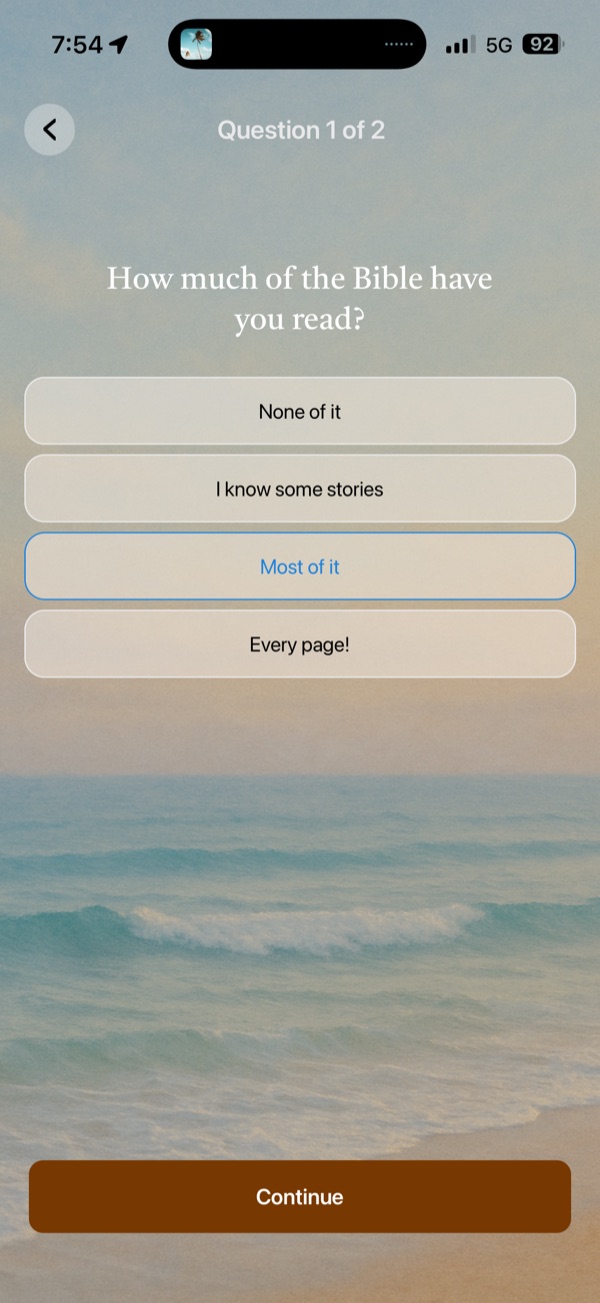 Bible BFF · iOS app · device model not recorded
“How much of the Bible have you read?”
User-contributed screenshot · resized, content unchanged
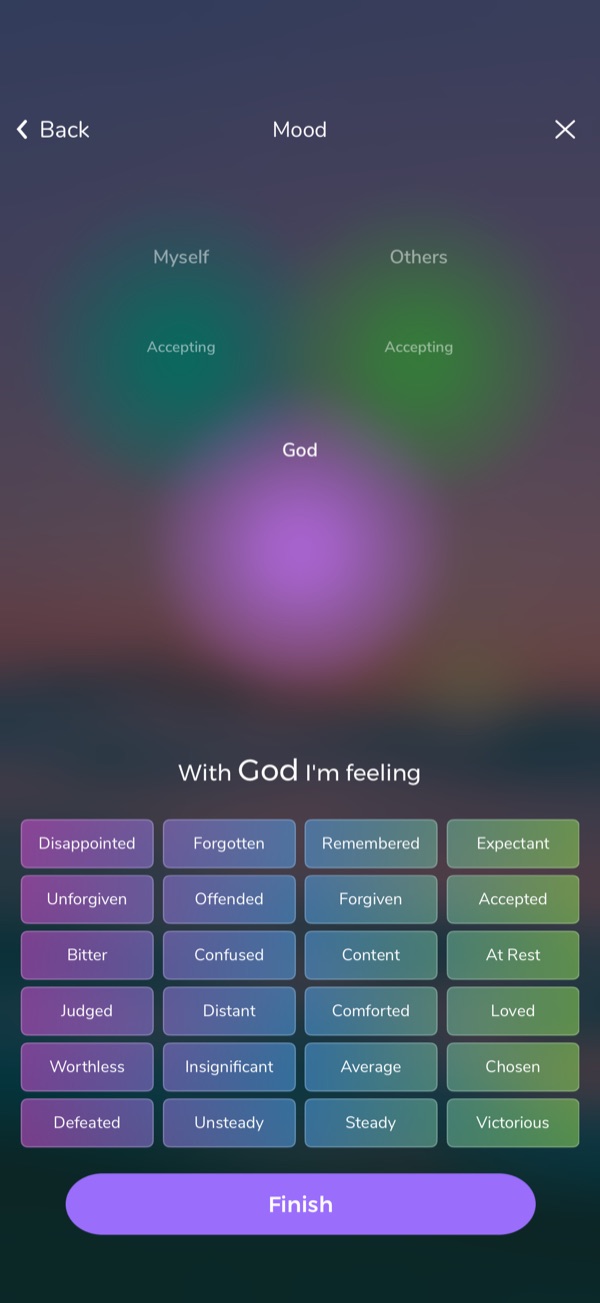 Soultime · iOS app · device model not recorded
“With God I’m feeling”
User-contributed screenshot · resized, content unchanged
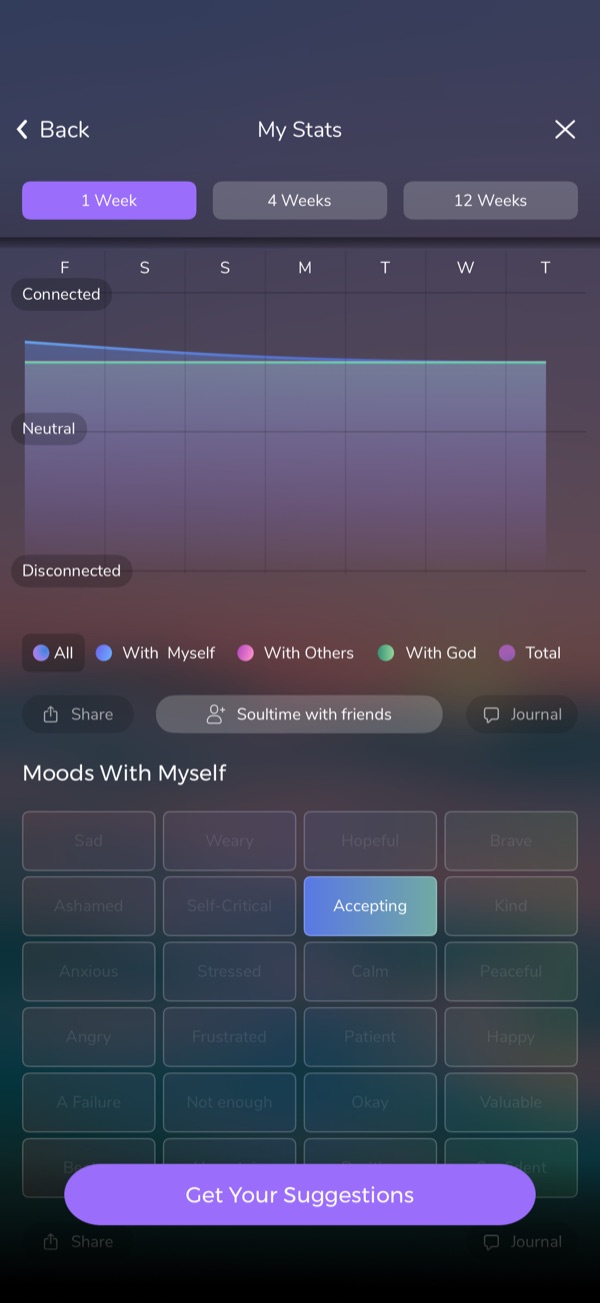 Soultime · iOS app · device model not recorded
Moods over a week, by dimension
User-contributed screenshot · resized, content unchanged
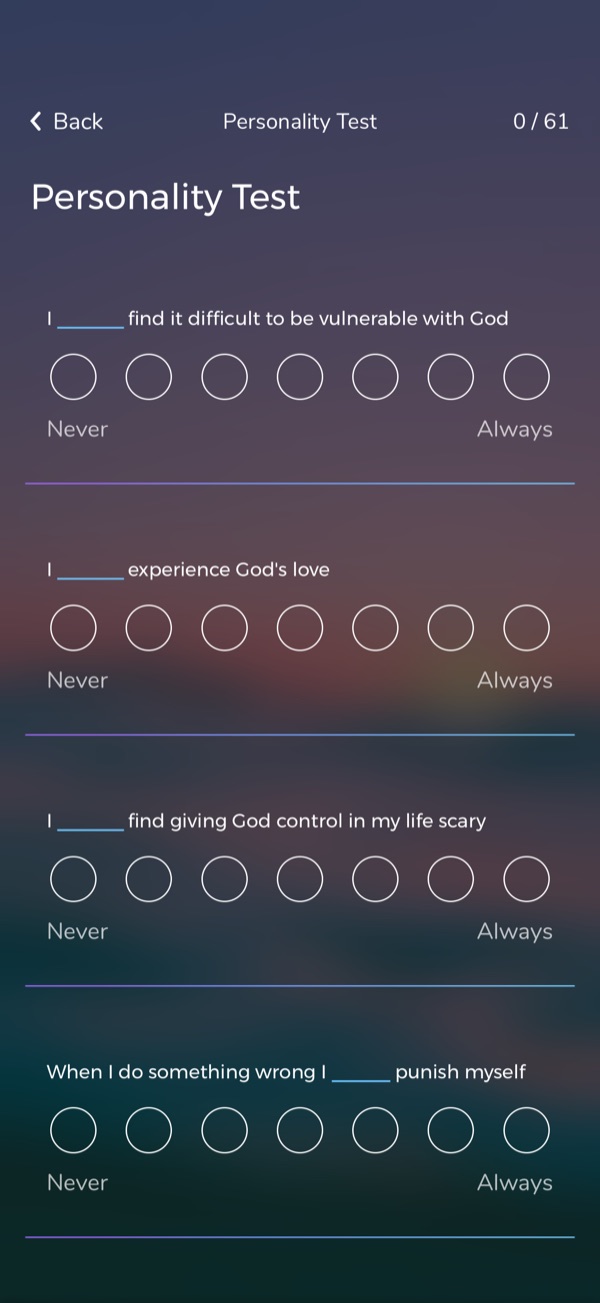 Soultime · iOS app · device model not recorded
A 61-statement personality test
User-contributed screenshot · resized, content unchanged
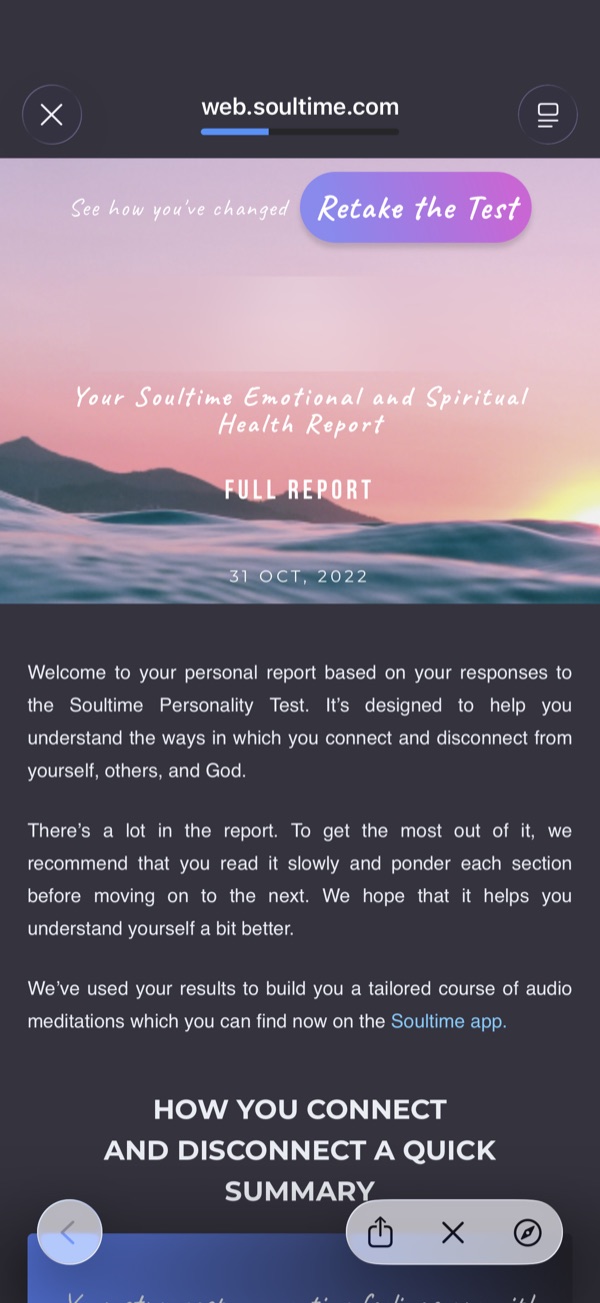 Soultime · iOS app · device model not recorded
An “Emotional and Spiritual Health Report”
User-contributed screenshot · resized; name blurred
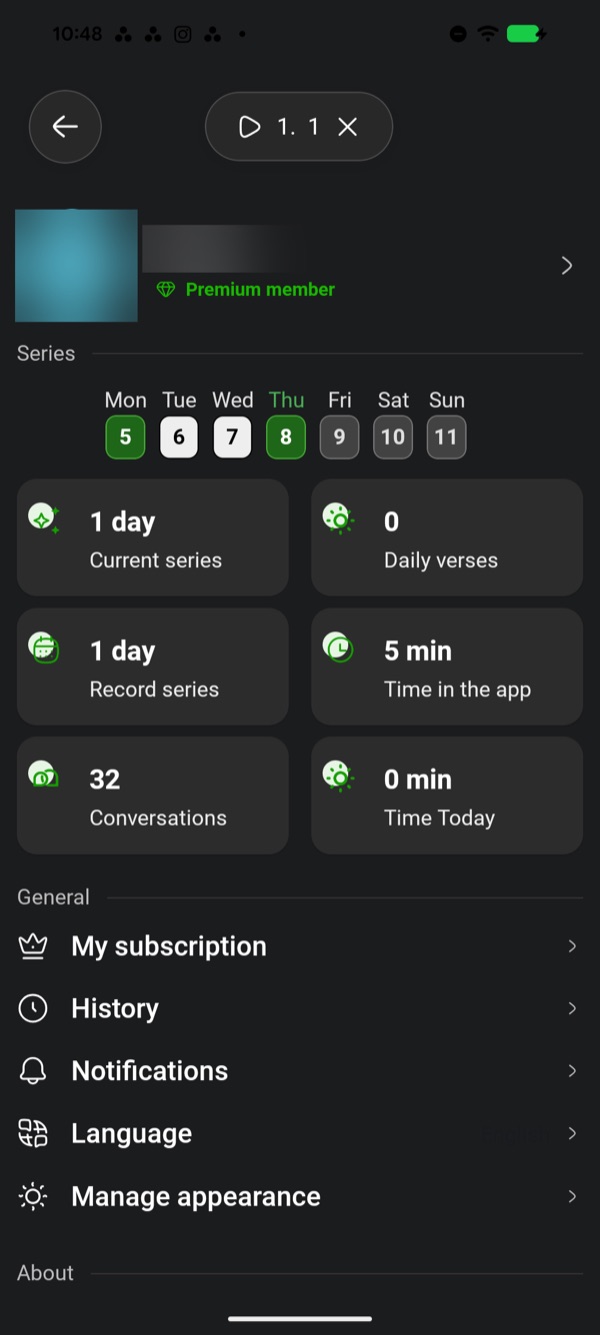 HelloBible · Android app · Pixel 8 Pro
A profile of series, time in the app and conversations
Screenshot captured for this reference · resized; account name and avatar blurred
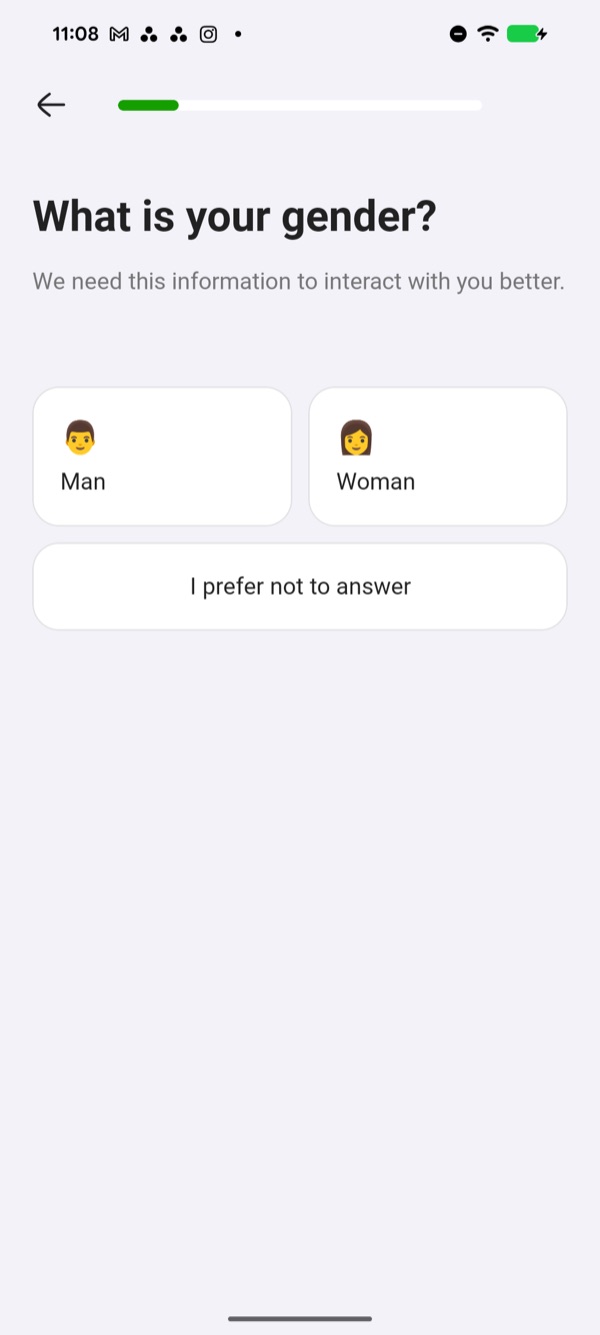 HelloBible · Android app · Pixel 8 Pro
“What is your gender?” with a reason and an opt-out
User-contributed screenshot · resized, content unchanged
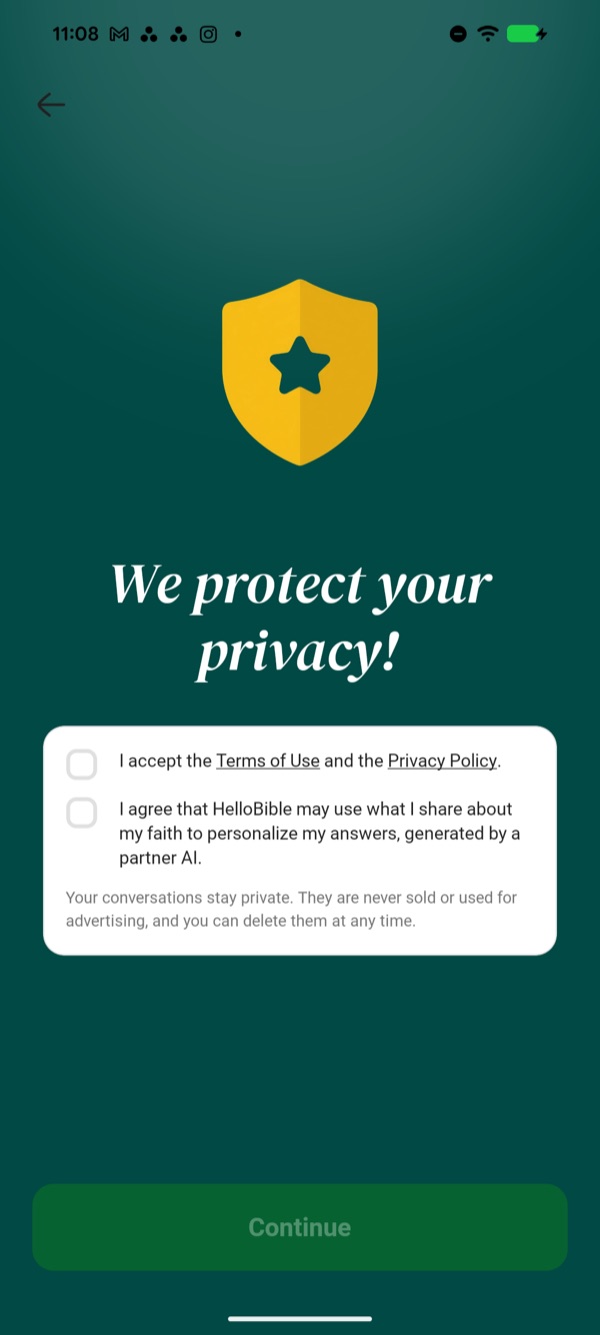 HelloBible · Android app · Pixel 8 Pro
A separate consent for using faith data with a partner AI
User-contributed screenshot · resized, content unchanged
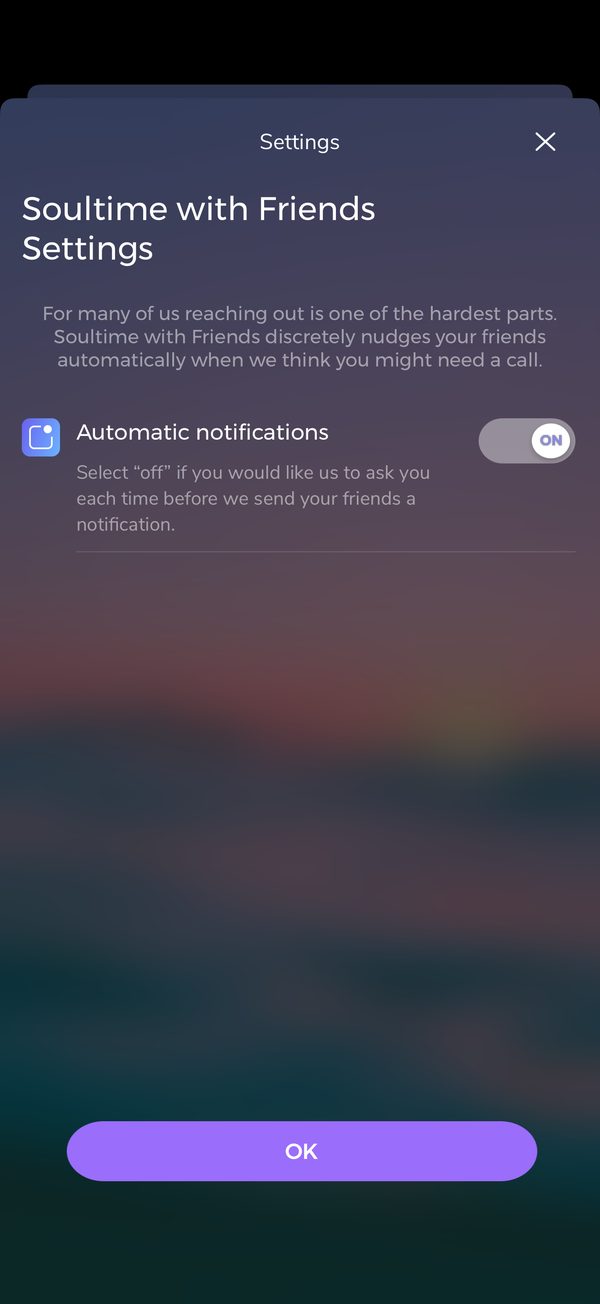 Soultime · iOS app · device model not recorded
Friends notified automatically “when we think you might need a call”
User-contributed screenshot · resized, content unchanged
Theological reflection
What is this practice for?
What self-examination is for
“Examine yourselves to see whether you are in the faith” (2 Corinthians 13:5); “Search me, O God, and know my heart” (Psalm 139:23). Self-examination in Scripture is done before God, often with others, and it leads to confession and change, not to a profile. The Examen and Wesley’s band questions kept that shape.
Where Christians differ
Evangelical churches have embraced gifts inventories and church health surveys as tools for service and mission. Others are wary of importing management measurement into the church, as Mark Galli asked of Willow Creek’s Reveal. Traditions also differ on the gifts themselves: some expect every gift listed in the New Testament today, others hold that some have ceased.
What follows for design
Paul wrote, “I do not even judge myself … It is the Lord who judges me” (1 Corinthians 4:3–4). Asking can serve discernment, but only God knows a heart. Make results starting points for conversation and service, keep answers private, and never turn a life with God into a score.
In conversation with
- Dietrich Bonhoeffer, Life Together (1939) placed confession within a community of real people who bear one another’s burdens, not in self-assessment alone.
- Mark Galli, “Am I Growing Yet?” (2007) asked whether constant monitoring of one’s own growth serves discipleship or turns the disciple inward.
Scripture is quoted from the Berean Standard Bible. This reflection is the editor’s, written from within the Christian tradition and open to correction. How we approach theology here →
Three ways to build
What would each way do here?
ExploitativeTakes from the person
Quizzes that feed a paywall, mood records sent to others, spiritual scores and ranks.
EthicalDoes no harm
Say what each answer changes, let it be skipped, and protect health and belief data.
RedemptiveGives something up for them
Keep answers on the phone and point results toward serving and toward people who know the person, though the app learns less.
The three ways are Praxis’s frame for redemptive entrepreneurship; their application here is ours. Why we use it, and its limits →
Take into your next review
For each question: what does the answer change, who could ever see it, and what does the result claim to know?
Exercise
Take your own app’s questions and, beside each, write what it changes and where the answer is stored. Then show five people their results and ask what the app now thinks of them, and whether they agree.
Every answer is entrusted to you. Ask only what you are ready to carry with care.
Record the decision with the worksheet →
Something missing or wrong here? Send a correction or suggest a topic.
Details
Go further
Edge cases to design for
Name the purpose of each question set. For personalisation, ask few questions, say what each changes, allow skipping and editing, and ask nothing about health or belief that the app does not need. For a check-in, let naming be enough, respond with Scripture or a next step rather than a score, and keep the record on the device with a delete option. For gifts, frame results as places to try and people to talk with. For a church survey, keep answers anonymous and aggregated, and share results as a conversation starter. Never send anything automatically, and never rank people.
What tends to go wrong
Quizzes that cannot be skipped and end in a paywall; questions about anxiety, sins or shame without saying why; mood records sent to servers or friends automatically; charts of feelings that invite self-monitoring; results that hand out a label (“You are a Teacher”); spiritual scores, stages and rankings against others; prompts to retake a test to raise a score; leaders seeing individual answers.
How to test it
For every question, ask what it changes and who could ever see the answer, and check that it can be skipped. Ask people to read their result aloud and say what it claims about them, and whether that is fair. Check what is stored and sent with a network inspector. Ask a pastor or spiritual director how they would respond to the same answers.
Sources and their limits
Research-informed design proposal. Editorial review, not user validation.
- How can I pray? The Daily ExamenPage reviewed · A modern adaptation; Ignatius’s own five points in the Spiritual Exercises differ in wording.
- Rules of the Band-SocietiesText reviewed · A small-group discipline for committed members, not a public survey.
- Natural Church Development SurveyPage reviewed · A denomination’s description of the tool, not an evaluation of it.
- Book review: Natural Church Development by Christian SchwarzAbstract reviewed · A review, from within the church-growth movement.
- Network: discover your spiritual gifts, personal style and passionProduct page reviewed · A publisher’s description.
- Relationships between personality and spiritual giftsAbstract reviewed · One inventory and one sample.
- Am I growing yet?Article reviewed · Commentary on a church’s survey, not a study of apps.
- Putting feelings into words: affect labeling disrupts amygdala activity in response to affective stimuliAbstract reviewed · Laboratory study with images, not mood apps.
- Ecological momentary assessmentAbstract reviewed · A method review for researchers and clinicians.
- The fallacy of personal validation: a classroom demonstration of gullibilityCitation reviewed · A classroom demonstration; later studies refined it.
- The hidden cost of personal quantificationAbstract reviewed · Leisure activities in experiments, not prayer.
- Process personal data lawfullyOfficial guidance reviewed · Specific lawful basis, retention and DPIA decisions require the actual data flows.
- What is special category data?Categories and inference guidance reviewed · Context and processing intent matter; not every Bible-page visit automatically establishes a belief.
- Top mental health and prayer apps fail spectacularly at privacy, securityReport summary reviewed · A 2022 review; apps’ practices may have changed since.
- What the Christian app Soultime has discovered with its mood trackerArticle reviewed · A news interview; data practices were not independently verified.
- HelloBible: interactive Bible (App Store listing)Listing and privacy label reviewed 8 October 2026 · A store listing; the onboarding itself was not tested here.
Faith and interpretation
Self-examination is old Christian practice. “Examine yourselves to see whether you are in the faith” (2 Corinthians 13:5); “Search me, O God, and know my heart” (Psalm 139:23). The Examen asks people to notice their feelings each evening, and Wesley’s band meetings asked the same questions every week, among friends. Paul wrote that “to each one the manifestation of the Spirit is given for the common good” (1 Corinthians 12:7), and told readers, “Do not think of yourself more highly than you ought” (Romans 12:3). He also wrote “I do not even judge myself … It is the Lord who judges me” (1 Corinthians 4:3–4). Asking can serve discernment; only God knows a heart, and no app should pretend to score one.