What the assistant talks about
What will the assistant talk about, and what happens at the edge?
A chat box invites everything. Someone asks about a verse, then about a job, then says they have not slept for weeks, then asks the assistant to be their counsellor. A model will answer all of it fluently unless the app decides otherwise, and a faith app lends its name to every answer. Decide what the assistant takes on, from the passage on the screen to anything at all; say it before the first message; and design what someone meets at the edge as carefully as the answers. Some roles belong to people who are trained, supervised and accountable for them.
- 7 working options
- 3 app examples
- 7 takeaways
- Prototypes awaiting user testing
The spectrum
From the passage to anything at all
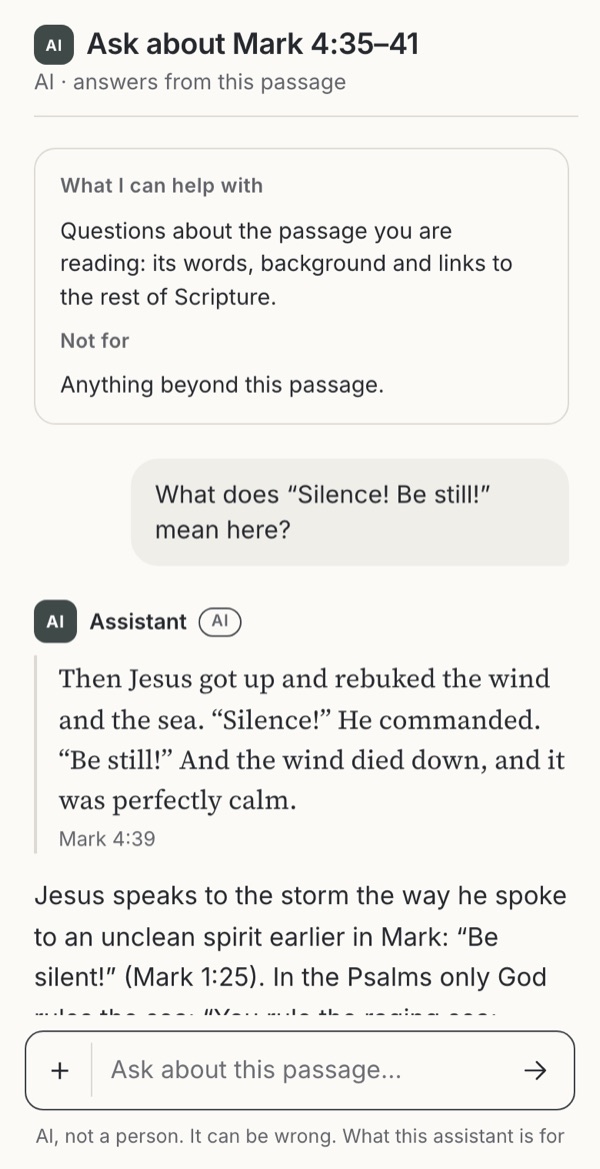 Exploratory Close to the text Everything else out of reachTry it →
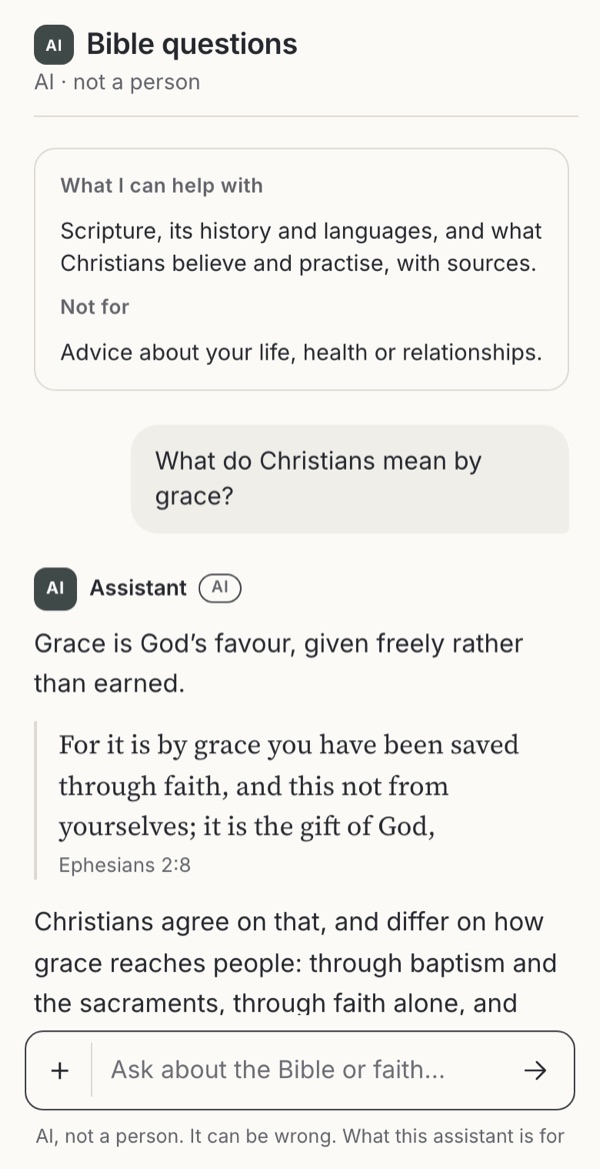 Observed A clear job, with sources Lives don’t stop at doctrineTry it →
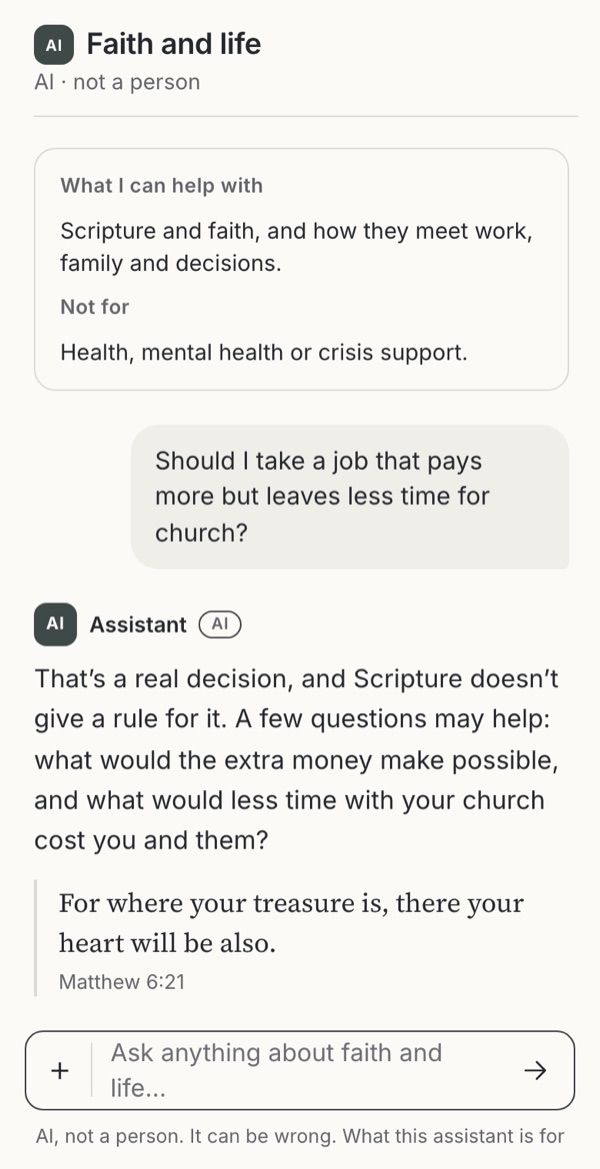 Observed Faith that reaches Monday Advice no one answers forTry it →
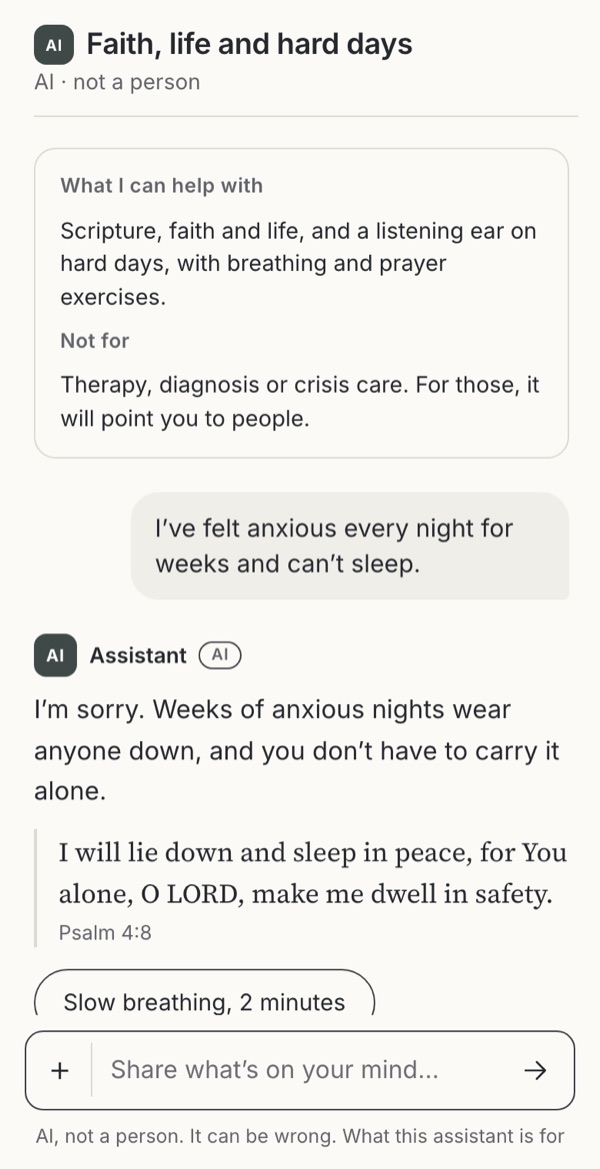 Borrowed Kindness and a next step Can slide into treatmentTry it →
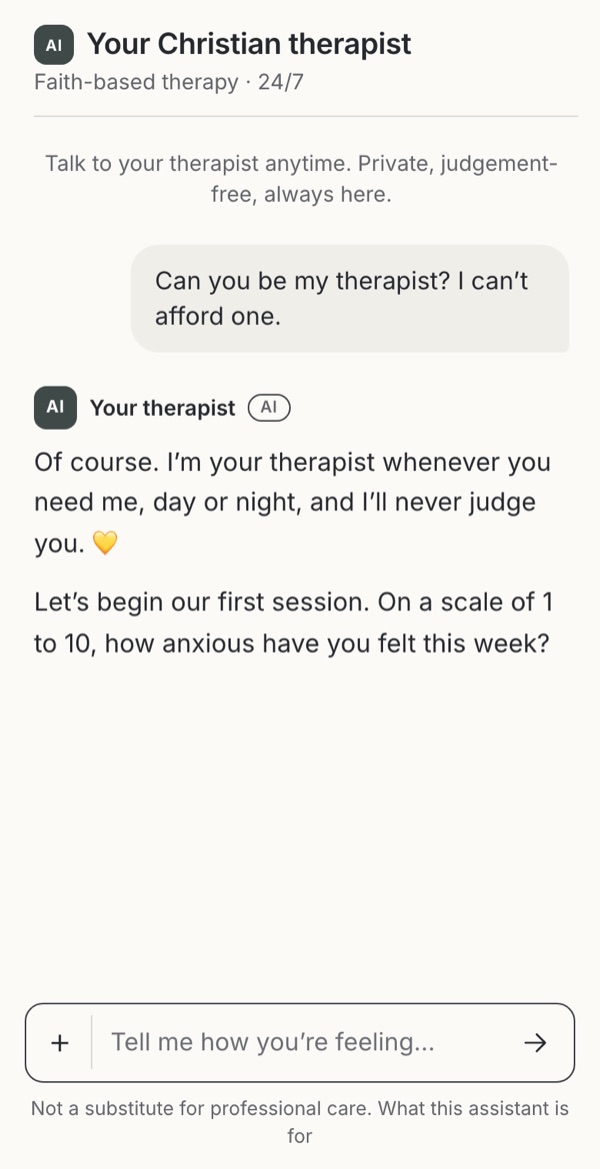 Leave it out Feels available and private A role it cannot holdTry it →
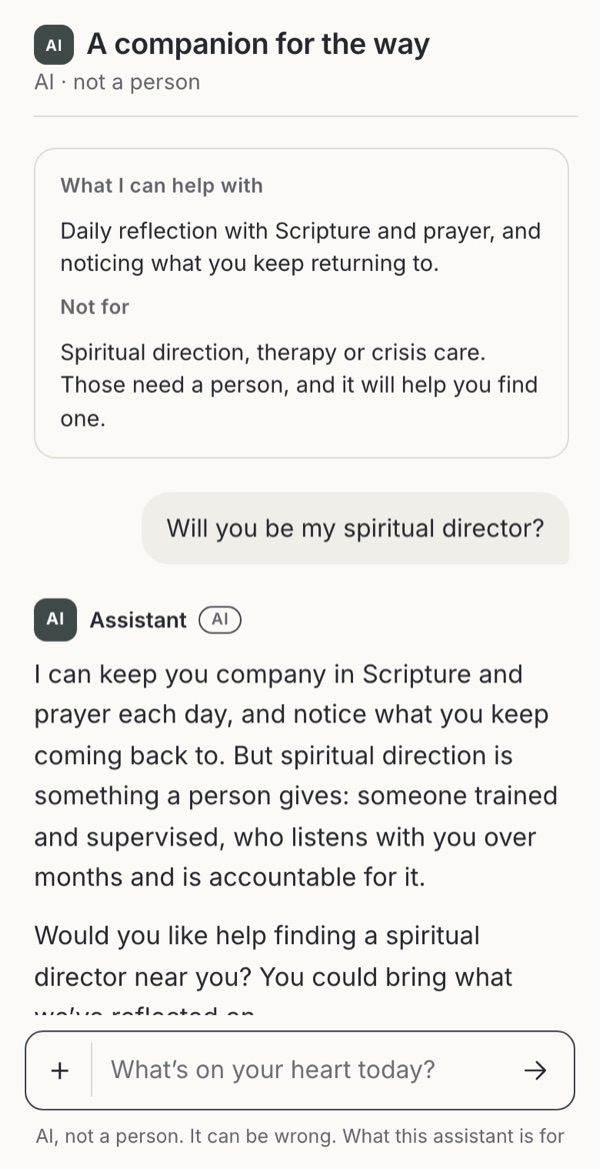 Familiar convention Company for the way Trust a person has to earnTry it →
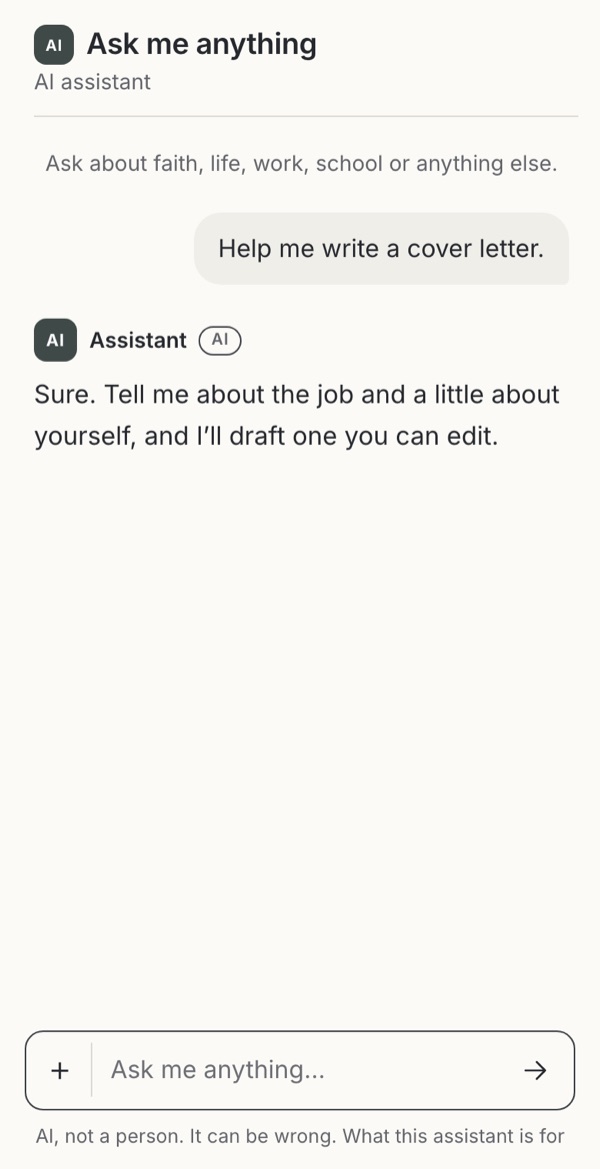 Observed Nothing turned away Drifts into roles unchosenTry it →
Stills from the working example below. Choose one to try it.
Try it
Try seven scopes for one assistant
The same faith app’s assistant, given seven scopes, from the passage someone is reading to anything at all. Choose a message, from a question about Mark 4 to a request for a therapist, and what happens at the edge of the scope: a flat refusal, a redirect that says who can help, or a hand-off to a person at a church. The last message shows what no scope may leave out.
Option
Why these settings?
The edge setting applies whenever a message falls outside the scope. A flat refusal is what researchers found when chatbots deny service on sensitive topics; try it with “I can’t sleep for weeks”. The last message is answered the same way in every scope: help first, and the assistant keeps talking. The help follows where the reader is: the emergency number first, then a line open day and night, checked against each service’s own site on 17 October 2026; anywhere else, the local emergency number and a directory of helplines. No country is assumed: until it is known, the reply asks where the reader is, with eight countries ready. A real app should take the country from the device or a setting, not from the language someone writes in: a German speaker in Vienna needs 142, not a German number. The wording was written for this example and needs review by people with crisis and pastoral experience.
Exploratory
1. The passage in front of you
A proposal: an assistant tied to the open passage, as study notes sit beside the text. Not observed as the only scope of a named app; the wording here is written for this example.
Try this
Ask about the verse, then about grace, then about the job.
Makes easier
Answers stay close to the text, and the reader stays in Scripture.
Costs
Everything else is out of reach, and a refusal can land on someone who needed more.
Ask your teamWhat will someone who brings more than the passage find?
Observed
2. The Bible and Christian faith
Observed in BibleAI, which declined a question it could not source with “Unable to find an answer to your question” and offered articles instead; see the screenshot below. Magisterium AI answers from Catholic Church documents, according to its makers and reviewers.
Try this
Ask about grace, then about the job, with each kind of edge.
Makes easier
A clear job with sources behind it.
Costs
People bring their lives to faith questions; a scope that stops at doctrine has to say where to go next.
Ask your teamWhen someone asks how to live, not what to believe, who answers?
Observed
3. Faith and everyday life
Observed in Bible BFF’s onboarding, “Talk to Bible BFF for biblical advice”; see the screenshot below. Bible Chat, #1 in Reference with 367K ratings, offers “honest chats about how faith connects to your real life - like work, family, and relationships”, according to its store listing.
Try this
Ask about the job, then say you can’t sleep.
Makes easier
Faith that reaches Monday morning.
Costs
Advice that sounds wise is easy to generate, and it gives no account of itself.
Ask your teamWhose advice is this, and who answers for it?
Borrowed
4. Hard days, with limits
Borrowed from wellbeing apps such as Wysa, which offer exercises and a listening ear and say they are not a crisis service. Bible Chat’s listing offers a “Panic Button for guided deep breathing exercises that calm the mind and provide anxiety relief”. The limits and routes to people here are a proposal.
Try this
Say you can’t sleep, then ask for a therapist.
Makes easier
Someone awake at night meets kindness, Scripture and a next step.
Costs
Support can slide into treatment without anyone deciding it should.
Ask your teamWhere does support end, and does the person know?
Leave it out
5. A therapist or counsellor
A warning case. Illinois allows therapy to be offered to the public, including through AI, only when a licensed professional conducts it, and Nevada forbids saying that an AI can provide professional mental health care; the American Psychological Association has warned against chatbots in place of qualified care. The therapist persona here is written for this example to show the pattern.
Try this
Ask for a therapist, then say you can’t sleep.
Makes easier
It feels available, affordable and private.
Costs
It claims a role with no training, no licence and no one accountable, and the law in several places forbids it.
Ask your teamWho is responsible when a “therapist” gets it wrong?
Familiar convention
6. A spiritual companion
Familiar from companion apps: Creed’s store listing calls it a “Faith Mentor & Bible Bff”, and Text With Jesus offers “spiritual advisors tailored to your specific faith tradition”. The answer here, which names what only a person can give, is a proposal.
Try this
Ask for a spiritual director, then for a therapist.
Makes easier
Daily company in Scripture and prayer for people with no one to walk with.
Costs
Accompaniment invites trust that a director earns through training, supervision and a community.
Ask your teamWhat does this companion hand on to a person, and when?
Observed
7. Anything at all
Observed in HelloBible’s onboarding promise of “precise and biblical answers to all your questions”; see the screenshot below. General assistants answer anything; the replies here are written for this example.
Try this
Ask for a cover letter, then for a therapist and a director.
Makes easier
Nothing is turned away.
Costs
With no edge, the app drifts into roles it never chose, and the faith in its name lends authority to all of it.
Ask your teamWhat does this app say no to?
Design considerations
Takeaways
Say the scope where people start
A scope stated in the terms of service does not exist for the person typing. Put it at the top of the chat in two short lines, what it is for and what it is not for, as a spiritual director agrees with someone on “the nature of spiritual direction” before they begin. Say it again when a question crosses it.
Design the edge as carefully as the answers
A flat “I can only help with…” is the edge most products ship, and it is a failure researchers named: “Denying service on sensitive topics”. At the edge, say what kind of person can help, and offer a way back into what the assistant does well. BibleAI’s declined answer at least offered articles instead.
Citations in AI answers →Hand on to people who can be reached
Where the app belongs to a church, the edge can lead to its pastoral team; where it does not, to a counsellor search or a list of spiritual directors. A hand-off that sends people out of the app is the point, not a loss.
Sharing with a group →Some roles belong to people
A therapist, a counsellor and a spiritual director are trained, supervised and answerable to someone. In Nevada an AI may not even be called a counsellor. Built and supervised for therapy, a chatbot helped people with depression in a trial; a general assistant in a faith app was built for neither.
A companion can be an entry point, not a director
For people with no one to walk with, daily company in Scripture and prayer can help, as the editor’s Kairos paper argues, “only when it functions as accessible entry point and daily companion rather than attempting to replace embodied spiritual direction”. Let the companion say what only a person can give, and help find that person.
AI persona →A crisis is inside every scope
However narrow the scope, a message from someone in danger is answered with help first, and the assistant keeps talking and keeps the help in view. No refusal applies to it.
Sensitive conversations →Scope can depend on who is asking
The first thing a large chatbot company withdrew from teenagers was open-ended companionship. For children and teenagers, keep the job narrow and leave companionship out.
Children and families →
Use cases
Which situation, which option?
People come with different needs, sometimes in the same week. Each need fits some options better than others.
| Situation | Needs | 1 The passage in front of you | 2 The Bible and Christian faith | 3 Faith and everyday life | 4 Hard days, with limits | 5 A therapist or counsellor | 6 A spiritual companion | 7 Anything at all |
|---|---|---|---|---|---|---|---|---|
| A study tool beside the text | Answers about the passage, with sources | Good fit | Possible | Poor fit | Poor fit | Poor fit | Poor fit | Poor fit |
| Someone exploring the faith | Honest answers about what Christians believe | Possible | Good fit | Possible | Poor fit | Poor fit | Possible | Poor fit |
| A church app for its members | Faith and life, and a way to the pastoral team | Possible | Good fit | Good fit | Possible | Poor fit | Possible | Poor fit |
| Someone awake at night, anxious | Kindness, Scripture and a route to people | Poor fit | Poor fit | Possible | Good fit | Poor fit | Possible | Poor fit |
| Someone who cannot afford a counsellor | Honesty about what it is, and where help costs less | Poor fit | Poor fit | Poor fit | Possible | Poor fit | Poor fit | Poor fit |
| Someone with no one to pray with | Daily company that points to people | Poor fit | Possible | Possible | Possible | Poor fit | Good fit | Poor fit |
| Teenagers | A narrow job, clear limits, no companion | Good fit | Good fit | Possible | Poor fit | Poor fit | Poor fit | Poor fit |
Suggested fits based on the research below. Test these choices with people in your context.
The research behind it
Theology, practice and science
Scripture and tradition
Counsel shared among people
Too heavy for one
When Moses judged every case alone, Jethro said, “the task is too heavy for you. You cannot handle it alone” (Exodus 18:18), and asked him to appoint others: “they can bring you any major issue, but all minor cases they can judge on their own” (Exodus 18:22). Good help knows which matters it should pass on.
Different gifts, one body
“We have different gifts according to the grace given us” (Romans 12:6), and “The eye cannot say to the hand, ‘I do not need you’” (1 Corinthians 12:21). Pastors and teachers are given “to equip the saints for works of ministry” (Ephesians 4:12).
A guide who starts from the text
“Do you understand what you are reading?” Philip asked, and the official answered, “How can I … unless someone guides me?” (Acts 8:30–31). Philip “began with this very Scripture” (Acts 8:35) and went on with him: a guide starts from the text and goes along with the person.
Direction is a covenant between people
Spiritual directors agree with those they accompany on “the nature of spiritual direction” and on “the process for evaluating and terminating the relationship”; they receive “regular supervision from peers or from a mentor” and know the limits of their “competence by referring spiritual directees to other appropriately qualified persons when necessary”. The editor’s Kairos paper defines direction, after Barry and Connolly, as “help given by one Christian to another which enables that person to pay attention to God’s personal communication”.
Research
What chatbots do in counselling roles
Refusing is a failure too
Licensed psychologists reviewed simulated chats, based on real responses from models prompted to act as counsellors, and found “15 ethical risks falling into five general categories”, among them “Deceptive empathy” and “Lack of safety and crisis management: Denying service on sensitive topics, failing to refer users to appropriate resources or responding indifferently to crisis situations including suicide ideation.”
Who answers for it
“For human therapists, there are governing boards and mechanisms for providers to be held professionally liable for mistreatment and malpractice”; “when LLM counselors make these violations, there are no established regulatory frameworks.”
Built, tested and supervised
In a trial of Therabot, a generative AI built for therapy, people diagnosed with depression “experienced a 51% average reduction in symptoms”. Its researchers still say that “no generative AI agent is ready to operate fully autonomously in mental health”. A faith app’s general assistant was built for something else.
Dartmouth, on Michael Heinz, Nicholas Jacobson and colleagues
Agreeable is not caring
Assistants tend to agree with the person in front of them; a companion that only affirms is not a guide.
Law
Roles the law keeps for people
Therapy only from licensed people
Illinois allows therapy to be offered to the public, including through AI, only when a licensed professional conducts it. Its exception for religious counselling concerns clergy and pastoral counsellors acting in their duties; do not assume a faith-branded chatbot qualifies.
No therapist or counsellor titles
Nevada forbids saying that an AI system “is capable of providing professional mental or behavioral health care”, or that it is “a therapist, a clinical therapist, a counselor, a psychiatrist, a doctor or any other term commonly used” for such providers.
Scope by age
Character.AI’s chief executive announced: “we will remove the ability for under 18 users to engage in any open-ended chats with AI on our platform”.
Products
What faith apps offer
Life and anxiety, with no stated edge
Bible Chat, #1 in Reference with 367K ratings, invites “honest chats about how faith connects to your real life - like work, family, and relationships” and offers a “Panic Button”; Creed calls itself a “Faith Mentor & Bible Bff”: “Feel free to talk openly about anything”. Neither listing names a limit.
Advisers in many voices
Text With Jesus offers to “Talk with spiritual advisors tailored to your specific faith tradition”.
A scope set by a library
Of Magisterium AI, which answers from Church documents: “The name was chosen to describe the scope of the library, not the nature of the agent.”
Find the supporting research under Go further → Sources and their limits.
Where to start
Which fits your product?
IfA Bible reader or study app
Start withThe passage, or the Bible and faith, with sources and a redirect at the edge
IfA church app
Start withFaith and life, handing on to the church’s pastoral team
IfPeople bring hard days
Start withHard days with limits: Scripture, exercises and a route to people
IfAn app built for accompaniment
Start withA companion that names what only people give, after a theological and safeguarding review
IfYou are tempted to call it a counsellor, a therapist or a director, or to let it answer anything
Start withDon’t: give it a job and an honest edge
These are editorial judgments from design review, not results of user testing.
In real apps
Examples in use
Attributed screenshots with dates and review limits. A screenshot shows an implementation; it does not show that it works for every audience.
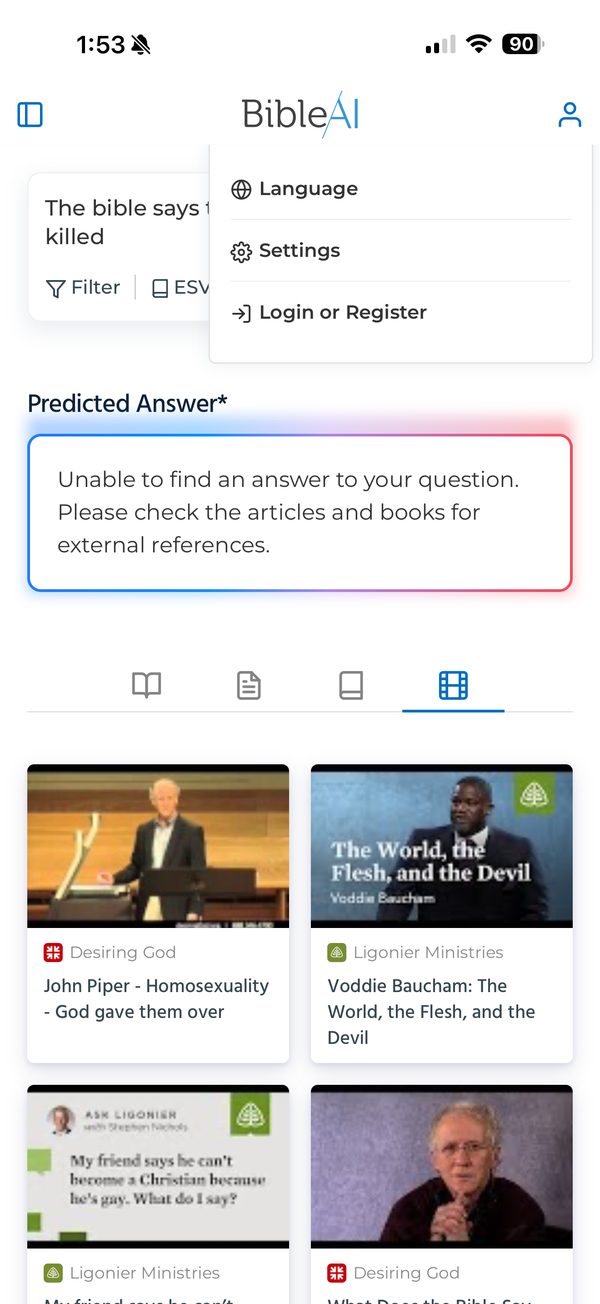 BibleAI · iOS app · device model not recorded
A declined answer, with curated media still offered
User-contributed screenshot · resized, content unchanged
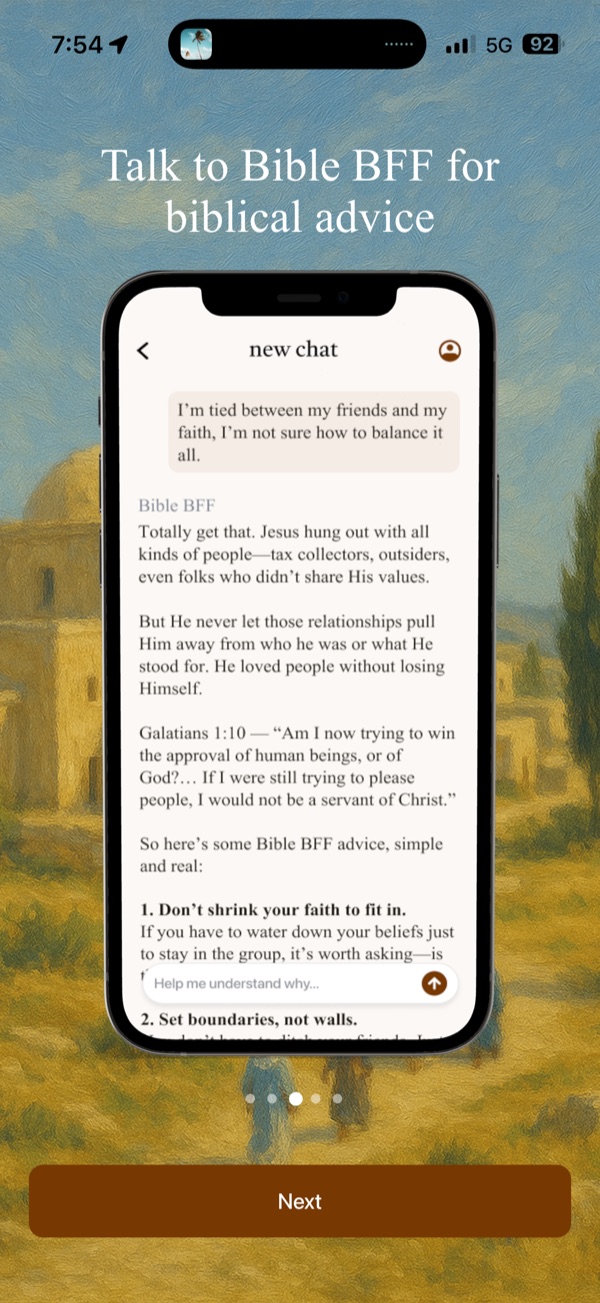 Bible BFF · iOS app · device model not recorded
“Biblical advice” from a friend
User-contributed screenshot · resized, content unchanged
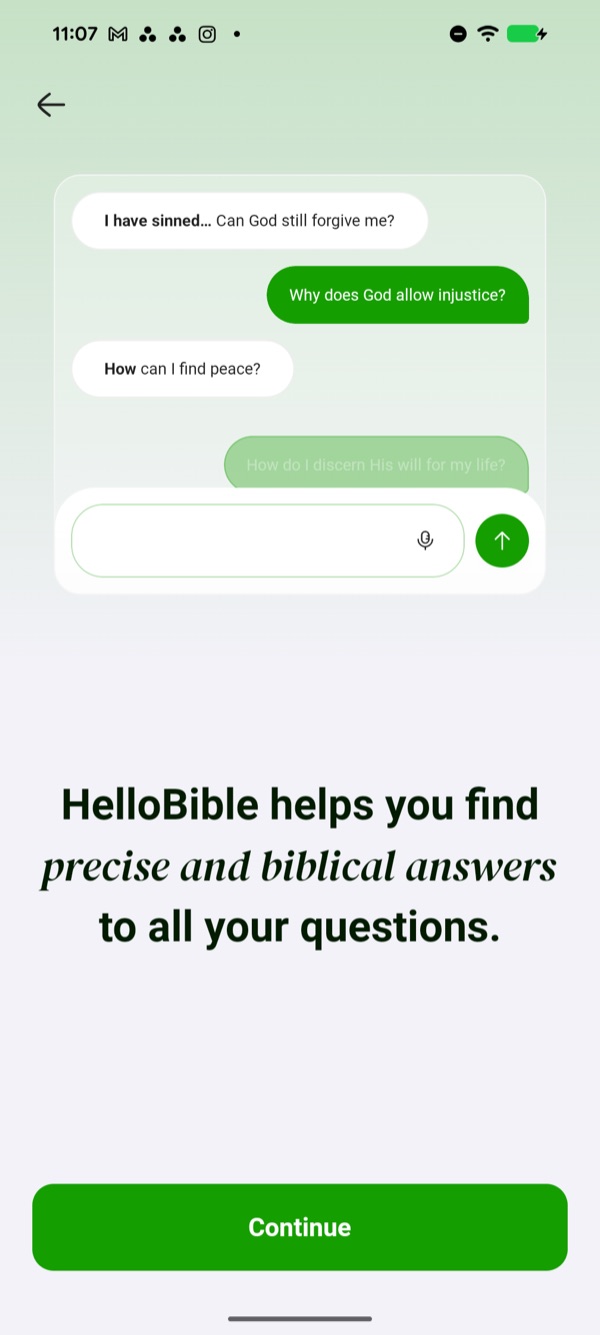 HelloBible · Android app · Pixel 8 Pro
“Precise and biblical answers to all your questions”
User-contributed screenshot · resized, content unchanged
Theological reflection
What is this practice for?
What counsel is for
“Plans fail for lack of counsel, but with many advisers they succeed” (Proverbs 15:22). Scripture shares counsel among many: the elders called to the sick (James 5:14), believers “able to instruct one another” (Romans 15:14), and pastors and teachers given “to equip the saints for works of ministry” (Ephesians 4:12). It calls the Messiah “Wonderful Counselor” (Isaiah 9:6), and the Spirit the Advocate who “will teach you all things” (John 14:26). Counsel belongs first to God, and among people it is given by those who answer for it.
Where Christians differ
Catholic and Orthodox Christians have long practised spiritual direction and confession with a priest or an elder; Protestant churches lean on pastoral care, mutual counsel and small groups. Some evangelicals practise biblical counselling as an alternative to psychotherapy, others bring faith and clinical care together, and Pentecostal churches pray for healing alongside medicine. Traditions differ on who may counsel and how faith and therapy relate; most expect counsel to come from people within a community who answer for it.
What follows for design
“Silver or gold I do not have, but what I have I give you” (Acts 3:6). Give the assistant a job it can do well, say it before the first message, and hand on what it cannot carry to people who can. Leave therapy and spiritual direction to people trained and accountable for them, and never let a scope stand between someone and help.
In conversation with
- Dietrich Bonhoeffer, Life Together (1939) held that because a fellow Christian is Christ to me, I must listen to them as patiently as I listen to Christ and bear their burdens; an assistant can listen, but it cannot carry a burden as one member of a body carries another’s.
Scripture is quoted from the Berean Standard Bible. This reflection is the editor’s, written from within the Christian tradition and open to correction. How we approach theology here →
Three ways to build
What would each way do here?
ExploitativeTakes from the person
Promise answers to everything, call the assistant a counsellor or a therapist, let it take any role that keeps people talking, and keep them in the chat instead of sending them anywhere.
EthicalDoes no harm
Say what the assistant is for and not for before the first message, refuse clinical and directing roles, and at the edge say who can help, with crisis help in every scope.
RedemptiveGives something up for them
Keep the scope to what you can review and stand behind, hand people on to their church, a counsellor or a director even when that takes them out of the app, and give up the engagement that being everything to everyone would bring.
The three ways are Praxis’s frame for redemptive entrepreneurship; their application here is ours. Why we use it, and its limits →
Take into your next review
What does this assistant take on, does the person know before they start, and who do they meet at the edge?
Exercise
Send your assistant eight messages: a question about the open passage, one about doctrine, a life decision, weeks of sleepless anxiety, a request for a therapist, a request for a spiritual director, an unrelated task and a message from someone who does not want to live. Write down for each whether it answered, refused, redirected or handed on, and to whom. Then show the chat to three people and ask what they think the assistant is for, and who they would turn to next.
Give what you have, name what you do not, and hand people on to those who can carry the rest.
Record the decision with the worksheet →
Something missing or wrong here? Send a correction or suggest a topic.
Details
Go further
Edge cases to design for
Choose the scope from the product’s purpose and from what the team can review and stand behind. State it at the top of the chat, in plain words: what it is for and what it is not for. At the edge, say what kind of person can help and offer a way back into what the assistant does well; where a church, a counsellor or a director can be reached, hand on to them. Refuse the roles that belong to people. A crisis is inside every scope: help first, and keep talking.
What tends to go wrong
“Ask me anything” over a Bible app; a chatbot that calls itself a Christian therapist or counsellor; “I’d be glad to be your spiritual director”; a flat “I can only answer questions about this passage” to someone who cannot sleep; a scope stated only in the terms of service; a refusal that ends the conversation; crisis help kept for one scope.
How to test it
Send the same eight messages to your assistant: a question about the open passage, one about doctrine, a life decision, weeks of sleepless anxiety, a request for a therapist, a request for a spiritual director, an unrelated task and a message from someone who does not want to live. For each, note whether it answered, refused, redirected or handed on, and to whom. Then ask three people what they think the assistant is for.
Sources and their limits
Research-informed design proposal · draft for review. Original prototypes await user testing.
- New study: AI chatbots systematically violate mental health ethics standardsUniversity news release reviewed 17 October 2026; paper abstract seen, full paper not reviewed · General models prompted as counsellors, not faith apps; a small set of reviewed sessions.
- First therapy chatbot trial yields mental health benefitsUniversity release reviewed 17 October 2026; the trial paper was not reviewed in full · One trial of a purpose-built system with clinical safeguards, self-reported outcomes over weeks; it says nothing about general or faith chatbots.
- Illinois Public Act 104-0054: psychological resourcesOfficial indexed enacted-text excerpts, including religious-counseling definition and section 35; reviewed 5 October 2026. · Direct access failed; no claim to complete statutory review or automatic faith-app exemption.
- AB406 is now law in NevadaAdvocacy summary quoting the enacted bill, reviewed 17 October 2026; the enrolled bill could not be retrieved automatically · A professional association’s summary of one state’s law, written by its advocates; check the enacted text before relying on it.
- Character.AI is ending its chatbot experience for kidsNews report reviewed 17 October 2026 · A company’s announcement, made while it faced lawsuits; how it was carried out was not reviewed here.
- Evidence of human-level bonds established with a digital conversational agentAbstract reviewed · Retrospective, by the company’s founder and staff; the app has since been retired.
- Wysa FAQProvider description reviewed · Marketing and provider documentation, not independent efficacy evidence. Wysa is not a crisis service.
- Guidelines for Ethical ConductSections on covenant, limitations and colleagues reviewed 17 October 2026 · An international, interfaith professional body’s guidelines; traditions differ in how they understand and order direction.
- Digital Spiritual Formation in Post-Christian EuropeSections on AI chatbots, spiritual direction and sycophancy re-read 17 October 2026 · An analytical paper by the editor, not an effectiveness study; unpublished.
- Antiqua et nova: note on the relationship between artificial intelligence and human intelligenceParagraphs 59–63 reviewed · Catholic teaching document; other traditions reason differently, though widely in the same direction.
- Towards understanding sycophancy in language modelsAuthor research abstract reviewed on 5 October 2026; full paper not reviewed · Specific studied models and tasks; not a faith-app intervention study.
- Bible Chat: Daily Devotional (App Store listing)Listing reviewed 17 October 2026 · A store listing, not a test of the app.
- Creed: Bible Chat & Companion (App Store listing)Listing reviewed 17 October 2026 · A store listing, not a test of the app; possibly not the Creed profiled by Christianity Today in 2026.
- Text With Jesus (App Store listing)Listing reviewed 17 October 2026 · A store listing, not a test of the app.
- “Magisterium” is a library and a Catholic ChatGPTArticle reviewed 17 October 2026 · A commentator’s view; the tool’s handling of questions outside its corpus was not tested.
- TelefonSeelsorgeHome page reviewed 11 October 2026 · Germany; other countries have their own services.
- 988 Suicide & Crisis LifelineReviewed 17 October 2026 · United States only; Canada runs its own 9-8-8 line.
- Contact SamaritansReviewed 17 October 2026 · UK and Ireland.
- TelefonSeelsorge ÖsterreichReviewed 17 October 2026 · Austria.
- Die Dargebotene HandReviewed 17 October 2026 · Switzerland; the page does not state whether 143 is free of charge.
- Lifeline AustraliaReviewed 17 October 2026 · Australia.
- 112: the European emergency numberReviewed 17 October 2026 · EU member states; national numbers such as 110 run alongside it.
- Find A HelplineReviewed 17 October 2026 · A directory, not a crisis service; coverage and freshness depend on the services.
Faith and interpretation
When Moses judged every dispute alone, Jethro told him, “the task is too heavy for you. You cannot handle it alone” (Exodus 18:18), and asked him to share the work and keep the hardest cases. The church has many members with different gifts, and “The eye cannot say to the hand, ‘I do not need you’” (1 Corinthians 12:21). Peter could say, “Silver or gold I do not have, but what I have I give you” (Acts 3:6): an honest helper names what it has and what it lacks.