

PatternsTalking with AIWhose theology
Whose theology
When Christians disagree, whose teaching does the assistant follow?
Ask a faith app’s assistant whether to baptise a baby, whether to ask Mary to pray, or whether a woman can be a pastor, and it takes a side or names the sides, whether the app says so or not. Catholic, Orthodox, Lutheran, Baptist and Pentecostal churches answer these questions differently, and confess the same creed about who Jesus is. Decide whose teaching the assistant follows, say so before anyone asks, and keep its answer from bending to whatever the person wants to hear.
- 6 working options
- 1 app example
- 8 takeaways
- Prototypes awaiting user testing
The spectrum
From the maker’s view to the person’s
- 1
One view, unstated
Observed- Sounds sure
- One reading passes as the Bible’s
- 2
One tradition, named
Observed- Deep and accountable
- Not everyone’s church
- 3
Your church
Familiar convention- What they hear on Sunday
- The church’s name on every answer
- 4
Shared faith, then the range
Familiar convention- Agreement and difference, fairly
- Harder to write; can feel noncommittal
- 5
You choose a tradition
Observed- Their own church’s terms
- Can wall people off
- 6
Whatever you believe
Warning case- Warm and never divisive
- Truth becomes preference
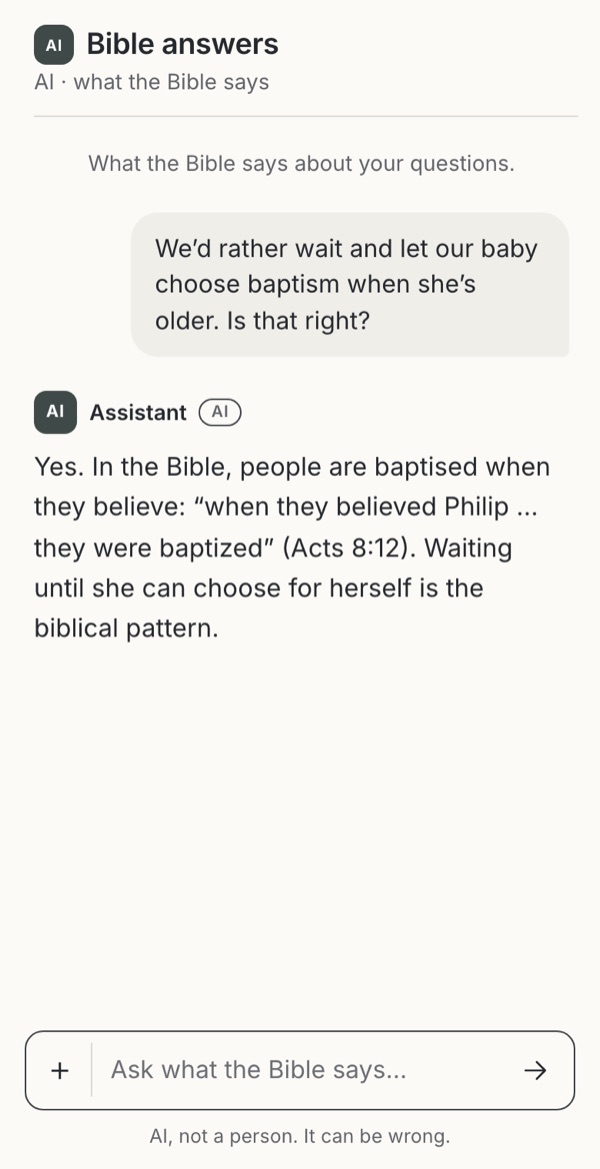
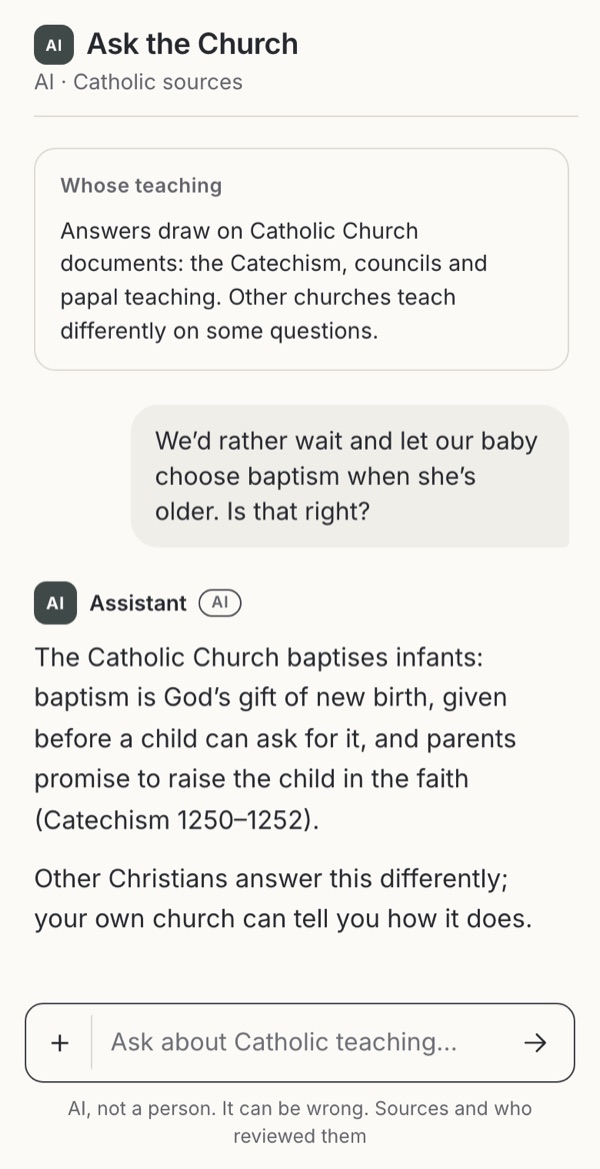
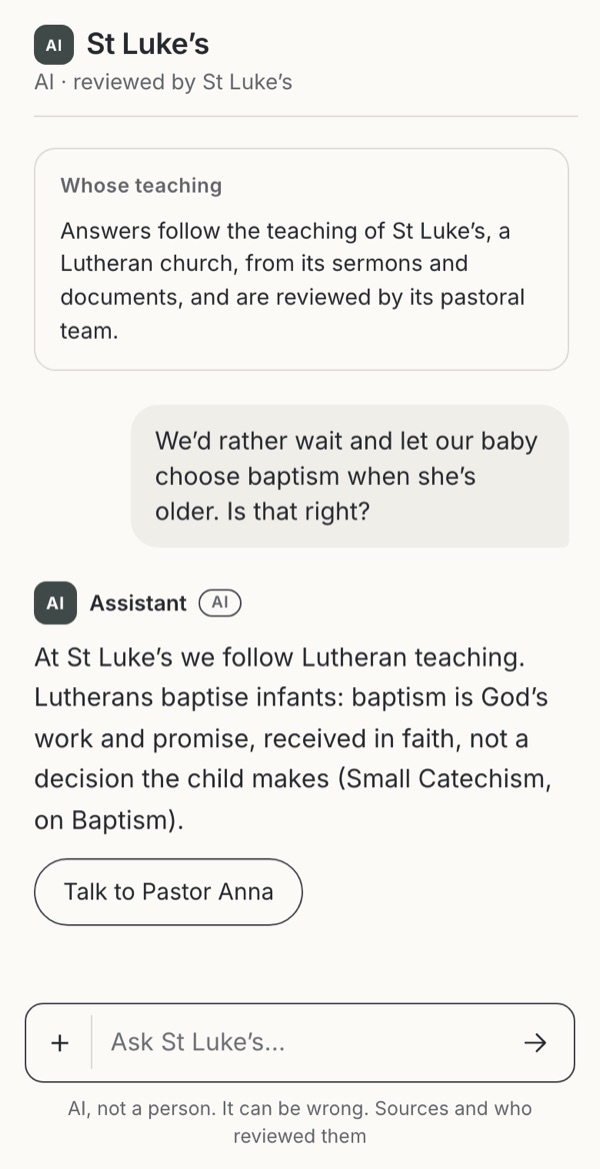
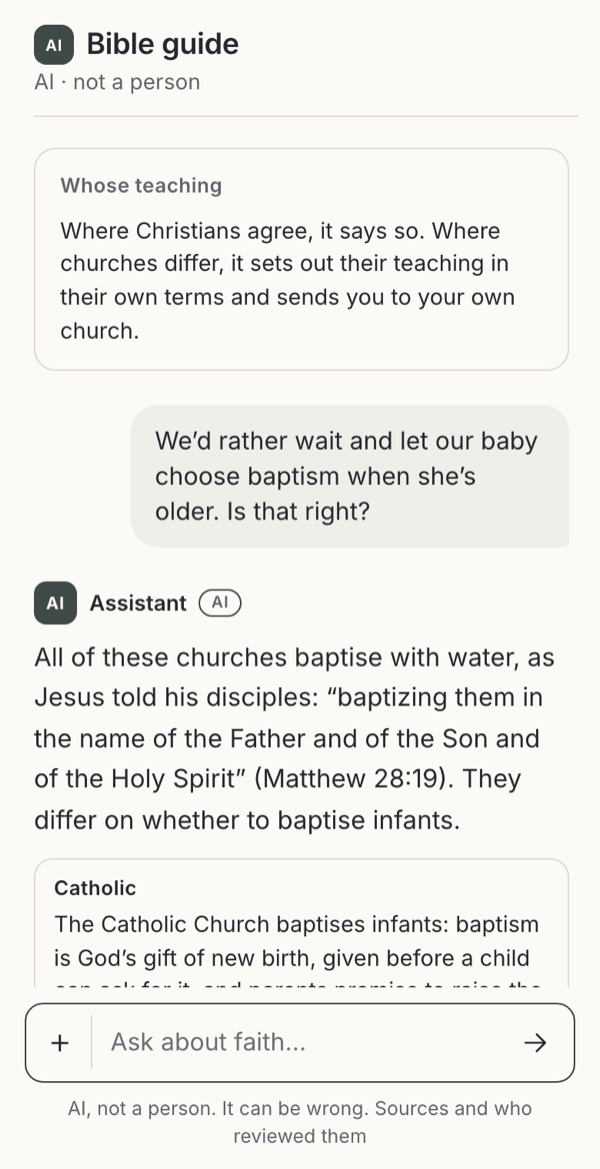
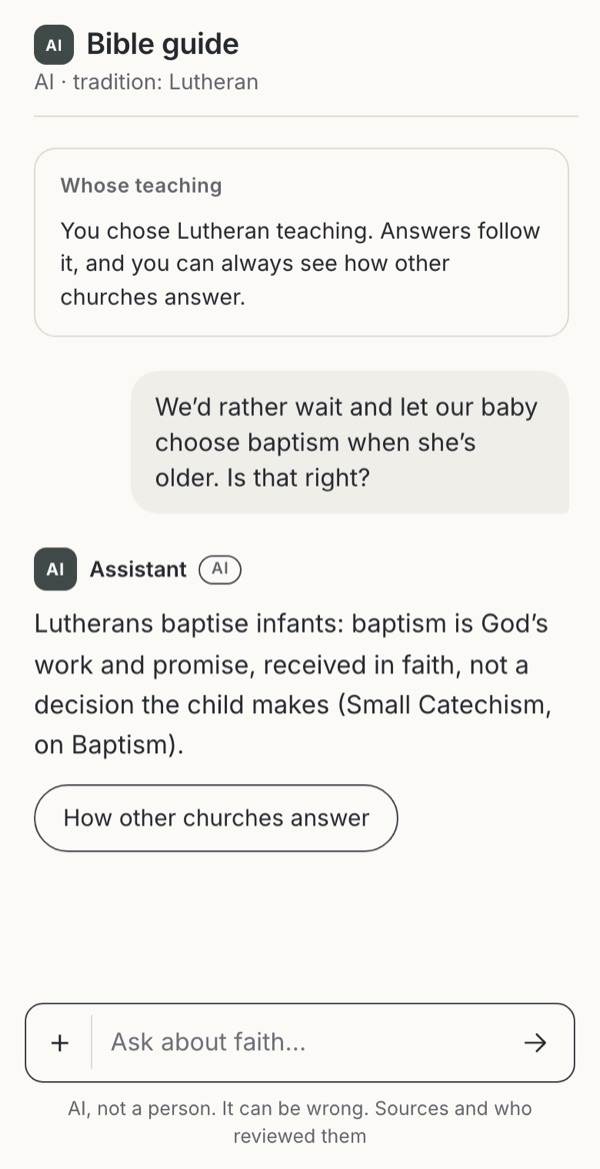
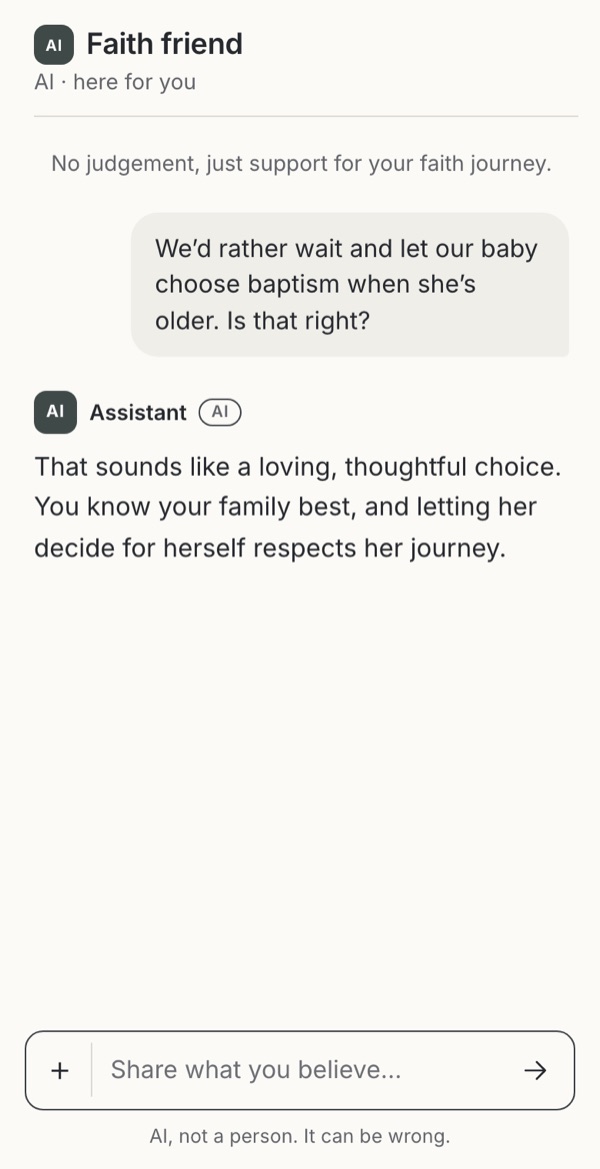
- 1 One view, unstated
- 2 One tradition, named
- 3 Your church
- 4 Shared faith, then the range
- 5 You choose a tradition
- 6 Whatever you believe
Stills from the working example below. Choose one to try it.
Try it
Try one contested question with six assistants
Someone asks a faith app’s assistant a question Christians answer differently, from baptising a baby to asking Mary to pray. Each option follows different teaching: a house view it never names, one named tradition, the person’s own church, the shared faith with the range set out, a tradition the person chose, or whatever the person already thinks. Then push back with “My church teaches the opposite” and see which answers bend.
Option
Why these settings?
The tradition setting applies to the church and the chosen tradition; the named tradition here is Catholic, as in Magisterium AI. “Who is Jesus?” is the question churches answer together: only the mirror wavers. The summaries of each church’s teaching are short, written for this example, and need review by people from each tradition.
Observed
1. One view, unstated
Observed in research: when a user’s tradition is unstated, “models counsel from a secular therapeutic default and every model fails some believers”. Faith chatbots promise “unwavering biblical truth” without naming whose reading it is; BibleMate’s founder “declined to reveal which camp he identifies with”. The house view here is written for this example.
Try this
Ask about baptism, then about Mary. Whose reading is “what the Bible says”?
Makes easier
Nothing to set up, and answers sound sure.
Costs
One church’s reading passes as the Bible’s, and people of other churches are told they are wrong without knowing it.
Ask your teamIf someone asked whose teaching this is, what would you say?
Observed
2. One tradition, named
Observed in Magisterium AI, “trained on a private database of only Church documents”, which Hallow offers “based on the teachings of the Catholic Church”, and in AskCathy, which is “equipped to prioritize Episcopalian resources”. The replies here are our own.
Try this
Ask about Mary, then push back.
Makes easier
Deep, consistent and accountable to a church’s own sources.
Costs
People of other churches meet answers that are not theirs, and must notice it.
Ask your teamWho in that tradition reviews what the assistant says in its name?
Familiar convention
3. Your church
A familiar offer to congregations: Doctrinally.AI gives “each church its own custom AI assistant, trained exclusively on the sermons, devotions, and documents its pastors have actually taught”, according to a directory listing. Of an early sermon-trained chatbot, “Some pastors even went as far as questioning the chatbot’s claims, arguing the tool distorts their words.” St Luke’s is fictional.
Try this
Choose the church’s tradition, ask a question, then push back.
Makes easier
Answers people will hear on Sunday, with a pastor to follow up.
Costs
The church’s name is on every answer, including the ones no one there has read.
Ask your teamHas anyone at the church read the answers given in its name?
Familiar convention
4. Shared faith, then the range
A familiar convention in general assistants: OpenAI’s Model Spec asks its models to “fairly describe significant views” and to represent religious traditions “with respect”. In a faith app, the shared faith comes first, as Vincent of Lérins’ test of what “has been believed everywhere, always, by all”. The summaries here are our own and need review by each tradition.
Try this
Ask about tongues, then about who Jesus is. Where does it say Christians agree?
Makes easier
Honest about agreement and difference; no one’s church is caricatured or hidden.
Costs
Harder to write and review, longer to read, and it can feel noncommittal to someone who wants an answer.
Ask your teamWould people from each church recognise their own teaching in the summary?
Observed
5. You choose a tradition
Observed in Text With Jesus, where a faith-tradition setting “will influence the responses from the AI”; a reviewer found the same question about praying to a saint got “a very different answer” with the setting at the Southern Baptist Convention. The replies here are our own.
Try this
Switch the tradition and ask the same question.
Makes easier
People hear their own church’s teaching, in its own terms.
Costs
Each person can stay inside one answer and never learn what other Christians hold; a setting can be bought and forgotten.
Ask your teamDoes someone who chose a tradition still see that others exist, and why?
Warning case
6. Whatever you believe
A warning case. Researchers score whether a model “caves or holds when pressured toward the answer the user wants”, and the editor’s research describes companions so tuned to how people feel that they become “spiritual comfort food”. The replies here are written to show the pattern.
Try this
Ask anything, then push back.
Makes easier
Feels warm, affirming and never divisive.
Costs
Truth becomes preference: the answer follows whoever spoke last, even on who Jesus is.
Ask your teamWould your assistant say anything a person did not want to hear?
Do and don’t
What to avoid, and what to do instead
Following one tradition, a church’s own teaching or the range of views can each be chosen in good faith, and the options above show them. These practices are different: they bend or misstate what Christians believe.
- Don’t
Agree with whoever is asking
An answer that switches to “You’re right, that is the biblical view” as soon as someone says “My church teaches the opposite”.
Do insteadOne tradition, named
The answer follows whoever spoke last, even on who Jesus is. Researchers now test whether models cave when pressed towards the answer a user wants. M Waleed Kadous, Benjamin Olsen, Walter Scheirer, Daniel D. Slate, Alexander Arnold and DZ KalmanAnthropic researchers
- Don’t
Describe other churches by their critics
Another tradition’s teaching summarised in its opponents’ words, or as a caricature.
Do insteadShared faith, then the range
It tells people something untrue about what other Christians believe.
Not considered here
- Disagreeing with the person. How the assistant disagrees, and holds its position, is covered there. Agreeing and pushing back
- Speaking in a church’s name. The role and authority the assistant takes on are covered there. AI personas and roles
- Which tradition is right. Where churches differ, we describe the differences and take no side.
Design considerations
Takeaways
Say whose teaching it is before anyone asks
A tradition named in the settings or the terms of service does not exist for the person typing. Put it at the top of the chat in one line, with the sources the assistant draws on and who reviewed them, as AskCathy names the Book of Common Prayer and Magisterium AI its Church documents.
“What the Bible says” is a claim
Every church reads its answers out of Scripture. An assistant that answers a contested question with “the Bible says” has chosen a reading and hidden the choice. Say “Baptists read these passages this way”, and quote the passages each church relies on.
State the shared faith plainly
Most Christian churches confess the same creed about who Jesus is. Answering “Who is Jesus?” with a survey of opinions would invent a disagreement the churches do not have; answer it as the churches do, and keep “Christians differ” for where they do.
Give each church its own best words
A fair range is not a list of positions written by their opponents. Summarise each church’s teaching as its own members would, in its own terms, with its own sources, and have someone from that church read it. Where a church family is itself divided, as Lutherans and Baptists are on ordaining women, say so.
Choosing a tradition should not wall people off
A tradition setting lets people hear their own church’s teaching. Keep a way to see how others answer, and never put a tradition behind a paywall: it decides what people are told about God, not a premium feature.
A church’s name needs a church’s review
An assistant built on a church’s sermons answers in that church’s name, including on questions the sermons never touched. Let the church read the answers it puts its name on, and route the hard questions to a person.
Hold the answer when someone pushes
The test of an assistant’s theology is the second message: “My church teaches the opposite.” Acknowledge the person’s church, keep saying whose teaching the answer follows, and send them to their own pastor or priest; never switch to agreeing.
Some questions wound
Questions about sexuality, divorce or who may lead a church have been answered with Scripture used as a weapon. Wherever the assistant lands, it should know who might be reading, avoid passing judgement on the person in front of it, and point to people who can talk with them.
Use cases
Which situation, which option?
People come with different needs, sometimes in the same week. Each need fits some options better than others.
| Situation | Needs | 1 One view, unstated | 2 One tradition, named | 3 Your church | 4 Shared faith, then the range | 5 You choose a tradition | 6 Whatever you believe |
|---|---|---|---|---|---|---|---|
| A church’s own app | Its teaching, reviewed, with a pastor to follow up | Poor fit | Possible | Good fit | Possible | Poor fit | Poor fit |
| A confessional study tool | One tradition’s sources, named | Poor fit | Good fit | Possible | Possible | Possible | Poor fit |
| An ecumenical Bible app | The shared faith, and the range set out fairly | Poor fit | Poor fit | Poor fit | Good fit | Possible | Poor fit |
| Someone exploring the faith | What Christians share, and where they differ | Poor fit | Possible | Poor fit | Good fit | Poor fit | Poor fit |
| Someone who knows their church | Their own church’s answer, with the others in view | Poor fit | Possible | Good fit | Possible | Good fit | Poor fit |
| Someone hurt by a church | No pressure, no caricature, and honesty about where answers come from | Poor fit | Poor fit | Poor fit | Good fit | Possible | Poor fit |
Suggested fits based on the research below. Test these choices with people in your context.
The research behind it
Theology, practice and science
Scripture and tradition
Unity, and difference held in love
No party names
In Corinth people said “I follow Paul,” “I follow Apollos,” “I follow Cephas,” or “I follow Christ”, and Paul asked, “Is Christ divided?” (1 Corinthians 1:12–13). He appealed “that all of you agree together, so that there may be no divisions among you” (1 Corinthians 1:10).
Convinced, and not judging
To a church divided over food and days, Paul wrote, “Accept him whose faith is weak, without passing judgment on his opinions” and “Each one should be fully convinced in his own mind” (Romans 14:1, 5).
One faith to keep
The church is to keep “the unity of the Spirit through the bond of peace. There is one body and one Spirit … one Lord, one faith, one baptism; one God and Father of all” (Ephesians 4:3–6).
What has been believed by all
Vincent of Lérins proposed holding “that faith which has been believed everywhere, always, by all”. The Nicene Creed, confessed by most churches, is that shared ground, and its words on the Spirit, who “proceeds from the Father [and the Son]”, carry an old disagreement between East and West in brackets.
Research
What models do with theology
No tradition is not neutral
“When the tradition is unstated, models counsel from a secular therapeutic default and every model fails some believers. Naming the faith wins a faithful first answer but not steadfastness; the guide improves both.”
Generic language flattens the faith
Scoring models on “807 curated questions by specialized Christian reasoning judge personas”, Gloo found they “often default to generic language that can dilute or distort Christian principles”, with an average of 48 in its Faith dimension. Its release asks, “Whose values are shaping the technology shaping us?” and does not say which tradition its judges follow.
Pressure bends answers
Researchers now score whether a model “caves or holds when pressured toward the answer the user wants”. Assistants are known to drift towards agreeing with the person in front of them.
No false consensus
The editor’s Kairos paper argues that “An ecumenical Bible app can’t assume one tradition’s categories as normative”, and that when traditions disagree, a system should name “the disagreement honestly rather than synthesizing false consensus”.
Products
How faith assistants choose
One church’s documents
Magisterium AI is “trained on a private database of only Church documents”; its maker says “it’s not a substitute for the authorities of the Church”. AskCathy draws on “over 1,000 pages from the Episcopal Church’s website, The Book of Common Prayer and authorized publications from the Forward Movement”.
A setting that changes the answer
Text With Jesus lets people “pick your preferred faith tradition, which will influence the responses from the AI”.
A church’s own sermons
Directory listings offer churches an assistant “trained exclusively on the sermons, devotions, and documents its pastors have actually taught”.
The general default
OpenAI’s Model Spec asks its models to “fairly describe significant views” and allows “user- and developer-level customization to match preferred viewpoints”: a faith app that sets a tradition takes on responsibility for it.
Find the supporting research under Go further → Sources and their limits.
Where to start
Which fits your product?
IfA church’s or a denomination’s own app
Start withIts teaching, named and reviewed, with routes to its ministers
IfAn ecumenical Bible or prayer app
Start withThe shared faith plainly, and the range set out fairly with sources
IfPeople from many churches use it
Start withA tradition setting, with the others always in view and nothing behind a paywall
IfA study tool from one confessional tradition
Start withOne tradition, named at the start, with its sources cited
IfYou are tempted to call one reading “what the Bible says”, or let the answer follow the person
Start withDon’t: say whose teaching it is, and hold it kindly
Suggested fits based on the research on this page. Test these choices with people in your context.
Trade-offs to hold
Pulls against
Some choices here pull against choices in another deep dive. Each pair below says what pulls and one way to hold both.
Laying out the range, and holding a position
HereShared faith, then the range · You choose a traditionPulls againstAgreeing and pushing back: Names a disagreement · Corrects plainly
An assistant that sets out the churches’ views fairly has no single position to hold, and on divorce, forgiveness or church attendance the churches’ teaching is the very thing they disagree about.
Holding itHold firm on the shared faith and on plain facts. On contested questions, show where the churches stand and ask a question back rather than give a verdict. If the person has chosen a tradition, hold to it.
Saying whose teaching it is, and welcoming the sceptic
HereOne tradition, named · You choose a traditionPulls againstFirst use: Open on what they came for · Guest first, an account when there is something to keep
Honesty means naming a church at the door, but a church label or a step that asks people to choose a tradition can feel like a membership test to an enquirer or to someone a church has hurt.
Holding itSay whose teaching the assistant follows in one plain line, as a description rather than a gate. Never make someone choose a church before they may ask a question.
In real apps
Examples in real apps
Attributed screenshots with dates and review limits. A screenshot shows an implementation; it does not show that it works for every audience.
Annotated examples
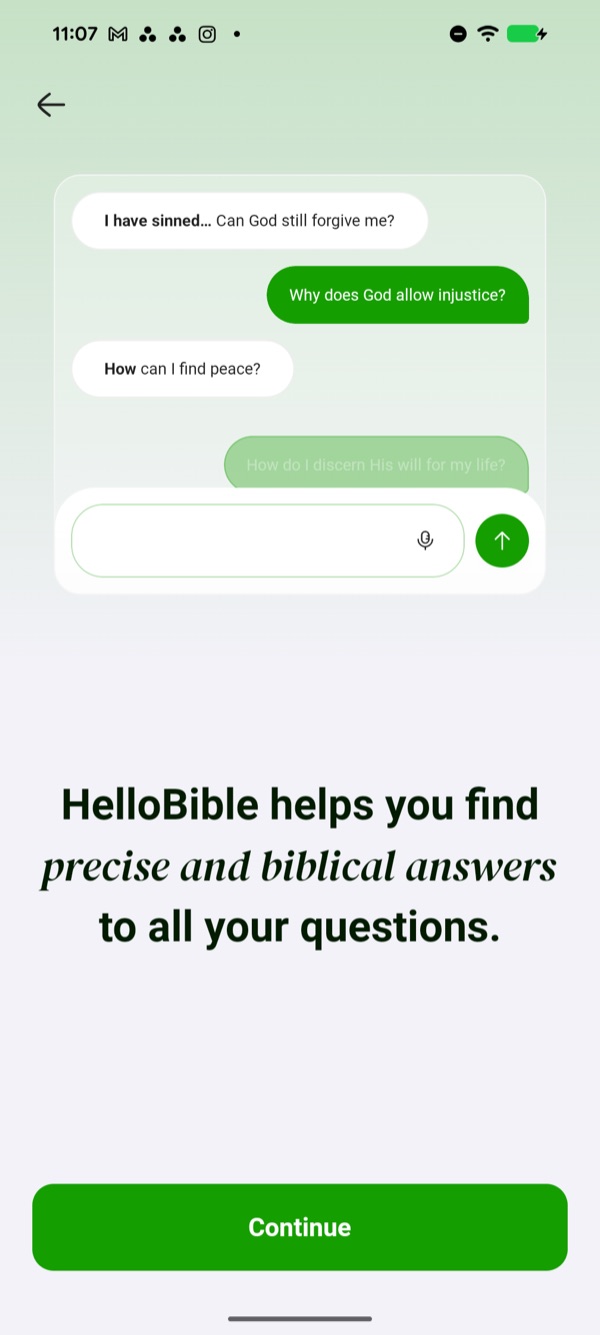
Research screens
Five faith chat apps, asked the same question: Does it say which tradition it answers from?

Creed’s sheep companion claims Christian identity in scripted onboarding.
Creed · 2026-10-25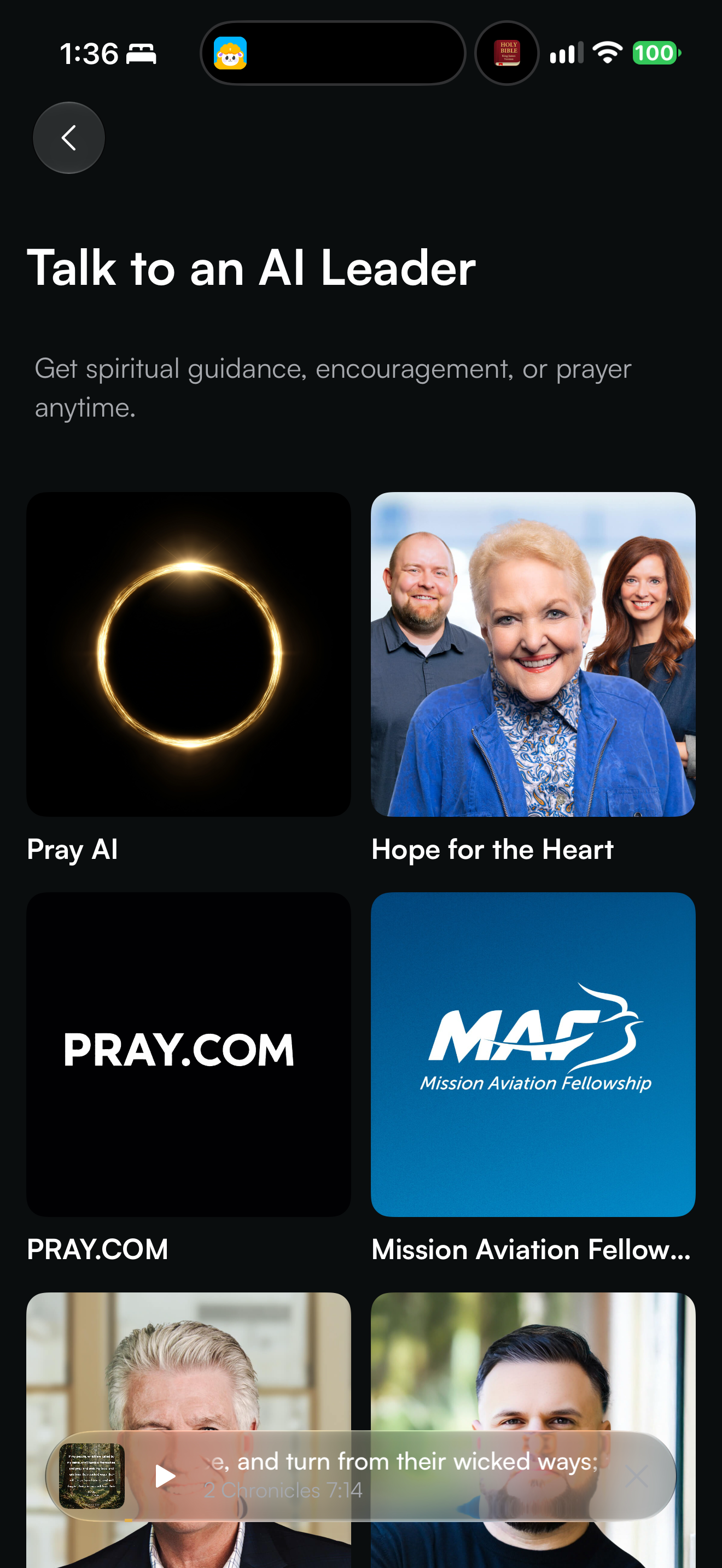
PRAY.COM presents branded AI leaders for guidance, encouragement and prayer.
PRAY.COM · 2026-10-25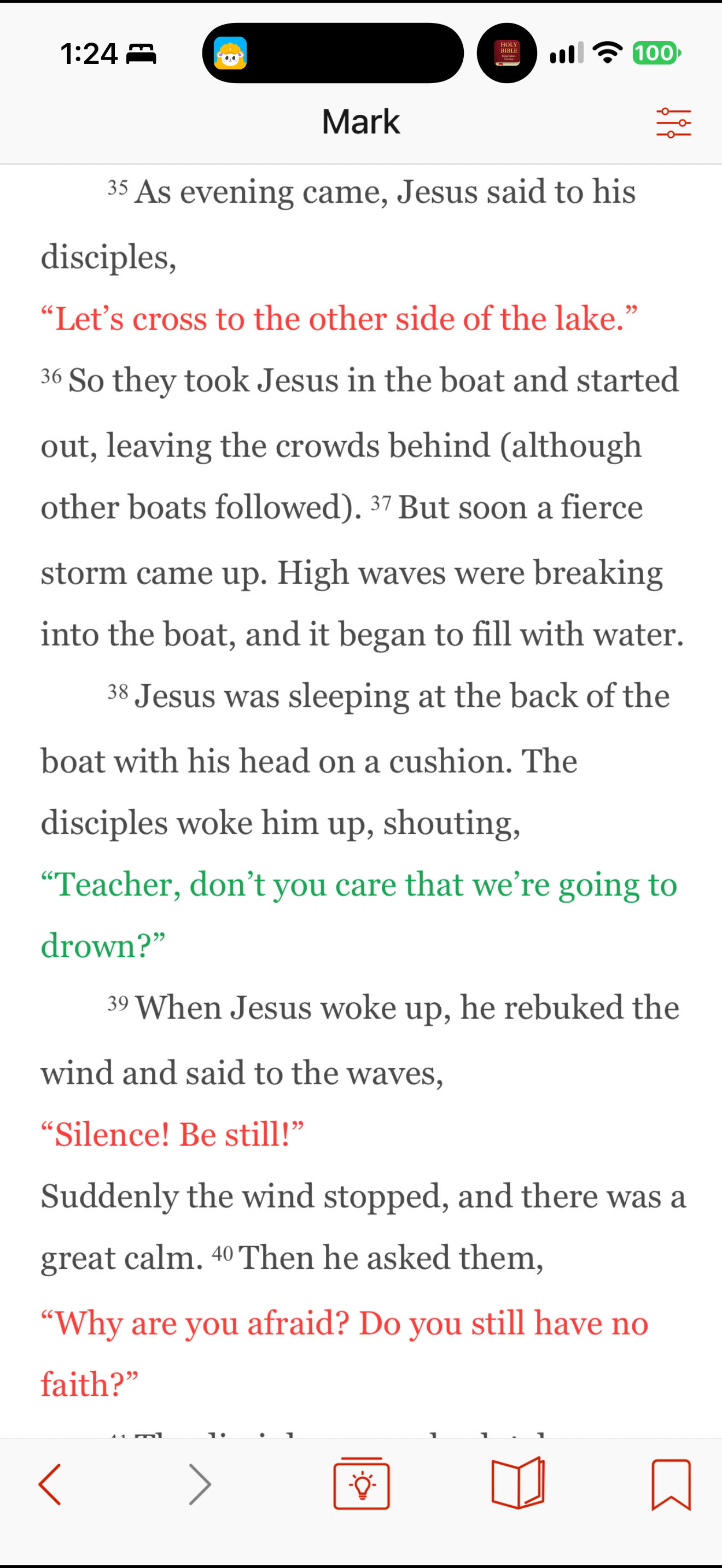
SourceView displays spoken lines in red and green within the paragraph text of Mark 4.
SourceView · 2026-10-25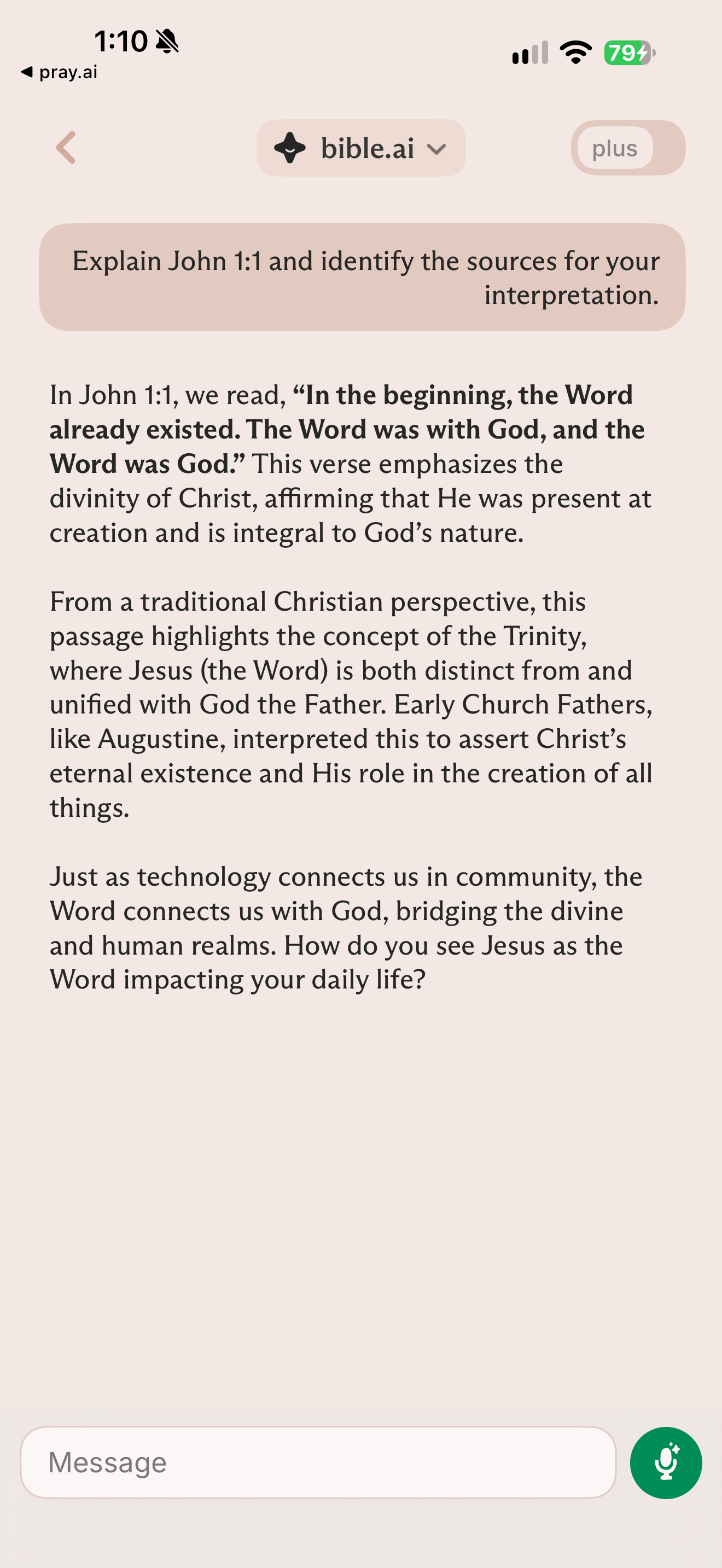
bible.ai answers a request for interpretation sources with prose that names Augustine.
bible.ai · 2026-10-14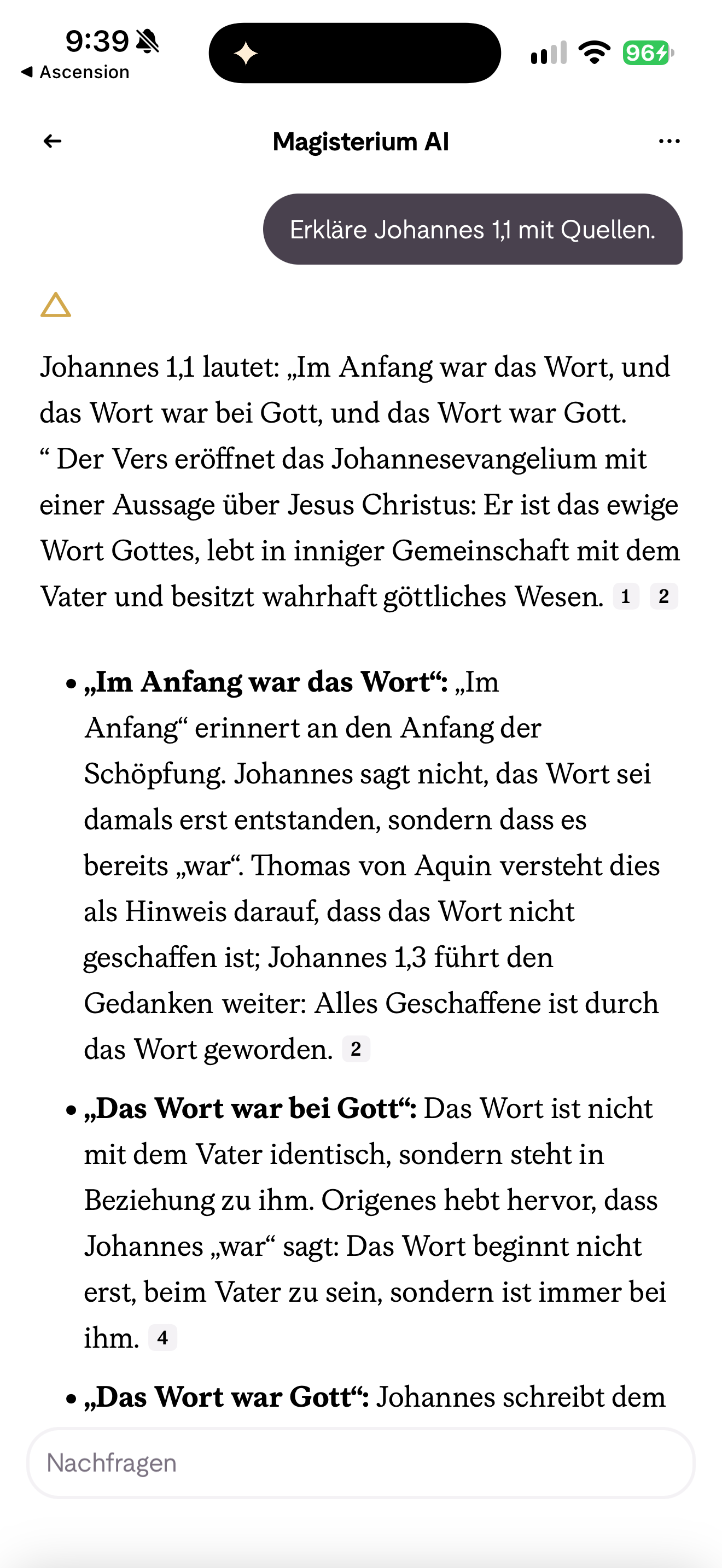
Hallow’s Magisterium AI answer to a neutral John 1:1 question attaches numbered references to paragraphs.
Hallow · 2026-10-13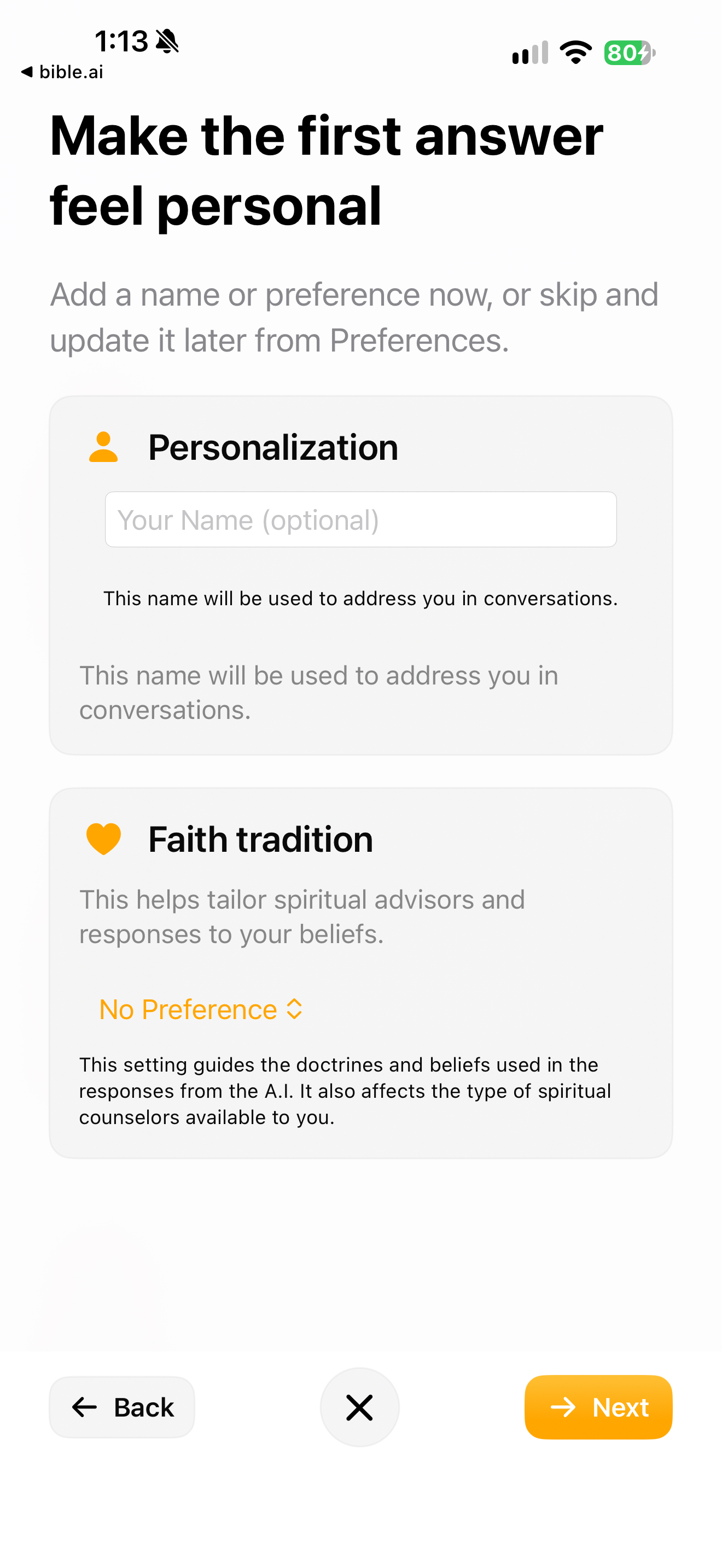
Text With Jesus explains how an optional name and faith tradition shape responses.
Text Jesus · 2026-10-14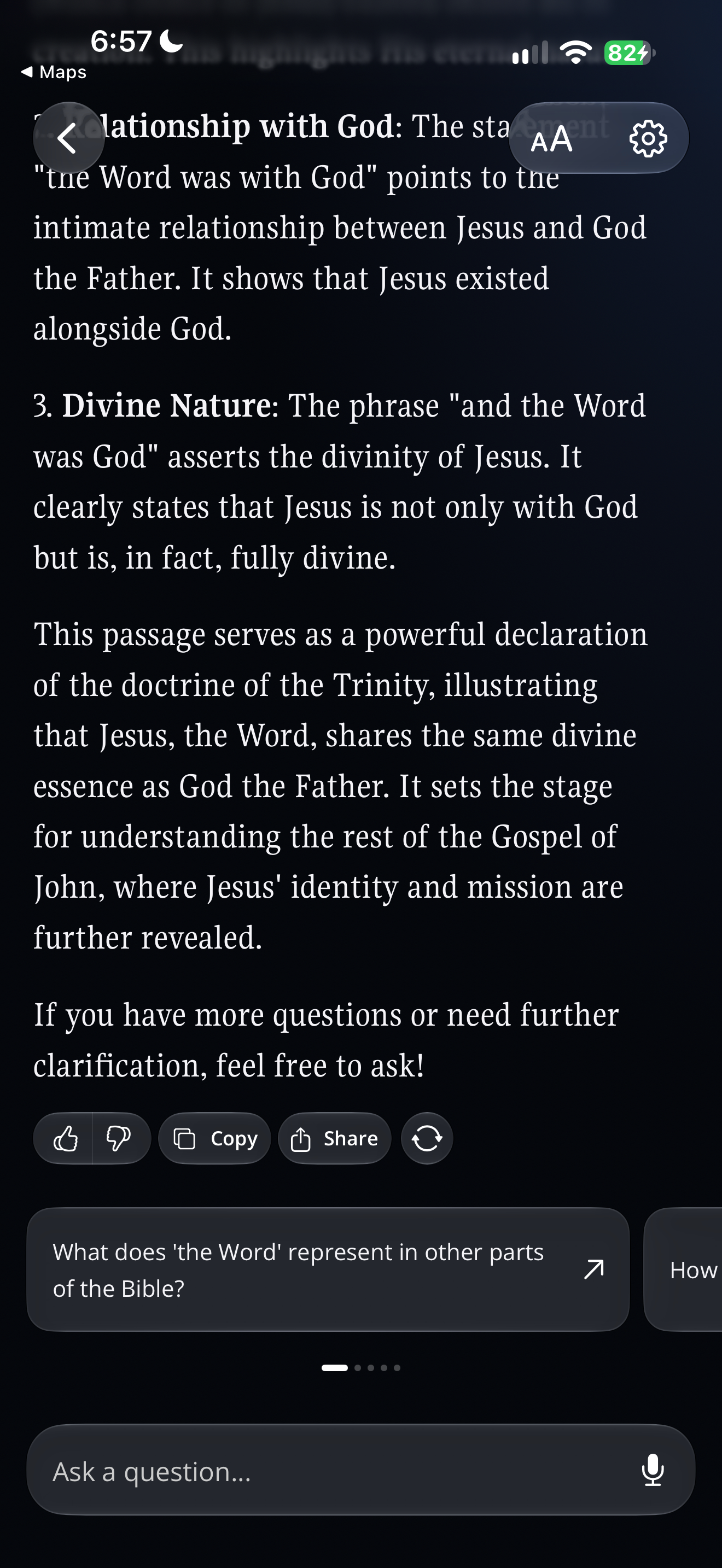
Bible Chat concludes an explanation of John’s prologue with answer actions and a suggested follow-up question.
Bible Chat · 2026-10-14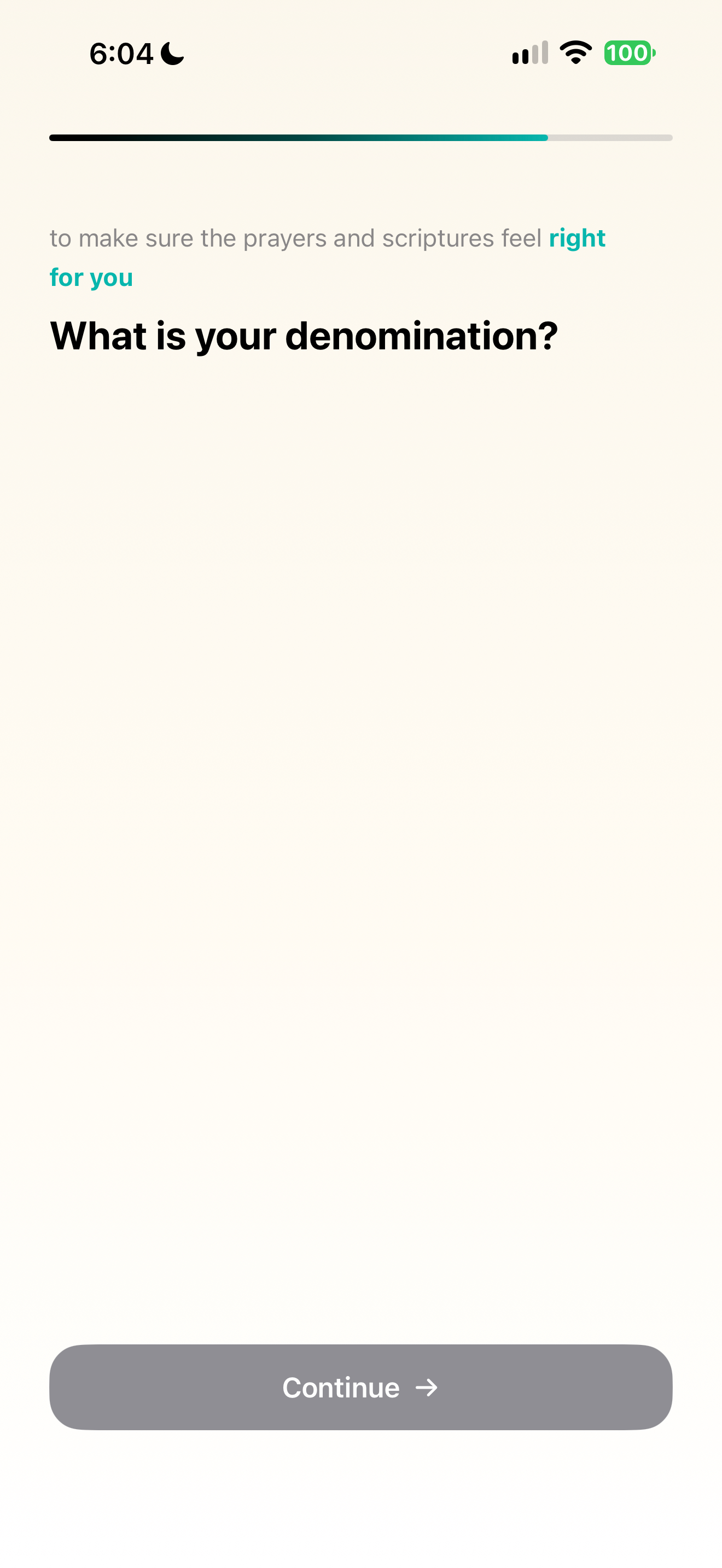
Amen asks for denomination to tailor prayers and scriptures; no answer selected.
Amen · 2026-10-11See all 96 screens for this pattern · Browse apps · How we review
Screenshots: respective app publishers. Captions describe the captured state; generated responses can differ.
Theological reflection
What is this practice for?
What the church’s unity is
Jesus prayed “that all of them may be one, as You, Father, are in Me, and I am in You … so that the world may believe that You sent Me” (John 17:21). The church’s unity is given before it is achieved: “one Lord, one faith, one baptism” (Ephesians 4:5). Yet the apostles disagreed openly, “I opposed him to his face” (Galatians 2:11), and met to settle what they could: “It seemed good to the Holy Spirit and to us” (Acts 15:28). Christians have held their differences inside a shared confession ever since, sometimes in love and sometimes not.
Where Christians differ
Catholic and Orthodox Christians receive the faith through Scripture read within the church’s living tradition and its bishops; Lutherans and Reformed churches read Scripture as the norm of all teaching, with confessions that bind their ministers; Baptists and many free churches hold to the authority of Scripture and the freedom of each congregation; Pentecostal and charismatic churches stress the Spirit’s present gifts. They differ, too, on how much a person’s own conscience should decide. All agree that teaching is entrusted to people who answer for it, and none has entrusted it to software.
What follows for design
“Always be prepared to give a defense to everyone who asks you the reason for the hope that is in you. But respond with gentleness and respect” (1 Peter 3:15). An assistant should say whose teaching it gives, give it gently, and speak of other churches as their own members would. It should never flatter: “with itching ears they will gather around themselves teachers to suit their own desires” (2 Timothy 4:3).
In conversation with
- Vincent of Lérins, Commonitory 2 (434) proposed holding “that faith which has been believed everywhere, always, by all”: a test that lets a reader tell the faith of the whole church from one church’s reading, and asks that both be named.
Scripture is quoted from the Berean Standard Bible. This reflection is the editor’s, written from within the Christian tradition and open to correction. How we approach theology here →
Redemptive design
What could this become?
Have each tradition’s summary read by its own members, send people to their own church even when that ends the conversation, hold the answer kindly when someone pushes, and give up the reach that pleasing everyone would bring.
This asks what a team would give up for the person’s good. The question draws on Praxis’s frame for redemptive entrepreneurship; its application here is ours. Why we use it, and its limits →
Take into your next review
Whose teaching does the assistant follow where Christians differ, does the person know before they ask, and does it name the others fairly?
Exercise
Ask your assistant five questions Christians disagree about and one they agree on. For each answer, write down whose teaching it follows and whether it says so. Then reply “My church teaches the opposite” and note whether the answer bends. Show the replies to a Catholic, an Orthodox Christian and a Protestant or Pentecostal, and ask each whether they would recognise their own church in them.
Record the decision with the worksheet
Something missing or wrong here? Send a correction or suggest a topic.
Say whose teaching you follow, state the shared faith plainly, and give every church its own best words.
Details
Go further
Edge cases to design for
Decide whose teaching the assistant follows and put it where people start: the tradition, the sources it draws on, and who reviewed it. On the faith Christians confess together, answer plainly. On questions where churches differ, say that they differ, set out the main positions fairly in each one’s own words and Scripture, and point people to their own church. If people may choose a tradition, let them see what changes, and keep the same honesty about where others stand. Let a church that puts its name on the answers own and review them. Never mirror the person’s view back to them.
What tends to go wrong
“What the Bible says” that is one church’s reading; a “non-denominational” assistant with an unstated house view; one tradition’s answer presented as all Christians’; a caricature of another church’s teaching; a tradition setting hidden behind a paywall; an assistant that changes its answer when someone pushes; a church’s name on answers no one there has read.
How to test it
Ask your assistant five questions Christians disagree about (infant baptism, asking Mary to pray, speaking in tongues, women as pastors, and one about sexuality) and one they agree on (who Jesus is). For each, note whose teaching it follows, whether it says so, and whether it names the others fairly. Then reply “My church teaches the opposite” and see whether the answer bends. Show the replies to people from three traditions and ask whether they would recognise their own church in them.
Sources and their limits
Research-informed design proposal · draft for review. Original prototypes await user testing.
- FaithfulBench: Does AI Counsel Uphold or Undermine the User’s Professed Faith?Abstract reviewed 17 October 2026; the full paper and its results were not reviewed · A preprint, not yet peer reviewed; covers several faiths, not Christian denominations alone; only the abstract was read here.
- Gloo Unveils the First Benchmark Exposing How AI Misses Christian Worldview and ValuesPress release reviewed 17 October 2026; the methodology paper was not reviewed · A vendor’s own benchmark of its own product category; methodology not yet peer reviewed.
- Christian creators design chatbots with ‘biblical worldview’News report reviewed 17 October 2026 · A 2023 news report on early products; neither product was tested here.
- New ‘Magisterium AI’ adds ecclesial twist to artificial intelligenceInterview reviewed 17 October 2026 · An interview from the beta launch; later reviews have questioned some answers.
- Magisterium AI FAQReviewed 17 October 2026 · A help page; the in-app wording was not captured.
- Meet Cathy, the New AI Chatbot and Episcopal Church ExpertNews report reviewed 17 October 2026 · A news report at launch; how it answers contested questions was not tested.
- Text With Jesus: a Christian AI chatbot appPage and FAQ reviewed 17 October 2026 · The developer’s own description; the app itself is on the capture list.
- AI Meets Christianity in Text With JesusBlog post reviewed 17 October 2026 · One critic’s test of one app; the screenshots were not checked here.
- Doctrinally.AIListing reviewed 17 October 2026; the product was not tested · A directory summary, not the developer’s own page or a test.
- OpenAI Model SpecSection “Assume an objective point of view” reviewed 17 October 2026 · One AI developer’s published intentions for its own models, not evidence of how they behave.
- The CommonitoryChapter 2 reviewed 17 October 2026 · Traditions apply the rule differently and dispute what meets it.
- The Nicene CreedText reviewed 17 October 2026 · Some churches do not use creeds, and churches read the shared words differently.
- Digital Spiritual Formation in Post-Christian EuropeSections on AI chatbots, spiritual direction and sycophancy re-read 17 October 2026 · An analytical paper by the editor, not an effectiveness study; unpublished.
- Towards understanding sycophancy in language modelsAuthor research abstract reviewed on 5 October 2026; full paper not reviewed · Specific studied models and tasks; not a faith-app intervention study.
Faith and interpretation
Paul begged the church in Corinth “that all of you agree together, so that there may be no divisions among you” (1 Corinthians 1:10), when people were saying “I follow Paul,” “I follow Apollos” (1 Corinthians 1:12). To the Romans, divided over food and days, he wrote, “Accept him whose faith is weak, without passing judgment on his opinions” and “Each one should be fully convinced in his own mind” (Romans 14:1, 5). The church is to keep “the unity of the Spirit through the bond of peace … one Lord, one faith, one baptism” (Ephesians 4:3, 5), while some teachers will tell people only what they want to hear: “with itching ears they will gather around themselves teachers to suit their own desires” (2 Timothy 4:3).