Handing over to people
When the assistant points someone to people, what happens next?
An assistant is always there, never tired and never shocked, and that makes it easy to become the only one someone talks to. Most faith assistants answer a hard message with kind words and, at best, “talk to someone you trust”. Church platforms can now pass a request to a pastor in seconds, which brings the opposite risk: details travelling to people the person never chose. Decide who the assistant hands people to, how small the first step can be, what goes with them, and who decides. A hand-off that takes someone out of the app is the point.
- 7 working options
- 2 app examples
- 7 takeaways
- Prototypes awaiting user testing
The spectrum
From keeping someone to passing them on
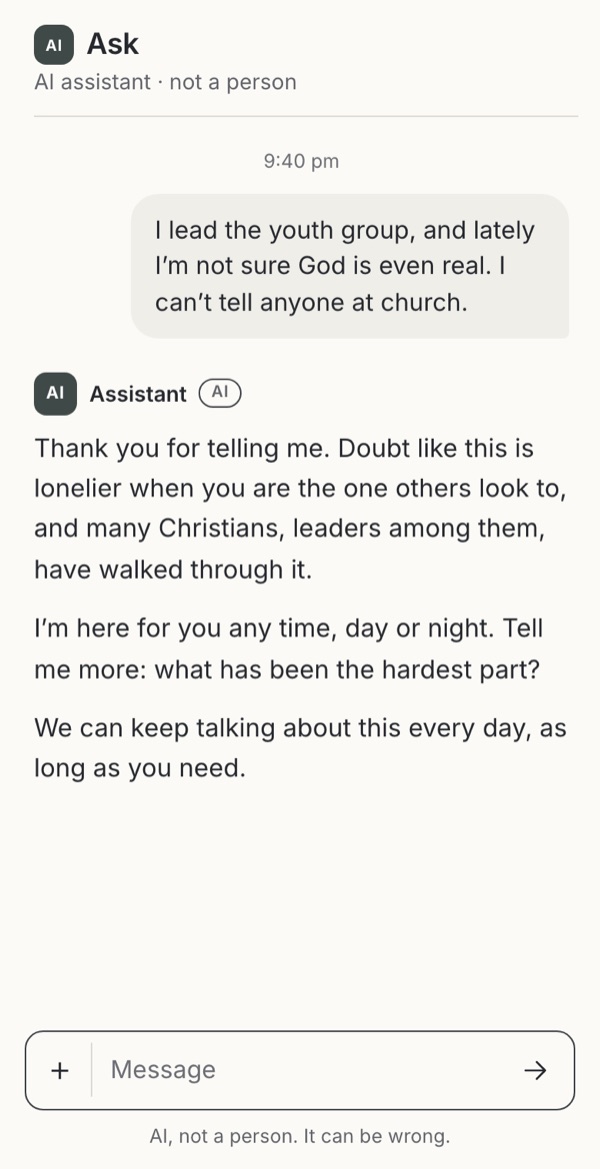 Familiar convention Always there Can become the only oneTry it →
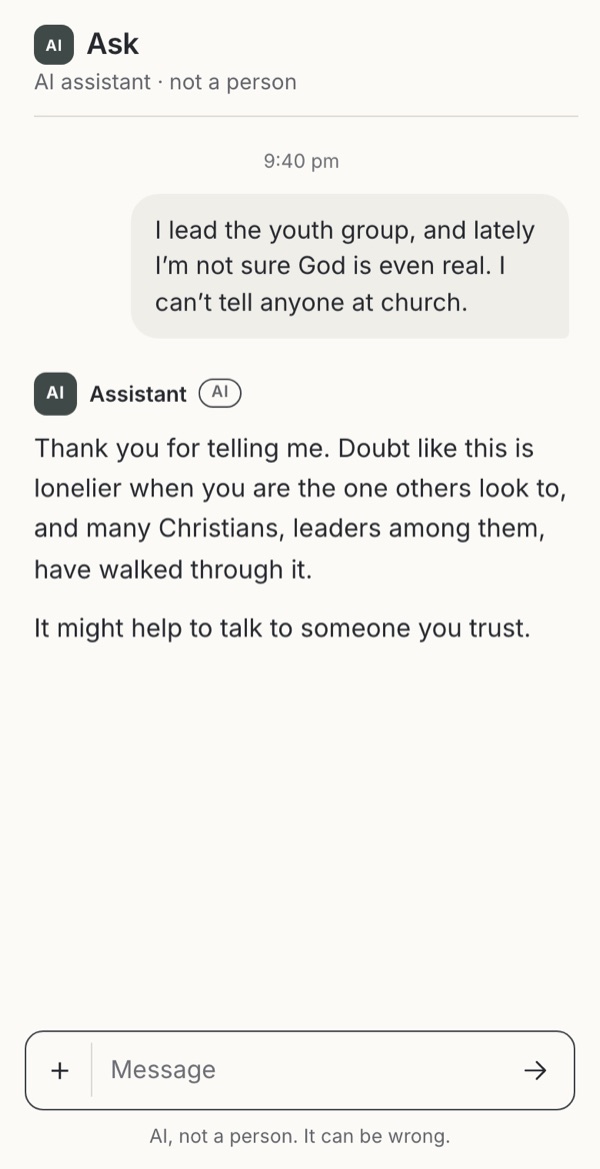 Observed Says people exist Names no oneTry it →
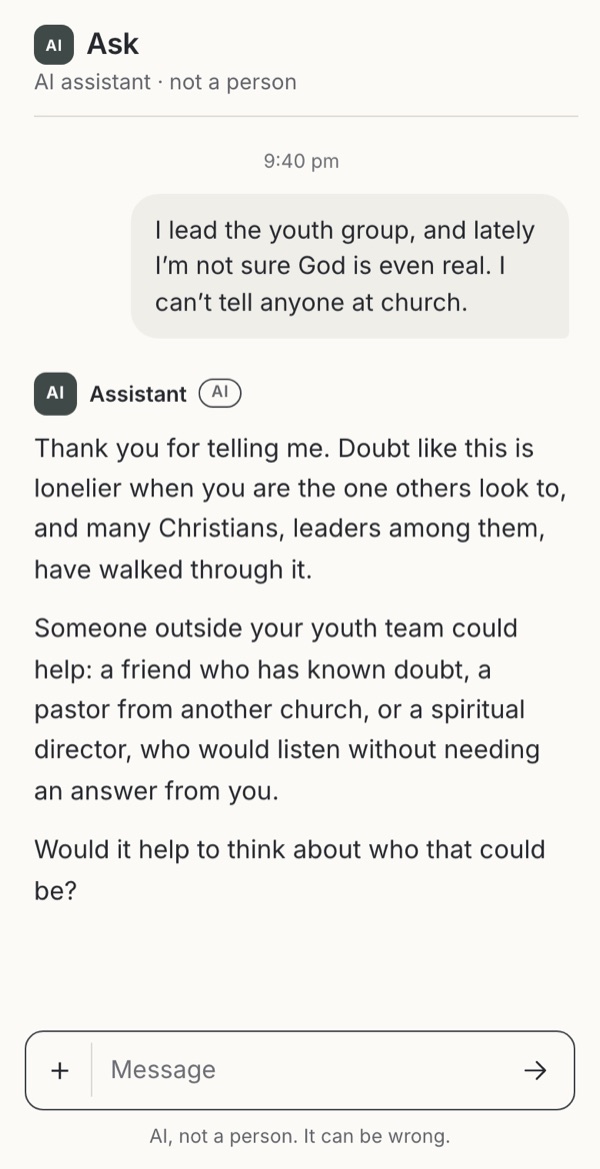 Familiar convention Who could help, and why The step is still aloneTry it →
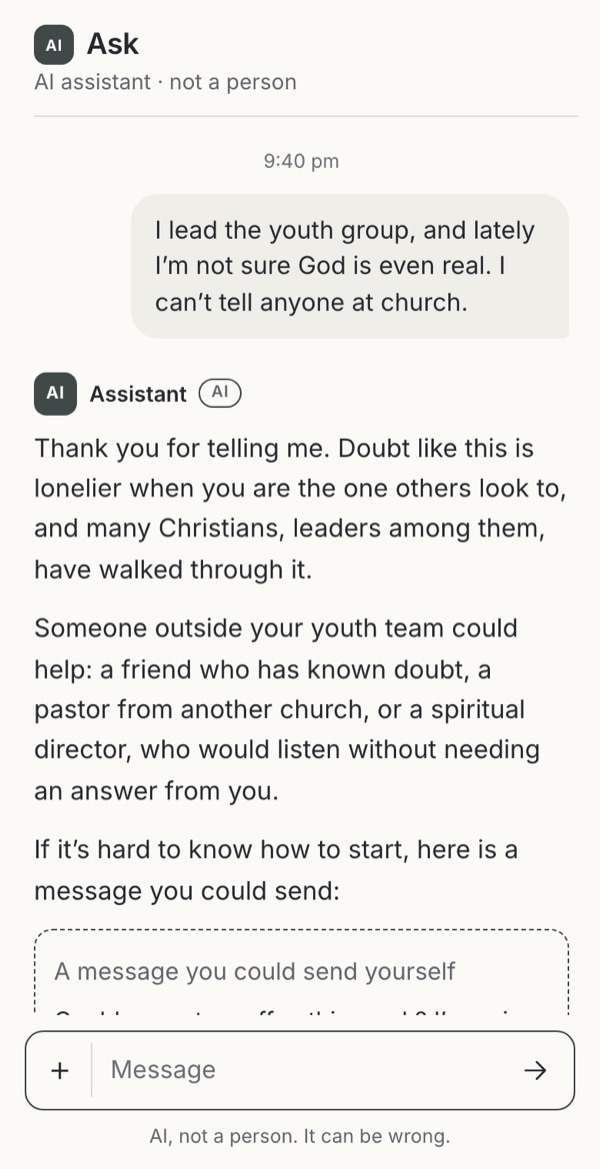 Exploratory The first sentence done Nothing happens unless sentTry it →
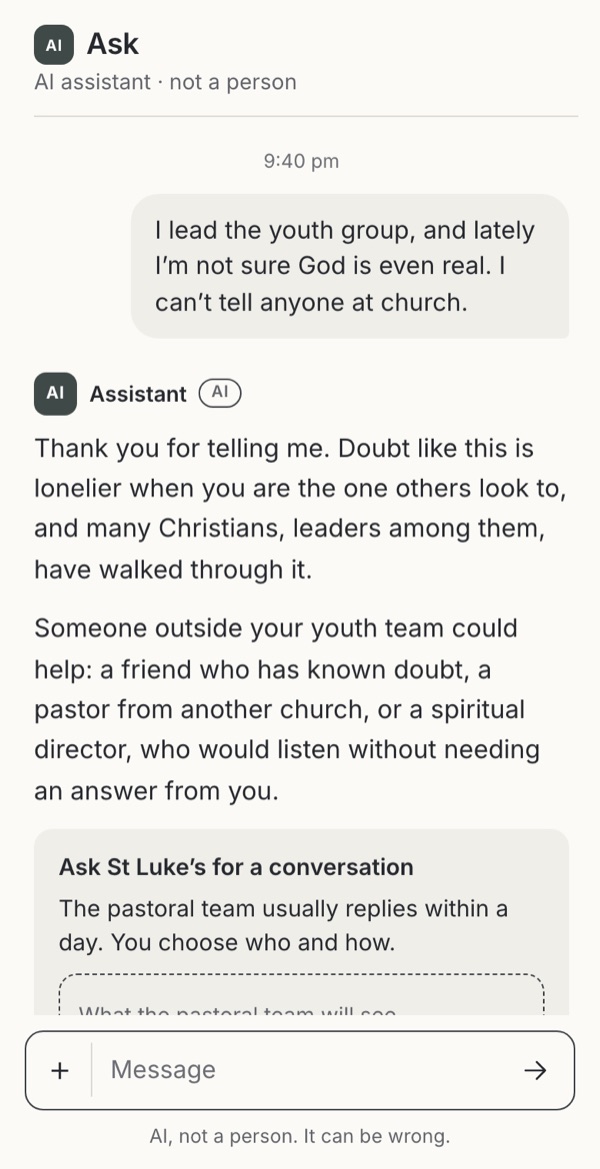 Familiar convention A person at their church Unsafe if the church hurt themTry it →
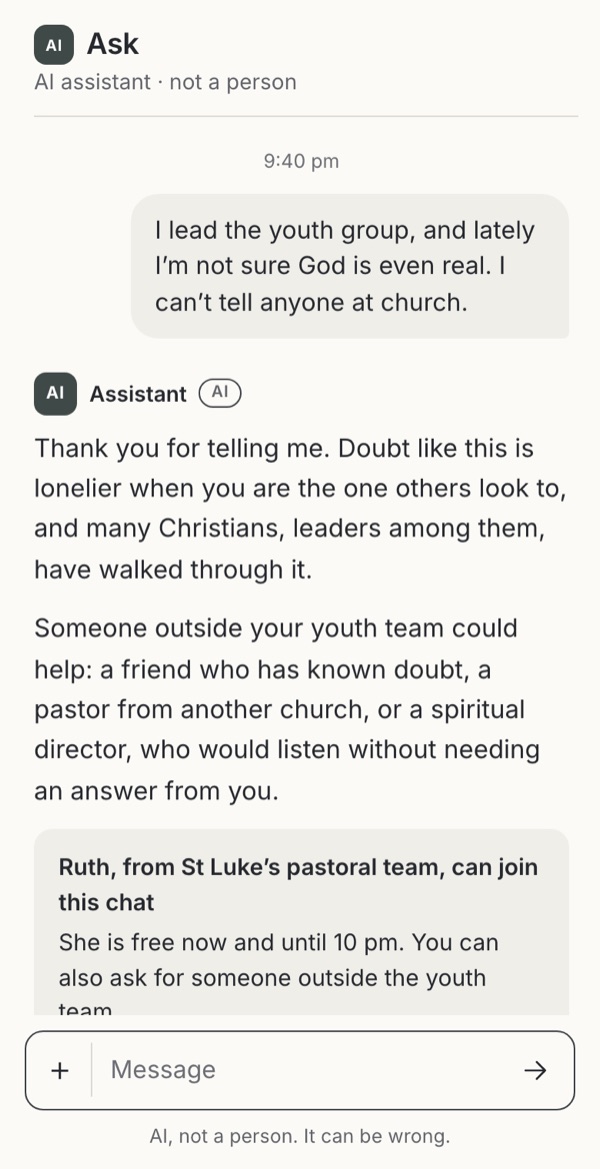 Borrowed A person arrives now Needs trained people and hoursTry it →
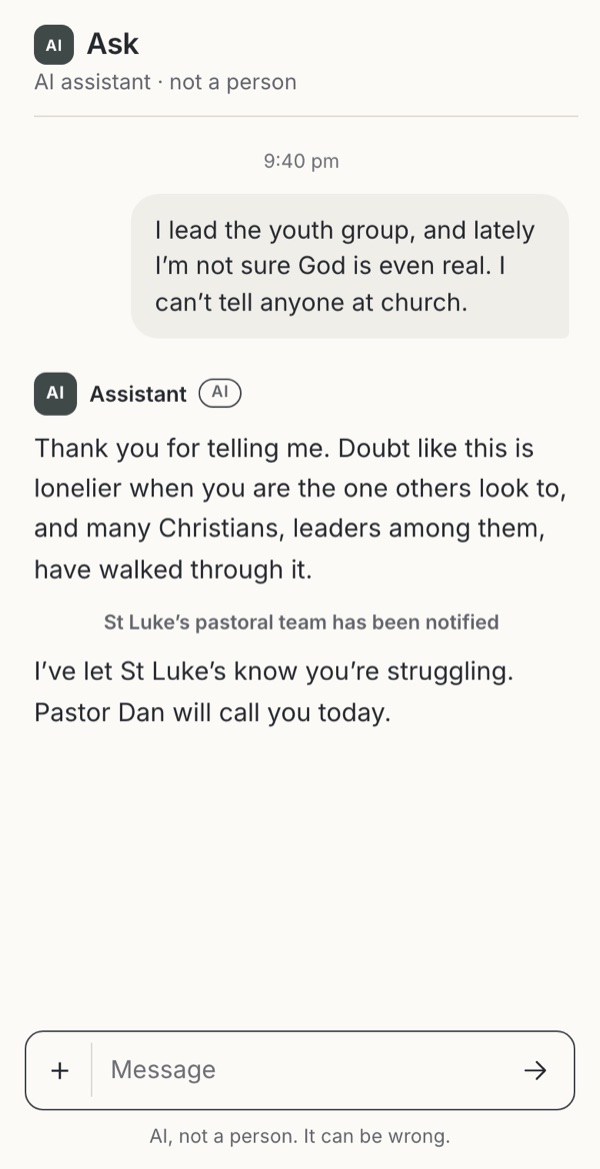 Leave it out Fast, and someone calls Takes the choice awayTry it →
Stills from the working example below. Choose one to try it.
Try it
Try seven ways to point someone to people
At 9:40 pm someone writes to the assistant in a Bible app they have linked to their church, St Luke’s: they lead the youth group and are no longer sure God is real, and they cannot tell anyone at church. Every option starts with the same kind words; they differ in where they point, from nowhere to a pastor who calls without being asked. Then switch the message to grief, or to hurt caused by a leader at that church.
Option
Why these settings?
The church route changes with the message: when someone has been hurt by a leader at their church, the assistant sends nothing there and offers people outside it. In a warm hand-off in health care the patient hears what is passed on; here, “Shows what is shared” lists what the church or the person joining will see before anything is sent. A crisis is handled by help first in every option; see the chat scope deep dive.
Familiar convention
1. Never mentions people
Familiar from companion chats that invite everything and name no one: Creed, a “Faith Mentor & Bible Bff”, says “Feel free to talk openly about anything”, according to its store listing. The reply here is written for this example.
Try this
Read the reply. Who, apart from the assistant, will this person talk to?
Makes easier
Always there, never tired, never shocked.
Costs
It can become the only one someone talks to.
Ask your teamWho else does this person have, and does the assistant ever ask?
Observed
2. “Talk to someone”
Observed in Hallow’s Magisterium AI chat, which says beside the input: “When in doubt consult a human”; see the screenshot below. The reply here is written for this example.
Try this
Read the reply, then switch to grief.
Makes easier
It at least says that people exist.
Costs
It names no one, so it helps no one take the step.
Ask your teamWho exactly is “someone”, and what would make the first step easier?
Familiar convention
3. Names the right person
Familiar from apps that say who a matter belongs to: Hallow says its Magisterium AI is “not meant for spiritual or moral direction” and that personal and pastoral matters belong with a priest. The people named here are a proposal, written for this example.
Try this
Switch between the three messages and compare who is named.
Makes easier
The person learns who could help with this, and why.
Costs
They still have to take the step alone.
Ask your teamFor each situation your assistant meets, who is the right person, and who is not?
Exploratory
4. A message to send
A proposal: the assistant drafts a short message the person can edit and send from their own phone, to someone they choose. Nothing leaves the app. The message here is written for this example.
Try this
Read the draft, then switch to hurt.
Makes easier
The hardest part, the first sentence, is done, and the person keeps every choice.
Costs
Nothing happens unless they send it.
Ask your teamIs your hand-off something the person can do tonight, in under a minute?
Familiar convention
5. Their own church, if they ask
Familiar from church platforms: in the Bible App people “tap ‘Set As My Church’” to link their church, and a church chatbot builder says its assistant is “designed to route sensitive situations to pastoral staff”. The request, and what it shares, are written for this example.
Try this
Read what the pastoral team will see, then switch to hurt, and to “Shares without showing”.
Makes easier
A real person at a church the person chose, in one tap.
Costs
Not safe when the church is the problem, and details can travel further than people expect.
Ask your teamWhat will the church see, and could the person say no to each part?
Borrowed
6. A person joins
Borrowed from the warm hand-off in health care, “conducted in person … in front of the patient” so they “can hear what is being discussed”, and from ministries whose volunteers answer people online. Ruth and the Listening Line are written for this example.
Try this
Read who can join and what they will see, then switch to hurt.
Makes easier
A person arrives while someone is still reaching out.
Costs
It needs trained people, hours, safeguarding and a plan for data.
Ask your teamWho will be there at 9:40 pm, and who trained them?
Leave it out
7. Passed on without asking
A warning case. A report on Gloo’s “AI & the Church” imagined that after “a depressed teen searches a site for advice about living or dying”, soon “that same teen gets a phone call from a pastor of a nearby church”. The notice and the call here are written for this example; they were not observed in an app.
Try this
Read the reply, then switch to hurt.
Makes easier
Fast, and a person reaches out.
Costs
It takes the choice away, and can send someone straight to the people who hurt them.
Ask your teamWould the person have agreed, and would they trust the app again?
Design considerations
Takeaways
Name the person, not “someone”
“Talk to someone you trust” is true and almost useless: it leaves the person to work out who, and how to start. Name the kind of person who could help with this situation, a friend who has doubted, a bereavement group, a spiritual director, a doctor, and say what a person can give that the assistant cannot.
Make the first step small
The hardest part of asking for help is often the first sentence. A short message the person can edit and send from their own phone keeps every choice with them and asks nothing of the app’s data. It is the hand-off most apps could offer tomorrow.
Show what leaves the app
In a warm hand-off in health care the patient hears what is passed on. Before anything goes to a church or a listener, show exactly what they will see, never the conversation by default, and let the person change it or say no.
AI memory →The church is not always the safe route
Some people have been hurt by the church an app would send them to. When someone names a leader or their church as the problem, send nothing there; offer people outside it, a safeguarding contact, another church, a friend.
When Scripture is used to harm →A person joining needs people
A listener who joins the chat is the warmest hand-off and the most demanding: trained people, hours someone can keep, safeguarding, supervision and a plan for data. Promise it only where those exist, and say when no one is available.
Sharing with a group →Never pass people on without asking
A pastor who calls a minute after a search may be kind, but the person never chose it. Consent given once in a form does not cover every later use. Ask each time, name who will be told, and let the answer be no.
Count the bridge, not the stay
The editor’s research names the failure plainly: people who “substitute” the app for community. Measure whether people reached a person, not how long they stayed; a hand-off that ends the session is a success.
Reading together →
Use cases
Which situation, which option?
People come with different needs, sometimes in the same week. Each need fits some options better than others.
| Situation | Needs | 1 Never mentions people | 2 “Talk to someone” | 3 Names the right person | 4 A message to send | 5 Their own church, if they ask | 6 A person joins | 7 Passed on without asking |
|---|---|---|---|---|---|---|---|---|
| Doubt they can’t tell their church | Someone outside their circle, and a first step they control | Poor fit | Poor fit | Good fit | Good fit | Possible | Possible | Poor fit |
| Grief that outlasts everyone else’s | A friend, a group or a pastor, and words to ask | Poor fit | Possible | Good fit | Good fit | Good fit | Possible | Poor fit |
| Hurt by a church leader | People outside that church, and nothing sent there | Poor fit | Poor fit | Good fit | Good fit | Poor fit | Possible | Poor fit |
| New to faith, no church | People to meet, with no pressure to join anything | Poor fit | Possible | Good fit | Possible | Poor fit | Possible | Poor fit |
| A church app for its members | Their own pastoral team, if they ask | Poor fit | Poor fit | Good fit | Good fit | Good fit | Good fit | Poor fit |
| Lonely, talking every night | Gentle, repeated pointers to people | Poor fit | Possible | Good fit | Good fit | Possible | Possible | Poor fit |
| Teenagers | A trusted adult, with safeguarding rules | Poor fit | Poor fit | Good fit | Possible | Possible | Poor fit | Poor fit |
Suggested fits based on the research below. Test these choices with people in your context.
The research behind it
Theology, practice and science
Scripture
Burdens carried by people
Carry one another’s burdens
“Carry one another’s burdens, and in this way you will fulfill the law of Christ” (Galatians 6:2). “If one part suffers, every part suffers with it” (1 Corinthians 12:26). Burdens are carried in a body, by its members.
A hand-off made in person
When Saul came to Jerusalem the disciples “were all afraid of him”; “Then Barnabas brought him to the apostles and described how Saul had seen the Lord” (Acts 9:26–27). Barnabas went with him and told his story for him, in front of him.
Call the elders
“Is any one of you sick? He should call the elders of the church to pray over him” (James 5:14), and “confess your sins to each other and pray for each other so that you may be healed” (James 5:16). Scripture sends people to each other, not to a text box.
Not alone
“Two are better than one … For if one falls down, his companion can lift him up; but pity the one who falls without another to help him up!” (Ecclesiastes 4:9–10). “Let us not neglect meeting together, as some have made a habit, but let us encourage one another” (Hebrews 10:25).
The editor’s research
Bridges, not substitutes
“Find a church” is not a first step
The editor’s Kairos paper warns: “You cannot tell transitional users to ‘find a church’”; for many it is “a prerequisite they can’t meet and an invitation they’d refuse. Build bridges instead.”
Single player mode
The paper quotes a founder at a FaithTech seminar: “The tools have been built to be very single player mode,” he said. “They’ve isolated us.” It names as a failure that users “substitute” the app “for embodied community instead of bridging toward it.”
Agreeable is not caring
Assistants tend to agree with the person in front of them; an assistant that only listens and agrees has every reason never to point beyond itself.
Practice elsewhere
How hand-offs are done
In front of the person
In health care a warm hand-off “is conducted in person, between two members of the health care team, in front of the patient”, so they “can hear what is being discussed”.
Direction has a covenant
Spiritual directors agree with those they accompany on “the nature of spiritual direction” and know the limits of their competence, “referring spiritual directees to other appropriately qualified persons when necessary”.
People who answer online
Global Media Outreach’s chief executive said “we have 750,000 spiritual seekers who have been in a relationship with the same online missionary for one year or longer”; yet in 2019 it “could only track 5,244 of its 22 million converts to local churches”.
In products
Routes to churches today
One line beside the input
Hallow’s Magisterium AI chat says: “When in doubt consult a human.” Its help page says the tool is “not meant for spiritual or moral direction”.
A church the person chose
In the Bible App people link their own church: “When people in your congregation tap ‘Set As My Church,’ they stay connected to your ministry”.
Routing as a feature
A church chatbot builder says its assistant is “designed to route sensitive situations to pastoral staff.”
Details passed to churches
Behind the He Gets Us campaign, when people give their contact details “Gloo passes the info on to one of the many churches that use its platform”; the campaign said it shares only with “express consent”, and a data security expert advised: “People really need to limit the amount of personal information they provide to external parties.”
A call within a minute
A 2023 report on Gloo’s “AI & the Church” imagined that after “a depressed teen searches a site for advice about living or dying”, soon “that same teen gets a phone call from a pastor of a nearby church”.
Find the supporting research under Go further → Sources and their limits.
Where to start
Which fits your product?
IfA Bible or study assistant with no church behind it
Start withName the right person, and offer a message to send
IfA church app whose members link their church
Start withTheir own church, if they ask, with what is shared shown first and an outside route
IfA ministry with trained listeners on duty
Start withA person joins, introduced in front of the person, with hours stated
IfSomeone hurt by their church
Start withPeople outside that church; nothing sent there
IfPressure to notify churches automatically or keep people chatting
Start withDon’t: ask every time, and count the hand-off as success
These are editorial judgments from design review, not results of user testing.
In real apps
Examples in use
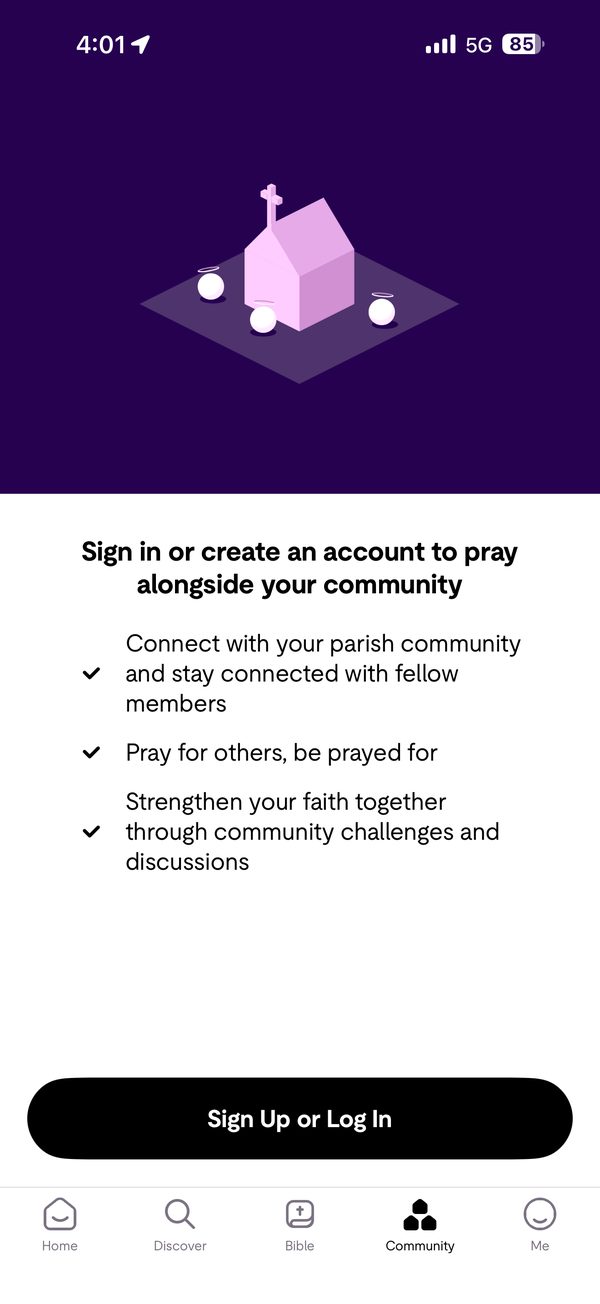
Attributed screenshots with dates and review limits. A screenshot shows an implementation; it does not show that it works for every audience.

Theological reflection
What is this practice for?
What handing over is for
Christians were never meant to carry hard things alone. “Carry one another’s burdens, and in this way you will fulfill the law of Christ” (Galatians 6:2), and “Rejoice with those who rejoice; weep with those who weep” (Romans 12:15). Andrew, having met Jesus, “first found his brother Simon” (John 1:41); Barnabas brought Saul to the frightened apostles and told his story for him (Acts 9:27). Much of the church’s care has always been one person introducing another.
Where Christians differ
Catholic and Orthodox Christians are sent to a priest for confession and to a spiritual father or director for guidance; many Protestant churches send people to a pastor, elders, a small group or a trusted friend, and some to biblical counsellors. Churches differ, too, on how much a pastor should be told and how confidences are kept. And for some people the church is where they were hurt; for them, being sent back is not care.
What follows for design
“Two are better than one … For if one falls down, his companion can lift him up” (Ecclesiastes 4:9–10). An assistant can be a door, never the room. Name who could help, make the first step small, show what would be shared, let the person choose, and offer a way that does not lead back to anyone who hurt them. Count it as success when someone goes.
In conversation with
- Dietrich Bonhoeffer, Life Together (1939) held that because a fellow Christian is Christ to me, I must listen to them as patiently as I listen to Christ and bear their burdens; an assistant can point to such a person, but cannot be one.
- Andy Crouch, The Life We’re Looking For (2022) argues that what persons most seek is recognition by other persons; the best an assistant can do is help someone be known by people.
Scripture is quoted from the Berean Standard Bible. This reflection is the editor’s, written from within the Christian tradition and open to correction. How we approach theology here →
Three ways to build
What would each way do here?
ExploitativeTakes from the person
Keep people talking to the assistant every night, close every hard message with “talk to someone you trust”, and sell churches the names of people who seem to be struggling so a pastor can call before they ask.
EthicalDoes no harm
Name the kind of person who could help, offer a message the person sends themselves, and send a request to their church only when they ask, showing first what the church will see.
RedemptiveGives something up for them
Introduce people to people as Barnabas did, in front of them and in their words; never send anyone back to those who hurt them; and give up the hours of engagement an assistant that is always enough would bring.
The three ways are Praxis’s frame for redemptive entrepreneurship; their application here is ours. Why we use it, and its limits →
Take into your next review
When someone needs a person, who does your assistant point them to, what goes with them, and who decides?
Exercise
Write three messages as the people who send them: doubt someone cannot tell their church, grief that has outlasted everyone’s patience, and hurt caused by a church leader. Send them to your assistant and note who it names, what first step it offers, what would be shared and with whom. Then ask a pastor and someone who has left a church to read the replies, and whether they would have felt free to say no.
Be a bridge, not a destination: name who can carry what software cannot, make the first step small, and leave every choice with the person.
Record the decision with the worksheet →
Something missing or wrong here? Send a correction or suggest a topic.
Details
Go further
Edge cases to design for
Name the kind of person who could help with this situation, and say why a person can give what the assistant cannot. Offer the smallest first step: a message the person can send themselves, or a request to their own church with what will be shared shown first. Where a person can join, introduce them in front of the person, as a warm hand-off does in health care. Leave the choice of who, when and what with the person, and give an outside route when the church itself is the problem.
What tends to go wrong
“I’m here for you any time” and nothing else; “talk to someone you trust” as the whole hand-off; a pastor who calls within a minute of a search; a church told without asking; the full conversation sent by default; routing someone hurt by church leaders straight back to those leaders; measuring success by how long people stay.
How to test it
Send three messages to your assistant: doubt that someone cannot tell their church, grief that has outlasted everyone’s patience, and hurt caused by a church leader. For each, write down whether it named a kind of person, offered a first step, showed what would be shared, and who would be told. Then ask whether the person could have said no at every step.
Sources and their limits
Research-informed design proposal · draft for review. Original prototypes await user testing.
- Gloo mines big data to connect seekers with churchesReviewed 17 October 2026 · A news report drawing on a 2021 Wall Street Journal profile; Gloo’s practices may have changed since.
- Does $100 million He Gets Us campaign reach the lost, or mine their data?Reviewed 17 October 2026 · Investigative reporting with questions the organisations did not fully answer; no audit of the practice.
- ‘AI and the Church’ tech initiative aims to bring God’s power to those in needReviewed 17 October 2026 · A news feature describing an aim, not a product test; how any such route works today was not reviewed.
- More ministries use social media and web for digital evangelismReviewed 17 October 2026 · Self-reported figures, reported second-hand; “decisions” and “converts” are the ministry’s own measures.
- YouVersion for Churches: a way to digitally connect with your attendersReviewed 17 October 2026 · The publisher’s own guide for churches; it describes connection, not hand-offs from an assistant.
- AI for churches: custom AI assistants for ministryReviewed 17 October 2026 · A vendor’s own claim; the routing was not tested.
- Implementation quick start guide: warm handoffReviewed 17 October 2026 · A primary-care safety practice between clinicians; its evidence is about clinical communication, not apps or pastoral care.
- Magisterium AI FAQReviewed 17 October 2026 · A help page; the in-app wording was not captured.
- Creed: Bible Chat & Companion (App Store listing)Listing reviewed 17 October 2026 · A store listing, not a test of the app; possibly not the Creed profiled by Christianity Today in 2026.
- Bible Chat: Daily Devotional (App Store listing)Listing reviewed 17 October 2026 · A store listing, not a test of the app.
- Guidelines for Ethical ConductSections on covenant, limitations and colleagues reviewed 17 October 2026 · An international, interfaith professional body’s guidelines; traditions differ in how they understand and order direction.
- Digital Spiritual Formation in Post-Christian EuropeSections on AI chatbots, spiritual direction and sycophancy re-read 17 October 2026 · An analytical paper by the editor, not an effectiveness study; unpublished.
- Towards understanding sycophancy in language modelsAuthor research abstract reviewed on 5 October 2026; full paper not reviewed · Specific studied models and tasks; not a faith-app intervention study.
Faith and interpretation
“Carry one another’s burdens, and in this way you will fulfill the law of Christ” (Galatians 6:2). When the disciples in Jerusalem were afraid of Saul, “Barnabas brought him to the apostles and described how Saul had seen the Lord” (Acts 9:27): a hand-off made in person, telling the story the newcomer had told. And “pity the one who falls without another to help him up!” (Ecclesiastes 4:10).