

Bible BFF · User-contributed screenshot · resized, content unchanged
“Biblical advice” from a friend
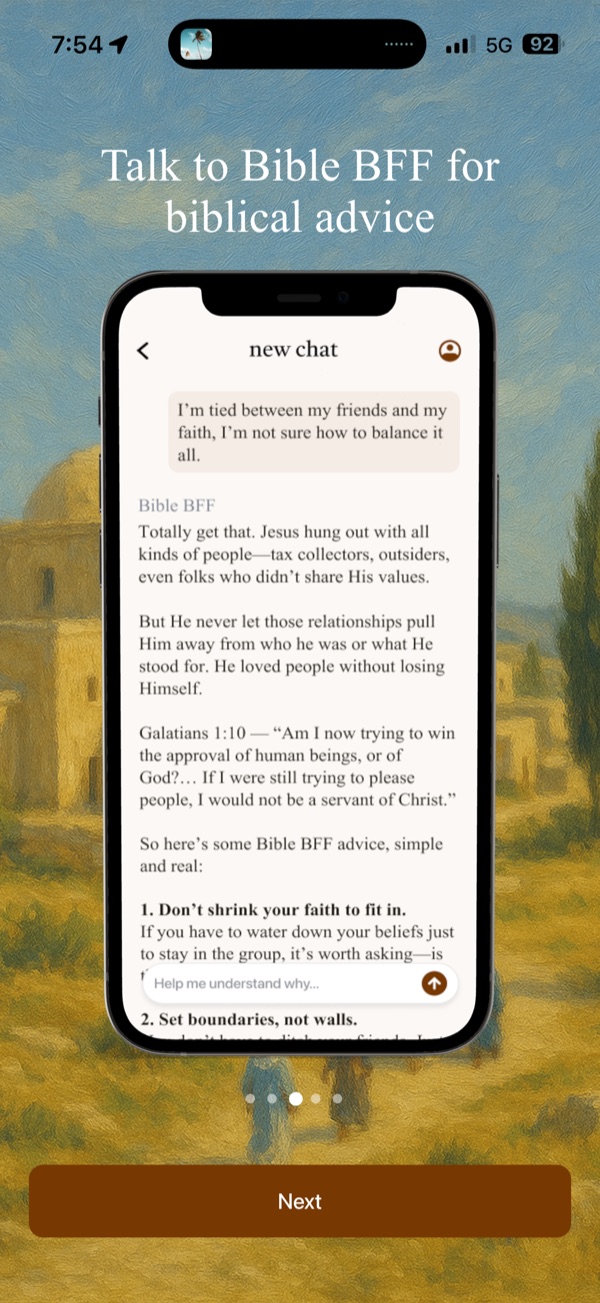
An onboarding slide reads “Talk to Bible BFF for biblical advice” over a chat mockup: “I’m torn between my friends and my faith” is answered by “Bible BFF” in a casual voice (“Totally get that…”), quoting Galatians 1:10 and listing “Bible BFF advice, simple and real”. The next slide quotes a review: “like a religious friend who can explain anything about the Bible”.
Observed in Bible BFF: app profile, research screenshots and design review.
Design takeaway
A best-friend name and casual voice sell closeness, and “can explain anything” sets expectations no assistant can meet. Make the AI and its limits as visible as the friendship.
What this example establishes
An onboarding slide reads “Talk to Bible BFF for biblical advice” over a chat mockup: “I’m torn between my friends and my faith” is answered by “Bible BFF” in a casual voice (“Totally get that…”), quoting Galatians 1:10 and listing “Bible BFF advice, simple and real”. The next slide quotes a review: “like a religious friend who can explain anything about the Bible”.
Limits and further verification
A still image shows one interface state. Gestures, timing, accessibility, persistence and what happens next were not tested. App version not recorded.
Provenance
- Platform
- iOS app · device model not recorded
- Image origin
- User-contributed screenshot · resized, content unchanged
- Source or capture date
- Captured 29 August 2025 · from embedded image metadata
- Reviewed
- 6 October 2026
- Version
- Not recorded
Screenshot captured by Tobias Treppmann for his app-pattern research and supplied for this design reference. Resized for the web; content unchanged. Interface, imagery and Scripture text remain the property of their respective rights holders.
Compare the relevant patterns
How human the assistant seems
From a plain tool with no name, through labelled and named assistants, to personas, companions and chatbots speaking as Jesus: decide how much personhood an AI in a faith app performs, and make what it is as clear as how it sounds.
Research-informed design proposal116 · Conversation and contentAI personas and roles
From answers with no speaker, through a guide, a friend and a church’s teaching, to a pastor, a saint and Christ himself: decide whose voice an AI in a faith app speaks in, what authority that voice borrows, and what it says when someone asks who it really is.
Research-informed design proposal · draft for review118 · Conversation and contentWhat the assistant talks about
From the passage in front of the reader, through the Bible and Christian faith, everyday life and hard days, to a therapist, a spiritual companion and anything at all: decide what the assistant takes on, say it before the first message, and decide what someone meets when they bring more than it can hold.
Research-informed design proposal · draft for review121 · Conversation and contentAgreeing and pushing back
From always taking someone’s side, through comfort, a gentle addition, a question back and a named disagreement, to plain correction and rebuke: decide when the assistant agrees, when it holds its ground, and how it says so.
Research-informed design proposal · draft for review