Research · landscape
A landscape of faith and Bible apps
160 apps, communities and tools for Scripture, prayer and Christian practice, on one poster and in five views. See which practices each product serves, how far AI reaches, who the products say they are for, and who pays for them.
- 160 selected products
- 325 sources read
- Checked 8 November 2026
Why a landscape
Across this resource we ask one practical question: when do proven attention, growth and subscription practices fit a faith product, and when do they cross a line? The answer depends on context: the practice, the person, the tradition, and who carries the cost. This landscape shows that context across the field, so your team can see where a product sits and which pressures come with that place.
Read this first
- A selected landscape, not market share. Products were chosen to show the range of the field, not counted or ranked.
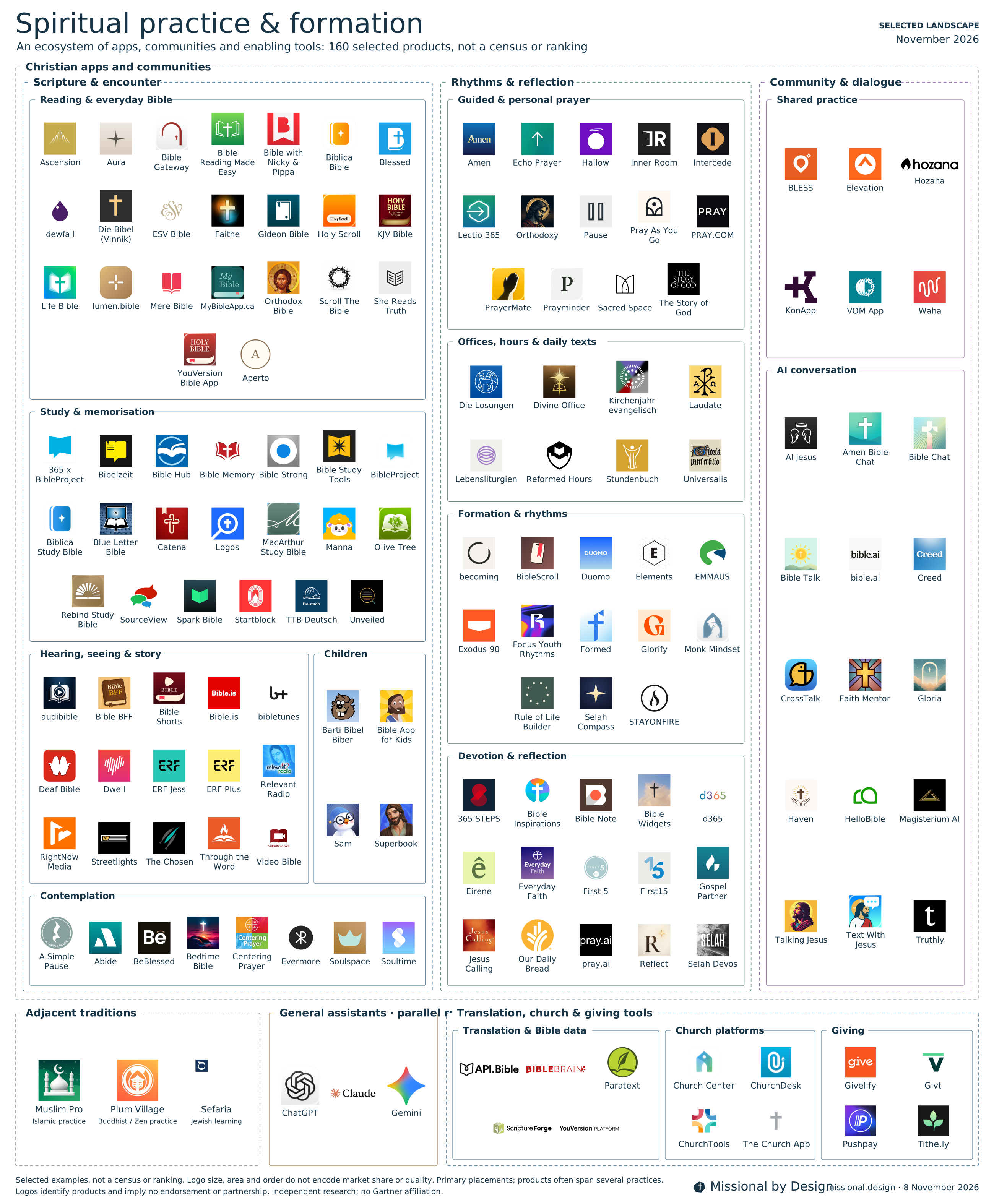
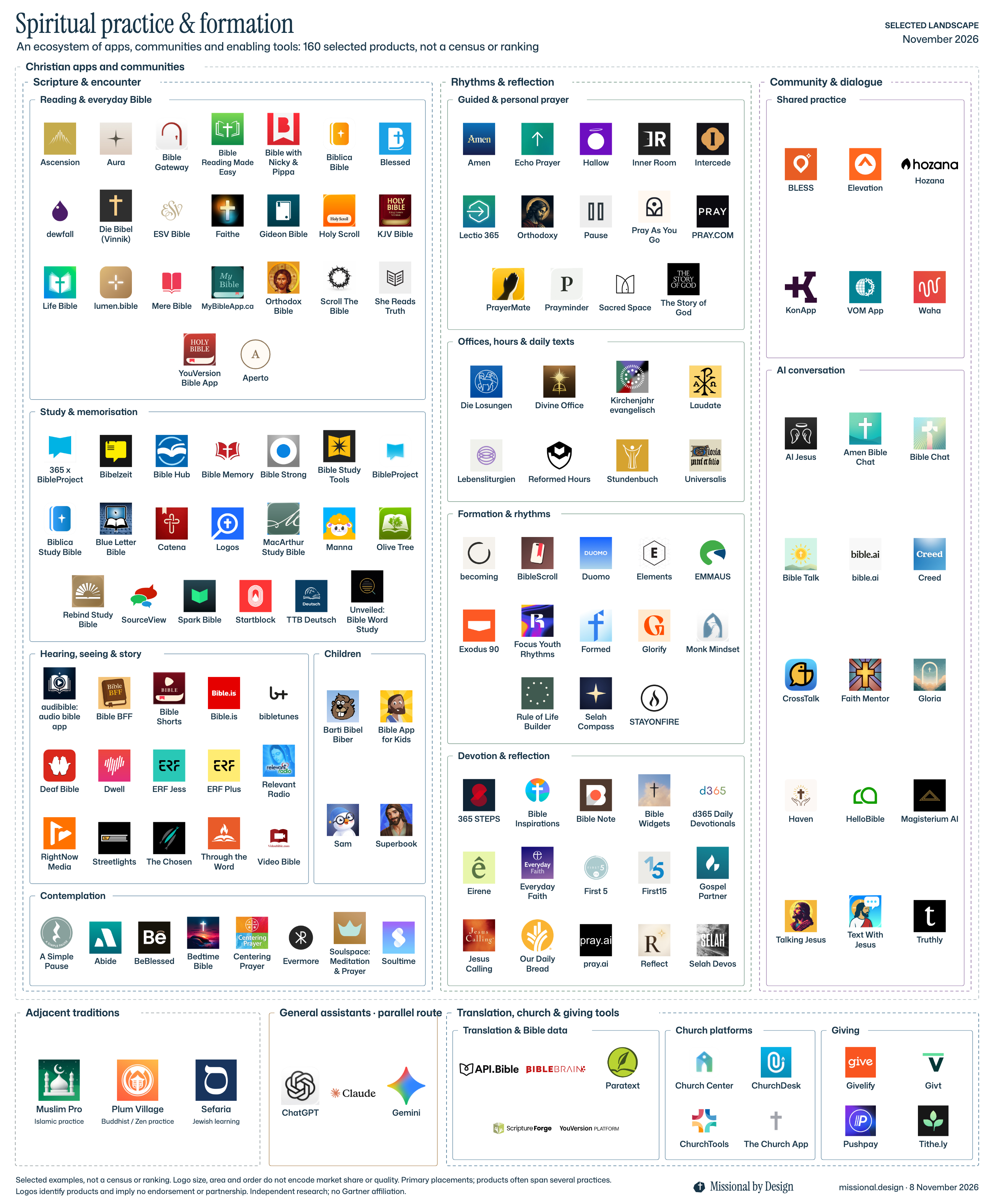
- Size and position mean nothing. Logo size, order and position never encode quality, adoption or reach. Order within a box is alphabetical.
- Provider claims, as stated. Every placement rests on the App Store listing or the provider’s own page. Nothing was installed, bought, signed into or tested.
- Checked 8 November 2026. Listings change, so a product may describe itself differently today.
- Uneven coverage. The selection leans on the US App Store and is thin outside Europe and North America. A product missing here is unknown to this map, not absent from the field.
- Logos identify products and imply no endorsement. They remain the property of their owners.
Seven ways in
The poster, five views and the records
 Poster160 products in nested practice families141 Christian apps and communities form the main field, with 3 products from other traditions, 3 general AI assistants and 13 translation, church and giving tools beneath.
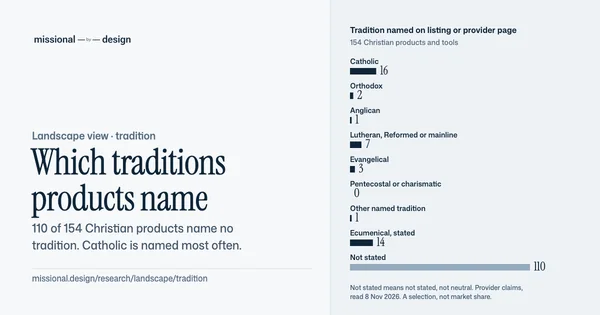 TraditionWhich traditions the products say they serve110 of the 154 Christian products and tools name no tradition on their listing or provider page.
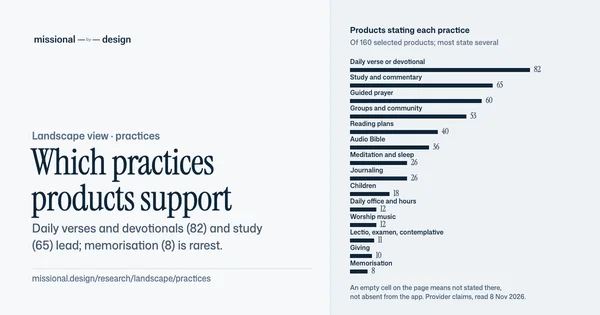 PracticesWhich practices each product says it supportsDaily verse or devotional (82) and study and commentary (65) are the most common stated practices.
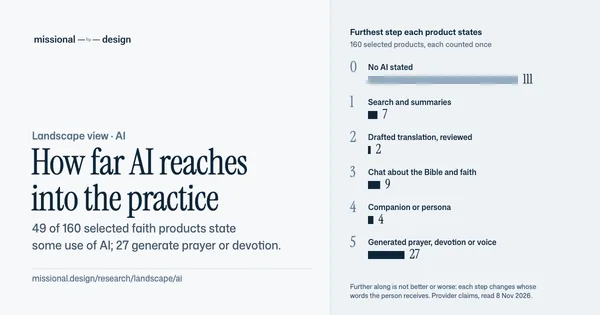 AIHow far AI reaches into the practice49 of 160 products state some use of AI.
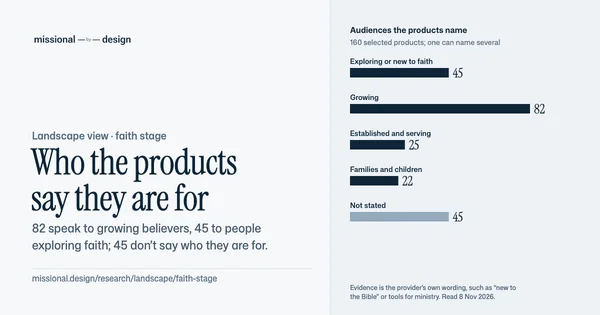 Faith stageWho the products say they are for45 products address people exploring or new to faith, 82 speak to growing believers, 25 to leaders, clergy or scholars, and 22 to families and children.
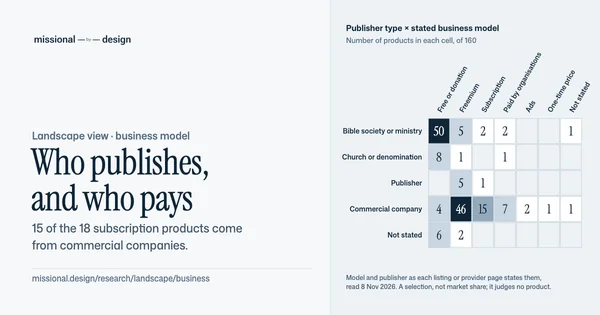 Business model × publisherWho publishes the product, and how it is paid for15 of the 18 subscription products come from commercial companies.
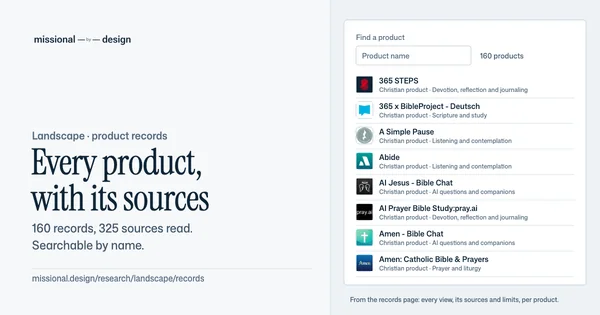 Product recordsProduct records160 records with 325 sources, searchable by name.
Method
How the landscape was made
Selection
A purposive selection from our app library, a tracked market list and further leads, including European and German-language products on merit, because US ratings underplay them. It is not a census. Giving and church platforms are included as the setting many congregations work in. The unit is a named product, not a company.
Placement
Practice families answer “what does this product help someone do?”. Each product has one editorial main place on the poster and often belongs to several families; the record explains the overlaps. Nested boxes connect related practices. They do not imply ownership, partnership, theological agreement, or a progression from lesser to better practices.
Evidence
Practice-family placements rest on listings and provider pages read between 2 and 8 November 2026; the five views rest on pages read on 8 November 2026. Tradition is never inferred from a name. Not stated means not stated, not neutral. Scale claims such as “#1” or download counts were not used.
Limits
No app workflow, AI answer, privacy behaviour, theological accuracy or spiritual outcome was tested. Being on the map is not a recommendation, and a product’s place says nothing about how well it serves people. For the history behind today’s field, read waves of Bible and faith apps.
Data: all 160 records as JSON. Poster: SVG · PNG, 2600 × 3150. Logos are the products’ own App Store icons or official marks, shown unaltered to identify each product; they imply no endorsement or affiliation, and inclusion grants no permission for other reuse. Independent research; no Gartner affiliation, quadrant scores or rankings.