Faith · User-contributed screenshot · resized, content unchanged
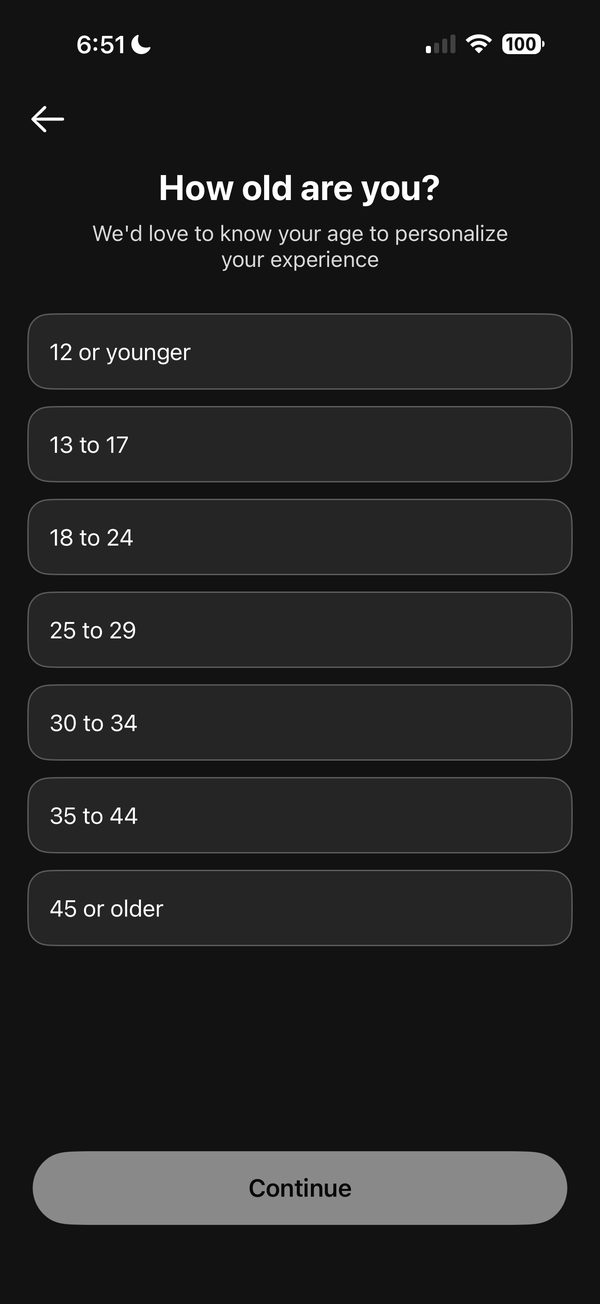
“How old are you?” during setup
“How old are you?” and “We’d love to know your age to personalize your experience”, above ranges from “12 or younger” to “45 or older”, and a Continue button.
Design takeaway
An age question can protect children, or simply profile people. Say which it is, and what changes for a child; see the coming deep dive on children and families.
What this example establishes
“How old are you?” and “We’d love to know your age to personalize your experience”, above ranges from “12 or younger” to “45 or older”, and a Continue button.
Limits and further verification
A still image shows one interface state. Gestures, timing, accessibility, persistence and what happens next were not tested. App version not recorded.
Provenance
- Platform
- iOS app · device model not recorded
- Image origin
- User-contributed screenshot · resized, content unchanged
- Source or capture date
- Captured 27 September 2025 · from embedded image metadata
- Reviewed
- 6 October 2026
- Version
- Not recorded
Screenshot captured by Tobias Treppmann for his app-pattern research and supplied for this design reference. Resized for the web; content unchanged. Interface, imagery and Scripture text remain the property of their respective rights holders.
Compare the relevant patterns
First use
From opening on a passage, a prayer or a question box with nothing asked, through a first page of places to start, guest use and a short tour, to questions first and payment before the first use: decide what a new person must give, and when, before they reach what they came for.
Research-informed design proposal · draft for review107 · Habits and spiritual formationCheck-ins and assessments
From a few setup questions that only shape what the app suggests, through a daily check-in, a gifts inventory and a church survey, to a spiritual score as a warning case: decide what each question is for, what is kept, who sees a result, and how much the result claims to know.
Research-informed design proposal113 · Habits and spiritual formationChildren and families
From a story read aloud with a grown-up, through family time in a general app, a children’s Bible app and games with episodes, to a youth group app with a leader and a child alone with an AI or a public community: decide who is with the child, what the app collects, how it holds attention, and what happens when a child says something worrying.
Research-informed design proposal · draft for review