

Faith · User-contributed screenshot · resized, content unchanged
A companion chat with a call button
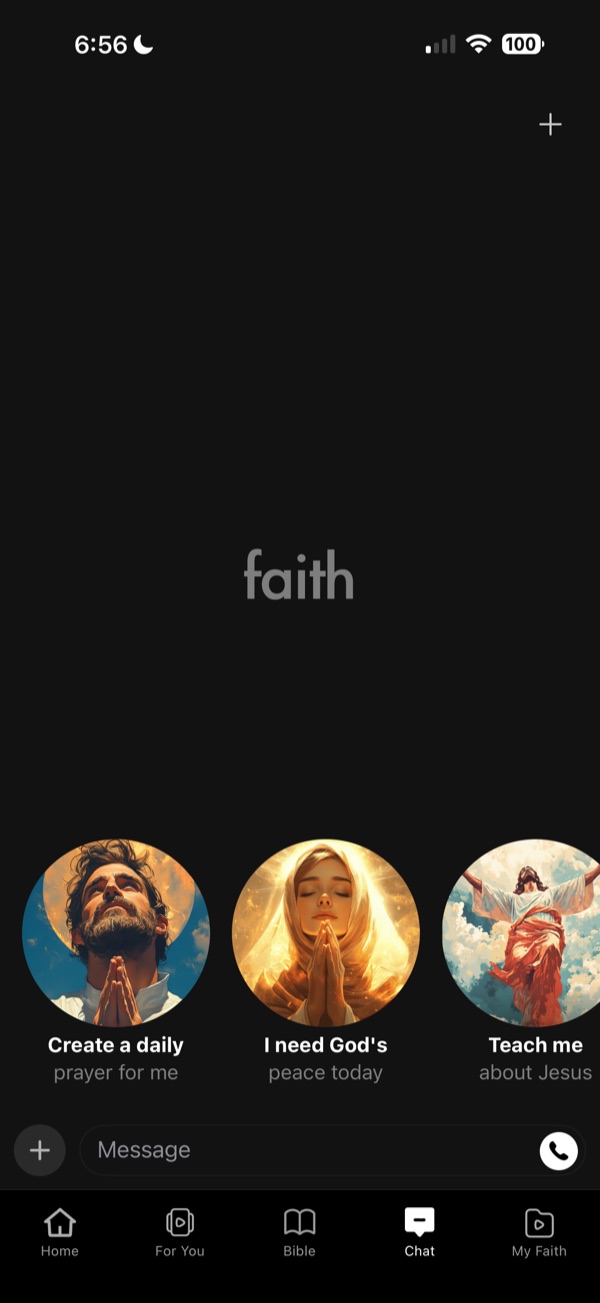
The Chat tab is empty except for a faint “faith” wordmark, three painted portraits of praying figures and Jesus as suggestion cards (“Create a daily prayer for me”, “I need God’s peace today”, “Teach me about Jesus”), and a Message field with a phone icon for a voice call.
Design takeaway
Portraits of praying people and of Jesus stand where a sender would be, and a call button suggests someone to ring. Test who people think they are talking to, and label the AI before the first message.
What this example establishes
The Chat tab is empty except for a faint “faith” wordmark, three painted portraits of praying figures and Jesus as suggestion cards (“Create a daily prayer for me”, “I need God’s peace today”, “Teach me about Jesus”), and a Message field with a phone icon for a voice call.
Limits and further verification
A still image shows one interface state. Gestures, timing, accessibility, persistence and what happens next were not tested. App version not recorded.
Provenance
- Platform
- iOS app · device model not recorded
- Image origin
- User-contributed screenshot · resized, content unchanged
- Source or capture date
- Captured 27 September 2025 · from embedded image metadata
- Reviewed
- 6 October 2026
- Version
- Not recorded
Screenshot captured by Tobias Treppmann for his app-pattern research and supplied for this design reference. Resized for the web; content unchanged. Interface, imagery and Scripture text remain the property of their respective rights holders.
Compare the relevant patterns
How human the assistant seems
From a plain tool with no name, through labelled and named assistants, to personas, companions and chatbots speaking as Jesus: decide how much personhood an AI in a faith app performs, and make what it is as clear as how it sounds.
Research-informed design proposal116 · Conversation and contentAI personas and roles
From answers with no speaker, through a guide, a friend and a church’s teaching, to a pastor, a saint and Christ himself: decide whose voice an AI in a faith app speaks in, what authority that voice borrows, and what it says when someone asks who it really is.
Research-informed design proposal · draft for review120 · Conversation and contentSpiritual acts and AI
From an assistant that says it cannot pray and points to God and to people, through the church’s own words, help to find one’s own and a prayer written for someone, to an AI that prays “with” them, promises to pray for them, or blesses, assures and absolves: decide which spiritual acts the assistant may perform, which it may only describe, and how it hands people over to those who can pray with them.
Research-informed design proposal · draft for review126 · Conversation and contentWhen the assistant writes first
From an assistant that waits to be asked, through a check-in the person set in their own words, the app’s own reminder, a daily page built from memory and a follow-up on something shared, to a persona that says it misses them and an app that tells their friends: decide who may start a conversation, about what, and what happens when it goes unanswered.
Research-informed design proposal · draft for review