Hallow · User-contributed screenshot · resized, content unchanged
The day named before its readings
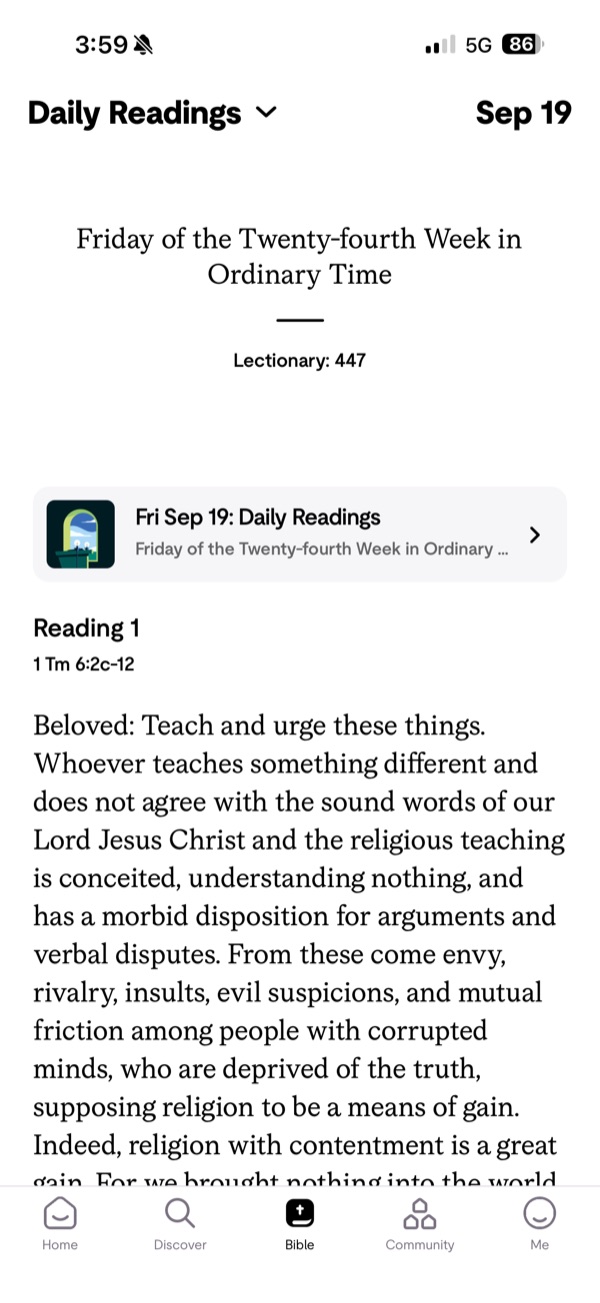
Daily Readings for Sep 19 open with “Friday of the Twenty-fourth Week in Ordinary Time” and “Lectionary: 447” above Reading 1 (1 Tm 6:2c-12) in full.
Design takeaway
Naming the liturgical day and the lectionary number tells people whose calendar supplied the readings. Make the calendar itself (here the Roman Catholic lectionary for the United States) as findable as the date.
What this example establishes
Daily Readings for Sep 19 open with “Friday of the Twenty-fourth Week in Ordinary Time” and “Lectionary: 447” above Reading 1 (1 Tm 6:2c-12) in full.
Limits and further verification
A still image shows one interface state. Gestures, timing, accessibility, persistence and what happens next were not tested. App version not recorded.
Provenance
- Platform
- iOS app · device model not recorded
- Image origin
- User-contributed screenshot · resized, content unchanged
- Source or capture date
- Captured 19 September 2025 · from embedded image metadata
- Reviewed
- 6 October 2026
- Version
- Not recorded
Screenshot captured by Tobias Treppmann for his app-pattern research and supplied for this design reference. Resized for the web; content unchanged. Interface, imagery and Scripture text remain the property of their respective rights holders.