

Hallow · User-contributed screenshot · resized, content unchanged
Limits stated beside the input
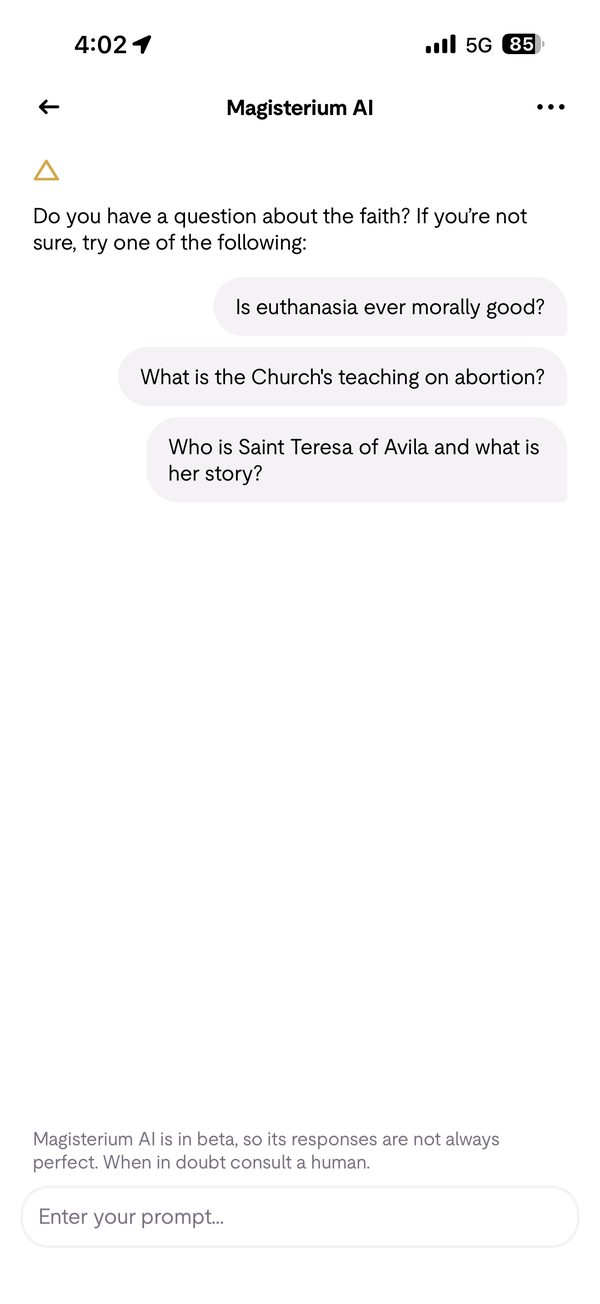
A “Magisterium AI” chat suggests questions such as “Is euthanasia ever morally good?”, “What is the Church’s teaching on abortion?” and “Who is Saint Teresa of Avila and what is her story?”. Above the input: “Magisterium AI is in beta, so its responses are not always perfect. When in doubt consult a human.”
Observed in Hallow: app profile, research screenshots and design review.
Design takeaway
A limit stated next to where people type is more likely to be read than one in onboarding. Pair it with a real route to a person, and with how sensitive moral questions are handled.
What this example establishes
A “Magisterium AI” chat suggests questions such as “Is euthanasia ever morally good?”, “What is the Church’s teaching on abortion?” and “Who is Saint Teresa of Avila and what is her story?”. Above the input: “Magisterium AI is in beta, so its responses are not always perfect. When in doubt consult a human.”
Limits and further verification
A still image shows one interface state. Gestures, timing, accessibility, persistence and what happens next were not tested. App version not recorded.
Provenance
- Platform
- iOS app · device model not recorded
- Image origin
- User-contributed screenshot · resized, content unchanged
- Source or capture date
- Captured 19 September 2025 · from embedded image metadata
- Reviewed
- 6 October 2026
- Version
- Not recorded
Screenshot captured by Tobias Treppmann for his app-pattern research and supplied for this design reference. Resized for the web; content unchanged. Interface, imagery and Scripture text remain the property of their respective rights holders.
Compare the relevant patterns
Identify what AI did, where it matters
Label the actor, action and artifact at the moment they could be misunderstood.
Research-informed design proposal78 · Study and annotationsCitations in AI answers
A citation is a route to supporting material, with source type and limitations visible.
Research-informed design proposal124 · Conversation and contentSaying “I don’t know”
From an assistant that answers everything with the same confidence, through a warning in the fine print and a confidence level on each answer, to answers that say which parts are Scripture, which are a tradition’s teaching and which are a guess, an honest “I don’t know”, and declining to answer: decide how the assistant shows the limits of what it knows.
Research-informed design proposal · draft for review125 · Conversation and contentHanding over to people
From never mentioning people, through a generic “talk to someone” and naming the right kind of person, to a drafted message, a request to the person’s own church, a person who joins the chat, and the warning case of an app that passes people on without asking: decide who the assistant hands people to, what goes with them, and who decides.
Research-informed design proposal · draft for review