HelloBible · User-contributed screenshot · resized, content unchanged
A separate consent for using faith data with a partner AI
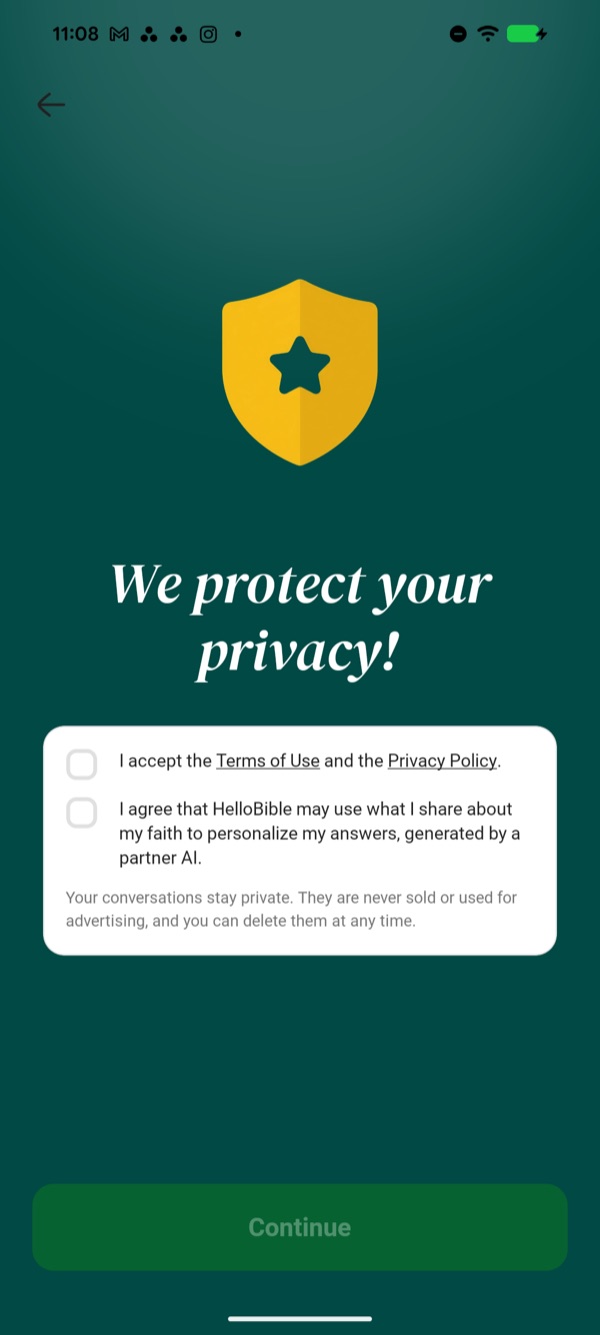
Before an account is created, “We protect your privacy!” shows two unticked boxes: accepting the Terms of Use and Privacy Policy, and agreeing “that HelloBible may use what I share about my faith to personalize my answers, generated by a partner AI.” Below: “Your conversations stay private. They are never sold or used for advertising, and you can delete them at any time.”
Design takeaway
A separate, unticked consent for faith data matches GDPR’s explicit consent for religious belief. Name the AI partner and where data is processed, and check that the app still works for someone who declines the second box.
What this example establishes
Before an account is created, “We protect your privacy!” shows two unticked boxes: accepting the Terms of Use and Privacy Policy, and agreeing “that HelloBible may use what I share about my faith to personalize my answers, generated by a partner AI.” Below: “Your conversations stay private. They are never sold or used for advertising, and you can delete them at any time.”
Limits and further verification
A still image shows one interface state. Gestures, timing, accessibility, persistence and what happens next were not tested. App version not recorded.
Provenance
- Platform
- Android app · Pixel 8 Pro
- Image origin
- User-contributed screenshot · resized, content unchanged
- Source or capture date
- Captured 8 October 2026 · from embedded image metadata
- Reviewed
- 6 October 2026
- Version
- 2.7.2
Captured by the editor for this design reference during a signed-out onboarding, without accepting the terms. Resized for the web. Interface remains the property of HelloBox.
Compare the relevant patterns
Check-ins and assessments
From a few setup questions that only shape what the app suggests, through a daily check-in, a gifts inventory and a church survey, to a spiritual score as a warning case: decide what each question is for, what is kept, who sees a result, and how much the result claims to know.
Research-informed design proposal101 · Conversation and contentAI persona
From a plain tool with no name, through labelled and named assistants, to personas, companions and chatbots speaking as Jesus: decide how much personhood an AI in a faith app performs, and make what it is as clear as how it sounds.
Research-informed design proposal109 · Conversation and contentAI memory
From an assistant that keeps nothing, through context the person adds and a conversation they can see, to memory they switch on and can see item by item, and a profile the app builds from their prayers as a warning case: decide what the assistant may use, what it keeps, and whether the person can see and change it.
Research-informed design proposal