HelloBible · User-contributed screenshot · resized, content unchanged
“Precise and biblical answers to all your questions”
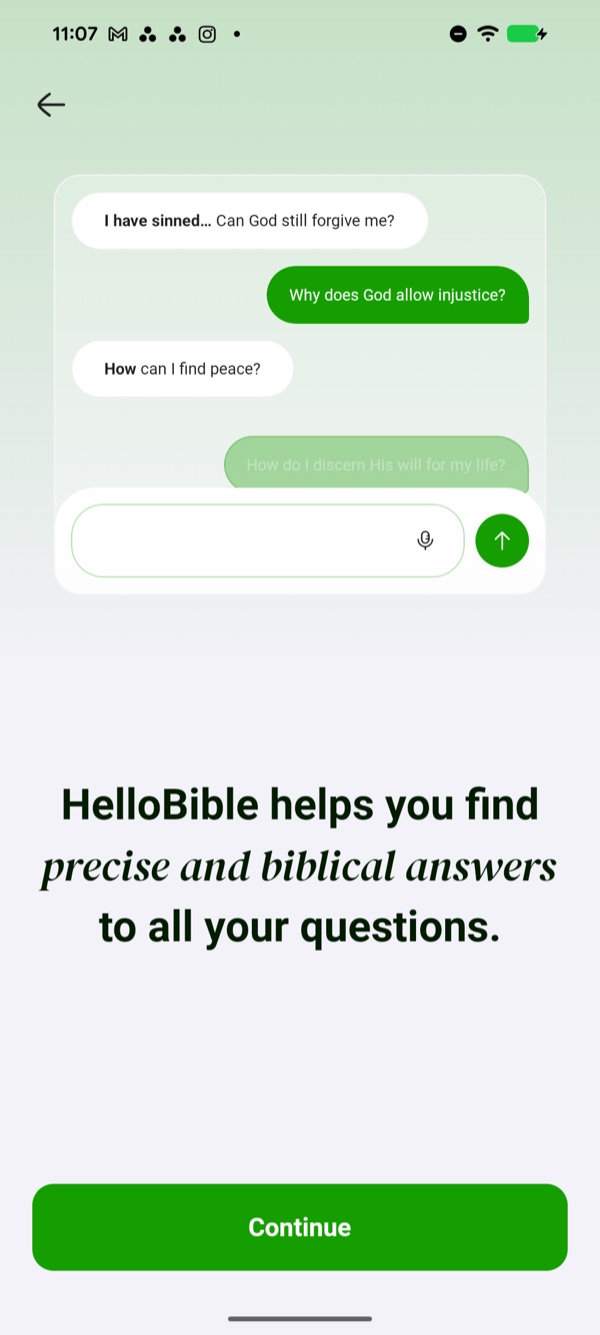
An onboarding slide shows chat bubbles (“I have sinned… Can God still forgive me?”, “Why does God allow injustice?”, “How can I find peace?”, “How do I discern His will for my life?”) above the claim “HelloBible helps you find precise and biblical answers to all your questions.”
Design takeaway
The questions are real and pastoral. Promising precise answers to all of them sets an expectation no source can meet; say whose tradition answers, and when a person should be asked instead.
What this example establishes
An onboarding slide shows chat bubbles (“I have sinned… Can God still forgive me?”, “Why does God allow injustice?”, “How can I find peace?”, “How do I discern His will for my life?”) above the claim “HelloBible helps you find precise and biblical answers to all your questions.”
Limits and further verification
A still image shows one interface state. Gestures, timing, accessibility, persistence and what happens next were not tested. App version not recorded.
Provenance
- Platform
- Android app · Pixel 8 Pro
- Image origin
- User-contributed screenshot · resized, content unchanged
- Source or capture date
- Captured 8 October 2026 · from embedded image metadata
- Reviewed
- 6 October 2026
- Version
- 2.7.2
Captured by the editor for this design reference during a signed-out onboarding, without accepting the terms. Resized for the web. Interface remains the property of HelloBox.
Compare the relevant patterns
Citations in AI answers
A citation is a route to supporting material, with source type and limitations visible.
Research-informed design proposal101 · Conversation and contentAI persona
From a plain tool with no name, through labelled and named assistants, to personas, companions and chatbots speaking as Jesus: decide how much personhood an AI in a faith app performs, and make what it is as clear as how it sounds.
Research-informed design proposal