Soultime · User-contributed screenshot · resized, content unchanged
A 61-statement personality test
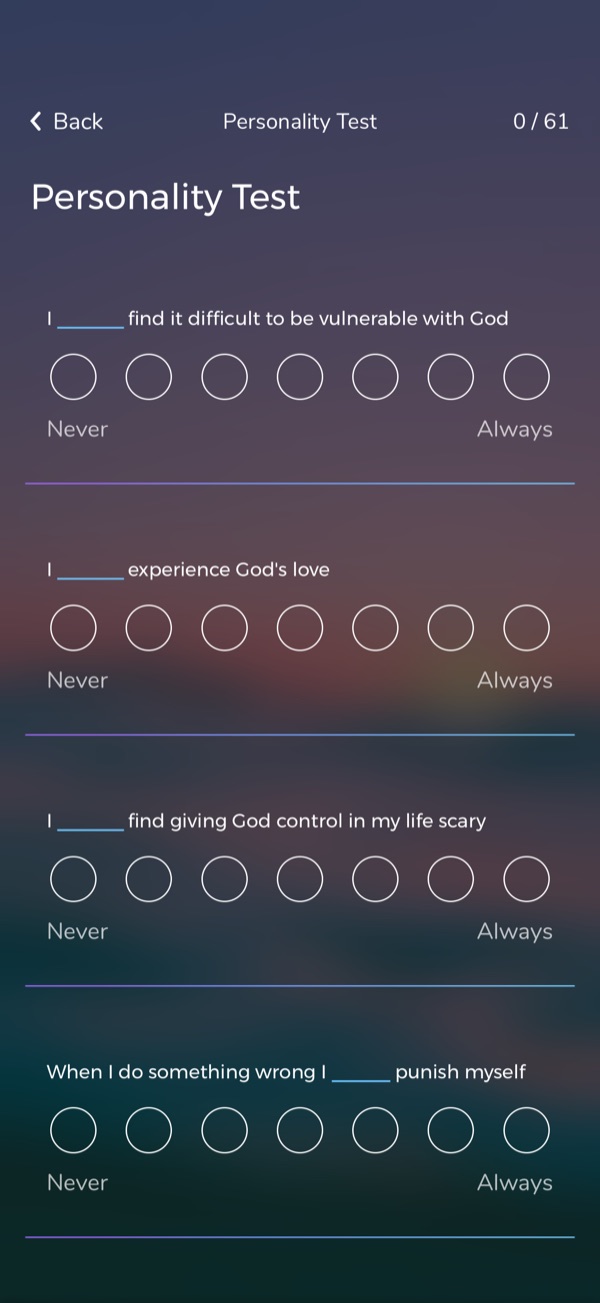
“Personality Test · 0 / 61” shows four sentence completions on a seven-point Never to Always scale: “I ___ find it difficult to be vulnerable with God”, “I ___ experience God’s love”, “I ___ find giving God control in my life scary”, “When I do something wrong I ___ punish myself”.
Design takeaway
These questions touch shame and images of God. Say before the first one why they are asked, who will read the answers, and how to stop and delete them.
What this example establishes
“Personality Test · 0 / 61” shows four sentence completions on a seven-point Never to Always scale: “I ___ find it difficult to be vulnerable with God”, “I ___ experience God’s love”, “I ___ find giving God control in my life scary”, “When I do something wrong I ___ punish myself”.
Limits and further verification
A still image shows one interface state. Gestures, timing, accessibility, persistence and what happens next were not tested. App version not recorded.
Provenance
- Platform
- iOS app · device model not recorded
- Image origin
- User-contributed screenshot · resized, content unchanged
- Source or capture date
- Captured 28 August 2025 · from embedded image metadata
- Reviewed
- 6 October 2026
- Version
- Not recorded
Screenshot captured by Tobias Treppmann for his app-pattern research and supplied for this design reference. Resized for the web; content unchanged. Interface, imagery and Scripture text remain the property of their respective rights holders.