Decision guide
Analytics
What is the least you need to know?
“Where does playback fail?” is a product question. “What is this person confessing?” is a very different one, and an analytics tool switched on with its defaults can quietly answer both. Prayer text and conversations can hold beliefs, health, sexuality, family circumstances and other people’s stories. Reading history, searches and group membership say more than they seem to.
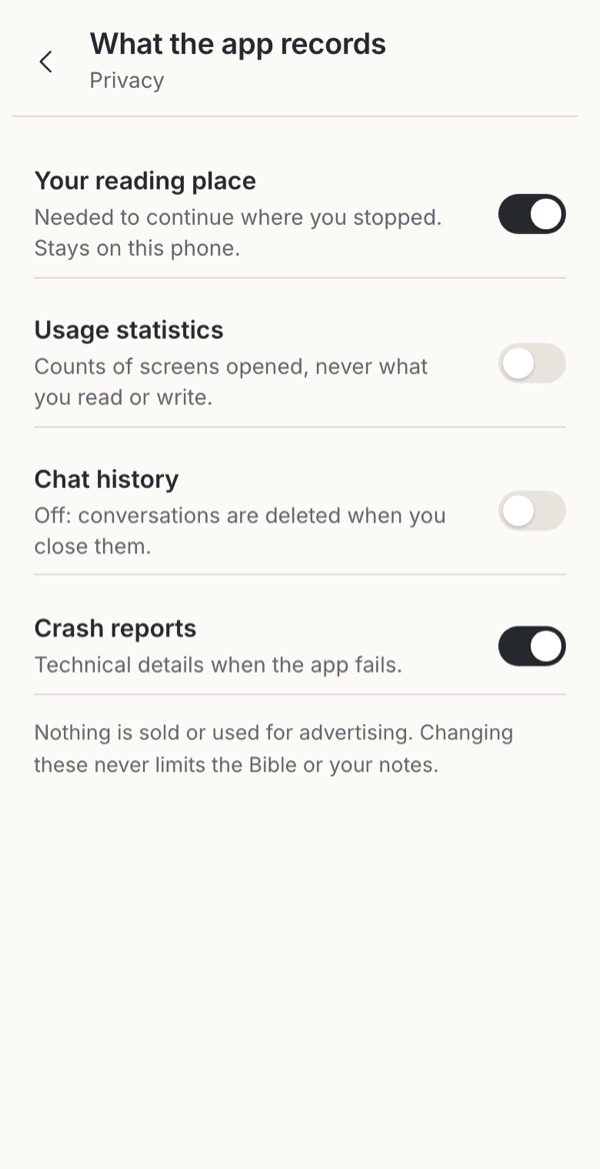 1Say what is recorded, and why
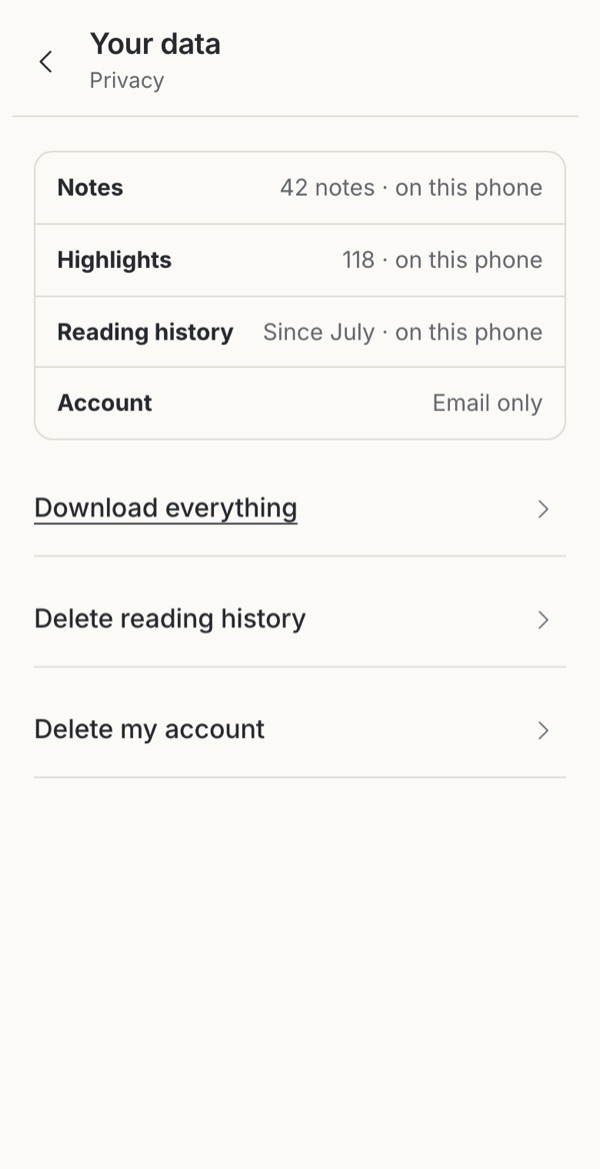 2Let people see, download and delete it
- 4 decisions
- One question for your next review
- Editorial guidance, not user-tested
Start with a question, not an analytics kit
Before enabling automatic capture, write down the decision you need to make, the least data that could inform it, who can see it, how long it is kept and how it is deleted. A pseudonymous identifier does not make a history anonymous.
Keep each purpose separate
| Purpose | Prefer | Keep separate or leave out |
|---|---|---|
| Reliability | Error category, app version, latency bucket and a short-lived diagnostic identifier | Prompt text, transcripts, tokens, keys, raw URLs and private notes in error logs |
| Usability | A few events tied to a defined question; coarse or aggregate results where they suffice | Automatically collecting every tap, field, passage and a persistent identity |
| Answer quality | An excerpt the person chooses to share, with a preview, a clear purpose and restricted access | All conversations flowing into a general analytics dashboard |
| Safety | A separately governed process with access, retention and escalation rules | Reusing safety flags for conversion, advertising or “faith scoring” |
| Model improvement | A distinct decision, truthfully explained, with real choices | Treating ordinary chat use or analytics consent as permission to train |
| Marketing | Declared channel preferences and campaign-level reporting | Targeting offers at inferred vulnerability, confessions or private doubts |
A smaller event can still answer the question. To learn whether a new player reduces failed starts, the playback result, error category, app version and network class are enough, aggregated promptly and kept briefly. Leave out prayer text, chat messages, names, precise location and passage history. Even that schema is not automatically anonymous: check what the vendor’s kit adds, how IP addresses and device identifiers are handled, and what crash reports attach. A privacy label is only credible if the actual payload matches it.
Look at conversations only through an explicit door
When someone chooses “Report this answer”, show exactly which messages and attachments will be included, offer to remove personal details, and say who reviews it, why and for how long. Keep quality review apart from a request for urgent help, and don’t imply that reports are continuously monitored.
Restrict and audit staff access. Plan deletion across storage, logs, vendors, backups and anything derived from the data, and explain what deletion can and cannot achieve, including data already used for training. Redaction misses indirect identifiers and other people’s details, so use synthetic conversations for routine development, and set up a separate, justified process if real samples are truly needed.
Switch off session replay where people pour out their hearts
Disable recording of sessions by default on chat, prayer journals, pastoral support, payments and sign-in. Test masking of rendered answers as well as typed input, and of the clipboard, accessibility labels, network requests and error attachments. A vendor’s default masking needs checking, not trust.
Take into your next review
Could we answer the next decision with less data, a shorter retention period, or by asking people directly?
Exercise
Combine task success, reliability and voluntary interviews. Ask about understanding and pressure without demanding intimate testimony, report uncertainty, and include people who decline research. A completed prayer, positive sentiment or a longer chat is not a validated measure of spiritual maturity.
Details
Go further
Regional and evidential boundaries
ICO guidance identifies religious beliefs and health as special-category data and explains when intended inferences or different treatment bring data into that category. Not every visit to a Bible page establishes a belief, but an inferred “faith stage” or vulnerability profile needs particular scrutiny. UK requirements are not interchangeable with other jurisdictions.
The ICO also treats email tracking pixels separately from permission to send the email. CNIL’s February 2026 consultation identifies privacy risks in session replay; it is a draft consultation, now closed, and its final adoption was not established in this review. The conservative defaults above are this library’s proposals.
Apply the regional research to the whole data flow: app, analytics vendor, model provider, support tools and exports.