Decision guide
Trust in AI answers
What authority does a fluent answer seem to have?
Someone asks an app what a passage means, and three confident paragraphs appear in a warm voice, next to the verse itself. Nothing on the screen says which words are Scripture, which are a publisher’s commentary and which a model produced a second ago. Fluency feels like authority, whether or not it has earned it.
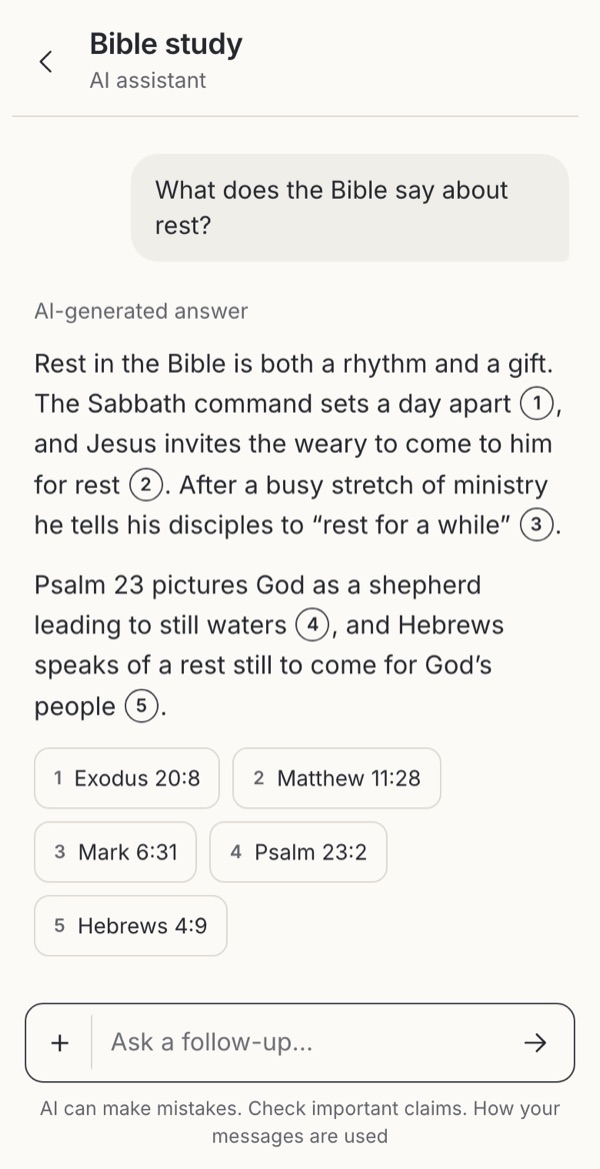 1A fluent answer, with numbered sources
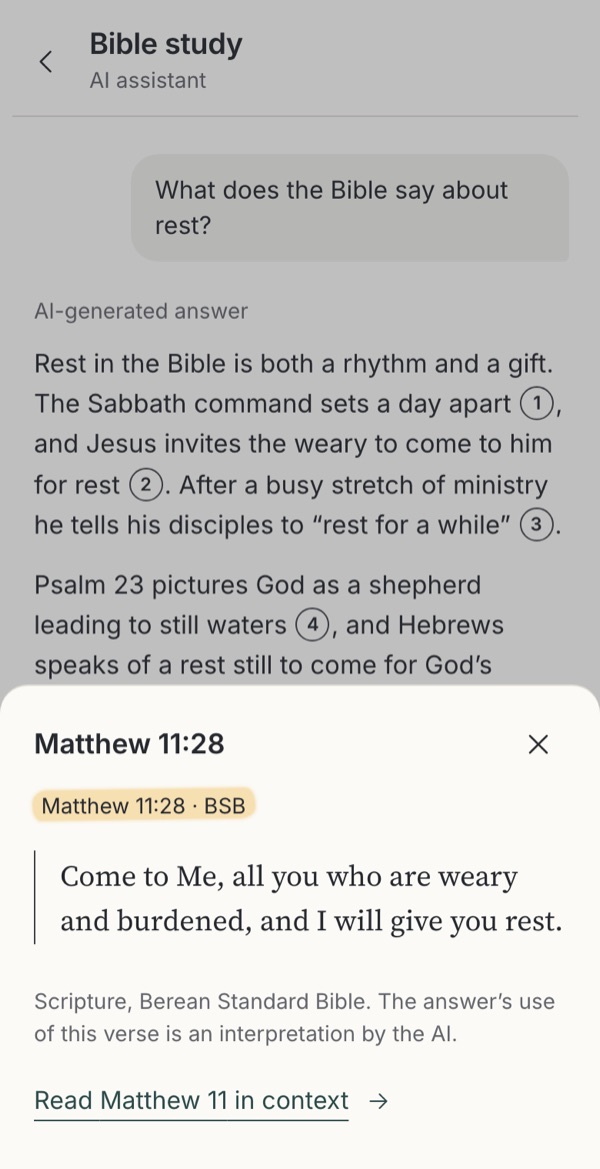 2Each source opens the verse itself
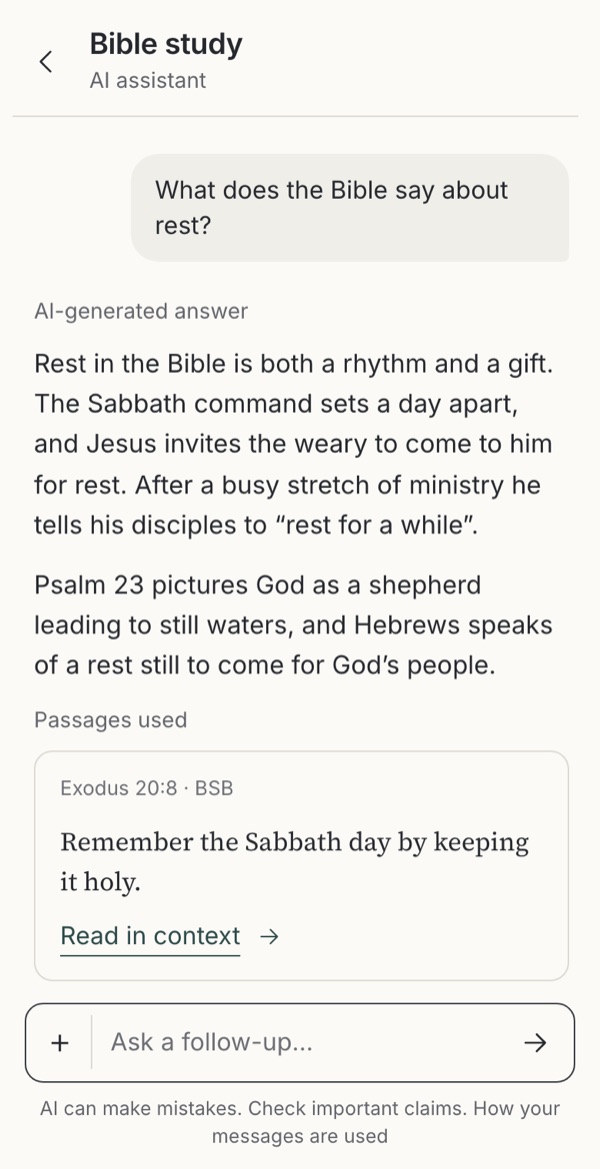 3Or put the passages in front of the reader
- 4 decisions
- One question for your next review
- Editorial guidance, not user-tested
Give the AI one bounded job
Explaining a passage, putting together a devotional and responding to someone in distress are different jobs with different risks. Say what the system does and what stays the person’s choice. A warm voice must never suggest pastoral, clinical or divine authority.
Show what the AI did, where it matters
Mark the difference between Scripture, authored commentary, generated interpretation and synthetic narration at the moment it could be misunderstood: in the answer, in a shared screenshot, in audio. A label in the settings page does not reach the person reading the answer.
Deep diveHow human should the assistant appear?Let people check the source
A citation should open the material that supports the claim, at the right passage or point in the recording. A citation that only names a source asks for trust instead of earning it. Show what happens when the source is missing, too.
PatternCitations open the evidence behind a claimKeep the person in charge, and care with people
Let people correct the assistant, decline its suggestion and choose a different kind of help. Agreement is not the same as honest support. Distress, abuse, dependency and crisis need review with the right specialists; a well-designed response card cannot by itself make a service safe.
How human the assistant should seem, with names, avatars and typing indicators, is its own decision. See warmth without mistaken identity.
Take into your next review
What authority might this answer appear to have, and has it earned it?
Exercise
Trace one claim to its source, then remove the source and see what happens. Correct the assistant. Copy or share the answer and check whether its origin survives. Repeat with a long Scripture passage, and with someone who wants to stop.
Details
Go further
Research and related guides
AI disclosure and content origin · sensitive conversations · what to learn from conversation data
These proposals draw on selected sections of the Kairos manuscript (Tobias Treppmann, Digital Spiritual Formation: The Aperto Vision, Draft 4, reviewed 5 October 2026). It is not an effectiveness study, and the full manuscript is not published here.