Decision guide
Attention and time
What would “enough for now” look like?
A reminder at 8 pm can help someone do what they meant to do. The same reminder, repeated by email, nudged again the next morning and followed by an endless feed, starts to work against them. Every app asks for attention; the question is whether it also knows when it has done its job.
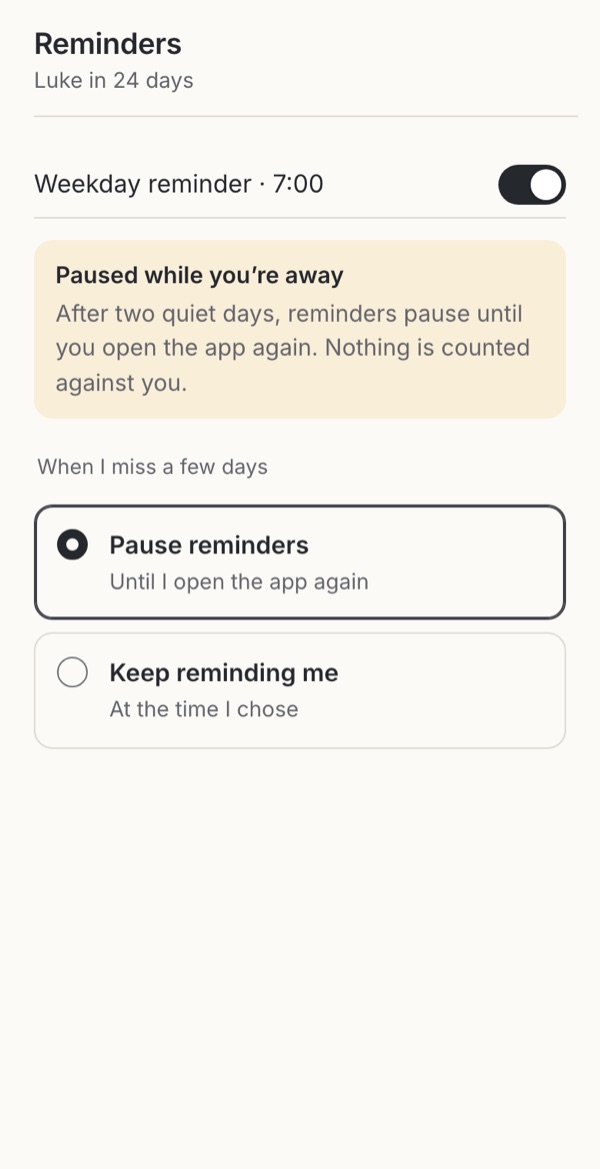 1Reminders at a time the reader chose
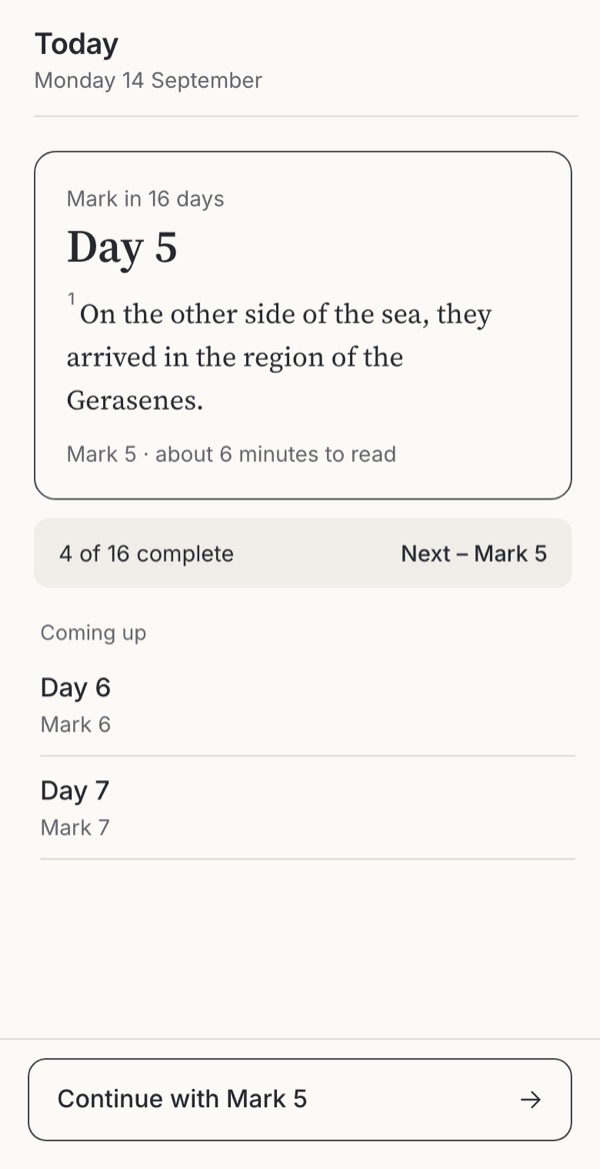 2One step for today, not a feed
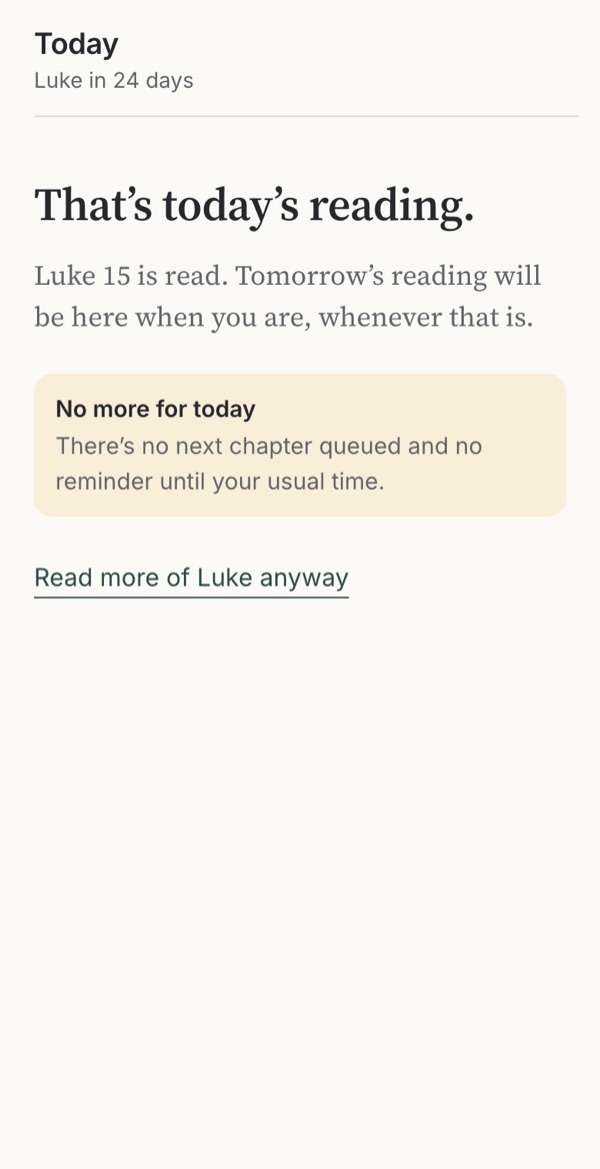 3A clear end: enough for now
- 4 decisions
- One question for your next review
- Editorial guidance, not user-tested
Name the moment the app has done its job
Start with the practice you are supporting and the point at which it is complete. Longer sessions and more opens can mean value, confusion or compulsion; the number alone cannot tell you which.
Rewards make this harder to read. External rewards can weaken intrinsic interest even while participation rises, so a reminder someone chose, a learning challenge and a reward for opening the app every day deserve separate evaluation. Read the evidence on rewards, autonomy and habit.
Choose by what the person came for
| If the person wants | Start with | Watch for |
|---|---|---|
| A chosen daily practice | A reminder they set themselves: time, days, quiet hours and a pause | Missed days turning into a debt |
| Occasional inspiration | A weekly digest or a finite daily verse email | Making the message useless unless the app is opened |
| To explore a collection | Bounded results, filters and a deliberate “Load more” | The extra step; keep their position and show how much remains |
| Sustained reading | A continuous chapter or book with landmarks | Confusing long-form Scripture with an endless algorithmic feed |
| To complete a reflection | A clear end, with optional repeat, save or next session | Forcing an abrupt exit, or implying a set duration makes someone more faithful |
NN/g describes the trade-offs of infinite scrolling, including orientation, finding things again and reaching the end of a page. It says nothing about spiritual formation either way.
PatternHow a reading plan holds timeTreat push, email and the app as one conversation
Offer choices by purpose, channel and frequency: a reading reminder by push, a weekly reflection by email, group replies in a digest, essential account messages separately. Allowing notifications in the operating system is not permission for every kind of marketing.
Don’t send the same prompt by push and email unless someone asked for both. Make the message useful on its own, with the reference, the edition and a link to the surrounding passage, and with a web fallback if the app isn’t installed. Put pause and unsubscribe in the message itself. Don’t read a tracking pixel as proof that someone read the passage.
Lock screens and shared inboxes can expose sensitive interests. Never build a preview from a prayer request, grief, an abuse disclosure or a private chat; even the sender’s name can reveal an affiliation.
Make the invitation honest
Your evening reading is ready.
You chose a reminder for 8 pm.
You’ve reached the end of this reflection.
Avoid suggesting that God personally sent a notification, manufactured urgency, and anything that ties someone’s worth to opening the app. For some people, staying connected online is an important source of access and community, so “put the phone down” should remain an invitation, never an instruction.
Take into your next review
Would we still call it a good outcome if the person finished sooner, read the email without clicking, or took a week away?
Exercise
Compare a chosen reminder with no reminder, or with a lower frequency. Look at voluntary reports of usefulness, opt-outs, complaints about duplicate messages and finished tasks, alongside return rates, and include the people who stopped using the app. Don’t secretly track offline prayer to prove the product helped.
Details
Go further
Platform guidance and regional checks
Apple’s subscription guidance requires opt-in and opt-out for marketing push and excludes sensitive information from those notifications; it is platform guidance, not universal law. The UK ICO’s electronic-mail guidance, updated in April 2026, includes a conditional soft opt-in for charitable purposes. Being a Christian organisation or a charity does not settle eligibility on its own; check the message, organisation, subscriber and conditions. Email tracking needs its own assessment.
These are source-specific requirements, not one universal notification law. See the regional research.
Where these proposals come from
The Kairos manuscript (Tobias Treppmann, Digital Spiritual Formation: The Aperto Vision, Draft 4, selected sections reviewed 5 October 2026) asks how formation goals can conflict with retention incentives. It is not an effectiveness study, and the full manuscript is not published here.