Decision guide
Coming back after a break
What should greet someone after five days away?
Someone opens your app after five days. They may have been caring for a parent, reading on paper, or simply losing interest. You don’t know which, and you don’t need to. What the screen shows first will either help them carry on or quietly ask them to explain themselves.
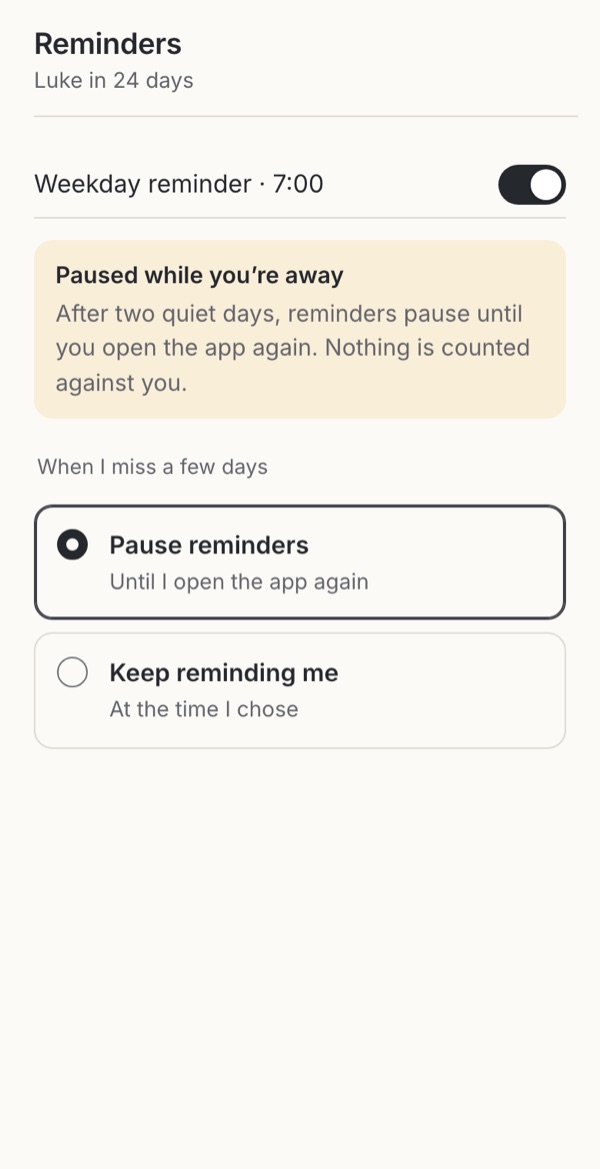 1Away for five days: reminders pause instead of nagging
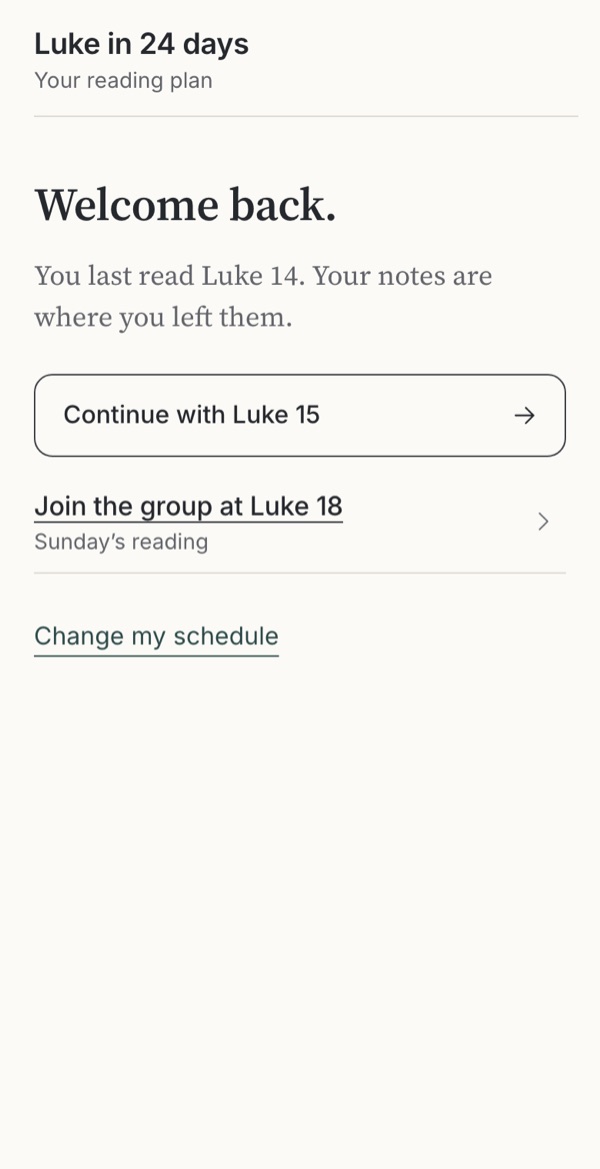 2Back again: a welcome and the obvious next step
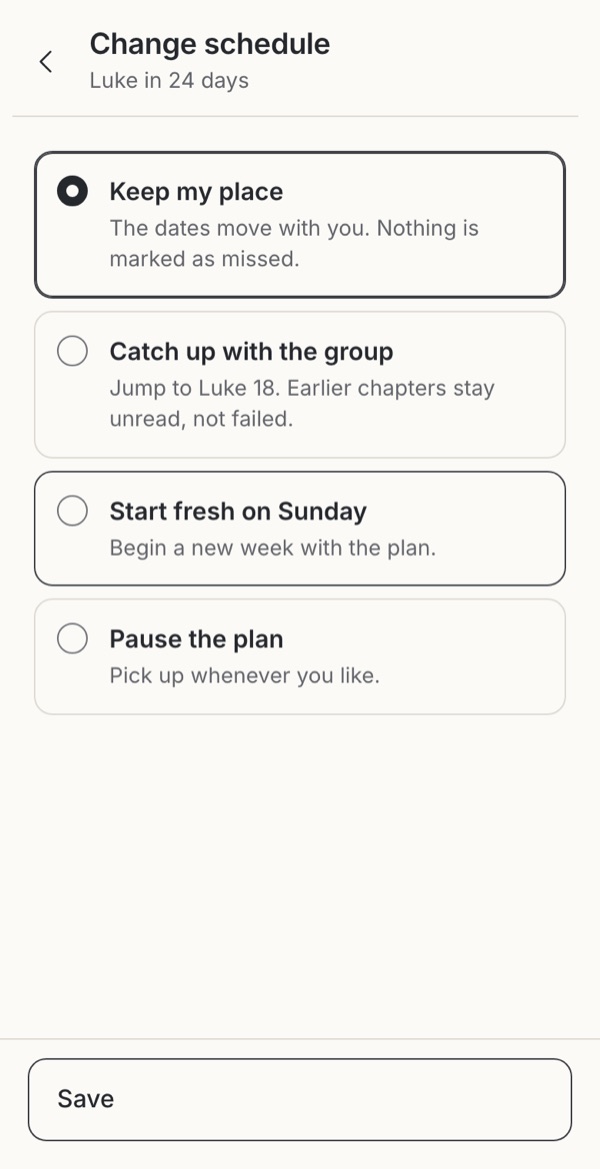 3If needed: change the schedule without penalty
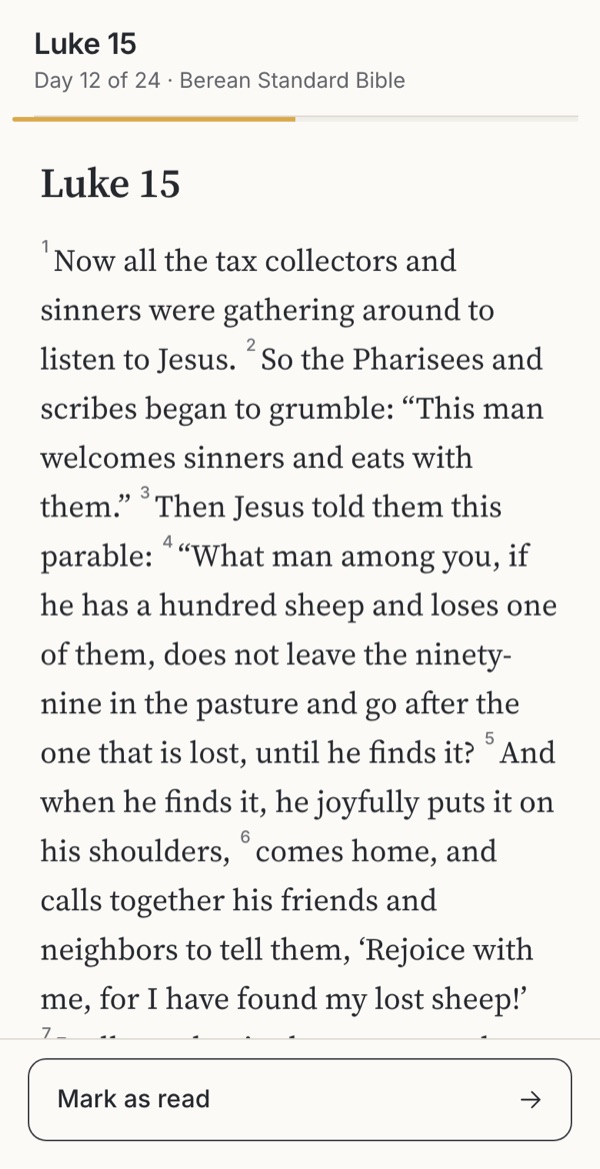 4Reading again, with the plan in quiet view
- 5 decisions
- One question for your next review
- Editorial guidance, not user-tested
A daily practice is worth supporting
Regular time with Scripture and prayer is one of the oldest Christian practices: the person who meditates on God’s law “day and night” (Psalm 1:2), Daniel praying three times a day “just as he had done before” (Daniel 6:10), Jesus praying “while it was still dark” (Mark 1:35). Evangelical and historic traditions alike treat these disciplines as means of grace and as training, not as a way of earning God’s favour.
Grace is not opposed to effort, it is opposed to earning.
Research points the same way, with care. Regular religious practice is associated with better wellbeing and health, mostly in studies of church attendance. Habit research adds something every plan should know: missing one day does not undo a habit, but showing someone a broken streak makes them more likely to stop.
So helping people keep a rhythm they chose is a good thing to build. The decisions below are about doing it without making the app the measure of anyone’s faithfulness: who chose the commitment, who can see it, and what it says on the day after a miss.
Research notePractice that forms, features that pressure: theology, habits, health and consentWhat is the structure for?
A church group following a seasonal reading needs a common date: everyone should arrive on Sunday having read the same passage. Someone reading through a Gospel alone only needs the next chapter. Both are real commitments, and they need different support.
- MonTueWedThuFriSatSun
Dated plan
Everyone reads the same passage by the same day.
FitsA group, a church season, a lectionary
- Luke 13141516
Sequence
The next chapter, whenever the person next reads.
FitsReading a book through alone
- 4 days a week
Weekly rhythm
A number of days chosen by the person, no dates.
FitsSetting time aside without deadlines
- Luke 15:11
Saved place
Just where they stopped. No plan at all.
FitsPeople who know what they want to read
Does it need to be a plan at all?
Receiving a passage chosen by a community or an editor can be a deliberate practice, not a passive one. A daily verse, the Moravian Daily Texts, a lectionary reading and an authored devotional are different traditions, though. Say who chose the reading and keep Scripture separate from commentary. Let yesterday’s reading stay available without becoming overdue.
Four decisions are easy to tangle, and each can be made separately. A daily devotional can record nothing at all; a chosen plan can show progress without a deadline.
Who chooses the reading?
The readerA churchAn editorA lectionary
Is there an end?
A finite planOngoing
Do dates matter?
Shared datesOwn pace
What does the app record?
NothingSaved placeCompletionDays
Make the way back obvious
The welcome can be simple. Show where they stopped, offer the obvious next step, and keep changing the schedule as a quieter option.
The welcomeA quieter optionKeep notes where they were. Leave reminders paused until the person chooses otherwise. If they skip ahead, keep the earlier sessions as unread rather than failed, and don’t treat opening a passage as reading it. Nobody should have to account for their absence to find the next step.
PatternCompare return screensWhat should the app remember?
Each kind of record answers a different question. Only the last is about consistency, which is useful to someone who asked for it and heavy for someone who didn’t.
| Record | Answers | Useful to |
|---|---|---|
| Saved place | “Where was I?” | Everyone |
| Completion | “What’s left in this plan?” | Someone in a finite plan |
| Shared date | “Where is the group?” | Groups and churches |
| Streak, calendar or chart | “How consistent have I been?” | Only people who asked for it |
Scale matters too. Measured against the whole Bible, a good first month is about 2% of it, which can make a beginner feel they have barely started. Views that start from the reader’s own first week, or from a plan they chose, give progress a size they can see.
Try itNine ways to show a reading history, before and after a breakTake into your next review
When someone comes back, what will they see first, and does it help them read?
Exercise
Open your current return screen together and pick one situation: someone continuing alone, or someone rejoining a dated group. Then finish this sentence: when someone returns, we will offer ___ because they are trying to ___. We will keep ___ and make it possible to ___.
Ask people in that situation to resume, change their schedule and say who can see what. Notice where they hesitate, and listen to the ones who decide not to restart. If prayer is part of your team’s practice, you might ask whose circumstances you have overlooked in wanting to help. Participation should be voluntary.
Details
Go further
Plans, catch-up and pressure: what we know
Tobias Treppmann recounts a conversation with one Bibel TV user who preferred reading the same plan there, because YouVersion’s display of days behind felt guilt-inducing to him. This is a paraphrased personal report, not a direct quotation, a comparative study or a claim about the publisher’s intentions. The date and app version were not recorded.
YouVersion’s Android documentation describes Catch Me Up, which shifts the schedule without marking sections complete; it is unavailable for Plans with Friends. A recovery option and a reader’s experience of pressure can both be true. Test its visibility and wording rather than assuming either settles the matter.
Treppmann reports that Bibel TV data favours shorter plans; the figures, period and definition of “popular” were not available for this review, so this remains a reported observation. No verifiable primary-source abandonment rate for annual YouVersion plans was found. Starts, continued use and completion measure different things, and an unfinished plan does not show that someone stopped reading the Bible.
Behavioural design: benefits and unintended effects · when rewards can undermine motivation · reading research
Discipline, grace and success
The research note on practice and formation gathers the theology, pastoral writing, habit psychology and health research behind this guide.
Daily reading and annual plans can be meaningful, freely chosen disciplines; there is no need to weaken that commitment to make room for other circumstances. The difficulty comes when a product treats one rhythm as the measure of everyone’s faithfulness. A completed session tells us about an action recorded in the app, not the whole story of someone’s attention, understanding or life with God.
Dallas Willard’s interview on disciplines and grace explores practices in relation to a person’s circumstances, and his interviewer raises questions about corporate worship and the means of grace; the exchange invites reflection without settling the matter for every tradition. The Cape Town Commitment (Part II E.4) calls for truthful reporting and challenges unrealistic demands for visible results. For a product team that becomes a practical question: can we describe reading activity honestly without presenting it as proof of transformation?
These are theological perspectives. The interface recommendations here are editorial proposals to test, not measured effects of a reading schedule.
Other practices need other forms
A daily observance, a mixed-media devotion and a time of prayer ask for different interfaces. Compare liturgical calendar views, reading, card and audio formats and dedicated prayer surfaces. For reminders outside the reading itself, see attention and reminders.