Decision guide
Community and visibility
Who can see this, respond to it, and hold authority?
A shared reading plan, a prayer group, a public comment thread and a mentoring relationship can all be called “community”. They have different audiences, different risks and different people responsible when something goes wrong. More visible activity is not proof that anyone belongs.
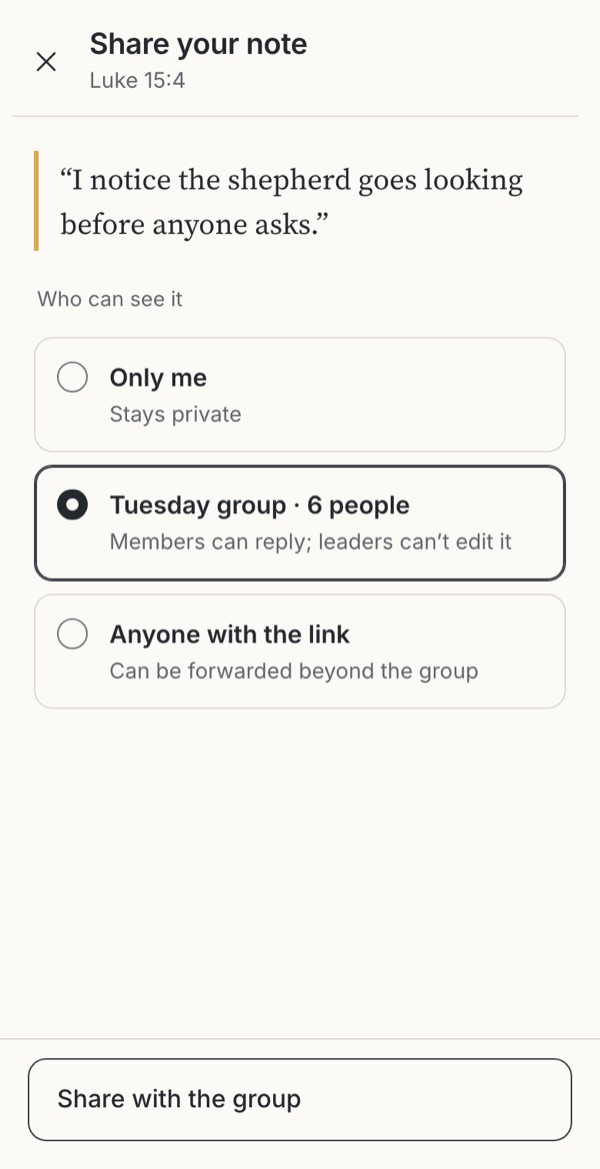 1Choose who can see a note before sharing
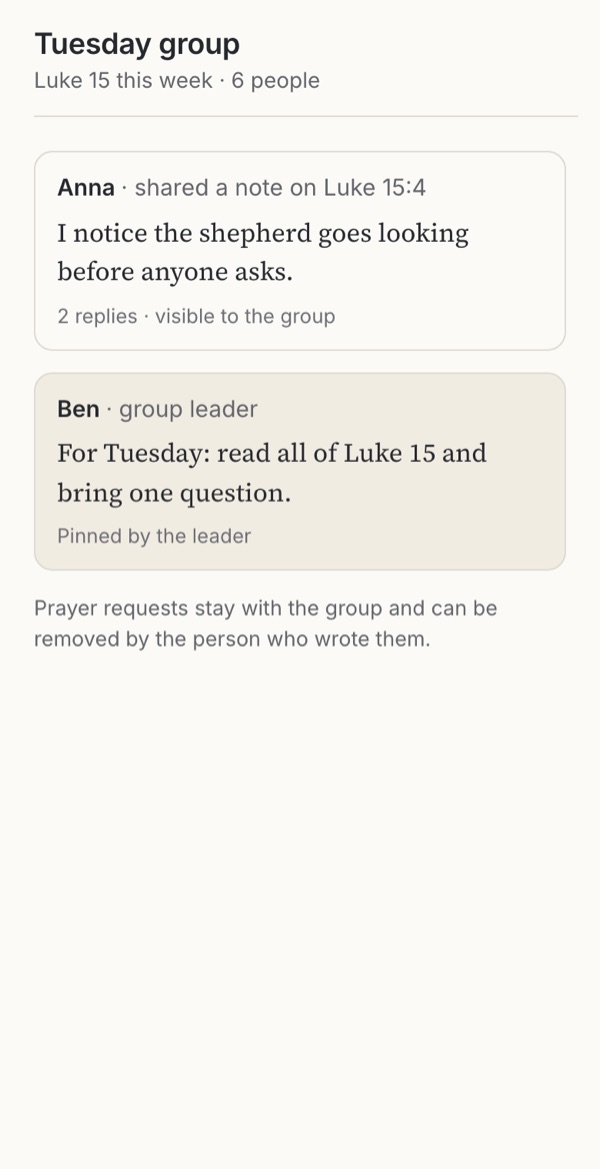 2A group space with visible roles
- 3 decisions
- One question for your next review
- Editorial guidance, not user-tested
Begin with the relationship, not the feed
Name the relationship the feature supports, then decide who sees what, who can respond, and who has authority. Online relationships can be meaningful and accessible in their own right; sending people “offline” is not always possible, or safe.
| Shape | What it can offer | What has to be resolved first |
|---|---|---|
| A private shared plan | A chosen rhythm with people you know | Optional activity visibility; no automatic disclosure of missed days or private notes |
| A prayer request to a chosen group | Mutual support | An audience preview, other people’s privacy, edit and remove controls, and expectations about resharing |
| Public discussion | Broader perspectives and discovery | Moderation capacity, reporting, blocking, a harassment response and clear conduct rules |
| A leader or mentor relationship | Continuity and accountable support | A visible role and its limits, safeguarding, boundaries for minors, and freedom to leave |
| An invitation to act beyond the app | Connecting reflection with service or relationship | A voluntary, suitable and accessible destination, and no surveillance to prove participation |
Show the audience before anything is shared
Let people choose what to share, with private notes and anything the AI inferred left out unless they add it deliberately. Preview the exact audience and content, including anyone named in it, and confirm with a clear visibility state. Make report, mute, block and leave easy to find, say what group administrators can see, and be honest that removal has limits once someone else has copied the material.
Say what can be removed, before people join
YouVersion’s Android help distinguishes private plans, friends-only plan activity in the Community Feed, and Plan with Friends activity visible to participants. It also says Community Feed and timeline plan activity cannot be deleted. That is documented behaviour, not a tested current flow, but the lesson holds: show who will see someone’s participation before they join, and what they can take back.
A block button is not a moderation service. eSafety’s Safety by Design framework places the provider’s responsibility alongside users’ autonomy and accountability.
Take into your next review
Can someone decline to share, miss a session, challenge a leader or leave the group without a public penalty?
Exercise
Walk through each of those moments with the people who would use the feature, and with whoever would moderate it. Write down who handles a report on a Sunday evening.
Details
Go further
What still needs investigation
This is an initial framework. Comparisons of real sharing flows, research with moderators, the needs of minors, denominational differences and long-term community outcomes are still open. Nothing here establishes a live moderation or safeguarding service, and the pattern illustrations for this area are still in development.
The Kairos manuscript argues for formation connected to community and embodied action. That is a theological contribution, not evidence that a particular social feature works.