Decision guide
Pricing and access
Who pays for a faith app, and for what?
A free Bible app is paid for by someone: donors, a church or ministry budget, investors, advertisers, or a team giving its time. A paid app is paid for by the people who use it. Neither arrangement is more faithful than the other. The question for both is whether people can see the exchange, and whether it fits the relationship the app invites.
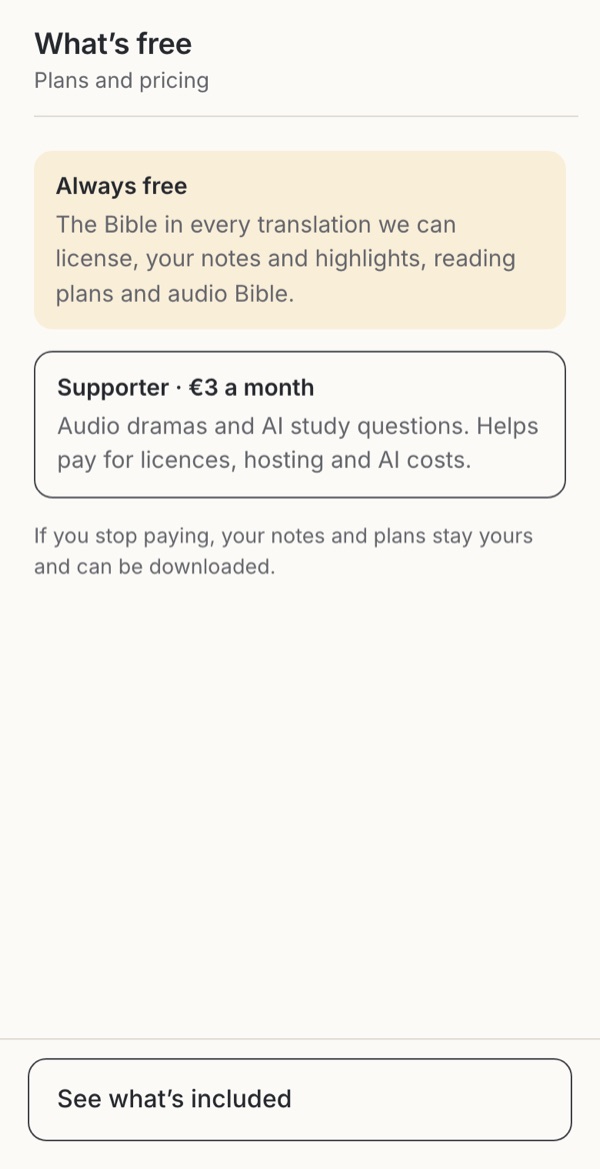 1Say what is always free, and what pays for it
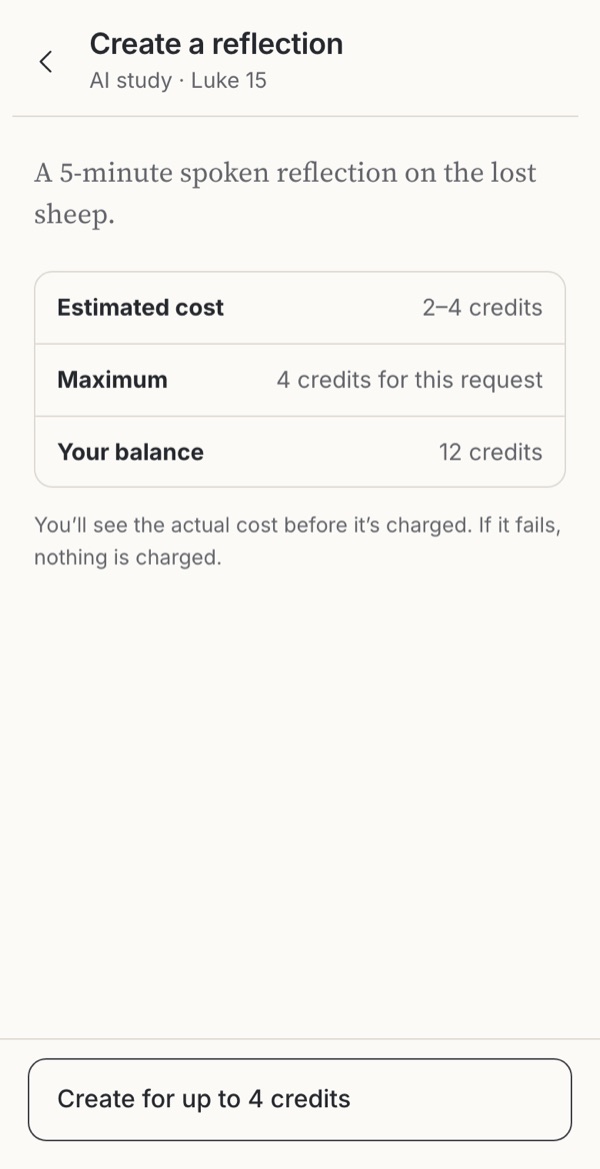 2Show AI costs before they are charged
- 5 decisions
- One question for your next review
- Editorial guidance, not user-tested
What it actually costs
- Scripture text and audio. Most modern translations are licensed from their publishers, often with conditions on offline storage, quotation length, audio and use in AI systems. Public-domain texts avoid fees but still need careful editing and formatting.
- Design and development. Building is the start. Operating-system updates, accessibility, app-store requirements and bug fixes continue for as long as the app exists.
- Infrastructure. Hosting, sync, streaming audio, backups and security grow with every person who uses the app.
- AI. Model use is usually billed per token and varies by person. See the section on credits below.
- People. Support, moderation, safeguarding, editorial and theological review are ongoing costs that are easy to leave out of a plan.
- Store fees. Apple and Google take a commission on in-app purchases, commonly 15% or 30% depending on the programme.
Being honest about these costs, with your team, your funders and the people you serve, makes the rest of the decisions easier to explain.
Start by writing down what will always be available without payment, what costs money, and what people keep if they stop paying or the product closes.
Commercial and ministry models both make trade-offs
| Model | Works well when | Watch for |
|---|---|---|
| Ministry or donor funded | A community wants broad, free access and can sustain it | Donor priorities shaping the product, fundraising inside devotional moments, and variable AI costs that grow faster than giving. |
| Subscription | Ongoing content, service or operating costs create ongoing value | Paywalls around essentials, renewals people did not expect, and cancellation made harder than signing up. |
| One-time purchase | A defined resource or edition has lasting value | “Lifetime” promises that outlast the funding to keep the app running. |
| Free with paid extras | A useful core can stay free while costly features are paid | Upgrade prompts in reading, prayer or moments of distress. |
| Credits or usage limits | AI or audio generation costs vary widely by person | Units nobody can predict, and running out at the wrong moment. |
| Church or organisation licence | A group pays for its members | Who can see participation, and what members keep when they leave. Funding must not give leaders access to private content. |
| Advertising | Rarely a good fit for reading and prayer | Attention and data incentives that pull against the purpose of the app. |
Put the paywall at a boundary people understand
- Let the person understand the feature and price before collecting intimate input or beginning a paid task.
- Present included capabilities, recurring total, trial end, renewal and any minimum commitment. Show a real decline or free route if one exists.
- Confirm the selected plan in the platform purchase flow; handle pending payment, restored purchases and an existing subscription.
- Show entitlement and the next billing date in settings, with a direct management route.
- On cancellation or expiry, explain when access ends and which saved work remains readable or exportable under its licence.
Keep emergency contacts and basic safety information reachable when credits run out. Do not present a conversion offer as the response to suicidal distress or an abuse disclosure. This is an editorial service boundary, not a claim that unlimited AI use must be free.
The FTC’s 2022 dark-pattern report summary identifies hidden terms, obstructive cancellation and manipulative data choices. It is a design reference, not a statement that a particular later subscription rule is currently in force. Apple’s subscription guidance provides platform-specific purchase and management expectations.
AI makes the cost of each person different
Most model providers bill per token, so every conversation, long context, retrieved passage and retry has a cost, and generated audio is billed separately. A heavy user can cost many times what a light one does. That is why AI features push products towards credits, limits or higher prices, and why “unlimited” is a promise worth checking against the bill.
Model tokens measure processing units; product credits are a pricing abstraction. Neither inherently corresponds to one verse, one answer or one minute of audio. Explain your conversion and its uncertainty. Hidden history, tools and retries can change cost.
Illustrative flow · example units, not market prices
Create a 5-minute audio reflection
Estimated 2–4 credits. Maximum 4 credits for this request. 12 available.
Review sources → Confirm generation → Show actual charge and remaining balance.
Implement the promised cap; a warning alone is not enforcement. Define partial output, failed generation, user cancellation, retries, refunds and reservation release. Disclose expiry, rollover, top-up price and auto-recharge separately. If estimates cannot be bounded, offer a smaller predictable task.
Some tools let people connect their own AI provider key instead. Today that suits a small technical audience, because most people do not have a key; if you offer it, say plainly who is billed and where requests go.
Questions worth sitting with
“The worker is worthy of his wages” (Luke 10:7) and “Freely you have received; freely give” (Matthew 10:8) are both quoted in debates about charging for ministry. Both come from Jesus sending out his disciples, and Christian traditions apply them differently. Neither settles your pricing, but together they hold a real tension worth discussing as a team.
- Who is the customer, and who is being served? Are they the same people?
- Scripture is available free in many forms. What exactly are you asking people to pay for?
- If the money ran out next year, what would happen to people’s notes, plans and audio?
- Which source of money would you turn down because of what it would ask of the product?
Take into your next review
What will always be free, what costs money and why, and what do people keep if they stop paying?
Exercise
Before purchase, ask someone to explain what they will pay today and later, what is included and how to leave. Then test a failed generation, exhausted credits and cancellation. Track billing confusion, refunds and support load alongside revenue. Do not infer generosity or faith from spending.
Decision to record: what will always be free, what costs money and why, and what people keep if they stop paying.
Details
Go further
Sources and their limits
Apple’s subscription guidance sets platform expectations for purchase and management; it is not universal law. The FTC’s 2022 dark-patterns report describes hidden terms, obstructive cancellation and manipulative data choices; it is a design reference, not a statement that any later subscription rule is in force.