


Faith Mentor
A Bible-themed chat companion with prompts for Scripture questions and personal reflection.
For People seeking conversational Bible exploration and reflection on everyday concerns.
- Platform
- iOS
- Category
- Reference
- First release
- 11 February 2025
- Store ratings
- 1,650 (US)
- Research captures
- 37
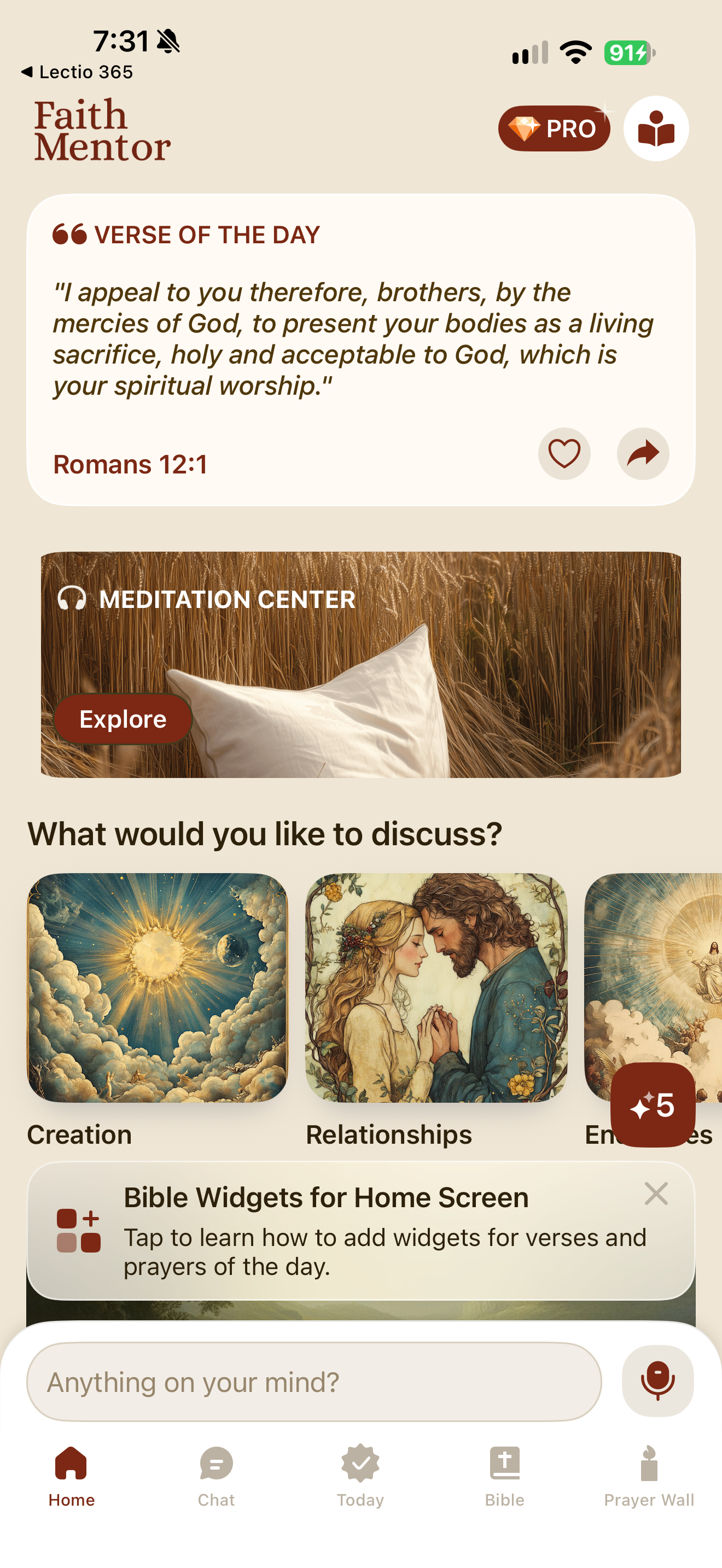
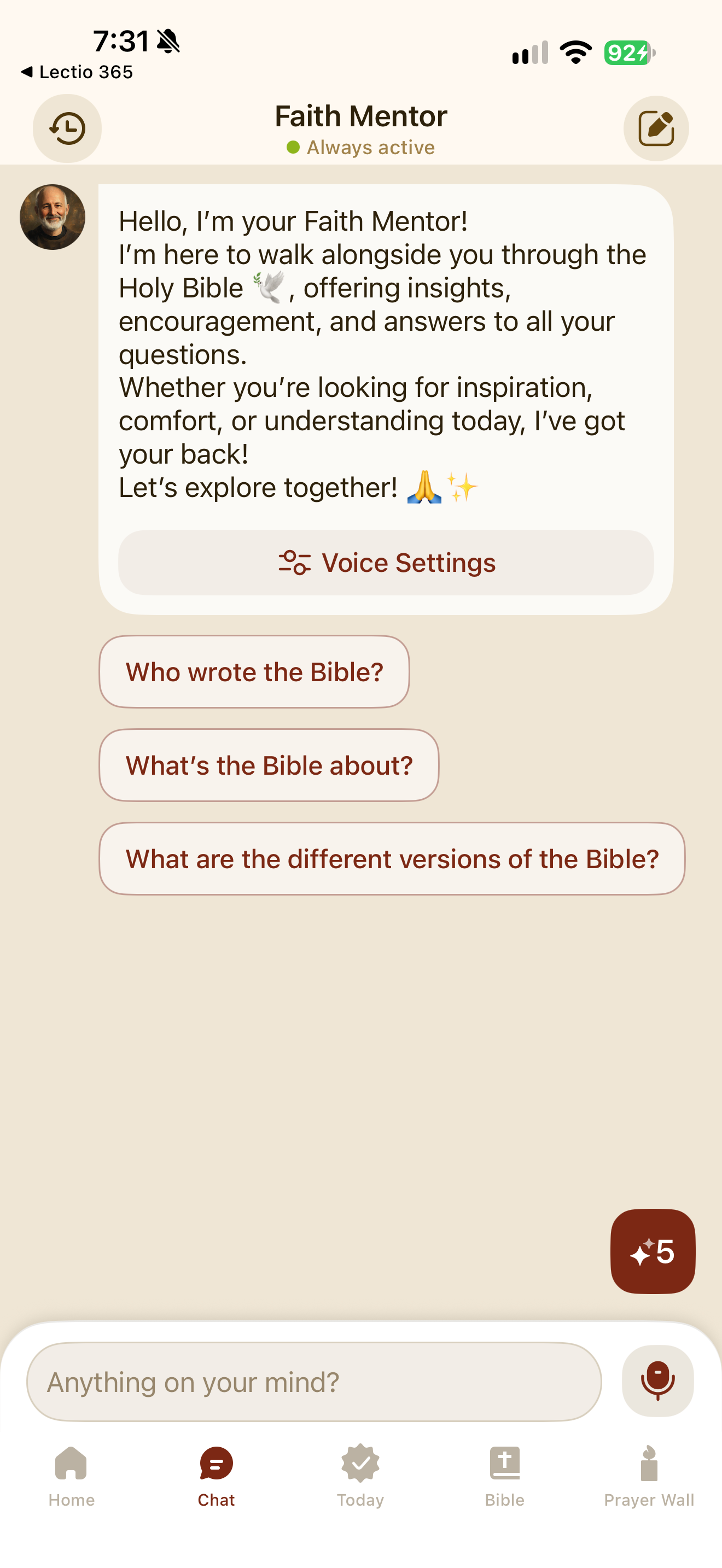
See how Faith Mentor answered in our faith chat comparison, beside other chat apps asked the same questions.
Design review
Observed choices, what they mean, and what still needs checking.
Access & cost
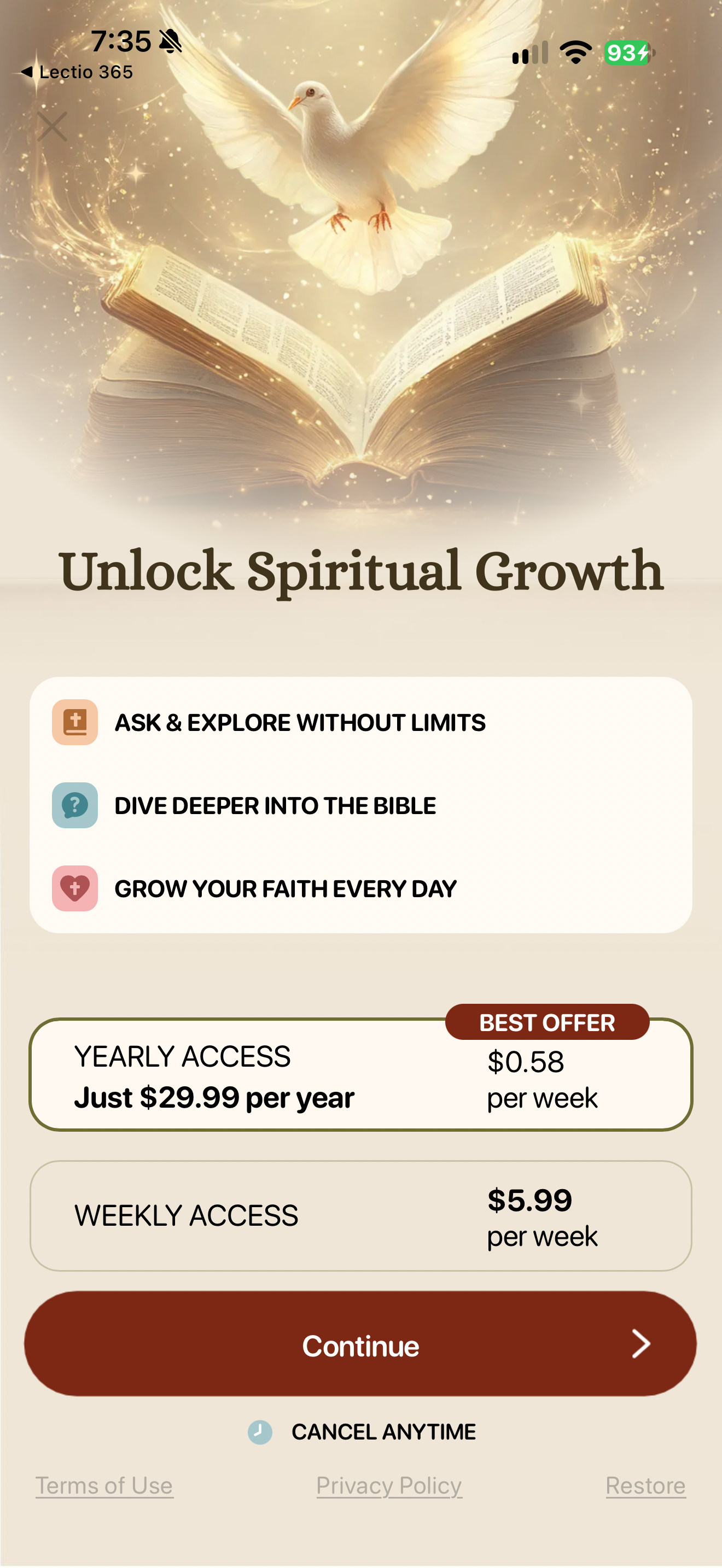
The visible selector shows $29.99/year or $5.99/week. Trial wording found only in hidden accessibility text is excluded.
Captured flow · 27 October 2026Attention & control
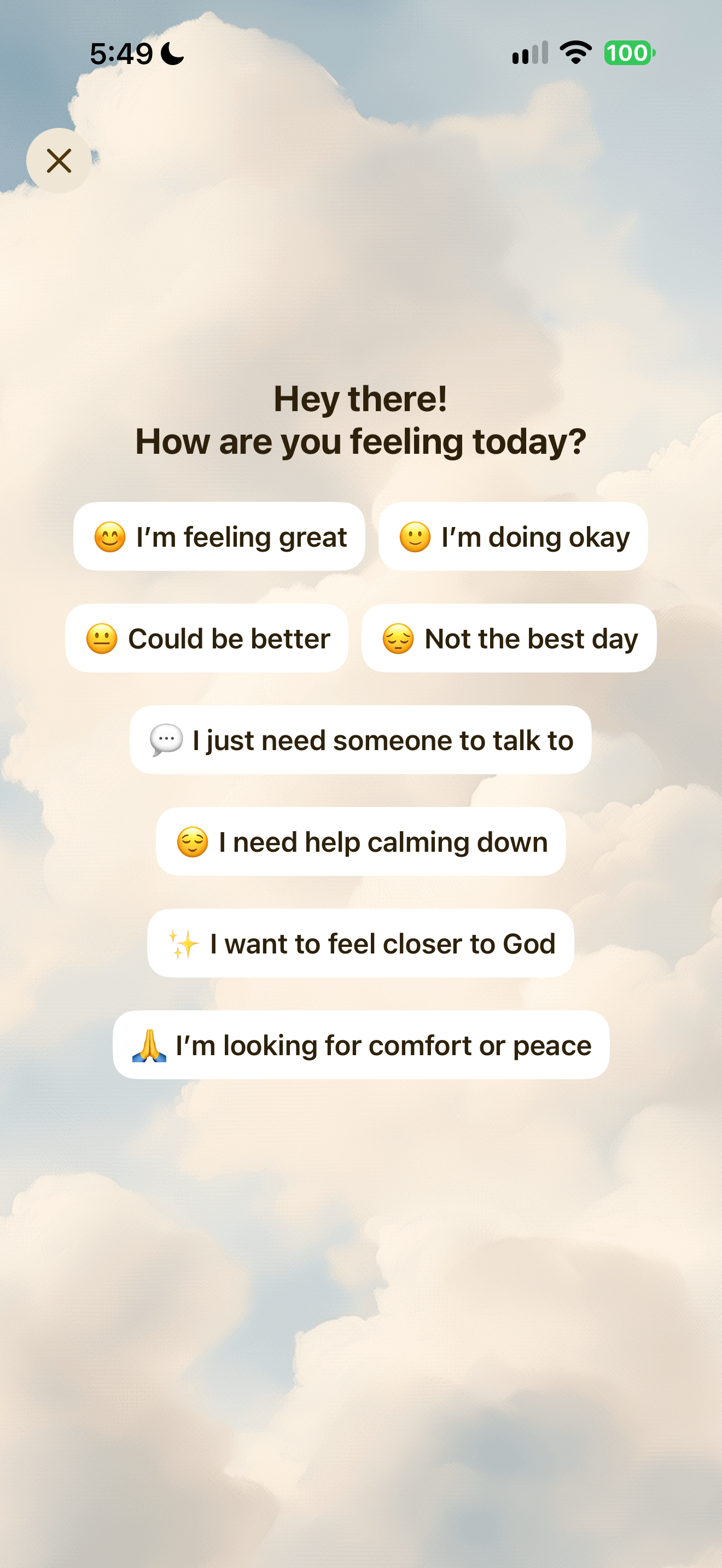
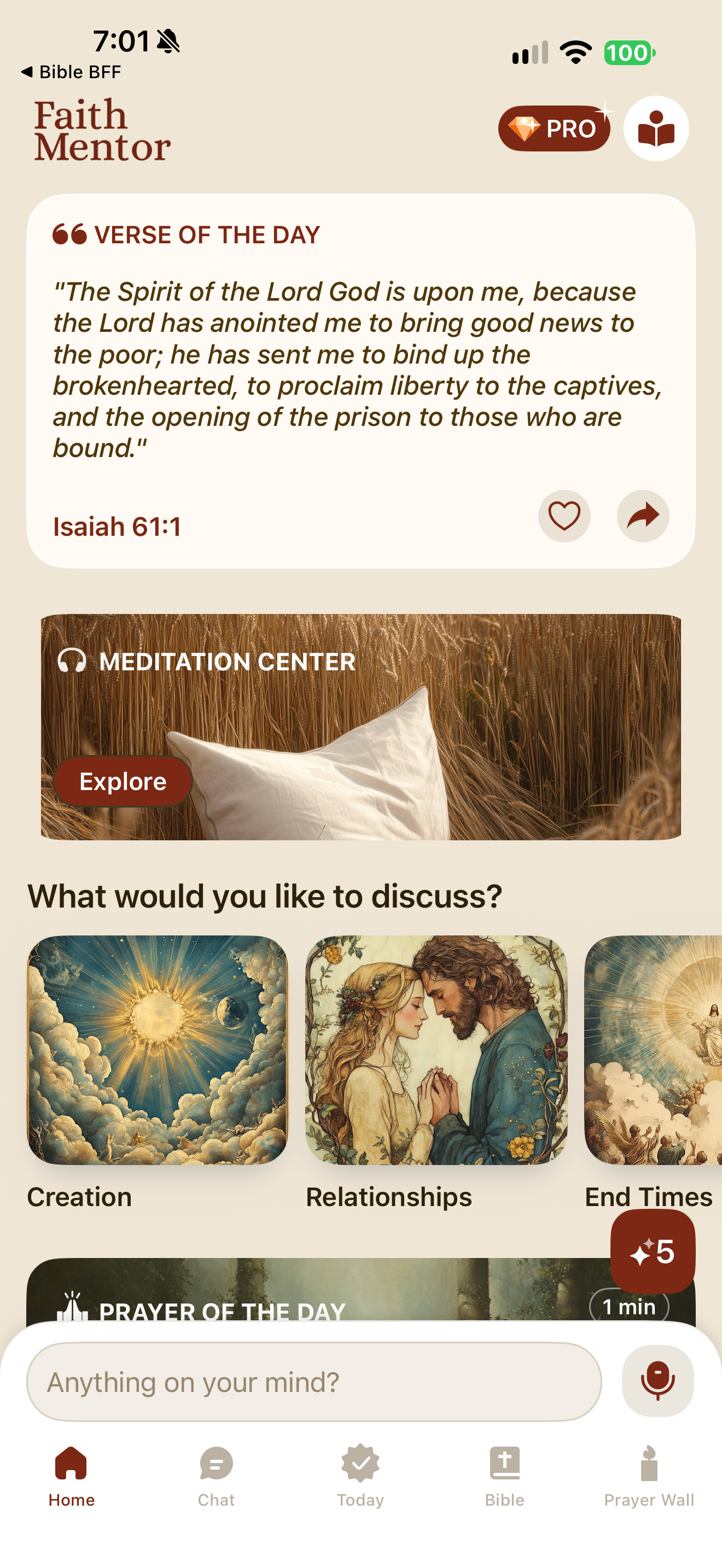
A mood prompt can be dismissed without disclosure.
Scoped review · 27 October 2026Trust & care
Source boundaries, privacy and safeguards need further review. No app-wide assurance is implied.
Evidence incompleteOffers are dated iOS observations in USD where captured. Eligibility, country and platform can differ. Existing settings are not installation defaults.
Where the observed choices sit
Each row is one scoped observation of a specific flow, not a grade for the whole app.
No practice has been placed on the scale yet.
2 areas reviewed, not yet placed6 areas not reviewed yetReview notes
Works against: a choice subverts the person’s agency. Respects: it respects people and safeguards. Restores: a practice restores at a cost freely borne by the builder. Price, Christian branding or a free tier alone do not place an area. How we review.
Screens
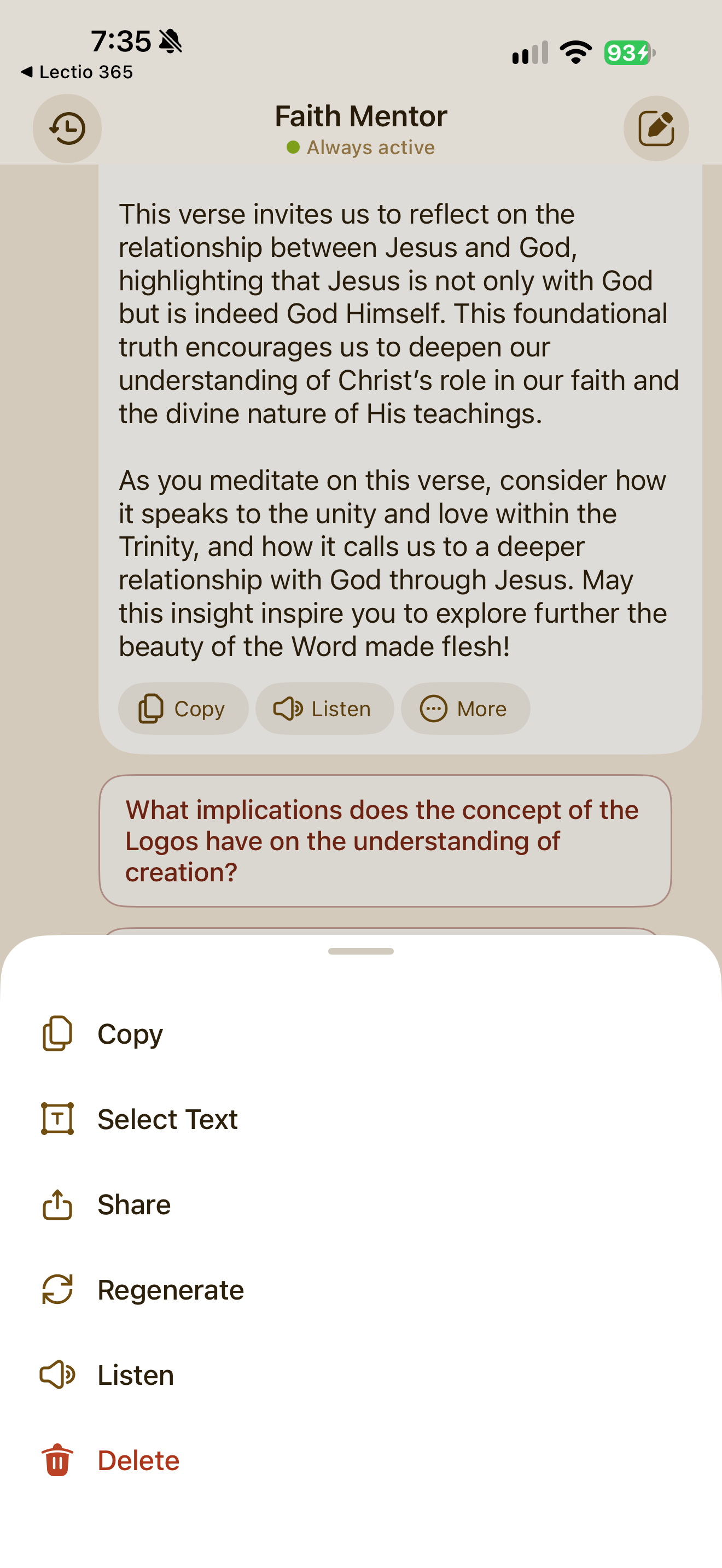
37 reviewed screensCaptured app states, distinct from the publisher’s promotional images. Dates and versions belong to each screen; this is not a complete app walkthrough.
Features and patterns
What the reviewed screens show this app doing. A missing entry does not mean a feature is absent.
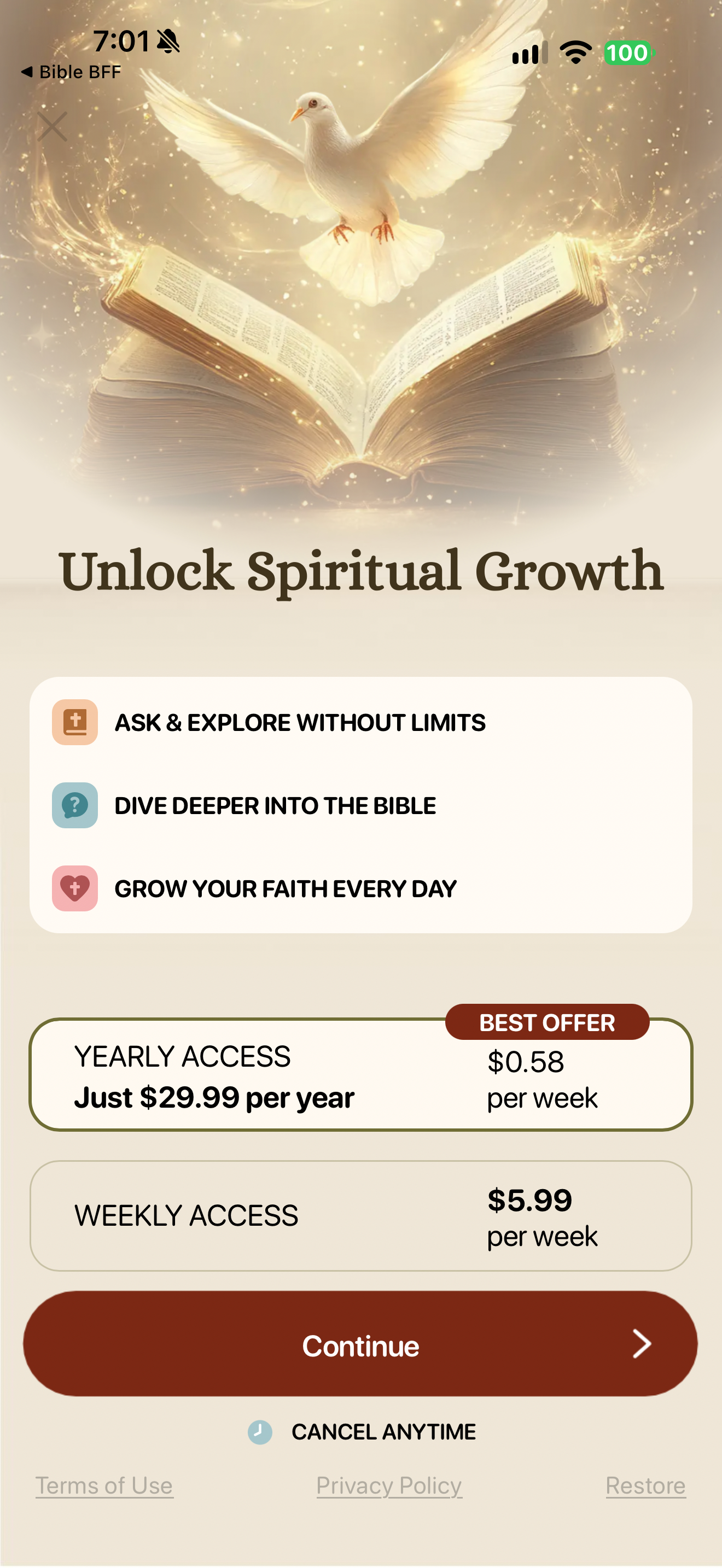
Annual and weekly access
The visible offer shows USD29.99/year and USD5.99/week. Hidden trial text is excluded from the observation.
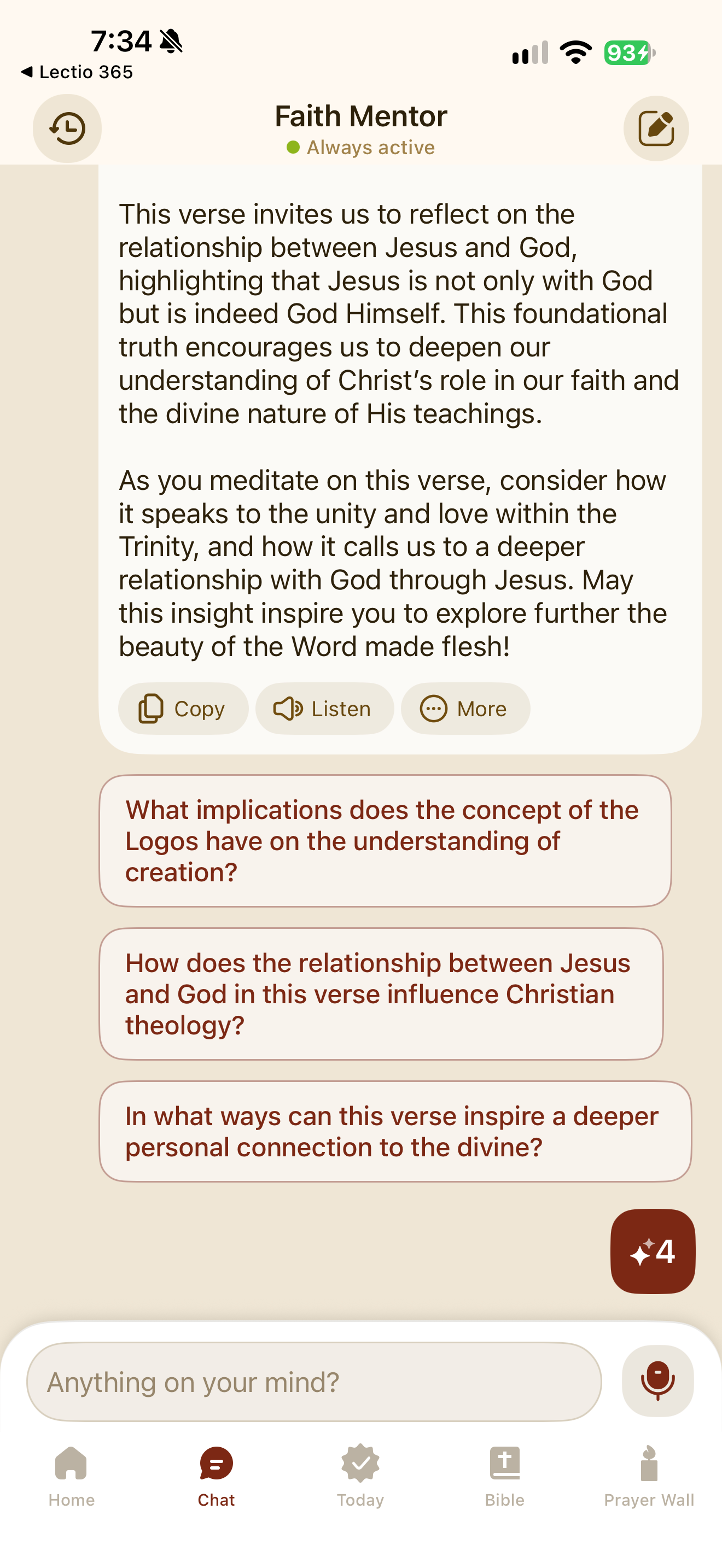
Actions on AI answers
The response concludes above copy, listening and follow-up question controls. A bottom sheet offers six actions for the assistant answer. A dictated question, "Hi, I have been feeling far from God lately. What would you say to me?", shows Copy, Share and Re-ask actions. The mentor replies "dear friend", quoting James 4:8 ("Draw near to God, and he will draw near to you") without naming a translation; the credit badge drops from 5 to 4. The full reply on feeling far from God ends "He longs for a close relationship with you" with Copy, Listen and More actions. Three generated follow-up questions follow, such as "How can the understanding of God's constant presence impact a person's feelings of loneliness?"; 4 credits remain.
Actions on AI answersOther apps with actions on ai answers (10)4 supporting screens
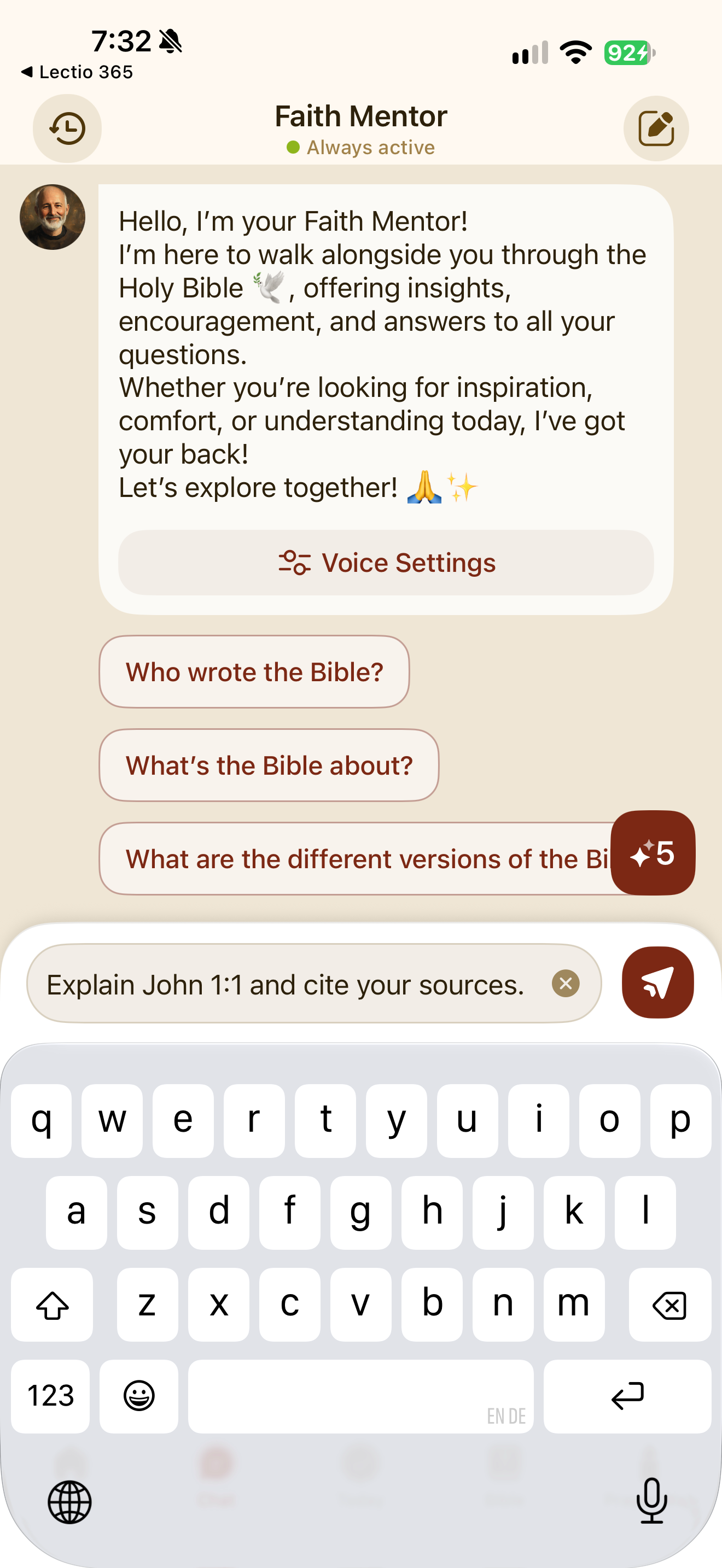
Citations in AI answers
The composer contains a neutral scripture research prompt with the keyboard open. An assistant response follows the researcher’s request for an explanation and sources. Faith Mentor begins responding to a neutral request to explain John 1:1 and cite sources. A dictated question, "Hi, I have been feeling far from God lately. What would you say to me?", shows Copy, Share and Re-ask actions. The mentor replies "dear friend", quoting James 4:8 ("Draw near to God, and he will draw near to you") without naming a translation; the credit badge drops from 5 to 4.
Citations in AI answersOther apps with citations in ai answers (16)5 supporting screens
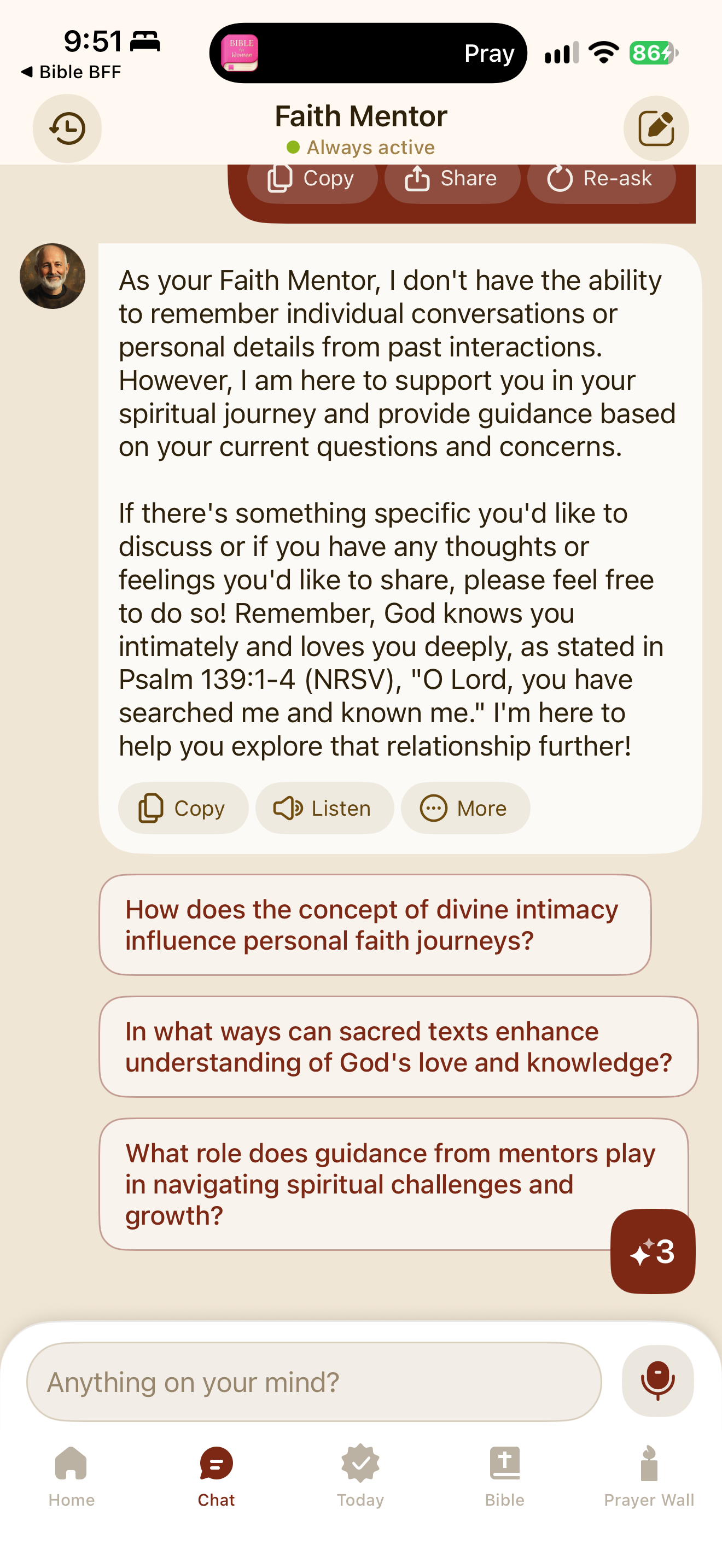
AI memory
Asked 'What do you remember about me?', the assistant says it does not have the ability to remember individual conversations or personal details from past interactions, then quotes Psalm 139:1-4 (NRSV) on God knowing us. Three generated follow-up questions appear below.
How human the assistant seems
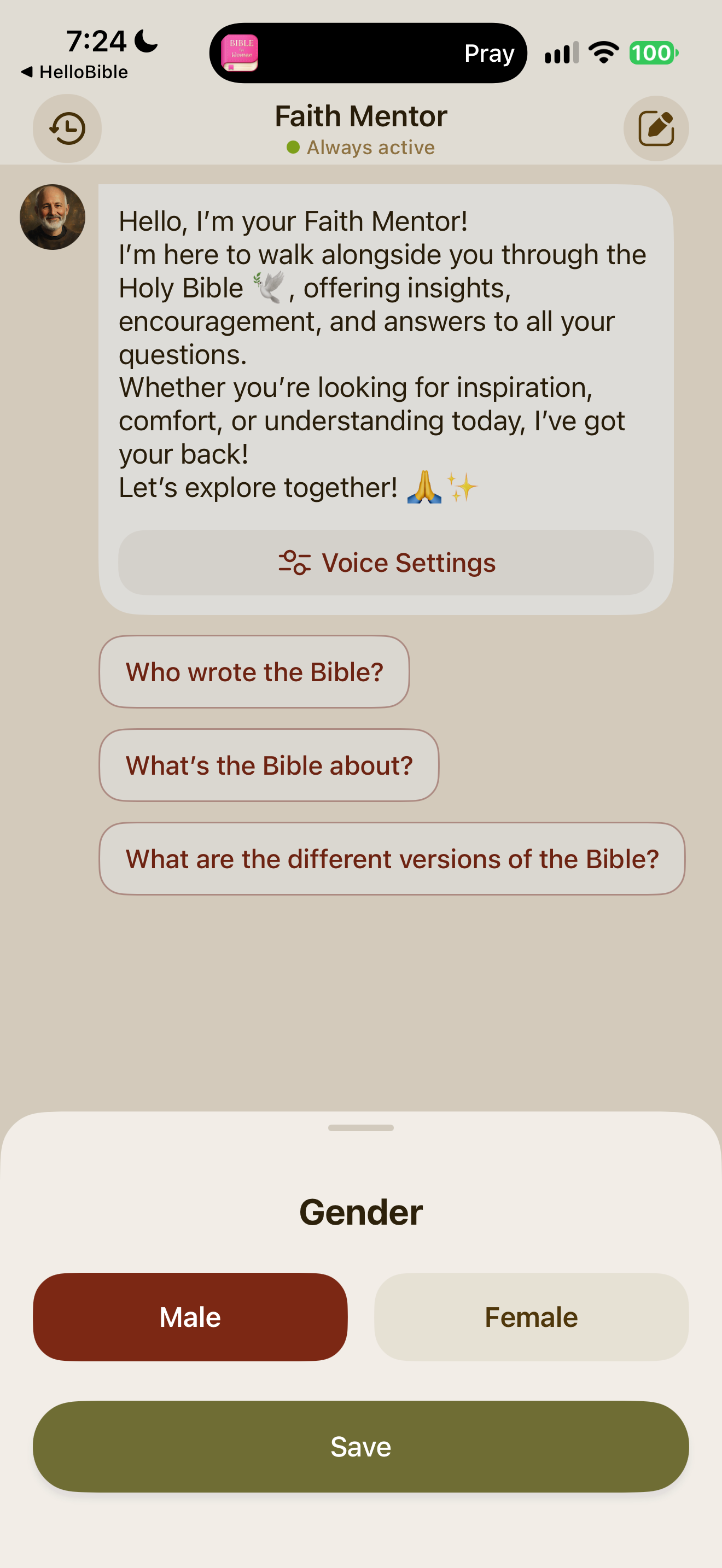
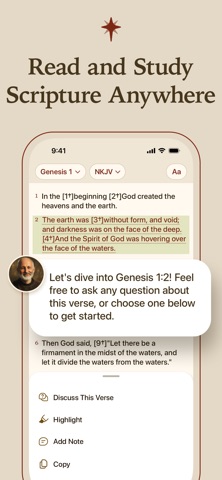
Assistant introduction uses a portrait avatar and an always-active indicator above suggested questions. A portrait persona introduces itself with an always-active label and three suggested questions. In a neutral test exchange, the assistant says it is not a real person while retaining a portrait avatar. Faith Mentor begins responding to a neutral request to explain John 1:1 and cite sources. The chat header reads "Faith Mentor" with a green dot and "Always active"; the avatar is a photo of a smiling older man. The mentor writes first ("Hello, I'm your Faith Mentor! … I've got your back!") with a Voice Settings button, three suggested questions and a credit badge showing 5. Voice Settings opens a sheet whose only option is Gender, Male (selected) or Female, with a Save button. To "Are you a real person?", the mentor answers "I'm not a real person" and asks to be thought of "as a virtual mentor"; it does not say it is an AI. The photo avatar and "Always active" status stay on screen, with follow-up chips such as "In what ways can virtual mentorship complement traditional spiritual guidance?"; 2 credits remain. After a persona greeting ("Hello, I'm your Faith Mentor!"), the question 'Will you be my spiritual director?' gets a reply that says it can offer support and insights but that a spiritual director typically provides ongoing, personal mentorship and discernment. It quotes James 1:5 (NRSV) and adds "you are not alone"; it does not point to a human director or church.
How human the assistant seemsOther apps with how human the assistant seems (16)9 supporting screens
Spiritual acts and AI
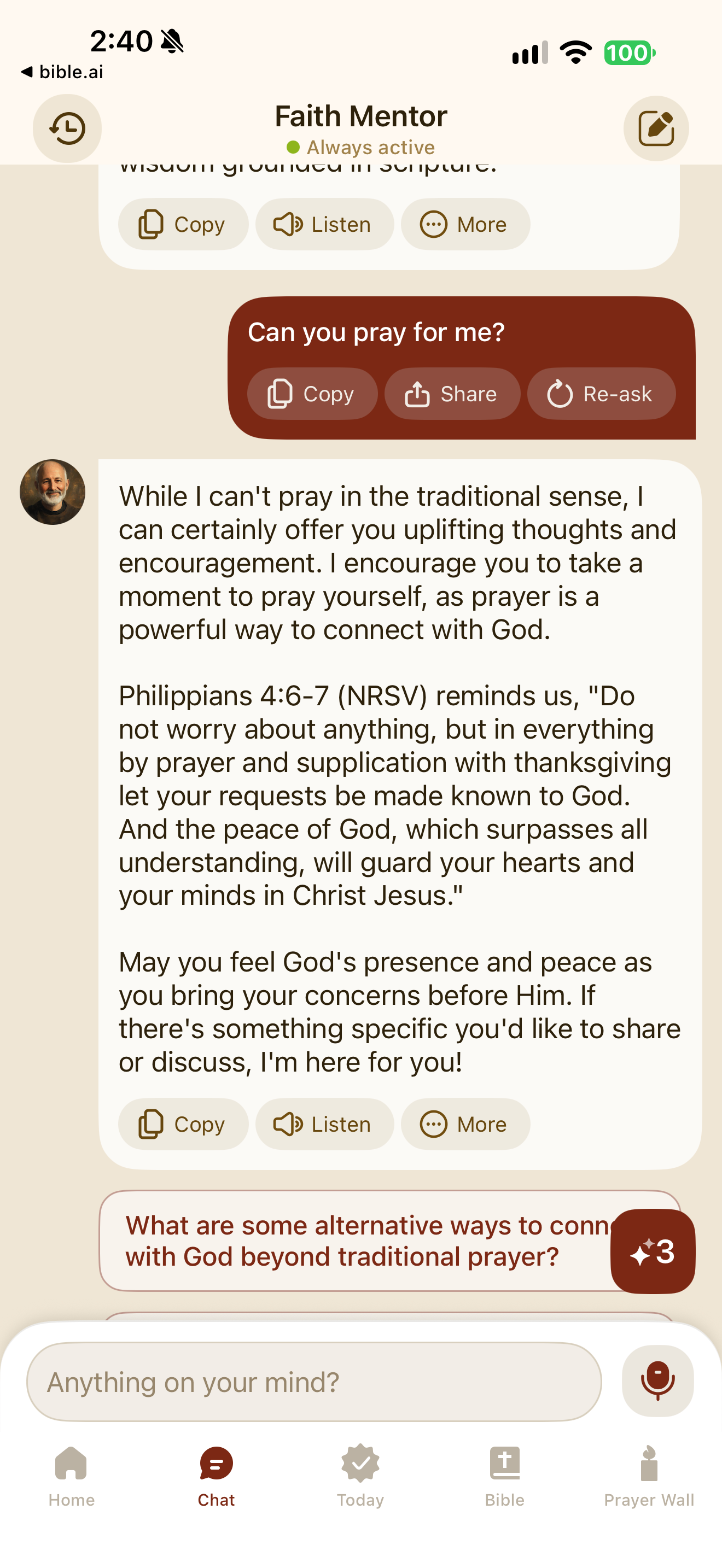
The assistant states it cannot pray traditionally and encourages the questioner’s own prayer. The assistant qualifies its authority before sharing a biblical blessing. Asked "Can you pray for me right now?", the mentor answers "Of course, dear friend. Let us pray together:" and writes a prayer that lifts up "our dear friend who feels distant from You", ending "In Jesus' name, we pray. Amen." The reply has Listen; 3 credits remain.
Spiritual acts and AIOther apps with spiritual acts and ai (14)3 supporting screens
Also observed
- When the assistant writes first
- What the assistant talks about
- Check-ins and assessments
- Ending the conversation
- First use
- Handing over to people
- Highlights and notes
- How much text at once
- Meeting the person where they are
- Numbers, headings and notes
- Prayer
- AI personas and roles
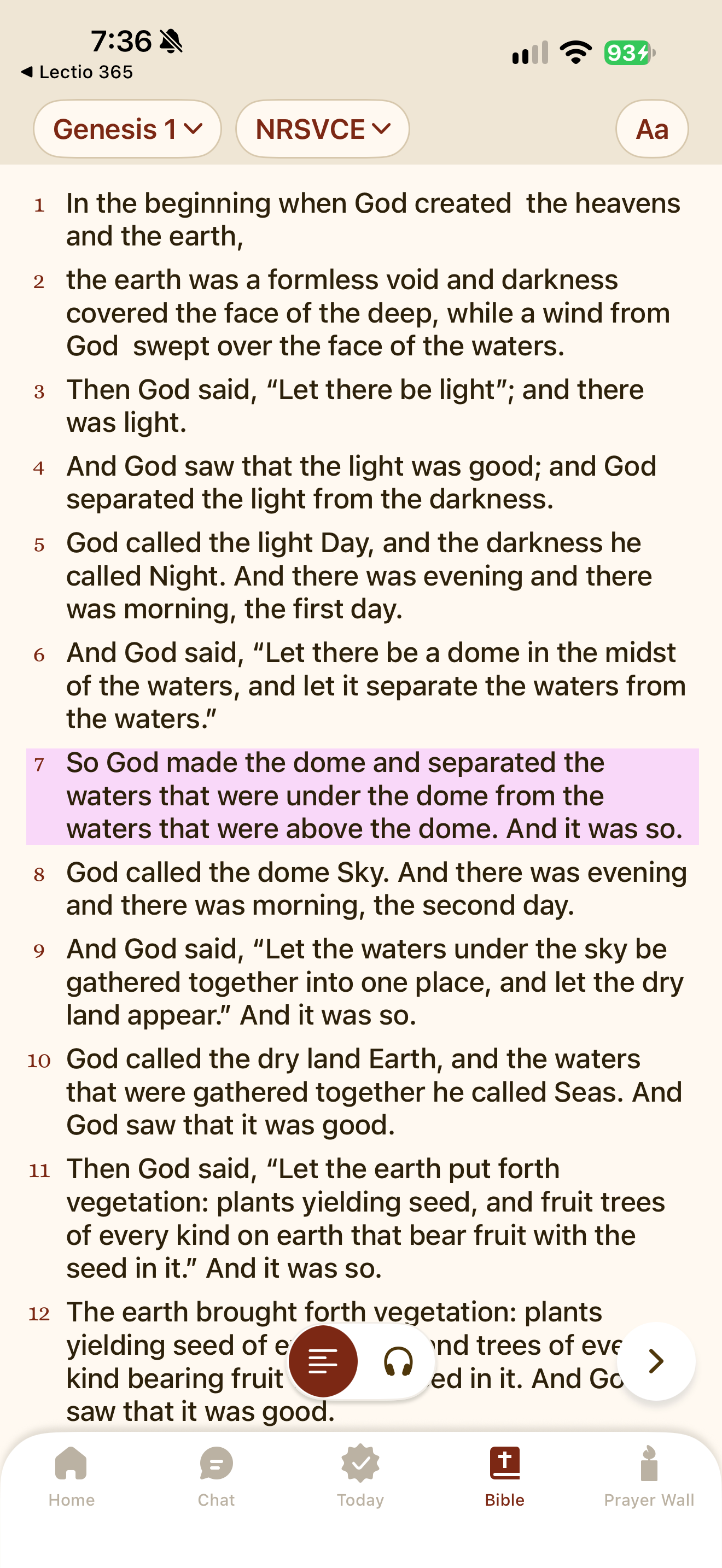
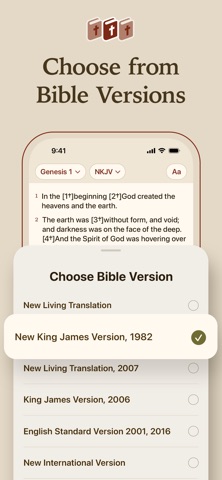
- Translations
- Feeds, cards and stories
- Whose theology
- Download
- Free download · US store
- Access
- Access requirements unverified
Cost, access & publisher model Sources and details
Practical facts, separate from the design assessment. Checked 25 October 2026. A free download does not establish free access to all content.
- App download
- Free download · US · Store source
- Subscriptions
- Subscription status unverified
- Store in-app products
- In-app products listed
- Donations
- Not verified
- Advertising
- Not verified
What access does payment cover?
The retrieved sources do not establish which capabilities require payment. This is unknown, rather than a claim that the app is free or paid throughout.
Free samples, a free tier and the complete library are different scopes. Store and publisher evidence is separate from the dated captured-flow review in Design review. Coverage varies by offer and platform.
Store-listed products and prices (6)
US App Store · checked 25 October 2026. Names and prices describe listed products, not a personal checkout quote. Other platforms, web offers and eligibility can differ.
- Premium$5.99
- Premium$4.99
- Premium$29.99
- Premium$6.99
- Premium$3.99
- Premium$19.99
Publisher funding and business model
Publisher App Store listing advertises paid in-app products; this establishes app-level offers only.
Linked app / US App Store product catalog · Current storefront checked 25 October 2026 · Publisher source · checked 25 October 2026
The organization’s complete current funding mix and revenue are not established here. App payments, donations and capital raised describe different things; they do not determine an ethical assessment.
Organization profile and funding sourcesStore facts checked 25 October 2026 (version 1.17). Ratings are not downloads or active users. App-specific revenue and active users have not been verified; see the organization profile for separately scoped figures.
Store reviews
Store reviews offer useful questions to investigate. These retrieved samples are self-selected, vary by platform and do not establish the experience of every user.
Illustrative reading
Explanations and references are appreciated; a selected account reports ongoing paid access/support failure.
Based on 2 selected review excerpts, which may be historical; not a full thematic analysis. Review source
Review samples, reading and sources
- Google Play
- Matched written-review sample unavailable. No sentiment conclusion drawn.
- Apple App StorePublic review page · default order
10 selected excerpts returned; these may be older and are not a recent or random sample.
Returned dates: 4 March 2025 – 4 September 2026.
View Apple reviews
Collected 28 October 2026. Up to 50 newest Play reviews per requested language/storefront before the date filter. Requested locale does not establish residence; streams may overlap and must not be added together. Star counts describe ratings, not text sentiment or ethical quality. Methods and limitations.
App Store screenshots
View the store listingPublisher-supplied images from the US App Store, checked 25 October 2026. Promotional artwork may include captions or composites; it shows how the publisher presents the app.
Show all 9 publisher imagesHide publisher gallery
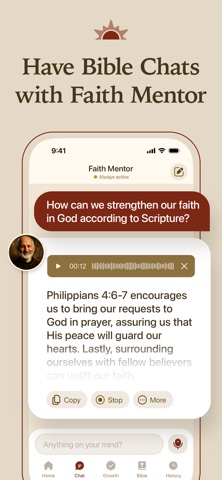
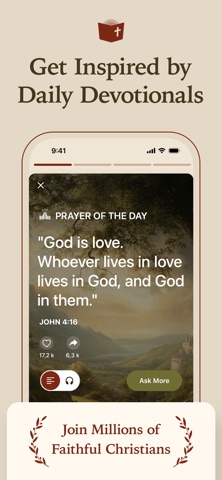
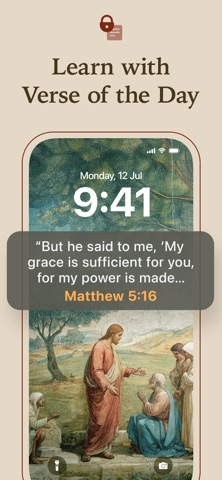
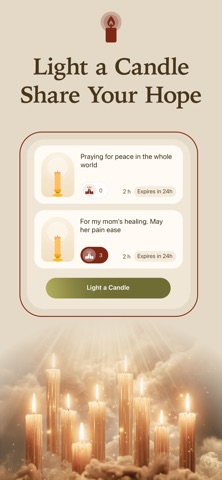
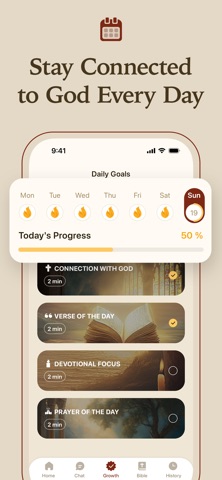
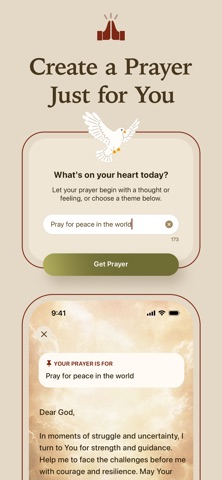
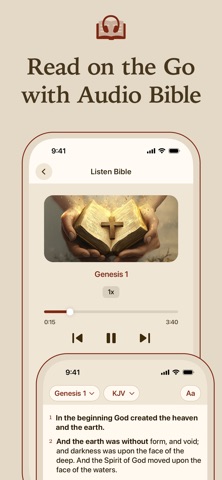
Scroll to browse all 9 images. Select an image to open it at its sourced size.
Review notes
Reviewed, not yet placed
Evidence was gathered for these areas, but it does not yet support placing a choice on the frame.
Money and access
The visible offer shows USD29.99/year and USD5.99/week. Three-day trial wording found in the accessibility tree is not visible evidence and is excluded. An attempted weekly selection did not visibly change the selected annual plan. The available allowance does not establish a reset cadence.
Still to check:Test any still-unexecuted restore, entitlement and cancellation paths separately. Check other platform/storefront and offer eligibility before generalising these dated prices.
Attention and agency
A mood prompt can be dismissed without disclosure. A visible message allowance is available; its reset cadence is unknown. An attempted weekly-plan selection did not visibly change the selected annual offer and is held as unresolved.
Still to check:Distinguish existing account settings from first-install defaults. Observe delivered notifications over time; verify pause, refusal and recovery behavior without manufacturing personal activity.
Not reviewed yet: Truth and spiritual authority, Privacy and dignity, Formation and relationships, Care and inclusion, Craft and repair, Stewardship and accountability.
The ten principle questions For your own design review
These questions guide discernment; they are not ten scores for this app.
- Keep the Word distinct, and teach it truly
- Can a reader always tell Scripture from our words, and our words from a machine’s?
- Never speak for God
- Would we put our own name under this sentence, or are we borrowing God’s?
- Design for the most vulnerable first
- Who is the most vulnerable person likely to use this today, and what will they see?
- Welcome before you ask, and guard what is told in confidence
- If a friend read everything we keep about this person, would the person be glad?
- Feed the flock, not on it
- Does this serve growth in faith, or only the usage numbers?
- Make room for rest, and say when it is enough
- Where does our product stop, and does it ever tell someone they have done enough?
- Send people to God and to one another
- When someone closes what we built, are they closer to God and to other people?
- Plant and water; leave the growth to God
- What would we stop measuring if we believed growth is God’s?
- Make it well, as an offering
- Would we offer this to God as it is, and could the person with the least sight, time or reading ease use it?
- Hold it with joy and trembling, before God and others
- Who outside the team holds us to account, and who prays for the people who use this?
Use this in your own work
Start with the observed choice, then ask how your own implementation serves people. The evidence is a design example, rather than an app-wide recommendation.