

Book review · prayer and formation
How God Becomes Real
Kindling the Presence of Invisible Others
An anthropologist on how prayer and practice make God feel present, and why every prayer feature is a training.
- T. M. Luhrmann
- 2020
- Book
- Reviewed 10 November 2026
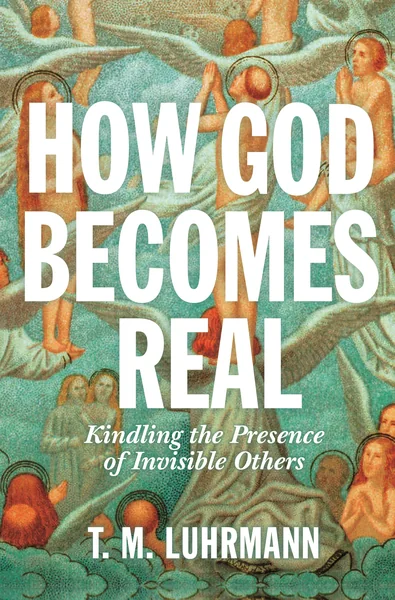
T. M. Luhrmann, How God Becomes Real: Kindling the Presence of Invisible Others. Princeton University Press, 2020 (paperback 2022). ISBN 978-0-691-16446-5. Publisher’s page.
Read in full from the ebook (the 2022 paperback edition), 9 November 2026. The ebook has no page numbers, so quotes give the chapter.
In one paragraph
Tanya Luhrmann is an anthropologist of religion and the mind who has spent decades with people who pray, above all charismatic evangelicals in Chicago and California, with comparisons in Chennai, Accra and elsewhere. Her question is not whether God is real. She calls this “an anthropologist’s book”, neither a believer’s nor an atheist’s, and says nothing in it speaks for or against “the genuine reality of gods and spirits”. She asks how people come to feel that God is present and responsive, and what that does to them. Her answer: through practice. Small, repeated acts of attention, which she calls “kindling”, make God feel real “the way your mother’s love feels real”, and they change the person who prays. She sets this out as seven hypotheses, one per chapter, drawing on interviews, surveys and a month-long experiment with prayer audio.
Three takeaways
Practice makes presence felt.
The churches she studied said that without daily prayer, Bible reading and a small group, God “would simply disappear” for them. Her unit of practice is small: saying thank you, thinking over the day, asking about the next step. Prayer, she argues, changes how people attend to their own thoughts, and speaking to someone who listens makes that stronger than talking to oneself.
Guided imagination trains people.
In her 2007 experiment, Christians listened for thirty minutes a day, six days a week, for a month. Those given audio that read a passage and then invited them to imagine the scene with all their senses reported more vivid mental imagery, and were more likely to say God had begun to feel like a person, than those given lectures on the Gospels.
The same practice lands differently.
People vary in “absorption”, a trait of being caught up in what they imagine; it predicted vivid and unusual experiences, though she calls the effects small. Culture matters too: with much the same theology, God felt like a chatty friend in California, a father met through people in Chennai and a power felt in the body in Accra. And first experiences tend to be the strongest; later ones are “more common but less startling”.
I call this kindling when God feels a little more real to those who pray. These are tiny acts.
What it means for design
Proposals for our patterns, drawn from the book. They are not yet part of the published pattern pages.
- Devotional audio
- Audio that asks the listener to imagine a scene (“See the shepherd before you”) is the nearest thing to a faith app that she tested, and it trained people within a month. Treat it as a practice with a name, imaginative prayer in the Ignatian tradition, not as atmosphere. Say what it will ask before it starts, offer plain reading beside it, and invite rather than promise: some listeners will see nothing, and that is not failure. My paper Digital Spiritual Formation in Post-Christian Europe proposes a guide style that “paints pictures” (“Picture the room. Who’s there?”). Her evidence suggests that is the most formative style, so it needs the most care in writing and review.
- Prayer
- Her “tiny acts” fit the pattern’s short options: thanks, looking back over the day, one concrete ask. Her list also includes “Being miffed when God fails to answer one’s prayers.” Leave room for complaint in a guided prayer, not only gratitude.
- Check-ins and assessments
- If an app asks how someone is “with God”, don’t chart the answers as a trend to improve. She found that experiences of God tend to become more common but less striking with practice, so a falling line may mean a person has grown, not drifted.
- AI personas and roles and Never speak for God
- The churches she studied tested whether a thought came from God: it differed from what they had just been thinking, fitted God’s character, could be confirmed some other way, and brought peace. A fluent generated reply in Scripture’s cadence can pass all four. People trained to listen for God may be the most likely to hear an app’s words as his, so keep the app’s words visibly the app’s.
- Whose theology
- Her comparison shows a product’s voice and examples teaching one way of meeting God as if it were the only one. An assistant that chats like a friend trains the Californian style. Teams outside the United States should notice whose piety their persona carries.
- Design for the most vulnerable first
- Write first-use and onboarding copy for the low-absorption person who will never hear a voice, and for the person whose felt God is a judge. She cites a study in which praying to a God felt as judging went with more psychiatric symptoms. A vivid inner voice is not good news for everyone who prays.
It is as if this intense inner attention makes the world of the mind more vivid, and the vividness leaks into the world.
Where we differ
Luhrmann studies the human side and brackets the rest, and she is careful to say so. As Christians we confess the other side: God is real and speaks first, before and apart from our practice. “We love because He first loved us” (1 John 4:19, BSB). Practice does not make God real; it trains our attention to the God who is already there. Her mechanisms explain why prayer features form people. They don’t explain God away, and she never claims they do.
Some of her analytic language, faith as “serious play” and the imagined worlds she calls paracosms, belongs to the observer. In a product that speaks from inside the faith, framing prayer as imagination would say something she herself only brackets.
The churches she describes test a thought against God’s character and against other people. We would add that the test is Scripture, read in the church: “test the spirits” (1 John 4:1). That is a stronger guard against a fluent machine than a feeling of peace.
She treats the moral fruit of different gods comparatively, and says she has wrestled with some commitments that people say grew from their relationship with Jesus. We judge formation by the character of God revealed in Christ. Her evidence that felt relationship forms people makes that judgement more urgent, not less.
Who should read it
- Designers of prayer, audio and onboarding features, and anyone writing an assistant’s voice.
- Pastors and spiritual directors who want an outsider’s careful account of how prayer is learned.
- Short on time? The preface lists all seven hypotheses; chapter 3 has the audio experiment; chapter 6 explains why prayer works.
How God Becomes Real at Princeton University Press. No affiliate link.
But a god that cannot startle you does not feel real to people
Evidence and limits
- Mostly her own research. Long fieldwork, about 130 interviews in the Spiritual Disciplines Project and the audio experiment, nearly all with charismatic evangelicals in the United States.
- Self-selected participants. People were recruited through church bulletins asking for those interested in spiritual transformation, and outcomes are mostly self-reported.
- Small effects, stated as such. She calls the absorption effects small. The audio study ran for one month.
- Thin comparisons. Twenty interviews each in Chennai and Accra, mostly done in a month. She says the differences she describes are an ethnographer’s interpretation, not objective measurement.
- Edited quotations. Interview quotes are edited to remove repetitions and hesitations, and details are changed to protect people.
- Not about technology. The iPods were a research tool; there is nothing on apps or AI. Every product implication here is ours.
Cited studies we have not checked yet
What the book reports, as it reports it. We don’t cite these as findings until we have read the original.
| Study, as cited | What the book reports | Status |
|---|---|---|
| Luhrmann, Nusbaum and Thisted, 2013 | A month of imaginative prayer audio raised imagery vividness more than lectures on the Gospels. | Not yet checked |
| Luhrmann, Nusbaum and Thisted, 2010 | Among 28 church members, absorption went with experiencing God as a person. | Not yet checked |
| Tellegen and Atkinson, 1974 | The Absorption Scale, the trait measure behind her findings. | Not yet checked |
| Flannelly et al., 2010 | Praying to a God felt as loving went with better health; to a God felt as judging, with more psychiatric symptoms. | Not yet checked |
| Schjoedt et al., 2009 | Informal prayer looked in the brain like talking to a friend; reciting the Lord’s Prayer did not. | Not yet checked |
| Sharp, 2010 | More than sixty women who had fled domestic violence described how talking with God helped them cope. | Not yet checked |