

Book review · prayer at night
Prayer in the Night
For Those Who Work or Watch or Weep
An Anglican priest on grief, doubt and the church’s night prayer, and what the person awake at 2 a.m. needs.
- Tish Harrison Warren
- 2021
- Book
- Reviewed 10 November 2026
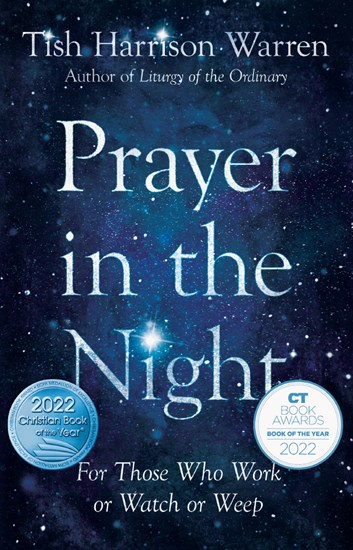
Tish Harrison Warren, Prayer in the Night: For Those Who Work or Watch or Weep. InterVarsity Press, 2021. ISBN 978-0-8308-4679-5. Publisher’s page.
Read in full from the ebook, 9 November 2026. The ebook has no page numbers, so quotes give the chapter.
In one paragraph
Tish Harrison Warren is a priest in the Anglican Church in North America and the author of Liturgy of the Ordinary. In 2017 her family moved to Pittsburgh; a week later her father died, and over the following months she lost two pregnancies. During the first, haemorrhaging in an emergency room, she asked her husband to pray Compline, the church’s last prayer service of the day, and he read it from the Book of Common Prayer on his phone. That year she was, in her words, “a priest who couldn’t pray”. The book walks phrase by phrase through one Compline prayer: “Keep watch, dear Lord, with those who work, or watch, or weep this night…”. Most chapters take one line and one theme, from lament and attention to sickness, death, affliction and joy. Her argument is that faith “is more craft than feeling”, and that the church’s prayers carry people when their own words fail.
Three takeaways
Received words hold when your own run out.
In the emergency room she “couldn’t drum up words”. A friend once objected to “other people’s prayers”; Warren answers that belief waxes and wanes over a lifetime, and inherited prayers “tether us to belief, far more securely than our own vacillating perspective or self-expression”. She still prays in her own words every day. The point is to have both.
Night is its own condition.
Grief and anxiety grow after dark. Night shifts fall most on the young, the poor and immigrants; dementia brings confusion at sunset. Her own nights in 2017 went to screens: articles, social media and Netflix until she collapsed into sleep. Her counsellor prescribed screen-free “comfort activities”, and slowly she returned to Compline.
Lament is more honest than cheer.
Laments are the most common kind of psalm. The Psalms, she writes, never say “Chin up” or “It’s not so bad”, and they don’t tell us why we suffer. Worship that only expresses trust and victory, she writes, teaches us to be less honest with God than Scripture is.
Here are some words. Pray them. They are strong enough to hold you.
What it means for design
Proposals for our patterns, drawn from the book. They are not yet part of the published pattern pages.
- Prayer
- An exploratory option from the prayer itself. It names the people it prays for: those who work, watch or weep, the sleeping, the sick, the weary, the dying, the suffering, the afflicted and the joyous. She calls it a list of “specific categories of human vulnerability”. Offer these as a way for someone awake at night to place themselves, and the people they carry, without typing out their story. Nothing is stored or shared.
- Spiritual acts and AI
- Her emergency room is the strongest case we know for the pattern’s “church’s words” option. In fear at night, she needed words written long before, not words about her. Name the night prayer of the app’s own church, with its source, rather than a prayer the model composes.
- Notifications and reminders and Make room for rest, and say when it is enough
- When someone opens the app late at night, consider opening on the night prayer rather than the feed, and ending there. The app is competing with the habit she describes, and a feed can become that habit. In my paper Digital Spiritual Formation in Post-Christian Europe I call this a dark night problem: falling use can be desolation that looks like churn, so send only gentle messages free of guilt.
- Agreeing and pushing back
- A test for replies to someone in grief or doubt: is the reply more cheerful than the lament psalms? If it says “Chin up” where the Psalms do not, it is less honest than Scripture.
- Handing over to people
- She writes that her church was good at walking with people in crisis and much less good at long-term need: “You need five meals after a hip replacement? We’ve got you.” Design hand-overs for the tenth week of a chronic illness or of caring, not only the first night, so that an assistant does not become the only constant presence in a long affliction.
- Children and families
- Her family prays the same Compline prayer so often that her eight-year-old can say it by heart. A short night prayer, the same each evening, prayed aloud together with the child’s part marked, is a family practice an app can serve and then leave.
So I’d fill the long hours of darkness with glowing screens, consuming mass amounts of articles and social media, binge-watching Netflix, and guzzling think pieces till I collapsed into a fitful sleep.
Where we differ
There is little distance between us and Warren; she writes from inside the faith we share. Where we would push further is on the person her book assumes: someone with a prayer book, a parish and a priest at home. Many people who open a faith app at night have none of these. An app can hand them the church’s words. It cannot be the church, and it should keep pointing to one.
Offering Compline is an Anglican choice. Pentecostal and free-church Christians pray mostly in their own words, and some traditions have objected to set prayer. Warren’s case for received prayer is strong, and she keeps a place for one’s own words. A product should still name which church’s night prayer it offers.
Some of her positions are her own within a wider Christian conversation, for example that God “does not cause suffering as a means to some greater good”. Christians who hold a stronger view of providence would put this differently. Attribute it to her.
She says little about technology, but her book holds both sides: the phone that carried Compline into the emergency room, and the screens she used to numb herself. Which of those an app becomes at night is a design decision, and that is the question her book leaves us.
Who should read it
- Anyone designing prayer, audio, notifications or an assistant that people use at night.
- Pastors and carers who sit with grief, doubt, chronic illness or night work.
- It ends with discussion questions and practices, arranged as five sessions for a group. The prologue and chapter 1 make the case.
Prayer in the Night at InterVarsity Press. No affiliate link.
Silence also taught me to be patient with God’s silence—to keep struggling to trust him when he wouldn’t give an answer, a sign, or a quick resolution.
Evidence and limits
- Pastoral theology and memoir. There is no study here. Claims rest on argument, her own story, her parish and the sources she cites.
- Her losses carry the argument. They illustrate rather than establish, and deserve the restraint she shows in telling them.
- Anglican and American. The practice assumed is the Book of Common Prayer in a US parish. Applying it to other traditions and countries is work for the reader.
- Facts at second hand. Night-work figures come from a newspaper report; sundowning from a medical explainer, which also carries her line that depression and anxiety worsen at night.
- Almost nothing on technology. Finished in early 2020, before today’s chat assistants. Every product implication here is ours.
Cited studies we have not checked yet
What the book reports, as it reports it. We don’t cite these as findings until we have read the original.
| Study, as cited | What the book reports | Status |
|---|---|---|
| Graff-Redford, Mayo Clinic, 2019 | In dementia, confusion and anxiety worsen around sunset (“sundowning”). | Not yet checked |
| Jan, Washington Post, 2017 | Immigrants account for a disproportionate share of night-shift workers. | Not yet checked |
| Carr, <cite>The Shallows</cite>, 2011 | What the internet does to attention. | Not yet checked |
| Sullivan, “I Used to Be a Human Being” | A writer’s silent retreat without phone or internet. | Not yet checked |