

Book review · making and beauty
Art and Faith
A Theology of Making
A painter on making as a way of knowing God, and what that asks of people who build products for faith.
- Makoto Fujimura
- 2020
- Book
- Reviewed 10 November 2026
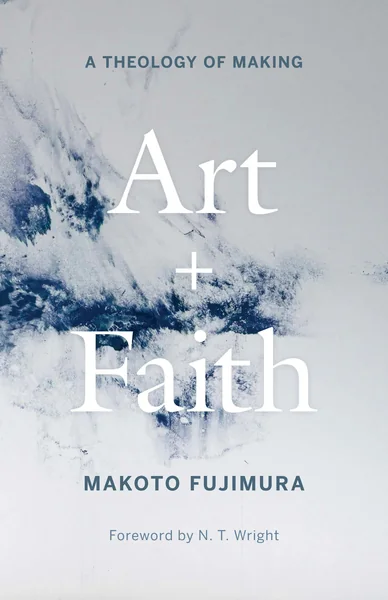
Makoto Fujimura, Art and Faith: A Theology of Making. Foreword by N. T. Wright. Yale University Press, 2020. ISBN 978-0-300-25414-3. Publisher’s page.
Read in full from the ebook, 9 November 2026. The ebook has no page numbers, so quotes give the chapter.
In one paragraph
Makoto Fujimura is a painter trained in Tokyo in nihonga, the Japanese tradition of painting with ground minerals, with studios in Princeton and Pasadena. He illuminated The Four Holy Gospels for Crossway and founded the International Arts Movement in 1991. His argument: God made the world out of love, not need, so the best human making is also generous and costly rather than merely useful. The church has narrowed the gospel to what he calls “plumbing theology”, a message of “God fixes things”, when the arc of Scripture runs from Creation to New Creation. His signature images are kintsugi, the Japanese art of mending broken tea bowls with gold until they are more beautiful than before, and the shortest verse in the Bible, “Jesus wept” (John 11:35), whose tears he reads as gratuitous, extravagant and costly.
Three takeaways
Make, don’t use.
He notices churches wanting to “use” young people’s instinct to make things online in order to reach them, and answers that “using” is a utilitarian word. Since the Industrial Revolution, he argues, we have valued what is efficient; the essence of being human may lie in what we call useless but is essential.
Ask what the pipes are for.
Sermons across denominations, he finds, present the gospel as God fixing what broke. That answers how the plumbing was mended, not why there are pipes at all. Making begins from abundance and points to New Creation, not only repair.
Behold before you mend.
A kintsugi master shows him old shards he collects not to repair but to contemplate. Fujimura asks what kind of church we would become if we let broken people gather and did not try to “fix” them, but loved and beheld them.
But “using” is a utilitarian word, and I wish to affirm those who “make” rather than “use.”
What it means for design
Proposals for our patterns, drawn from the book. They are not yet part of the published pattern pages.
- Make it well, as an offering
- A question for any brief that says “use”: use streaks to get people reading, use a character to reach teenagers. Ask what you are making for the person, and what the feature is for beyond getting them to return. Fujimura puts the objection himself: “if that method works, and the Good News is preached, what’s wrong with that?” His answer: churches are not empowering makers, and the context shapes the message as much as the preaching does.
- Feed the flock, not on it
- He borrows Lewis Hyde’s line that “where there is no gift, there is no art”, and warns that churches have treated the gospel like a commodity. A test for a paywall: keep Scripture, prayer and the church’s words on the gift side, and charge, if at all, for what is plainly extra.
- Progress and streaks
- Using C. S. Lewis’s image of Christians as horses with wings, he wants the church to be “a context and environment for failing many, many times” rather than demanding that believers jump higher. That gives the pattern’s quieter options a pastoral reason, not only a behavioural one.
- Art beside Scripture
- Sitting before a Rothko, he says, it takes about fifteen minutes to settle enough to truly see; most of the time we are trained to categorise and move on. When an app shows a painting beside a passage, give it the whole screen, no overlay and no timer, and credit the artist.
- Agreeing and pushing back
- His rule for grief: “Do not apply plumbing theology to a broken life.” Be careful not to prescribe to someone who is suffering “as if we know what to prescribe to heal despair”. For grief replies, that means presence and lament before any suggestion. Where someone is in danger, help still comes first; see Suicide concerns receive a direct, humane response (in development).
- Your design reviews
- Add his question to a review: what are the pipes for? A feature can work, retain and convert, and still never say what it is for.
Do not apply plumbing theology to a broken life.
Where we differ
We share his starting point: God makes, and calls people to make well. Our principle Make it well, as an offering rests on the same passage he reads, Bezalel and Oholiab filled with the Spirit for their craft, with “the ability to teach others” (Exodus 35:34).
He writes that every time he felt the charge of creating as a child, he “was experiencing the Holy Spirit”. We would hold the line between Creator and creature more firmly. Common grace explains much creative joy, and not every creative impulse is the Spirit’s voice. He supplies his own caution: we “may create idols of our art”.
Some readings are offered warmly rather than argued: gold hidden in Eden for the future city of God is, in his words, “I conjecture”, and God singing creation rests on what “many Hebraic scholars attest”, without a source. We would borrow the theology and leave the conjectures as his.
His maker works alone with materials over years. Product teams ship to many people under metrics and investors. He sees the risk in one line: “Technology and social media can be used creatively for life-giving storytelling, but they also can have life-taking results.” Extending his theology to software is our work, not his; he leaves the discernment to us.
Who should read it
- Designers and developers who wonder whether their craft matters to God.
- Product and ministry leaders tempted to justify every feature by usefulness or growth.
- Short on time? Chapter 1 on the vocation of the maker, chapter 4 on kintsugi, and chapter 8 on Christ’s tears.
Art and Faith at Yale University Press. No affiliate link.
There is no music without pauses. There is no art if we are unwilling to wait for paint to dry.
Evidence and limits
- Theology from Scripture, art and his own studio. There are no studies; the weight is exegesis, art history and experience.
- Some readings are conjecture. He marks some himself; others rest on uncited appeals. Check any passage against a commentary before reusing it.
- American targets. Plumbing theology, culture wars and church-as-mall are mostly American evangelical concerns.
- A book about art, not software. Technology appears in passing: Instagram and iPhones, and Jacques Ellul on “technique”. Every product implication here is ours.
- Another translation. Scripture is quoted mostly from the NIV; check any verse against your own translation before quoting it.
Cited studies we have not checked yet
What the book reports, as it reports it. We don’t cite these as findings until we have read the original.
| Study, as cited | What the book reports | Status |
|---|---|---|
| Hyde, <cite>The Gift</cite>, 1983 | A work of art lives in a gift economy as well as a market one. | Not yet checked |
| Ellul, <cite>The Technological Society</cite> | The dominance of “technique” and usefulness in modern life. | Not yet checked |
| “many Hebraic scholars attest” | That God sang creation into being; no source is given. | Not yet checked |