

Book review · children and AI
Human Raised
Nurturing Connection, Curiosity & Lifelong Learning in the Age of AI
A paediatric surgeon on early childhood and AI: enhance the grown-ups’ care, don’t replace it.
- Dana Suskind
- 2026
- Book
- Reviewed 10 November 2026
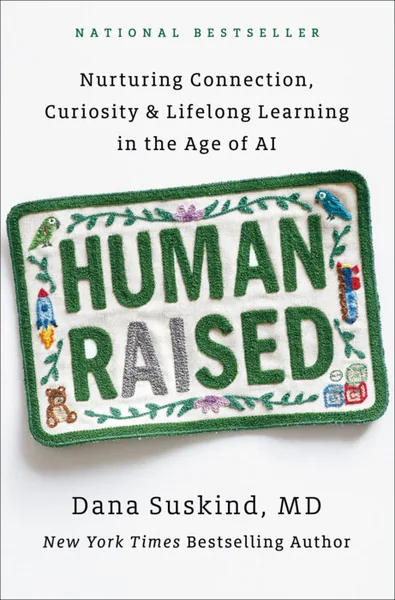
Dana Suskind, Human Raised: Nurturing Connection, Curiosity & Lifelong Learning in the Age of AI. Dutton, 2026. ISBN 979-8-217-18089-9. Publisher’s page.
Read from the ebook, 8 November 2026. The ebook has no page numbers, so quotes give the chapter.
In one paragraph
Dana Suskind is a paediatric surgeon who restores hearing to deaf children, and the author of Thirty Million Words. She writes for parents of children up to six. Her case: children’s brains are built through imperfect, responsive human interaction, the back-and-forth she calls serve and return, with small misunderstandings and their repair. AI can now imitate the cues that open a young child to learning and attachment, but it does not care about the child. So parents should use AI to enhance their care, for logistics, insight and teachers’ workload, and refuse it as a replacement: companion, nanny or comforter, above all in the early years. She sums this up as HOPE: human connection is irreplaceable, own the imperfections, protect the early years, enhance, don’t replace.
Three takeaways
AI can open a child’s “social gate” without caring.
Children learn from people because cues of understanding (gaze, turn-taking, a responsive voice) switch on their attention. Those cues can be imitated. A clumsy robot that misheard a three-year-old again and again was still hugged by her brother.
Enhance care, don’t replace it.
In early-years classrooms she wants AI teacher-facing for children under five, and she would not give an AI toy to any child under six to use alone. Where a child uses AI at all, her strongest rule, from roboticists who are parents, is that an engaged adult sits with them.
Design decides whether children can stop.
She reports a study in which preschoolers who chose a plan before watching stopped on their own when reminded of it; with a corner of suggested videos they watched longer and parents stepped in more. Her conclusion: managing use depends less on the child than on the design.
Augmentation may be a gift; replacement is a risk.
What it means for design
Proposals for our patterns, drawn from the book. They are not yet part of the published pattern pages.
- Children and AI
- Add an age line: under six, AI stays on the grown-up’s side. Keep “ask together” and authored, limited replies. For children’s modes, test five behaviours she takes from a recent benchmark: flattery, claimed feelings, trying to keep the child talking, presenting itself as the only listener, and playing therapist.
- Children and families
- A borrowed option: the child sets the plan. Before a story or video, the child picks how long and what comes next; at the end the app reminds them, with nothing queued. For read-aloud, design pauses where the child answers and the grown-up responds, rather than a monologue read at the child.
- Devotional audio
- She calls a robot that reads bedtime stories and comforts a child at night the greatest threat to “enhance, don’t replace”, and keeps middle-of-the-night comfort on her list of uniquely human tasks. An exploratory option: children’s Bible stories as a script for the grown-up to read, or recorded in a parent’s or grandparent’s voice, offered before a narrator. Sleep audio fades to silence.
- How human the assistant seems
- Two failures to add: an AI saying “we” as if it were one of us (“we’re wired to…”), and a self-description that changes between sessions. Fred Rogers signed letters to children “your television friend” and said the bond had a limit: a warm, honest model for stating limits.
- Progress and streaks and Check-ins and assessments
- Don’t give parents a score for a child’s prayer or reading. It repeats the quantified parenting she warns against.
- Design for the most vulnerable first
- She warns of a two-tier future: human care for children whose families can afford it, a machine for the rest. A church short of children’s volunteers should not hand children to a chatbot because it is better than nothing.
One is a set of training wheels. The other is a merry-go-round—an amusing activity that takes you nowhere.
Where we differ
Suskind does not write about faith or the church. Her account of care is evolutionary: love no code can copy, care that must come from us. Christians would say love is first received: “We love because He first loved us” (1 John 4:19, BSB). Parents are not only good enough; they also fail, repent and are forgiven. The repair she describes between parent and child can also be confession and reconciliation.
She wants parents and trusted caregivers, not companies or governments, to decide what AI enters a child’s life, while calling for policy support, and she mourns the lost village without naming the church. At a baptism or dedication, a congregation promises to help raise a child. Godparents, children’s leaders and grandparents are that village, and our patterns should name them on the human side.
She frames human strengths as the skills that will matter most in an AI-driven world. Christian formation aims at love of God and neighbour, not advantage. We cite her evidence and leave the competitive framing aside.
Her picture of serve and return has a counterpart she does not draw: Deuteronomy 6 describes talking about God’s words at home and on the road, a conversation, not a broadcast. Faith at home is where our patterns can add what the book leaves out.
Who should read it
- Parents of young children, and anyone designing a kids’ mode or family feature.
- Children’s and family ministry leaders weighing apps, audio and AI tools for church.
- Each chapter ends with a short review, useful if you want the argument without the stories.
Human Raised at Dutton (Penguin Random House). No affiliate link.
we should not design for a world in which parents will not be present. We should build tools that help parents be more present.
Evidence and limits
- A popular book for parents. Studies are summarised selectively and vividly. One finding, her centre’s work on the acoustic quality of a parent’s voice, carries no citation.
- Anecdote carries much of the argument. Waiting rooms going quiet, a robot with two children, roboticists’ household rules: these illustrate, they don’t establish effects.
- Small and early studies. The viewing study had 24 families; the infant language studies are small lab samples; the benchmark she cites tests chatbot replies, not children.
- Little long-term evidence on AI and children. She says so herself and argues from precaution and established developmental science. Reasonable, but extrapolation.
- US-centred, ages 0–6. Nothing on European or UK children’s codes; little for teenagers, who use Bible chat apps most.
- A conflict of interest to note. She developed an AI device that measures a child’s language environment, and argues for “enhancement” AI of the kind her centre builds.
Cited studies we have not checked yet
What the book reports, as it reports it. We don’t cite these as findings until we have read the original.
| Study, as cited | What the book reports | Status |
|---|---|---|
| Kuhl et al., 2003 | Nine-month-olds learned speech sounds from a live tutor but not from the same lesson on video. | Not yet checked |
| Romeo et al., 2018 | Conversational turns, more than words heard, relate to children’s brain activity and structure. | Not yet checked |
| Hiniker et al., 2018 | Preschoolers stopped on their own after choosing a plan; with suggested videos they watched longer. | Not yet checked |
| Xu et al., 2023 and 2024 | A TV character replying from scripted responses helped children aged four to seven correct wrong answers. | Not yet checked |
| Xu et al., 2021 | Children gave richer answers to a human reading partner than to a conversational agent. | Not yet checked |
| Kaffee et al., 2025 (INTIMA) | Five risky companion behaviours in chatbot replies. | Not yet checked |
| Gottman, 1983 | Children’s friendships form through play, conflict and repair. | Not yet checked |
| Madrian and Shea, 2001; Johnson and Goldstein, 2003 | People keep defaults 85–95% of the time. | Not yet checked |
| Sharma et al., 2023 | A chatbot changed a correct answer when told it might be wrong. | Not yet checked |
| Uncited in the book | Her centre’s finding on the acoustic quality of a parent’s voice. | Not yet checked |