

Book review · design as a Christian calling
A Christian Field Guide to Technology
for Engineers and Designers
Three Christian engineers on why design is never neutral, and how named norms can steer it. A colleague’s book for faith-app teams.
- Ethan J. Brue, Derek C. Schuurman and Steven H. VanderLeest
- 2022
- Book
- Reviewed 10 November 2026
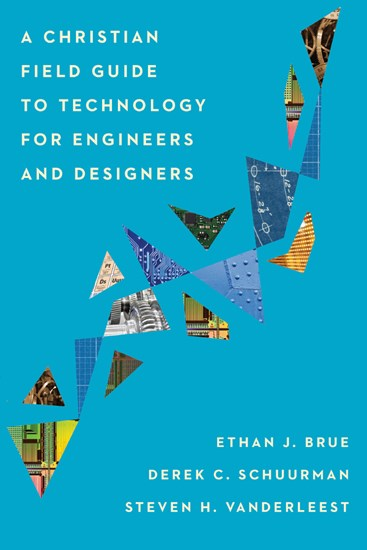
Ethan J. Brue, Derek C. Schuurman and Steven H. VanderLeest, A Christian Field Guide to Technology for Engineers and Designers. IVP Academic, 2022. ISBN 978-1-5140-0100-4. Publisher’s page.
Read in full from the ebook, 9 November 2026; quotes rechecked 10 November. The ebook carries the print page numbers, so quotes give chapter and page.
In one paragraph
Ethan Brue teaches engineering at Dordt University, Derek Schuurman computer science at Calvin University, and Steven VanderLeest is a principal engineer at Rapita Systems who taught engineering at Calvin. All three have worked in industry. They write for students and working engineers who want their faith to reach their technical work, and they ask in the preface: “How then shall we engineer?” Their answer starts from one claim: technology is not neutral. It carries its makers’ values and shapes the people who use it, so designing it is a moral act and a real Christian calling. They refuse both the hope that technology will save us and the fear that it is the villain. Following the theologian Al Wolters, they ask of any technology which way it is directed, toward God or away from him. The heart of the book is nine design norms, from clarity and justice to caring and faithfulness, each with Scripture and design examples. Those examples are bridges, cars, medical devices and church sound systems, not apps.
Three takeaways
Ask which way it points.
Calling technology good or bad is, in their words, a false dichotomy. Their own example sets software that helps with medical diagnoses beside software “designed to be addictive in order to monetize the attention of its users”. The same capabilities can be directed either way, which is the question our spectrum grids ask of each design practice.
Put the norms in the decision matrix, and know its limit.
Following earlier work by Gayle Ermer and VanderLeest, they suggest scoring design options on justice, caring and stewardship alongside cost, time to market and reliability. Their own discussion question names the risk: treating norms as technical criteria “might minimize the norms, making it easier to rationalize giving them less priority”. The list is there to provoke thinking; “Discernment is always necessary.”
Habits are liturgies.
Drawing on James K. A. Smith, they call everyday technology habits “liturgies” that shape our hearts, and suggest a “liturgical audit” of the devices we use. Autoplay that starts the next episode is their example of a design that nudges a habit.
Asking whether technology is good or bad presents a false dichotomy. Technology is, in fact, part of God’s good creation. The question to ask is, To what direction is it pointed?
What it means for design
Proposals for our patterns, drawn from the book. They are not yet part of the published pattern pages.
- Progress and streaks and Notifications and reminders
- The notifications page already cites Smith on habits as liturgies. The audit makes it a team exercise: write down what a streak or a daily reminder trains over a month of use, then ask their question, whether it encourages distracted living and consumption or healthy social habits and contentment.
- Handing over to people and Design for the most vulnerable first
- They read the command to build a railing around a roof (Deuteronomy 22:8) as a duty to anticipate the safety of our guests, the people who use what we build. They add that a parapet is a low wall, not a complete barrier. For a faith app that means guarding the person who arrives in crisis without taking their choices away: a clear route to help, not a hand-off made without asking.
- How human the assistant seems
- Their clarity norm says that messaging which “purposely distorts, lies, manipulates, or obscures true meaning” dishonours God. They add that more information does not always give more clarity: long notices get ignored. One honest line where people decide, saying an AI is replying, does more than pages of terms.
- Saying “I don’t know” and Citations in AI answers
- Their faithfulness norm holds a paradox: aim for reliability so people can trust they are safe, but too much trust lets people make technology an idol. Show sources and limits so trust stays in proportion. They also separate finiteness from fallenness: we accept our limits and fight our sin. An assistant that says “I don’t know” is finite, not failing.
- Prayer and Devotional audio
- On worship they write that technology should be “as transparent as possible so that it allows us to focus on loving God, not the device”, and warn against spotlights that turn attention to a performer. Test a prayer or audio screen the same way: does it step back once prayer begins?
- Comparing options
- They show that a culture sets the criteria for progress and then measures technology by them. Score options on engagement and the engagement option wins every time. Put formation, freedom and rest in the comparison itself; see Plant and water; leave the growth to God.
What habits do the devices we design nudge users toward? Do our designs encourage more distracted living and increased consumption, or do they help promote healthy social habits and contentment?
Where we differ
We share their starting point. Asking which way a technology is directed is close to our own conviction that the same practice can serve a person in one context and cross a line in another. This is a book by colleagues, and much of what we would add extends it rather than corrects it.
The book treats technology in general, and its one passage on AI is about the cultural idol of computers that think like humans. It was written before chat assistants. Faith apps now face a tool that speaks in the voice of a person, and is asked to speak for God. None of the nine norms covers that; our principles Never speak for God and Keep the Word distinct, and teach it truly are where we would go further.
Their worship examples assume a congregation: sound systems, lighting, livestreamed services, juice at Communion. Many people who open a faith app at night have no congregation, or have been hurt by one. We would add a question to their norms: does the design send people toward God and one another (Send people to God and to one another), with routes that are safe for them?
They trust that naming norms helps steer design, and their own discussion question shows they know a list can be rationalised away. Under growth targets a team can list every norm and still ship the streak. That is why we pair each principle with a test in the product.
Where we agree most is the joy of the work. Their harmony norm, beauty with integrity of form and function, and their reading of Bezalel as a Spirit-filled craftsman are close to Make it well, as an offering.
Who should read it
- Christian designers, engineers and product leads who want a shared vocabulary for design decisions.
- Teachers of design and computing, and technologists’ groups at church: each chapter has discussion questions at the back of the book.
- Short on time? Chapter 4 sets out the nine norms; chapter 6 covers habits, idolatry and which way technology points.
A Christian Field Guide to Technology at IVP Academic (InterVarsity Press). No affiliate link.
In the end, computers don’t think like humans; rather, humans more often succumb to thinking like computers. Those who make them will be like them.
Evidence and limits
- Normative, not empirical. The norms are argued from Scripture and Herman Dooyeweerd’s philosophy, not drawn from studies of what designs do to people. The few studies cited illustrate a point. Cite the book for what we ought to do, not for what is the case.
- One tradition’s framework. Dooyeweerd’s aspects belong to the Reformed tradition. Catholic, Orthodox and other readers may not take the norms as given; the authors offer the list to provoke thinking, not as complete.
- Written before chat assistants. Published in 2022. AI appears as a question about thinking machines, not as companions, prayer chats or AI Bible study.
- Not about consumer software. Engagement metrics, subscriptions and app stores barely appear; autoplay and attention-monetising software get a sentence each.
- US-centred. US professional codes and US churches; nothing on European regulation or church contexts.
- Three voices. Different authors wrote different chapters and say they did not always agree. Case histories are short retellings; read the sources before repeating them as fact.
Cited studies we have not checked yet
What the book reports, as it reports it. We don’t cite these as findings until we have read the original.
| Study, as cited | What the book reports | Status |
|---|---|---|
| Barry, Consumer Reports, 2020 | Women are 17 percent more likely than men to be killed in a car crash, traced to crash testing that rarely represents both sexes. | Not yet checked |
| Caro, The Power Broker, 1974 | Robert Moses built overpasses on the roads to beach parks too low for buses, to keep out people who depended on them. | Not yet checked |
| Lewis, New York Times, 2019 | Colour film was calibrated against the “Shirley card”, a photo of a white woman. | Not yet checked |
| Black, IBM and the Holocaust, 2001 | IBM punch-card systems served the Nazi regime. | Not yet checked |
| Ermer and VanderLeest, 2002 | Design norms used as criteria in an engineering decision matrix. | Not yet checked |
| Smith, You Are What You Love, 2016 | The “liturgical audit” of everyday habits. | Not yet checked |