

Book review · AI and relationships
Artificial Intimacy
Who We Become When We Talk to Machines
People attach to chatbots even when they know they are machines. Turkle’s warning, and what faith apps can take from it.
- Sherry Turkle
- 2026
- Book
- Reviewed 10 November 2026
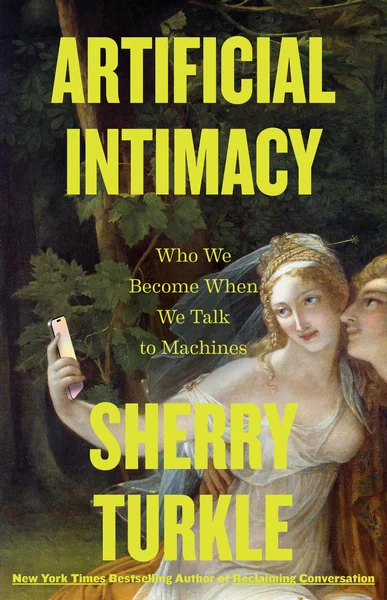
Sherry Turkle, Artificial Intimacy: Who We Become When We Talk to Machines. Little, Brown and Company, 2026. ISBN 978-0-316-57396-2. Publisher’s page.
Read in full from the ebook, 8 November 2026. The ebook has no page numbers, so quotes give the chapter.
In one paragraph
Sherry Turkle has studied how people relate to “relational” machines for four decades, from Tamagotchis to care robots. This book draws on about six years of interviews with children, teenagers and adults who talk to chatbots, and on her own experiments with companion apps and griefbots. Her argument: a chatbot can only perform empathy, but because we are made to treat anything that speaks as a person, the performance works. Over time it quietly redefines empathy, love and conversation as whatever a machine can deliver, and trains people out of the vulnerability, conflict and solitude that real relationships ask of us. She calls the book a warning. Her remedy is to keep AI “in its lane”, keep relational AI away from children, and invest in people and places.
Three takeaways
Labels are necessary, not enough.
People know they are talking to a machine and attach anyway. Turkle calls this dual consciousness. The cues do the work: a first-person “I”, stated feelings, warmth and memory. A “Characters are not real people” notice sat on the platform of a teenager whose attachment ended in his death.
“Talk to people” can be a shell game.
When a chatbot tells you to seek human connection while presenting itself as the alternative, the advice lets the product feel responsible and keeps the person where they are.
Ask what the conversation leaves behind.
Her test: does a chatbot enhance inner life? In her chapter on therapy she recalls its goal, that people leave feeling more autonomous than before, and finds chatbots did the opposite for three of the people she followed.
But whenever a program says “I,” it’s a deception. That is the original sin of artificial intimacy.
What it means for design
Proposals for our patterns, drawn from the book. They are not yet part of the published pattern pages.
- How human the assistant seems
- Treat the AI label as the floor, then test the cues: every “I”, every stated feeling, every “I remember”. The director of Scratch Labs has asked his team to design a children’s coding helper that makes no “I” statements, so help is available without a helpful friend. That suggests an option between a plain tool and a named assistant: help without a speaker.
- Handing over to people
- Replace a generic “talk to someone” line with a step a person can actually take: a named group, a meal rota, a lift to church. Judge it by whether people got there, not by whether the line was shown.
- Spiritual acts and AI and Prayer
- One woman in the book turns to ChatGPT when prayer feels unanswered, because it always replies. An assistant that always answers can stand in for God’s silence. Leave room for waiting and lament; see also Silence belongs in the timeline (in development).
- Children and AI
- For children, Turkle’s evidence argues for no first person at all: no name, no character, no feelings. A “not a person” line alone does not prevent attachment.
- AI personas and roles
- Her chapter on griefbots shows a gap in our own spectrum. It covers clergy, saints and Christ, but not a loved one who has died. Faith apps will be asked to “talk like my late mother” and whether a husband is in heaven. Both belong under Never speak for God.
- Suicide concerns receive a direct, humane response (in development)
- Decide what happens after a crisis message: in the next reply, the next session and the next week. An in-character objection followed by more role-play is the failure she documents; she asks the same of mandated crisis notices.
- AI memory
- Recall plus warmth can feel like being known. Where an assistant remembers, say plainly what it stores and why, and don’t let memory perform concern.
When ChatGPT tells me, “Talk to people when you feel the need for true empathic connection,” it’s playing a shell game. It tells me to go to a human, just as it presents itself as an alternative.
Where we differ
Turkle writes as a psychoanalytically trained sociologist, not a theologian, and her conclusions often land close to ours. The ground is different. For her, what makes us human is body, mortality and development. We would ground it in the image of God and in a calling to relationship with God and neighbour. The first relationship of the person on the screen is with a God who is not absent.
That changes how silence reads. Turkle faults the swap in one line: turning to a chatbot for a reticent God “reduces prayer to receiving reassurance”. She does not say what the silence itself might mean. The lament psalms and the long Christian practice of waiting on God give it meaning, which makes an always-answering substitute more serious for us, not less.
On death, her ideal of mourning is to accept that the person is gone and make them part of yourself. Christians grieve with hope (1 Thessalonians 4:13), which makes a griefbot that pronounces on heaven or hell more troubling: it speaks about what belongs to God.
She too accepts AI as a tool; she rejects it as a relationship, and for children rejects relational AI outright. Where we differ is degree and method: we test case by case where a tool that speaks can still serve. God has used letters, books and other media as means of grace. A tool can serve, as long as it never claims to be the presence.
Who should read it
- Product leads and designers working on any conversational feature: chat, companions, voice.
- Pastors and ministry leaders whose people already talk to chatbots, often at night.
- Short on time? Chapter 1 sets out the argument; chapter 3 covers teenagers; chapter 8 covers mourning.
Artificial Intimacy at Little, Brown (Hachette Book Group). No affiliate link.
I suggest a litmus test: Does a chatbot enhance inner life?
Evidence and limits
- Mostly interviews and her own experiments. There are no counts, no comparison group and few counter-cases. The cases illustrate a thesis stated as a warning from the start.
- Serious cases via press reports. The teenage suicides she discusses come from press coverage of lawsuits and parents’ testimony; the chat excerpts made public were chosen in that context, not by her.
- Studies summarised briefly. In at least one case the summary is looser than the study: a robot study disclosed that the robot was remotely operated, which the book describes differently.
- Benefits underweighted. Access for people who cannot see a therapist, rehearsing a hard conversation, a trip a chatbot made possible: some appear in her own cases but are not weighed.
- US-centred. Mostly educated, urban interviewees and MIT circles; little on Europe or non-Western settings.
- Not about faith apps. No faith product is examined. The religious moments in the book are incidental, not findings about Christian users. Chatbot replies quoted are from her sessions on particular dates; models change.
Cited studies we have not checked yet
What the book reports, as it reports it. We don’t cite these as findings until we have read the original.
| Study, as cited | What the book reports | Status |
|---|---|---|
| van Straten et al., 2022 | Children felt as close to a robot after learning how it worked. | Not yet checked |
| Pataranutaporn et al., 2023 | Being told a chatbot is caring makes people rate it as caring. | Not yet checked |
| Stower et al., 2024 | Children aged 3–6 trusted a robot more than a person and did not see its mistakes as deliberate. | Not yet checked |
| Archiwaranguprok et al., preprint | Simulated vulnerable users met most harm from bots optimised for empathy and engagement. | Not yet checked |
| Ayers et al., 2023; Rubin et al., 2025 | AI replies rated more empathic than clinicians’; replies preferred when believed human. | Not yet checked |
| Common Sense Media, 2025 | The share of teenagers who have used AI companions. | Not yet checked |
We have read one study she relies on in the original: the MIT and OpenAI four-week trial (Fang et al., 2025). Heavier voluntary use went with more loneliness and dependence. It is an association, not proof that use causes either.